

Revision Notes for Class 10 Social Science: Democratic Politics II Chapter 08 Challenges to Democracy
Explore reliable concept summaries and revision materials through the CBSE Class 10 Social Science Challenges To Democracy Notes Set 01. Tailored for Class 10 learners, utilizing these notes for Social Science Democratic Politics II Chapter 08 Challenges to Democracy ensures thorough preparation and strengthens core academic definitions before final evaluations.
Review Democratic Politics II Chapter 08 Challenges to Democracy for Class 10 Social Science
Navigate directly to the revision notes for Democratic Politics II Chapter 08 Challenges to Democracy using the digital viewer below. Each summary is structured to highlight high-weightage sections, allowing students to instantly access critical definitions and focus on core exam topics.
2. Ways and means of political reform in India →
· Through law – Carefully devised changes in law can discourage wrong political practices-
· but this should be carried mainly by political activists, parties, movements and politically conscious citizens.
· Legal changes must be carefully done – These must empower people to carry out democratic reforms like – The Right to information Act which empowers people to find out what is happening in the government. Such a law helps to ban corruption.
· Reforms to be brought out principally – mainly to strengthen democratic practices like improve the quality of political participation by ordinary people.
3. Redefining democracy –
· The representatives (rules elected by people) must take all decisions.
· Fair opportunity to change the current rulers through elections.
· Choice and opportunity available to all the people on equal basis.
· This should lead to a government limited by basic rules of the constitution and citizen’s right.
4. Condition for – a democracy or a description of a good democracy –
· Right given to a citizen in democratic country → Right to vote, stand for elections, form political organization and social and economic right – like Right to information Act.
· A well defined power sharing in democracy.
· Democracy give due respect to minority voice
· Democracy work on eliminating discrimination based on caste, religion and gender
· These are the outcomes we expect from democracy.
Topic : 1 : Challenges to Democracy :
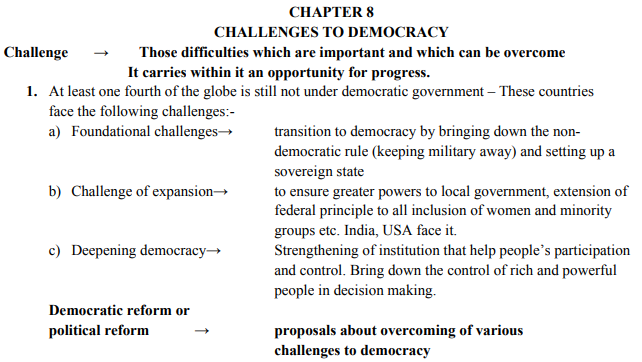
The serious challenges that democracy face in a country for smooth running of govt is called challenges. A challenge is not just any problem. We usually call only those difficulties a challenge which are significant and which can be overcome.
Challenges : At least one fourth of global is still not under democratic govt. The challenge for democracy in these parts of the world is very stark. These countries face the foundational challenge of making the transition to democracy and then instituting democratic govt.
- Most of the established democracies face the challenge of expression. This involves applying the basic principles of democratic govt across all the region, different social groups and various institutions.
- Challenge of deepening of democracy is faced by every democracy in one form or another. This involves strengthening of the institutions and practices of democracy. They should happen in such a way that people can realise their expectations of democracy.
- Elections are very expensive. The only rich persons can elect elections. The common man can not stand in elections. The govt should minimise the election expenditure. The govt should prepare budget for elections.
2. Topic : Political Reforms in Democracy
Meaning : All the suggestions or proposals about overcoming various challenges to democracy are called democracy reform or political reform.
- Reforming politics by making new laws.
- Carefully devised changes in law can help to discourage wrong political practices and encourage good ones.
- Any legal change must carefully look at what results it will have on politics. Sometimes the results may be counter productive. For example, many states have banned people who have more than two children from contesting panchayat elections. This has resulted in denial of democratic opportunity to many poor people and women.
- The best laws are those which empower people to carry out democratic reforms.
- The Right to Information Act is a good example of a law that empowers the people to find out what is happening in govt.
- Democratic reforms are to be brought about principally through political prac- tice.
- Any proposal for political reform should think not only about what is a good solution but also about who will implement it and how.
SHORT ANSWERS TYPE QUESTIONS –[3MARKS]
Q.1: - What are the basic rights of citizens for exercising voting Rights?
• Elections must offer a choice and fair opportunity to the people to change the current rulers.
• The choice and opportunity should be available to all the people on an equal basis.
• The exercise of this choice must lead to a govt. limited by basic rules of the constitution and citizens right.
Q.2: - How is the challenge of deepening of democracy faced by every democracy?
• This involves string tuning of the institutions and practices of democracy.
• This should happen in such a way that people can realize their expectations of democracy.
• This requires an attempt to bring down the control and influence of the rich and powerful people in making governmental decisions.
Q.3: - Enumerate there challenges which democracies in the world face today.
• Fundamental challenge — Those countries which do not have democratic form of govt. face the fundamental challenge of establishing democracy in the country.
• Challenge of Expansion.—Countries having democratic setup face the challenge of expansion.
• Deepening of Democracy – This challenge is faced by almost all the democracies. This involves strengthening of the institutions and practices of democracies.
Q.4: - What does Foundational challenge to democracy mean? Which two aspects are included in this challenge?
• Those countries which do not have democratic form of govt. face the foundational challenge of establishing democracy in the country. This involves bringing down the existing non-democratic govt. to keep the military away from capturing power and establishing a sovereign democratic state.
LONG ANSWERS TYPE QUESTIONS [5MARKS]
Q.1. Define Political Reform and explain the broad guidelines while devising ways and means of political reforms?
Carefully devised changes in law can help to discourage wrong political practices and encourage good ones.
• Laws are important in political reform m. carefully devised changes in law can help to discourage wrong political practices and encourage good ones.
• Any legal change must carefully look at what results it will have on politics. Example -The RTI Act.
• Democratic reforms are to be brought about principally through political practice.
• Any proposal for political reforms should think not only about what is a good solution but also about who will implement it and how.
Q.2 . India faces the ‘Challenge of expansion’- Justify the given statement
• Most of the established democracies face the Challenge of expansion.
• This involves applying the basic principle of democratic government across all the regions, different social groups and various institutions.
• Ensuring greater power to local governments, inclusion of women and minority groups etc. fall under this challenge.
• This means that less and less decisions should remain outside the arena of democratic control.
• Extension of federal principle to all the units of the federation.
• A bill with a reservation of at least one-third of seats in Lok Sabha and State Assemblies for women has been pending before the Parliament.
QUESTION BANK
1. List any four demerits of democracy?
2. Evaluate the main challenges faced by Indian democracy?
3. ‘Different countries face different kinds of challenges’- Support the statement with suitable examples..
4. What is Right to Information Act?
5. What do you understand by ‘counter-productive’ law?
Please click the link below to download pdf file for CBSE Class 10 Social Science Challenges To Democracy Notes
Free study material for Social Science
Revision Notes and Key Concepts for Class 10 Social Science Democratic Politics II Chapter 08 Challenges to Democracy
About Democratic Politics II Chapter 08 Challenges to Democracy Revision Notes
Review targeted chapter notes for Class 10 Social Science Democratic Politics II Chapter 08 Challenges to Democracy. Built according to official CBSE guidelines, these summaries highlight high-yield topics frequently tested in school evaluations.
How to Use These Revision Notes
Cross-reference your comprehension with comprehensive NCERT solutions for Class 10 to ensure absolute clarity across all sub-topics in this chapter.
Enhance Practice with MCQs and Worksheets
Wrap up your chapter revision by testing your knowledge against standard question formats. Everything on our platform is provided free of charge.
FAQs
You can download the teacher prepared revision notes for CBSE Class 10 Social Science Challenges To Democracy Notes Set 01 from StudiesToday.com. These notes are designed as per 2026-27 academic session to help Class 10 students get the best study material for Social Science.
Yes, our CBSE Class 10 Social Science Challenges To Democracy Notes Set 01 include 50% competency-based questions with focus on core logic, keyword definitions, and the practical application of Social Science principles which is important for getting more marks in 2026 CBSE exams.
Yes, our CBSE Class 10 Social Science Challenges To Democracy Notes Set 01 provide a detailed, topic wise breakdown of the chapter. Fundamental definitions, complex numerical formulas and all topics of CBSE syllabus in Class 10 is covered.
These notes for Social Science are organized into bullet points and easy-to-read charts. By using CBSE Class 10 Social Science Challenges To Democracy Notes Set 01, Class 10 students fast revise formulas, key definitions before the exams.
No, all study resources on StudiesToday, including CBSE Class 10 Social Science Challenges To Democracy Notes Set 01, are available for immediate free download. Class 10 Social Science study material is available in PDF and can be downloaded on mobile.