

Class 8 Mathematics Practice Assignments: CBSE Class 8 Mathematics Visualising Solid Shapes Assignment Set 01
Explore structured practice materials through the CBSE Class 8 Mathematics Visualising Solid Shapes Assignment Set 01. Tailored for Class 8 learners, utilizing these Mathematics assignments ensures thorough preparation and strengthens foundational knowledge before final CBSE evaluations.
Download Chapter 10 Visualising Solid Shapes Assignment PDF with Solutions
View or download the dedicated CBSE Class 8 Mathematics Visualising Solid Shapes Assignment Set 01 resource below. Engaging with these assignments under focused study conditions ensures continuous academic progress and mastery of the 2026-27 curriculum.
Very Short Answer type Questions
Question. Find the odd one out : bangle, circle, square, triangle.
Answer : Bangle
Question. Find the no. of edges in a Prism with pentagon base.
Answer : 15
Question. Find the no. of vertices in a Prism with square base.
Answer : 8
Question. Find the no. of faces in a Prism with pentagon base.
Answer : 7
Question. Find the no. of faces in a Pyramid with triangular base.
Answer : 4
Question. Find the no. of edges in a triangular Pyramid.
Answer : 6
Question. Find the no. of faces in a Pyramid with pentagon base.
Answer : 6
Question. Name the shape and also tell the type of the given figure.

Answer : Triangle, 2-D
Question. Find the no. of vertices in a Pyramid with square base.
Answer : 5
Question. In the given solid identify the top. Front and side view.
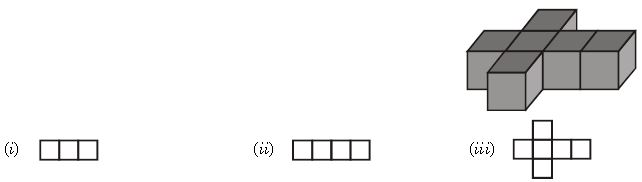
Answer : (i) Side view
Question. In a polyhedron there are 8 edges and 5 faces find its no. of vertices.
Answer : 6
Question. Find the no. of vertices in a Pyramid with hexagonal base.
Answer : 7
Question. Find the no. of edges in a Prism with hexagonal base.
Answer : 18
Question. A polyhedron has 7 vertices and 12 edges. Find its no. of faces
Answer : 7
Visualizing Solid Shapes
Q 1 What is a hexogonal prism?
Answer: A hexagonal prism is a prism that has two identical and parallel hexagonal bases connected by six rectangular lateral faces.
In simple words: It is a 3D shape with 6-sided top and bottom bases and rectangular sides connecting them.
Exam Tip: Remember that the base shape determines the name of the prism (hexagonal base = hexagonal prism).
Q 2 How many vertices are there in a pyramid with a square base?
Answer: A square-based pyramid has 5 vertices (4 vertices at the base corners and 1 apex vertex at the top).
In simple words: It has 4 corners at the bottom and 1 point at the top, making 5 vertices in total.
Exam Tip: Vertices refer to the corner points where edges meet.
Q 3 How many edges are there in a cuboid?
Answer: A cuboid has 12 edges (4 on the top face, 4 on the bottom face, and 4 vertical connecting edges).
In simple words: A standard box-like shape always has 12 straight line segments or edges.
Q 4 How many edges are there in a triangular pyramid?
Answer: A triangular pyramid (tetrahedron) has 6 edges (3 base edges and 3 edges meeting at the top apex).
In simple words: It has 3 lines at the base and 3 sloping lines going up to the top point.
Exam Tip: For any pyramid with an \(n\)-sided base, the number of edges is given by \(2n\). Here \(n = 3\), so edges = \(2 \times 3 = 6\).
Q 5 How many vertices are there in a triangular pyramid?
Answer: A triangular pyramid has 4 vertices (3 at the triangular base and 1 at the top apex).
In simple words: It has 3 corners on the bottom triangle and 1 point at the top.
Exam Tip: For any pyramid with an \(n\)-sided base, the number of vertices is \(n + 1\).
Q 6 How many faces are there in a triangular prism?
Answer: A triangular prism has 5 faces (2 triangular parallel bases and 3 rectangular lateral faces).
In simple words: It has two triangle ends and three flat rectangular sides around it.
Exam Tip: Total faces of a prism = number of sides of base + 2.
Q 7 What are the three views in a solid?
Answer: The three main views used to represent a 3D solid in 2D space are:
1. Front view
2. Side view
3. Top view
In simple words: How an object looks when seen from the front, from the side, and from directly above.
Exam Tip: These orthographic projections help engineers and architects design 3D objects on flat paper.
Q 8 What are regular polyhedrons?
Answer: A polyhedron is called regular if its faces are congruent (identical) regular polygons and the same number of faces meet at each vertex.
In simple words: 3D shapes made of identical regular flat shapes with corners that look exactly the same everywhere.
Exam Tip: Examples of regular polyhedrons include the cube and the regular tetrahedron.
Q 9 A pyramid with square base has 5 faces and 8 edges. By Euler's formula, find the vertices of the pyramid.
Answer: Given: Number of faces \(F = 5\), Number of edges \(E = 8\).
Euler's formula for polyhedrons is:
\(F + V - E = 2\)
Substitute the given values into the formula:
\(5 + V - 8 = 2\)
\(V - 3 = 2\)
\(V = 2 + 3 = 5\)
Therefore, the number of vertices is 5.
In simple words: Using the formula \(F + V - E = 2\), we plug in the known faces and edges to find that there are 5 vertices.
Exam Tip: Always state Euler's formula clearly before substituting values to secure full marks.
Q 10 Can a polyhedron have 20 faces, 40 edges and 30 vertices?
Answer: Given: \(F = 20\), \(E = 40\), \(V = 30\).
Let us verify using Euler's formula \(F + V - E = 2\):
Left Hand Side (LHS) = \(F + V - E = 20 + 30 - 40 = 50 - 40 = 10\)
Right Hand Side (RHS) = \(2\)
Since LHS \(\neq\) RHS (\(10 \neq 2\)), Euler's formula is not satisfied.
Therefore, a polyhedron cannot have 20 faces, 40 edges, and 30 vertices.
In simple words: When we test these numbers in Euler's formula, the left side equals 10 instead of 2, so such a shape is impossible.
Exam Tip: If \(F + V - E \neq 2\), the given combination of faces, edges, and vertices cannot form a valid polyhedron.
Q 11 For the given solid, identify the top view, front view and side view.
Answer:
- Top view matches figure (ii)
- Front view matches figure (i)
- Side view matches figure (iii)
In simple words: By looking at the arrows in the diagram, we match each viewing angle to the correct 2D projection outline.
Exam Tip: Trace the grid squares carefully from the direction indicated by each arrow.
Q 12 Identify the top view, front view and side view for the given solid.
Answer:
- Top view matches figure (iii)
- Front view matches figure (i)
- Side view matches figure (ii)
In simple words: Analyzing the stair-like stepped block, the front shows two blocks side by side, the side shows three in a row, and the top shows the composite grid layout.
Q 13 Give two basic differences between a prism and a pyramid.
Answer:
1. Bases: A prism has two identical, parallel bases (top and bottom), whereas a pyramid has only one base at the bottom and tapers to a single point (apex) at the top.
2. Lateral Faces: The side faces of a prism are always rectangles, whereas the side faces of a pyramid are always triangles.
In simple words: Prisms have two matching ends and flat rectangular sides, while pyramids have one bottom base and triangular sides meeting at a top point.
Exam Tip: Use bullet points for difference questions to make it easy for the examiner to award full marks.
Q 14 Can a polyhedron have for its faces
a) 3 triangles?
b) a square and four triangles?
Answer:
a) No, a polyhedron cannot be formed with only 3 triangular faces because a minimum of 4 faces is required to enclose a 3D space (which forms a tetrahedron).
b) Yes, a square and four triangles can form a polyhedron, specifically a square-based pyramid (like the Egyptian pyramids).
In simple words: (a) Three flat sides cannot close up into a 3D solid. (b) One square base with four triangles meeting at a point makes a valid pyramid.
Exam Tip: Remember that a tetrahedron (triangular pyramid) is the simplest polyhedron with 4 faces.
Q 15 Give the importance of the scale in a map.
Answer: The scale of a map gives the ratio between the distance on the map and the corresponding actual distance on the ground. It is important because it allows us to calculate real-world distances between different places accurately using the map.
In simple words: Scale tells us how much real distance is represented by a small measurement on the map.
Exam Tip: Mention the word 'ratio' and 'real distance' to secure full marks.
Q 16 Give two differences between a picture and a map.
Answer:
1. Perspective: A picture shows an object or place from a specific point of view with perspective (showing depth and relative apparent sizes), whereas a map represents a place from a direct top-down (overhead) view without perspective distortion.
2. Details and Scale: A picture captures all visible physical details (colors, textures, lighting), whereas a map uses specific symbols, directions, and a fixed scale to show locations and distances.
In simple words: Pictures show how a place looks in real life from an angle, while maps show a flat top-down layout using symbols and scale.
Q 17 State and verify the Euler's Formula for a rectangular prism.
Answer:
Statement: For any polyhedron, Euler's formula states that:
\(F + V - E = 2\)
where \(F\) is the number of faces, \(V\) is the number of vertices, and \(E\) is the number of edges.
Verification for a rectangular prism (cuboid):
- Number of faces \(F = 6\)
- Number of vertices \(V = 8\)
- Number of edges \(E = 12\)
Substituting into Euler's formula:
\(F + V - E = 6 + 8 - 12\)
\(= 14 - 12 = 2\)
Since LHS = RHS = 2, Euler's formula is verified for a rectangular prism.
In simple words: We state the formula \(F + V - E = 2\), count the faces, vertices, and edges of a box, and show that they satisfy the equation.
Exam Tip: Always clearly write down the counted values of \(F\), \(V\), and \(E\) before verification.
Q 18 Find the number of edges, vertices and faces in a cylinder.
Answer:
- Faces = 3 (2 flat circular faces at top and bottom, and 1 curved lateral surface)
- Edges = 2 (circular curved edges where the flat bases meet the curved surface)
- Vertices = 0 (no straight corners or vertices)
In simple words: A cylinder has 3 surfaces, 2 circular rim edges, and zero sharp corners.
Q 19 State and verify the Euler's Formula for a cube.
Answer:
Statement: Euler's formula for polyhedrons is \(F + V - E = 2\), where \(F\) = faces, \(V\) = vertices, and \(E\) = edges.
Verification for a cube:
- Faces \(F = 6\)
- Vertices \(V = 8\)
- Edges \(E = 12\)
LHS = \(F + V - E = 6 + 8 - 12 = 14 - 12 = 2\)
RHS = \(2\)
Since LHS = RHS, Euler's formula is verified for a cube.
In simple words: A cube has 6 square faces, 8 corners, and 12 edges. Putting these into \(F + V - E = 2\) gives 2 = 2.
Exam Tip: Cubes and cuboids share identical properties for Euler's formula verification.
Q 20 Draw the three views of a brick.
Answer:
A brick is in the shape of a cuboid with dimensions length \(>\) breadth \(>\) height.
1. Front view: A rectangle showing length and height.
2. Side view: A smaller rectangle showing breadth and height.
3. Top view: A rectangle showing length and breadth.
In simple words: A brick looks like three different sized rectangles depending on whether you look at it from the front, side, or top.
Exam Tip: Sketch clean rectangular outlines labeled clearly as Front, Side, and Top views.
Q 21 Draw the front, side and top view of an almirah.
Answer:
1. Front view: A tall rectangle showing the doors, handles, and height/width proportions.
2. Side view: A narrow vertical rectangle showing the depth and height.
3. Top view: A narrow horizontal rectangle or square showing the width and depth.
In simple words: An almirah appears as a tall door-faced rectangle from the front, a thin tall rectangle from the side, and a small rectangle from above.
Q 22 Find the number of edges, vertices and faces in a rectangular pyramid.
Answer:
A rectangular pyramid has a rectangular base and four triangular faces meeting at a top apex.
- Faces \(F = 5\) (1 rectangular base + 4 triangular side faces)
- Vertices \(V = 5\) (4 corners of the base + 1 top apex)
- Edges \(E = 8\) (4 edges around the base + 4 edges going up to the apex)
In simple words: It has 5 flat surfaces, 5 corner points, and 8 straight line edges.
Exam Tip: You can quickly cross-check your answer using Euler's formula: \(5 + 5 - 8 = 2\).
Q 23 Find the number of edges, vertices and faces in a given solid.
Answer:
Based on the standard textbook problem of a cube with a corner cut out (or modified solid as illustrated in standard curriculum):
- Faces = 7
- Vertices = 10
- Edges = 15
In simple words: Analyzing the modified cube shape, counting all exposed flat surfaces, sharp corners, and connecting lines gives 7 faces, 10 vertices, and 15 edges.
Exam Tip: Always verify using Euler's formula: \(7 + 10 - 15 = 2\).
Q 24 State and verify the Euler's Formula for a triangular pyramid.
Answer:
Statement: Euler's formula states that \(F + V - E = 2\) for any polyhedron.
Verification for a triangular pyramid (tetrahedron):
- Faces \(F = 4\) (1 triangular base + 3 triangular side faces)
- Vertices \(V = 4\) (3 base vertices + 1 top apex)
- Edges \(E = 6\) (3 base edges + 3 sloping edges)
LHS = \(F + V - E = 4 + 4 - 6 = 8 - 6 = 2\)
RHS = \(2\)
Since LHS = RHS, Euler's formula is verified for a triangular pyramid.
In simple words: A triangular pyramid has 4 faces, 4 corners, and 6 edges. Adding faces and vertices and subtracting edges gives 2.
Exam Tip: A tetrahedron is the simplest 3D polyhedron and has the minimum possible number of faces.
Q 25 Draw the front, side and top view of a television.
Answer:
1. Front view: A rectangular screen shape with a small base/stand underneath.
2. Side view: A thin vertical rectangle showing the thickness (depth) of the TV cabinet.
3. Top view: A thin horizontal rectangle showing the width and depth of the top edge.
In simple words: The front shows the display screen, the side shows the thickness of the box, and the top shows the narrow upper profile.
Exam Tip: Clearly label each sketch as Front, Side, and Top view.
Q 26 By using Euler's formula find the unknown.
a) Vertices = 12 , Faces = 4, Edges = ?
b) Faces = 5 , Edges = 8, Vertices = ?
c) Edges = 2 , Vertices = 3, Faces = ?
Answer:
Using Euler's formula \(F + V - E = 2\):
a) Given \(V = 12, F = 4\).
\(4 + 12 - E = 2\)
\(16 - E = 2 \implies E = 16 - 2 = 14\)
Edges = 14.
b) Given \(F = 5, E = 8\).
\(5 + V - 8 = 2\)
\(V - 3 = 2 \implies V = 2 + 3 = 5\)
Vertices = 5.
c) Given \(E = 2, V = 3\).
\(F + 3 - 2 = 2\)
\(F + 1 = 2 \implies F = 2 - 1 = 1\)
Faces = 1.
In simple words: Plug the two known values into \(F + V - E = 2\) and solve simple linear equations to find the missing third value.
Exam Tip: Show all transposition steps clearly when solving for the unknown variable.
Q 27 Look at the map given below:
Answer the following:
(a) Mark a green 'X' at the intersection of Church Street and High Street and a blue 'Y' at the intersection of North Street and Leret Way.
(b) Highlight the shortest street route followed by Annie from her current position to the Institute in pink.
(c) Which is further east, The Swan Centre or Institute?
Answer:
(a) Locate Church Street intersecting High Street for 'X', and North Street intersecting Leret Way for 'Y' on the map layout.
(b) Trace the most direct pedestrian pathway from Annie's starting location past Church Street/High Street directly to the Institute.
(c) The Institute is located further east compared to The Swan Centre based on the compass rose (East pointing to the right).
In simple words: (a) Find the street crossings. (b) Draw the shortest path to the Institute. (c) The Institute lies further towards the right (East) side of the map.
Exam Tip: Always check the compass rose (N, S, E, W directions) before answering questions about relative positions like east or west.
Most Important Questions
Q 1 What are two-dimensional shapes?
Answer: Two-dimensional (2D) shapes are flat figures that have only two dimensions - length and breadth (or width) - and no thickness or height. They can be drawn on a flat piece of paper.
In simple words: Flat shapes like squares, circles, and triangles that have length and width only.
Exam Tip: 2D shapes occupy area but have zero volume.
Q 2 What are three-dimensional shapes?
Answer: Three-dimensional (3D) shapes are solid objects or figures that have three dimensions - length, breadth, and height (or depth). They occupy space and have volume.
In simple words: Solid objects like cubes, spheres, and cylinders that you can hold and have thickness.
Q 3 T/F.
If we add the dimension 'height' to a rectangle (with certain length & breadth), we obtain a cuboid.
Answer: True
In simple words: Giving a flat rectangle height turns it into a 3D box or cuboid.
Exam Tip: This is the fundamental way 2D flat bases generate 3D prism/cuboid shapes.
Q 4 A three dimensional shape is _________ object. (solid/plane)
Answer: Answer: (solid) A three-dimensional shape is a solid object.
In simple words: 3D shapes are solid objects because they take up space in three directions.
Exam Tip: Plane refers to 2D flat surfaces, while solid refers to 3D objects.
Q 5 A two dimensional shape is _________ shape. (solid/plane)
Answer: Answer: (plane) A two-dimensional shape is a plane shape.
In simple words: 2D shapes lie completely flat on a plane surface.
Exam Tip: Plane means flat and two-dimensional.
Q 6 The three views in a solid are:
Answer: The three views in a solid are Front view, Side view, and Top view.
In simple words: Front, side, and top.
Exam Tip: Memorize these three standard projection views.
Q 7 The most important part of a map is the _______. (scale, location)
Answer: Answer: (scale) The most important part of a map is the scale.
In simple words: Scale is essential because it translates map distances into real-world distances.
Q 8 __________ are used to depict different objects/places in a map. (Symbols/landmarks)
Answer: Answer: (Symbols) Symbols are used to depict different objects/places in a map.
In simple words: Symbols represent real features like schools, hospitals, and rivers compactly on a map.
Exam Tip: Maps use a key or legend to explain what each symbol stands for.
Q 9 T/F:
In a map, places that are far & those that are near, will be of the same size to an observer.
Answer: False
In simple words: On a map drawn to scale, distances and sizes are proportional, unlike a photograph where distant objects appear smaller due to perspective.
Exam Tip: Maps maintain consistent scale representation across the entire layout.
Q 10 State the Euler's Formula for polyhedrons.
Answer: Euler's formula for any polyhedron is:
\(F + V - E = 2\)
where \(F\) represents the number of faces, \(V\) represents the number of vertices, and \(E\) represents the number of edges.
In simple words: Faces plus vertices minus edges always equals 2 for any polyhedron.
Exam Tip: This formula is a fundamental property of all convex polyhedrons.
Q 11 Give two examples of 2d & 3d shapes each.
Answer:
- 2D shape examples: Square, Circle
- 3D shape examples: Cube, Cylinder
In simple words: Flat drawings like squares and circles are 2D; solid objects like cubes and cylinders are 3D.
Q 12 Give two differences between a picture & a map.
Answer:
1. A picture shows an object with perspective from a specific angle, whereas a map shows an area from a direct overhead (top-down) view.
2. A picture depicts all visible physical details and colors, whereas a map uses abstract symbols and a scale to represent features.
In simple words: Pictures show side-angle real-life views with details, while maps show flat top-down layouts with symbols and scale.
Exam Tip: Emphasize the top-down versus perspective view difference.
Q 13 Give the importance of the scale in a map.
Answer: The scale provides the proportion between map distance and actual ground distance, enabling accurate measurement of real distances between locations.
In simple words: It helps us calculate real distances from map measurements.
Exam Tip: Always mention proportionality between map and ground distances.
Q 14 What are polyhedrons? Give two exs.
Answer: Polyhedrons are three-dimensional solid shapes bounded by flat polygonal faces straight edges, and sharp vertices.
Examples: Cube, Triangular prism.
In simple words: 3D shapes made entirely of flat polygon faces joined at straight edges.
Exam Tip: Spheres and cylinders are not polyhedrons because they have curved surfaces.
Q 15 Give two basic differences between a prism & a pyramid.
Answer:
1. Prisms have two identical parallel bases, while pyramids have only one base and taper to a single top apex.
2. Prisms have rectangular lateral faces, while pyramids have triangular lateral faces.
In simple words: Prisms have two matching ends and flat rectangular sides; pyramids have one bottom base and triangular sides meeting at the top point.
Exam Tip: Keep comparisons distinct and structured.
Q 16 Verify the Euler's formula for a Square-pyramid:
Answer:
For a square pyramid:
- Faces \(F = 5\) (1 square base + 4 triangular faces)
- Vertices \(V = 5\) (4 base corners + 1 apex)
- Edges \(E = 8\) (4 base edges + 4 slanting edges)
Applying Euler's formula \(F + V - E = 2\):
LHS = \(5 + 5 - 8 = 10 - 8 = 2\)
RHS = \(2\)
Since LHS = RHS, Euler's formula is verified for a square pyramid.
In simple words: A square pyramid has 5 faces, 5 vertices, and 8 edges. Plugging these in verifies \(5 + 5 - 8 = 2\).
Exam Tip: State the face, vertex, and edge counts clearly before substituting.
Q 17 Draw the three views of a brick.
Answer:
1. Front view: A rectangle showing length and height.
2. Side view: A rectangle showing breadth and height.
3. Top view: A rectangle showing length and breadth.
In simple words: A brick appears as different rectangular outlines when viewed from the front, side, and top.
Exam Tip: Draw neat rectangular boxes representing each respective orthogonal projection.
Q 18 Define :
a) Face
b) Edge
c) Vertex
Answer:
a) Face: The flat polygonal surface that bounds a 3D solid.
b) Edge: The straight line segment where two faces of a solid meet.
c) Vertex: The corner point where three or more edges of a solid meet.
In simple words: (a) Face is the flat side. (b) Edge is the line where sides meet. (c) Vertex is the corner point.
Exam Tip: Learn these three core definitions thoroughly as they form the basis of solid geometry.
Q 19 A pentagonal prism has ______ faces, ______ edges & _____ vertices.
Answer:
A pentagonal prism has 7 faces, 15 edges, and 10 vertices.
In simple words: It has 2 pentagon bases plus 5 rectangular sides (7 faces), 15 straight edges, and 10 corner points.
Exam Tip: For any \(n\)-gonal prism: Faces = \(n + 2\), Edges = \(3n\), Vertices = \(2n\). Here \(n = 5\).
Q 20 A hexagonal pyramid has ______ faces, ______ edges & _____ vertices.
Answer:
A hexagonal pyramid has 7 faces, 12 edges, and 7 vertices.
In simple words: It has 1 hexagonal base and 6 triangular side faces (7 faces), 12 edges, and 7 corner points.
Exam Tip: For any \(n\)-gonal pyramid: Faces = \(n + 1\), Edges = \(2n\), Vertices = \(n + 1\). Here \(n = 6\).
Q 21 Match the front, side & top views of the following :
Answer:
- Top view matches figure (iii)
- Front view matches figure (i)
- Side view matches figure (ii)
In simple words: Matching each directional perspective of the composite block to its correct 2D silhouette diagram.
Exam Tip: Count grid squares carefully along each viewing axis.
Free study material for Mathematics
Chapter Assignment & Practice Material for Class 8 Mathematics Chapter 10 Visualising Solid Shapes
Class 8 Mathematics Chapter 10 Visualising Solid Shapes Printable Assignments
Review targeted chapter assignments for Class 8 Mathematics Chapter 10 Visualising Solid Shapes. Built according to official CBSE guidelines, these downloadable problem sets help students build accuracy and prepare effectively for school tests.
Key Advantages of Solving Chapter 10 Visualising Solid Shapes Assignments
- Exam Alignment: Questions strictly follow contemporary CBSE sample papers and grading schemes.
- Comprehensive Coverage: Features objective drills, case studies, and structured descriptive problems for Chapter 10 Visualising Solid Shapes.
- Pacing & Precision: Regular problem-solving builds critical calculation speed and test-taking accuracy.
Effective Strategy for Class 8 Mathematics Assignments
- Initial Reading: Begin by reading the NCERT book for Class 8 Mathematics to build a baseline understanding.
- Independent Testing: Attempt assignment questions unassisted, then verify work using provided answer keys.
- Supplementary Aids: Leverage revision notes and worksheets whenever you encounter difficult topics.
FAQs
You can download free PDF assignments for Class 8 Mathematics Chapter 10 Visualising Solid Shapes from StudiesToday.com. These practice sheets have been updated for the 2026-27 session covering all concepts from latest NCERT textbook.
Yes, our teachers have given solutions for all questions in the Class 8 Mathematics Chapter 10 Visualising Solid Shapes assignments. This will help you to understand step-by-step methodology to get full marks in school tests and exams.
Yes. These assignments are designed as per the latest CBSE syllabus for 2026. We have included huge variety of question formats such as MCQs, Case-study based questions and important diagram-based problems found in Chapter 10 Visualising Solid Shapes.
Practicing topicw wise assignments will help Class 8 students understand every sub-topic of Chapter 10 Visualising Solid Shapes. Daily practice will improve speed, accuracy and answering competency-based questions.
Yes, all printable assignments for Class 8 Mathematics Chapter 10 Visualising Solid Shapes are available for free download in mobile-friendly PDF format.