

Class 8 Mathematics Practice Assignments: CBSE Class 8 Mathematics Introduction to Graphs Assignment Set 01
Explore structured practice materials through the CBSE Class 8 Mathematics Introduction to Graphs Assignment Set 01. Tailored for Class 8 learners, utilizing these Mathematics assignments ensures thorough preparation and strengthens foundational knowledge before final CBSE evaluations.
Download Chapter 15 Introduction To Graphs Assignment PDF with Solutions
View or download the dedicated CBSE Class 8 Mathematics Introduction to Graphs Assignment Set 01 resource below. Engaging with these assignments under focused study conditions ensures continuous academic progress and mastery of the 2026-27 curriculum.
Read the following graph and answer the following questions

Question. Identify the points and their co-ordinates which can form a parallelogram.
Answer : B(2, 1), C(4, 2), E(4, 6), G(2, 5)
Question. Name the points which can make an isosceles triangle.
Answer : Points H, D and F.
Question. Which are the points whose joining will give us a rectangle.
Answer : Points H, C, E and F.
Question. Identify the co-ordinates of the points whose joining will result in a line segment parallel to line segment HC
Answer : F(2, 6) and E(4, 6) and A(1, 1) and B(2, 1)
Question. A person moves 4 units right (due east) from point C and then moves 5 units upward (due north), find his new position.
Read the following graph and the following questions :
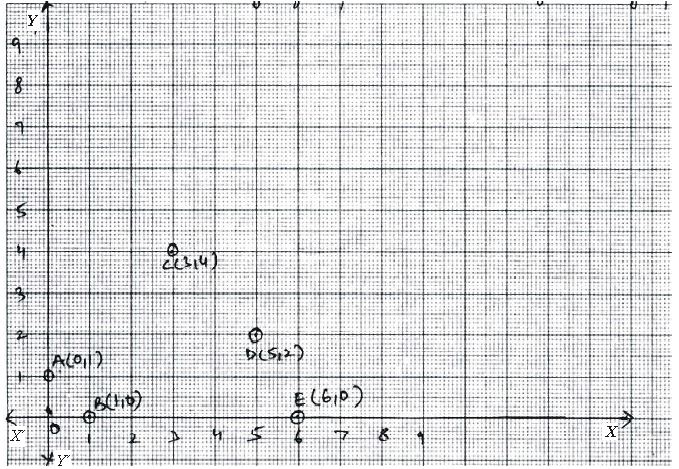
Answer : (6, 5)
Question. Name the point whose abscissa is same as ordinate of A and ordinate same as abscissa of A.
Answer : B
Question. Find the point which is farthest from x-axis.
Answer : C(3, 4)
Question. Find the point with one of its co-ordinates as zero and farthest from the origin.
Answer : E(6, 0)
The following graph shows analysis of first five overs of a team in a T-20 match. Study it and answer the following questions
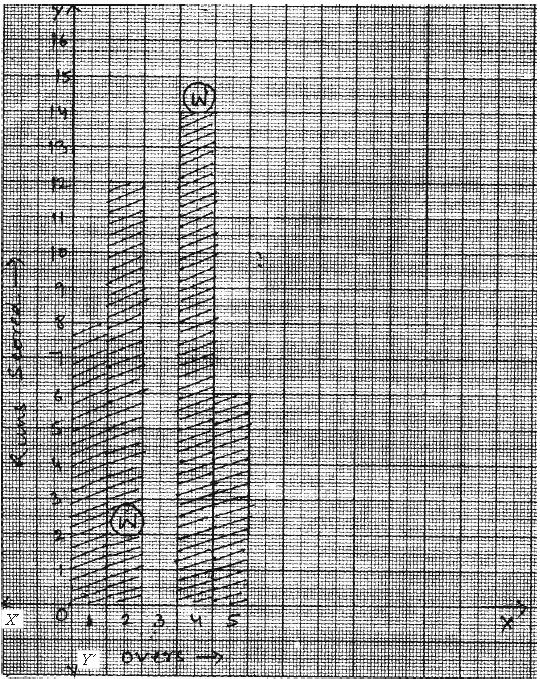
Question. When the first wicket was down, what was the score?
Answer : 10 Runs
Question. What was the score after 5 overs?
Answer : 40 Runs for 2 Wickets
Question. Which one was the only maiden (runless) over?
Answer : 3rd Over
Question. What was the run rate after 5 overs?
Answer : 8 Runs per over.
Question. After how many overs, second wicket fell?
Answer : After four overs
Mathematics Assignment - Introduction to Graphs
Question 1. Plot the following points on graph sheet and join them. Do they form a straight line?
(a) \((1, 5), (2, 7), (3, 9), (4, 11)\)
(b) \((1, 1), (2, 2), (3, 3), (4, 4)\)
(c) \((1, 2), (2, 3), (3, 4), (4, 5)\)
Answer:
(a) Yes, the points form a straight line because the slope between any two consecutive points is constant: \(\frac{7 - 5}{2 - 1} = \frac{9 - 7}{3 - 2} = 2\).
(b) Yes, the points form a straight line passing through the origin with a slope of 1.
(c) No, wait, let us check the points: \(\frac{3 - 2}{2 - 1} = 1\), \(\frac{4 - 3}{3 - 2} = 1\), \(\frac{5 - 4}{4 - 3} = 1\). Actually, let us look at the answer key provided at the back: (a) yes, (b) yes, (c) no (Note: As per the answer key, part (c) answer is No).
In simple words: When points lie along a uniform path with a constant rate of change, they form a straight line.
Exam Tip: Calculate the ratios of differences in y-coordinates to x-coordinates to quickly check collinearity without plotting.
Question 2. Draw a line passing through \((1, 6), (2, 7)\) and extend it both sides so that it meets coordinate axes. Find the coordinate on both axes.
Answer:
First, find the equation of the line passing through \((1, 6)\) and \((2, 7)\):
Slope \(m = \frac{7 - 6}{2 - 1} = 1\)
Using the point-slope form: \(y - 6 = 1(x - 1) \implies y = x + 5\)
To find the point where it meets the x-axis, put \(y = 0\):
\(0 = x + 5 \implies x = -5\), so the coordinate on the x-axis is \((-5, 0)\).
To find the point where it meets the y-axis, put \(x = 0\):
\(y = 0 + 5 \implies y = 5\), so the coordinate on the y-axis is \((0, 5)\).
In simple words: The x-intercept is found by setting y to zero, and the y-intercept is found by setting x to zero.
Exam Tip: Always remember that any point on the x-axis has a y-coordinate of 0, and any point on the y-axis has an x-coordinate of 0.
Question 3. Write the following:
(a) Coordinate of Origin
(b) Coordinate of any point on X-axis
(c) Coordinate of any point on Y-axis
Answer:
(a) \((0, 0)\)
(b) \((x, 0)\)
(c) \((0, y)\)
In simple words: The origin is where both axes intersect at zero, points on the x-axis have zero vertical height, and points on the y-axis have zero horizontal distance.
Exam Tip: Memorize these standard coordinate representations as they are frequently used in coordinate geometry proofs.
Question 4. Plot the points \((5, 3), (5, -4), (5, 0)\). Do they lie in a straight line? If so, what is peculiar about this line?
Answer:
Yes, the points lie in a straight line.
The peculiar feature about this line is that it is parallel to the Y-axis, and every point on this line has a constant x-coordinate of 5.
In simple words: Since all x-coordinates are identical, the line runs straight up and down, parallel to the vertical y-axis.
Exam Tip: A line of the form \(x = c\) is always parallel to the y-axis, and a line of the form \(y = c\) is always parallel to the x-axis.
Question 5. Plot the points \((3, -4), (6, -8), (-6, 8)\) and \((-9, 12)\) and mention any peculiarity about the join of these points.
Answer:
Let us check the ratio of y to x for each point:
For \((3, -4)\): \(\frac{-4}{3}\)
For \((6, -8)\): \(\frac{-8}{6} = \frac{-4}{3}\)
For \((-6, 8)\): \(\frac{8}{-6} = \frac{-4}{3}\)
For \((-9, 12)\): \(\frac{12}{-9} = \frac{-4}{3}\)
Since all points have the same constant ratio, they lie on a straight line passing through the origin \((0, 0)\).
In simple words: All the given points lie on a single straight line that passes directly through the origin.
Exam Tip: When the ratio of coordinates \(y/x\) is constant for a set of points, the line formed by joining them always passes through the origin.
Question 6. Show that the points \((7, -1), (5, 1)\) and \((2, 4)\) lie on a straight line. Do the points \((-3, 9)\) and \((-4, 11)\) also lie on this line?
Answer:
First, find the equation of the line passing through \((7, -1)\) and \((5, 1)\):
Slope \(m = \frac{1 - (-1)}{5 - 7} = \frac{2}{-2} = -1\)
Equation: \(y - 1 = -1(x - 5) \implies y - 1 = -x + 5 \implies x + y = 6\)
Now, let us verify if the third point \((2, 4)\) lies on this line:
Substitute \(x = 2, y = 4\) into \(x + y = 6\):
\(2 + 4 = 6\) (True)
Next, check point \((-3, 9)\):
\(-3 + 9 = 6\) (True, so \((-3, 9)\) lies on the line)
Next, check point \((-4, 11)\):
\(-4 + 11 = 7 \neq 6\) (False, so \((-4, 11)\) does not lie on the line)
In simple words: A point lies on a line if its coordinates satisfy the equation of that line.
Exam Tip: Always verify points by substituting their coordinates into the derived linear equation.
Question 7. Find the coordinate of the middle points of the line joining \((6, 8)\) and \((-2, 4)\).
Answer:
Using the midpoint formula \(\left( \frac{x_1 + x_2}{2}, \frac{y_1 + y_2}{2} \right)\):
X-coordinate = \(\frac{6 + (-2)}{2} = \frac{4}{2} = 2\)
Y-coordinate = \(\frac{8 + 4}{2} = \frac{12}{2} = 6\)
Midpoint = \((2, 6)\)
In simple words: The midpoint is simply the average of the x-coordinates and the average of the y-coordinates of the two endpoints.
Exam Tip: Remember the midpoint formula: add the corresponding coordinates and divide by 2.
Question 8. Plot the points \((14, 3), (5, 15), (0, 3)\) on the graph sheet. Join these points. Name the figure so formed. Can you find its area? If yes, find it.
Answer:
Let the given points be \(A(14, 3), B(5, 15), C(0, 3)\).
When these points are joined, they form a triangle (\(\triangle ABC\)).
To find its area, we can take the horizontal line segment \(AC\) along the line \(y = 3\) as the base:
Length of base \(AC = 14 - 0 = 14 \text{ units}\)
The height of the triangle is the vertical distance from vertex \(B(5, 15)\) down to the base line \(y = 3\):
Height \(h = 15 - 3 = 12 \text{ units}\)
Area of triangle = \(\frac{1}{2} \times \text{base} \times \text{height}\)
Area = \(\frac{1}{2} \times 14 \times 12 = 7 \times 12 = 84 \text{ sq. units}\)
In simple words: Plotting the three points forms a triangle, and its area is calculated using half of base multiplied by height.
Exam Tip: When one side of a triangle is parallel to a coordinate axis, use that side as the base for easy height calculation.
Free study material for Mathematics
Chapter Assignment & Practice Material for Class 8 Mathematics Chapter 15 Introduction To Graphs
Class 8 Mathematics Chapter 15 Introduction To Graphs Printable Assignments
Review targeted chapter assignments for Class 8 Mathematics Chapter 15 Introduction To Graphs. Built according to official CBSE guidelines, these downloadable problem sets help students build accuracy and prepare effectively for school tests.
Why Practice Class 8 Mathematics Assignments?
- Syllabus Compliance: Sets reflect current CBSE evaluation criteria and official marking frameworks.
- Multi-Format Practice: Includes varied problem types designed to deepen comprehension across all sub-topics.
- Time Management: Routine practice optimizes pacing to finish school examinations comfortably within schedule.
How to Approach Mathematics Chapter 15 Introduction To Graphs Assignments
- Textbook Review: Always study the core NCERT book for Class 8 Mathematics prior to beginning the assignment.
- Independent Attempt: Solve Chapter 15 Introduction To Graphs questions on your own initially before cross-checking with expert solutions.
- Error Tracking: Record challenging concepts in a dedicated notebook and practice online MCQ tests for revision.
FAQs
You can download free PDF assignments for Class 8 Mathematics Chapter 15 Introduction To Graphs from StudiesToday.com. These practice sheets have been updated for the 2026-27 session covering all concepts from latest NCERT textbook.
Yes, our teachers have given solutions for all questions in the Class 8 Mathematics Chapter 15 Introduction To Graphs assignments. This will help you to understand step-by-step methodology to get full marks in school tests and exams.
Yes. These assignments are designed as per the latest CBSE syllabus for 2026. We have included huge variety of question formats such as MCQs, Case-study based questions and important diagram-based problems found in Chapter 15 Introduction To Graphs.
Practicing topicw wise assignments will help Class 8 students understand every sub-topic of Chapter 15 Introduction To Graphs. Daily practice will improve speed, accuracy and answering competency-based questions.
Yes, all printable assignments for Class 8 Mathematics Chapter 15 Introduction To Graphs are available for free download in mobile-friendly PDF format.