

Class 8 Mathematics Practice Assignments: CBSE Class 8 Mathematics Factorisation Assignment Set 09
Explore structured practice materials through the CBSE Class 8 Mathematics Factorisation Assignment Set 09. Tailored for Class 8 learners, utilizing these Mathematics assignments ensures thorough preparation and strengthens foundational knowledge before final CBSE evaluations.
Download Chapter 14 Factorisation Assignment PDF with Solutions
View or download the dedicated CBSE Class 8 Mathematics Factorisation Assignment Set 09 resource below. Engaging with these assignments under focused study conditions ensures continuous academic progress and mastery of the 2026-27 curriculum.
Question. The factors of x2/4 - y2/9 are ____.
(A) (x/4 + y/9) (x/4 - y/9)
(B) (x/2 + y/9) (x/2 - y/9)
(C) (x/2 + y/3) (x/2 - y/3)
(D) Both (A) and (B)
Answer : C
Question. The factors of 15x2 – 26x + 8 are ____.
(A) (3x – 4) (5x + 2)
(B) (3x – 4) (5x – 2)
(C) (3x + 4) (5x – 2)
(D) (3x + 4) (5x + 2)
Answer : B
Question. One of the factors of (p + q)2 – (a – b)2 + p + q – a + b is
(A) (p + q + a + b)
(B) (p + q – a + b)
(C) (p – q + a – b)
(D) (p – q + a + b)
Answer : B
Question. If (x2 + 3x + 5) (x2 – 3x + 5) = m2 – n2, then m =____.
(A) x2 – 3x
(B) 3x
(C) x2 + 5
(D) Both (A) and (B)
Answer : C
Question. Which of the following is the factor of 12(a2 + 7a)2 – 8(a2 + 7a)(2a – 1) – 15 (2a – 1)2 ?
(i) (2a2 + 8a + 3) (ii) (6a2 + 52a – 5)
(iii) (3a + 5)
(A) Only (i)
(B) Both (i) and (ii)
(C) Only (ii)
(D) All (i), (ii) and (iii)
Answer : B
Question. The factors of x2 – 16 are ____.
(A) (x2 + 2)(x2 – 2)
(B) (x + 4)(x – 4)
(C) (x + 2)(x – 2)
(D) Does not exist
Answer : B
Question. The factors of √3x2 + 11x + 6√3 are ____.
(A) (x − 3√3) (√3x + 2)
(B) (x − 3√3) (√3x − 2)
(C) (x + 3√3) (√3x − 2)
(D) (x + 3√3) (√3x + 2)
Answer : D
Question. Factorisation of xy – pq + qy – px is ____.
(A) (y – p) (x + q)
(B) (y – p) (x – q)
(C) (y + p) (x + q)
(D) (y + p) (x – q)
Answer : A
Question. The factors of x4 + y4 + x2y2 are ____.
(A) (x2 + y2)(x2 + y2 – xy)
(B) (x2 + y2)(x2 – y2)
(C) (x2 + y2 + xy) (x2 + y2 – xy)
(D) Factorisation is not possible
Answer : C
Question. For x2 + 2x + 5 to be a factor of x4 + px2 + q, the values of p and q must be ____.
(A) – 2, 5
(B) 5, 25
(C) 10, 20
(D) 6, 25
Answer : D
Question. One of the factors of 4(x + y)(3a – b) + 6 (x + y)(2b – 3a) is
(A) (2b – 3a)
(B) (3a – b)
(C) (4a – 3b)
(D) (– 3a + 4b)
Answer : D
Question. Divide (32x4y3 – 16x3y4) by (–8x2y)
(A) 4x3y2 + 2xy3
(B) 4x3y – 2xy3
(C) – 4x2y2 + 2xy3
(D) –4xy2 + 2xy3
Answer : C
Question. Factorise: (2x + 3y)2 – 5(2x + 3y) – 14.
(A) 4(2x + 3y)(x + y – 2)
(B) 4(2x + 3y)(x + y + 2)
(C) (2x – 3y + 7)(2x – 3y + 2)
(D) (2x + 3y – 7)(2x + 3y + 2)
Answer : D
Question. Simplify : −14x12y + 8x5z / 2x2
(A) x3(– 7x7y + 4z)
(B) x2(7x7y – 4z)
(C) x2(–7x6y + 2z)
(D) x3(7x7y + 4z)
Answer : A
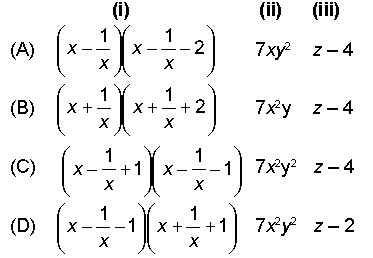
Question. Do as directed.
(i) Factorise: x2 + 1/x2 − 3
(ii) Find the greatest common factors of 14x2y3, 21x3y2 and 35x4y5z.
(iii) Divide z(5z2 – 80) by 5z(z + 4).
Answer : C
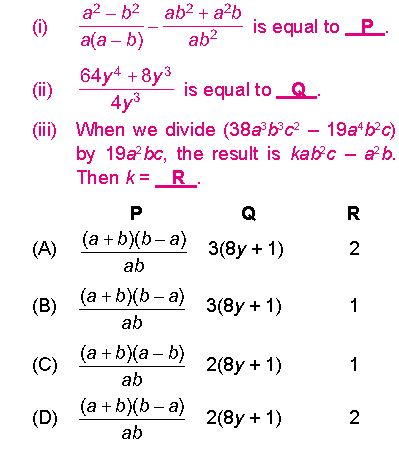
Question. Fill in the blanks.
Answer : D
Question. Which of the following statements is CORRECT?
(A) The factors of an expression are always either algebraic variable or algebraic expression.
(B) An irreducible factor is a factor that cannot be expressed further as a product of factors.
(C) Every binomial expression can be factorised into two monomial expression.
(D) The process of writing a given expression as the product of two or more factors is called multiplication of factors.
Answer : B
Question. Match the expression given in Column-I to one of their factors given in Column-II.
Column-I Column-II
P. 9x2 + 24x + 16 (i) (2x – 4)
Q. 25x2 + 30x + 9 (ii) (4x + 1)
R. 40x2 + 14x + 1 (iii) (5x + 3)
S. 4x2 – 16x + 16 (iv) (3x + 4)
(A) P → (iv); Q → (iii); R → (ii); S → (i)
(B) P → (iii); Q → (i); R → (iv); S → (ii)
(C) P → (ii); Q → (i); R → (iv); S → (iii)
(D) P → (iv); Q → (iii); R → (i); S → (ii)
Answer : A
Question. Factors of x4 – (x – z)4 are ____.
(A) (2x + z)(2x3 + z3 – 2x2)
(B) z(x + 2z)(x2 + z2 – x2)
(C) z(2x – z)(2x2 – 2xz + z2)
(D) z(x – 2z)(2z2 – 2xz + x2)
Answer : C
Question. Factorising (x – y)2 + 4xy – z2, we get
(A) (x + y + z)(x + y – z)
(B) (x – y – z)(x + y – z)
(C) (x – y + z)(x + y – z)
(D) None of these
Answer : A
Question. Complete it : x2 + 25x + 84 = (x + 21) × _______.
Answer : (x + 4)
Question. Find the product : (a – b – c) (a – b + c)
Answer : a2 – 2ab + b2 – c2
Question. Simplify : x2 - 13x + 40 / (x - 8)
Answer : x – 5
Question. Find the value of 34 – 14 using the identity x4 – y4 = (x + y) (x – y) (x2 + y2).
Answer : 80
Question. Express as product of two linear factors. x2 – 17x + 16.
Answer : (x – 16) (x – 1)
Question. Find z if, (x + 4) (x – 5) – z = x(x – 1)
Answer : –20
Question. Factorize : x2(y + 5) –4(y + 5)
Answer : (y + 5) (x + 2) (x – 2)
Question. Divide 121x5y4z3 by 11x3y2z.
Answer : 11x2y2z2
Question. Find the common factor in 7x2y + 49xy2 + 343x3y2.
Answer : 7xy
Question. Factorize : x2 – 3x + 2.
Answer : (x – 2) (x – 1)
Question. Find the value of x3y xy3/xy as a product of two factors.
Answer : (x + y) (x – y).
Question. Complete it : (x + 3) (x – 5) = x2 + ( )x + ( ).
Answer : –2, –15.
Question. Factorize : 16x2 + 40xy + 25y2
Answer : (4x + 5y)2
Question. Simplify : (1.9)2 - (1.1)2 / 3
Answer : 0.8
Question. Find (x4 + y4) (x4 – y4) if x = 1, y = 1.
Answer : 0
Question. Find the value of 252 – 242.
Answer : 49
Question. Simplify : (0.87)2 - (0.13)2 / (0.87 - 0.13)
Answer : 1
Question. Find the quotient : z(4y2 – 64) 4z(y – 4)
Answer : y + 4
Question. Find x and y that xy = 72, x + y = 17.
Answer : x = 9, y = 8.
Question. Simplify : 4m2 - 169n2 / 2m + 13n
Answer : 2m – 13n
Question. Find the value of : (3a + b)2 – (3a – b)2.
Answer : 12ab




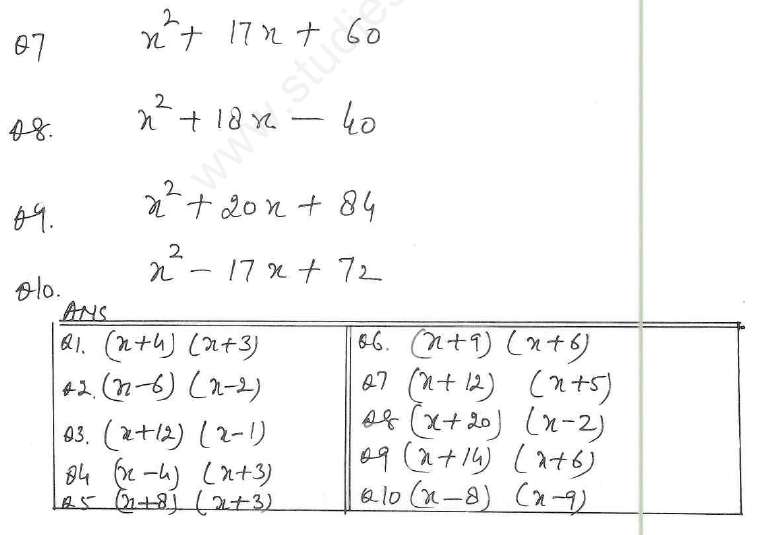
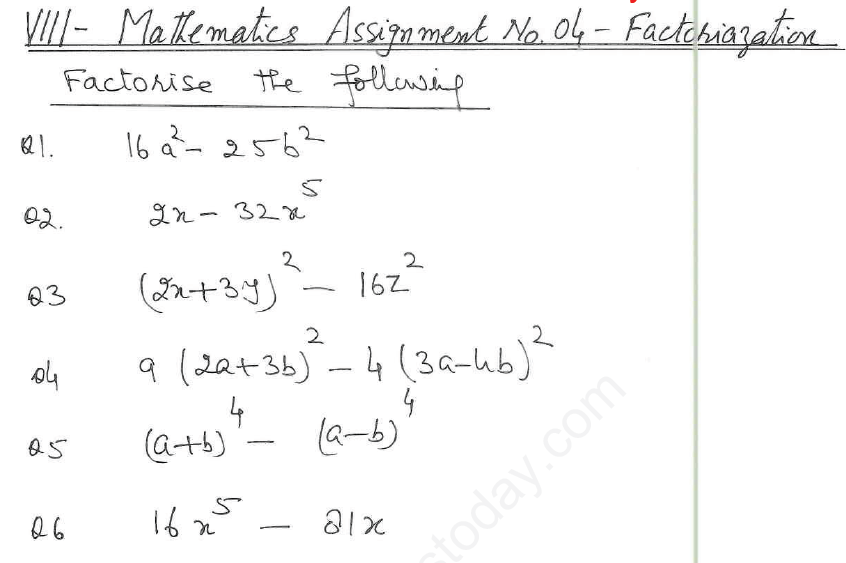


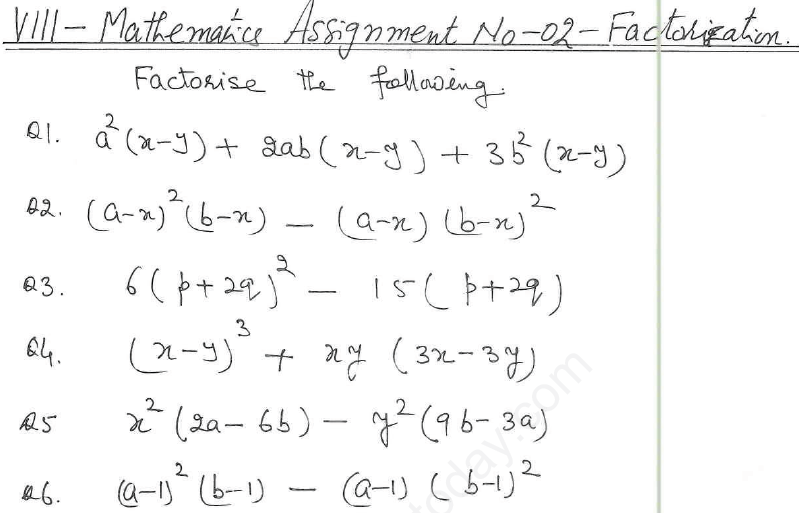


Questions carrying 1 mark each :-
Q.1 Factorise x2 + x.
Q.2 Is it correct : 3(x-4) = 3x -4.
Questions carrying 2 marks each :-
Q.3 Factorise 9a2 - 16b2
Q.4 Factorise 24x4 + 18x3
Q.5 Factorise 2a - 32a5
Q.6 Evaluate(ax+ay+ax) a
Questions carrying 3 marks each :
Q.7 Factorise 1-a2 - 2ab - b2
Q.8 Resolve into factors : 2x2 - 3ax - 2a2
Q.9 Find the greatest common factor of - 4a3b2, 12a3b3c, 16a5bc.
Q.10 Divide (4x2-9) by (2x-3).
Q.11 Factorise (x4) - (y-z)4
Multiple Choice Questions carrying 1mark each:-
Q.12 Division is opposite of
a) Subtraction
b) Addition
c) Multiplication
d) None of these
Multiple Choice Questions carrying 1mark each:-
Q.13 Division is opposite of
a) Subtraction
b) Addition
c) Multiplication
d) None of these
Question 1. Factorise \(2x + 4\).
Answer: \(2x + 4 = 2(x + 2)\)
In simple words: Take out the highest common factor, which is 2, from both terms.
Exam Tip: Always look for the greatest common divisor (GCD) of the numerical coefficients first.
Question 2. Factorise \(12a^2b + 15ab^2\).
Answer: \(12a^2b + 15ab^2 = 3ab(4a + 5b)\)
In simple words: Find the common numerical factor (3) and the lowest powers of common variables (\(a\) and \(b\)) to factor out \(3ab\).
Exam Tip: For variables with exponents, take the lowest power present in all terms as part of the common factor.
Question 3. Factorise \(10x^2 - 14x^3 + 18x^4\).
Answer: \(10x^2 - 14x^3 + 18x^4 = 2x^2(5 - 7x + 9x^2)\)
In simple words: The common factor is \(2x^2\). Divide each term by \(2x^2\) to get the remaining expression inside the bracket.
Exam Tip: Check your factorization by expanding the brackets back out to ensure you get the original expression.
Question 4. Factorise \(20x^2y + 30axy\).
Answer: \(20x^2y + 30axy = 10xy(2x + 3a)\)
In simple words: The greatest common factor of the coefficients 20 and 30 is 10, and the common variables are \(x\) and \(y\).
Exam Tip: Ensure all common variables present across all terms are completely factored out.
Question 5. Factorise \(x^2 + xy + 8x + 8y\).
Answer: \(x^2 + xy + 8x + 8y = x(x + y) + 8(x + y) = (x + 8)(x + y)\)
In simple words: Group the terms in pairs, factor out \(x\) from the first pair and 8 from the second pair, then take out the common binomial factor \((x + y)\).
Exam Tip: Grouping by terms is useful when there is no single common factor for all terms.
Question 6. Factorise \(1 + a + ac + a^2c\).
Answer: \(1 + a + ac + a^2c = 1(1 + a) + ac(1 + a) = (1 + ac)(1 + a)\)
In simple words: Group the first two terms and the last two terms to factor by grouping.
Question 7. Factorise \(a^2 + bc + ab + ac\).
Answer: Rearranging terms: \(a^2 + ab + ac + bc = a(a + b) + c(a + b) = (a + c)(a + b)\)
In simple words: Rearrange the terms so that like terms can be grouped easily before factoring.
Exam Tip: Rearrangement is often necessary in grouping problems if the initial order does not show immediate common factors.
Question 8. Factorise \(x^2 - 36\) using identity.
Answer: Using identity \(a^2 - b^2 = (a - b)(a + b)\):
\(x^2 - 36 = x^2 - 6^2 = (x - 6)(x + 6)\)
In simple words: Write 36 as \(6^2\) and apply the difference of squares identity.
Exam Tip: Memorize standard algebraic identities such as difference of squares thoroughly.
Question 9. Factorise \(xy - pq + qy - px\).
Answer: Rearranging terms: \(xy - px + qy - pq = x(y - p) + q(y - p) = (x + q)(y - p)\)
In simple words: Group terms containing common variables \(x\) and \(q\) together.
Exam Tip: Watch out for negative signs when rearranging terms.
Question 10. Factorise \(5a(2x - 3y) + 2b(2x - 3y)\).
Answer: \(5a(2x - 3y) + 2b(2x - 3y) = (5a + 2b)(2x - 3y)\)
In simple words: Treat the binomial \((2x - 3y)\) as a single common factor and pull it out.
Exam Tip: Binomial expressions can act as single terms for factoring purposes.
Question 11. Factorise \(ax^2 + by^2 + bx^2 + ay^2\).
Answer: Rearranging terms: \(ax^2 + bx^2 + ay^2 + by^2 = x^2(a + b) + y^2(a + b) = (x^2 + y^2)(a + b)\)
In simple words: Group terms containing \(x^2\) together and terms containing \(y^2\) together.
Exam Tip: Grouping terms with identical variable parts simplifies the expression quickly.
Question 12. Factorise \(8(4x + 5y)^2 - 12(4x + 5y)\).
Answer: \(8(4x + 5y)^2 - 12(4x + 5y) = 4(4x + 5y)[2(4x + 5y) - 3] = 4(4x + 5y)(8x + 10y - 3)\)
In simple words: Factor out the common numerical factor 4 and the binomial factor \((4x + 5y)\).
Exam Tip: Always extract both the greatest common number and common binomial expression simultaneously.
Question 13. Factorise using identity \(x^2 + 10x + 25\).
Answer: Using identity \(a^2 + 2ab + b^2 = (a + b)^2\):
\(x^2 + 2(x)(5) + 5^2 = (x + 5)^2\)
In simple words: Recognize the expression as a perfect square trinomial.
Exam Tip: Check if the middle term equals \(2 \times \text{first term} \times \text{square root of last term}\).
Question 14. Factorise using identity \(4x^2 + 9y^2 + 12xy\).
Answer: Rearranging into standard form: \(4x^2 + 12xy + 9y^2 = (2x)^2 + 2(2x)(3y) + (3y)^2 = (2x + 3y)^2\)
In simple words: Rewrite as \((2x)^2 + 2(2x)(3y) + (3y)^2\) and apply the square of a sum identity.
Exam Tip: Reorder terms into descending powers before applying identities.
Question 15. Factorise \(ax^2y + bxy^2 + cxyz\).
Answer: \(ax^2y + bxy^2 + cxyz = xy(ax + by + cz)\)
In simple words: Identify \(xy\) as the common factor across all three terms and factor it out.
Question 16. Factorise \(15xy - 6x + 5y - 2\).
Answer: Grouping terms: \(3x(5y - 2) + 1(5y - 2) = (3x + 1)(5y - 2)\)
In simple words: Factor \(3x\) from the first two terms and 1 from the remaining terms.
Exam Tip: Ensure the resulting binomial expressions in both groups match exactly.
Question 17. Factorise \(6pq - 4q + 6 - 9p\).
Answer: Rearranging terms: \(6pq - 9p - 4q + 6 = 3p(2q - 3) - 2(2q - 3) = (3p - 2)(2q - 3)\)
In simple words: Rearrange and factor by grouping carefully handling negative signs.
Exam Tip: Factoring out a negative sign changes the signs of the terms inside the parentheses.
Question 18. Find the factors of \(x^2 - 7x + 12\).
Answer: Splitting the middle term: \(x^2 - 4x - 3x + 12 = x(x - 4) - 3(x - 4) = (x - 3)(x - 4)\)
In simple words: Find two numbers that multiply to 12 and add up to \(-7\), which are \(-4\) and \(-3\).
Exam Tip: Use the middle-term splitting method for quadratic trinomials of the form \(ax^2 + bx + c\).
Question 19. Find the factors of \(3x^2 + 9x + 6\).
Answer: Factoring out 3 first: \(3(x^2 + 3x + 2) = 3(x^2 + 2x + x + 2) = 3[x(x + 2) + 1(x + 2)] = 3(x + 1)(x + 2)\)
In simple words: First factor out the common coefficient 3, then factor the remaining quadratic expression.
Exam Tip: Always check for a common numerical factor before attempting to split the middle term.
Question 20. Factorise \((a + b)^2 - (a - b)^2\).
Answer: Using difference of squares \(x^2 - y^2 = (x - y)(x + y)\):
\([(a + b) - (a - b)][(a + b) + (a - b)] = [a + b - a + b][a + b + a - b] = (2b)(2a) = 4ab\)
In simple words: Apply the difference of squares identity directly using \((a+b)\) and \((a-b)\) as terms.
Exam Tip: Be careful with distributing negative signs when simplifying bracketed expressions.
Question 21. Factorise the expression \(10ab + 4a + 5b + 2\).
Answer: Grouping terms: \(2a(5b + 2) + 1(5b + 2) = (2a + 1)(5b + 2)\)
In simple words: Factor \(2a\) from the first two terms and 1 from the remaining terms.
Exam Tip: Grouping terms in pairs is the standard technique for four-term polynomials.
Question 22. Divide \(24x^2y^2z^2\) by \(6yz\).
Answer: \(\frac{24x^2y^2z^2}{6yz} = 4x^2y^{(2-1)}z^{(2-1)} = 4x^2yz\)
In simple words: Divide the coefficients and subtract the exponents of matching variables.
Exam Tip: Use laws of exponents: \(\frac{y^m}{y^n} = y^{m-n}\).
Question 23. Divide \((7a^2 + 14a)\) by \((a + 2)\).
Answer: \(\frac{7a^2 + 14a}{a + 2} = \frac{7a(a + 2)}{a + 2} = 7a\)
In simple words: Factor out \(7a\) from the numerator so that \((a + 2)\) cancels out with the denominator.
Exam Tip: Always factor the numerator completely before attempting cancellation.
Question 24. Divide \(x(5x^2 - 80)\) by \(5x(x + 4)\).
Answer: \(\frac{x(5x^2 - 80)}{5x(x + 4)} = \frac{5x(x^2 - 16)}{5x(x + 4)} = \frac{5x(x - 4)(x + 4)}{5x(x + 4)} = x - 4\)
In simple words: Factor out 5 from the bracket, use the difference of squares on \(x^2 - 16\), then cancel common terms.
Exam Tip: Factor algebraic expressions fully before reducing fractions.
Question 25. Divide \(x^2 + 7x + 10\) by \(x + 5\).
Answer: Factorising the numerator: \(x^2 + 7x + 10 = (x + 5)(x + 2)\)
\(\frac{(x + 5)(x + 2)}{x + 5} = x + 2\)
In simple words: Factor the quadratic numerator by splitting the middle term, then cancel the common factor \((x + 5)\).
Exam Tip: Splitting the middle term is an essential prerequisite for algebraic division.
Question 26. Divide \(12pq(9p^2 - 16q^2)\) by \(4pq(3p + 4q)\).
Answer: \(\frac{12pq(9p^2 - 16q^2)}{4pq(3p + 4q)} = \frac{12pq(3p - 4q)(3p + 4q)}{4pq(3p + 4q)} = 3(3p - 4q) = 9p - 12q\)
In simple words: Write \(9p^2 - 16q^2\) as \((3p)^2 - (4q)^2\) and apply the difference of squares identity.
Exam Tip: Cancel common monomial coefficients and identical binomial factors simultaneously.
Question 27. Divide \(39x^3(50x^2 - 98)\) by \(26x^2(5x + 7)\).
Answer: Factor numerator: \(39x^3 \cdot 2(25x^2 - 49) = 78x^3(5x - 7)(5x + 7)\)
Denominator: \(26x^2(5x + 7)\)
\(\frac{78x^3(5x - 7)(5x + 7)}{26x^2(5x + 7)} = 3x(5x - 7) = 15x^2 - 21x\)
In simple words: Take out 2 from the bracket, factor using difference of squares, and divide coefficients and variables.
Question 28. Find the factors of \(25x^2 - 4y^2 + 28yz - 49z^2\).
Answer: Rearranging terms: \(25x^2 - (4y^2 - 28yz + 49z^2) = (5x)^2 - [(2y)^2 - 2(2y)(7z) + (7z)^2] = (5x)^2 - (2y - 7z)^2\)
Using difference of squares: \([5x - (2y - 7z)][5x + (2y - 7z)] = (5x - 2y + 7z)(5x + 2y - 7z)\)
In simple words: Group the last three terms into a perfect square trinomial and apply the difference of squares identity.
Exam Tip: Recognizing grouped perfect square trinomials is key for complex factorization problems.
Most Important Questions
Question 1. Add \(4x^2 + 2xy - 4\) & \(7x^2 - 3xy + 4\).
Answer: \((4x^2 + 2xy - 4) + (7x^2 - 3xy + 4) = (4 + 7)x^2 + (2 - 3)xy + (-4 + 4) = 11x^2 - xy\)
In simple words: Combine the coefficients of like terms: \(x^2\), \(xy\), and constant terms.
Exam Tip: Group like terms together carefully by matching their variable parts.
Question 2. Subtract \(7x - 3x^2\) from \(4x + 8x^2\).
Answer: \((4x + 8x^2) - (7x - 3x^2) = 4x + 8x^2 - 7x + 3x^2 = (8 + 3)x^2 + (4 - 7)x = 11x^2 - 3x\)
In simple words: Subtract each term of the first expression from the second expression, remembering to distribute the negative sign.
Exam Tip: The phrase "Subtract A from B" means writing it as \(B - A\).
Question 3. Find the product of \((7x - 4y)\) and \((3x - 7y)\).
Answer: \((7x - 4y)(3x - 7y) = 7x(3x - 7y) - 4y(3x - 7y)\)
\(= 21x^2 - 49xy - 12xy + 28y^2\)
\(= 21x^2 - 61xy + 28y^2\)
In simple words: Multiply each term of the first binomial by each term of the second binomial (FOIL method) and combine like terms.
Exam Tip: Combine middle terms \(-49xy\) and \(-12xy\) carefully.
Question 4. Using suitable identity find \((7x - 3y)^2\).
Answer: Using identity \((a - b)^2 = a^2 - 2ab + b^2\):
\((7x - 3y)^2 = (7x)^2 - 2(7x)(3y) + (3y)^2 = 49x^2 - 42xy + 9y^2\)
In simple words: Square the first term, subtract twice the product of both terms, and add the square of the second term.
Exam Tip: Ensure the middle term includes the negative sign prescribed by the identity.
Question 5. Using identity \((a - b)^2 = a^2 - 2ab + b^2\) find the value of \(98^2\).
Answer: \(98^2 = (100 - 2)^2 = 100^2 - 2(100)(2) + 2^2\)
\(= 10000 - 400 + 4 = 9604\)
In simple words: Express 98 as \((100 - 2)\) and expand using the square of a difference identity.
Exam Tip: Converting numbers to powers of 10 makes mental arithmetic much easier.
Question 6. Subtract \(3x(x - 4y + 5z)\) from \(4x(2x - 3y + 10z)\).
Answer: Expand first expression: \(4x(2x - 3y + 10z) = 8x^2 - 12xy + 40xz\)
Expand second expression: \(3x(x - 4y + 5z) = 3x^2 - 12xy + 15xz\)
Subtract: \((8x^2 - 12xy + 40xz) - (3x^2 - 12xy + 15xz) = 8x^2 - 12xy + 40xz - 3x^2 + 12xy - 15xz = 5x^2 + 25xz\)
In simple words: Multiply out both brackets completely and then subtract like terms.
Exam Tip: Distribute the monomial outside the bracket to every term inside before subtracting.
Question 7. Multiply \((a^2 + 2c^2)(3a - 3c)\).
Answer: \((a^2 + 2c^2)(3a - 3c) = a^2(3a - 3c) + 2c^2(3a - 3c)\)
\(= 3a^3 - 3a^2c + 6ac^2 - 6c^3\)
In simple words: Multiply each term of the first polynomial by each term of the second polynomial.
Exam Tip: Double-check signs and variable exponents during multiplication.
Question 8. Using suitable identity find \((6x^2 - \frac{5}{3})^2\).
Answer: Using \((a - b)^2 = a^2 - 2ab + b^2\):
\((6x^2)^2 - 2(6x^2)(\frac{5}{3}) + (\frac{5}{3})^2 = 36x^4 - 20x^2 + \frac{25}{9}\)
In simple words: Apply the square of a difference identity directly with fractional terms.
Exam Tip: Simplify fractions carefully when multiplying the middle term: \(2 \times 6 \times \frac{5}{3} = 20\).
Question 9. Simplify \((xy + yz)^2 - (xy - yz)^2\).
Answer: Using difference of squares \(A^2 - B^2 = (A - B)(A + B)\):
\([(xy + yz) - (xy - yz)][(xy + yz) + (xy - yz)] = [xy + yz - xy + yz][xy + yz + xy - yz]\)
\(= (2yz)(2xy) = 4xy^2z\)
In simple words: Use the difference of squares identity to factor the expression quickly.
Question 10. Using identity find the product of \((\frac{a}{2} + \frac{3b}{4})(\frac{a}{2} + \frac{3b}{4})\).
Answer: \((\frac{a}{2} + \frac{3b}{4})^2 = (\frac{a}{2})^2 + 2(\frac{a}{2})(\frac{3b}{4}) + (\frac{3b}{4})^2\)
\(= \frac{a^2}{4} + \frac{3ab}{4} + \frac{9b^2}{16}\)
In simple words: Since the expression is multiplied by itself, apply the square of a sum identity \((a + b)^2\).
Exam Tip: Square both the numerator and denominator of fractional terms.
Question 11. If \(x + \frac{1}{x} = 6\), find \(x^2 + \frac{1}{x^2}\).
Answer: Squaring both sides of \(x + \frac{1}{x} = 6\):
\((x + \frac{1}{x})^2 = 6^2\)
\(x^2 + 2(x)(\frac{1}{x}) + \frac{1}{x^2} = 36\)
\(x^2 + 2 + \frac{1}{x^2} = 36\)
\(x^2 + \frac{1}{x^2} = 36 - 2 = 34\)
In simple words: Square the given equation on both sides and simplify using algebraic identities.
Exam Tip: Remember that \(x \times \frac{1}{x} = 1\).
Question 12. Find the product of \((\frac{5}{3}x + \frac{3}{4}y)^2\) and \((\frac{5}{3}x + \frac{3}{4}y)^2\) and also evaluate it when \(x = +2\) and \(y = -1\).
Answer: Product: \((\frac{5}{3}x + \frac{3}{4}y)^2 \cdot (\frac{5}{3}x + \frac{3}{4}y)^2 = (\frac{5}{3}x + \frac{3}{4}y)^4\)
Substitute \(x = 2\) and \(y = -1\):
\(\frac{5}{3}(2) + \frac{3}{4}(-1) = \frac{10}{3} - \frac{3}{4} = \frac{40 - 9}{12} = \frac{31}{12}\)
Evaluating fourth power: \((\frac{31}{12})^4 = \frac{923521}{20736}\)
In simple words: Combine the identical terms using exponent rules, then substitute the given values of \(x\) and \(y\).
Exam Tip: Substitute values into the base expression before raising it to higher powers to keep calculations manageable.
Question 13. Using identity \(a^2 - b^2 = (a + b)(a - b)\) find \((1.02)^2 - (0.98)^2\).
Answer: \((1.02 + 0.98)(1.02 - 0.98) = (2.00)(0.04) = 0.08\)
In simple words: Apply the difference of squares identity with decimals directly.
Exam Tip: This identity is extremely useful for mental calculation of squares of numbers.
Question 14. If \(x + y = 12\) and \(xy = 32\). Find the value of \(x^2 + y^2\).
Answer: Using \((x + y)^2 = x^2 + 2xy + y^2\):
\(12^2 = x^2 + 2(32) + y^2\)
\(144 = x^2 + 64 + y^2\)
\(x^2 + y^2 = 144 - 64 = 80\)
In simple words: Square the equation \((x + y)\) and substitute the given value of \(xy\).
Exam Tip: Memorize the expansion of \((x+y)^2\) in terms of sum and product.
Question 15. Simplify \((xy + yz)^2 - 2x^2y^2z\) find the value when \(x = -1\), \(y = 1\) and \(z = 2\).
Answer: Expand \((xy + yz)^2 = x^2y^2 + 2xy^2z + y^2z^2\)
Expression: \(x^2y^2 + 2xy^2z + y^2z^2 - 2x^2y^2z\)
Substitute \(x = -1\), \(y = 1\), \(z = 2\):
\((-1)^2(1)^2 + 2(-1)(1)^2(2) + (1)^2(2)^2 - 2(-1)^2(1)^2(2)\)
\(= 1(1) + 2(-1)(1)(2) + 1(4) - 2(1)(1)(2)\)
\(= 1 - 4 + 4 - 4 = -3\)
In simple words: Expand the binomial square, combine terms if any, and substitute the given values.
Exam Tip: Be careful with negative signs when evaluating powers.
Question 16. Subtract \(4x^2 - 2y + 7z^3 - 3\) from \(3y + 7x^2 - 2z^3 + 4\).
Answer: \((3y + 7x^2 - 2z^3 + 4) - (4x^2 - 2y + 7z^3 - 3)\)
\(= 3y + 7x^2 - 2z^3 + 4 - 4x^2 + 2y - 7z^3 + 3\)
\(= (7x^2 - 4x^2) + (3y + 2y) + (-2z^3 - 7z^3) + (4 + 3)\)
\(= 3x^2 + 5y - 9z^3 + 7\)
In simple words: Distribute the negative sign across all terms in the first polynomial and group like terms.
Exam Tip: Align like terms with identical variable parts to prevent subtraction errors.
Question 17. Divide \(-72x^2yz\) by \(-12xyz\).
Answer: \(\frac{-72x^2yz}{-12xyz} = \frac{-72}{-12} \cdot \frac{x^2}{x} \cdot \frac{y}{y} \cdot \frac{z}{z} = 6x^{(2-1)}y^{(1-1)}z^{(1-1)} = 6x\)
In simple words: Divide the numerical coefficients and subtract exponents of like variables.
Question 18. Divide \(9m^5 + 12m^4 - 6m^2\) by \(3m^2\).
Answer: \(\frac{9m^5 + 12m^4 - 6m^2}{3m^2} = \frac{9m^5}{3m^2} + \frac{12m^4}{3m^2} - \frac{6m^2}{3m^2} = 3m^3 + 4m^2 - 2\)
In simple words: Divide each term in the numerator separately by the monomial denominator.
Exam Tip: Split polynomial division into separate monomial division steps.
Question 19. Divide \(\frac{2}{3}a^2b^2c^2 + \frac{4}{3}ab^2c^3 - \frac{1}{5}ab^3c^2\) by \(\frac{1}{2}abc\).
Answer: Divide each term by \(\frac{1}{2}abc\):
1. \(\frac{\frac{2}{3}a^2b^2c^2}{\frac{1}{2}abc} = \frac{2}{3} \times 2 \cdot a^{(2-1)}b^{(2-1)}c^{(2-1)} = \frac{4}{3}abc\)
2. \(\frac{\frac{4}{3}ab^2c^3}{\frac{1}{2}abc} = \frac{4}{3} \times 2 \cdot a^{(1-1)}b^{(2-1)}c^{(3-1)} = \frac{8}{3}bc^2\)
3. \(\frac{-\frac{1}{5}ab^3c^2}{\frac{1}{2}abc} = -\frac{1}{5} \times 2 \cdot a^{(1-1)}b^{(3-1)}c^{(2-1)} = -\frac{2}{5}bc\)
Combined Answer: \(\frac{4}{3}abc + \frac{8}{3}bc^2 - \frac{2}{5}bc^2\) (or grouped as \(\frac{4}{3}abc + (\frac{8}{3} - \frac{2}{5})bc^2 = \frac{4}{3}abc + \frac{34}{15}bc^2\))
In simple words: Divide each fraction coefficient by \(\frac{1}{2}\) (which means multiplying by 2) and subtract exponents.
Exam Tip: Dividing by a fraction is equivalent to multiplying by its reciprocal.
Question 20. Divide \(6 + x - 4x^2 + x^3\) by \(x - 3\) by long division method.
Answer: Arrange dividend in standard descending order: \(x^3 - 4x^2 + x + 6\)
Long division steps:
1. Divide leading term: \(\frac{x^3}{x} = x^2\). Multiply \(x^2(x - 3) = x^3 - 3x^2\). Subtract to get \(-x^2 + x\).
2. Divide leading term: \(\frac{-x^2}{x} = -x\). Multiply \(-x(x - 3) = -x^2 + 3x\). Subtract to get \(-2x + 6\).
3. Divide leading term: \(\frac{-2x}{x} = -2\). Multiply \(-2(x - 3) = -2x + 6\). Remainder is \(0\).
Quotient = \(x^2 - x - 2\), Remainder = \(0\)
In simple words: Use algebraic long division by matching leading terms at each step.
Exam Tip: Always arrange polynomials in descending order of powers before starting long division.
Question 21. Divide \(12x^3 - 8x^2 - 6x + 10\) by \(3x - 2\). Write the quotient and remainder.
Answer: Long division steps:
1. \(\frac{12x^3}{3x} = 4x^2\). Multiply: \(4x^2(3x - 2) = 12x^3 - 8x^2\). Subtract: remainder terms leave \(-6x + 10\).
2. \(\frac{-6x}{3x} = -2\). Multiply: \(-2(3x - 2) = -6x + 4\). Subtract: \((-6x + 10) - (-6x + 4) = 6\).
Quotient = \(4x^2 - 2\), Remainder = \(6\)
In simple words: Divide step-by-step using polynomial long division.
Exam Tip: Pay close attention when subtraction eliminates intermediate terms.
Question 22. Divide \(x^3 - 6x^2 + 11x - 6\) by \(x^2 - 4x + 3\).
Answer: Long division steps:
1. \(\frac{x^3}{x^2} = x\). Multiply: \(x(x^2 - 4x + 3) = x^3 - 4x^2 + 3x\).
2. Subtract: \((x^3 - 6x^2 + 11x - 6) - (x^3 - 4x^2 + 3x) = -2x^2 + 8x - 6\).
3. \(\frac{-2x^2}{x^2} = -2\). Multiply: \(-2(x^2 - 4x + 3) = -2x^2 + 8x - 6\).
4. Subtract: Remainder is \(0\).
Quotient = \(x - 2\), Remainder = \(0\)
In simple words: Divide the leading terms of the dividend and divisor successively until the degree of the remainder is less than the divisor.
Exam Tip: Verify your answer by multiplying the quotient by the divisor.
Question 23. Find whether \(x + 1\) is a factor of \(2x^2 + 5x + 4\) or not.
Answer: Using the Factor Theorem, set \(x + 1 = 0 \implies x = -1\). Substitute \(x = -1\) into the polynomial:
\(P(-1) = 2(-1)^2 + 5(-1) + 4 = 2(1) - 5 + 4 = 2 - 5 + 4 = 1 \neq 0\)
Since the remainder is not zero, \(x + 1\) is not a factor.
In simple words: Substitute the root into the polynomial; if the result is not zero, it is not a factor.
Exam Tip: The Factor Theorem states that \((x - a)\) is a factor if and only if \(P(a) = 0\).
Question 24. Divide the following \(63a^2b^4c\) by \(7a^2b^2c\).
Answer: \(\frac{63a^2b^4c}{7a^2b^2c} = \frac{63}{7} \cdot \frac{a^2}{a^2} \cdot \frac{b^4}{b^2} \cdot \frac{c}{c} = 9a^{(2-2)}b^{(4-2)}c^{(1-1)} = 9b^2\)
In simple words: Divide coefficients and subtract exponents of identical variables.
Exam Tip: Any variable raised to the power of 0 equals 1 (\(a^0 = 1\)).
Question 25. Divide the polynomial \(5x(x^2 - x + 1) - (9 + 4x^4)\) by \(4x - 1\). Write quotient and remainder.
Answer: Expand and rearrange dividend in standard form:
\(5x^3 - 5x^2 + 5x - 9 - 4x^4 = -4x^4 + 5x^3 - 5x^2 + 5x - 9\)
Performing long division by \(4x - 1\):
1. \(\frac{-4x^4}{4x} = -x^3\). Multiply: \(-x^3(4x - 1) = -4x^4 + x^3\). Subtract: \(4x^3 - 5x^2\).
2. \(\frac{4x^3}{4x} = x^2\). Multiply: \(x^2(4x - 1) = 4x^3 - x^2\). Subtract: \(-4x^2 + 5x\).
3. \(\frac{-4x^2}{4x} = -x\). Multiply: \(-x(4x - 1) = -4x^2 + x\). Subtract: \(4x - 9\).
4. \(\frac{4x}{4x} = 1\). Multiply: \(1(4x - 1) = 4x - 1\). Subtract: \(-9 - (-1) = -8\).
Quotient = \(-x^3 + x^2 - x + 1\), Remainder = \(-8\)
In simple words: Expand the polynomial, arrange it in descending order of powers, and apply long division.
Exam Tip: Be meticulous with signs when subtracting polynomials during long division.
Question 26. Divide the polynomial \(x^3 + 3x^2 - 5x + 4\) by \(x - 1\). Write quotient and remainder.
Answer: Long division steps:
1. \(\frac{x^3}{x} = x^2\). Multiply: \(x^2(x - 1) = x^3 - x^2\). Subtract: \(4x^2 - 5x\).
2. \(\frac{4x^2}{x} = 4x\). Multiply: \(4x(x - 1) = 4x^2 - 4x\). Subtract: \(-x + 4\).
3. \(\frac{-x}{x} = -1\). Multiply: \(-1(x - 1) = -x + 1\). Subtract: \(4 - 1 = 3\).
Quotient = \(x^2 + 4x - 1\), Remainder = \(3\)
In simple words: Divide step-by-step using long division.
Exam Tip: Check your division using the division algorithm: \(\text{Dividend} = (\text{Divisor} \times \text{Quotient}) + \text{Remainder}\).
Question 27. Divide \(z(5z^2 - 80)\) by \(5z(z + 4)\).
Answer: \(\frac{z(5z^2 - 80)}{5z(z + 4)} = \frac{5z(z^2 - 16)}{5z(z + 4)} = \frac{5z(z - 4)(z + 4)}{5z(z + 4)} = z - 4\)
In simple words: Factor out 5 from the bracket, apply the difference of squares identity on \(z^2 - 16\), and cancel common factors.
Exam Tip: Always factor completely before cancelling terms in rational expressions.
Free study material for Mathematics
Chapter 14 Factorisation Printable Assignments & Solutions for Class 8 Mathematics
Download Assignment: Chapter 14 Factorisation (Class 8 Mathematics)
Review targeted chapter assignments for Class 8 Mathematics Chapter 14 Factorisation. Built according to official CBSE guidelines, these downloadable problem sets help students build accuracy and prepare effectively for school tests.
Maximize Exam Scores with Chapter Practice Sets
- Curriculum Standards: Assignments match modern CBSE sample formats to ensure relevant preparation.
- Thorough Revision: Detailed problem sets reinforce core concepts and eliminate conceptual weak spots.
- Execution Speed: Timed practice with assignment sets sharpens overall response timing.
How to Approach Mathematics Chapter 14 Factorisation Assignments
- Concept Foundation: Review the NCERT book for Class 8 Mathematics thoroughly before diving into assignment tasks.
- Self-Evaluation: Solve exercises independently before inspecting professional answer guides.
- Progress Monitoring: Note down complex formulas or concepts, clearing them up using available online practice aids.
FAQs
You can download free PDF assignments for Class 8 Mathematics Chapter 14 Factorisation from StudiesToday.com. These practice sheets have been updated for the 2026-27 session covering all concepts from latest NCERT textbook.
Yes, our teachers have given solutions for all questions in the Class 8 Mathematics Chapter 14 Factorisation assignments. This will help you to understand step-by-step methodology to get full marks in school tests and exams.
Yes. These assignments are designed as per the latest CBSE syllabus for 2026. We have included huge variety of question formats such as MCQs, Case-study based questions and important diagram-based problems found in Chapter 14 Factorisation.
Practicing topicw wise assignments will help Class 8 students understand every sub-topic of Chapter 14 Factorisation. Daily practice will improve speed, accuracy and answering competency-based questions.
Yes, all printable assignments for Class 8 Mathematics Chapter 14 Factorisation are available for free download in mobile-friendly PDF format.