

Official CBSE Assignments for Class 8 Mathematics
Access comprehensive school assignments for Chapter 15 Introduction To Graphs using the CBSE Class 8 Mathematics Introduction to Graphs Assignment Set 02. Designed to align with the 2026-27 CBSE academic guidelines, these practice sets help Class 8 Mathematics students reinforce core concepts and improve their problem-solving accuracy.
Solved Practice Assignments for Mathematics
Access the complete assignment PDF for Class 8 Mathematics below. Regular practice with these targeted academic tasks builds familiarity with standard question patterns and helps secure higher marks in final school evaluations.
1. (0, – 3) lies on ________.
(A) Positive x-axis
(B) Negative x-axis
(C) Positive y-axis
(D) Negative y-axis
Answer : D
2. To draw the graph of a line, the least number of points required is ________.
(A) One
(B) Two
(C) Three
(D) Four
Answer : B
DIRECTION (3-4) : The following graph shows the temperature of a patient admitted in a hospital, recorded every 2 hours.

3. What was the patient’s temperature at 3 p.m.?
(A) 37.5 °C
(B) 38 °C
(C) 36 °C
(D) 37 °C
Answer : A
4. When was the patient’s temperature highest ?
(A) 10 a.m.
(B) 6 p.m.
(C) 4 p.m.
(D) 2 p.m.
Answer : B
5. Which of the following graphs cannot be a time temperature graph?
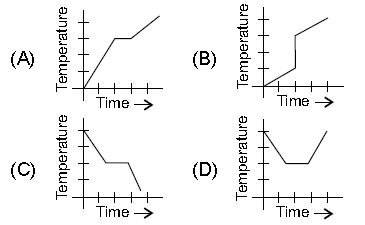
Answer : B
DIRECTION (6-7) : The line graph shows the performance of two students during a year. Read the graph and answer the following questions.

6. In which test student B showed his worst performance?
(A) Test 5
(B) Test 3
(C) Test 2
(D) Test 1
Answer : D
7. In all, whose performance is better during the year?
(A) Student A
(B) Both showed same performance
(C) Student B
(D) Can’t be determined
Answer : C
8. The point of intersection of co-ordinate axes is called _______.
(A) Common point
(B) Zero point
(C) Origin
(D) Null point
Answer : C
DIRECTION (9-10) : Observe the given graph and answer the following questions.
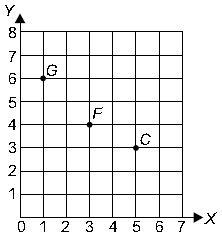
9. The coordinate of F is
(A) (4, 3)
(B) (3, 4)
(C) (3, 3)
(D) (4, 4)
Answer : B
10. The difference between y-coordinate of G and C is
(A) 3
(B) 2
(C) 4
(D) 1
Answer : A
DIRECTION (11-12): The graph shown below exhibits the rate of interest on fixed deposits upto one year announced by the Reserve Bank of India in different years. Read the graph and answer the following questions.
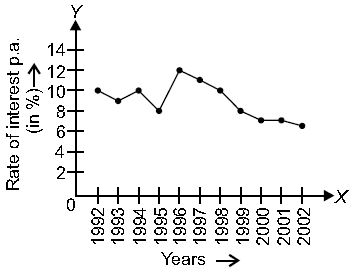
11. The difference between maximum and minimum rate of interest is _______.
(A) 3%
(B) 6%
(C) 4%
(D) 5%
Answer : D
12. The sum of rate of interest in 1993 and 1998 is _______.
(A) 12.5%
(B) 13%
(C) 10%
(D) 19%
Answer : D
DIRECTION (13-15) : A courier person cycles from a town to a neighbouring sub-urban area to deliver a parcel to a merchant. His distance from the town at different times is shown by the following graph.
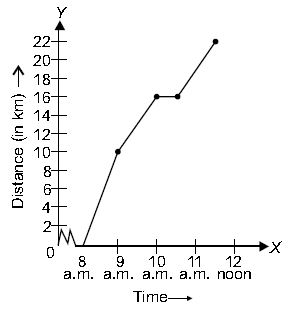
13. How much time did the person take to reach the place of merchant?
(A) 3.5 hours
(B) 2 hours
(C) 1.5 hours
(D) 3 hours
Answer : A
14. How far is the place of merchant from the town?
(A) 19 km
(B) 18 km
(C) 22 km
(D) 20 km
Answer : C
15. During which period did he ride fastest ?
(A) 9 a.m. - 10 a.m.
(B) 10 a.m. - 11 a.m.
(C) 8 a.m. - 9 a.m.
(D) 11 a.m. - 11:30 a.m.
Answer : C
16. The graph shows the temperature forecast and the actual temperature of a city on ten days.
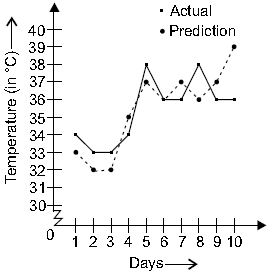
On what day, the graph shows the maximum deviation of actual temperature from the forecast?
(A) Day 10
(B) Day 8
(C) Day 5
(D) Day 4
Answer : A
17. The graph shows the production of cycles (in thousands) of two factories A and B for ten years.
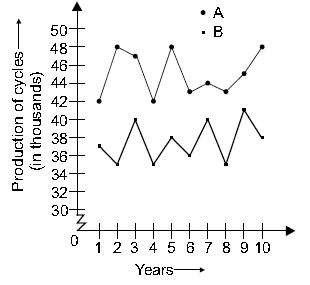
Find the production of cycles of A in the year when combined production of cycles was maximum.
(A) 47 thousands
(B) 48 thousands
(C) 49 thousands
(D) 46 thousands
Answer : A
18. The following graph shows the number of books read by Ashok in a week.
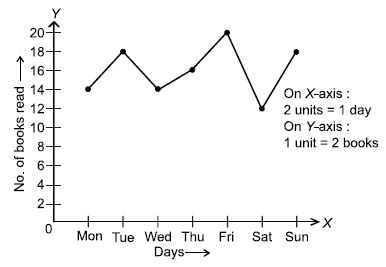
Find the ratio of number of books read on Tuesday and Wednesday together to the total number of books read.
(A) 2 : 7
(B) 3 : 7
(C) 1 : 7
(D) 6 : 7
Answer : A
19. The following graph shows the amount of milk (in litres) that a milkman sold over 10 days.
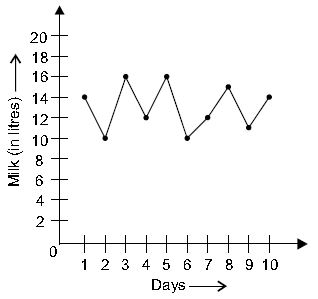
On an average, how much milk he sells every day ?
(A) 10 litres
(B) 12.5 litres
(C) 11 litres
(D) 13 litres
Answer : D
20. Study the graph and answer the questions that follow.
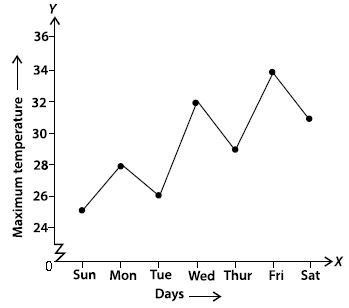
(a) On which day was the temperature 31°C?
(b) On which day was the temperature the least?
(c) Which was the hottest day?
(a) (b) (c)
(A) Saturday Sunday Friday
(B) Sunday Monday Tuesday
(C) Monday Sunday Friday
(D) Wednesday Saturday Wednesday
Answer : A
Question 1. The temperature of a patient, admitted in a hospital taken at different times in a day is given below. Draw the temperature time graph for the data.
| Time (in hrs) | 4:00 | 6:00 | 8:00 | 10:00 | 12:00 | 14:00 | 16:00 | 18:00 |
|---|---|---|---|---|---|---|---|---|
| Temp (in \(^{\circ}\text{F}\)) | 100 | 101 | 104 | 102 | 100 | 99 | 100 | 98 |
Answer:
To draw the temperature-time line graph, follow these steps:
1. Take time along the horizontal axis (X-axis) by choosing a suitable scale (e.g., 1 unit = 2 hours).
2. Take temperature (in \(^{\circ}\text{F}\)) along the vertical axis (Y-axis) by choosing a suitable scale (e.g., 1 unit = 1\(^{\circ}\text{F}\), starting the axis break from 95).
3. Plot the given coordinate points: \((4, 100)\), \((6, 101)\), \((8, 104)\), \((10, 102)\), \((12, 100)\), \((14, 99)\), \((16, 100)\), and \((18, 98)\).
4. Join consecutive points with line segments to obtain the required temperature-time graph.
In simple words: A line graph connects the recorded temperature points plotted against their respective times of the day to show how the patient's fever changed.
Exam Tip: Always label both axes clearly with units and mark equal divisions for the scale.
Question 2. The velocities of a car at various times (in hrs) on a day are given below. Draw the velocity time graph for the above data.
| Time | 5:00 | 5:15 | 5:30 | 5:45 | 6:00 | 6:15 | 6:30 | 6:45 |
|---|---|---|---|---|---|---|---|---|
| Velocity (in km/hr) | 45 | 50 | 60 | 40 | 60 | 70 | 30 | 45 |
Answer:
To draw the velocity-time line graph:
1. Represent time along the X-axis with intervals of 15 minutes.
2. Represent velocity (in km/hr) along the Y-axis choosing a scale like 1 unit = 10 km/hr.
3. Plot the ordered pairs: \((5:00, 45)\), \((5:15, 50)\), \((5:30, 60)\), \((5:45, 40)\), \((6:00, 60)\), \((6:15, 70)\), \((6:30, 30)\), and \((6:45, 45)\).
4. Connect the plotted points with straight line segments.
In simple words: Plot each time and its corresponding car speed on the grid, then connect the dots to see how speed varies over time.
Exam Tip: Ensure time gaps on the X-axis are uniform even if the recorded intervals are equal.
Question 3. The sales of a shopkeeper for eight days of a month in any year is given below. Draw the line graph depicting the above data.
| Date | 01 | 02 | 03 | 04 | 05 | 06 | 07 | 08 |
|---|---|---|---|---|---|---|---|---|
| Sales (in Rs) | 3300 | 3390 | 3450 | 3490 | 3370 | 3470 | 3590 | 4000 |
Answer:
To draw the line graph for sales:
1. Plot the dates (01 to 08) on the horizontal axis (X-axis).
2. Plot the sales amount (in Rs) on the vertical axis (Y-axis), using a suitable scale and axis break if required.
3. Plot the points: \((1, 3300)\), \((2, 3390)\), \((3, 3450)\), \((4, 3490)\), \((5, 3370)\), \((6, 3470)\), \((7, 3590)\), and \((8, 4000)\).
4. Join the points consecutively with line segments.
In simple words: Represent the dates on the bottom axis and sales amounts on the side axis, then connect each day's plotted point to form the trend line.
Exam Tip: When values start high up (like 3300), use a kink (break symbol) on the Y-axis to avoid wasted blank space.
Question 4. The data regarding pressure (in Newton/\(\text{cm}^2\)) and volume (\(\text{km}\cdot\text{cm}^3\)) of a gas are given below.
| Pressure | 67.5 | 71 | 75 | 79.5 | 82.3 | 83.5 | 84.5 |
|---|---|---|---|---|---|---|---|
| Volume | 100 | 95 | 90 | 85 | 82 | 81 | 80 |
Draw a line graph depicting the pressure-volume of the above data.
Answer:
To draw the pressure-volume line graph:
1. Take pressure (in Newton/\(\text{cm}^2\)) along the horizontal axis (X-axis).
2. Take volume along the vertical axis (Y-axis).
3. Plot the given points: \((67.5, 100)\), \((71, 95)\), \((75, 90)\), \((79.5, 85)\), \((82.3, 82)\), \((83.5, 81)\), and \((84.5, 80)\).
4. Connect the plotted points with straight line segments.
In simple words: Plot pressure values on the horizontal line and volume values on the vertical line, then connect the dots to display the inverse relationship.
Exam Tip: Double-check decimal values on the X-axis to ensure proper spacing between points.
Question 5. The runs scored by two teams A and B in first 10 overs are given below
| Overs | I | II | III | IV | V | VI | VII | VIII | IX | X |
|---|---|---|---|---|---|---|---|---|---|---|
| Team A | 4 | 7 | 8 | 6 | 10 | 5 | 8 | 7 | 6 | 5 |
| Team A | 3 | 2 | 10 | 2 | 6 | 3 | 4 | 2 | 6 | 10 |
Draw a graph depicting the data on the same axes in each case.
Answer:
To draw the double line graph for both teams on the same axes:
1. Represent the overs (I to X) along the horizontal axis (X-axis).
2. Represent the runs scored along the vertical axis (Y-axis).
3. Plot the points for Team A and join them with a solid line.
4. Plot the points for Team B on the same set of axes and join them with a dashed or distinct colored line.
5. Include a legend to distinguish between Team A and Team B.
In simple words: Draw two separate line graphs on the exact same grid using different line styles or colors to compare the performance of both cricket teams side by side.
Exam Tip: Always provide a clear legend so the examiner can easily identify which line represents which team.
Free study material for Mathematics
CBSE Class 8 Mathematics Assignments for Chapter 15 Introduction To Graphs
Class 8 Mathematics Chapter 15 Introduction To Graphs Printable Assignments
Explore reliable practice questions for Chapter 15 Introduction To Graphs tailored for Class 8 learners. Use these structured worksheets to evaluate preparedness and strengthen core problem-solving skills.
Maximize Exam Scores with Chapter Practice Sets
- Syllabus Compliance: Sets reflect current CBSE evaluation criteria and official marking frameworks.
- Multi-Format Practice: Includes varied problem types designed to deepen comprehension across all sub-topics.
- Time Management: Routine practice optimizes pacing to finish school examinations comfortably within schedule.
Effective Strategy for Class 8 Mathematics Assignments
- Textbook Review: Always study the core NCERT book for Class 8 Mathematics prior to beginning the assignment.
- Independent Attempt: Solve Chapter 15 Introduction To Graphs questions on your own initially before cross-checking with expert solutions.
- Error Tracking: Record challenging concepts in a dedicated notebook and practice online MCQ tests for revision.
FAQs
You can download free PDF assignments for Class 8 Mathematics Chapter 15 Introduction To Graphs from StudiesToday.com. These practice sheets have been updated for the 2026-27 session covering all concepts from latest NCERT textbook.
Yes, our teachers have given solutions for all questions in the Class 8 Mathematics Chapter 15 Introduction To Graphs assignments. This will help you to understand step-by-step methodology to get full marks in school tests and exams.
Yes. These assignments are designed as per the latest CBSE syllabus for 2026. We have included huge variety of question formats such as MCQs, Case-study based questions and important diagram-based problems found in Chapter 15 Introduction To Graphs.
Practicing topicw wise assignments will help Class 8 students understand every sub-topic of Chapter 15 Introduction To Graphs. Daily practice will improve speed, accuracy and answering competency-based questions.
Yes, all printable assignments for Class 8 Mathematics Chapter 15 Introduction To Graphs are available for free download in mobile-friendly PDF format.