

Class 8 Mathematics Practice Assignments: CBSE Class 8 Mathematics Exponents and Powers Assignments Set 02
Access comprehensive school assignments for Chapter 12 Exponents And Powers using the CBSE Class 8 Mathematics Exponents and Powers Assignments Set 02. Designed to align with the 2026-27 CBSE academic guidelines, these practice sets help Class 8 Mathematics students reinforce core concepts and improve their problem-solving accuracy.
Download Chapter 12 Exponents And Powers Assignment PDF with Solutions
Access the complete assignment PDF for Class 8 Mathematics below. Regular practice with these targeted academic tasks builds familiarity with standard question patterns and helps secure higher marks in final school evaluations.
Question. The value of 22001 + 21999 / 22000 - 21998, is ____.
(A) 2
(B) 10/3
(C) 21000 + 1
(D) 10
Answer : B
Question. When simplified, (x –1 + y –1)–1 is equal to ____.
(A) x + y
(B) xy/x + y
(C) x y
(D) 1/x y
Answer : B
Question. The value of x + x (xx) at x = 2 is ____.
(A) 10
(B) 16
(C) 18
(D) 36
Answer : A
Question. If ax = by = cz and b2 = ac, then y equals
(A) 2xz/x + z
(B) xz/2(x − z)
(C) xz/2(z − x)
(D) 2xz/(x − z)
Answer : A
Question. Find x, if (5/11)-3 x (5/11)5 = (5/11)x.
(A) 3
(B) 4
(C) 8
(D) 2
Answer : D
Question. The size of a red blood cell is 0.000007 m and the size of a plant cell is 0.00001275 m.
Find the ratio of the size of red blood cell to that of plant cell.
(A) 13 : 56
(B) 28 : 51
(C) 31 : 39
(D) 22 : 31
Answer : B
Question. Pluto is 5913000000 km away from the Sun.
Express this distance in standard form.
(A) 5.913 × 10⁻¹¹
(B) 5.913 × 10⁻⁹
(C) 5.913 × 10⁶
(D) 5.913 × 10⁹
Answer : D
Question. Solve for y, if
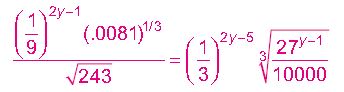
(A) 1/2
(B) −19/18
(C) 3/10
(D) 12/17
Answer : B
Question. Simplify :
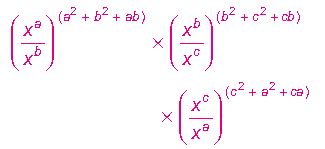
(A) 1
(B) (a + b + c)3
(C) a2 + b2 + c2
(D) 0
Answer : A
Question. If (6x)6 = 623 = then find the value of x.
(A) 1
(B) √6
(C) 3√6
(D) 6√6
Answer : C
Question. Find the value of (0.000064)5/6 ÷ (0.00032)6/5 .
(A) 0.2
(B) 0.4
(C) 5
(D) 2.5
Answer : C
Question. The value of (7–1 – 8–1)–1 – (3–1 – 4–1)–1 is
(A) 56
(B) 12
(C) 68
(D) 44
Answer : C
Question. When 5 × 10⁻³ – 2000 × 10–6 is expressed in standard form, we will get
(A) 3 × 10⁻²
(B) 3 × 10⁻³
(C) 3 × 10³
(D) 3 × 10²
Answer : B
Question. If 3(x – y) = 27 and 3(x + y) = 243, then x is equal to _______.
(A) 0
(B) 2
(C) 4
(D) 6
Answer : C
Question. Number of prime factors in (216)3/5 x (2500)2/5 x (300)1/5 is _______.
(A) 6
(B) 9
(C) 8
(D) None of these
Answer : D
Question. Match the following.
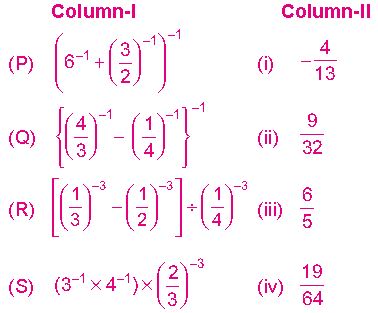
(A) (P) → (iii); (Q) → (i); (R) → (iv); (S) → (ii)
(B) (P) → (iv); (Q) → (i); (R) → (ii); (S) → (iii)
(C) (P) → (ii); (Q) → (iii); (R) → (iv); (S) → (i)
(D) (P) → (iii); (Q) → (i); (R) → (ii); (S) → (iv)
Answer : A
Question. If x = (3/2)2 x (2/3)-4, find the value of x–2.
(A) (4/3)12
(B) (2/3)12
(C) (3/2)12
(D) (3/4)12
Answer : B
Question. Fill in the blanks.
(i) If m2 = 272/3 × 16–3/2, then m = P
(ii) If ab = 1, then 1/1+1a-1 + 1/1 + b-1 = Q
(iii) If x = (82/3 · 32–2/5), then x–5 = R
P Q R
(A) 5/4 0 10/7
(B) 1 1 5/16
(C) 3/8 1 1
(D) 7/8 0 7/8
Answer : C
Question. If 10/3 × 3x – 3x – 1 = 81, then the value of x is ____.
(A) 2
(B) 1
(C) 3
(D) 0
Answer : C
Question. Which of the following values are equal ?
P. 14 Q. 40
R. 04 S. 41
(A) P and Q
(B) Q and R
(C) P and R
(D) P and S
Answer : A
Question. The cell of bacteria doubles itself after every 1 hour. How many cells will there be after 8 hours?
(A) 200 times of the original
(B) 210 times of the original
(C) 28 times of the original
(D) 26 times of the original
Answer : C
19. At the end of the 20th century, the world’s population was approximately 6.125 × 10⁹.
Express this population in usual form.
(A) 6.125 × 10¹⁰
(B) 6125000000
(C) 6125 × 105
(D) 61250000
Answer : B
Question. Weight of moon is (7.346 × 10²²) kg and weight of Earth is (5.9724 × 1024) kg. What is the total weight of both in standard form?
(A) 6.04 × 1024 kg
(B) 7.08 × 10²² kg
(C) 5.98 × 1024 kg
(D) 6.44 × 1024 kg
Answer : A
Question. Simplify :
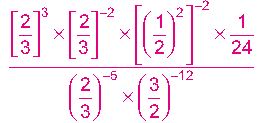
(A) (2/3)-4
(B) 32/3
(C) 243/16
(D) 243/32
Answer : D
Question. If a = (2–2 – 2–3), b = (2–3 – 2–4) and c =(2–4 – 2–2) then find :
(i) a3 + b3 + c3 (ii) 10 abc
(i) (ii)
(A) 9/2048 7/2048
(B) 3/1024 5/2048
(C) –3/1024 –10/2048
(D) –9/2048 –15/1024
Answer : D
M.C.Q
Choose the correct option from the following four alternative answers.
Question 1. \((27)^{-\frac{4}{3}}\), its simplified form is
(i) \(\frac{1}{81}\)
(ii) \(81\)
(iii) \(\frac{1}{9}\)
(iv) \(\frac{1}{27}\)
Answer: (i) \(\frac{1}{81}\)
\((27)^{-\frac{4}{3}} = (3^3)^{-\frac{4}{3}}\)
\(= 3^{3 \times \left(-\frac{4}{3}\right)}\)
\(= 3^{-4} = \frac{1}{3^4} = \frac{1}{81}\)
In simple words: Write 27 as \(3^3\) and multiply the powers to get \(3^{-4}\), which becomes \(\frac{1}{81}\).
Exam Tip: Always express numbers in base form (prime factorization) before applying exponent laws like \((a^m)^n = a^{m \times n}\).
Question 2. \(\frac{a^m \times a^n}{a^p}\) can be rewritten as
(i) \(a^{m-p-n}\)
(ii) \(a^{m+n-p}\)
(iii) \(a^{p-m+n}\)
(iv) \(a^{p-m-n}\)
Answer: (ii) \(a^{m+n-p}\)
Using laws of exponents: \(a^m \times a^n = a^{m+n}\)
\(\frac{a^{m+n}}{a^p} = a^{(m+n) - p} = a^{m+n-p}\)
In simple words: Add exponents when multiplying terms with the same base, and subtract the exponent of the denominator when dividing.
Exam Tip: Remember the product rule \(a^m \times a^n = a^{m+n}\) and quotient rule \(\frac{a^m}{a^n} = a^{m-n}\).
Question 3. \(a^{\frac{m}{n}}\) can be written as
(i) \(\sqrt[n]{a}\)
(ii) \(\sqrt[m]{a^n}\)
(iii) \(\sqrt[n]{a^m}\)
(iv) \(a^{-n}\)
Answer: (iii) \(\sqrt[n]{a^m}\)
By definition of fractional exponents: \(a^{\frac{m}{n}} = (a^m)^{\frac{1}{n}} = \sqrt[n]{a^m}\)
In simple words: The numerator of a fractional exponent acts as a power, and the denominator acts as a root.
Exam Tip: The denominator of the exponent always goes into the index of the radical root.
Question 4. If \(a^x = 1\), the value of \(x\) is
(i) \(1\)
(ii) \(-1\)
(iii) \(a\)
(iv) \(0\)
Answer: (iv) \(0\)
Any non-zero base raised to the power of zero is equal to 1, i.e., \(a^0 = 1\) (where \(a \neq 0\)).
In simple words: Any number (except 0) raised to the power zero gives 1.
Exam Tip: Do not confuse this with \(a^1 = a\). Zero exponent always yields 1.
Question 5. The value of \(\left(\frac{1}{216}\right)^{-\frac{2}{3}}\) is
(i) \(36\)
(ii) \(\frac{1}{36}\)
(iii) \(6\)
(iv) \(\frac{1}{6}\)
Answer: (i) \(36\)
\(\left(\frac{1}{216}\right)^{-\frac{2}{3}} = (216)^{\frac{2}{3}}\)
\(= (6^3)^{\frac{2}{3}}\)
\(= 6^{3 \times \frac{2}{3}} = 6^2 = 36\)
In simple words: Flip the fraction to make the negative power positive, write 216 as \(6^3\), and simplify.
Exam Tip: A negative exponent can be eliminated by taking the reciprocal of the base: \(\left(\frac{a}{b}\right)^{-m} = \left(\frac{b}{a}\right)^m\).
Question 6. The value of \(2^{2^{2^2}}\) is
(i) \(2^8\)
(ii) \(2^{16}\)
(iii) \(2^{32}\)
(iv) \(4\)
Answer: (ii) \(2^{16}\)
Evaluate the tower of exponents from top to bottom:
Innermost exponent: \(2^2 = 4\)
Next level: \(2^4 = 16\)
Final expression: \(2^{16}\)
In simple words: Solve exponent towers from the top down. Here, \(2^2 = 4\), then \(2^4 = 16\), so the answer is \(2^{16}\).
Exam Tip: Do not multiply the base exponents directly when dealing with exponent towers; evaluate from top to bottom.
Question 7. Write \(\sqrt[8]{2^{-3}}\) in exponent form with positive power.
(i) \(2^{\frac{3}{8}}\)
(ii) \(\frac{8}{2^3}\)
(iii) \(\frac{1}{2^{\frac{3}{8}}}\)
(iv) \(\frac{1}{\frac{8}{2^3}}\)
Answer: (iii) \(\frac{1}{2^{\frac{3}{8}}}\)
\(\sqrt[8]{2^{-3}} = (2^{-3})^{\frac{1}{8}} = 2^{-\frac{3}{8}}\)
To make the power positive, take the reciprocal: \(\frac{1}{2^{\frac{3}{8}}}\)
In simple words: Convert the root to a fractional power \(-\frac{3}{8}\), then move it to the denominator to make the power positive.
Exam Tip: \(\sqrt[n]{a^m} = a^{\frac{m}{n}}\), and \(a^{-m} = \frac{1}{a^m}\).
Question 8. The value of \((2^3)^2\) is
(i) \(2^9\)
(ii) \(\frac{1}{2^9}\)
(iii) \(2^5\)
(iv) \(2^6\)
Answer: (iv) \(2^6\)
Using the power of a power rule \((a^m)^n = a^{m \times n}\):
\((2^3)^2 = 2^{3 \times 2} = 2^6\)
In simple words: Multiply the powers together when an exponent is raised to another exponent.
Exam Tip: \((a^m)^n\) means multiply powers (\(m \times n\)), whereas \(a^m \times a^n\) means add powers (\(m + n\)).
Question 9. The value of \((1^2 + 2^2 + 3^2)^2\) is
(i) \(14^2\)
(ii) \(6^4\)
(iii) \(6^2\)
(iv) \(14\) क्विंटल (or 14)
Answer: (i) \(14^2\)
Evaluate inside the parentheses:
\(1^2 + 2^2 + 3^2 = 1 + 4 + 9 = 14\)
Now apply the outer square: \((14)^2 = 14^2\)
In simple words: First calculate the sum inside the bracket (\(1+4+9 = 14\)), then square the result.
Exam Tip: Always simplify expressions inside brackets completely before applying outer exponents.
Question 10. The value of \(x^{a-b} \times x^{b-c} \times x^{c-a}\) is
(i) \(x\)
(ii) \(1\)
(iii) \(x^{2a+2b+2c}\)
(iv) \(x^{a+b+c}\)
Answer: (ii) \(1\)
Since the bases are the same, add all the exponents:
\(x^{(a-b) + (b-c) + (c-a)}\)
\(= x^{a - b + b - c + c - a}\)
\(= x^0 = 1\)
In simple words: When multiplying identical bases, add all exponents together. All terms cancel out to 0, giving \(x^0 = 1\).
Exam Tip: Cyclic algebraic sums in exponents often cancel out to zero when multiplied.
Free study material for Mathematics
CBSE Class 8 Mathematics Assignments for Chapter 12 Exponents And Powers
Chapter Practice Questions for Class 8 Mathematics
Review targeted chapter assignments for Class 8 Mathematics Chapter 12 Exponents And Powers. Built according to official CBSE guidelines, these downloadable problem sets help students build accuracy and prepare effectively for school tests.
Key Advantages of Solving Chapter 12 Exponents And Powers Assignments
- Curriculum Standards: Assignments match modern CBSE sample formats to ensure relevant preparation.
- Thorough Revision: Detailed problem sets reinforce core concepts and eliminate conceptual weak spots.
- Execution Speed: Timed practice with assignment sets sharpens overall response timing.
How to Approach Mathematics Chapter 12 Exponents And Powers Assignments
- Initial Reading: Begin by reading the NCERT book for Class 8 Mathematics to build a baseline understanding.
- Independent Testing: Attempt assignment questions unassisted, then verify work using provided answer keys.
- Supplementary Aids: Leverage revision notes and worksheets whenever you encounter difficult topics.
FAQs
You can download free PDF assignments for Class 8 Mathematics Chapter 12 Exponents And Powers from StudiesToday.com. These practice sheets have been updated for the 2026-27 session covering all concepts from latest NCERT textbook.
Yes, our teachers have given solutions for all questions in the Class 8 Mathematics Chapter 12 Exponents And Powers assignments. This will help you to understand step-by-step methodology to get full marks in school tests and exams.
Yes. These assignments are designed as per the latest CBSE syllabus for 2026. We have included huge variety of question formats such as MCQs, Case-study based questions and important diagram-based problems found in Chapter 12 Exponents And Powers.
Practicing topicw wise assignments will help Class 8 students understand every sub-topic of Chapter 12 Exponents And Powers. Daily practice will improve speed, accuracy and answering competency-based questions.
Yes, all printable assignments for Class 8 Mathematics Chapter 12 Exponents And Powers are available for free download in mobile-friendly PDF format.