

Official CBSE Assignments for Class 8 Mathematics
Access comprehensive school assignments for Chapter 09 Algebraic Expressions And Identities using the CBSE Class 8 Mathematics Algebraic Expressions and Identities Assignment Set 01. Designed to align with the 2026-27 CBSE academic guidelines, these practice sets help Class 8 Mathematics students reinforce core concepts and improve their problem-solving accuracy.
Solved Practice Assignments for Mathematics
Navigate directly to the solved Mathematics assignments using the digital viewer below. Each practice set includes detailed step-by-step solutions, allowing students to instantly cross-check their work and identify areas requiring further revision.
Very Short Answer type Questions
Question. If a = 3, b = 4 and x = 5. Find the value of (x + a) (x + b),
Answer : 72
Question. Simplify 4x2 - 9y2 / 2x + 3y
Answer : 2x – 3y
Question. Find (3pq + 4q)2 – (3pq – 4q)2.
Answer : 48pq2
Question. Find the value of (2/3 m - 3/2n)2 + 2mn
Answer : 4/9m2 + 9/4n2
Question. What should be added to a2 + b2 to get (a – b)2.
Answer : –2ab
Question. Find the product of (t + s2) (t2 – s).
Answer : t3 + t2s2 – st – s3
Question. Find the product of (4m + 3) (4m + 1)
Answer : 16m2 + 16m + 3
Question. Simplify 9x2 + 16y2 + 24xy / 3x + 4y
Answer : 3x + 4y
Question. Find the product of (xyz – 3) (xyz – 2).
Answer : x2y2z2 – 5xyz + 6
Question. Simplify : (2x + 5)2 – (2x – 5)2.
Answer : 40x
Question. Simplify : (m2 + 9) (m2 – 9) + 81.
Answer : m4
Question. Multiply : (2.5m – 0.5n) (2.5m + 0.5n).
Answer : 6.25m2 – 0.25n2
Question. Multiply : (a + 1) (a + 2)
Answer : a2 + 3a + 2
Question. Simplify 6.25m2 - 2.25n2 / 2.5m - 1.5n
Answer : 2.5m + 1.5n
Question. Find the value of (4.9)2.
Answer : 24.01

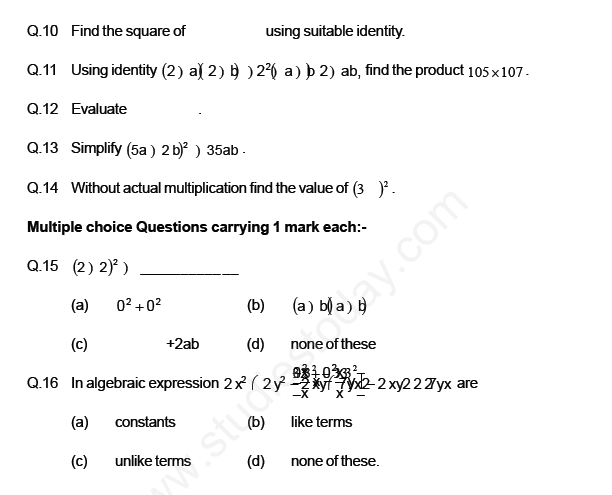
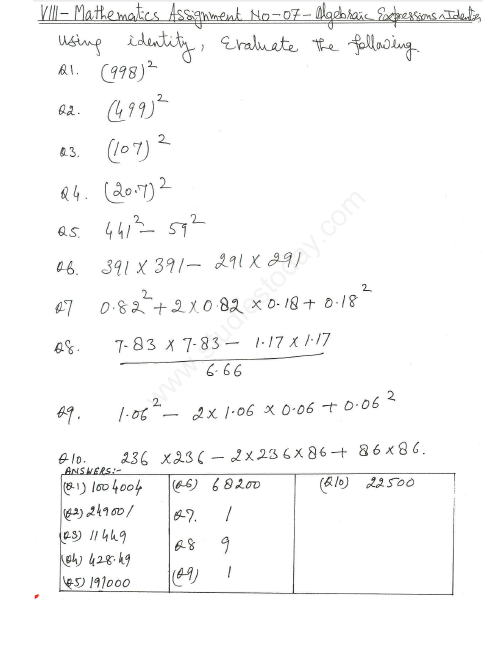
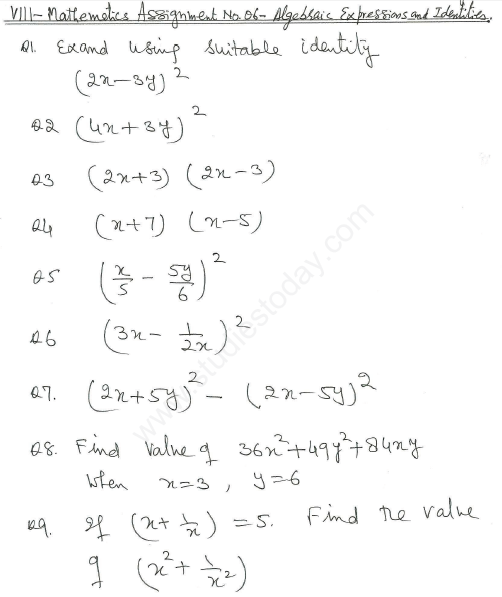
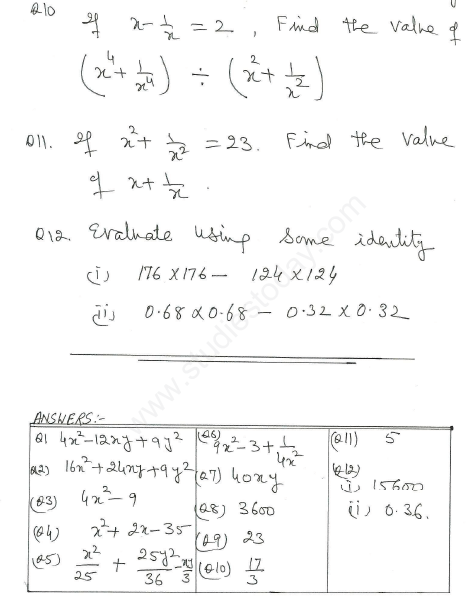
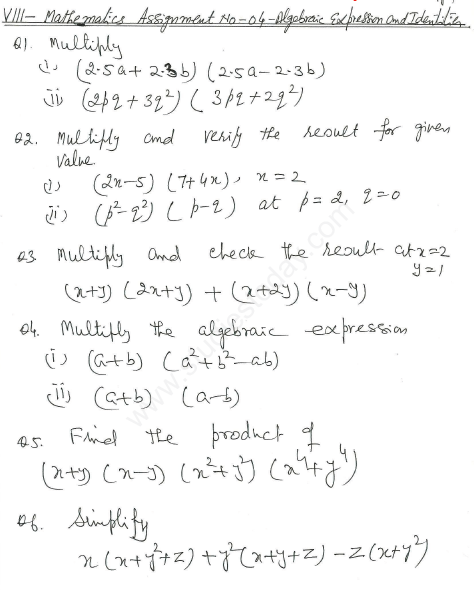
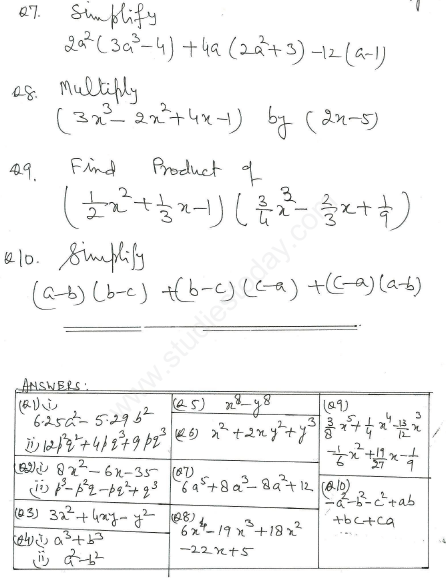
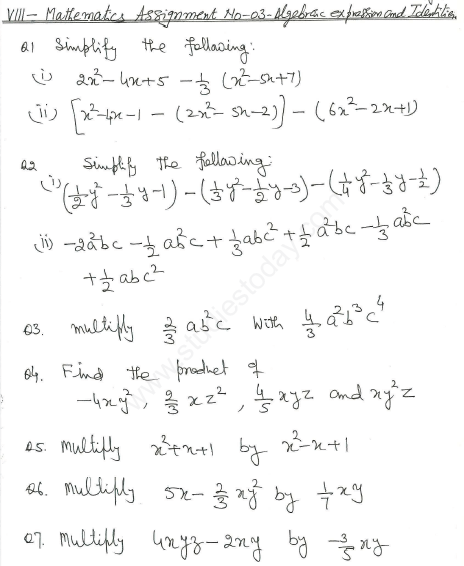
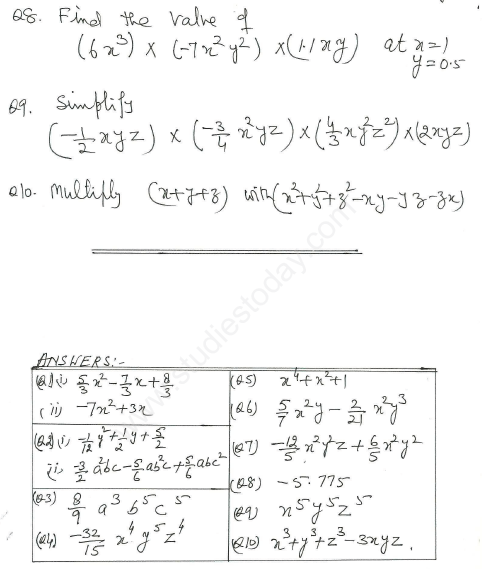
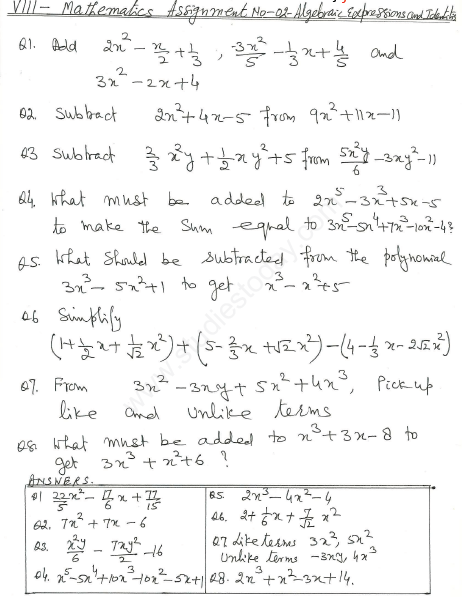
Algebraic Expressions and Identities
Question 1. Using identity \((x - a)(x + a) = x^2 - a^2\) find \(6^2 - 5^2\).
Answer: Given expression: \(6^2 - 5^2\)
Comparing with \(x^2 - a^2 = (x - a)(x + a)\), where \(x = 6\) and \(a = 5\).
\(6^2 - 5^2 = (6 - 5)(6 + 5)\)
\(= (1)(11)\)
\(= 11\)
In simple words: Apply the difference of squares identity by subtracting and adding the two numbers, then multiply the results.
Exam Tip: Recognize that \(x^2 - a^2\) can be factored directly to save calculation time over squaring large numbers.
Question 2. Find the product of \((7x - 4y)\) and \((3x - 7y)\).
Answer: Product \(= (7x - 4y)(3x - 7y)\)
\(= 7x(3x - 7y) - 4y(3x - 7y)\)
\(= (7x \cdot 3x) + (7x \cdot (-7y)) + (-4y \cdot 3x) + (-4y \cdot (-7y))\)
\(= 21x^2 - 49xy - 12xy + 28y^2\)
\(= 21x^2 - 61xy + 28y^2\)
In simple words: Multiply each term of the first binomial by each term of the second binomial and combine like terms.
Exam Tip: Be careful with negative signs when distributing terms across subtraction.
Question 3. Using suitable identity find \((a + 3)(a + 2)\).
Answer: Using identity \((x + a)(x + b) = x^2 + (a + b)x + ab\)
Here, \(x = a\), \(a = 3\), and \(b = 2\).
\((a + 3)(a + 2) = a^2 + (3 + 2)a + (3)(2)\)
\(= a^2 + 5a + 6\)
In simple words: Use the algebraic identity for the product of two binomials with a common term.
Exam Tip: Memorize the standard product identity \((x + a)(x + b)\) to quickly expand binomial products.
Question 4. Using identity \((a + b)^2 = a^2 + 2ab + b^2\) find the value of \(103^2\).
Answer: Express \(103\) as \((100 + 3)\).
\(103^2 = (100 + 3)^2\)
Using \((a + b)^2 = a^2 + 2ab + b^2\) with \(a = 100\) and \(b = 3\):
\(= (100)^2 + 2(100)(3) + (3)^2\)
\(= 10000 + 600 + 9\)
\(= 10609\)
In simple words: Split the number into a round base of ten and a small integer, then expand using the square of a binomial.
Exam Tip: Always choose the base as a multiple of 10 or 100 to make mental multiplication easy.
Question 5. Using identity \((a - b)^2 = a^2 - 2ab + b^2\) find the value of \(98^2\).
Answer: Express \(98\) as \((100 - 2)\).
\(98^2 = (100 - 2)^2\)
Using \((a - b)^2 = a^2 - 2ab + b^2\) with \(a = 100\) and \(b = 2\):
\(= (100)^2 - 2(100)(2) + (2)^2\)
\(= 10000 - 400 + 4\)
\(= 9600 + 4\)
\(= 9604\)
In simple words: Write the number as a subtraction from a neat power of ten and apply the square formula.
Exam Tip: Double-check subtraction signs when expanding the middle term in the minus identity.
Question 6. Using identity find \((2x + 3)^2\).
Answer: Using identity \((a + b)^2 = a^2 + 2ab + b^2\) with \(a = 2x\) and \(b = 3\):
\((2x + 3)^2 = (2x)^2 + 2(2x)(3) + (3)^2\)
\(= 4x^2 + 12x + 9\)
In simple words: Square the first term, add twice the product of both terms, and square the last term.
Exam Tip: Remember to square both the coefficient and the variable when evaluating \((2x)^2\).
Question 7. Subtract \(7x - 3x^2\) from \(4x + 8x^2\).
Answer: Setup the subtraction expression: \((4x + 8x^2) - (7x - 3x^2)\)
Remove parentheses by distributing the negative sign:
\(= 4x + 8x^2 - 7x + 3x^2\)
Group like terms together:
\(= (8x^2 + 3x^2) + (4x - 7x)\)
\(= 11x^2 - 3x\)
In simple words: Place the second expression first, change all signs inside the subtracted expression, and combine like terms.
Exam Tip: The phrase "subtract A from B" means write it as \((B - A)\).
Question 8. Using suitable identity find \((7x - 3y)^2\).
Answer: Using identity \((a - b)^2 = a^2 - 2ab + b^2\) with \(a = 7x\) and \(b = 3y\):
\((7x - 3y)^2 = (7x)^2 - 2(7x)(3y) + (3y)^2\)
\(= 49x^2 - 42xy + 9y^2\)
In simple words: Apply the binomial square subtraction identity carefully.
Exam Tip: Ensure the product term includes both variables \(x\) and \(y\).
Question 9. Add \(4x^2 + 2xy - 4\) and \(7x^2 - 3xy + 4\).
Answer: Write the addition expression: \((4x^2 + 2xy - 4) + (7x^2 - 3xy + 4)\)
Group like terms:
\(= (4x^2 + 7x^2) + (2xy - 3xy) + (-4 + 4)\)
\(= 11x^2 - xy + 0\)
\(= 11x^2 - xy\)
In simple words: Combine the coefficients of identical variable terms and constant terms.
Exam Tip: Constant terms that add up to zero disappear from the final expression.
Question 10. Find the product of \(4x\), \(7x^2\), \(-2x\).
Answer: Multiply the numerical coefficients and the variables separately:
\(= (4 \cdot 7 \cdot -2) \cdot (x \cdot x^2 \cdot x)\)
\(= -56 \cdot x^{1 + 2 + 1}\)
\(= -56x^4\)
In simple words: Multiply all numbers together and add the exponents of the variable \(x\).
Exam Tip: Use the law of exponents \(x^a \cdot x^b = x^{a+b}\) when multiplying identical bases.
Question 11. Find the product of \((x^2 - y^2)(2x + y)\).
Answer: Distribute each term of the first binomial across the second binomial:
\(= x^2(2x + y) - y^2(2x + y)\)
\(= (2x^3 + x^2y) - (2xy^2 + y^3)\)
\(= 2x^3 + x^2y - 2xy^2 - y^3\)
In simple words: Multiply every term in the first bracket by every term in the second bracket.
Exam Tip: Check that all four distinct product terms are fully simplified with no like terms remaining.
Question 12. Simplify: \((xy + yz)^2 - (xy - yz)^2\)
Answer: Method 1 (Using identity \(a^2 - b^2 = (a - b)(a + b)\)):
Let \(A = (xy + yz)\) and \(B = (xy - yz)\).
\(A^2 - B^2 = [ (xy + yz) - (xy - yz) ] [ (xy + yz) + (xy - yz) ]\)
\(= [ xy + yz - xy + yz ] [ xy + yz + xy - yz ]\)
\(= [ 2yz ] [ 2xy ]\)
\(= 4xy^2z\)
In simple words: Use the difference of two squares identity to factor and simplify the expression rapidly.
Exam Tip: Applying the difference of squares identity avoids the lengthy process of expanding both squares individually.
Question 13. Using identity find the product of \(\left(\frac{a}{2} + \frac{3b}{4}\right)\left(\frac{a}{2} + \frac{3b}{4}\right)\)
Answer: The expression can be written as \(\left(\frac{a}{2} + \frac{3b}{4}\right)^2\).
Using identity \((x + y)^2 = x^2 + 2xy + y^2\):
\(= \left(\frac{a}{2}\right)^2 + 2\left(\frac{a}{2}\right)\left(\frac{3b}{4}\right) + \left(\frac{3b}{4}\right)^2\)
\(= \frac{a^2}{4} + \frac{3ab}{4} + \frac{9b^2}{16}\)
In simple words: Square the binomial expression by applying the standard sum-of-squares formula with fractions.
Exam Tip: Remember to square both the numerator and the denominator of each fractional term.
Question 14. Multiply: \((a^2 + 2c^2)(3a - 3c)\)
Answer: Multiply each term of the first factor by each term of the second factor:
\(= a^2(3a - 3c) + 2c^2(3a - 3c)\)
\(= (3a^3 - 3a^2c) + (6ac^2 - 6c^3)\)
\(= 3a^3 - 3a^2c + 6ac^2 - 6c^3\)
In simple words: Distribute both terms across the second polynomial and collect the resulting terms.
Exam Tip: Ensure all variables maintain correct alphabetical ordering in each term.
Question 15. Simplify: \((x + y)(2x - 3y + z) - (2x - 3y)z\)
Answer: Expand the first product: \(x(2x - 3y + z) + y(2x - 3y + z)\)
\(= 2x^2 - 3xy + zx + 2xy - 3y^2 + yz\)
Expand the second part: \(-(2x - 3y)z = -2xz + 3yz\)
Combine all expanded parts:
\(= 2x^2 - 3xy + xz + 2xy - 3y^2 + yz - 2xz + 3yz\)
Combine like terms:
\(x^2\text{ term: } 2x^2\)
\(xy\text{ terms: } -3xy + 2xy = -xy\)
\(y^2\text{ term: } -3y^2\)
\(xz\text{ terms: } xz - 2xz = -xz\)
\(yz\text{ terms: } yz + 3yz = 4yz\)
Final expression: \(= 2x^2 - xy - 3y^2 - xz + 4yz\)
In simple words: Expand both parts completely and carefully combine all like terms.
Exam Tip: Group terms by variable combinations to avoid missing any terms during simplification.
Question 16. Subtract \(3x(x - 4y + 5z)\) from \(4x(2x - 3y + 10z)\).
Answer: First, expand both expressions:
First expression \(= 4x(2x - 3y + 10z) = 8x^2 - 12xy + 40xz\)
Second expression \(= 3x(x - 4y + 5z) = 3x^2 - 12xy + 15xz\)
Perform the subtraction: \((8x^2 - 12xy + 40xz) - (3x^2 - 12xy + 15xz)\)
\(= 8x^2 - 12xy + 40xz - 3x^2 + 12xy - 15xz\)
Combine like terms:
\(= (8x^2 - 3x^2) + (-12xy + 12xy) + (40xz - 15xz)\)
\(= 5x^2 + 0 + 25xz\)
\(= 5x^2 + 25xz\)
In simple words: Expand both products first, then subtract the second polynomial from the first by reversing signs.
Exam Tip: Notice that the \(-12xy\) and \(+12xy\) terms cancel each other out completely.
Question 17. Simplify: \((x^2 - y^2)^2\)
Answer: Using identity \((a - b)^2 = a^2 - 2ab + b^2\) with \(a = x^2\) and \(b = y^2\):
\((x^2 - y^2)^2 = (x^2)^2 - 2(x^2)(y^2) + (y^2)^2\)
\(= x^4 - 2x^2y^2 + y^4\)
In simple words: Apply the square of a difference identity, remembering to multiply exponents when raising a power to a power.
Exam Tip: \((x^2)^2 = x^4\) by the power rule of exponents.
Question 18. Using suitable identity find the product of \(\left(\frac{2}{3}x - 5\right)\left(\frac{2}{3}x + 5\right)\).
Answer: Using identity \((a - b)(a + b) = a^2 - b^2\) with \(a = \frac{2}{3}x\) and \(b = 5\):
\(\left(\frac{2}{3}x - 5\right)\left(\frac{2}{3}x + 5\right) = \left(\frac{2}{3}x\right)^2 - (5)^2\)
\(= \frac{4}{9}x^2 - 25\)
In simple words: Use the difference of squares identity since the terms in both brackets are identical except for the middle sign.
Exam Tip: Square both the numerator and denominator of the fraction \(\frac{2}{3}\) to get \(\frac{4}{9}\).
Question 19. Simplify \(3a(4a - 5) + 3\) and find its value for \(a = 3\).
Answer: Expand the expression:
\(3a(4a - 5) + 3 = 12a^2 - 15a + 3\)
Substitute \(a = 3\) into the simplified expression:
\(= 12(3)^2 - 15(3) + 3\)
\(= 12(9) - 45 + 3\)
\(= 108 - 45 + 3\)
\(= 63 + 3\)
\(= 66\)
In simple words: Expand the bracket first, then substitute the given numerical value for the variable.
Exam Tip: Always simplify the algebraic expression before plugging in values to minimize arithmetic errors.
Question 20. Using suitable identity find \(\left(6x^2 - \frac{5}{3}\right)^2\).
Answer: Using identity \((a - b)^2 = a^2 - 2ab + b^2\) with \(a = 6x^2\) and \(b = \frac{5}{3}\):
\(\left(6x^2 - \frac{5}{3}\right)^2 = (6x^2)^2 - 2(6x^2)\left(\frac{5}{3}\right) + \left(\frac{5}{3}\right)^2\)
\(= 36x^4 - 2(2x^2)(5) + \frac{25}{9}\)
\(= 36x^4 - 20x^2 + \frac{25}{9}\)
In simple words: Apply the binomial square subtraction formula, simplifying the middle term's fraction.
Exam Tip: Cancel common factors in the middle term before multiplying coefficients.
Question 21. Using identity \(a^2 - b^2 = (a + b)(a - b)\), find \((1.02)^2 - (0.98)^2\).
Answer: Let \(a = 1.02\) and \(b = 0.98\).
\((1.02)^2 - (0.98)^2 = (1.02 + 0.98)(1.02 - 0.98)\)
\(= (2.00)(0.04)\)
\(= 2 \cdot 0.04\)
\(= 0.08\)
In simple words: Factor the difference of squares into the sum and difference of the two decimals, then multiply.
Exam Tip: This identity turns a difficult decimal squaring problem into simple addition and subtraction.
Question 22. Using \((x + a)(x + b) = x^2 + (a + b)x + ab\) find \(105 \times 107\).
Answer: Express \(105 \times 107\) as \((100 + 5)(100 + 7)\).
Here, \(x = 100\), \(a = 5\), and \(b = 7\).
\((100 + 5)(100 + 7) = (100)^2 + (5 + 7)(100) + (5)(7)\)
\(= 10000 + (12)(100) + 35\)
\(= 10000 + 1200 + 35\)
\(= 11235\)
In simple words: Write both numbers as a base of one hundred plus their offsets, then apply the binomial product identity.
Exam Tip: Choosing 100 as the common term makes multiplication by powers of ten effortless.
Question 23. Using identity find the value of \((7.2)^2\).
Answer: Express \(7.2\) as \((7 + 0.2)\).
\((7.2)^2 = (7 + 0.2)^2\)
Using \((a + b)^2 = a^2 + 2ab + b^2\) with \(a = 7\) and \(b = 0.2\):
\(= (7)^2 + 2(7)(0.2) + (0.2)^2\)
\(= 49 + 2.8 + 0.04\)
\(= 51.84\)
In simple words: Split the decimal into an integer and fractional part, then use the square of a sum identity.
Question 24. Using identity evaluate \(297 \times 303\).
Answer: Express numbers around a common base: \(297 = 300 - 3\) and \(303 = 300 + 3\).
\(297 \times 303 = (300 - 3)(300 + 3)\)
Using identity \((a - b)(a + b) = a^2 - b^2\) with \(a = 300\) and \(b = 3\):
\(= (300)^2 - (3)^2\)
\(= 90000 - 9\)
\(= 89991\)
In simple words: Write the expression as the product of a sum and difference from 300.
Exam Tip: Recognizing equidistant numbers allows direct application of the difference of squares identity.
Question 25. Using identity find the value of \((4.7)^2\).
Answer: Express \(4.7\) as \((5 - 0.3)\).
\((4.7)^2 = (5 - 0.3)^2\)
Using \((a - b)^2 = a^2 - 2ab + b^2\) with \(a = 5\) and \(b = 0.3\):
\(= (5)^2 - 2(5)(0.3) + (0.3)^2\)
\(= 25 - 3 + 0.09\)
\(= 22 + 0.09\)
\(= 22.09\)
In simple words: Represent the decimal as a subtraction from a whole integer and apply the binomial square formula.
Exam Tip: Squaring \(0.3\) gives \(0.09\), not \(0.9\).
Question 26. Simplify \(\left(\frac{5}{3}x + \frac{3}{4}y\right)^2 - \left(\frac{5}{3}x - \frac{3}{4}y\right)^2\) and also evaluate it when \(x = 2\) and \(y = -1\).
Answer: Let \(A = \left(\frac{5}{3}x + \frac{3}{4}y\right)\) and \(B = \left(\frac{5}{3}x - \frac{3}{4}y\right)\).
Using \(A^2 - B^2 = (A - B)(A + B)\):
\(= \left[ \left(\frac{5}{3}x + \frac{3}{4}y\right) - \left(\frac{5}{3}x - \frac{3}{4}y\right) \right] \left[ \left(\frac{5}{3}x + \frac{3}{4}y\right) + \left(\frac{5}{3}x - \frac{3}{4}y\right) \right]\)
\(= \left[ \frac{5}{3}x + \frac{3}{4}y - \frac{5}{3}x + \frac{3}{4}y \right] \left[ \frac{5}{3}x + \frac{3}{4}y + \frac{5}{3}x - \frac{3}{4}y \right]\)
\(= \left[ \frac{6}{4}y \right] \left[ \frac{10}{3}x \right]\)
\(= \left( \frac{3}{2}y \right) \left( \frac{10}{3}x \right)\)
\(= \frac{3 \cdot 10}{2 \cdot 3}xy\)
\(= 5xy\)
Now, evaluate for \(x = 2\) and \(y = -1\):
\(= 5(2)(-1)\)
\(= -10\)
In simple words: Simplify the difference of two squared binomials using the algebraic difference of squares identity before substituting values.
Exam Tip: Factoring first reduces a massive expansion involving fractions into a simple single-term product.
Question 27. Simplify \((xy + yz)^2 - 2x^2y^2z\). Find the value when \(x = -1\), \(y = 1\) and \(z = 2\).
Answer: Expand \((xy + yz)^2\):
\((xy + yz)^2 = (xy)^2 + 2(xy)(yz) + (yz)^2\)
\(= x^2y^2 + 2xy^2z + y^2z^2\)
Substitute into the full expression:
\(= x^2y^2 + 2xy^2z + y^2z^2 - 2x^2y^2z\)
Notice there are no like terms to combine further, so the simplified expression is:
\(= x^2y^2 + 2xy^2z + y^2z^2 - 2x^2y^2z\)
Now substitute \(x = -1\), \(y = 1\), and \(z = 2\):
\(= (-1)^2(1)^2 + 2(-1)(1)^2(2) + (1)^2(2)^2 - 2(-1)^2(1)^2(2)\)
\(= (1)(1) + 2(-1)(1)(4) + (1)(4) - 2(1)(1)(2)\)
\(= 1 - 8 + 4 - 4\)
\(= -7 + 4 - 4\)
\(= -7\)
In simple words: Expand the binomial square, combine any like terms, and substitute the given values step by step.
Exam Tip: Pay close attention to negative signs when evaluating powers of negative numbers.
Question 28. Simplify: \((1.5x - 4y)(1.5x + 4y + 3) - 4.5x + 12y\)
Answer: Expand the first product: \(1.5x(1.5x + 4y + 3) - 4y(1.5x + 4y + 3)\)
\(= 2.25x^2 + 6xy + 4.5x - 6xy - 16y^2 - 12y\)
Bring down the remaining terms from the expression: \(- 4.5x + 12y\)
Combine all parts:
\(= 2.25x^2 + 6xy + 4.5x - 6xy - 16y^2 - 12y - 4.5x + 12y\)
Group and cancel like terms:
\(x^2\text{ term: } 2.25x^2\)
\(xy\text{ terms: } 6xy - 6xy = 0\)
\(x\text{ terms: } 4.5x - 4.5x = 0\)
\(y^2\text{ term: } -16y^2\)
\(y\text{ terms: } -12y + 12y = 0\)
Final simplified expression: \(= 2.25x^2 - 16y^2\)
In simple words: Multiply out all terms and watch how many terms cancel out completely to leave a clean binomial.
Exam Tip: Cancellation of multiple terms is a sign that the algebraic expansion is correct.
Most Important Questions
Question 1. What are algebraic expressions?
Answer: An algebraic expression is a combination of constants and variables connected by mathematical operations such as addition, subtraction, multiplication, and division.
In simple words: Mathematical phrases built using numbers, letters, and operation signs.
Exam Tip: Ensure you distinguish between algebraic expressions and algebraic equations (which contain an equals sign).
Question 2. Expressions consists of ___________ & ___________ .
Answer: Terms & Factors (or Constants & Variables)
In simple words: Expressions are made up of terms, which in turn consist of factors.
Exam Tip: Know the hierarchical breakdown of algebraic structures.
Question 3. T/F. The value of an expression changes with the value chosen for the variables it contains.
Answer: True
In simple words: Changing the number assigned to a variable changes the overall value of the expression.
Exam Tip: Variables represent values that can vary, hence the name.
Question 4. When numbers/literals are added or subtracted, they are called _________ .
Answer: Terms
In simple words: Parts of an expression separated by plus or minus signs are terms.
Exam Tip: Addition and subtraction separate terms, while multiplication and division form parts of a single term.
Question 5. When numbers/literals are multiplied, they are called ________.
Answer: Factors
In simple words: Individual multiplied components that form a term are called factors.
Exam Tip: Do not confuse terms (separated by \(+\) or \(-\)) with factors (multiplied together).
Question 6. The terms in the expression \(4ab + 5a(b + c)\) are:
Answer: First expand \(5a(b + c) = 5ab + 5ac\).
The terms in the expression are \(4ab\), \(5ab\), and \(5ac\) (or viewed in raw form as \(4ab\) and \(5a(b+c)\)).
In simple words: The distinct parts separated by plus or minus signs in the expression.
Exam Tip: Always expand bracketed expressions to correctly identify all individual terms.
Question 7. The factors in the term \(5a(b + c)\) are :
Answer: \(5\), \(a\), and \((b + c)\)
In simple words: The individual quantities multiplied together to form the term.
Exam Tip: Binomial expressions in parentheses count as a single factor unit when multiplied.
Question 8. A monomial is an expression in which ____________________ .
Answer: there is only one term.
In simple words: A single-term algebraic expression.
Exam Tip: Example: \(7xy^2\) is a monomial.
Question 9. A binomial is an expression in which ___________________ .
Answer: there are exactly two unlike terms.
In simple words: An expression made of two terms.
Exam Tip: Example: \(3x + 4y\) is a binomial.
Question 10. While multiplying two monomials, Coefficient of product = _________ X ___________.
Answer: Coefficient of first monomial \(\times\) Coefficient of second monomial
In simple words: Multiply the numerical numbers of both monomials to get the new coefficient.
Exam Tip: Coefficients multiply with coefficients, and variables multiply with variables.
Question 11. Identify the terms, their coefficients for the expression: \(0.75x + 0.44y + 1.56zx\)
Answer:
Term 1: \(0.75x\), Coefficient \(= 0.75\)
Term 2: \(0.44y\), Coefficient \(= 0.44\)
Term 3: \(1.56zx\), Coefficient \(= 1.56\)
In simple words: List each term and state the numerical number multiplying the variables.
Exam Tip: The coefficient includes its sign (positive or negative).
Question 12. Classify the following as binomials and trinomials: \(2a + 3b\), \(2x + 3y - 5\), \(a + 4\), \(12x + 13y + 17z\)
Answer:
Binomials (2 terms): \(2a + 3b\), \(a + 4\)
Trinomials (3 terms): \(2x + 3y - 5\), \(12x + 13y + 17z\)
In simple words: Count the number of terms to classify as binomial (two) or trinomial (three).
Exam Tip: Prefix "bi" means two, and "tri" means three.
Question 13. What are the polynomials? Give an example.
Answer: An expression containing one or more terms with non-negative integer exponents for the variables is called a polynomial.
Example: \(3x^3 - 5x^2 + 7x - 9\)
In simple words: Expressions with one or many terms where variables have whole number powers.
Exam Tip: Monomials, binomials, and trinomials are all special types of polynomials.
Question 14. What are like and unlike terms?
Answer: Like terms are terms that have the same variables with identical exponents. Unlike terms are terms that have different variables or different exponents on the same variables.
In simple words: Like terms match exact letter variables and powers; unlike terms do not.
Exam Tip: Only like terms can be added or subtracted together.
Question 15. Classify as like and unlike terms: \(2abc\) and \(bac\), \(x^2y^2z\) and \(y^2zx^2\), \(7x\) and \(3y\), \(xy + z\) and \(xyz\)
Answer:
1. \(2abc\) and \(bac\) - Like terms (order of multiplication does not change variables)
2. \(x^2y^2z\) and \(y^2zx^2\) - Like terms (same variable powers)
3. \(7x\) and \(3y\) - Unlike terms (different variables)\(x\) vs \(y\)
4. \(xy + z\) and \(xyz\) - Unlike terms (different structures and variable combinations)
In simple words: Check if variable letters and their exponents match regardless of order.
Exam Tip: Multiplication is commutative, so \(abc\) is identical to \(bac\).
Question 16. Add: \(2p^2q^2 - 3pq + 4\) & \(5 + 7pq - 3p^2q^2\)
Answer: Write the sum: \((2p^2q^2 - 3pq + 4) + (5 + 7pq - 3p^2q^2)\)
Group like terms:
\(= (2p^2q^2 - 3p^2q^2) + (-3pq + 7pq) + (4 + 5)\)
\(= -p^2q^2 + 4pq + 9\)
In simple words: Combine coefficients of matching variable terms and constants.
Exam Tip: Grouping terms with identical variable parts prevents arithmetic mistakes.
Question 17. Add: \(-8x^2 + 2y^2z - 11\) and \(-2x^2 + 9y^2z - 1\)
Answer: Write the sum: \((-8x^2 + 2y^2z - 11) + (-2x^2 + 9y^2z - 1)\)
Group like terms:
\(= (-8x^2 - 2x^2) + (2y^2z + 9y^2z) + (-11 - 1)\)
\(= -10x^2 + 11y^2z - 12\)
In simple words: Add coefficients of like terms together.
Exam Tip: Watch negative signs carefully when adding numbers with the same sign.
Question 18. Subtract \(4p^2q + 5pq + 5pq^2 - 8p + 7q - 10\) from \(18 - 3p - 11q + 5pq - 2pq^2 + 5p^2q\).
Answer: Setup subtraction: \((18 - 3p - 11q + 5pq - 2pq^2 + 5p^2q) - (4p^2q + 5pq + 5pq^2 - 8p + 7q - 10)\)
Distribute the negative sign to all terms in the second polynomial:
\(= 18 - 3p - 11q + 5pq - 2pq^2 + 5p^2q - 4p^2q - 5pq - 5pq^2 + 8p - 7q + 10\)
Group like terms:
Constants: \(18 + 10 = 28\)
\(p\text{ terms: } -3p + 8p = 5p\)
\(q\text{ terms: } -11q - 7q = -18q\)
\(pq\text{ terms: } 5pq - 5pq = 0\)
\(pq^2\text{ terms: } -2pq^2 - 5pq^2 = -7pq^2\)
\(p^2q\text{ terms: } 5p^2q - 4p^2q = p^2q\)
Final expression: \(= 28 + 5p - 18q - 7pq^2 + p^2q\)
In simple words: Reverse every sign in the polynomial being subtracted and combine like terms.
Exam Tip: Double-check that every term from the subtracted polynomial has its sign flipped.
Question 19. Find the product of : \(2z\), \(4y\), \(2y^2\) & \(6xyz\)
Answer: Multiply coefficients and variables:
Coefficient product \(= 2 \cdot 4 \cdot 2 \cdot 6 = 96\)
Variable product \(= z \cdot y \cdot y^2 \cdot xyz\)
\(= x^1 \cdot (y \cdot y^2 \cdot y) \cdot (z \cdot z)\)
\(= x \cdot y^4 \cdot z^2\)
Final product \(= 96xy^4z^2\)
In simple words: Multiply all numbers together and add exponents for each matching variable letter.
Exam Tip: List variables in alphabetical order in the final monomial product.
Question 20. Find : a) \(13mn \times 13np\) b) \(-4xy \times -7x^2y\)
Answer:
a) \(13mn \times 13np = (13 \cdot 13) \cdot (m) \cdot (n \cdot n) \cdot (p)\)
\(= 169mn^2p\)
b) \(-4xy \times -7x^2y = (-4 \cdot -7) \cdot (x \cdot x^2) \cdot (y \cdot y)\)
\(= 28x^3y^2\)
In simple words: Multiply coefficients and combine identical variables using exponent laws.
Exam Tip: Negative multiplied by negative gives a positive coefficient.
Question 21. State the distributive property.
Answer: The distributive property states that multiplication distributes over addition and subtraction: \(a(b + c) = ab + ac\) and \(a(b - c) = ab - ac\).
In simple words: Multiplying a number by a sum gives the same result as multiplying the number by each addend and then adding the products.
Exam Tip: This is a foundational property used heavily in polynomial expansion.
Question 22. T/F: \(n(4 + m) = 4n + nm\)
Answer: True
In simple words: Distributing \(n\) to both \(4\) and \(m\) gives \(4n + nm\).
Exam Tip: \(nm\) can also be written alphabetically as \(mn\).
Question 23. T/F : \(p(9 - p) = 9p - 2p\)
Answer: False
Correct expansion: \(p(9 - p) = 9p - p^2\).
In simple words: Multiplying \(p\) by \(p\) gives \(p^2\), not \(2p\).
Exam Tip: Multiplying identical variables adds exponents (\(p^1 \cdot p^1 = p^2\)), whereas adding them gives coefficients (\(p + p = 2p\)).
Question 24. Whenever we multiply a binomial by a binomial, we get _____terms in the product.
Answer: 4 terms (before combining like terms)
In simple words: Multiplying two terms by two terms initially produces four distinct product terms.
Exam Tip: These four terms may reduce to fewer if like terms combine.
Question 25. Whenever we multiply a binomial by a trinomial, we get ____terms in the product.
Answer: 6 terms (before combining like terms)
In simple words: Two terms multiplied by three terms initially yields six distinct products.
Exam Tip: Always check for like terms to simplify the expanded polynomial.
Question 26. Find : \(a^2(2ab - 5c)\)
Answer: Distribute \(a^2\) across the binomial:
\(= a^2(2ab) - a^2(5c)\)
\(= 2a^{2+1}b - 5a^2c\)
\(= 2a^3b - 5a^2c\)
In simple words: Multiply \(a^2\) into each term inside the bracket, adding exponents for matching variables.
Exam Tip: \(a^2 \cdot a = a^3\).
Question 27. Simplify \(x(x - 3) + 2\) and evaluate for \(x = 2\).
Answer: Expand the expression:
\(x(x - 3) + 2 = x^2 - 3x + 2\)
Substitute \(x = 2\):
\(= (2)^2 - 3(2) + 2\)
\(= 4 - 6 + 2\)
\(= -2 + 2\)
\(= 0\)
In simple words: Expand the bracket first, then plug in \(2\) for \(x\) and evaluate.
Exam Tip: Follow order of operations (exponents first, then multiplication, then addition/subtraction).
Question 28. Find: \(\left(-\frac{7}{3}pq\right) \times \left(\frac{6}{5}pqr\right)\)
Answer: Multiply coefficients and variables separately:
Coefficient product \(= \left(-\frac{7}{3}\right) \times \left(\frac{6}{5}\right) = \frac{-42}{15} = -\frac{14}{5}\)
Variable product \(= (pq) \times (pqr) = (p \cdot p) \cdot (q \cdot q) \cdot (r) = p^2q^2r\)
Final product \(= -\frac{14}{5}p^2q^2r\)
In simple words: Multiply fractions normally, simplify, and add exponents for matching variables.
Exam Tip: Cross-cancel numbers before multiplying fractions to keep calculations simple.
Question 29. Find : \((3x^6) \times (6x^{12}) \times (9x^{18})\)
Answer: Multiply coefficients and add exponents of \(x\):
Coefficient product \(= 3 \times 6 \times 9 = 18 \times 9 = 162\)
Exponent sum \(= 6 + 12 + 18 = 36\)
Final product \(= 162x^{36}\)
In simple words: Multiply all numbers together and add up all the exponents of \(x\).
Exam Tip: Use the exponent rule \(x^a \cdot x^b \cdot x^c = x^{a+b+c}\).
Question 30. Find using distributive property : \(125 \times 42\)
Answer: Rewrite \(42\) as \((40 + 2)\):
\(125 \times 42 = 125 \times (40 + 2)\)
Apply distributive property: \((125 \times 40) + (125 \times 2)\)
\(= 5000 + 250\)
\(= 5250\)
In simple words: Split one number into tens and units to multiply mentally using the distributive law.
Exam Tip: Splitting numbers into multiples of 10 makes mental arithmetic much faster.
Question 31. Find : \(ab(a^2 + bc + c^2)\)
Answer: Distribute \(ab\) to each term inside the bracket:
\(= ab(a^2) + ab(bc) + ab(c^2)\)
\(= a^{1+2}b + ab^2c + abc^2\)
\(= a^3b + ab^2c + abc^2\)
In simple words: Multiply \(ab\) across every term in the expression.
Exam Tip: Ensure variables are multiplied correctly by combining like bases.
Question 32. Find : \(5m(m^2 + m + 1)\) and evaluate for \(m = 1\).
Answer: Expand the expression:
\(5m(m^2 + m + 1) = 5m(m^2) + 5m(m) + 5m(1)\)
\(= 5m^3 + 5m^2 + 5m\)
Now evaluate for \(m = 1\):
\(= 5(1)^3 + 5(1)^2 + 5(1)\)
\(= 5(1) + 5(1) + 5(1)\)
\(= 5 + 5 + 5\)
\(= 15\)
In simple words: Distribute \(5m\) into the polynomial, then substitute \(1\) for \(m\).
Exam Tip: Powers of \(1\) always equal \(1\), making evaluation simple.
Question 33. Multiply : \((2.5a - 0.5b)\) and \((2.5a + 0.5b + c)\)
Answer: Distribute each term of the first binomial across the trinomial:
\(= 2.5a(2.5a + 0.5b + c) - 0.5b(2.5a + 0.5b + c)\)
\(= (6.25a^2 + 1.25ab + 2.5ac) - (1.25ab + 0.25b^2 + 0.5bc)\)
Remove parentheses and combine like terms:
\(= 6.25a^2 + 1.25ab + 2.5ac - 1.25ab - 0.25b^2 - 0.5bc\)
\(= 6.25a^2 + (1.25ab - 1.25ab) + 2.5ac - 0.25b^2 - 0.5bc\)
\(= 6.25a^2 + 2.5ac - 0.25b^2 - 0.5bc\)
In simple words: Multiply every term in the first bracket by every term in the second bracket and cancel opposing terms.
Exam Tip: The \(1.25ab\) and \(-1.25ab\) terms cancel out completely.
Question 34. Multiply : \((ab + 5)(a + c^2)(b + 6)\)
Answer: First multiply the binomials \((ab + 5)\) and \((b + 6)\) or rearrange factors. Let us multiply \((ab + 5)\) by \((b + 6)\):
\((ab + 5)(b + 6) = ab(b) + ab(6) + 5(b) + 5(6)\)
\(= ab^2 + 6ab + 5b + 30\)
Now multiply this result by \((a + c^2)\):
\(= (ab^2 + 6ab + 5b + 30)(a + c^2)\)
\(= a(ab^2 + 6ab + 5b + 30) + c^2(ab^2 + 6ab + 5b + 30)\)
\(= (a^2b^2 + 6a^2b + 5ab + 30a) + (abc^2 + 6abc^2 + 5bc^2 + 30c^2)\)
\(= a^2b^2 + 6a^2b + 5ab + 30a + abc^2 + 6abc^2 + 5bc^2 + 30c^2\)
In simple words: Multiply pairs of binomials sequentially using the distributive property.
Exam Tip: Break triple products into two-step multiplications to avoid errors.
Question 35. Simplify : \((m + n)(3m + n) + (m + 2n)(m - n)\)
Answer: Expand the first product \((m + n)(3m + n)\):
\(= m(3m + n) + n(3m + n)\)
\(= 3m^2 + mn + 3mn + n^2\)
\(= 3m^2 + 4mn + n^2\)
Expand the second product \((m + 2n)(m - n)\):
\(= m(m - n) + 2n(m - n)\)
\(= m^2 - mn + 2mn - 2n^2\)
\(= m^2 + mn - 2n^2\)
Add both expanded parts together:
\(= (3m^2 + 4mn + n^2) + (m^2 + mn - 2n^2)\)
Combine like terms:
\(m^2\text{ terms: } 3m^2 + m^2 = 4m^2\)
\(mn\text{ terms: } 4mn + mn = 5mn\)
\(n^2\text{ terms: } n^2 - 2n^2 = -n^2\)
Final expression: \(= 4m^2 + 5mn - n^2\)
In simple words: Expand each binomial product separately, then combine all resulting like terms.
Exam Tip: Keep brackets around each product until all expansions are finished.
Question 36. Simplify: \((3.5e - 4.5f)(1.5e + 4f + ef) - 4.5e + 10f\)
Answer: Expand the product \((3.5e - 4.5f)(1.5e + 4f + ef)\):
\(= 3.5e(1.5e + 4f + ef) - 4.5f(1.5e + 4f + ef)\)
\(= (5.25e^2 + 14ef + 3.5e^2f) - (6.75ef + 18f^2 - 4.5ef^2)\)
\(= 5.25e^2 + 14ef + 3.5e^2f - 6.75ef - 18f^2 - 4.5ef^2\)
Combine like terms inside the product: \(14ef - 6.75ef = 7.25ef\)
Expression becomes: \(5.25e^2 + 7.25ef + 3.5e^2f - 18f^2 - 4.5ef^2 - 4.5e + 10f\)
In simple words: Distribute all terms carefully and combine like variable combinations.
Exam Tip: Decimal multiplication requires careful placement of decimal points.
Question 37. Simplify : \((3.5e - 4.5f)(1.5e + 4f + ef) - 4.5e + 10f\)
Answer: (Identical to Question 36)
\(= 5.25e^2 + 7.25ef + 3.5e^2f - 18f^2 - 4.5ef^2 - 4.5e + 10f\)
In simple words: Identical expression evaluated following standard polynomial expansion steps.
Exam Tip: Verify each intermediate product to ensure no terms are missed.
Question 38. What is an identity.
Answer: An identity is an equality relation that is true for all possible values of the variables involved in it.
In simple words: An equation that holds true no matter what numbers you substitute for the variables.
Exam Tip: Distinguish between equations (true for specific values) and identities (true for all values).
Question 39. True/False. An equation, which is true for only certain values of the variable in it, is not an identity.
Answer: True
In simple words: If an equation works only for specific numbers, it is a conditional equation, not an identity.
Exam Tip: Identities work universally for any variable replacement.
Question 40. \((x + a)(x + b) = \text{________________}\)
Answer: \(x^2 + (a + b)x + ab\)
In simple words: The standard algebraic product identity for binomials with a common term.
Exam Tip: Memorize this identity for quick expansion of quadratic forms.
Question 41. \((a - b)^2 = \text{________________}\)
Answer: \(a^2 - 2ab + b^2\)
In simple words: The square of a binomial difference identity.
Exam Tip: Never forget the middle term \(-2ab\).
Question 42. \((x - a)(x + a) = \text{___________}\).
Answer: \(x^2 - a^2\)
In simple words: The difference of squares identity.
Exam Tip: The middle terms cancel out in this product.
Question 43. If \(x + \frac{1}{x} = 6\), find \(x^2 + \frac{1}{x^2}\).
Answer: Square both sides of the given equation \(\left(x + \frac{1}{x}\right) = 6\):
\(\left(x + \frac{1}{x}\right)^2 = 6^2\)
Using \((a + b)^2 = a^2 + 2ab + b^2\):
\(x^2 + 2(x)\left(\frac{1}{x}\right) + \left(\frac{1}{x}\right)^2 = 36\)
\(x^2 + 2 + \frac{1}{x^2} = 36\)
\(x^2 + \frac{1}{x^2} = 36 - 2\)
\(x^2 + \frac{1}{x^2} = 34\)
In simple words: Square the given sum equation and simplify the middle reciprocal term to solve for the squares.
Exam Tip: The product \(x \cdot \frac{1}{x}\) always simplifies to \(1\).
Question 44. If \(x + y = 12\) and \(xy = 32\). Find the value of \(x^2 + y^2\).
Answer: Use the identity \((x + y)^2 = x^2 + 2xy + y^2\).
Substitute the known values \(x + y = 12\) and \(xy = 32\):
\((12)^2 = x^2 + 2(32) + y^2\)
\(144 = x^2 + 64 + y^2\)
\(x^2 + y^2 = 144 - 64\)
\(x^2 + y^2 = 80\)
In simple words: Square the sum equation, substitute the known product value, and isolate \(x^2 + y^2\).
Exam Tip: This is a standard algebraic substitution problem frequently tested in exams.
Question 45. Find using identities: \(106^2\)
Answer: Express \(106\) as \((100 + 6)\).
\(106^2 = (100 + 6)^2\)
Using \((a + b)^2 = a^2 + 2ab + b^2\):
\(= (100)^2 + 2(100)(6) + (6)^2\)
\(= 10000 + 1200 + 36\)
\(= 11236\)
In simple words: Split the number into \(100 + 6\) and apply the square formula.
Exam Tip: Using a base of 100 makes squaring and multiplication mental tasks.
Question 46. Find using identities: \((4.8)^2\)
Answer: Express \(4.8\) as \((5 - 0.2)\).
\((4.8)^2 = (5 - 0.2)^2\)
Using \((a - b)^2 = a^2 - 2ab + b^2\):
\(= (5)^2 - 2(5)(0.2) + (0.2)^2\)
\(= 25 - 2 + 0.04\)
\(= 23 + 0.04\)
\(= 23.04\)
In simple words: Write the decimal as \(5 - 0.2\) and use the subtraction identity.
Exam Tip: Squaring \(0.2\) gives \(0.04\).
Question 47. Find using identities: \((-p + q)(-p + q)\)
Answer: The expression is \((-p + q)^2\).
Using \((a + b)^2 = a^2 + 2ab + b^2\) with \(a = -p\) and \(b = q\):
\((-p + q)^2 = (-p)^2 + 2(-p)(q) + (q)^2\)
\(= p^2 - 2pq + q^2\)
In simple words: Apply the binomial square formula treating the first term as negative.
Exam Tip: \((-p)^2 = p^2\) because squaring a negative number yields a positive result.
Question 48. Find : \((2x + 5y)(2x + 3y)\)
Answer: Using identity \((x + a)(x + b) = x^2 + (a + b)x + ab\) with \(x = 2x\), \(a = 5y\), and \(b = 3y\):
\((2x + 5y)(2x + 3y) = (2x)^2 + (5y + 3y)(2x) + (5y)(3y)\)
\(= 4x^2 + (8y)(2x) + 15y^2\)
\(= 4x^2 + 16xy + 15y^2\)
In simple words: Apply the common first term binomial product identity.
Exam Tip: Remember to substitute \(2x\) everywhere \(x\) appears in the standard identity formula.
Question 49. Find : \((2x - y)(2x + y)(4x^2 + y^2)\)
Answer: First, multiply the first two factors using \((a - b)(a + b) = a^2 - b^2\):
\((2x - y)(2x + y) = (2x)^2 - (y)^2 = 4x^2 - y^2\)
Now multiply this result by the remaining factor \((4x^2 + y^2)\):
\(= (4x^2 - y^2)(4x^2 + y^2)\)
Apply the difference of squares identity again with \(a = 4x^2\) and \(b = y^2\):
\(= (4x^2)^2 - (y^2)^2\)
\(= 16x^4 - y^4\)
In simple words: Apply the difference of squares identity twice consecutively to simplify the expression.
Exam Tip: Recognizing consecutive difference of squares patterns saves considerable expansion time.
Question 50. Multiply : \([p^2 + (qr)^2][p^2 - (qr)^2]\) and evaluate for \(p = 1\), \(q = 2\), \(r = 3\).
Answer: Using identity \((a + b)(a - b) = a^2 - b^2\) with \(a = p^2\) and \(b = (qr)^2\):
\(= (p^2)^2 - ((qr)^2)^2\)
\(= p^4 - q^2r^2\)
Now, evaluate for \(p = 1\), \(q = 2\), \(r = 3\):
\(p^4 - (2)^2(3)^2 = (1)^4 - (4)(9)\)
\(= 1 - 36\)
\(= -35\)
In simple words: Simplify using the difference of squares identity first, then substitute the given numerical values.
Exam Tip: Simplify the algebraic expression completely before plugging in values.
Question 51. Derive the identity : \((x + a)(x + b) = x^2 + (a + b)x + ab\)
Answer: Start with the left-hand side product: \((x + a)(x + b)\)
Distribute \((x + a)\) across \((x + b)\):
\(= x(x + b) + a(x + b)\)
Expand each term:
\(= x \cdot x + x \cdot b + a \cdot x + a \cdot b\)
\(= x^2 + bx + ax + ab\)
Combine the middle like terms (\(bx + ax = (a + b)x\)):
\(= x^2 + (a + b)x + ab\)
This equals the right-hand side. Hence derived.
In simple words: Multiply out the binomials using distribution and combine the middle like terms.
Exam Tip: Showing every distributive step is essential for complete algebraic proofs.
Question 52. Find the product : \(\left(a - \frac{b}{2} - 1\right)\left(a + \frac{b}{2} + 1\right)\)
Answer: Rearrange the expression by grouping terms:
\(= \left[ a - \left(\frac{b}{2} + 1\right) \right] \left[ a + \left(\frac{b}{2} + 1\right) \right]\)
Let \(x = a\) and \(y = \left(\frac{b}{2} + 1\right)\). The expression becomes \((x - y)(x + y)\).
Using identity \((x - y)(x + y) = x^2 - y^2\):
\(= (a)^2 - \left(\frac{b}{2} + 1\right)^2\)
Expand \(\left(\frac{b}{2} + 1\right)^2\) using \((u + v)^2 = u^2 + 2uv + v^2\):
\(= a^2 - \left[ \left(\frac{b}{2}\right)^2 + 2\left(\frac{b}{2}\right)(1) + (1)^2 \right]\)
\(= a^2 - \left[ \frac{b^2}{4} + b + 1 \right]\)
Distribute the negative sign:
\(= a^2 - \frac{b^2}{4} - b - 1\)
In simple words: Group terms cleverly to treat the expression as a difference of two squares.
Exam Tip: Regrouping terms into a form matching \((x - y)(x + y)\) avoids long, tedious multiplication.
Free study material for Mathematics
Chapter Assignment & Practice Material for Class 8 Mathematics Chapter 09 Algebraic Expressions And Identities
Download Assignment: Chapter 09 Algebraic Expressions And Identities (Class 8 Mathematics)
Review targeted chapter assignments for Class 8 Mathematics Chapter 09 Algebraic Expressions And Identities. Built according to official CBSE guidelines, these downloadable problem sets help students build accuracy and prepare effectively for school tests.
Maximize Exam Scores with Chapter Practice Sets
- Exam Alignment: Questions strictly follow contemporary CBSE sample papers and grading schemes.
- Comprehensive Coverage: Features objective drills, case studies, and structured descriptive problems for Chapter 09 Algebraic Expressions And Identities.
- Pacing & Precision: Regular problem-solving builds critical calculation speed and test-taking accuracy.
Effective Strategy for Class 8 Mathematics Assignments
- Textbook Review: Always study the core NCERT book for Class 8 Mathematics prior to beginning the assignment.
- Independent Attempt: Solve Chapter 09 Algebraic Expressions And Identities questions on your own initially before cross-checking with expert solutions.
- Error Tracking: Record challenging concepts in a dedicated notebook and practice online MCQ tests for revision.
FAQs
You can download free PDF assignments for Class 8 Mathematics Chapter 09 Algebraic Expressions And Identities from StudiesToday.com. These practice sheets have been updated for the 2026-27 session covering all concepts from latest NCERT textbook.
Yes, our teachers have given solutions for all questions in the Class 8 Mathematics Chapter 09 Algebraic Expressions And Identities assignments. This will help you to understand step-by-step methodology to get full marks in school tests and exams.
Yes. These assignments are designed as per the latest CBSE syllabus for 2026. We have included huge variety of question formats such as MCQs, Case-study based questions and important diagram-based problems found in Chapter 09 Algebraic Expressions And Identities.
Practicing topicw wise assignments will help Class 8 students understand every sub-topic of Chapter 09 Algebraic Expressions And Identities. Daily practice will improve speed, accuracy and answering competency-based questions.
Yes, all printable assignments for Class 8 Mathematics Chapter 09 Algebraic Expressions And Identities are available for free download in mobile-friendly PDF format.