

Download CBSE Class 8 Mathematics Assignments
Explore structured practice materials through the CBSE Class 8 Mathematics Direct and Inverse Proportions Assignment Set 03. Tailored for Class 8 learners, utilizing these Mathematics assignments ensures thorough preparation and strengthens foundational knowledge before final CBSE evaluations.
Access CBSE School Assignments and Answers
View or download the dedicated CBSE Class 8 Mathematics Direct and Inverse Proportions Assignment Set 03 resource below. Engaging with these assignments under focused study conditions ensures continuous academic progress and mastery of the 2026-27 curriculum.
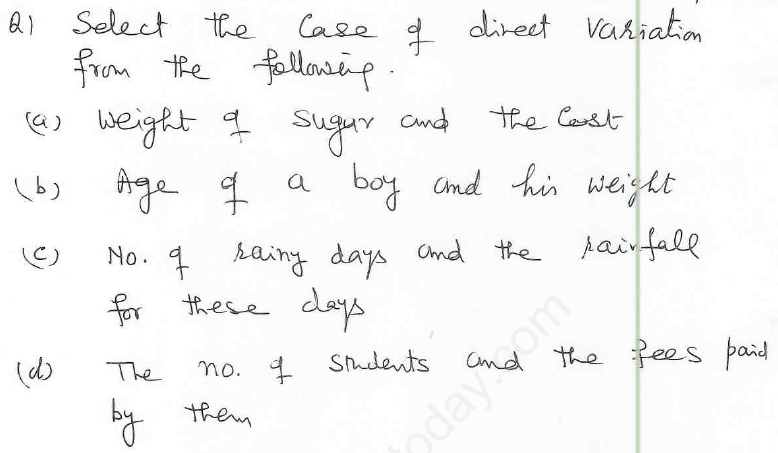
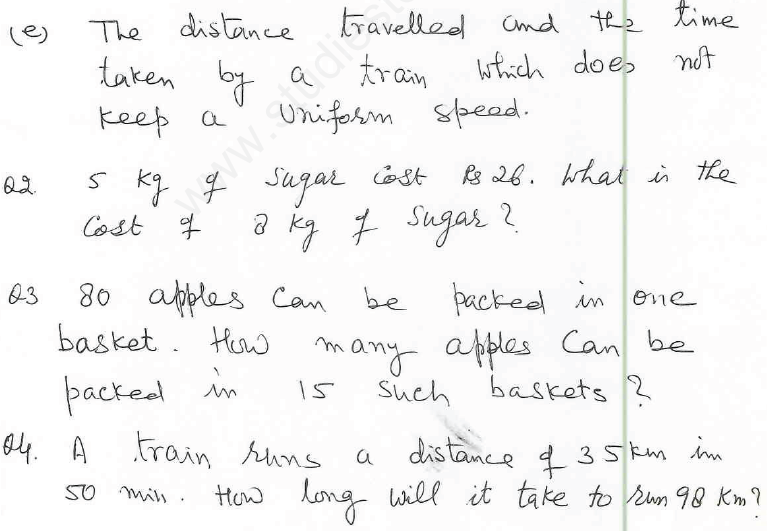
DIRECT AND INVERSE PROPORTIONS
CONTENTS
- Direct Variation
- Inverse Variation
- Time and Work
- Time Distance and Speed
DIRECT VARIATION
Consider the following table which shows various numbers of books (each of same cost) denoted by x and the corresponding cost denoted by y.
x (No. of Books): 2, 3, 5, 10, 15
y (Cost in Rupees): 15, 75, 125, 250, 375
Here, we note that there is an increase in cost corresponding to the increase in the number of books. Hence, it is a case of direct variation.
In this case, if we compare the ratio of different number of books to the corresponding costs, then we have :
\( \frac{2}{50} , \frac{3}{75} , \frac{5}{125} , \frac{10}{250} , \frac{15}{375} \)
↓ ↓ ↓ ↓ ↓
or \( \frac{1}{25} , \frac{1}{25} , \frac{1}{25} , \frac{1}{25} , \frac{1}{25} \)
Thus is, each ratio reduces to \( \frac{1}{25} \) which is constant. We may express is in a general form as:
\( \frac{x}{y} = k \) (constant)
Thus, we conclude that,
When two quantities x and y vary such that the ratio \( \frac{x}{y} \) remains constant and positive, then we say that x and y vary directly and the variation is called a Direct Variation.
In Mathematical language, it may be written as,
\( \frac{x}{y} = k \) or \( x = ky \)
Let us consider any two values of x, say \( x_1 \) and \( x_2 \) with their corresponding values of y as \( y_1 \) and \( y_2 \). We have
\( x_1 = ky_1 \) and \( x_2 = ky_2 \)
∴ \( \frac{x_1}{x_2} = \frac{ky_1}{ky_2} \) or \( \frac{x_1}{x_2} = \frac{y_1}{y_2} \), which helps us to find the value of any one of \( x_1, x_2, y_1 \) and \( y_2 \), when other three are known.
EXAMPLES
Question. If the cost of 15 pens of the same value is ₹ 600, find the cost of - (i) 20 pens (ii) 3 pens.
Answer: Let us denote the required cost by x. Now, writing the like terms together, we have :
(i) No. of Pens: 15, 20 | Cost in rupees: 600, x
Ratio of pens = \( \frac{15}{20} = \frac{3}{4} \)
Ratio of rupees = \( \frac{600}{x} \)
Since, more pens cost more money, so this is a case of direct variation.
Therefore, \( \frac{3}{4} = \frac{600}{x} \)
or \( 3 \times x = 600 \times 4 \)
or \( x = \frac{600 \times 4}{3} \)
or \( x = 200 \times 4 = 800 \)
∴ The cost of 20 pens is ₹ 800.
(ii) Again, ratio of pens = \( \frac{15}{3} = \frac{5}{1} \)
ratio of rupees = \( \frac{600}{x} \)
∴ \( \frac{5}{1} = \frac{600}{x} \)
or \( 5 \times x = 600 \times 1 \)
or \( x = \frac{600}{5} = 120 \)
∴ The cost of 3 pens is ₹ 120.
Question. Reema types 540 words during half an hour. How many words would she type in 6 minutes ?
Answer: Suppose she types x words in 6 minutes. Then, the given information can be represented in the following tabular form :
Number of words: 540, x | Time (in minutes): 30, 6
Since in more time more words can be typed, it is case of direct variation.
∴ Ratio of number of words = Ratio of number of minutes
⇒ \( \frac{540}{x} = \frac{30}{6} \)
⇒ \( x = \frac{6 \times 540}{30} \)
⇒ \( x = 108 \).
Hence, she types 108 words in 6 minutes.
INVERSE VARIATION
Consider the following table showing various number of men and the corresponding number of days to complete the work.
x (No. of men): 40, 20, 10, 8, 5, 1
y (No. of days): 1, 2, 4, 5, 8, 40
Here, the number of men are denoted by x and the corresponding number of days by y. In this case, when the number of men increases, the corresponding number of days decreases. But, by a careful observation, we find that the product of the corresponding number of men and days is always the same :
40 × 1 = 40
20 × 2 = 40
10 × 4 = 40
8 × 5 = 40
5 × 8 = 40
1 × 40 = 40
That is the product (40) is constant. In general, it may be expressed as \( xy = k \)(constant).
Let \( x_1 \) and \( x_2 \) be two values of x and their corresponding values of y be \( y_1 \) and \( y_2 \).
Then, \( x_1y_1 = k \) and \( x_2y_2 = k \)
∴ \( \frac{x_1y_1}{x_2y_2} = \frac{k}{k} = 1 \)
or \( x_1y_1 = x_2y_2 \) or \( \frac{x_1}{x_2} = \frac{y_2}{y_1} \)
Hence, we conclude that, if two quantities x and y vary such that their product xy remains constant, then we say that x and y vary inversely and the variation is called inverse variation.
The relation \( \frac{x_1}{x_2} = \frac{y_2}{y_1} \) is used to find the value of any one of \( x_1, x_2, y_1 \) and \( y_2 \), if the other three are known.
EXAMPLES
Question. In a boarding house of 80 boys, there is food provisions for 30 days. If 20 more boys join the boarding house, how long will the provisions last ?
Answer: Obviously, more the boys the sooner would the provisions exhaust. It is, therefore, the case of inverse variation. The number of boys in the two situations are : 80 and (80 + 20), i.e., 100 respectively. If the provisions last for x days when the number of boys increased from 80 to 100, we can have the following table :
Number of Boys: 80, 100 | Number of Days: 30, x
Here, the ratio between the like terms are : \( \frac{80}{100} \) and \( \frac{30}{x} \)
Since, the problem is of inverse variation, we will invert the ratio and then equate them :
\( \frac{x}{30} = \frac{80}{100} \)
or \( \frac{x}{30} = \frac{4}{5} \)
or \( x = \frac{4 \times 30}{5} = \frac{4 \times 6}{1} \)
or \( x = 24 \)
Therefore, the provisions will last for 24 days.
Question. A jeep finishes a journey in 9 hours at a speed of 60 km per hour. by how much should its speed be increased so that it may take only 6 hours to finish the same journey ?
Answer: Let the desired speed of the jeep be x km per hour, then we have :
Number of Hours: 9, 6 | Speed of the Jeep (in km per hour): 60, x
Since, the greater the speed, the lesser the time taken. Therefore, the number of hours and speed vary inversely.
∴ \( \frac{9}{6} = \frac{x}{60} \)
or \( \frac{x}{60} = \frac{9}{6} \)
or \( x = \frac{9}{6} \times 60 = \frac{9 \times 10}{1} = 90 \)
∴ Increase in speed = (90 – 60) km per hour = 30 km per hour
Thus, the required increase in speed is 30 km per hour.
Problems on Time and Distance
The speed of a moving body is the distance moved in unit time. It is usually represented either in km/h or m/s.
Relation among Speed, Time and Distance
The relation among speed, distance and time is given by Distance covered = Speed × Time taken.
If any two of them are given, it is easy to determine the third one. The above relation can also be expressed in the following manners :
Speed = \( \frac{\text{Distance}}{\text{Time}} \) or Time = \( \frac{\text{Distance}}{\text{Speed}} \)
We talk about speed, say 27 km/h, it means that we are actually talking about its average speed. By average speed of a vehicle, we mean that constant speed at which the vehicle would cover a distance of 27 km in an hour. Unless mentioned otherwise, by speed we shall mean an average speed.
EXAMPLES
Question. A man takes 12 hours to travel 48 kilometres. How long will he take to travel 72 kilometres?
Answer: Since the man travels 48 km in 12 hours, therefore, one kilometre is travelled in \( \frac{12}{48} \) hours.
∴ He travels 72 km in \( \frac{12 \times 72}{48} \) hours or in 18 hours.
Question. A train of 320 metres length, is running at a speed of 72 km/h. How much time will it take to cross a pole ?
Answer: Speed of the train = 72 km/h
= 72 × 1000 m/h
= \( \frac{72000}{60 \times 60} \) m/s = 20 m/s
Length of the train = 320 m
Since the train of length 320 m has to cross the pole of negligible dimension, it has to cross the length of itself, i.e., 320 m.
Thus, distance to be covered = 320 m
Now, using the relation \( \text{time} = \frac{\text{Distance}}{\text{Speed}} \), we get the required time for the train to cross a distance of 320 m = \( \frac{320}{20} \) [Speed of the train is 20 m/s (found above)]
Hence, the train takes 16 seconds to cross the pole.
TIME AND WORK
We use the principles of direct and indirect variations to solve problems on ‘time and work’, such as :
“More men do more work and less men do less work” (Direct variation)
“More men take less time to do a work and less men take more time to do the same work.” (Indirect variation)
The problems on “time and work” are divided in two categories:
(i) To find the work done in a given period of time.
(ii) To find the time required to complete a given job.
Working Rules
We shall use the unitary method by considering the following fundamental rules for solving problems regarding time and work:
(i) A complete job or work is taken to be one.
(ii) Time to complete a work = \( \frac{\text{Total work to be done}}{\text{Part of the work done in one day}} \).
EXAMPLES
Question. Ratan takes 5 days to complete a certain job and shankar takes 8 days to do the same job. If both of them work together, how long will they take to complete the work ?
Answer: Since, Ratan takes 5 days to complete the given work
∴ Ratan finishes \( \frac{1}{5} \) part in 1 day.
Similarly, Shankar takes 8 days to complete the work.
Therefore, Shankar finishes \( \frac{1}{8} \) part in 1 day.
∴ In a day, they together will finish
= \( \frac{1}{5} + \frac{1}{8} = \frac{8 + 5}{40} = \frac{13}{40} \) i.e., \( \frac{13}{40} \) part of the work.
So, they both will take \( \frac{40}{13} \) days = \( 3 \frac{1}{13} \) days to complete the work. Hence, the complete work will be finished by them together in \( 3 \frac{1}{13} \) days.
Question. Kshitij can do a piece of work in 20 days and Rohan can do the same work in 15 days. They work together for 5 days and then Rohan leaves. In how many days will Kshitij alone finish the remaining work ?
Answer: Since, Kshitij completes the work in 20 days
∴ Kshitij’s 1 day work = \( \frac{1}{20} \) part
Now, Rohan completes the work in 15 days.
Similarly, Rohan’s 1 day work = \( \frac{1}{15} \) part
∴ Their combined work for 1 day = \( \frac{1}{20} + \frac{1}{15} = \frac{3 + 4}{60} = \frac{7}{60} \)
∴ Their combined work for 5 days = \( 5 \times \frac{7}{60} = \frac{7}{12} \) part
Remaining work = Complete work – Work done in 5 days
= \( 1 - \frac{7}{12} = \frac{12 - 7}{12} = \frac{5}{12} \) part
Now, the remaining work is to be completed by Kshitij alone. Kshitij can complete the whole work in 20 days.
So, he will complete \( \frac{5}{12} \) work in \( \frac{5}{12} \times 20 \) days, i.e., \( \frac{25}{3} \) days or \( 8 \frac{1}{3} \) days.
Question. A and B can do a piece of work in 10 days; B and C in 15 days; C and A in 12 days. How long would A and B take separately to do the same work ?
Answer: A and B can complete the work in 10 days.
∴ (A and B)’s one day work = \( \frac{1}{10} \) part
Similarly, (B and C)’s one day work = \( \frac{1}{15} \) part
(C and A)’s one day work = \( \frac{1}{12} \) part
Adding up, we get 2(A and B and C)’s work in 1 day
= \( \frac{1}{10} + \frac{1}{15} + \frac{1}{12} = \frac{6 + 4 + 5}{60} = \frac{15}{60} = \frac{1}{4} \) part
∴ (A and B and C) can do in 1 day = \( \frac{1}{4} \times \frac{1}{2} = \frac{1}{8} \) part
Now, Part of work A can do in 1 day = (1 day work of A and B and C) – (1 day work of B and C)
= \( \frac{1}{8} - \frac{1}{15} = \frac{15 - 8}{120} = \frac{7}{120} \) part
Hence, A can complete the work in \( 1 \times \frac{120}{7} \) days, i.e., \( \frac{120}{7} \) or \( 17 \frac{1}{7} \) days.
Similarly, Part of the work B can do in 1 day = (1 day work of A and B and C) – (1 day work of A and C)
= \( \frac{1}{8} - \frac{1}{12} = \frac{3 - 2}{24} = \frac{1}{24} \)
Hence, B can complete the work in \( 1 \times \frac{24}{1} \) days, i.e., 24 days.
Question. A contractor undertakes to construct a road in 20 days and engages 12 workers. After 16 days, he finds that only \( \frac{2}{3} \) part of the work has been done. How many more workers should he now engage in order to finish the job in time ?
Answer: From the question, it is clear that \( \frac{2}{3} \) part of the work has been completed by 12 workers in 16 days.
∴ Remaining work = \( 1 - \frac{2}{3} = \frac{1}{3} \)
Remaining number of days = 20 – 16 = 4
Thus, \( \frac{1}{3} \) part of the work is to be finished in 4 days.
∴ Number of workers required to complete \( \frac{2}{3} \) part of work in 16 days = 12
Number of workers required to complete 1 work in 16 days = \( 12 \times \frac{3}{2} \times 16 \)
Number of workers required to complete \( \frac{1}{3} \) work in 1 day = \( 12 \times \frac{3}{2} \times 16 \times \frac{1}{3} \)
Number of workers required to complete \( \frac{1}{3} \) work in 4 days = \( 12 \times \frac{3}{2} \times 16 \times \frac{1}{3} \times \frac{1}{4} \)
∴ Number of additional workers required = 24 – 12 = 12
Hence, the contractor will have to engage 12 more workers to complete the work in time.
Question. A garrison of 350 men had food for 25 days. However, after 5 days a reinforcement of 150 men join them. How long will the food last now?
Answer: As 350 men have already eaten the food for 5 days, so they will eat the remaining food in 20 days. Since 150 men have arrived, the number of men now becomes 500. Thus, it can be represented in a tabular form as,
Men: 350, 500 | Number of days: 20, x
Clearly, it is the case of inverse proportion.
Thus, ratio of men = inverse ratio of number of days.
or \( \frac{350}{500} = \frac{x}{20} \) or \( x = \frac{350 \times 20}{500} = 14 \)
∴ The food will last for 14 days.
Time and Work
The amount of work done by a person varies directly with the time taken by him or her.
If a man completes a work in 20 days, thus by unitary method we can say that he will complete \( \frac{1}{20} \) th of the work in one day.
Rule 1. If A completes a work in n days, then the work done by A in one day = \( \frac{1}{n} \) th part of the works.
Rule 2. If A completes \( \frac{1}{n} \) th part of the work in one day, then A will take n days to complete the work.
Question. Ashish takes 12 days to do a piece of work, while Arjun takes 15 days to do the work. Find the time taken by them if they work together.
Answer: Ashish takes 12 days to do piece of work.
∴ In one day he does \( \frac{1}{12} \) th of the work.
Arjun takes 15 days to do a piece of work.
∴ In one day he does \( \frac{1}{15} \) th of the work.
∴ Together they do \( \frac{1}{12} + \frac{1}{15} \) th of the work in one day.
i.e. \( \frac{1}{12} + \frac{1}{15} = \frac{5 + 4}{60} = \frac{9}{60} = \frac{3}{20} \)
∴ In one day they will finish \( \frac{3}{20} \) th of the work
∴ They take \( \frac{20}{3} = 6 \frac{2}{3} \) days to finish the work.
Question. Two taps take 12 hours and 16 hours respectively to fill a tank. Find the time taken to fill the tank if they are open at the same time.
Answer: Time taken by first pipe = 12 hours
∴ In 1 hour it fills \( \frac{1}{12} \) th of the tank.
Time taken by second pipe = 16 hours
∴ In 1 hour it fills \( \frac{1}{16} \) th of the tank.
∴ Total work done in 1 hours = \( \frac{1}{12} + \frac{1}{16} = \frac{4 + 3}{48} = \frac{7}{48} \)
∴ Time taken = \( \frac{48}{7} \) hour = 6 hours 51 minutes (approximately).
Question. Mohinder ploughs a field in 6 days and Ram ploughs the same field in 12 days. How long both of them take to plough the same field working together ?
Answer: Mohinder ploughs in 6 days = 1 field
Mohinder ploughs in 1 day = \( \frac{1}{6} \) th field
Ram ploughs in 1 day = \( \frac{1}{12} \) th field
Both Ram and Mohinder ploughs in 1 day = \( \frac{1}{6} + \frac{1}{12} \) th field. = \( \frac{2 + 1}{12} = \frac{3}{12} = \frac{1}{4} \) field.
Now \( \frac{1}{4} \) th of the field is ploughed by them in 1 day.
∴ The complete field will be ploughed by them in \( 1 \times \frac{4}{1} = 4 \) days.
Question. 12 men working 8 hours a day complete a work in 10 days. How long would 16 men working \( 7 \frac{1}{2} \) hours a day take to complete the same work ?
Answer: Let the work completed in x days.
Men: 12, 16 | Hours: 8, \( \frac{15}{2} \) | Days: 10, x
More men less time [16 : 12]
Less men more time [\( \frac{15}{2} : 8 \)]
Thus, it is inverse variation :: 10 : x
∴ \( x = \frac{10 \times 12 \times 8 \times 2}{16 \times 15} = 8 \)
∴ 16 men will complete the same work in 8 days.
Question. 2 men and 3 boys can harvest a field in 7 days. How long would 1 man and 2 boys take to harvest the same field ?
Answer: Given that 2 men and 3 boys harvest a field in 7 days. Thus, let us calculate the amount of field harvested by each one in one day. 2 men harvest 1 field in 7 days.
In one day 2 men will harvest \( \frac{1}{7} \) th of the field.
In one day 1 man will harvest \( \frac{1}{2 \times 7} \) th, i.e. \( \frac{1}{14} \) th of the field.
Similarly, 1 boy will harvest \( \frac{1}{3 \times 7} \) th, i.e. \( \frac{1}{21} \) th of the field in one day.
Now, we have to find the time taken by 1 man and 2 boys to harvest the field. Adding the amounts of work completed by 1 man and 2 boys in one day, we get \( \frac{1}{14} + \frac{2}{21} = \frac{3 + 4}{42} = \frac{7}{42} \) or \( \frac{1}{6} \)
Thus, they will take 6 days to complete the harvesting.
TIME, DISTANCE AND SPEED
We generally say that a body is covering so many kilometres every hour or so many metres in every second. We define speed of a body as the distance covered in unit time. Here, unit time can be one hour or one minute or one second and a body means an object.
Thus, speed is expressed in metres per second (m/s) or kilometres per hour (km/h) or centimetres per second (cm/s). To find the speed of a moving object, we divide the distance covered by the time taken.
∴ Speed = \( \frac{\text{Distance}}{\text{Time}} \) or Time = \( \frac{\text{Distance}}{\text{Speed}} \) or Distance = Speed × Time.
Question. A man takes 2 hours to cover a distance when he walks at 3 kilometres per hour (kmph). Find the time taken if he walks at the rate of 4 kmph.
Answer: Speed = 3 km/h; Time = 2 hours
∴ Distance = 3 × 2 = 6 km
New speed = 4 km/h
Distance = 6 km
∴ Time = \( \frac{\text{Distance}}{\text{Speed}} = \frac{6}{4} = 1 \frac{1}{2} \) hours
Thus, the time taken by the man is \( 1 \frac{1}{2} \) hours.
Question. A train 375 m long takes 30 seconds to cross a pole. Find the speed of the train in kilometres per hour.
Answer: To cross a pole means the whole train should cross the pole.
∴ The distance travelled = 375 m
Time taken = 30 seconds
∴ Speed = \( \frac{\text{Distance}}{\text{Time}} = \frac{375}{30} \) ms¹ = 12.5 ms¹
In the above example, we have to convert metres per second into kilometres per hour.
Now, 1 hour = 60 × 60 seconds, 1 km = 1000 m
∴ \( \frac{\text{km}}{\text{hr}} = \frac{1000 \text{ m}}{3600 \text{ s}} \), \( 1 \frac{\text{km}}{\text{hr}} = \frac{5 \text{ m}}{18 \text{ s}} \) or 1 m/s = \( \frac{18}{5} \) km/hr
∴ 12.5 m/s = 12.5 × \( \frac{18}{5} \) = 2.5 × 18 = 45 km/h.
Remember: To convert m/s to km/hr multiply by \( \frac{18}{5} \). To convert km/hr to m/s, multiply by \( \frac{5}{18} \).
Question. A train 400 m long crosses a 800m long bridge. If it is travelling at 40 kmph, find the time taken to cross the bridge.
Answer: The distance travelled will be the whole length of the train and the whole length of bridge = 400 m + 800 m = 1200 m.
Speed = 40km/h = 40 × \( \frac{5}{18} \) m/s = \( \frac{100}{9} \) m/s
∴ Time = \( \frac{\text{Distance}}{\text{Speed}} = \frac{1200}{100/9} \) sec = 108 sec or 1 min 48 sec.
Question. Two trains 132 m and 400 m in length are running on parallel tracks towards each other at 40 km/h and 55 km/h. Find the time taken to cross each other.
Answer: Since they are travelling towards each other, their relative speed will be (40 + 55) km/h = 95 km/h.
The distance travelled is the total length of the two trains, i.e. 132 + 400 = 532 m.
∴ Time taken = \( \frac{\text{Total distance}}{\text{Total Speed}} = \frac{532}{95 \times \frac{5}{18}} = \frac{532 \times 18}{95 \times 5} = 20.16 \) seconds.
Question. Two trains of length 150 m and 180 m are running on parallel tracks in the same direction. Find the time taken to cross each other if their speeds are 35 km/h and 40 km/h.
Answer: Since they are moving in the same directing, the relative speed will be (40 – 35) km/h = 5 km/h.
The distance covered will be total length of the two trains = 150 + 180 = 330 m
Time taken = \( \frac{\text{Distance}}{\text{Speed}} = \frac{330}{5 \times \frac{5}{18}} = \frac{330 \times 18}{5 \times 5} = 237.6 \) seconds = 3.96 minutes.
Question. A train moving at 30 km per hour completes its journey in 14 hours. How much time will the train take for the same journey if it travelled at 60 km per hour ?
Answer: The given information can be shown in a tabular form as :
Speed (kmph): 30, 60 | Time (hours): 14, x
As the speed increases, the time decreases and the distance remains the same.
∴ 30 × 14 = 60 × x (refers to distance).
∴ \( x = \frac{30 \times 14}{60} = 7 \) hours
Thus, the train will take 7 hours to complete the journey moving at 60 km/hr.
Click on link below to download CBSE Class 8 Mathematics Direct and Inverse Proportions Assignment Set C
Free study material for Mathematics
Chapter 13 Direct And Inverse Proportions Printable Assignments & Solutions for Class 8 Mathematics
Revision Assignment: Chapter 13 Direct And Inverse Proportions (CBSE)
Review targeted chapter assignments for Class 8 Mathematics Chapter 13 Direct And Inverse Proportions. Built according to official CBSE guidelines, these downloadable problem sets help students build accuracy and prepare effectively for school tests.
Key Advantages of Solving Chapter 13 Direct And Inverse Proportions Assignments
- Syllabus Compliance: Sets reflect current CBSE evaluation criteria and official marking frameworks.
- Multi-Format Practice: Includes varied problem types designed to deepen comprehension across all sub-topics.
- Time Management: Routine practice optimizes pacing to finish school examinations comfortably within schedule.
Effective Strategy for Class 8 Mathematics Assignments
- Textbook Review: Always study the core NCERT book for Class 8 Mathematics prior to beginning the assignment.
- Independent Attempt: Solve Chapter 13 Direct And Inverse Proportions questions on your own initially before cross-checking with expert solutions.
- Error Tracking: Record challenging concepts in a dedicated notebook and practice online MCQ tests for revision.
FAQs
You can download free PDF assignments for Class 8 Mathematics Chapter 13 Direct And Inverse Proportions from StudiesToday.com. These practice sheets have been updated for the 2026-27 session covering all concepts from latest NCERT textbook.
Yes, our teachers have given solutions for all questions in the Class 8 Mathematics Chapter 13 Direct And Inverse Proportions assignments. This will help you to understand step-by-step methodology to get full marks in school tests and exams.
Yes. These assignments are designed as per the latest CBSE syllabus for 2026. We have included huge variety of question formats such as MCQs, Case-study based questions and important diagram-based problems found in Chapter 13 Direct And Inverse Proportions.
Practicing topicw wise assignments will help Class 8 students understand every sub-topic of Chapter 13 Direct And Inverse Proportions. Daily practice will improve speed, accuracy and answering competency-based questions.
Yes, all printable assignments for Class 8 Mathematics Chapter 13 Direct And Inverse Proportions are available for free download in mobile-friendly PDF format.