

School Assignments for Class 8 Mathematics: Chapter 13 Direct And Inverse Proportions
Access comprehensive school assignments for Chapter 13 Direct And Inverse Proportions using the CBSE Class 8 Mathematics Direct and Inverse Proportions Assignment Set 02. Designed to align with the 2026-27 CBSE academic guidelines, these practice sets help Class 8 Mathematics students reinforce core concepts and improve their problem-solving accuracy.
Practice Class 8 Mathematics Assignments: Chapter 13 Direct And Inverse Proportions
Access the complete assignment PDF for Class 8 Mathematics below. Regular practice with these targeted academic tasks builds familiarity with standard question patterns and helps secure higher marks in final school evaluations.
Question. If x : y = 2 : 3 and 2 : x = 1 : 2, then the value of y is ____.
(A) 1/3
(B) 3/2
(C) 6
(D) 1/2
Answer : C
Question. Which of the following statements is CORRECT?
(A) Length of a side of square and its area vary directly with each other.
(B) If one angle of a triangle is kept fixed then the measure of the remaining two angles vary inversely with each other.
(C) The area of circle and its diameter vary directly with each other.
(D) All of these
Answer : D
Question. If A : B = 2 : 3 and B : C = 4 : 5, then C : A is equal to ____.
(A) 15 : 8
(B) 12 : 10
(C) 8 : 5
(D) 8 : 15
Answer : A
Question. If x varies directly as y2 and x = 4 when y = 5, then find x when y is 15.
(A) 4
(B) 9
(C) 12
(D) 36
Answer : D
Question. If 1/5 : 1/x = 1/x : 1/125 then the value of x is ____.
(A) 1.25
(B) 1.5
(C) 25
(D) 2.25
Answer : C
Question. x and y vary in inverse proportion. When x is 12, y is 3. Which of the following is not a possible pair of corresponding values of x and y ?
(A) 4 and 9
(B) 10 and 3.6
(C) 72 and 0.5
(D) 5 and 6
Answer : D
Question. A labourer is paid ₹ 806 for 13 days of work. If he receives ₹ 1,798, then for how many days did he work?
(A) 29
(B) 35
(C) 60
(D) 40
Answer : A
Question. Match the following.
| Column-I | Column-II |
| (P) If the cost of 93 m of a certain kind of plastic sheet is ₹ 1395, then what would it cost (in ₹) to buy 105 m of such plastic sheet? | (1) 42 |
| (Q) 55 cows can graze a field in 16 days. How many cows will graze the same field in 10 days? | (2) 18 |
| (R) 18 men can reap a field in 35 days. For reaping the same field in 15 days; how many men are required? | (3) 88 |
| (S) Suneeta types 1080 words in one hour. What is her GWPM (gross words per minute)? | (4) 1575 |
P Q R S
(A) 4 3 1 2
(B) 2 1 4 3
(C) 3 2 1 4
(D) 1 3 2 4
Answer : A
Question. A worker is paid ₹ 139.20 for 3 days.
(i) What will he get in the month of June (in ₹)?
(ii) For how many days will he be working for ₹ 696?
(i) (ii)
(A) 1392 15
(B) 15 1392
(C) 1382 20
(D) 1392 20
Answer : A
Question. 8 men can do a piece of work in 10 days.
How long will 10 men take to do the same work?
(A) 12 days
(B) 8 days
(C) 7 days
(D) 6 days
Answer : B
Question. A photograph of a bacteria enlarged 50,000 times, attains a length of 5 cm. What is the actual length of the bacteria?
(A) 2 × 10⁻⁴ cm
(B) 103 cm
(C) 10–4 cm
(D) 104 cm
Answer : C
Question. Match the following.
| Column-I | Column-II |
| P. x and y are in direct proportion and x = 40 when y = 120. If x = 60 then y = | (i) 160 |
| Q. x varies inversely as y and x = 12 when y = 300, if x = 24 then y = | (ii) 180 |
| R. x varies directly as y and y = 50 when x = 30, if x = 96 then y = | (iii) 130 |
| S. x varies inversely as y and y = 650 when x = 20, if x = 100 then y = | (iv) 150 |
(A) P → (iv); Q → (i); R → (iii); S → (ii)
(B) P → (ii); Q → (iv); R → (iii); S → (i)
(C) P → (iv); Q → (i); R → (ii); S → (iii)
(D) P → (ii); Q → (iv); R → (i); S → (iii)
Answer : D
Question. When x = 2, 7, 11, ...., y = 8, 28, 44, ...., then x and y are in ............ .
(A) Direct proportion
(B) Inverse proportion
(C) Neither direct nor inverse proportion
(D) None of these
Answer : A
Question. In a camp there is sufficient food for 105 soldiers for 21 days. If 42 soldiers leave the camp, then how long would the food last?
(A) 30 days
(B) 35 days
(C) 65 days
(D) 45 days
Answer : B
Question. A shopkeeper has just enough money to buy 52 cycles worth ₹ 525 each. If each cycle were to cost ₹ 21 more, then number of cycles, he will be able to buy with that amount of money, is ____.
(A) 40
(B) 30
(C) 50
(D) 20
Answer : C
Question. If x and y vary inversely as each other, and x = 10 when y = 6. Find y when x = 15.
(A) 3
(B) 4
(C) 2
(D) 6
Answer : B
Question. Two quantities x and y vary inversely with each other, then ______ .
(A) x/y remains constant
(B) x – y remains constant
(C) x + y remains constant
(D) x × y remains constant
Answer : D
Question. Raghu has enough money to buy 75 machines worth ₹ 200 each. How many machines can he buy if he gets a discount of ₹ 50 on each machine?
(A) 180
(B) 200
(C) 150
(D) 100
Answer : D
Question. An agent receives a commission of ₹ 73.00 on sales of ₹ 1000.00. The commission he will get on sales of ₹ 100.00 is ____.
(A) ₹ 7.30
(B) ₹ 7.00
(C) ₹ 6.00
(D) ₹ 6.30
Answer : A
Question. In a birthday party, on an average, 5 bottles of coke are served for a group of 6 children. How many friends were present at Mohit’s party if 15 bottles of coke were used?
(A) 18
(B) 24
(C) 30
(D) 12
Answer : A
Question. Which of the following tables shows the inverse proportion?
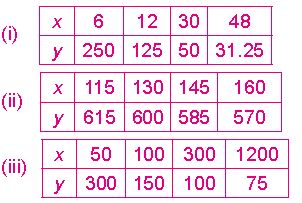
(A) Only (i)
(B) Both (i) and (ii)
(C) Both (ii) and (iii)
(D) None of these
Answer : A
vA cistern has two inlets A and B which can fill it in 12 minutes and 15 minutes respectively. An outlet C can empty the full cistern in 10 minutes. If all the three pipes then are opened together in the empty cistern, time taken to fill the cistern
completely is ____.
(A) 20 minutes
(B) 10 minutes
(C) 15 minutes
(D) 5 minutes
Answer : A
Question. In 15 days, the earth picks up 1.2 × 10⁸ kg of dust from the atmosphere. In how many days it will pick up 4.8 × 10⁸ kg of dust?
(A) 50
(B) 40
(C) 60
(D) 100
Answer : C
Question. State ‘T’ for true and ‘F’ for false.
(i) If x and y are in direct proportion, then
(x – 1) and (y – 1) are also in direct proportion.
(ii) If x and y are in inverse proportion then (x + 2) and (y + 2) are also in inverse proportion.
(iii) Two quantities x and y are said to vary directly with each other if x/y = k, where k is a positive constant.
(iv) When distance is kept fixed, then speed and time vary inversely with each other.
(i) (ii) (iii) (iv)
(A) T F F T
(B) T T F F
(C) F F T T
(D) T F T F
Answer : C
Question. Fill in the blanks.
(i) The perimeter of circle and its diameter vary P with each other.
(ii) If two quantities p and q vary inversely with each other then Q of their corresponding values remain constant.
(iii) When x and y are in indirect proportion and if y doubles then x becomes R
P Q R
(A) Inversely Ratio Double
(B) Directly Product Half
(C) Inversely Ratio Half
(D) Directly Product Double
Answer : C
Assignment No. 3 - Direct and Indirect Variation
Question 1. Telegraphic posts are fixed at equal distances from each other. If 8 such posts are fixed over a distance of 70 km, how many posts are required for a distance of 30 km?
Answer: Let the number of posts required for a distance of 30 km be \(x\).
Note that the number of intervals between posts is one less than the number of posts.
For 8 posts, the number of intervals = \(8 - 1 = 7\).
Distance covered in 7 intervals = 70 km.
Let us set up the direct proportion for intervals and distance:
Distance \(D_1 = 70\) km, Intervals \(I_1 = 7\)
Distance \(D_2 = 30\) km, Intervals \(I_2 = x - 1\)
Since distance is directly proportional to the number of intervals:
\(\frac{70}{7} = \frac{30}{x - 1}\)
\(10 = \frac{30}{x - 1}\)
\(10(x - 1) = 30\)
\(x - 1 = 3\)
\(x = 4\)
Therefore, 4 posts are required.
In simple words: The number of spaces between poles decreases as the total distance decreases in direct proportion.
Exam Tip: Always remember that \(n\) posts create \(n - 1\) intervals. This is a common trap in distance-pole problems.
Question 2. A car uses 24 litres of petrol on a journey of 112 km. How much petrol will be needed for a journey of 210 km?
Answer: Let the petrol needed for 210 km be \(x\) litres.
This is a case of direct proportion because more distance requires more petrol.
\(\frac{112}{24} = \frac{210}{x}\)
\(112 \times x = 210 \times 24\)
\(x = \frac{210 \times 24}{112}\)
\(x = \frac{5040}{112}\)
\(x = 45\)
Therefore, 45 litres of petrol will be needed.
In simple words: More distance means you need more fuel, so we use direct proportion.
Exam Tip: Simplify fractions before multiplying large numbers to avoid calculation errors.
Question 3. The distance between two cities on a map is 8.4 cm. The map uses 3 cm to represent 16 km. What is the actual distance between the two cities?
Answer: Let the actual distance be \(x\) km.
Map distance and actual distance are in direct proportion.
\(\frac{3}{16} = \frac{8.4}{x}\)
\(3 \times x = 16 \times 8.4\)
\(3x = 134.4\)
\(x = \frac{134.4}{3}\)
\(x = 44.8\)
Therefore, the actual distance between the two cities is 44.8 km.
In simple words: Map scale is constant, so map distance and real distance are directly proportional.
Question 4. \(2\frac{1}{2}\) litres of paint are used to paint 400 sq. metres. How much of paint will be needed for 640 sq. metres?
Answer: Convert mixed fraction into decimal: \(2\frac{1}{2} = 2.5\) litres.
Let the paint needed for 640 sq. metres be \(x\) litres.
Area and paint required are in direct proportion.
\(\frac{2.5}{400} = \frac{x}{640}\)
\(400 \times x = 2.5 \times 640\)
\(400x = 1600\)
\(x = \frac{1600}{400}\)
\(x = 4\)
Therefore, 4 litres of paint will be needed.
In simple words: A larger surface area needs more paint in direct proportion.
Exam Tip: Convert mixed fractions to decimals or improper fractions at the very beginning to simplify calculations.
Question 5. In what time will an athlete cover 400 m race if his speed is 100 m flat in 10.2 seconds?
Answer: Let the time taken to cover 400 m be \(x\) seconds.
Assuming constant speed, distance and time are in direct proportion.
\(\frac{100}{10.2} = \frac{400}{x}\)
\(100 \times x = 400 \times 10.2\)
\(100x = 4080\)
\(x = \frac{4080}{100}\)
\(x = 40.8\)
Therefore, the athlete will cover the 400 m race in 40.8 seconds.
In simple words: If distance becomes 4 times greater, the time taken also becomes 4 times greater.
Exam Tip: Check if speed remains constant before applying direct proportion between distance and time.
Question 6. Cost of 40 table lamps is Rs 2024. How many table lamps can be purchased in Rs 1518?
Answer: Let the number of table lamps purchased for Rs 1518 be \(x$.
Cost and number of items are in direct proportion.
\(\frac{40}{2024} = \frac{x}{1518}\)
\(2024 \times x = 40 \times 1518\)
\(2024x = 60720\)
\(x = \frac{60720}{2024}\)
\(x = 30\)
Therefore, 30 table lamps can be purchased.
In simple words: Less money means fewer items can be bought.
Exam Tip: Always place the unknown variable \(x\) in the numerator to make solving equations easier.
Question 7. The literacy rate in 1981 Census is 362 per thousand in India. Suppose at that time, the population of India is nearly 68 Crores, find the number of literates in India, in Crores.
Answer: Literacy rate = 362 per 1000 people.
Total population = 68 Crores.
Let the number of literate people be \(x\) Crores.
\(\frac{362}{1000} = \frac{x}{68}\)
\(1000 \times x = 362 \times 68\)
\(1000x = 24616\)
\(x = \frac{24616}{1000}\)
\(x = 24.616\)
Therefore, the number of literates in India is 24.616 Crores.
In simple words: Multiply the total population by the literacy fraction to get the total literate population.
Exam Tip: Keep the units of population in Crores on both sides to get the final answer directly in Crores.
Question 8. A machine fills 840 tablets in a box in 6 hours. How many tablets can be filled in 5 hours?
Answer: Let the number of tablets filled in 5 hours be \(x$.
Time and number of tablets filled are in direct proportion.
\(\frac{840}{6} = \frac{x}{5}\)
\(6 \times x = 840 \times 5\)
\(6x = 4200\)
\(x = \frac{4200}{6}\)
\(x = 700\)
Therefore, 700 tablets can be filled in 5 hours.
In simple words: Working for fewer hours means fewer tablets will be filled.
Exam Tip: Verify your answer by finding the unit rate per hour first (\(840 \div 6 = 140\) tablets/hour, then \(140 \times 5 = 700\)).
Free study material for Mathematics
Download Practice Assignments: Class 8 Mathematics Chapter 13 Direct And Inverse Proportions
Revision Assignment: Chapter 13 Direct And Inverse Proportions (CBSE)
Explore reliable practice questions for Chapter 13 Direct And Inverse Proportions tailored for Class 8 learners. Use these structured worksheets to evaluate preparedness and strengthen core problem-solving skills.
Maximize Exam Scores with Chapter Practice Sets
- Syllabus Compliance: Sets reflect current CBSE evaluation criteria and official marking frameworks.
- Multi-Format Practice: Includes varied problem types designed to deepen comprehension across all sub-topics.
- Time Management: Routine practice optimizes pacing to finish school examinations comfortably within schedule.
Effective Strategy for Class 8 Mathematics Assignments
- Concept Foundation: Review the NCERT book for Class 8 Mathematics thoroughly before diving into assignment tasks.
- Self-Evaluation: Solve exercises independently before inspecting professional answer guides.
- Progress Monitoring: Note down complex formulas or concepts, clearing them up using available online practice aids.
FAQs
You can download free PDF assignments for Class 8 Mathematics Chapter 13 Direct And Inverse Proportions from StudiesToday.com. These practice sheets have been updated for the 2026-27 session covering all concepts from latest NCERT textbook.
Yes, our teachers have given solutions for all questions in the Class 8 Mathematics Chapter 13 Direct And Inverse Proportions assignments. This will help you to understand step-by-step methodology to get full marks in school tests and exams.
Yes. These assignments are designed as per the latest CBSE syllabus for 2026. We have included huge variety of question formats such as MCQs, Case-study based questions and important diagram-based problems found in Chapter 13 Direct And Inverse Proportions.
Practicing topicw wise assignments will help Class 8 students understand every sub-topic of Chapter 13 Direct And Inverse Proportions. Daily practice will improve speed, accuracy and answering competency-based questions.
Yes, all printable assignments for Class 8 Mathematics Chapter 13 Direct And Inverse Proportions are available for free download in mobile-friendly PDF format.