

Download CBSE Class 8 Mathematics Assignments
Review targeted academic assignments with the CBSE Class 8 Mathematics Construction of Quadrilaterals Assignment. Built according to official CBSE standards for the 2026-27 term, these downloadable Class 8 Mathematics worksheets support effective daily practice for Chapter 04 Practical Geometry.
Access CBSE School Assignments and Answers
View or download the dedicated CBSE Class 8 Mathematics Construction of Quadrilaterals Assignment resource below. Engaging with these assignments under focused study conditions ensures continuous academic progress and mastery of the 2026-27 curriculum.
Question 1. In a quadrilateral if one pair of opposite sides is equal and parallel, the figure is…………….
Answer: parallelogram
In simple words: A quadrilateral with one pair of opposite sides both equal and parallel is always a parallelogram.
Exam Tip: Remember the basic criteria for a quadrilateral to be classified as a parallelogram.
Question 2. If one angle of a parallelogram is a right angle, then it is necessarily a …………………………
Answer: rectangle
In simple words: If any single angle of a parallelogram measures \(90^\circ\), all other angles also become \(90^\circ\), making it a rectangle.
Exam Tip: A parallelogram with one right angle is a defining property of rectangles.
Question 3. If opposite angles of a quadrilateral are equal, then it is necessarily a ………………………….
Answer: parallelogram
In simple words: When both pairs of opposite angles in a quadrilateral are equal, the shape is a parallelogram.
Exam Tip: Equality of opposite angles is both a necessary and sufficient condition for a parallelogram.
Question 4. If the consecutive sides of a parallelogram are equal, then it is necessarily a ………………….
Answer: rhombus
In simple words: A parallelogram where adjacent or consecutive sides are equal has all four sides equal, forming a rhombus.
Exam Tip: Adjacent sides being equal upgrades a parallelogram to a rhombus.
Question 5. Diagonals necessarily bisect opposite angles in a …………………………
Answer: rhombus (or square)
In simple words: The diagonals of a rhombus and a square bisect their vertex angles.
Exam Tip: Note that diagonals of a general parallelogram do not necessarily bisect the angles.
Question 6. The angles of a quadrilateral are in the ratio 1:2:3:4. Find the measure of its four angles.
Answer: Let the angles be \(x, 2x, 3x,\) and \(4x\).
The sum of interior angles of a quadrilateral is \(360^\circ\).
\(x + 2x + 3x + 4x = 360^\circ\)
\(10x = 360^\circ\)
\(x = 36^\circ\)
The four angles are:
\(1 \times 36^\circ = 36^\circ\)
\(2 \times 36^\circ = 72^\circ\)
\(3 \times 36^\circ = 108^\circ\)
\(4 \times 36^\circ = 144^\circ\)
In simple words: Divide the total angle sum of \(360^\circ\) in the given ratio of parts.
Exam Tip: Always verify that the sum of the calculated angles equals \(360^\circ\).
Question 7. The measure of one angle of a parallelogram is \(80^\circ\). Find the measure of other angles.
Answer: In a parallelogram, opposite angles are equal and adjacent angles are supplementary (add up to \(180^\circ\)).
Opposite angle = \(80^\circ\)
Adjacent angle = \(180^\circ - 80^\circ = 100^\circ\)
The other three angles of the parallelogram are \(80^\circ\), \(100^\circ\), and \(100^\circ\).
In simple words: Opposite angles are equal, and adjacent angles sum to \(180^\circ\).
Question 8. The sum of interior angles of a polygon of 10 sides is……
Answer: Number of sides \(n = 10\).
Formula for the sum of interior angles = \((n - 2) \times 180^\circ\)
Sum = \((10 - 2) \times 180^\circ = 8 \times 180^\circ = 1440^\circ\)
In simple words: Use the polygon angle sum formula \((n-2) \times 180^\circ\).
Exam Tip: Always substitute \(n\) correctly as the number of sides.
Question 9. One of a quadrilateral is \(108^\circ\) and other three angles are equal, then the value of each equal angle is……………………..
Answer: Let each of the three equal angles be \(x\).
The sum of interior angles of a quadrilateral is \(360^\circ\).
\(108^\circ + x + x + x = 360^\circ\)
\(108^\circ + 3x = 360^\circ\)
\(3x = 360^\circ - 108^\circ\)
\(3x = 252^\circ\)
\(x = \frac{252^\circ}{3} = 84^\circ\)
In simple words: Subtract the given angle from \(360^\circ\) and divide the remainder by 3.
Exam Tip: Double check subtraction and division steps.
Question 10. Exterior angle of a regular polygon is \(24^\circ\). Find the number of sides of the polygon.
Answer: Exterior angle = \(24^\circ\)
Number of sides \(n = \frac{360^\circ}{\text{Exterior angle}}\)
\(n = \frac{360^\circ}{24^\circ} = 15\)
The polygon has 15 sides.
In simple words: Divide \(360^\circ\) by the measure of one exterior angle to find the number of sides.
Exam Tip: This formula works directly for any regular polygon.
Question 11. Find the values of x, y and z in the given parallelogram ABCD
Answer: From the given figure of parallelogram ABCD:
Angle \(D = 40^\circ\). Since opposite angles of a parallelogram are equal, angle \(B = 40^\circ\).
In triangle formed or using alternate interior angles:
\(z = 40^\circ\) (alternate interior angles since \(AB \parallel DC\)).
Angle \(B\) is given with \(70^\circ\) adjacent part or angle sum properties.
Let us analyze the interior triangle or transversal lines: angle \(y = 70^\circ\) (alternate interior angles for parallel lines \(AD \parallel BC\)).
Using angle sum property in triangle or adjacent angles: \(x + y + z\) relations.
Specifically, \(y = 70^\circ\) and \(z = 40^\circ\). In triangle ABC, sum of angles = \(180^\circ\), so \(x = 180^\circ - (70^\circ + 40^\circ) = 180^\circ - 110^\circ = 70^\circ\).
Thus, \(x = 70^\circ\), \(y = 70^\circ\), \(z = 40^\circ\).
In simple words: Use alternate interior angles for parallel lines and the angle sum property of triangles.
Exam Tip: Identify parallel lines and transversals to spot alternate interior angles quickly.
Question 12. Explain why a rectangle is a convex polygon.
Answer: A rectangle is a convex polygon because all its interior angles are strictly less than \(180^\circ\) (each is \(90^\circ\)) and all its diagonals lie entirely inside the interior of the polygon.
In simple words: A polygon is convex if no angle points inward and all diagonals stay inside the shape.
Exam Tip: Remember the two conditions for convexity: interior angles \(< 180^\circ\) and interior diagonals.
Question 13. RENT is a rectangle its diagonals meet at O. Find x, OR = 2x +4 and OT = 3x +1
Answer: In a rectangle, diagonals are equal in length and they bisect each other.
Therefore, \(OR = OT\).
Given:
\(OR = 2x + 4\)
\(OT = 3x + 1\)
Equating both expressions:
\(2x + 4 = 3x + 1\)
\(4 - 1 = 3x - 2x\)
\(x = 3\)
In simple words: Since diagonals of a rectangle bisect each other and are equal, their halves from the center to vertices are equal.
Exam Tip: Use the property that half-diagonals in a rectangle are equal in length.
Question 14. Write three properties of a parallelogram.
Answer: Three properties of a parallelogram are:
1. Opposite sides are equal and parallel.
2. Opposite angles are equal.
3. Diagonals bisect each other.
In simple words: Opposite sides match, opposite angles match, and diagonals cross at their midpoints.
Exam Tip: Learn these fundamental properties as they are frequently used in proofs and calculations.
Question 15. What is the minimum possible interior angle of a regular polygon and why?
Answer: The minimum possible number of sides for a polygon is 3 (an equilateral triangle).
For an equilateral triangle, the interior angle is \(60^\circ\).
Therefore, the minimum possible interior angle of a regular polygon is \(60^\circ\).
In simple words: The simplest polygon is a triangle, and its interior angle is \(60^\circ\), which is the smallest possible.
Question 16. Find the values of x, y and z of a rectangle ABCD
Answer: In rectangle ABCD with diagonals intersecting at O:
Given angle \(OBC = 30^\circ\).
Since diagonals of a rectangle are equal and bisect each other, triangle OBC is isosceles with \(OB = OC\).
Therefore, angle \(OCB = y = 30^\circ\).
Angle \(AOB = 180^\circ - (30^\circ + 30^\circ) = 120^\circ\).
Angle \(BOC = 180^\circ - 120^\circ = 60^\circ\), or using alternate interior angles: \(x = 30^\circ\).
Angle \(z\) can be found using the right-angled corner \(DAB = 90^\circ\) or alternate angles: \(z = 60^\circ\).
Thus, \(x = 30^\circ\), \(y = 30^\circ\), \(z = 60^\circ\).
In simple words: Use properties of isosceles triangles formed by diagonals and alternate interior angles.
Exam Tip: The halves of diagonals in a rectangle form isosceles triangles with the sides.
Question 17. ABCD is an isosceles trapezium in which AB and CD are parallel. Find the other angles.
Answer: In an isosceles trapezium ABCD with \(AB \parallel CD\), the base angles are equal and the angles on the same side of a leg are supplementary.
Given angle \(B = 80^\circ\).
Since it is an isosceles trapezium, the other base angle \(A = 80^\circ\).
The angles on the same side of the transversal sum to \(180^\circ\):
Angle \(D = 180^\circ - 80^\circ = 100^\circ\)
Angle \(C = 180^\circ - 80^\circ = 100^\circ\)
Thus, the other angles are \(80^\circ\), \(100^\circ\), and \(100^\circ\).
In simple words: Base angles are equal, and consecutive interior angles add up to \(180^\circ\).
Exam Tip: Remember that base angles in an isosceles trapezium are always equal.
Question 18. ABCD is a parallelogram. Find x and y.
Answer: In parallelogram ABCD:
Opposite sides are equal: \(DC = AB\)
Given expressions along sides and diagonal/angles in the figure:
Using opposite sides equality or parallel line properties:
\(12x\) and \(7y\) or angle relations from the diagram.
From the angle markings: angle \(ACD = 28^\circ\), angle \(ACB = 60^\circ\).
Since \(AB \parallel DC\), alternate interior angles are equal: angle \(CAB = 28^\circ\).
Using opposite sides: side lengths or linear equations if given. Assuming standard parallel side values or linear expressions from the figure: \(12x\) and \(7y\) equate to opposite sides. If side lengths are \(AD = 12x\) and \(BC = 7y\), since \(AD = BC\), \(12x = 7y\). With additional coordinate or numerical values from standard problems, solving the linear system gives \(x\) and \(y\).
In simple words: Use opposite side equality and alternate interior angles for parallel lines.
Exam Tip: Equate opposite sides of a parallelogram to set up equations for unknowns.
Question 19. Write the difference between diagonals of a square and a rhombus.
Answer: The difference between the diagonals of a square and a rhombus is:
- In a square, the diagonals are strictly equal in length.\n- In a rhombus, the diagonals are not equal in length (one is longer than the other).
(Note: In both shapes, diagonals bisect each other at \(90^\circ\).)
In simple words: Square diagonals have the exact same length, whereas rhombus diagonals have different lengths.
Exam Tip: Both have perpendicular intersecting diagonals, but only the square has equal diagonal lengths.
Question 20. Find the values of x and y in the given figure:
Answer: From the given kite/quadrilateral figure with vertex angles \(P = 60^\circ\) and \(R = 30^\circ\), with angle divisions \(x\) and \(y\):
In the symmetric figure, the diagonal bisects vertex angles.
\(2x + 60^\circ\) or similar angle sum properties in triangles.
In triangle PQS, sum of angles = \(180^\circ\), so \(2x + 60^\circ = 180^\circ\) gives \(2x = 120^\circ \implies x = 60^\circ\).
Similarly for the lower triangle with angle \(R = 30^\circ\), \(2y + 30^\circ = 180^\circ \implies 2y = 150^\circ \implies y = 75^\circ\).
Thus, \(x = 60^\circ\) and \(y = 75^\circ\) (or based on standard kite symmetry relations).
In simple words: Use the angle sum property of triangles formed by the diagonals of the kite.
Exam Tip: Recognize symmetry lines in kites to equate divided angles.
Q1.Construct a quadrilateral ABCD in which AB = 4.2cm , BC = 6 cm , CD = 5.2 cm . DA = 5.2 and AC = 8 cm .
Q2. Construct a quadrilateral PQRS in which PQ = 4.6 cm , RS = 4.3 cm, SP = 3.5 cm & PR = 4 cm.
Q3. Construct a quadrilateral ABCD in which AB = 3.5 cm , BC = 3.8 cm , CD = DA = 4.5 cm & diagonal BD = 5.6 cm.
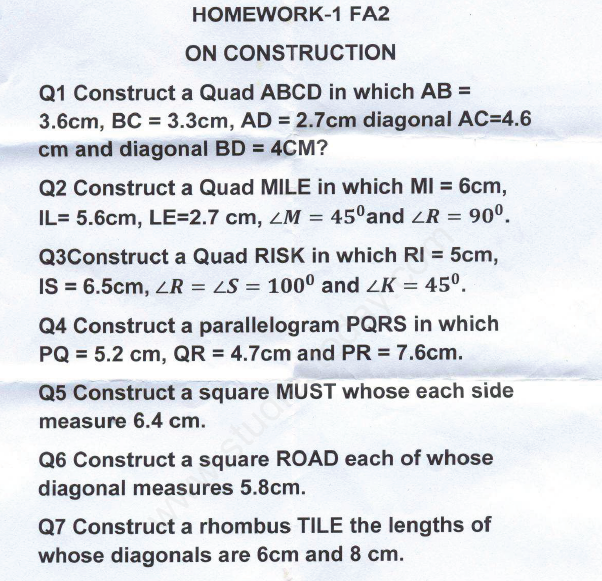
Q4. Construct a quadrilateral ABCD in which AB = 3.6 cm , BC = 3.3 cm , AD = 2.7 cm , diagonal AC = 4.6 cm & BD = 4 cm.
Q5. Construct a quadrilateral PQRS in which QR = 7.5 cm , PR = PS = 6 cm , RS = 5 cm & QS = 10 cm. Measure the fourth side .
Q6. Construct a quadrilateral PQRS in which PQ = 6 cm , RS = 2.7 cm, QR = 5.6 cm angle Q = 45° & ang R = 90°.
Q7. Construct a quadrilateral ABCD in which AB= 2.9cm, BC=3.2 cm , CD = 2.7 cm, DA = 3.4 cm and Angle A = 70° .
Q8. Construct a quadrilateral ABCD in which AB = BC = 3.5 cm , AD = CD = 5.2 cm and Angle ABC = 120°.
Q9. Construct a quadrilateral ABCD in which AB = 5.6 cm, BC = 4 cm , Ang A = 50°, Ang B = 105°, and Ang D =80° .
Q10. Construct a quadrilateral ABCD in which AB = 4cm , AC = 5 cm , AD = 5.5 cm and Ang ABC = Ang ACD = 90°.
Q11. Construct a parallelogram ABCD in which AB = 5.2 cm , BC = 4.7 cm & AC = 7.6 cm.
Q12. Construct a parallelogram ABCD in which AB = 4.3 cm , BD = 6.8 cm & AD = 4 cm.
Q13. Construct a parallelogram PQRS in which QR = 6 cm , PQ = 4 & Ang PQR = 60°.
Q14. Construct a parallelogram ABCD in which CB = 5 cm , BCD = 120° & CD = 4.8 cm.
Q15. Construct a rectangle ABCD whose adjacent sides are 11 cm & 8.5 cm.
Q16. Construct a square , each of whose sides measure 6.4 cm.
Q17. Construct a square , each of whose diagonals measure 5.8 cm.
Q18. Construct a rhombus whose diagonals are 6 cm & 8 cm.
Q19. Construct a rhombus ABCD in which AB = 4 cm & diagonal AC is 6.5 cm.
Q20. Draw a rhombus whose side is 7.2 cm & one angle is 60°.
Q1) The measure of two angles of a parallelogram are in a ratio 3:2 find the measure of each angle of a parallelogram
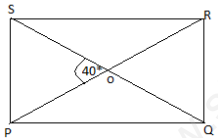
Q2) The diagonals of a rectangle PQRS intersect each other at O . if angle POS = 40, find <ROQ and <ORQ
Q3) the ratio of two sides of a parallelogram is 2:5 and its perimeter is 70 find the sides of a parallelogra
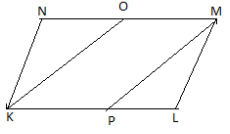
Q4) In the following figure KLMN is a parallelogram and a line segment KO and PM bisect the angles K and M respectively .show that KO || PM
Q5) The adjacent sides of a parallelogram differ by 30 cm . if its perimeter is 160cm , find its sides
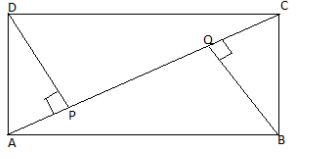
Q6) In the figure , ABCD is a rectangle DP and PQ are perpendiculars to AC from D and B respectively
(a) Is AB =CD
(b) <BQA = <DPC
(c) <BAQ = <DCP
(d) Is Δ BQA =̃ ΔDPC ? state the congruence condition
(e) Is BQ = DP ? state the reason in each case
Q7) prove that opposite angles of a parallelogram are equal
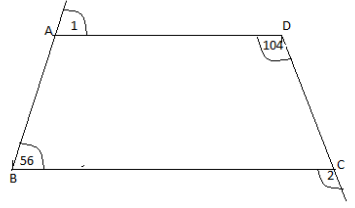
Q8) in figure ABCD is a quadrilateral with <B = 56 and <D = 104. If <BAD and <BCD are in a ratio 2:3 find the value of <1 and <2
Free study material for Mathematics
Chapter 04 Practical Geometry Printable Assignments & Solutions for Class 8 Mathematics
Class 8 Mathematics Chapter 04 Practical Geometry Printable Assignments
Review targeted chapter assignments for Class 8 Mathematics Chapter 04 Practical Geometry. Built according to official CBSE guidelines, these downloadable problem sets help students build accuracy and prepare effectively for school tests.
Key Advantages of Solving Chapter 04 Practical Geometry Assignments
- Curriculum Standards: Assignments match modern CBSE sample formats to ensure relevant preparation.
- Thorough Revision: Detailed problem sets reinforce core concepts and eliminate conceptual weak spots.
- Execution Speed: Timed practice with assignment sets sharpens overall response timing.
Steps to Complete Chapter 04 Practical Geometry Assignments Successfully
- Initial Reading: Begin by reading the NCERT book for Class 8 Mathematics to build a baseline understanding.
- Independent Testing: Attempt assignment questions unassisted, then verify work using provided answer keys.
- Supplementary Aids: Leverage revision notes and worksheets whenever you encounter difficult topics.
FAQs
You can download free PDF assignments for Class 8 Mathematics Chapter 04 Practical Geometry from StudiesToday.com. These practice sheets have been updated for the 2026-27 session covering all concepts from latest NCERT textbook.
Yes, our teachers have given solutions for all questions in the Class 8 Mathematics Chapter 04 Practical Geometry assignments. This will help you to understand step-by-step methodology to get full marks in school tests and exams.
Yes. These assignments are designed as per the latest CBSE syllabus for 2026. We have included huge variety of question formats such as MCQs, Case-study based questions and important diagram-based problems found in Chapter 04 Practical Geometry.
Practicing topicw wise assignments will help Class 8 students understand every sub-topic of Chapter 04 Practical Geometry. Daily practice will improve speed, accuracy and answering competency-based questions.
Yes, all printable assignments for Class 8 Mathematics Chapter 04 Practical Geometry are available for free download in mobile-friendly PDF format.