

Class 8 Mathematics Practice Assignments: CBSE Class 8 Mathematics Understanding Quadrilaterals Assignments Set 02
Explore structured practice materials through the CBSE Class 8 Mathematics Understanding Quadrilaterals Assignments Set 02. Tailored for Class 8 learners, utilizing these Mathematics assignments ensures thorough preparation and strengthens foundational knowledge before final CBSE evaluations.
Download Chapter 03 Understanding Quadrilaterals Assignment PDF with Solutions
Navigate directly to the solved Mathematics assignments using the digital viewer below. Each practice set includes detailed step-by-step solutions, allowing students to instantly cross-check their work and identify areas requiring further revision.
Question. ABCD is a rhombus in which the altitude from D to side AB bisects AB. Then ∠A and ∠B respectively, are ________.
(A) 60°, 120°
(B) 120°, 60°
(C) 80°, 100°
(D) 100°, 80°
Answer : A
Question. The ratio of two sides of a parallelogram is 3 : 5 and its perimeter is 48 cm. Then, the sides of the parallelogram are _______.
(A) 9 cm, 16 cm
(B) 9 cm, 15 cm
(C) 8 cm, 15 cm
(D) 6 cm, 10 cm
Answer : B
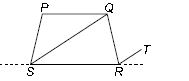
Question. In the given figure, line RT is drawn parallel to SQ. If ∠QPS = 100°, ∠PQS = 40°, ∠PSR = 85° and ∠QRS = 70°, then ∠QRT = ________.
(A) 45°
(B) 65°
(C) 85°
(D) 90°
Answer : B
Question. Which of the quadrilaterals is NOT a parallelogram?
(A) Rectangle
(B) Square
(C) Kite
(D) Rhombus
Answer : C
Question. Match the following :
| Column-I | Column-II |
| (P) Diagonals of a rectangle | (1) Bisect each other at right angles |
| (Q) Diagonals of a square | (2) Bisect each other |
| (R) Diagonals of a rhombus | (3) Equal and bisect each other |
| S) Diagonals of a parallelogram | (4) Equal and bisect each other at right angles |
(A) (P) → (1), (Q) → (2), (R) → (3), (S) → (4)
(B) (P) → (3), (Q) → (4), (R) → (1), (S) → (2)
(C) (P) → (4), (Q) → (2), (R) → (3), (S) → (1)
(D) (P) → (4), (Q) → (3), (R) → (2), (S) → (1)
Answer : B
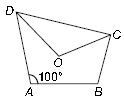
Question. In the given figure (not drawn to scale), DO and CO are the bisectors of ∠ADC and ∠BCD respectively. If ∠ADC = ∠BCD = 60° and ∠DAB = 100°, find the measure of ∠DOC and ∠ABC respectively.
(A) 100°, 160°
(B) 110°, 150°
(C) 120°, 140°
(D) 110°, 130°
Answer : C
Question. Which of the following can never be the measure of exterior angle of a regular polygon?
(A) 22°
(B) 36°
(C) 45°
(D) 30°
Answer : A
Question. The exterior angle of a regular polygon is one-third of its interior angle. How many sides does the polygon has?
(A) 10
(B) 8
(C) 9
(D) 13
Answer : B
Question. Which of the following statements is CORRECT ?
(A) The diagonals of a parallelogram are equal.
(B) The diagonals of a rectangle are perpendicular to each other.
(C) If the diagonals of a quadrilateral intersect at right angles, it is not necessarily a rhombus.
(D) Every quadrilateral is either a trapezium or a parallelogram or a kite.
Answer : C
Question. If each pair of opposite sides of a quadrilateral are equal and parallel, then it is a _______.
(A) Kite
(B) Trapezium
(C) Parallelogram
(D) None of these
Answer : C
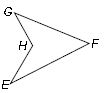
Question. The given quadrilateral EFGH is a ________.
(A) Parallelogram
(B) Concave quadrilateral
(C) Convex quadrilateral
(D) Trapezium
Answer : B
Question. Four angles of a quadrilateral are in the ratio 1 : 2 : 3 : 4. The difference between the greatest and the smallest angle is ________.
(A) 125°
(B) 75°
(C) 108°
(D) 120°
Answer : C
Question. A trapezium in which non-parallel sides are equal is said to be ________.
(A) Right trapezium
(B) Equilateral trapezium
(C) Isosceles trapezium
(D) None of these
Answer : C
Question. If the diagonals of a quadrilateral bisect each other at right angle, then it is a _______.
(A) Kite
(B) Parallelogram
(C) Rhombus
(D) Rectangle
Answer : C
Question. The quadrilateral having only one pair of opposite sides parallel is called a ______ .
(A) Square
(B) Rhombus
(C) Trapezium
(D) Parallelogram
Answer : C
Question. The theatre in the town is built in the form of a kite. Its perimeter is 100 m. If one of its sides is 20 m, then what are the lengths of other sides?
(A) 20 m, 30 m, 30 m
(B) 30 m, 40 m, 40 m
(C) 20 m, 40 m, 32 m
(D) 30 m, 40 m, 50 m
Answer : A
Question. Vikas’s garden is in the form of a parallelogram whose one side is 4.8 cm and other side is 1(1/2) times of this side. He wants to fence his garden four times by a wire. Find the length of the wire required.
(A) 96 cm
(B) 108 cm
(C) 132 cm
(D) 84 cm
Answer : A
Question. Fill in the blanks.
(i) Sum of interior angles of a polygon of n sides is P right angles
(ii) The measure of at least one Q angle of a concave quadrilateral is more than 180°.
(iii) A quadrilateral which has only one pair of equal opposite angles is R .
(iv) Sum of all exterior angles of a polygon of n sides is S .
| P | Q | R | S | |
| A | 4 | exterior | kite | n × 360° |
| B | n – 2 | exterior | trapezium | n × 180° |
| C | 2n – 4 | interior | trapezium | 360° |
| D | 2 | interior | trapezium | 180° |
Answer : C
Question. The number of sides of a regular polygon whose each exterior angle has a measure of 30° is _______.
(A) 12
(B) 6
(C) 8
(D) 10
Answer : A
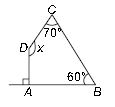
Question. In the given figure, the value of x is_____.
(A) 120°
(B) 140°
(C) 160°
(D) 130°
Answer : B
Question. ABCD is a parallelogram.
Find the angles x, y and z in the given figure.
(A) 40°, 50°, 60°
(B) 60°, 60°, 60°
(C) 50°, 50°, 50°
(D) 60°, 70°, 70°
Answer : C
Question. Select the INCORRECT statement.
(A) Every rectangle is a trapezium.
(B) A quadrilateral can be drawn if all four sides and one angle is known.
(C) Triangle is a polygon whose sum of exterior angles is double the sum of interior angles.
(D) If diagonals of a quadrilateral are equal, it must be a rectangle.
Answer : A
Question. A field is in the form of an isosceles trapezium whose perimeter is 215 m. One of its non-parallel side is 50 m. What is the sum of its parallel sides?
(A) 115 m
(B) 60 m
(C) 165 m
(D) 135 m
Answer : A
Question. Rohit has 6 wooden sticks of equal length. He wants to join all of them in such a way that they make a regular polygon.
At what internal angle he has to join wooden stick with each other?
(A) 105°
(B) 120°
(C) 115°
(D) 90°
Answer : B
Question. Atul is playing in a playground which is of the form of a parallelogram. He observes that the diagonals of the playground are 80 m and 60 m long. So, the playground is in the shape of _______.
(A) Rectangle
(B) Rhombus
(C) Kite
(D) Square
Answer : B
Questions carrying 1 Mark each :-
Q.1 What is the sum of the measures of the four angles of a quadrilateral?
Q.2 If the diagonals of a quadrilateral bisect each other at right angle, the quadrilateral is called ..............
Q.3 The adjacent angles in a parallelogram are.............
Q.4 State true or false :
A pentagon is a concave polygon.
Q.5 A regular polygon is both equiangular and..........
Questions carrying 2 Marks each :-
Q.6 The adjacent sides of a parallelogram are in the ratio 3:7 and its perimeter is 100 cm. Find the sides of the parallelogram.
Q.7 The angles of a quadrilateral are in the ratio 2:3:4:6. Find the measure of the angles.
Q.8 Find the number of sides of a regular polygon whose each exterior angle has a measure of 36°.
Q.9 The sumof the exterior angles of any polygon is:
a) 180° b) 360° c) 90° d) 60°
Q.10 Which of the following is a regular polygon:
a) Isosceles triangle
b) Square
c) Parallelogram
d) Rhombus
c) Parallelogram
d) Rhombus
Q.11 The opposite angles of a _______ are equal.
a) Parallelogram
b) Rhombus
c) Trapezium
d) None of these
Refer to attached file for detailed assignment CBSE Class 8 Mathematics Understanding Quadrilaterals Assignments Set B
Free study material for Mathematics
Chapter Assignment & Practice Material for Class 8 Mathematics Chapter 03 Understanding Quadrilaterals
Revision Assignment: Chapter 03 Understanding Quadrilaterals (CBSE)
Explore reliable practice questions for Chapter 03 Understanding Quadrilaterals tailored for Class 8 learners. Use these structured worksheets to evaluate preparedness and strengthen core problem-solving skills.
Why Practice Class 8 Mathematics Assignments?
- Syllabus Compliance: Sets reflect current CBSE evaluation criteria and official marking frameworks.
- Multi-Format Practice: Includes varied problem types designed to deepen comprehension across all sub-topics.
- Time Management: Routine practice optimizes pacing to finish school examinations comfortably within schedule.
Steps to Complete Chapter 03 Understanding Quadrilaterals Assignments Successfully
- Textbook Review: Always study the core NCERT book for Class 8 Mathematics prior to beginning the assignment.
- Independent Attempt: Solve Chapter 03 Understanding Quadrilaterals questions on your own initially before cross-checking with expert solutions.
- Error Tracking: Record challenging concepts in a dedicated notebook and practice online MCQ tests for revision.
FAQs
You can download free PDF assignments for Class 8 Mathematics Chapter 03 Understanding Quadrilaterals from StudiesToday.com. These practice sheets have been updated for the 2026-27 session covering all concepts from latest NCERT textbook.
Yes, our teachers have given solutions for all questions in the Class 8 Mathematics Chapter 03 Understanding Quadrilaterals assignments. This will help you to understand step-by-step methodology to get full marks in school tests and exams.
Yes. These assignments are designed as per the latest CBSE syllabus for 2026. We have included huge variety of question formats such as MCQs, Case-study based questions and important diagram-based problems found in Chapter 03 Understanding Quadrilaterals.
Practicing topicw wise assignments will help Class 8 students understand every sub-topic of Chapter 03 Understanding Quadrilaterals. Daily practice will improve speed, accuracy and answering competency-based questions.
Yes, all printable assignments for Class 8 Mathematics Chapter 03 Understanding Quadrilaterals are available for free download in mobile-friendly PDF format.