

Class 8 Mathematics Practice Assignments: CBSE Class 8 Mathematics Comparing Quantities Assignment Set 01
Review targeted academic assignments with the CBSE Class 8 Mathematics Comparing Quantities Assignment Set 01. Built according to official CBSE standards for the 2026-27 term, these downloadable Class 8 Mathematics worksheets support effective daily practice for Chapter 08 Comparing Quantities.
Download Chapter 08 Comparing Quantities Assignment PDF with Solutions
View or download the dedicated CBSE Class 8 Mathematics Comparing Quantities Assignment Set 01 resource below. Engaging with these assignments under focused study conditions ensures continuous academic progress and mastery of the 2026-27 curriculum.
Very Short Answer type Questions
Question. Compound interest on a certain sum for 2 years at 12 (1/2) % per annum is Rs. 170. Find the sum.
Answer : 640
Question. On Monday, if 1/2 of number of students of class VIII are in a computer room, 1/4 are in art room and rest 12 students are in playground. What is the total number of students in a class.
Answer : 48
Question. Ankita bought a book for Rs. 450 and after two months she sold it for Rs. 360 to her friend. Find the loss percentage.
Answer : 20%
Question. x% of 360 = 72. Find x
Answer : x = 20
Question. Find the money Raj borrowed from his friend if he paid Rs. 72900 to him after 2 years at 8% per annum compounded annually.
Answer : Rs. 62500
Question. By selling a chair for Rs. 880.00, Rohit loses 20%, For what price Rohit bought the chair.
Answer : Rs. 1100
Question. At what price does Poonam sell her T.V. set which she bought for Rs. 5000 so as to make a profit of 20%?
Answer : Rs. 6,000
Question. Seema purchased a washing machine for Rs. 10,000 at credit at 10% for 2 years. What amount she has to pay after 2 years if interest in compounded annually?
Answer : Rs. 12,100
Question. Find 30% of 600.
Answer : 180
Question. Seema purchased a shirt for Rs. 250 a frock for Rs. 350 and a jeans for Rs. 650. She paid Rs. 1000 for all the three items. What percentage discount she got?
Answer : 20%
Question. If in a class of 40 students, 70% of students are girls then what is the number of boys in the class.
Answer : 12 Boys
Question. At what rate percent compound interest per annum will Rs. 12500 amount to Rs. 21600 in 3 years?
Answer : 20%
Question. By selling a car for Rs. 44,000 a man made a profit of 10%. At what price did he buy the car?
Answer : Rs. 40,000
Question. Ramesh scored 445 marks out of 500. What percent of marks he scored?
Answer : 89%
Question. Anil bought a quilt for Rs. 1200 and sold it at a profit of 15%. At what price did he sell the quilt?
Answer : Rs. 1380
Question. Express 25% as a fraction,
Answer : 1/4
Question. Selling price of 25 painting is equal to cost price of 35 paintings. Find the profit percentage.
Answer : 40%
Question. Which is more : A discount of (50% + 20%) or discount (70%)?
Answer : 70%
Question. At what rate of interest (Compound) per annum will Rs. 625 amount to 784 in a 2 years.
Answer : 12%
Question. Ragani borrow a sum of Rs. 8000 from Seema at 5% per annum for 3 years. How much money she has to return to Seema?
Answer : Rs. 9261
Fill in the blanks:
(i) 3 : 8 as a per cent is ……….. .
(ii) If a man loses Rs. 240 on selling an article for Rs. 1260, the loss per cent will be …..
(iii) If S. P. = Rs. 900 and M. P. = Rs. 1200, then discount = ……. %.
(iv) The compound interest on Rs. 500 at 5% per annum for 1 year = Rs. …………
(v) If the interest is paid half yearly, then in the formula , we take …... for .
2. Answer True (T) or False (F) :
(i) % of b is equal to b% of a.
(ii) If I am 20% taller than you, you are 20% shorter than me.
(iii) If the profit is 20%, S. P. must be multiplied by to get C. P.
(iv) When the interest is calculated yearly, the simple interest and compound interest are same for the first year.
(v) Simple interest is calculated on the same principal for the entire loan period.
3. Choose the correct option (Multiple Choice Questions) :
(i) If 9% of is 27, the value of will be
(a) 24 (b) 30 (c) 300 (d) 330.
(ii) If the selling price of an article is twice the cost price, the profit per cent is
(a) 50% (b) 100% (c) 200% (d) cannot be calculated
(iii) The simple interest on a sum of Rs. 2700, at a rate of for 4 years is
(a) Rs. 270 (b) Rs. 300 (c) Rs. 350 (d) Rs. 360.
(iv) If a sum of money borrowed on simple interest for 10 years doubles itself, then the rate percent is
(a) 2% (b) 5% (c) 10% (d) 12%.
(v) Which of the following is more profitable for a one-year deposit?
(a) a simple interest of 10%
(b) a compound interest of 10% compounded annually
(c) a compound interest of 10% compounded half-yearly
(d) a simple interest of 11%.
4. A garden has 2000 trees. 12% of these are mango trees, 18% lemon and the rest are orange trees. Find the number of orange trees.
5. A certain school has 300 students, 142 of whom are boys. It has 30 teachers, 12 of whom are men. What percent of the total number of students and teachers in the school is female?
6. Ankita was given an increment of 10% on his salary. Her new salary is Rs. 3575. What was her salary before increment?
7. The population of a town increases by 10% annually. If the present population is 60000, what will be its population after 2 years?
8. Sunil loaned Rs. 8192 to Raveena to enable her to purchase a T. V. set. If Sunil charged interest at the rate of 12.5% per annum, compounded half-yearly, calculate the amount that Raveena will have to pay to Sunil after 11/2 years.
9. Ankit buys 50 chairs for Rs. 50, 000 but 20 of them are damaged. He decides to sell each damaged one at three fourths the price of the normal one. What should this price be in order that he may make a profit of 35% on the whole transaction?
10. A dealer of scientific instruments allows 20% discount on the marked price of the instruments and still makes a profit of 25%. If his gain over the sale of an instrument is Rs. 150, find the marked price of the instrument.
11. Pratyusha purchases a motorcycle, having marked price Rs. 46000 at a discount of 5%. If VAT is charged at the rate of 10%, find the amount Pratyusha has to pay to purchase the motorcycle.
12. A wholesale company marks goods without including sales tax. A particular item is marked as Rs. 760. If a customer is required to pay a sales tax of 15% on the item,
(i) How much sales tax does she have to pay?
(ii) How much will the item cost her when sales tax is included?
13. Petroleum is a very dark liquid when it is pumped out of the ground. Several useful products are made from this in a refinery. Two major products of petroleum are shown here. A particular refinery produces 8.4 lakh gallons of petroleum products per day. A gallon is nearly litres.
(i) How many of these gallons are used to make gasoline? How much is this in litres?
(ii) Oil is measured by the barrel, each containing 42 gallons. How many barrels are used to make fuel oil?
14. A man bought two T. V. sets for Rs. 42500. He sold one at a loss of 10% and other at a profit of 10%. If the selling price of each T. V. set is same, determine the C. P. of each set.
15. Afridi purchased an old scooter for Rs. 16, 000. If the cost of scooter after 2 years depreciates to Rs. 14440, find the rate of depreciation.
16. Find the rate of interest for a sum that becomes times of itself in 2 years, when compounded annually.
17. The population of a place in the year 2000 was 48, 000. This showed a rate of increase of 5% per year. What would have been the population in the year 1998 and what will it be in the year 2003?
18. The boys and girls in a college are in the ratio . If 20% of the boys and 25% of the girls are adults, then what is the percentage of students who are not adults?
19. The simple interest on a certain sum of money for 3 years at 8% per annum is half of the compound interest on Rs. 4000 for 2 years at 10% per annum. What sum is placed on simple interest?
20. Suzy borrowed from Gurkeet certain sum for two years at simple interest. Suzy lent this sum to Hamida at the same rate for two years compound interest. At the end of two years, she received Rs. 110 as compound interest but paid Rs. 100 as simple interest. Find the sum and the rate of interest
Question. Find the ratio of 5 paise to Rs. 25.
Answer : 1 : 500
Question. Find the ratio of speed of a car and truck travelling 150 km in 3 hours and 120 km in 4 hours respectively.
Answer : 5 : 3
Question. In off-season a company announced 25% discount on A.C. to clear their stock. If Mr. Gupta has paid Rs. 22,500 for the A.C. what was the original price for A.C.
Answer : Rs. 30,000
Question. Radhika earned Rs. 16,000 in a month. She saves 20% of her income. How much does she spend?
Answer : Rs. 12,800
Question. Find the ratio of 5m to 10 mm.
Answer : 500 : 1
Question. Anil bought a quilt for Rs. 1200 and sold it at a profit of 15%. At what price did he sell the quilt?
Answer : Rs. 1380
Question. Vijay has bought a motor bike for Rs. 32,400 including 8% VAT. What is the price of motorbike before VAT.
Answer : Rs. 30,000
Question. The price of a computer is Rs. 48,000. The sales tax charged was 4%, what is the amount to be payed by Mr. Gupta?
Answer : Rs. 49,920
Question. Find 30% of 600.
Answer : 180
Question. The list price of washing machine is Rs. 26,000. A discount of 10% was given by the shopkeeper to attract the customers. How much money does one has to pay?
Answer : Rs. 23,400
Question. Express 4/25 as a percentage.
Answer : 16%
Question. Find 50% of Rs. 728.
Answer : Rs. 364
Question. The cost of 6 pens is Rs. 72. What would be the cost of 10 such pens?
Answer : Rs. 120
Question. x% of 360 = 72. Find x
Answer : x = 20
Question. On Monday, if 1/2 of number of students of class VIII are in a computer room, 1/4 are in art room and rest 12 students are in playground. What is the total number of students in a class.
Answer : 48
Question. Mrs. Sunita has got 20% increase in her salary. If her salary was Rs. 18000. What will be her new salary?
Answer : Rs. 21,600
Question. Express 0.295 as a percentage.
Answer : 29.5%
Question. Which is more : A discount of (50% + 20%) or discount (70%)?
Answer : 70%
Question. Complete it. (50% + 40%) = _________% discount
Answer : 70%
Question. Ankita bought a book for Rs. 450 and after two months she sold it for Rs. 360 to her friend. Find the loss percentage.
Answer : 20%
Question. By selling a chair for Rs. 880.00, Rohit loses 20%, For what price Rohit bought the chair.
Answer : Rs. 1100
Question. A whole sale dealer observed that cost of 45 pants of equal to selling price of 30 pants. What is his profit percent?
Answer : 50%
Question. Seema purchased a washing machine for Rs. 10,000 at credit at 10% for 2 years. What amount she has to pay after 2 years if interest in compounded annually?
Answer : Rs. 12,100
Question. Selling price of 25 painting is equal to cost price of 35 paintings. Find the profit percentage.
Answer : 40%
Mark (1)
Q 1 When 5% sale tax is added on the purchase of a bedsheet of Rs 300, find the buying price or the cost price of the bedsheet.
Q 2 Find the ratio of the speed of a car 60 km/hr to the speed of a scooter 30 km/hr.
Q 3 Find the ratio of 5 m to 10 km.
Q 4 Convert the ratio 4 : 5 to percentage.
Q 5 76% of 50 students are good in English. How many students are not good in English?
Q 6 A table fan is bought for Rs 560 and expenses of Rs 40 are made on its repairs. It is sold at a profit of 5%. Find the selling price.
Q 7 A man got 10% increase in his salary. If his original salary was Rs 30,000, find his new salary.
Q 8 Find the amount on a principal of Rs 2000 for 2 years at 10% per annum compounded annually. Also find the compound interest.
Q 9 An item marked at Rs 640 is sold for 560. What is the discount and discount%?
Q 10 The price of a car was Rs 2,60,000 last year. It has increased 15% this year. What is the new price?
Q 11 A table is sold at Rs 5000 after allowing a discount of 12.5%. Find its marked price.
Marks (2)
Q 12 Ram had Rs 400 left after spending 60% of his money. How much did he have in the beginning?
Q 13 Shalu bought a water cooler for Rs 1100 including a tax of 10%. Find the price of the water cooler before the tax was added.
Q 14 On selling a fan for Rs 810, Sunil gains 8%. For how much did he purchase it?
Q 15 A scooter was bought at Rs 32,000. Its value depreciated at the rate of 8% per annum. Find its value after one year.
Q 16 Find the compound interest on Rs 1,60,000 for 2 years at 10% per annum when compounded semi-annually.
Q 17 If the cost price of 10 greeting cards is equal to the selling price of 8 greeting cards, find the gain or loss%.
Q 18 Rishi bought a wrist watch for Rs 2200 and sold it for Rs 1980. Find his gain or loss%.
Q 19 A cricket team won 10 matches out of the total matches they played. If their win percentage was 40, then how many matches did they play in all?
Marks (3)
Q 20 A shopkeeper offers his customers 10% discount and still makes a profit of 26%. What is the actual cost of an article marked Rs 280?
Q 21 A person sells an article for Rs 550, gaining 1/10 of its C.P. Find gain%.
Q 22 Rahul bought an air conditioner for Rs 22,000 including a tax of 10%. Find the price of the air conditioner before VAT was added.
Q 23 Harish sold a bicycle at 8% gain. Had it been sold for Rs 75 more, the gain would have been 14%. Find the cost price of the bicycle.
Q 24 Shruti borrows Rs 12,000 at 10% per annum for 3 years at simple interest and Shalini borrows the same amount for the same
period at 8% per annum compounded annually. Who pays more interest and by how much?
Marks (4)
Q 25 Mr. Kashiv sold his old chair at a loss of 15%. If he had sold it for Rs. 800 more, he would have received a profit of 5%. Find the
cost price of the table.
Q 26 Rakesh bought a watch for Rs. 800 and sold it for Rs. 1000. Mukesh bought a car for Rs. 4,00,000 and sold it for Rs. 4,20,000.
Who made a better sale, Rakesh or Mukesh?
Q 27 A washing machine was sold for Rs. 5760 after giving successive discounts of 15% and 10% respectively. What was the marked
price?
Q 28 The marked price of a television is 25% more than the cost price. It is sold at a discount of 10%. If the marked price is Rs.
12,000, then find the cost price, selling price and the profit. What will be the percentage of profit?
Q 29 In how much time will the simple interest on Rs. 3,500 at the rate of 6% per annum be the same as simple interest on Rs. 4,000
at 10.5% per annum for 4 years?
Marks (5)
Q 30 A man sold two of his buffaloes for Rs 20,000 each. On one, he made a profit of 5% and on the other, he lost 10%. Find his overall profit% or loss%.
Q 31 Find the amount and compound interest on Rs 20,000 for 1.5 years at 10% per annum compounded half yearly. Would this interest be more than the interest he gets if it was compounded annually?
Q 32 If 60% people speak Spanish, 30% speak English and the remaining speak other language, then what percent of the people speak other languages? If the total population is 50 lakhs, find the exact number of people who speak each type of language?
Most Important Questions
Q 1 Ratio is a means of comparing quantities of similar kinds. (T/F)
Q 2 Is 2:4 = 1:2?
Q 3 Percentages are a means of comparison. (T/F)
Q 4 Increase in price = old price + increase (True/False)
Q 5 Discount = _______ - _______
Q 6 Find the discount price of a skirt with a price of Rs 200 and a discount of 25%. What will be the sale price.
Q 7 What will be the price of petrol if its price now is Rs 50 and the hike is expected to be 12%?
Q 8 What will be the price of rice if its price now is Rs 25/kg and the reduction is expected to be 8 %?
Q 9 Convert into percentage: - a) 3 : 4
Q 10 What percent of the total distance of 100km is 22km?
Q 11 If M.P = Rs 650 and discount = 10% Find Sale Price
Q 12 A fan of M.P of Rs 1500 is sold for Rs 1080 after allowing a certain discount. Find the rate of discount
Q 13 A shirt with marked price Rs 1500 was sold to a customer for Rs 1080. Find the rate of discount allowed on the shirt.
Q 14 A team won 6 matches out of total that they played. If their winning percentage is 60 percent , what is the total number of matches they played? How many did they loose?
Q 15 What price should Kavita mark on an item, which costs her Rs 2200 so as to gain 26% after allowing a discount of 12%
Q 16 A cycle merchant allows 25% discount on the marked price of the cycle and still makes a profit of 20%. If he gains Rs 360 over the sale of one cycle find M.P of the cycle.
Q 17 A shopkeeper offers his customers 10% discount and still makes a profit of 26%. What is the actual cost to his of an article marked Rs 280.
Q 18 0.6 % can be expressed as
Q 19 Gain% = Gain/S.P x 100%
Q 20 Discount = M.P. x Discount% / 100
Q 21 Loss% = (C.P. - S.P.) / C.P x 100%
Q 22 If M.P = Rs x and discount = y%. Find S.P
Q 23 If C.P = Rs X and loss = A% Find S.P.
Q 24 If S.P = Rs. Y and Gain = B% find C.P
Q 25 Total Bill amount = Bill amount + Sales Tax% of (bill amount) (T/F)
Q 26 Price including VAT = _________.
Q 27 To calculate the compound interest with the help of simple interest the Principal Amount of second year = _____________
Q 28 If Principal Amount = P, Rate of Interest = r%, Time period = n years
Than compound Interest will be = ___________
Q 29 The Difference between the original principal and last amount is said to be ___________
Q 30 The time period after which interest is added each time to form a new principal is said to be __________
Q 31 What is the formula to calculate Simple interest?
Q 32 Write the formula for computing price including Sales Tax.
Q 33 A man purchased an article for Rs1000. He sold it by gaining two-fifth of its cost price. Find his S.P. of article.
Q 34 C.P = Rs. 225 , overhead charges = 15, S.P = Rs 300. Find loss or profit percent
Q 35 A fruit seller purchased 6 oranges for a rupee and sold them at the rate of Rs 2.50 per dozen, find his gain or loss% .
Q 36 Find the Simple interest of Rs 8500 for 2 years at 8% p.a.
Q 37 Find the Compound interest on Rs 5000 for 1 yr at 8% p.a. compounded annually.
Q 38 Find the amount on Rs 16000 for 3 yrs at 5% p.a. compounded annually.
Q 39 The sale price of an article including the sales tax is Rs 616. The rate of sales tax is 10%. If the shopkeeper has made a profit of 12% then find the cost price.
Q 40 Find the Compound Interest on Rs 6400 for 2yrs compounded annually at 7½% p.a.
Q 41 Find the amount of Rs 12000 after 2yrs, compounded annually, the rate of interest being 5% p.a. during the 1st yr and 6% p.a. during the 2nd yr.
Q 42 If the C.P of 10 chairs be equal to S.P of 16 chairs. Find gain or loss percent
Q 43 Sabena bought 16 dozen-ball pens and sold them at a loss equal to S.P of 8 ball pens. Find her loss%
Q 44 Find the difference between the compound interest and the simple interest on Rs 32000 at 12% p.a. for 3 yrs.
Q 45 A charity purchased 100 blankets at Rs 2000 each. They found that 10 blankets were defective and they sold these at Rs 1200 each. At what rate should they sell the remaining blankets so as to gain 14% on the whole?
Q 46 Rajan bought two buffaloes for Rs 30000. By selling one at a loss of 15% and other at a gain of 19%, he found that selling price of both buffaloes is the same. Fine the C.P of each.
Q 47 A man sold two articles at Rs 25920 each. These were sold at 8% gain and 4% loss respectively. Find the gain or loss present in the whole transaction.
Q 48 In how much time will a sum of Rs 1000 amount to Rs 1331.20 at 10% p.a. Compound interest?
Q 49 At what rate % p.a. will a sum of Rs 7500 amount to Rs 8427 in 2 yrs, compounded annually?
Q 50 Semi annual means ________.
Q 51 Quarterly means every ______ months in a year.
Q 52 There are ______ conversion periods when the interest is computed half-yearly.
Q 53 There are ______ conversion periods when the interest is computed quarterly.
Q 54 What is the formula for finding increased population during n years?
Q 55 If the growth rate of a company’s employees is r% every year and there head count in 2004 was x million, find their head count in 2009?
Q 56 If the value of a car depreciates by 6 % each year and its current value is 3 lakhs, find its value the next yr.
Q 57 When the interest is calculated semi-annually, the rate of interest of each conversion period is _______ & the time period gets______.
Q 58 When the interest is calculated quarterly, the rate of interest of each conversion period becomes _______ & the time period becomes ______.
Q 59 Compound Interest formula is applicable in following cases (T/F).
a) To calculate Increase/Decrease in population.
b) Calculating value of an item increasing/decreasing over a number of years.
Q 60 What will be the compound interest on Rs1000 at the rate of 8% per annum for 1 and ½ years when interest is compounded quarterly.
Q 61 Find the compound interest on Rs14,000 at the rate of 12% per annum for 1 and 1/2 years when interest is compounded semiannually.
Q 62 Rakesh bought a scooter for Rs 42,000. If its value decreases by 8% every year, find its value at the end of 2 years.
Q 63 Find the amount to be paid on a loan of Rs 50,000 for 3 years at 12% per annum compounded semi-annually.
Q 64 The bacteria in our hands grow at the rate of 20% every hour. What will be their count after 3 hrs if their initial count is 5 lakhs.
Q 65 The population of the world in 2008 is 6 billion. It increases at a rate of 1.5% every year. What will be the population 2 years from now? Also estimate what would have been the population in 2006?
Question. Express 42/50 as a percentage.
Answer : 84%
Question. Find the amount Preeti has to pay to the bank after 2 years at 4% per annum on Rs. 625. If the Interest is compounded annually.
Answer : Rs. 676
Question. Express 25% as a fraction,
Answer : 1/4
Question. Divide 95 chocolates among Rahul and Rekha in the ratio of 2:3. How many chocolate each will get?
Answer : 38 and 57
Question. A fruit seller bought a basket containing 2050 oranges out of which 41 oranges were rotten. What percentage of oranges were rotten?
Answer : 2%
Question. If in a class of 40 students, 70% of students are girls then what is the number of boys in the class.
Answer : 12 Boys
Question. 25% of x = 250. Find x.
Answer : 1000
Question. In a school there were 810 students 90% of them went to a picnic. How many students went to the picnic?
Answer : 729
Question. Ragani borrow a sum of Rs. 8000 from Seema at 5% per annum for 3 years. How much money she has to return to Seema?
Answer : Rs. 9261
Question. Find (25% of 600) – (20% of 450)
Answer : 60
Question. Find the money Raj borrowed from his friend if he paid Rs. 72900 to him after 2 years at 8% per annum compounded annually.
Answer : Rs. 62500
Question. Find the difference between simple interest and compound interest on Rs. 1000 for 2 years at 10% per annum.
Answer : Rs. 10
Question. By selling a car for Rs. 44,000 a man made a profit of 10%. At what price did he buy the car?
Answer : Rs. 40,000
Question. Compound interest on a certain sum for 2 years at 12(1/2)% per annum is Rs. 170. Find the sum.
Answer : 640
Question. Seema purchased a shirt for Rs. 250 a frock for Rs. 350 and a jeans for Rs. 650. She paid Rs. 1000 for all the three items. What percentage discount she got?
Answer : 20%
Question. Last year price of mangoes was Rs. 30 per kg. This year the price of mangoes has increased by 30%. What is the price now?
Answer : Rs. 39
Question. Which is more : (90% of 800) or (70% of 1100)?
Answer : (70% of 1100)
Question. C.P. of 360 books = S.P. of 270 books. Find profit %.
Answer : (100/5) %
Question. Ramesh scored 445 marks out of 500. What percent of marks he scored?
Answer : 89%
Question. At what rate of interest (Compound) per annum will Rs. 625 amount to 784 in a 2 years.
Answer : 12%
Question. Convert the ratio 1:4 into percent.
Answer : 25%
Question. At what price does Poonam sell her T.V. set which she bought for Rs. 5000 so as to make a profit of 20%?
Answer : Rs. 6,000
Question. At what rate percent compound interest per annum will Rs. 12500 amount to Rs. 21600 in 3 years?
Answer : 20%
Questions carrying 1 Mark each :-
Q.1 Find the ratio of 1 dozen oranges to 28 oranges.
Q.2 Write the formula to find C.P. when S.P. and gain% are given.
Q.3 An item marked at Rs. 750 is sold for Rs. 525. Find the discount.
Q.4 Compound Interest= ___________ - __________.
Questions carrying 2 marks each:-
Q.5 Amit bought a stereo for Rs. 4500 and sold it for Rs. 4230. Find his gain or loss percent.
Q.6 The marked price of a sofa set is Rs. 3000. It is sold for Rs. 2500. Find the rate of discount.
Q.7 If 10% VAT is included in the prices, find the original price of a TV bought for Rs. 22000.
Questions carrying 3 marks each:-
Q.8 Find the compound interest of Rs. 5000 for 2 years at the rate of 8 % per annum, when the interest is compounded annually.
Q.9 A TV set was sold for Rs. 9000 after giving successive discount of 20% and 10% respectively. Find the marked price.
Q.10 If the selling price of 10 articles is equal to the cost price of 11 articles, find gian percent.
Q.11 40% of a number is 360. what is 25% of the number?
Questions carrying 6 marks each:-
Q.12 After allowing 20% discount to the customer, a dealer still gains 20% . Find the marked price of the electric fan which costs him Rs. 1600.
Q.13 A certain sum invested at 10% per annum compounded semi-annually amounts to Rs. 8820 at the end of one-year. Find the sum.
Q.14 The population of a town is 32000. The growth rate of population is 5%What will be the population of town after 3 years?
Questions choice Questions carrying 1 mark each:-
Q.15 When interest is compounded quarterly, we divide the rate by
(a) 4
(b) 2
(c) 1
(d) 3
Q.16 4 years 6 months equivalent to how many years?
(a) (3/2)years
(b) (2/3)years
(c) 54 years
(d) none of these.
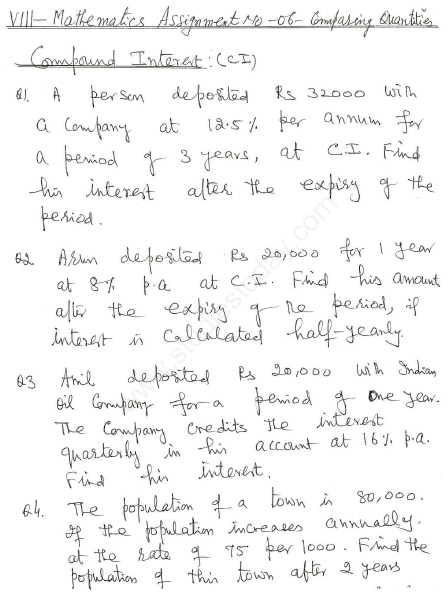
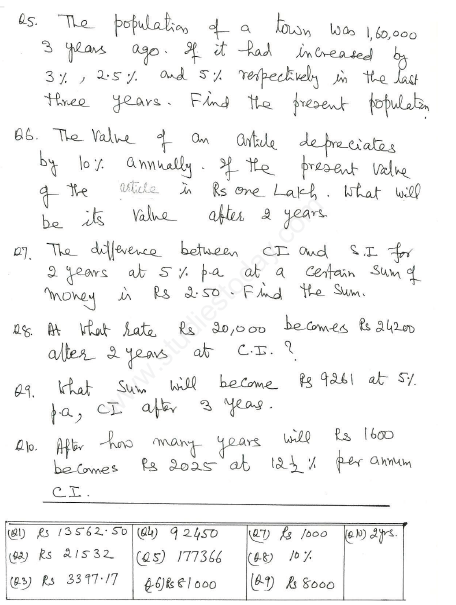
1. Fill in the blanks:
Question 1(i). 3 : 8 as a per cent is .......... .
Answer: 37.5%
Percentage = \(\frac{3}{8} \times 100\% = \frac{300}{8}\% = 37.5\%\)
In simple words: To convert a ratio or fraction to a percentage, multiply it by 100.
Exam Tip: Remember that \(\frac{1}{8} = 12.5\%\), so multiplying by 3 gives \(3 \times 12.5\% = 37.5\%\).
Question 1(ii). If a man loses Rs. 240 on selling an article for Rs. 1260, the loss per cent will be .....
Answer: 16%
Selling Price (S.P.) = Rs. 1260
Loss = Rs. 240
Cost Price (C.P.) = S.P. + Loss = 1260 + 240 = Rs. 1500
Loss % = \(\frac{\text{Loss}}{\text{C.P.}} \times 100 = \frac{240}{1500} \times 100 = \frac{240}{15} = 16\%\)
In simple words: First find the cost price by adding loss to selling price, then calculate loss percentage on the cost price.
Exam Tip: Loss and profit percentages are always calculated with respect to the Cost Price, never the Selling Price unless specifically stated.
Question 1(iii). If S. P. = Rs. 900 and M. P. = Rs. 1200, then discount = ....... %.
Answer: 25%
Marked Price (M.P.) = Rs. 1200
Selling Price (S.P.) = Rs. 900
Discount = M.P. - S.P. = 1200 - 900 = Rs. 300
Discount % = \(\frac{\text{Discount}}{\text{M.P.}} \times 100 = \frac{300}{1200} \times 100 = \frac{1}{4} \times 100 = 25\%\)
In simple words: Discount is the reduction on marked price, and discount percentage is calculated on the marked price.
Exam Tip: Always compute discount percentage using the Marked Price as the base denominator.
Question 1(iv). The compound interest on Rs. 500 at 5% per annum for 1 year = Rs. ..........
Answer: Rs. 25
Principal (\(P\)) = Rs. 500
Rate (\(R\)) = 5% per annum
Time (\(T\)) = 1 year
For 1 year, compounded annually, Compound Interest is equal to Simple Interest.
Interest = \(\frac{P \times R \times T}{100} = \frac{500 \times 5 \times 1}{100} = \text{Rs. } 25\)
In simple words: For the first year, compound interest and simple interest are always the same.
Exam Tip: When time is 1 year, do not apply complicated compound formulas; simple interest formula gives the exact result.
Question 1(v). If the interest is paid half yearly, then in the formula \(A = P\left(1 + \frac{r}{100}\right)^{2n}\), we take ...... for \(r\).
Answer: half the annual rate (or \(\frac{r}{2}\))
When interest is compounded half-yearly, the rate becomes half of the annual rate.
In simple words: Half-yearly compounding means interest is paid twice a year, so the yearly rate is divided by 2.
Exam Tip: Remember the conversion rules for half-yearly: Rate becomes \(r/2\) and time period becomes \(2n\).
2. Answer True (T) or False (F) :
Question 2(i). \(a\%\) of \(b\) is equal to \(b\%\) of \(a\).
Answer: True (T)
\(a\% \text{ of } b = \frac{a}{100} \times b = \frac{ab}{100}\)
\(b\% \text{ of } a = \frac{b}{100} \times a = \frac{ba}{100} = \frac{ab}{100}\)
Since both expressions result in \(\frac{ab}{100}\), they are equal.
In simple words: Changing the order of numbers in a percentage calculation does not change the final value.
Exam Tip: Use this property to make calculations easier: 4% of 50 is the same as 50% of 4, which is 2.
Question 2(iii). If the profit is 20%, S. P. must be multiplied by \(\frac{5}{6}\) to get C. P.
Answer: True (T)
Let C. P. = \(x\). Profit = \(20\% \text{ of } x = 0.2x\).
S. P. = \(x + 0.2x = 1.2x = \frac{6}{5}x\).
Therefore, \(x = \frac{5}{6} \times \text{S.P.}\), meaning S. P. must be multiplied by \(\frac{5}{6}\) to get C. P.
In simple words: To work backwards from Selling Price to Cost Price during a profit, multiply by the reciprocal of the profit multiplier.
Exam Tip: Profit multiplier is \(1 + \frac{\text{Profit}\%}{100}\). To reverse it, multiply by its reciprocal.
Question 2(iv). When the interest is calculated yearly, the simple interest and compound interest are same for the first year.
Answer: True (T)
For the first year, no previous interest has been added to the principal, so both simple interest and compound interest are calculated on the same initial principal amount.
In simple words: Compound interest only starts adding interest on interest from the second year onwards.
Exam Tip: Always remember that for 1 year (compounded annually), S.I. equals C.I.
Question 2(v). Simple interest is calculated on the same principal for the entire loan period.
Answer: True (T)
By definition, simple interest remains constant every year because it is always computed on the original principal amount.
In simple words: Simple interest does not compound, so the principal never changes year after year.
Exam Tip: Contrast this with compound interest, where the principal increases every compounding period.
3. Choose the correct option (Multiple Choice Questions) :
Question 3(i). If 9% of \(x\) is 27, the value of \(x\) will be
(a) 24
(b) 30
(c) 300
(d) 330.
Answer: (c) 300
\(9\% \text{ of } x = 27\)
\(\frac{9}{100} \times x = 27\)
\(x = \frac{27 \times 100}{9} = 3 \times 100 = 300\)
In simple words: Divide 27 by 9 and multiply by 100 to find the total value of \(x\).
Exam Tip: Translate "percentage of a number" directly into an algebraic equation: \(\frac{\text{Percentage}}{100} \times \text{Number} = \text{Value}\).
Question 3(ii). If the selling price of an article is twice the cost price, the profit per cent is
(a) 50%
(b) 100%
(c) 200%
(d) cannot be calculated
Answer: (b) 100%
Let C.P. = \(x\).
S.P. = \(2x\).
Profit = S.P. - C.P. = \(2x - x = x\).
Profit % = \(\frac{\text{Profit}}{\text{C.P.}} \times 100 = \frac{x}{x} \times 100 = 100\%\)
In simple words: When profit equals the cost price, the profit percentage is exactly 100%.
Exam Tip: If S.P. = \(n \times \text{C.P.}\), the profit percentage is \((n - 1) \times 100\%\). Here \(n = 2\), so profit is \((2 - 1) \times 100\% = 100\%\).
Question 3(iii). The simple interest on a sum of Rs. 2700, at a rate of \(3\frac{1}{3}\%\) for 4 years is
(a) Rs. 270
(b) Rs. 300
(c) Rs. 350
(d) Rs. 360.
Answer: (d) Rs. 360
Principal (\(P\)) = Rs. 2700
Rate (\(R\)) = \(3\frac{1}{3}\% = \frac{10}{3}\%\)
Time (\(T\)) = 4 years
Simple Interest = \(\frac{P \times R \times T}{100} = \frac{2700 \times \frac{10}{3} \times 4}{100}\)
\(= \frac{2700 \times 10 \times 4}{300} = 9 \times 10 \times 4 = \text{Rs. } 360\)
In simple words: Convert the mixed fraction rate into an improper fraction before applying the simple interest formula.
Exam Tip: Always convert mixed fraction rates like \(3\frac{1}{3}\%\) to improper fractions \(\frac{10}{3}\%\) to avoid calculation errors.
Question 3(iv). If a sum of money borrowed on simple interest for 10 years doubles itself, then the rate percent is
(a) 2%
(b) 5%
(c) 10%
(d) 12%.
Answer: (b) 5%
Let Principal = \(P\). Amount = \(2P\).
Simple Interest = Amount - Principal = \(2P - P = P\).
Time (\(T\)) = 10 years.
\(\text{Rate } (R) = \frac{\text{S.I.} \times 100}{P \times T} = \frac{P \times 100}{P \times 10} = 10\% \text{ per year? Wait, let us recalculate}\)
Wait: \(\frac{100}{10} = 10\%\). Let us check option (c) vs (b).
Ah, let's re-verify: If \(P = 100\), S.I. = 100, Time = 10. Rate = \(\frac{100 \times 100}{100 \times 10} = 10\%\).
Therefore, the correct option is (c) 10% (Note: OCR option c is 10%).
In simple words: When a sum doubles, the simple interest earned equals the principal itself. Divide 100 by the number of years to get the rate.
Exam Tip: Shortcut for money doubling at simple interest: Rate \(\times\) Time = 100. So Rate = \(\frac{100}{10} = 10\%\).
Question 3(v). Which of the following is more profitable for a one-year deposit?
(a) a simple interest of 10%
(b) a compound interest of 10% compounded annually
(c) a compound interest of 10% compounded half-yearly
(d) a simple interest of 11%.
Answer: (d) a simple interest of 11%
- Simple interest of 10% gives 10% return.
- Compound interest of 10% compounded annually for 1 year gives 10% return.
- Compound interest of 10% compounded half-yearly for 1 year gives effective rate = \(5\%\) for 2 periods, yielding \(\left(1 + \frac{5}{100}\right)^2 - 1 = 1.025 - 1 = 10.25\%\).
- Simple interest of 11% gives 11% return, which is the highest.
In simple words: An 11% straight simple interest yields more profit than a 10% compound interest (even half-yearly) over a single year.
Exam Tip: Compare the numerical percentage yields directly when time is 1 year: 11% is greater than 10.25%.
Question 4. A garden has 2000 trees. 12% of these are mango trees, 18% lemon and the rest are orange trees. Find the number of orange trees.
Answer:
Total number of trees = 2000
Percentage of mango trees = 12%
Percentage of lemon trees = 18%
Total percentage of mango and lemon trees = 12% + 18% = 30%
Percentage of orange trees = \(100\% - 30\% = 70\%\)
Number of orange trees = \(70\% \text{ of } 2000 = \frac{70}{100} \times 2000 = 70 \times 20 = 1400\)
In simple words: Subtract the percentages of mango and lemon trees from 100% to find the percentage of orange trees, then calculate that percentage of the total trees.
Exam Tip: You can also find individual tree counts first (mango = 240, lemon = 360) and subtract their sum from 2000 to verify.
Question 5. A certain school has 300 students, 142 of whom are boys. It has 30 teachers, 12 of whom are men. What percent of the total number of students and teachers in the school is female?
Answer:
Total number of students = 300
Number of boys = 142
Number of girls (female students) = 300 - 142 = 158
Total number of teachers = 30
Number of male teachers = 12
Number of female teachers = 30 - 12 = 18
Total number of people (students + teachers) = 300 + 30 = 330
Total number of females (female students + female teachers) = 158 + 18 = 176
Percentage of females = \(\frac{176}{330} \times 100 = \frac{1760}{33} = \frac{160}{3} = 53.33\%\)
In simple words: Find the total count of all females (girls plus female teachers) and divide by the grand total of all students and teachers, then multiply by 100.
Exam Tip: Be careful with totals; include both students and teachers in the denominator, not just students.
Question 6. Ankita was given an increment of 10% on his salary. Her new salary is Rs. 3575. What was her salary before increment?
Answer:
Let the original salary before increment be \(x\).
Increment = 10% of \(x\)
New Salary = Original Salary + Increment
\(3575 = x + 0.1x\)
\(3575 = 1.1x\)
\(x = \frac{3575}{1.1} = \frac{35750}{11} = \text{Rs. } 3250\)
In simple words: Divide the new salary by 1.10 (representing 100% + 10%) to find the original salary.
Exam Tip: Never calculate 10% of the new salary to subtract; the increment was based on the old (smaller) salary.
Question 7. The population of a town increases by 10% annually. If the present population is 60000, what will be its population after 2 years?
Answer:
Present population (\(P\)) = 60000
Rate of increase (\(R\)) = 10% per annum
Time (\(n\)) = 2 years
Population after 2 years (\(A\)) = \(P\left(1 + \frac{R}{100}\right)^n\)
\(A = 60000 \left(1 + \frac{10}{100}\right)^2\)
\(A = 60000 \left(\frac{11}{10}\right)^2\)
\(A = 60000 \times \frac{11}{10} \times \frac{11}{10}\)
\(A = 600 \times 121 = 72600\)
In simple words: Apply the compound growth formula year by year to find the increased population.
Exam Tip: Population growth problems use the exact same formula as compound interest.
Question 8. Sunil loaned Rs. 8192 to Raveena to enable her to purchase a T. V. set. If Sunil charged interest at the rate of 12.5% per annum, compounded half-yearly, calculate the amount that Raveena will have to pay to Sunil after \(1\frac{1}{2}\) years.
Answer:
Principal (\(P\)) = Rs. 8192
Annual Rate = 12.5% = \(\frac{25}{2}\%\)
Since interest is compounded half-yearly:
Half-yearly Rate (\(r\)) = \(\frac{1}{2} \times \frac{25}{2}\% = \frac{25}{4}\%\) per half-year
Time = \(1\frac{1}{2}\) years = 3 half-years (\(n = 3\))
Amount (\(A\)) = \(P \left(1 + \frac{\text{Rate}}{100}\right)^n\)
\(A = 8192 \left(1 + \frac{25}{4 \times 100}\right)^3\)
\(A = 8192 \left(1 + \frac{25}{400}\right)^3 = 8192 \left(1 + \frac{1}{16}\right)^3\)
\(A = 8192 \left(\frac{17}{16}\right)^3\)
\(A = 8192 \times \frac{17}{16} \times \frac{17}{16} \times \frac{17}{16}\)
\(A = 8192 \times \frac{4913}{4096} = 2 \times 4913 = \text{Rs. } 9826\)
In simple words: Halve the interest rate and double the number of time periods, then apply the compound amount formula.
Exam Tip: \(12.5\%\) is equal to \(\frac{1}{8}\), so half-yearly rate is \(\frac{1}{16}\), which simplifies fraction calculations greatly.
Question 9. Ankit buys 50 chairs for Rs. 50,000 but 20 of them are damaged. He decides to sell each damaged one at three fourths the price of the normal one. What should this price be in order that he may make a profit of 35% on the whole transaction?
Answer:
Total Cost Price = Rs. 50,000
Desired Profit = 35%
Total Selling Price required = \(50000 \times \left(1 + \frac{35}{100}\right) = 50000 \times 1.35 = \text{Rs. } 67,500\)
Total chairs = 50
Damaged chairs = 20, so normal chairs = 50 - 20 = 30.
Let the selling price of one normal chair be \(x\).
Selling price of one damaged chair = \(\frac{3}{4}x\)
Total Selling Price = \(30x + 20 \left(\frac{3}{4}x\right)\)
\(67500 = 30x + 15x\)
\(67500 = 45x\)
\(x = \frac{67500}{45} = 1500\)
So, the price of a normal chair should be Rs. 1500.
In simple words: Calculate total target revenue for a 35% profit, set up an equation combining the revenue from normal and damaged chairs, and solve for the normal price.
Exam Tip: Express damaged chair price in terms of normal chair price \(x\) to keep a single variable in your equation.
Question 10. A dealer of scientific instruments allows 20% discount on the marked price of the instruments and still makes a profit of 25%. If his gain over the sale of an instrument is Rs. 150, find the marked price of the instrument.
Answer:
Profit (gain) on the instrument = Rs. 150
Profit % = 25%
Cost Price (C.P.) of the instrument = \(\frac{\text{Profit}}{\text{Profit}\%} \times 100 = \frac{150}{25} \times 100 = \text{Rs. } 600\)
Selling Price (S.P.) = C.P. + Profit = 600 + 150 = Rs. 750
Discount = 20% on Marked Price (M.P.)
S.P. = M.P. - Discount = \(\text{M.P.} - 20\% \text{ of M.P.} = 80\% \text{ of M.P.}\)
\(750 = \frac{80}{100} \times \text{M.P.}\)
\(\text{M.P.} = \frac{750 \times 100}{80} = \frac{7500}{8} = \text{Rs. } 937.50\)
In simple words: First find the cost price using the profit amount, then find the selling price, and finally use the discount percentage to find the marked price.
Exam Tip: Break profit-discount problems into steps: Profit \(\rightarrow\) C.P. \(\rightarrow\) S.P. \(\rightarrow\) M.P.
Question 11. Pratyusha purchases a motorcycle, having marked price Rs. 46000 at a discount of 5%. If VAT is charged at the rate of 10%, find the amount Pratyusha has to pay to purchase the motorcycle.
Answer:
Marked Price (M.P.) = Rs. 46000
Discount = 5%
Discount amount = \(5\% \text{ of } 46000 = \frac{5}{100} \times 46000 = \text{Rs. } 2300\)
Selling Price (Price before VAT) = M.P. - Discount = 46000 - 2300 = Rs. 43700
VAT = 10% charged on Selling Price
VAT amount = \(10\% \text{ of } 43700 = \frac{10}{100} \times 43700 = \text{Rs. } 4370\)
Total amount to be paid = Selling Price + VAT = 43700 + 4370 = Rs. 48070
In simple words: Subtract the discount from marked price first to get the taxable price, then add the VAT percentage to find the final total amount.
Exam Tip: Taxes like VAT and GST are always calculated on the discounted price (Selling Price), never on the Marked Price.
Question 12. A wholesale company marks goods without including sales tax. A particular item is marked as Rs. 760. If a customer is required to pay a sales tax of 15% on the item,
(i) How much sales tax does she have to pay?
(ii) How much will the item cost her when sales tax is included?
Answer:
Marked Price = Rs. 760
Sales Tax rate = 15%
(i) Sales tax amount = \(15\% \text{ of } 760 = \frac{15}{100} \times 760 = \frac{11400}{100} = \text{Rs. } 114\)
(ii) Total cost with sales tax = Marked Price + Sales Tax = 760 + 114 = Rs. 874
In simple words: (i) Calculate 15% of Rs. 760 for the tax. (ii) Add this tax to Rs. 760 to get the total cost.
Exam Tip: Sales tax is added to the marked price just like VAT.
Question 13. Petroleum is a very dark liquid when it is pumped out of the ground. Several useful products are made from this in a refinery. Two major products of petroleum are shown here. A particular refinery produces 8.4 lakh gallons of petroleum products per day. A gallon is nearly \(4\frac{1}{2}\) litres.
(i) How many of these gallons are used to make gasoline? How much is this in litres?
(ii) Oil is measured by the barrel, each containing 42 gallons. How many barrels are used to make fuel oil?
Answer:
Total production = 8.4 lakh gallons = \(8,40,000\) gallons.
From the pie chart:
- Gasoline = 44%
- Fuel Oil = 35%
- Other Uses = 19%
(i) Gallons used for gasoline = \(44\% \text{ of } 8,40,000 = \frac{44}{100} \times 8,40,000 = 44 \times 8400 = 3,69,600\) gallons.
1 gallon = \(4\frac{1}{2}\) litres = 4.5 litres.
Volume in litres = \(3,69,600 \times 4.5 = 16,63,200\) litres.
(ii) Gallons used for fuel oil = \(35\% \text{ of } 8,40,000 = \frac{35}{100} \times 8,40,000 = 35 \times 8400 = 2,94,000\) gallons.
Each barrel = 42 gallons.
Number of barrels for fuel oil = \(\frac{2,94,000}{42} = 7,000\) barrels.
In simple words: (i) Multiply total gallons by 44%, then multiply by 4.5 to convert to litres. (ii) Multiply total gallons by 35%, then divide by 42 to get barrels.
Exam Tip: Read percentages carefully from the accompanying pie chart and check conversion factors given in the problem text.
Question 14. A man bought two T. V. sets for Rs. 42500. He sold one at a loss of 10% and other at a profit of 10%. If the selling price of each T. V. set is same, determine the C. P. of each set.
Answer:
Total C.P. of both T.V. sets = Rs. 42,500.
Let C.P. of the first T.V. set be \(x\). Then C.P. of the second T.V. set = \(42500 - x\).
First T.V. is sold at a loss of 10%:
Selling Price 1 = \(x \times \left(1 - \frac{10}{100}\right) = 0.9x\)
Second T.V. is sold at a profit of 10%:
Selling Price 2 = \((42500 - x) \times \left(1 + \frac{10}{100}\right) = 1.1(42500 - x)\)
Since selling prices are equal:
\(0.9x = 1.1(42500 - x)\)
\(0.9x = 46750 - 1.1x\)
\(0.9x + 1.1x = 46750\)
\(2x = 46750\)
\(x = \frac{46750}{2} = \text{Rs. } 23,375\)
Cost price of first T.V. = Rs. 23,375
Cost price of second T.V. = \(42500 - 23375 = \text{Rs. } 19,125\)
In simple words: Equate the selling price expressions of both items derived from their respective loss and profit percentages to find the individual cost prices.
Exam Tip: Whenever selling prices are equal, equate \(\text{C.P.}_1 \times (1 - \text{Loss}\%) = \text{C.P.}_2 \times (1 + \text{Profit}\%)\).
Question 15. Afridi purchased an old scooter for Rs. 16,000. If the cost of scooter after 2 years depreciates to Rs. 14440, find the rate of depreciation.
Answer:
Initial Value (\(P\)) = Rs. 16,000
Depreciated Value after 2 years (\(A\)) = Rs. 14,440
Time (\(n\)) = 2 years
Let rate of depreciation be \(R\%\).
Using depreciation formula: \(A = P\left(1 - \frac{R}{100}\right)^n\)
\(14440 = 16000 \left(1 - \frac{R}{100}\right)^2\)
\(\frac{14440}{16000} = \left(1 - \frac{R}{100}\right)^2\)
\(\frac{1444}{1600} = \left(1 - \frac{R}{100}\right)^2\)
Taking square root on both sides:
\(\sqrt{\frac{1444}{1600}} = 1 - \frac{R}{100}\)
\(\frac{38}{40} = 1 - \frac{R}{100}\)
\(\frac{19}{20} = 1 - \frac{R}{100}\)
\(\frac{R}{100} = 1 - \frac{19}{20} = \frac{1}{20}\)
\(R = \frac{100}{20} = 5\%\)
In simple words: Depreciation is like reverse compound interest. Set up the ratio of final value to initial value, take the square root for 2 years, and solve for the rate.
Exam Tip: Memorize squares of numbers around 30 to 40 (\(38^2 = 1444\), \(40^2 = 1600\)) to simplify square roots quickly.
Question 16. Find the rate of interest for a sum that becomes \(\frac{729}{625}\) times of itself in 2 years, when compounded annually.
Answer:
Let the principal be \(P\).
Amount after 2 years (\(A\)) = \(\frac{729}{625}P\)
Time (\(n\)) = 2 years
Using compound interest formula: \(A = P\left(1 + \frac{R}{100}\right)^n\)
\(\frac{729}{625}P = P\left(1 + \frac{R}{100}\right)^2\)
\(\frac{729}{625} = \left(1 + \frac{R}{100}\right)^2\)
Taking square root on both sides:
\(\sqrt{\frac{729}{625}} = 1 + \frac{R}{100}\)
\(\frac{27}{25} = 1 + \frac{R}{100}\)
\(\frac{R}{100} = \frac{27}{25} - 1 = \frac{2}{25}\)
\(R = \frac{2 \times 100}{25} = 8\%\)
In simple words: Divide the amount by principal, take the square root for 2 years, and solve for the interest rate.
Exam Tip: Recognize standard squares like \(25^2 = 625\) and \(27^2 = 729\) to save time during exams.
Question 17. The population of a place in the year 2000 was 48,000. This showed a rate of increase of 5% per year. What would have been the population in the year 1998 and what will it be in the year 2003?
Answer:
Population in 2000 (\(P_{2000}\)) = 48,000
Rate of increase (\(R\)) = 5% per year
(i) Population in 1998 (2 years before 2000):
\(P_{2000} = P_{1998}\left(1 + \frac{5}{100}\right)^2\)
\(48000 = P_{1998}\left(\frac{21}{20}\right)^2\)
\(48000 = P_{1998} \times \frac{441}{400}\)
\(P_{1998} = \frac{48000 \times 400}{441} = \frac{19,200,000}{441} = 43,537.41\) (approx 43,537 people)
(ii) Population in 2003 (3 years after 2000):
\(P_{2003} = P_{2000}\left(1 + \frac{5}{100}\right)^3\)
\(P_{2003} = 48000 \left(\frac{21}{20}\right)^3\)
\(P_{2003} = 48000 \times \frac{9261}{8000}\)
\(P_{2003} = 6 \times 9261 = 55,566\)
In simple words: To find past population, divide by the growth factor for the number of years. To find future population, multiply by the growth factor.
Exam Tip: For past years, treat the target year as initial principal and use division, or work backwards with negative powers.
Question 18. The boys and girls in a college are in the ratio 3 : 2. If 20% of the boys and 25% of the girls are adults, then what is the percentage of students who are not adults?
Answer:
Let the number of boys be \(3x\) and girls be \(2x\).
Total number of students = \(3x + 2x = 5x\).
Given that 20% of the boys are adults, the percentage of boys who are NOT adults = \(100\% - 20\% = 80\%\).
Number of non-adult boys = \(80\% \text{ of } 3x = \frac{80}{100} \times 3x = 2.4x\).
Given that 25% of the girls are adults, the percentage of girls who are NOT adults = \(100\% - 25\% = 75\%\).
Number of non-adult girls = \(75\% \text{ of } 2x = \frac{75}{100} \times 2x = 1.5x\).
Total number of non-adult students = \(2.4x + 1.5x = 3.9x\).
Percentage of students who are not adults = \(\frac{3.9x}{5x} \times 100 = 3.9 \times 20 = 78\%\).
In simple words: Assume counts as 300 boys and 200 girls, find how many are non-adults in each group, sum them up, and calculate the overall percentage.
Exam Tip: Assigning convenient values like 300 boys and 200 girls avoids decimals and makes percentage calculations very easy.
Question 19. The simple interest on a certain sum of money for 3 years at 8% per annum is half of the compound interest on Rs. 4000 for 2 years at 10% per annum. What sum is placed on simple interest?
Answer:
First, calculate the compound interest on Rs. 4000 for 2 years at 10% per annum:
Principal (\(P\)) = Rs. 4000, Rate (\(R\)) = 10%, Time (\(n\)) = 2 years.
Amount (\(A\)) = \(4000 \left(1 + \frac{10}{100}\right)^2 = 4000 \times \left(\frac{11}{10}\right)^2 = 4000 \times \frac{121}{100} = 40 \times 121 = \text{Rs. } 4840\)
Compound Interest (C.I.) = \(A - P = 4840 - 4000 = \text{Rs. } 840\)
According to the problem, Simple Interest on the unknown sum is half of this compound interest:
Simple Interest (S.I.) = \(\frac{840}{2} = \text{Rs. } 420\)
Now, for the simple interest part:
Time = 3 years, Rate = 8% per annum.
Let the unknown sum be \(P_s\).
\(\text{S.I.} = \frac{P_s \times R \times T}{100}\)
\(420 = \frac{P_s \times 8 \times 3}{100}\)
\(420 = \frac{24 P_s}{100}\)
\(P_s = \frac{420 \times 100}{24} = \frac{42000}{24} = \text{Rs. } 1750\)
In simple words: Find the compound interest first, take half of it to get the simple interest, and then use the simple interest formula to find the principal sum.
Exam Tip: Solve multi-part problems sequentially: compute C.I. completely first, then use its result as a given condition for the S.I. equation.
Question 20. Suzy borrowed from Gurkeet certain sum for two years at simple interest. Suzy lent this sum to Hamida at the same rate for two years compound interest. At the end of two years, she received Rs. 110 as compound interest but paid Rs. 100 as simple interest. Find the sum and the rate of interest.
Answer:
Let the borrowed sum be \(P\) and the annual rate of interest be \(R\%\).
For simple interest paid to Gurkeet over 2 years:
\(\text{S.I.} = \frac{P \times R \times 2}{100} = \frac{2PR}{100} = \frac{PR}{50} = 100\)
From this, \(PR = 5000\) ---(Equation 1)
For compound interest received from Hamida over 2 years:
\(\text{C.I.} = P \left(1 + \frac{R}{100}\right)^2 - P = P \left(1 + \frac{2R}{100} + \frac{R^2}{10000}\right) - P = P\left(\frac{2R}{100} + \frac{R^2}{10000}\right) = 110\)
Substitute \(PR = 5000\) into the equation:
\(\frac{2(PR)}{100} + \frac{P R^2}{10000} = 110\)
\(\frac{2(5000)}{100} + \frac{(PR)R}{10000} = 110\)
\(100 + \frac{5000 R}{10000} = 110\)
\(100 + \frac{R}{2} = 110\)
\(\frac{R}{2} = 10\)
\(R = 20\%\)
Now, substitute \(R = 20\) into Equation 1 (\(PR = 5000\)):
\(P \times 20 = 5000\)
\(P = \frac{5000}{20} = \text{Rs. } 250\)
Sum = Rs. 250, Rate of interest = 20% per annum.
In simple words: Write equations for both simple and compound interest, substitute the simple interest expression into the compound interest equation, solve for rate \(R\), and then find principal \(P\).
Exam Tip: The difference between C.I. and S.I. for 2 years is equal to the interest on the first year's interest: \(\text{Difference} = P\left(\frac{R}{100}\right)^2 = 110 - 100 = 10\). Using this property makes solving simultaneous equations much faster.
Free study material for Mathematics
Chapter 08 Comparing Quantities Printable Assignments & Solutions for Class 8 Mathematics
Class 8 Mathematics Chapter 08 Comparing Quantities Printable Assignments
Review targeted chapter assignments for Class 8 Mathematics Chapter 08 Comparing Quantities. Built according to official CBSE guidelines, these downloadable problem sets help students build accuracy and prepare effectively for school tests.
Why Practice Class 8 Mathematics Assignments?
- Syllabus Compliance: Sets reflect current CBSE evaluation criteria and official marking frameworks.
- Multi-Format Practice: Includes varied problem types designed to deepen comprehension across all sub-topics.
- Time Management: Routine practice optimizes pacing to finish school examinations comfortably within schedule.
How to Approach Mathematics Chapter 08 Comparing Quantities Assignments
- Textbook Review: Always study the core NCERT book for Class 8 Mathematics prior to beginning the assignment.
- Independent Attempt: Solve Chapter 08 Comparing Quantities questions on your own initially before cross-checking with expert solutions.
- Error Tracking: Record challenging concepts in a dedicated notebook and practice online MCQ tests for revision.
FAQs
You can download free PDF assignments for Class 8 Mathematics Chapter 08 Comparing Quantities from StudiesToday.com. These practice sheets have been updated for the 2026-27 session covering all concepts from latest NCERT textbook.
Yes, our teachers have given solutions for all questions in the Class 8 Mathematics Chapter 08 Comparing Quantities assignments. This will help you to understand step-by-step methodology to get full marks in school tests and exams.
Yes. These assignments are designed as per the latest CBSE syllabus for 2026. We have included huge variety of question formats such as MCQs, Case-study based questions and important diagram-based problems found in Chapter 08 Comparing Quantities.
Practicing topicw wise assignments will help Class 8 students understand every sub-topic of Chapter 08 Comparing Quantities. Daily practice will improve speed, accuracy and answering competency-based questions.
Yes, all printable assignments for Class 8 Mathematics Chapter 08 Comparing Quantities are available for free download in mobile-friendly PDF format.