

Class 8 Mathematics Practice Assignments: CBSE Class 8 Mathematics Mensuration Assignment Set 07
Review targeted academic assignments with the CBSE Class 8 Mathematics Mensuration Assignment Set 07. Built according to official CBSE standards for the 2026-27 term, these downloadable Class 8 Mathematics worksheets support effective daily practice for Chapter 11 Mensuration.
Download Chapter 11 Mensuration Assignment PDF with Solutions
Access the complete assignment PDF for Class 8 Mathematics below. Regular practice with these targeted academic tasks builds familiarity with standard question patterns and helps secure higher marks in final school evaluations.
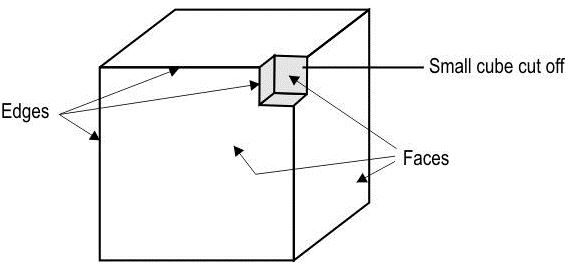
Question. A small cube is cut off from a larger cube as shown below
What is the number of FACES and EDGES in the cut cube as shown above?
(a) Faces: 6 Edges: 12
(b) Faces: 9 Edges: 21
(c) Faces: 9 Edges: 12
(d) Faces: 6 Edges: 18
Answer : B
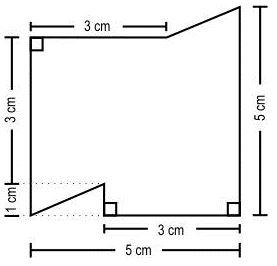
Question. What is the area of this shape?
(a) 19 sq. cm
(b) 20 sq. cm
(c) 21 sq. cm
(d) 24 sq. cm
Answer : B
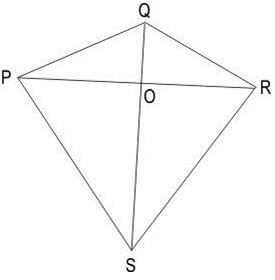
Question. The diagonals of quadrilateral PQRS intersect at O.
Which of the following is NOT a correct way of finding the Area of quadrilateral PQRS?
(a) Area (ΔPQR) + Area (ΔPSR)
(b) Area (ΔPOS) + Area (ΔSOR) + Area (ΔPQR)
(c) Area (ΔPOQ) + Area (ΔROS) + Area (ΔROQ) + Area (ΔPOS)
(d) Area (ΔPQR) + Area (ΔPQS) + Area (ΔSOR)
Answer : D
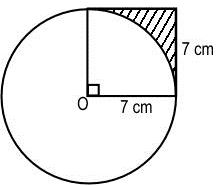
Question. If the area of a circle of radius 7 cm is 154 sq cm, what is the area of the shaded portion of the figure shown below?
(a) 9 sq cm
(b) 10.5sq cm
(c) 12.25 sq cm
(d) 16.5sq cm
Answer : B
Question. The solid shown below is made of 10 small cubes of side 2 cm each. What is the total volume of the solid?
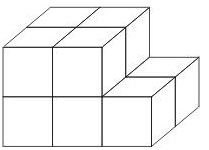
(a) 20 sq cm
(b) 20 cu cm
(c) 40 sq cm
(d) 80 cu cm
Answer : D
Question. Which of the following can NOT be used to measure the capacity of a container?
(a) dm3
(b) litre
(c) cm2
(d) ml
Answer : C
Question. The box is divided into four separate areas P, Q, R and S. In which area should 38 be placed?
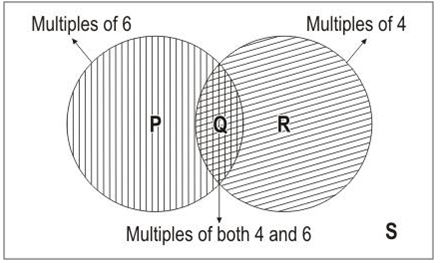
(a) P
(b) Q
(c) R
(d) S
Answer : D
Question. What is the area of the shaded part of the rectangle?
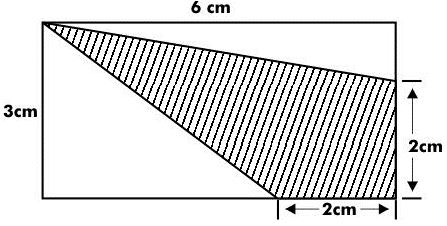
(a) 4 sq cm
(b) 8 sq cm
(c) 9 sq cm
(d) 12 sq cm
Answer : C
Question. What is the area of the shaded portion if the area of the circle is 64 cm2
Note: PQ is a straight line passing through the centre of the circle.
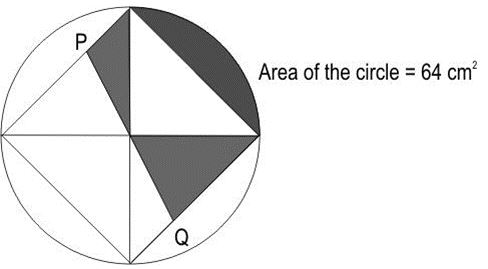
(a) 8cm2
(b) 16 cm2
(c) 16.8 cm2
(d) 28 cm2
Answer : B
Question. A part of one side of a vessel is shown below. Using this beaker which of these measurements can be made EXACTLY?
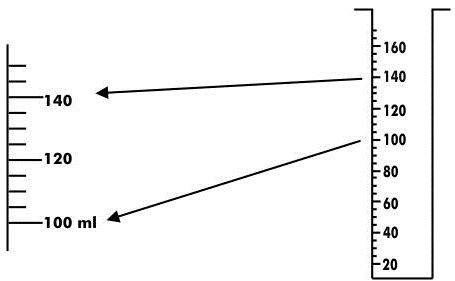
(a) 121.5 ml
(b) 124 ml
(c) 125 ml
(d) 128 ml
Answer : C
Question. What is the area of the shaded part of the square?
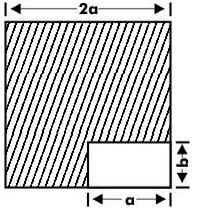
(a) 2a2 - ab
(b) 4a - ab
(c) 4a2 - ab
(d) 2a2 + ab
Answer : C
Question. Consider the two figures given below. Which of the following is true about their areas and perimeters?
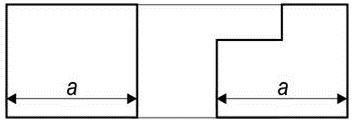
(a) The areas are the same, perimeters are different.
(b) The areas are different, perimeters are the same.
(c) The areas and perimeters are both different.
(d) The areas and perimeters are both the same.
Answer : B
Question. Of the pieces shown here, which two could form a semicircle when placed next to each other with their edges touching?
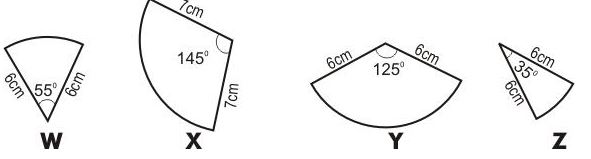
(a) Z and W
(b) W and Y
(c) Y and Z
(d) Z and X
Answer : B
Question. The capacity of a closed cylindrical water tank is 9.24 kilolitres. If the height of the cylinder is 1.5 m, what is its radius?
(A) 1.4 m
(B) 14 m
(C) 7m
(D) 0.7 m
Answer : A
Question. The thickness of a hollow metallic cylinder is 2 cm. It is 70 cm long with outer radius of 14 cm. Find the volume of the metal used in making the cylinder, assuming that it is open at both the ends. Also find its weight if the metal weighs 8 g per cm3.
(A) 10440 cm3, 91250 g
(B) 13440 cm3, 90000 g
(C) 11440 cm3, 91520 g
(D) 12440 cm3, 91550 g
Answer : C
Question. A wooden box (including the lid) has external dimensions 40 cm by 34 cm by 30 cm. If the wood is 1 cm thick, then how many cm3 of wood is used in it?
(A) 6752 cm3
(B) 6750 cm3
(C) 5752 cm3
(D) 5750 cm3
Answer : A
Question. How many bricks of size 22 cm × 10 cm × 7 cm are required to construct a wall 11m
long, 3.5 m high and 40 cm thick, if the cement and sand used in the construction occupy (1/10)th part of the wall?
(A) 8000
(B) 9000
(C) 7000
(D) 10000
Answer : B
Question. A rectangular block of ice measures 40 cm by 25 cm by 15 cm. Calculate its weight (in kg), if ice weighs 9/10 of the weight of the same volume of water and 1 cm3 of water weighs 1 gm.
(A) 9
(B) 13.5
(C) 8
(D) 9.5
Answer : B
Question. A cylindrical tower is 5 metres in diameter and 14 metres high. The cost of white washing its curved surface at 50 paise per m2 is ____.
(A) ₹ 90
(B) ₹ 97
(C) ₹ 110
(D) ₹ 95
Answer : C
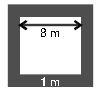
Question. A square garden measuring 8 m on a side is surrounded by a 1 m wide path. What is the area of the path ?
(A) 8 m2
(B) 9 m2
(C) 28 m2
(D) 36 m2
Answer : D
Question. The radii of the bases of two cylinders are in the ratio of 1 : 2 respectively and their heights are in the ratio 2 : 1 respectively. Find the ratio of their volumes.
(A) 1 : 2
(B) 1 : 4
(C) 2 : 1
(D) 4 : 1
Answer : A
Question. Find the sum of the lengths of the parallel sides of a trapezium whose altitude is 11 cm and whose area is 0.55 m2.
(A) 25 m
(B) 15 m
(C) 12 m
(D) 10 m
Answer : D
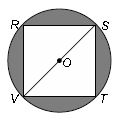
Question. In the given figure, RSTV is a square inscribed in a circle with centre O and radius r. The total area of the shaded region is _____.
(A) r2 (p – 2)
(B) 2r2 (2 – p)
(C) p (r2 – 2)
(D) 8r2 – 8r
Answer : A
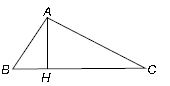
Question. ABC is a right angled triangle with ∠BAC = 90°. AH is drawn perpendicular to BC. If AB = 60 cm and AC = 80 cm, then BH = ____.
(A) 36 cm
(B) 32 cm
(C) 24 cm
(D) 30 cm
Answer : A
Question. Three cubes whose edges are 3 cm, 4 cm and 5 cm respectively are melted without any loss of metal into a single cube. The edge of the new cube is ____.
(A) 6 cm
(B) 12 cm
(C) 9 cm
(D) 10 cm
Answer : A
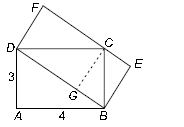
Question. Two rectangles ABCD and DBEF are as shown in the figure. The area of rectangle DBEF (in square units) is _____.
(A) 10
(B) 12
(C) 14
(D) 15
Answer : B
Question. The ratio of areas of two squares, if diagonal of one is double the diagonal of the other, is ____.
(A) 3 : 2
(B) 4 : 1
(C) 3 : 1
(D) 4 : 3
Answer : B
Question. Ratio of surface areas of two cubes is 25 : 36. Find the ratio of their volumes.
(A) 5 : 6
(B) 125 : 216
(C) 1 : 2
(D) 64 : 216
Answer : B
Question. The area of a quadrilateral is 342 sq. m. The perpendiculars from two of its opposite vertices to the diagonal are 12 m and 12 m. What is the length of the diagonal?
(A) 28.6 cm
(B) 25.3 cm
(C) 28.5 cm
(D) 22.5 cm
Answer : C
Question. The volume of a cuboid is 440 cm3 and the area of its base is 88 cm2. Find its height.
(A) 5 cm
(B) 11 cm
(C) 4 cm
(D) 8 cm
Answer : A
Question. A hoop is resting vertically at staircase as shown in the diagram. AB = 12 cm and BC = 8 cm. The radius of the hoop is _____.
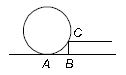
(A) 13cm
(B) 12√2cm
(C) 14 cm
(D) 13√2cm
Answer : A
Question. A well 12 m deep with a diameter 3.5 m is dug up and earth from it is evenly spread to form a platform 10.5 m long and 8.8 m wide. Find the height of the platform.
(A) 2.5 m
(B) 12.5 m
(C) 1.25 m
(D) 1.5 m
Answer : C
Question. A room is 9 m long, 6 m wide and 4 m high. Find the cost of plastering its walls and ceiling at the rate of ₹ 2.50 per square metre.
(A) ₹ 435
(B) ₹ 600
(C) ₹ 502
(D) ₹ 354
Answer : A
Question. A solid iron rectangular block of dimensions 4.4 m, 2.6 m and 1 m is cast into a hollow cylindrical pipe of internal radius 30 cm and thickness 5 cm. Find the length of the pipe.
(A) 112.5 m
(B) 112 m
(C) 212 m
(D) 312 m
Answer : B
Question. Find the area of the given field. All dimensions are in m.
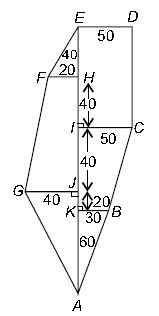
(A) 9000 m2
(B) 11700 m2
(C) 11000 m2
(D) 12000 m2
Answer : B
Question. Fill in the blanks.
(i) The perimeter of a rectangle becomes _______ times its original perimeter, if its length and breadth are doubled.
(ii) The curved surface area of a cylinder is reduced by _______ percent if the height is half of the original height.
(iii) Opposite faces of a cuboid are _______ in area.
(iv) If the diagonal d of a quadrilateral is doubled and the heights h1 and h2 falling on d are halved, then the new area of quadrilateral is _______.
| (i) | (ii) | (iii) | (i)v | |
| (A) | 2 | 50 | equal | 1/2 (h1 + h2)d |
| (B) | 2 | 35 | unequal | 1/2 (h1 + h2)d |
| (C) | 3 | 40 | equal | (h1 + h2)d |
| (D) | 3 | 35 | unequal | (h1 + h2)d |
Answer : A
Question. Match the figure in column I with their total surface area in column II

(A) P → (iii); Q → (ii); R → (iv); S → (i)
(B) P → (ii); Q → (iv); R → (i); S → (iii)
(C) P → (ii); Q → (iii); R → (i); S → (iv)
(D) P → (ii); Q → (iv); R → (iii); S → (i)
Answer : B
Question. The area of a trapezium with equal nonparallel sides is 168 m2. If the lengths of the parallel sides are 36 m and 20 m, find the length of the non-parallel sides.
(A) 8 m
(B) 10 m
(C) 15 m
(D) 4 m
Answer : B
Click on link below to download CBSE Class 8 Mathematics Mensuration Assignment Set G
Free study material for Mathematics
Download Practice Assignments: Class 8 Mathematics Chapter 11 Mensuration
Chapter Practice Questions for Class 8 Mathematics
Explore reliable practice questions for Chapter 11 Mensuration tailored for Class 8 learners. Use these structured worksheets to evaluate preparedness and strengthen core problem-solving skills.
Maximize Exam Scores with Chapter Practice Sets
- Exam Alignment: Questions strictly follow contemporary CBSE sample papers and grading schemes.
- Comprehensive Coverage: Features objective drills, case studies, and structured descriptive problems for Chapter 11 Mensuration.
- Pacing & Precision: Regular problem-solving builds critical calculation speed and test-taking accuracy.
Steps to Complete Chapter 11 Mensuration Assignments Successfully
- Initial Reading: Begin by reading the NCERT book for Class 8 Mathematics to build a baseline understanding.
- Independent Testing: Attempt assignment questions unassisted, then verify work using provided answer keys.
- Supplementary Aids: Leverage revision notes and worksheets whenever you encounter difficult topics.
FAQs
You can download free PDF assignments for Class 8 Mathematics Chapter 11 Mensuration from StudiesToday.com. These practice sheets have been updated for the 2026-27 session covering all concepts from latest NCERT textbook.
Yes, our teachers have given solutions for all questions in the Class 8 Mathematics Chapter 11 Mensuration assignments. This will help you to understand step-by-step methodology to get full marks in school tests and exams.
Yes. These assignments are designed as per the latest CBSE syllabus for 2026. We have included huge variety of question formats such as MCQs, Case-study based questions and important diagram-based problems found in Chapter 11 Mensuration.
Practicing topicw wise assignments will help Class 8 students understand every sub-topic of Chapter 11 Mensuration. Daily practice will improve speed, accuracy and answering competency-based questions.
Yes, all printable assignments for Class 8 Mathematics Chapter 11 Mensuration are available for free download in mobile-friendly PDF format.