

Download CBSE Class 8 Mathematics Assignments
Explore structured practice materials through the CBSE Class 8 Mathematics Cubes and Cube Roots Assignment Set 06. Tailored for Class 8 learners, utilizing these Mathematics assignments ensures thorough preparation and strengthens foundational knowledge before final CBSE evaluations.
Access CBSE School Assignments and Answers
Access the complete assignment PDF for Class 8 Mathematics below. Regular practice with these targeted academic tasks builds familiarity with standard question patterns and helps secure higher marks in final school evaluations.
1. The value of 453 – 653 – 203 is ____.
(A) 175500
(B) – 191500
(C) 170000
(D) – 170000
Answer : B
2. If 3√−2744 ÷ 3√0.008 = x, then the value of x is ____.
(A) 70
(B) – 70
(C) 14
(D) – 14
Answer : B
3. If

(A) 10/3
(B) −10/3
(C) 3/15
(D) Both (A) and (B)
Answer : D
4. How many cubes of side 2 cm can be packed in a cubical box with inner side equal to 4 cm?
(A) 6
(B) 4
(C) 8
(D) 2
Answer : C
5. Find the smallest natural number by which 1458 must be divided so that the quotient is a perfect cube.
(A) 4
(B) 2
(C) 6
(D) 8
Answer : B
6. In the five digit number 1b6a3, a is the greatest single digit perfect cube and twice of it exceeds b by 7. Then the sum of the number and its cube root is ____.
(A) 18700
(B) 11862
(C) 19710
(D) 25320
Answer : C
7. The value of
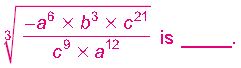
(A) −bc3/a2
(B) bc4/a2
(C) −ab4/c2
(D) −bc4/a2
Answer : D
8. Three numbers are in the ratio 2 : 3 : 5 to one another. The sum of their cubes is 54880. The numbers are______.
(A) 14, 21, 35
(B) 12, 15, 17
(C) 14, 18, 21
(D) 21, 28, 32
Answer : A
9. The cube of a 2-digit number will contain ________.
(A) 4 digits
(B) 5 digits
(C) 6 digits
(D) 4, 5 or 6 digits
Answer : C
10. The cube of an odd natural number is always _____.
(A) Even
(B) Odd
(C) Even or odd
(D) Can’t say
Answer : B
11. The length of each side of a cubical box is 2.4 m. Its volume is _____.
(A) 1.3824 × 10⁷ cu. cm
(B) 13.824 cu. cm
(C) 1.3824 × 10⁶ cu. cm
(D) 13.824 × 10⁴ cu. cm
Answer : A
12. The unit’s digit of the cube of a number is 9. The unit’s digit of its cube root is _____.
(A) 9
(B) 7
(C) 3
(D) 1
Answer : A
13. The cube of a number x is nine times of x, then find x, where x ≠ 0 and x ≠ –3.
(A) 8
(B) 2
(C) 4
(D) 3
Answer : D
14. Two cubes have volumes in the ratio 1 : 27. The ratio of the area of the face of one to that of the other is ____.
(A) 1 : 3
(B) 1 : 6
(C) 1 : 9
(D) 1 : 18
Answer : C
15. The smallest number by which 392 must be amultiplied so that the product is a perfect cube, is ____.
(A) 3
(B) 5
(C) 7
(D) 9
Answer : C
16. Mohit gave a problem to Samrath. Difference of two perfect cubes is 189. If the cube root of the smaller of the two numbers is 3, find the cube root of the larger number.
Help Samrath to answer the question.
(A) 4
(B) 6
(C) 8
(D) 10
Answer : B
17. A tank is in the form of a cube whose volume is 9261000 m3. Find the length of side of the tank.
(A) 230 m
(B) 250 m
(C) 210 m
(D) 180 m
Answer : C
18. Atul made a cuboid of plasticine. Length, breadth and height of the cuboid are
25 cm, 25 cm and 50 cm. How many minimum such cuboids he needs to make a perfect cube?
(A) 4
(B) 20
(C) 12
(D) 25
Answer : A
19. A rectangular cubical piece of metal of dimensions 2 cm × 3 cm × 4 cm is melted. Some more of the metal is added and it is made into a cube. The cube has integral measures for its sides. What is the minimum amount of metal that is added and what is the side of this cube?
(A) 10 cm3, 4 cm
(B) 3 cm3, 3 cm
(C) 11 cm3 3 cm
(D) 4 cm3, 3 cm
Answer : B
20. To collect rain water, Mini made a cubical tank which can hold 91125 m3 water. She uses this water for watering the plants of her garden. What is the height of the tank?
(A) 50 m
(B) 25 m
(C) 45 m
(D) 40 m
Answer : C
21. Which of the following options is INCORRECT?
(A) Three numbers are in the ratio 1 : 2 : 3 and the sum of their cubes is 4500.
The numbers will be 5, 10, 15.
(B) The digit in the units place for the cube of a four digit number of the form xyz8 is 2.
(C) The smallest number by which 3600 be divided to make it a perfect cube is 450.
(D) None of these
Answer : D
22. Find the cube root of:
(i) 0.003375 = P .
(ii) 1.331 = Q .
(iii) 4.913 = R .
(iv) 15.625 = S .
P Q R S
(A) 0.215 1.31 2.7 2.55
(B) 0.115 1.11 1.17 3.25
(C) 0.15 1.1 1.7 2.5
(D) 0.25 1.21 2.17 4.15
Answer : C
23. Match the following
| Column-I | Column-II |
| P. The smallest number that should be subtracted from 130 to make it perfect cube is | (i) 4 |
| Q. The smallest number that should be subtracted from 9268 to make it perfect cube is | (ii) 3 |
| R. The smallest number that should be added to 2194 to make it perfect cube is | (iii) 5 |
| S. The smallest number that should be added to 6855 to make it perfect cube is | (iv) 7 |
(A) P → (iii); Q → (i); R → (iv); S → (ii)
(B) P → (ii); Q → (iv); R → (i); S → (iii)
(C) P → (iii); Q → (i); R → (ii); S → (iv)
(D) P → (iii); Q → (iv); R → (ii); S → (i)
Answer : D
24. Evaluate the following.
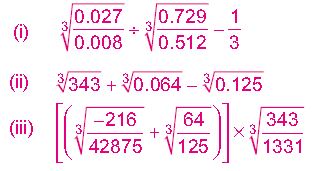
(i) (ii) (iii)
(A) 1 6.9 2/5
(B) 3 7.1 1/5
(C) 4 7.9 2/5
(D) 1 6.5 1/5
Answer : A
25. Which of the following statements is CORRECT ?
Statement - 1 : Cube root of 117.649 is a rational number.
Statement - 2 : Cube of an odd number may or may not be odd.
(A) Only Statement - 1
(B) Only Statement - 2
(C) Both Statement - 1 and Statement - 2
(D) Neither Statement - 1 nor Statement - 2
Answer : A
VIII - Mathematics Assignment No. 01 - Cube and Cube Roots
Question 1. Show that 5120 is not a perfect cube of any natural number.
Answer: First, find the prime factorization of 5120:
\(5120 = 2 \times 2 \times 2 \times 2 \times 2 \times 2 \times 2 \times 2 \times 2 \times 2 \times 5 = 2^{10} \times 5\)
Grouping the prime factors in triplets:
\(5120 = (2^3 \times 2^3 \times 2^3) \times (2 \times 5)\)
Since the prime factors \(2\) and \(5\) do not appear in triplets (groups of three), 5120 is not a perfect cube.
In simple words: A number is a perfect cube if all its prime factors can be grouped in triplets. Since 2 and 5 are left over, it is not a perfect cube.
Exam Tip: Always prime-factorize the number completely and check if every exponent is a multiple of 3.
Question 2. Is 9261 a perfect cube? If yes, find that no.
Answer: Finding the prime factorization of 9261:
\(9261 = 3 \times 3 \times 3 \times 7 \times 7 \times 7 = 3^3 \times 7^3\)
Since all prime factors can be grouped in exact triplets, 9261 is a perfect cube.
The number whose cube is 9261 is \(3 \times 7 = 21\).
In simple words: Yes, 9261 is a perfect cube because its prime factors form complete triplets of 3 and 7. The required number is 21.
Exam Tip: Take one factor from each triplet and multiply them together to find the cube root.
Question 3. Find cube root of 74088.
Answer: Prime factorization of 74088:
\(74088 = 2 \times 2 \times 2 \times 3 \times 3 \times 3 \times 7 \times 7 \times 7 = 2^3 \times 3^3 \times 7^3\)
Taking the cube root on both sides:
\(\sqrt[3]{74088} = 2 \times 3 \times 7 = 42\)
In simple words: Break 74088 into prime factors, group them in triplets, and multiply one from each group to get 42.
Exam Tip: Group identical prime factors into sets of three before extracting the cube root.
Question 4. Can we find the cube root of \((-10648)\)? If yes, find that integer.
Answer: Yes, we can find the cube root of a negative integer because the cube of a negative number is negative.
\(\sqrt[3]{-10648} = -\sqrt[3]{10648}\)
Finding the prime factorization of 10648:
\(10648 = 2 \times 2 \times 2 \times 11 \times 11 \times 11 = 2^3 \times 11^3\)
\(\sqrt[3]{10648} = 2 \times 11 = 22\)
Therefore, \(\sqrt[3]{-10648} = -22\).
In simple words: Negative numbers do have real cube roots. We find the cube root of the positive number and attach a negative sign.
Exam Tip: Remember that \(\sqrt[3]{-x} = -\sqrt[3]{x}\) for any real number \(x\).
Question 5. Show that \(\sqrt[3]{216 \times 64} = \sqrt[3]{216} \times \sqrt[3]{64}\).
Answer: Taking the Left Hand Side (LHS):
\(\text{LHS} = \sqrt[3]{216 \times 64}\)
Since \(216 = 6^3\) and \(64 = 4^3\):
\(\text{LHS} = \sqrt[3]{6^3 \times 4^3} = 6 \times 4 = 24\)
Taking the Right Hand Side (RHS):
\(\text{RHS} = \sqrt[3]{216} \times \sqrt[3]{64} = \sqrt[3]{6^3} \times \sqrt[3]{4^3} = 6 \times 4 = 24\)
Since LHS = RHS, the given statement is true.
In simple words: The cube root of a product is equal to the product of the cube roots of the individual numbers.
Exam Tip: Utilize the exponent rule \(\sqrt[3]{a \times b} = \sqrt[3]{a} \times \sqrt[3]{b}\) to simplify calculations.
Question 6. Is the following statement true? If the statement is not true then under what condition the above statement is true? \(\sqrt[3]{12^3 + 1^3} = \sqrt[3]{12^3} + \sqrt[3]{1^3}\).
Answer: Let us evaluate LHS:
\(\text{LHS} = \sqrt[3]{12^3 + 1^3} = \sqrt[3]{1728 + 1} = \sqrt[3]{1729}\)
Let us evaluate RHS:
\(\text{RHS} = \sqrt[3]{12^3} + \sqrt[3]{1^3} = 12 + 1 = 13\)
Since \(\sqrt[3]{1729} \neq 13\) (as \(13^3 = 2197\)), the statement is not true.
The statement is true if the plus sign (+) is replaced by a multiplication sign (\(\times\)), i.e., \(\sqrt[3]{a^3 \times b^3} = \sqrt[3]{a^3} \times \sqrt[3]{b^3}\).
In simple words: Cube roots do not distribute over addition. The statement is false for addition, but it would be true if multiplication was used instead.
Exam Tip: Never distribute radicals (roots) over addition or subtraction.
Question 7. Show that \(\sqrt[3]{125 \times (-216)} = \sqrt[3]{-216} \times \sqrt[3]{125}\) or \(= \sqrt[3]{125} \times \sqrt[3]{-216}\) (Which is true or both are true).
Answer: Evaluating LHS:
\(\text{LHS} = \sqrt[3]{125 \times (-216)} = \sqrt[3]{-27000} = -30\)
Evaluating first RHS form:
\(\text{RHS}_1 = \sqrt[3]{-216} \times \sqrt[3]{125} = (-6) \times 5 = -30\)
Evaluating second RHS form:
\(\text{RHS}_2 = \sqrt[3]{125} \times \sqrt[3]{-216} = 5 \times (-6) = -30\)
Since LHS = \(\text{RHS}_1\) = \(\text{RHS}_2\), both expressions are true due to the commutative property of multiplication.
In simple words: Both forms are completely true because multiplication is commutative (order does not change the result).
Question 8. Find the value of \(\sqrt[3]{392} \times \sqrt[3]{448}\).
Answer: Combine the cube roots using the multiplication property:
\(\sqrt[3]{392 \times 448}\)
Prime factorize 392 and 448:
\(392 = 2^3 \times 7^2\)
\(448 = 2^6 \times 7\)
Multiply them together inside the cube root:
\(392 \times 448 = (2^3 \times 7^2) \times (2^6 \times 7) = 2^9 \times 7^3\)
Now, take the cube root:
\(\sqrt[3]{2^9 \times 7^3} = 2^{\frac{9}{3}} \times 7^{\frac{3}{3}} = 2^3 \times 7 = 8 \times 7 = 56\)
In simple words: Combine both numbers under a single cube root, find their prime factors, and extract the cube root to get 56.
Exam Tip: Combining separate cube roots into a single radical often makes simplification much easier.
Question 9. Show that \(\sqrt[3]{\frac{125}{64}} = \frac{\sqrt[3]{125}}{\sqrt[3]{64}}\).
Answer: Taking LHS:
\(\text{LHS} = \sqrt[3]{\frac{125}{64}} = \sqrt[3]{\frac{5^3}{4^3}} = \frac{5}{4}\)
Taking RHS:
\(\text{RHS} = \frac{\sqrt[3]{125}}{\sqrt[3]{64}} = \frac{\sqrt[3]{5^3}}{\sqrt[3]{4^3}} = \frac{5}{4}\)
Since LHS = RHS, the statement is proven true.
In simple words: The cube root of a fraction is equal to the cube root of the numerator divided by the cube root of the denominator.
Exam Tip: Apply the property \(\sqrt[3]{\frac{a}{b}} = \frac{\sqrt[3]{a}}{\sqrt[3]{b}}\) directly for fractions.
Question 10. Find cube root of 9.261.
Answer: Convert the decimal into a fraction:
\(9.261 = \frac{9261}{1000}\)
We need to find:
\(\sqrt[3]{\frac{9261}{1000}} = \frac{\sqrt[3]{9261}}{\sqrt[3]{1000}}\)
From previous calculations, \(\sqrt[3]{9261} = 21\), and we know \(\sqrt[3]{1000} = 10\).
Therefore:
\(\frac{21}{10} = 2.1\)
In simple words: Convert the decimal to a fraction \(\frac{9261}{1000}\), take the cube root of numerator and denominator separately, and convert back to a decimal to get 2.1.
Exam Tip: Convert decimals into fractions with powers of 10 in the denominator to easily evaluate cube roots.
Free study material for Mathematics
Chapter Assignment & Practice Material for Class 8 Mathematics Chapter 07 Cubes And Cube Roots
Revision Assignment: Chapter 07 Cubes And Cube Roots (CBSE)
Access structured practice assignments for Chapter 07 Cubes And Cube Roots designed in alignment with the latest CBSE curriculum for Class 8 Mathematics. These printable sets cover objective and descriptive problem types to support thorough revision.
Maximize Exam Scores with Chapter Practice Sets
- Curriculum Standards: Assignments match modern CBSE sample formats to ensure relevant preparation.
- Thorough Revision: Detailed problem sets reinforce core concepts and eliminate conceptual weak spots.
- Execution Speed: Timed practice with assignment sets sharpens overall response timing.
How to Approach Mathematics Chapter 07 Cubes And Cube Roots Assignments
- Textbook Review: Always study the core NCERT book for Class 8 Mathematics prior to beginning the assignment.
- Independent Attempt: Solve Chapter 07 Cubes And Cube Roots questions on your own initially before cross-checking with expert solutions.
- Error Tracking: Record challenging concepts in a dedicated notebook and practice online MCQ tests for revision.
FAQs
You can download free PDF assignments for Class 8 Mathematics Chapter 07 Cubes And Cube Roots from StudiesToday.com. These practice sheets have been updated for the 2026-27 session covering all concepts from latest NCERT textbook.
Yes, our teachers have given solutions for all questions in the Class 8 Mathematics Chapter 07 Cubes And Cube Roots assignments. This will help you to understand step-by-step methodology to get full marks in school tests and exams.
Yes. These assignments are designed as per the latest CBSE syllabus for 2026. We have included huge variety of question formats such as MCQs, Case-study based questions and important diagram-based problems found in Chapter 07 Cubes And Cube Roots.
Practicing topicw wise assignments will help Class 8 students understand every sub-topic of Chapter 07 Cubes And Cube Roots. Daily practice will improve speed, accuracy and answering competency-based questions.
Yes, all printable assignments for Class 8 Mathematics Chapter 07 Cubes And Cube Roots are available for free download in mobile-friendly PDF format.