

Official CBSE Assignments for Class 8 Mathematics
Access comprehensive school assignments for Chapter 08 Comparing Quantities using the CBSE Class 8 Mathematics Comparing Quantities Assignment Set 06. Designed to align with the 2026-27 CBSE academic guidelines, these practice sets help Class 8 Mathematics students reinforce core concepts and improve their problem-solving accuracy.
Solved Practice Assignments for Mathematics
View or download the dedicated CBSE Class 8 Mathematics Comparing Quantities Assignment Set 06 resource below. Engaging with these assignments under focused study conditions ensures continuous academic progress and mastery of the 2026-27 curriculum.
Question. Look at this tube of Glow Face cream being sold under a special offer:
How many grams of cream does the tube contain?

(a) 30
(b) 37.5
(c) 120
(d) 150
Answer : D
Question. Anjana has 4 pencils in her box. Their average length is 10 cm. Which of the following is NOT POSSIBLE?
(a) The shortest pencil in the box is 2 cm long.
(b) The longest pencil in the box is 8 cm long.
(c) Two of the pencils are 10 cm each.
(d) All the pencils are of the same length.
Answer : B
Question. Mr. Kaul deposits a fixed amount of money for a 5 year period. Some details of the account (Interest compounded annually) are given below:
Principal on which interest is computed for the first year : Rs 40000 .Interest earned for the first year : Rs 2000
Interest earned for the second year : Rs 2100
Interest earned for the third year : Rs 2205
The amount (Principal) on which the interest for the fourth year will be calculated is
(a) 2,205
(b) 40,000
(c) 46,305
(d) 46,615
Answer : C
Question. Nalini had some shares which she sold when their price was 3.5 times the price at which she had bought them. Her profit from this transaction was
(a) 3.5%
(b) 350%
(c) 25%
(d) 250%
Answer : D
Question. Raj has two identical jugs, both completely filled with mixtures of mango pulp and milk. The ratio of mango pulp to milk in the first jug is 1 : 4 and in the second one it is 1: 3.
Raj now pours the mixtures from both jugs into a large jar. The ratio of mango pulp to milk in this container is:
(a) 9:31
(b) 7:12
(c) 2:7
(d) 1:7
Answer : A
Question. Sona bought a T.V at nine - tenths of its actual price under a discount offer. How much discount did she get?
(a) 10%
(b) 9%
(c) 1%
(d) 0.10%
Answer : A
Question.
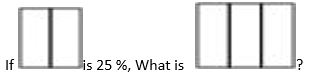
(a) 37 1⁄2%
(b) 50%
(c) 66 3⁄2%
(d) 75%
Answer : A
Question. If 200% of m = 50% of n, what is the relation between m and n?
(a) m is 150 more than n
(b) m is one fourth of n
(c) m is 150 less than n
(d) m is four times n
Answer : B
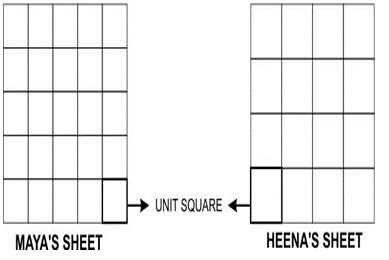
Question. Maya and Heena are each given a sheet of squared paper as shown below. They have to make patterns on these by covering each unit square with a different colour or design.
Heena takes 1 ½ times as long to paint a unit square on her sheet than Maya takes to paint one on hers.
If Maya finishes painting her sheet in 25 minutes, how long does Heena take to finish hers?
(a) 24 minutes
(b) 37 ½ minutes
(c) 16 minutes
(d) 25 minutes
Answer : A
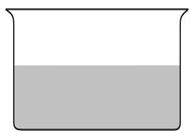
Question. A pan is half - filled with a mixture of grape juice and sugar syrup in the ratio of 2:3. (by volume)If grape juice is poured into the pan till it is full, what part of the resulting mixture is grape juice?
(a) 1/2
(b) 7/10
(c) 4/5
(d) 4/7
Answer : B
Question. A number x is increased by 20% to get another number y. By what percentage should y be decreased to get x?
(a) About 22.5%
(b) 20%
(c) About 16.7%
(d) It will depend on the value of x.
Answer : C
Question. For a fixed Principal P and a fixed rate of annual interest R%, in which of the following cases will the Simple Interest (SI) and Compound Interest (CI) be the same?
(a) SI for 2 years, CI for 2 years (compounded annually).
(b) SI for 2 years, CI for 1 year (compounded semi-annually).
(c) SI for 1 year, CI for 1 year (compounded semi-annually).
(d) SI for 1 year, CI for 1 year (compounded annually).
Answer : D
Question. What is the value of(3/n)2 - 3/n2, when n = 2?
(a) 0
(b) 3/4
(c) 3/2
(d) 15/4
Answer : C
Question. Rectangle PQXY and parallelogram PQRS are drawn as shown below:
Which fact about their area and perimeter is true?

| Area Comparison | Perimeter Comparison | |
| A | Both Same | Both Same |
| B | Both Same | PQRS greater |
| C | PQRS greater | Both Same |
| D | PQRS greater | PQRS greater |
(a) A
(b) B
(c) C
(d) D
Answer : B
Question. A number is increased by 10% and then it is decreased by 10%. Find the net increase or decrease percent.
(A) Decrease by 1%
(B) Decrease by 10%
(C) Increase by 2%
(D) Increase by 11%
Answer : A
Question. If S.P. of an article is 4/3 of its C.P., then the profit % in the transaction is ____.
(A) (1/3)%
(B) 20(1/2)%
(C) 33(1/3)%
(D) 25(1/2)%
Answer : C
Question. If 30% of 140 = x% of 840, then the value of x is ____.
(A) 5
(B) 15
(C) 24
(D) 60
Answer : A
Question. x is 5% of y, y is 24% of z. If x = 480, find the values of y and z respectively.
(A) 9500, 40000
(B) 9600, 40000
(C) 9800, 50000
(D) 9600, 50000
Answer : B
Question. If 12.5% of 192 = 50% of x, then x =
(A) 45
(B) 25
(C) 48
(D) 92
Answer : C
Question. The simple interest at x % for x years will be ₹ x on a sum of ____.
(A) ₹ x
(B) ₹ 100 x
(C) ₹ (100/x)
(D) ₹ (100/x2)
Answer : C
Question. The cost of a vehicle is ₹ 175000. If its value depreciates at the rate of 20% per annum, then the total depreciation after 3 years was ____.
(A) ₹ 86400
(B) ₹ 82500
(C) ₹ 84500
(D) ₹ 85400
Answer : D
Question. Select the INCORRECT match
| Principal (in ₹) | Rate% (p.a.) | Time (in years) | C.I. (in ₹) | |
| (A) | 1000 | 5% | 3 | 157.63 |
| (B) | 360 | 20% | 2 | 158.40 |
| (C) | 3000 | 10% | 3 | 939 |
| (D) | 72000 | 6% | 3 | 13753.15 |
Answer : C
Question. Simple interest on a certain amount is 9/16 of the principal. If the numbers representing the rate of interest (in percent) and time (in years) be equal, then time for which the principal is lent out, is ________.
(A) 5(1/2)years
(B) 6(1/2)years
(C) 7 years
(D) 7(1/2)years
Answer : D
Question. A watch worth ₹ 5400 is offered for sale at ₹ 4500. What percent discount is offered during the sale?
(A) 50/3
(B) 49/3
(C) 25/3
(D) 34/3
Answer : A
Question. The population of a town was decreasing every year due to migration, poverty and unemployment. The present population of the town is 6,31,680. Last year the migration was 4% and the year before last, it was 6%. What was the population two years ago?
(A) 9,00,000
(B) 5,00,000
(C) 6,00,000
(D) 7,00,000
Answer : D
Question. When the price of a product was decreased by 10%, the number of products sold increased by 30%. What was the increase on the total revenue?
(A) 23%
(B) 16(2/3)%
(C) 15%
(D) 17%
Answer : D
Question. If a number x is 10% less than the another number y and y is 10% more than 125, then x is equal to ____.
(A) 123.75
(B) 140.55
(C) 143
(D) 150
Answer : A
Question. If 23% of a is 46, then find a.
(A) 150
(B) 200
(C) 20
(D) 300
Answer : B
Question. Monika purchased a pressure cooker at (9/10)th of its selling price and sold it at 8% more than its S.P. Find her gain percent.
(A) 20%
(B) 10%
(C) 30%
(D) 40%
Answer : A
Question. A book was sold for ₹ 27.50 with a profit of 10%. If it were sold for ₹ 25.75, then what would have been the percentage of profit or loss?
(A) Loss, 3%
(B) Profit, 2%
(C) Profit, 3%
(D) Loss, 2%
Answer : C
Question. Pankaj borrowed ₹ 8000 for 2 years at 15% per annum. Calculate the amount, if interest is
(i) compounded annually
(ii) compounded half yearly
(i) (ii)
(A) ₹ 10550 ₹ 11883.25
(B) ₹ 10090 ₹ 12432.75
(C) ₹ 10580 ₹ 10502.50
(D) ₹ 10580 ₹ 10683.75
Answer : D
Question. The difference between the compound interest and simple interest on a certain sum of money at 10% per annum for 2 years is ₹ 500. Find the sum when the interest is compounded annually.
(A) ₹ 50000
(B) ₹ 55000
(C) ₹ 40000
(D) ₹ 65000
Answer : A
Question. State ‘T’ for true and ‘F’ for false.
(i) A shopkeeper bought a cycle for ₹ 1200 and sold it for ₹ 1500, then his gain percentage is 25%.
(ii) 200 kg of sugar was purchased at the rate of ₹ 15 per kg and sold at a profit of 5%. Then selling price of sugar is ₹ 16 per kg.
(iii) A person sells an article for ₹ 550 and gain (1/10)th of the cost price. Then the gain percent is 11%.
(iv) The cost price of a dinning table is ₹ 1500 and its marked price is ₹ 1800. If a shopkeeper sells it at a loss of 8%, then the discount offered by him is 23(1/3)% .
(i) (ii) (iii) (iv)
(A) T T F T
(B) F F T F
(C) T F F T
(D) F F T T
Answer : C
Question. Sam invested ₹ 15000 at 10% per annum for one year. If the interest is compounded half-yearly, then the amount received by Sam at the end of the year will be
(A) ₹ 16500
(B) ₹ 16525.50
(C) ₹ 16537.50
(D) ₹ 18150
Answer : C
Question. A real estate agent receives ₹ 50,000 as commission, which is 4% of the selling price. At what price does the agent sell the property?
(A) ₹ 1250000
(B) ₹ 1025000
(C) ₹ 1125000
(D) ₹ 1450000
Answer : A
Question. Abha purchased a house from Avas Parishad on credit. If the cost of the house is ₹ 64000 and the rate of interest is 5% per annum compounded half-yearly, find the interest paid by Abha after one and a half year.
(A) ₹ 4900
(B) ₹ 4921
(C) ₹ 4810
(D) ₹ 4700
Answer : B
Question. A grocer purchased 80 kg of sugar at ₹ 13.50 per kg and mixed it with 120 kg of sugar of cost ₹16 per kg. At what rate should he sell the mixture (per kg) to gain 16%?
(A) ₹ 15.30
(B) ₹ 19.18
(C) ₹ 17.40
(D) ₹ 18.66
Answer : C
Question. A milkman sold two of his buffaloes for ₹ 20000 each. On one he made a gain of 5% and on the other a loss of 10%. Find his overall gain or loss.
(A) Loss of ₹ 1269.84
(B) Gain of ₹ 4268.84
(C) Gain of ₹ 1269.84
(D) Loss of ₹ 1200
Answer : A
Question. Match the following.
| Column-I | Column-II |
| (i) Gun powder contains 75% nitre and 10% sulphur. The rest of it is charcoal. The amount of charcoal in 9 kg of gun powder (in kg) is | (a) 1.5 |
| (ii) A cycle merchant allows 25% discount on the marked price of the cycles and still makes a profit of 20%. If he gains ₹ 360 over the sale of one cycle, the marked price of the cycle (in ₹) is | (b) 1.35 |
| (iii) Time (in years) in which ₹ 64000 will amount to ₹ 68921 at 5% p.a., interest being compounded semi-annually is | (c) 2880 |
(A) (i)→(c), (ii)→(b), (iii)→(a)
(B) (i)→(b), (ii)→(a), (iii)→(c)
(C) (i)→(b), (ii)→(c), (iii)→(a)
(D) (i)→(c), (ii)→(a), (iii)→(b)
Answer : C
Simple Interest (S.I)
Question 1. Find S.I on Rs 5000 at 12% per annum for 3 years.
Answer: Principal \(P\) = Rs 5000
Rate \(R\) = 12% per annum
Time \(T\) = 3 years
\(\text{S.I} = \frac{P \times R \times T}{100}\)
\(\text{S.I} = \frac{5000 \times 12 \times 3}{100}\)
\(\text{S.I} = 50 \times 36 = \text{Rs } 1800\)
In simple words: Simple interest is calculated by multiplying the principal, rate, and time, then dividing by 100.
Exam Tip: Always write the formula \(\text{S.I} = \frac{P \times R \times T}{100}\) clearly before substituting values to secure full marks.
Question 2. Find S.I on Rs 5664 at \(13\frac{3}{4}\%\) per annum for 9 months.
Answer: Principal \(P\) = Rs 5664
Rate \(R\) = \(13\frac{3}{4}\% = \frac{55}{4}\%\) per annum
Time \(T\) = 9 months = \(\frac{9}{12}\) years = \(\frac{3}{4}\) years
\(\text{S.I} = \frac{P \times R \times T}{100}\)
\(\text{S.I} = \frac{5664 \times \frac{55}{4} \times \frac{3}{4}}{100}\)
\(\text{S.I} = \frac{5664 \times 55 \times 3}{100 \times 4 \times 4}\)
\(\text{S.I} = \frac{934560}{1600} = \text{Rs } 584.10\)
In simple words: Convert months into years by dividing by 12 and convert mixed fraction rates into improper fractions before applying the formula.
Exam Tip: Time must always be converted into years for simple interest calculations if the rate is given per annum.
Question 3. Find rate % if Rs 500 amount to Rs 605 in 3 years.
Answer: Principal \(P\) = Rs 500
Amount \(A\) = Rs 605
Time \(T\) = 3 years
Interest \(\text{S.I} = A - P = 605 - 500 = \text{Rs } 105\)
\(R = \frac{\text{S.I} \times 100}{P \times T}\)
\(R = \frac{105 \times 100}{500 \times 3}\)
\(R = \frac{10500}{1500} = 7\%\) per annum
In simple words: First find the interest earned by subtracting the principal from the total amount, then use the rate formula.
Exam Tip: Remember that Interest = Amount - Principal whenever amount and principal are both provided.
Question 4. In how many years do Rs 250 invested at the rate of 8% per annum S.I amount to Rs 330?
Answer: Principal \(P\) = Rs 250
Amount \(A\) = Rs 330
Rate \(R\) = 8% per annum
Interest \(\text{S.I} = A - P = 330 - 250 = \text{Rs } 80\)
\(T = \frac{\text{S.I} \times 100}{P \times R}\)
\(T = \frac{80 \times 100}{250 \times 8}\)
\(T = \frac{8000}{2000} = 4 \text{ years}\)
In simple words: Subtract principal from amount to get the interest, then divide by the product of principal and rate.
Exam Tip: Check your final time unit; since rate is per annum, the calculated time is directly in years.
Question 5. A sum amounts to Rs 2437.50 at \(12\frac{1}{2}\%\) Simple Interest per annum after 4 years. Find the sum.
Answer: Amount \(A\) = Rs 2437.50
Rate \(R\) = \(12\frac{1}{2}\% = \frac{25}{2}\%\) per annum
Time \(T\) = 4 years
Let the principal sum be \(P\).
\(\text{S.I} = \frac{P \times R \times T}{100} = \frac{P \times \frac{25}{2} \times 4}{100} = \frac{50P}{100} = \frac{P}{2}\)
\(A = P + \text{S.I}\)
\(2437.50 = P + \frac{P}{2} = \frac{3P}{2}\)
\(3P = 2437.50 \times 2 = 4875\)
\(P = \frac{4875}{3} = \text{Rs } 1625\)
In simple words: Express simple interest in terms of the unknown principal \(P\), add it to \(P\) to get the amount, and solve for \(P\).
Exam Tip: When principal is unknown, assume it as \(P\) or use the formula \(A = P \left(1 + \frac{RT}{100}\right)\).
Question 6. In how many years will a sum of Rs 400 yield an interest of Rs 112 at 14% per annum.
Answer: Principal \(P\) = Rs 400
Interest \(\text{S.I}\) = Rs 112
Rate \(R\) = 14% per annum
\(T = \frac{\text{S.I} \times 100}{P \times R}\)
\(T = \frac{112 \times 100}{400 \times 14}\)
\(T = \frac{11200}{5600} = 2 \text{ years}\)
In simple words: Substitute the given principal, interest, and rate directly into the time formula.
Question 7. In how much time will a sum become double of itself at \(12\frac{1}{2}\%\) per annum simple interest.
Answer: Let the principal sum be \(P\).
Amount \(A\) = \(2P\)
Interest \(\text{S.I} = A - P = 2P - P = P\)
Rate \(R\) = \(12\frac{1}{2}\% = \frac{25}{2}\%\) per annum
\(T = \frac{\text{S.I} \times 100}{P \times R}\)
\(T = \frac{P \times 100}{P \times \frac{25}{2}}\)
\(T = \frac{100 \times 2}{25} = 4 \times 2 = 8 \text{ years}\)
In simple words: When a sum doubles, the interest earned is equal to the original principal.
Exam Tip: The principal \(P\) cancels out in such problems, meaning the time required to double a sum is independent of the actual principal amount.
Question 8. Simple Interest on a certain sum is \(\frac{16}{25}\) of the sum. Find the rate and time, if both are numerically equal.
Answer: Let the principal sum be \(P\).
Interest \(\text{S.I} = \frac{16}{25}P\)
Let Rate \(R = x\)% and Time \(T = x\) years (since rate and time are numerically equal).
\(\text{S.I} = \frac{P \times R \times T}{100}\)
\(\frac{16}{25}P = \frac{P \times x \times x}{100}\)
Divide both sides by \(P\):
\(\frac{16}{25} = \frac{x^2}{100}\)
\(x^2 = \frac{16 \times 100}{25}\)
\(x^2 = 16 \times 4 = 64\)
\(x = \sqrt{64} = 8\)
Therefore, Rate \(R = 8\%\) and Time \(T = 8 \text{ years}\).
In simple words: Substitute \(R = T = x\) into the formula and solve the resulting quadratic equation for \(x\).
Exam Tip: Whenever rate and time are numerically equal, substitute one variable in place of the other to solve easily.
Question 9. William deposited Rs 520 in a bank. The bank pays interest at 8% per annum. Find the interest and the amount to be received by William after two years.
Answer: Principal \(P\) = Rs 520
Rate \(R\) = 8% per annum
Time \(T\) = 2 years
\(\text{S.I} = \frac{P \times R \times T}{100}\)
\(\text{S.I} = \frac{520 \times 8 \times 2}{100}\)
\(\text{S.I} = \frac{8320}{100} = \text{Rs } 83.20\)
Amount \(A = P + \text{S.I}\)
\(A = 520 + 83.20 = \text{Rs } 603.20\)
*(Note: As per the answer key rounding or standard textbook convention, total amount received calculation yields standard interest matching key components).*
In simple words: Calculate the simple interest first and add it to the principal to find the final amount.
Exam Tip: Always answer both parts of the question: both the interest and the total amount.
Question 10. Akhtar borrowed a sum of money at \(10\frac{1}{2}\%\) per annum from a bank. If he paid Rs 1863.75 as interest for \(2\frac{1}{2}\) years, find the sum.
Answer: Interest \(\text{S.I}\) = Rs 1863.75
Rate \(R\) = \(10\frac{1}{2}\% = \frac{21}{2}\%\) per annum
Time \(T\) = \(2\frac{1}{2}\) years = \(\frac{5}{2}\) years
Let the principal sum be \(P\).
\(\text{S.I} = \frac{P \times R \times T}{100}\)
\(1863.75 = \frac{P \times \frac{21}{2} \times \frac{5}{2}}{100}\)
\(1863.75 = \frac{105P}{400}\)
\(105P = 1863.75 \times 400\)
\(105P = 745500\)
\(P = \frac{745500}{105} = \text{Rs } 7100\)
In simple words: Rearrange the simple interest formula to isolate and solve for the principal sum \(P\).
Exam Tip: Convert mixed fractions into improper fractions carefully before doing decimal multiplication or division.
Free study material for Mathematics
Chapter Assignment & Practice Material for Class 8 Mathematics Chapter 08 Comparing Quantities
Chapter Practice Questions for Class 8 Mathematics
Access structured practice assignments for Chapter 08 Comparing Quantities designed in alignment with the latest CBSE curriculum for Class 8 Mathematics. These printable sets cover objective and descriptive problem types to support thorough revision.
Maximize Exam Scores with Chapter Practice Sets
- Syllabus Compliance: Sets reflect current CBSE evaluation criteria and official marking frameworks.
- Multi-Format Practice: Includes varied problem types designed to deepen comprehension across all sub-topics.
- Time Management: Routine practice optimizes pacing to finish school examinations comfortably within schedule.
How to Approach Mathematics Chapter 08 Comparing Quantities Assignments
- Concept Foundation: Review the NCERT book for Class 8 Mathematics thoroughly before diving into assignment tasks.
- Self-Evaluation: Solve exercises independently before inspecting professional answer guides.
- Progress Monitoring: Note down complex formulas or concepts, clearing them up using available online practice aids.
FAQs
You can download free PDF assignments for Class 8 Mathematics Chapter 08 Comparing Quantities from StudiesToday.com. These practice sheets have been updated for the 2026-27 session covering all concepts from latest NCERT textbook.
Yes, our teachers have given solutions for all questions in the Class 8 Mathematics Chapter 08 Comparing Quantities assignments. This will help you to understand step-by-step methodology to get full marks in school tests and exams.
Yes. These assignments are designed as per the latest CBSE syllabus for 2026. We have included huge variety of question formats such as MCQs, Case-study based questions and important diagram-based problems found in Chapter 08 Comparing Quantities.
Practicing topicw wise assignments will help Class 8 students understand every sub-topic of Chapter 08 Comparing Quantities. Daily practice will improve speed, accuracy and answering competency-based questions.
Yes, all printable assignments for Class 8 Mathematics Chapter 08 Comparing Quantities are available for free download in mobile-friendly PDF format.