

Official CBSE Assignments for Class 9 Mathematics
Review targeted academic assignments with the CBSE Class 9 Mathematics Surface areas and Volumes Assignment Set 03. Built according to official CBSE standards for the 2026-27 term, these downloadable Class 9 Mathematics worksheets support effective daily practice for Chapter 11 Surface Areas And Volumes.
Solved Practice Assignments for Mathematics
Navigate directly to the solved Mathematics assignments using the digital viewer below. Each practice set includes detailed step-by-step solutions, allowing students to instantly cross-check their work and identify areas requiring further revision.
Surface Areas and Volumes
Question 1. Find the area enclosed between two concentric circles of radii 4 cm and 3 cm.
Answer:
Radius of outer circle \(R = 4\) cm
Radius of inner circle \(r = 3\) cm
Area enclosed between the two concentric circles = Area of outer circle - Area of inner circle
\(= \pi R^2 - \pi r^2 = \pi (R^2 - r^2)\)
\(= \frac{22}{7} (4^2 - 3^2)\)
\(= \frac{22}{7} (16 - 9)\)
\(= \frac{22}{7} \times 7 = 22 \text{ cm}^2\)
In simple words: The area between two circles is found by subtracting the smaller circle's area from the larger circle's area.
Exam Tip: Use the identity \(R^2 - r^2 = (R - r)(R + r)\) for faster calculation.
Question 2. The diameter of a garden roller is 1.4 m and it is 2 m long. How much area will it cover in 5 revolutions?
Answer:
Diameter of the roller \(d = 1.4\) m, so radius \(r = \frac{1.4}{2} = 0.7\) m
Length (height) of the roller \(h = 2\) m
Area covered in 1 revolution = Curved surface area of the cylinder
\(= 2\pi rh = 2 \times \frac{22}{7} \times 0.7 \times 2\)
\(= 2 \times \frac{22}{7} \times \frac{7}{10} \times 2 = 8.8 \text{ m}^2\)
Area covered in 5 revolutions = \(5 \times 8.8 = 44 \text{ m}^2\)
In simple words: A garden roller covers area equal to its curved surface area in one complete turn (revolution).
Exam Tip: Remember that a roller rolls on its curved surface, so always use the curved surface area formula \(2\pi rh\).
Question 3. A cuboid has total surface area of 40 sq m and its lateral surface area is 26 sq m. Find the area of base.
Answer:
Total Surface Area (TSA) of cuboid = 40 m\(^2\)
Lateral Surface Area (LSA) of cuboid = 26 m\(^2\)
Formula for TSA of a cuboid = LSA + 2 \(\times\) Area of base
\(40 = 26 + 2 \times (\text{Area of base})\)
\(2 \times (\text{Area of base}) = 40 - 26 = 14\)
Area of base = \(\frac{14}{2} = 7 \text{ m}^2\)
In simple words: Total surface area consists of lateral walls plus the top and bottom bases.
Exam Tip: The base and top of a cuboid are identical rectangles, hence TSA = LSA + 2(Base Area).
Question 4. Three metal cubes whose edges measure 3 cm, 4 cm and 5 cm respectively are melted to form a single cube. Find the edge of the new cube. Also find the surface area of the new cube.
Answer:
Volume of first cube = \(3^3 = 27 \text{ cm}^3\)
Volume of second cube = \(4^3 = 64 \text{ cm}^3\)
Volume of third cube = \(5^3 = 125 \text{ cm}^3\)
Volume of the new single cube = Sum of volumes of three cubes
\(= 27 + 64 + 125 = 216 \text{ cm}^3\)
Let the edge of the new cube be \(a\) cm.
\(a^3 = 216 \implies a = \sqrt[3]{216} = 6 \text{ cm}\)
Surface area of the new cube = \(6a^2 = 6 \times (6)^2 = 6 \times 36 = 216 \text{ cm}^2\)
In simple words: When objects are melted and recast, their total volume remains conserved.
Answer:
Length of pipe \(h = 20\) cm
Exterior diameter = 50 cm, so exterior radius \(R = \frac{50}{2} = 25\) cm
Thickness = 1 cm
Interior radius \(r = R - \text{Thickness} = 25 - 1 = 24\) cm
Total surface area of a hollow pipe = Outer curved surface area + Inner curved surface area + Area of two circular ends
Outer CSA = \(2\pi Rh = 2 \times \frac{22}{7} \times 25 \times 20 = \frac{22000}{7} \text{ cm}^2\)
Inner CSA = \(2\pi rh = 2 \times \frac{22}{7} \times 24 \times 20 = \frac{21120}{7} \text{ cm}^2\)
Area of two circular ends = \(2 \times \pi (R^2 - r^2) = 2 \times \frac{22}{7} \times (25^2 - 24^2)\)
\(= 2 \times \frac{22}{7} \times (25 - 24)(25 + 24) = 2 \times \frac{22}{7} \times 1 \times 49 = 308 \text{ cm}^2 = \frac{2156}{7} \text{ cm}^2\)
Total Surface Area = \(\frac{22000 + 21120 + 2156}{7} = \frac{45276}{7} = 6468 \text{ cm}^2\)
In simple words: A hollow pipe has both outer and inner curved surfaces along with flat ring-shaped ends at both openings.
Exam Tip: For hollow cylindrical pipes, do not forget to add the area of the two circular ring faces at the top and bottom.
Question 6. The lateral surface of a cylinder is equal to the curved surface of a cone. If the radius is the same, find the ratio of the height of the cylinder and slant height of the cone.
Answer:
Let the common radius of the cylinder and cone be \(r\).
Let the height of the cylinder be \(h\) and the slant height of the cone be \(l\).
Given: Lateral surface of cylinder = Curved surface of cone
\(2\pi rh = \pi rl\)
Dividing both sides by \(\pi r\):
\(2h = l\)
\(\frac{h}{l} = \frac{1}{2}\)
Ratio of the height of the cylinder to the slant height of the cone is \(1 : 2\).
In simple words: Set the curved surface area formulas equal to each other and simplify to find the ratio.
Exam Tip: Cancel out common terms like \(\pi\) and \(r\) from both sides before finding ratios.
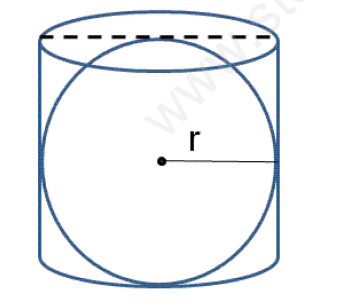
Question 7. A right circular cylinder just enclosed a sphere of radius r as shown in figure find the surface area of the sphere , curved surface area of the cylinder and also their ratio.
Answer:
Radius of the sphere = \(r\)
Surface area of the sphere = \(4\pi r^2\)
Since the cylinder just encloses the sphere:
Radius of the cylinder = Radius of the sphere = \(r\)
Height of the cylinder = Diameter of the sphere = \(2r\)
Curved surface area of the cylinder = \(2\pi r(\text{Height}) = 2\pi r(2r) = 4\pi r^2\)
Ratio of surface area of sphere to curved surface area of cylinder = \(\frac{4\pi r^2}{4\pi r^2} = 1 : 1\)
In simple words: A cylinder enclosing a sphere tightly has the same curved surface area as the sphere's surface area.
Exam Tip: When a cylinder circumscribes a sphere, its height equals the diameter of the sphere.
Question 8. A godown is in the form of a cuboid measuring 60 m x 40 m x 20 m. How many cuboidal boxes can be stored in it if the volume of one box 0.8 m\(^3\)?
Answer:
Dimensions of the godown cuboid = \(60 \text{ m} \times 40 \text{ m} \times 20 \text{ m}\)
Volume of the godown = \(60 \times 40 \times 20 = 48000 \text{ m}^3\)
Volume of one cuboidal box = \(0.8 \text{ m}^3\)
Number of boxes that can be stored = \(\frac{\text{Volume of godown}}{\text{Volume of one box}}\)
\(= \frac{48000}{0.8} = \frac{480000}{8} = 60000\)
In simple words: Divide the total volume of the godown by the volume of a single box to find how many boxes fit.
Exam Tip: Always ensure units are consistent before dividing volumes.
Question 9. The diameter of a sphere is decreased by 50%. What is the ratio between initial and final curved surface areas?
Answer:
Let initial diameter be \(d_1\), so initial radius \(r_1 = \frac{d_1}{2}\).
Initial curved surface area \(S_1 = 4\pi r_1^2\)
Diameter is decreased by 50%, so final diameter \(d_2 = 0.5 d_1\), and final radius \(r_2 = 0.5 r_1\).
Final curved surface area \(S_2 = 4\pi r_2^2 = 4\pi (0.5 r_1)^2 = 4\pi (0.25 r_1^2) = 0.25 \times 4\pi r_1^2\)
Ratio between initial and final curved surface areas \(= \frac{S_1}{S_2} = \frac{4\pi r_1^2}{0.25 \times 4\pi r_1^2} = \frac{1}{0.25} = \frac{4}{1} = 4 : 1\)
In simple words: Halving the radius quarters the surface area since surface area depends on the square of the radius.
Exam Tip: Surface area is proportional to \(r^2\); if radius is halved (\(1/2\)), surface area becomes \((1/2)^2 = 1/4\).
Question 10. Find the volume of the largest right circular cone that can be fitted in a cube whose edge is 14 cm.
Answer:
Edge of the cube \(a = 14\) cm
The largest cone that can fit inside a cube has a base diameter equal to the edge of the cube and height equal to the edge of the cube.
Radius of the cone \(r = \frac{14}{2} = 7\) cm
Height of the cone \(h = 14\) cm
Volume of the cone = \(\frac{1}{3}\pi r^2 h\)
\(= \frac{1}{3} \times \frac{22}{7} \times (7)^2 \times 14\)
\(= \frac{1}{3} \times \frac{22}{7} \times 49 \times 14\)
\(= \frac{1}{3} \times 22 \times 7 \times 14 = \frac{2156}{3} = 718.67 \text{ cm}^3\)
In simple words: The base circle touches all four sides of the cube's face, making its diameter equal to the cube's side.
Exam Tip: For maximum cone inside a cube, \(\text{radius} = \text{side}/2\) and \(\text{height} = \text{side}\).
Question 11. The semi-circular sheet of metal of diameter 28 cm is bent into an open conical cup. Find the depth and the capacity of cup.
Answer:
Diameter of semi-circular sheet = 28 cm, so radius of semi-circular sheet \(R = 14\) cm.
When this semi-circular sheet is bent into a conical cup, the radius of the sheet becomes the slant height of the cone.
Slant height of the cone \(l = R = 14\) cm.
The perimeter of the semi-circular sheet becomes the circumference of the base of the cone.
Circumference of base of cone = Arc length of semi-circle
\(2\pi r = \pi R\)
\(2r = R \implies 2r = 14 \implies r = 7\) cm (where \(r\) is base radius of cone).
Depth (height) of the cone \(h = \sqrt{l^2 - r^2} = \sqrt{14^2 - 7^2} = \sqrt{196 - 49} = \sqrt{147} = 7\sqrt{3} \approx 12.12\) cm.
Capacity (volume) of the cup = \(\frac{1}{3}\pi r^2 h\)
\(= \frac{1}{3} \times \frac{22}{7} \times 7^2 \times 7\sqrt{3}\)
\(= \frac{1}{3} \times \frac{22}{7} \times 49 \times 7\sqrt{3} = \frac{1078\sqrt{3}}{3} \approx 622.37 \text{ cm}^3\)
In simple words: The semi-circle's radius becomes the cone's slant height, and its curved edge becomes the cone's base circumference.
Exam Tip: Always remember: for a cone formed from a semi-circular sheet, slant height \(l\) equals the radius of the semi-circle.
Question 12. A well with 10 m inside diameter is dug 14 m deep. Earth taken out of it is spread all around to a width of 5 m to form an embankment. Find the height of embankment.
Answer:
Inside diameter of well = 10 m, so inner radius \(r = 5\) m
Depth of well \(h = 14\) m
Volume of earth dug out = Volume of cylinder = \(\pi r^2 h = \pi \times (5)^2 \times 14 = 350\pi \text{ m}^3\)
Width of embankment = 5 m
Outer radius of embankment \(R = \text{Inner radius} + \text{Width} = 5 + 5 = 10\) m
The embankment is in the form of a cylindrical shell (hollow cylinder).
Area of the base of embankment = \(\pi (R^2 - r^2) = \pi (10^2 - 5^2) = \pi (100 - 25) = 75\pi \text{ m}^2\)
Height of embankment (\(H\)) = \(\frac{\text{Volume of earth}}{\text{Area of base}}\)
\(H = \frac{350\pi}{75\pi} = \frac{350}{75} = \frac{14}{3} = 4.67 \text{ m}\)
In simple words: The volume of soil dug from the well equals the volume of the hollow cylindrical embankment built around it.
Exam Tip: Outer radius \(R\) is always inner radius plus the width of the embankment, not just the width itself.
Question 13. The radius and slant height of a cone are in the ratio 4 : 7. If its curved surface area is 792 sq cm, find its radius.
Answer:
Let radius \(r = 4x\) and slant height \(l = 7x\).
Curved surface area of cone = \(\pi rl\)
\(\frac{22}{7} \times (4x) \times (7x) = 792\)
\(\frac{22}{7} \times 28x^2 = 792\)
\(22 \times 4x^2 = 792\)
\(88x^2 = 792\)
\(x^2 = \frac{792}{88} = 9 \implies x = 3\)
Radius \(r = 4x = 4 \times 3 = 12\) cm.
In simple words: Use variables with a common multiplier (\(4x\) and \(7x\)) when dimensions are given in a ratio.
Exam Tip: Solve for \(x^2\) first to simplify radical calculations.
Question 14. The diameter of 0.84 m long roller is 1.5 m. If it takes 100 complete revolutions to level a playground, find the cost of levelling it at the rate of 50 paise per square metre.
Answer:
Length of roller \(h = 0.84\) m
Diameter of roller = 1.5 m, so radius \(r = \frac{1.5}{2} = 0.75\) m
Area covered in 1 revolution = Curved surface area of roller
\(= 2\pi rh = 2 \times \frac{22}{7} \times 0.75 \times 0.84\)
\(= 2 \times \frac{22}{7} \times \frac{3}{4} \times \frac{84}{100} = 3.96 \text{ m}^2\)
Total area covered in 100 revolutions = \(100 \times 3.96 = 396 \text{ m}^2\)
Cost of levelling = Area \(\times\) Rate
Rate = 50 paise = Rs. 0.50 per m\(^2\)
Total Cost = \(396 \times 0.50 = \text{Rs. } 198\)
In simple words: Multiply the area covered in one revolution by 100, then multiply by the cost per square meter.
Exam Tip: Convert paise to rupees (divide by 100) before calculating final monetary cost.
Question 15. Three equal cubes are placed adjacently in a row. Find the ratio of total surface area of the new cuboid to that of sum of the surface areas of the three cubes.
Answer:
Let the edge of each cube be \(a\).
When three such cubes are placed adjacently, the dimensions of the resulting cuboid are:
Length \(L = 3a\), Breadth \(B = a\), Height \(H = a\)
Total Surface Area (TSA) of the new cuboid = \(2(LB + BH + HL)\)
\(= 2((3a \times a) + (a \times a) + (a \times 3a))\)
\(= 2(3a^2 + a^2 + 3a^2) = 2(7a^2) = 14a^2\)
Surface area of one cube = \(6a^2\)
Sum of surface areas of three cubes = \(3 \times 6a^2 = 18a^2\)
Ratio = \(\frac{\text{TSA of new cuboid}}{\text{Sum of TSA of 3 cubes}} = \frac{14a^2}{18a^2} = \frac{7}{9} = 7 : 9\)
In simple words: Joining cubes reduces exposed faces, decreasing the total surface area compared to the sum of individual cubes.
Exam Tip: Only the length changes when cubes are placed in a row; breadth and height remain \(a\).
Question 16. The cost of papering four walls of a room at 90 paise per square metre is Rs. 157.50. The height of the room is 5 metres. Find the length and the breadth of the room if they are in the ratio 4:1.
Answer:
Total cost = Rs. 157.50
Rate = 90 paise = Rs. 0.90 per m\(^2\)
Area of four walls (Lateral surface area) = \(\frac{\text{Total cost}}{\text{Rate}} = \frac{157.50}{0.90} = \frac{15750}{90} = 175 \text{ m}^2\)
Height of the room \(h = 5\) m
Let length \(l = 4x\) and breadth \(b = x\).
Area of four walls = \(2(l + b)h\)
\(175 = 2(4x + x) \times 5\)
\(175 = 10(5x)\)
\(175 = 50x\)
\(x = \frac{175}{50} = 3.5\)
Length \(l = 4 \times 3.5 = 14\) m
Breadth \(b = 3.5\) m
In simple words: Divide total cost by rate to find wall area, then use the lateral surface area formula to find dimensions.
Exam Tip: Area of four walls is given by perimeter of base multiplied by height: \(2(l + b)h\).
Question 17. A hollow cylinder is made of iron of height 1 m. Its inner diameter is 54 cm and thickness of iron sheet of cylinder is 9 cm. Find the weight of the hollow cylinder if 1 c.c. of iron weighs 8 gm.
Answer:
Height \(h = 1 \text{ m} = 100\) cm
Inner diameter = 54 cm, so inner radius \(r = 27\) cm
Thickness = 9 cm
Outer radius \(R = r + \text{Thickness} = 27 + 9 = 36\) cm
Volume of iron in the cylinder = \(\pi (R^2 - r^2)h\)
\(= \frac{22}{7} \times (36^2 - 27^2) \times 100\)
Using \(a^2 - b^2 = (a - b)(a + b)\):
\(36^2 - 27^2 = (36 - 27)(36 + 27) = 9 \times 63 = 567\)
Volume = \(\frac{22}{7} \times 567 \times 100 = 22 \times 81 \times 100 = 178200 \text{ cm}^3\)
Weight of 1 cm\(^3\) of iron = 8 gm
Total weight = \(178200 \times 8 = 1425600 \text{ gm} = 1425.6 \text{ kg}\)
In simple words: Find the volume of the iron shell by subtracting inner cylinder volume from outer cylinder volume, then multiply by density.
Exam Tip: Convert all dimensions to centimeters first since the weight is given in grams per cubic centimeter.
Question 18. A well with 8 m inner diameter is dug 21 m deep. Earth taken out of it is spread all around to a width of 3 m to form an embankment. Find the height of embankment.
Answer:
Inner diameter = 8 m, so inner radius \(r = 4\) m
Depth of well \(h = 21\) m
Volume of earth dug out = \(\pi r^2 h = \pi \times (4)^2 \times 21 = 336\pi \text{ m}^3\)
Width of embankment = 3 m
Outer radius \(R = 4 + 3 = 7\) m
Base area of embankment = \(\pi (R^2 - r^2) = \pi (7^2 - 4^2) = \pi (49 - 16) = 33\pi \text{ m}^2\)
Height of embankment \(H = \frac{\text{Volume of earth}}{\text{Base area}} = \frac{336\pi}{33\pi} = \frac{336}{33} = \frac{112}{11} = 10.18 \text{ m}\)
In simple words: The volume of soil from the well equals the volume of the hollow cylindrical embankment.
Exam Tip: Base area of a hollow cylindrical embankment is \(\pi(R^2 - r^2)\).
Question 19. A plastic box 1.25 m long, 1.05 m wide and 75 cm deep is to be made. It is to be open at the top. Ignoring the thickness of the plastic sheet, determine the area of the sheet required for making the box and also find the cost of sheet for it, if a sheet measuring 1 sq m cost Rs. 20.
Answer:
Length \(l = 1.25\) m
Breadth \(b = 1.05\) m
Depth \(h = 75 \text{ cm} = 0.75\) m
Since the box is open at the top, the area of sheet required = \(lb + 2(bh + hl)\)
\(= (1.25 \times 1.05) + 2(1.05 \times 0.75 + 0.75 \times 1.25)\)
\(= 1.3125 + 2(0.7875 + 0.9375)\)
\(= 1.3125 + 2(1.725)\)
\(= 1.3125 + 3.45 = 4.7625 \text{ m}^2\)
Cost of sheet = Area \(\times\) Rate = \(4.7625 \times 20 = \text{Rs. } 95.25\)
In simple words: Add the area of the bottom rectangle and the four walls (excluding the top) to get total sheet area.
Exam Tip: For open boxes, use \(lb + 2bh + 2hl\) instead of full total surface area formula.
Question 20. A reservoir is in the form of rectangular parallelepiped. Its length is 20 m. If 18 kl of water is removed from the reservoir, the water level goes down by 15 cm. Find the width of the reservoir.
Answer:
Length \(l = 20\) m
Drop in water level \(h = 15 \text{ cm} = 0.15\) m
Volume of water removed = \(18 \text{ kl} = 18 \text{ m}^3\) (since \(1 \text{ kl} = 1 \text{ m}^3\))
Volume = \(\text{Length} \times \text{Width} \times \text{Drop in height}\)
\(18 = 20 \times b \times 0.15\)
\(18 = 3 \times b\)
\(b = \frac{18}{3} = 6 \text{ m}\)
Width of the reservoir is 6 m.
In simple words: The volume of the removed water equals the volume of the cuboid formed by length, width, and drop in height.
Question 21. If v is the volume of a cuboid of dimension a, b, c and s is its surface area, then prove that \(\frac{1}{v} = \frac{2}{s} \left(\frac{1}{a} + \frac{1}{b} + \frac{1}{c}\right)\)
Answer:
Volume of cuboid \(v = abc\)
Surface area of cuboid \(s = 2(ab + bc + ca)\)
Consider the right-hand side (RHS):
\(\text{RHS} = \frac{2}{s} \left(\frac{1}{a} + \frac{1}{b} + \frac{1}{c}\right)\)
Substitute \(s = 2(ab + bc + ca)\):
\(\text{RHS} = \frac{2}{2(ab + bc + ca)} \left(\frac{bc + ca + ab}{abc}\right)\)
\(\text{RHS} = \frac{1}{ab + bc + ca} \times \frac{ab + bc + ca}{abc}\)
\(\text{RHS} = \frac{1}{abc}\)
Since \(v = abc\), this becomes \(\frac{1}{v} = \text{LHS}\). Hence proved.
In simple words: Substitute the algebraic expressions for volume and surface area, then simplify the fractions step by step.
Exam Tip: Take LCM inside the bracket: \(\frac{1}{a} + \frac{1}{b} + \frac{1}{c} = \frac{bc + ca + ab}{abc}\).
Question 22. The area of three adjacent faces of a cuboid are x, y and z. If the volume is V, prove that \(V^2 = xyz\).
Answer:
Let the dimensions of the cuboid be \(l, b, h\).
The areas of three adjacent faces are:
\(x = lb\)
\(y = bh\)
\(z = hl\)
Multiply \(x, y, and z\):
\(xyz = (lb) \times (bh) \times (hl) = l^2 b^2 h^2 = (lbh)^2\)
Since the volume of the cuboid \(V = lbh\), we have:
\(xyz = V^2\). Hence proved.
In simple words: Multiplying the areas of three adjacent faces gives the square of the volume because each dimension appears twice.
Exam Tip: Remember adjacent faces of a cuboid are \(lb, bh, hl\); their product is \((lbh)^2 = V^2\).
Question 23. A wall of the length 10 m was to be built across an open ground. The height of the wall is 4 m and thickness of the wall is 24 cm. If this wall is to be built up with bricks whose dimensions are 24 cm x 12 cm x 8 cm, how many bricks would be required?
Answer:
Dimensions of the wall:
Length \(L = 10 \text{ m} = 1000\) cm
Height \(H = 4 \text{ m} = 400\) cm
Thickness \(B = 24\) cm
Volume of the wall = \(1000 \times 400 \times 24 \text{ cm}^3\)
Dimensions of one brick = \(24 \text{ cm} \times 12 \text{ cm} \times 8 \text{ cm}\)
Volume of one brick = \(24 \times 12 \times 8 \text{ cm}^3\)
Number of bricks = \(\frac{\text{Volume of wall}}{\text{Volume of one brick}}\)
\(= \frac{1000 \times 400 \times 24}{24 \times 12 \times 8}\)
\(= \frac{1000 \times 400}{12 \times 8} = \frac{400000}{96} = 4166.67 \approx 4167 \text{ bricks}\)
In simple words: Divide the total volume of the wall by the volume of a single brick to find the required quantity.
Exam Tip: Convert all dimensions to the same unit (centimeters) before calculating volumes.
Question 24. How many litres of water flow out of a pipe having an area of cross-section of 5 sq cm. in one minute if the speed of the water in the pipe is 30 cm/sec?
Answer:
Area of cross-section \(A = 5 \text{ cm}^2\)
Speed of water \(v = 30 \text{ cm/sec}\)
Volume of water flowing per second = \(\text{Area} \times \text{Speed} = 5 \times 30 = 150 \text{ cm}^3\text{/sec}\)
Volume of water flowing in one minute (60 seconds) = \(150 \times 60 = 9000 \text{ cm}^3\)
Convert cubic centimeters to litres (\(1000 \text{ cm}^3 = 1 \text{ litre}\)):
\(\text{Volume in litres} = \frac{9000}{1000} = 9 \text{ litres}\)
In simple words: Water flow volume per second equals cross-sectional area multiplied by water speed per second.
Question 25. A circular tent is cylindrical to a height of 3 metres and conical above it. If its diameter is 105 m and the slant height of the conical portion is 53 m, calculate the length of canvas 5 m wide to make the required tent.
Answer:
Diameter = 105 m, so radius \(r = \frac{105}{2}\) m
Height of cylindrical part \(h = 3\) m
Slant height of conical part \(l = 53\) m
Total surface area of canvas required = Curved surface area of cylinder + Curved surface area of cone
\(= 2\pi rh + \pi rl = \pi r (2h + l)\)
\(= \frac{22}{7} \times \frac{105}{2} \times (2(3) + 53)\)
\(= \frac{22}{7} \times \frac{105}{2} \times (6 + 53)\)
\(= \frac{22}{7} \times \frac{105}{2} \times 59\)
\(= 11 \times 15 \times 59 = 9735 \text{ m}^2\)
Width of canvas = 5 m
Length of canvas = \(\frac{\text{Total Area}}{\text{Width}} = \frac{9735}{5} = 1947 \text{ m}\)
In simple words: Find the total surface area of the tent and divide by the width of the canvas to get its required length.
Exam Tip: Factor out common terms like \(\pi r\) to simplify complex multiplication.
Question 26. The radius and slant height of a cone are in the ratio 4:7. If its curved surface area is 792 sq cm, find its radius.
Answer:
Let radius \(r = 4x\) and slant height \(l = 7x\).
Curved surface area = \(\pi rl = \frac{22}{7} \times 4x \times 7x = 792\)
\(88x^2 = 792 \implies x^2 = 9 \implies x = 3\)
Radius \(r = 4 \times 3 = 12\) cm.
In simple words: This is identical to Question 13. Use ratio variables to solve for \(x\).
Question 27. A powder tin is in cylindrical shape, whose base has a diameter of 14 cm and height 20 cm. A label is wrapped around the surface of the container. If the label is pasted leaving 2 cm from the top and the bottom. What is the area of the label?
Answer:
Diameter = 14 cm, so radius \(r = 7\) cm
Total height of tin = 20 cm
Height of label = Total height - 2 cm (top) - 2 cm (bottom) = \(20 - 2 - 2 = 16\) cm
Area of the label = Curved surface area of cylinder with height 16 cm
\(= 2\pi rh = 2 \times \frac{22}{7} \times 7 \times 16\)
\(= 2 \times 22 \times 16 = 704 \text{ cm}^2\)
In simple words: The label's height is reduced by 2 cm from both top and bottom, so use height = 16 cm in the CSA formula.
Question 28. A sphere of diameter 7 cm is dropped in a right circular cylinder vessel partly filled with water. The diameter of the cylindrical vessel is 14 cm. If the sphere is completely submerged in water, by how much will the level of water rise in the cylindrical vessel?
Answer:
Diameter of sphere = 7 cm, so radius of sphere \(r = \frac{7}{2}\) cm
Volume of the sphere = \(\frac{4}{3}\pi r^3 = \frac{4}{3} \times \pi \times \left(\frac{7}{2}\right)^3 = \frac{4}{3} \times \pi \times \frac{343}{8} = \frac{343\pi}{6} \text{ cm}^3\)
Diameter of cylindrical vessel = 14 cm, so radius of cylinder \(R = 7\) cm
Let the rise in water level be \(h\).
Volume of water raised in cylinder = \(\pi R^2 h = \pi \times 7^2 \times h = 49\pi h\)
Volume of sphere = Volume of raised water
\(\frac{343\pi}{6} = 49\pi h\)
\(h = \frac{343}{6 \times 49} = \frac{7}{6} \text{ cm} \approx 1.17 \text{ cm}\)
In simple words: The volume of the submerged sphere equals the volume of the displaced water column in the cylinder.
Exam Tip: Equate the volume of the immersed object directly to \(\pi R^2 h\) to find water level rise.
Question 29. The diameter of a sphere is decreased by 50%. By what percent will its curved surface area decrease?
Answer:
Let initial radius be \(r\). Initial surface area \(S_1 = 4\pi r^2\)
Diameter decreased by 50% means new radius is \(0.5r\).
New surface area \(S_2 = 4\pi (0.5r)^2 = 0.25 \times 4\pi r^2 = 0.25 S_1\)
Decrease in surface area = \(S_1 - S_2 = S_1 - 0.25 S_1 = 0.75 S_1\)
Percentage decrease = \(\frac{0.75 S_1}{S_1} \times 100\% = 75\%\)
In simple words: When the surface area becomes 25% of the original, it has decreased by 75%.
Question 30. Three equal cubes are placed adjacently in a row. Find the ratio of total surface area of the new cuboid to that of sum of the surface areas of the three cubes.
Answer:
This is identical to Question 15.
Ratio of total surface area of new cuboid to sum of surface areas of three cubes is \(7 : 9\).
In simple words: Joining three cubes in a row gives a surface area ratio of 7 to 9.
Question 31. How many bricks will be required for a wall 8 m long, 6 m high and 22.5 cm thick if each brick measures 25 cm x 11.25 cm x 6 cm?
Answer:
Volume of wall = \(800 \text{ cm} \times 600 \text{ cm} \times 22.5 \text{ cm}\)
Volume of one brick = \(25 \text{ cm} \times 11.25 \text{ cm} \times 6 \text{ cm}\)
Number of bricks = \(\frac{800 \times 600 \times 22.5}{25 \times 11.25 \times 6}\)
\(= \frac{800 \times 600 \times 2.25}{25 \times 1.125 \times 6} = \frac{480000 \times 22.5}{1687.5} = 6400 \text{ bricks}\)
In simple words: Divide the volume of the wall by the volume of one brick.
Question 32. The internal measurements of a cuboidal room are 10 m x 4 m x 6 m. Find the cost of white washing of the walls at the rate of Rs. 5 per square metre.
Answer:
Dimensions: length \(l = 10\) m, breadth \(b = 4\) m, height \(h = 6\) m
Area of four walls (excluding floor and ceiling) = \(2(l + b)h\)
\(= 2(10 + 4) \times 6 = 2 \times 14 \times 6 = 168 \text{ m}^2\)
Cost of whitewashing = Area \(\times\) Rate = \(168 \times 5 = \text{Rs. } 840\)
In simple words: Whitewashing is done only on the four walls, so calculate lateral surface area and multiply by rate.
Question 33. A cylinder is within the cube touching all the vertical faces. A cone is inside the cylinder. If the height and base of the cone is same as cylinder, find the ratio of their volumes.
Answer:
Let radius of cylinder and cone be \(r\) and height be \(h\).
Volume of cone \(V_1 = \frac{1}{3}\pi r^2 h\)
Volume of cylinder \(V_2 = \pi r^2 h\)
Ratio of volume of cone to volume of cylinder = \(\frac{\frac{1}{3}\pi r^2 h}{\pi r^2 h} = 1 : 3\)
In simple words: A cone's volume is always one-third of a cylinder's volume when both have the same base and height.
Question 34. The external length, breadth and height of a closed rectangular wooden box are 18 cm, 10 cm and 6 cm respectively and thickness of wood is \(\frac{1}{2}\) cm. When the box is empty, it weighs 15 kg and when filled with sand it weighs 100 kg. Find the weight of one cubic cm of wood and one cubic cm of sand.
Answer:
External dimensions: \(L = 18\) cm, \(B = 10\) cm, \(H = 6\) cm
External volume = \(18 \times 10 \times 6 = 1080 \text{ cm}^3\)
Thickness \(t = 0.5\) cm
Internal dimensions: \(l = 18 - 2(0.5) = 17\) cm, \(b = 10 - 2(0.5) = 9\) cm, \(h = 6 - 2(0.5) = 5\) cm
Internal volume (capacity for sand) = \(17 \times 9 \times 5 = 765 \text{ cm}^3\)
Volume of wood = External volume - Internal volume = \(1080 - 765 = 315 \text{ cm}^3\)
Weight of empty box (wood) = \(15 \text{ kg} = 15000 \text{ g}\)
Density of wood = \(\frac{15000}{315} = 47.62 \text{ g/cm}^3\)
Weight of sand = Total weight when full - Weight of empty box = \(100 - 15 = 85 \text{ kg} = 85000 \text{ g}\)
Density of sand = \(\frac{85000}{765} = 111.11 \text{ g/cm}^3\)
In simple words: Subtract internal volume from external volume to find wood volume, then divide respective weights by volumes.
Question 35. How many litres of water flows out of a pipe having an area of cross-section of 5 sq. cm in one minute, if the speed of water in the pipe is 30 cm/sec?
Answer:
This is identical to Question 24.
Volume flowing in one minute = 9 litres.
In simple words: Multiply cross-section area by water speed and time to get total volume in litres.
Question 36. A hemispherical bowl of internal diameter 40 cm contains a liquid. This liquid is to be filled in cylindrical bottles of radius 2 cm and height 8 cm. How many bottles are required to empty the bowl?
Answer:
Internal diameter of bowl = 40 cm, so radius \(R = 20\) cm
Volume of liquid in hemispherical bowl = \(\frac{2}{3}\pi R^3 = \frac{2}{3}\pi (20)^3 = \frac{16000\pi}{3} \text{ cm}^3\)
Radius of cylindrical bottle \(r = 2\) cm, height \(h = 8\) cm
Volume of one cylindrical bottle = \(\pi r^2 h = \pi (2)^2 \times 8 = 32\pi \text{ cm}^3\)
Number of bottles required = \(\frac{\text{Volume of bowl}}{\text{Volume of one bottle}} = \frac{\frac{16000\pi}{3}}{32\pi} = \frac{16000}{3 \times 32} = \frac{500}{3} = 166.67 \approx 167 \text{ bottles}\)
In simple words: Divide the volume of the hemisphere by the volume of one cylindrical bottle to find the total number of bottles.
Question 37. An open box is made of wood 3 cm thick. Its external length, breadth and height are 1.48 m, 1.16 m and 8.3 dm. Find the cost of painting the inner surface of Rs. 1000 per 10 sq metres.
Answer:
External dimensions in cm:
\(L = 1.48 \text{ m} = 148\) cm
\(B = 1.16 \text{ m} = 116\) cm
\(H = 8.3 \text{ dm} = 83\) cm
Thickness \(t = 3\) cm
Internal dimensions:
\(l = 148 - 2(3) = 142\) cm = 1.42 m
\(b = 116 - 2(3) = 110\) cm = 1.10 m
\(h = 83 - 3 = 80\) cm = 0.80 m (since box is open at the top, subtract thickness only once from height)
Inner surface area to be painted = \(lb + 2bh + 2hl\)
\(= (1.42 \times 1.10) + 2(1.10 \times 0.80 + 0.80 \times 1.42)\)
\(= 1.562 + 2(0.88 + 1.136)\)
\(= 1.562 + 2(2.016) = 1.562 + 4.032 = 5.594 \text{ m}^2\)
Rate = Rs. 1000 per 10 m\(^2\) = Rs. 100 per m\(^2\)
Total cost = \(5.594 \times 100 = \text{Rs. } 559.40\)
In simple words: Calculate internal dimensions, find open box inner surface area, and multiply by the cost per square meter.
Question 38. The ratio of radii of two right circular cylinders is 2:5 and that of their heights is 1:4, find the ratio of their Volumes.
Answer:
Let radii be \(r_1 = 2x, r_2 = 5x\) and heights be \(h_1 = y, h_2 = 4y\).
Volume of first cylinder \(V_1 = \pi r_1^2 h_1 = \pi (2x)^2 (y) = 4\pi x^2 y\)
Volume of second cylinder \(V_2 = \pi r_2^2 h_2 = \pi (5x)^2 (4y) = 100\pi x^2 y\)
Ratio of volumes = \(\frac{V_1}{V_2} = \frac{4\pi x^2 y}{100\pi x^2 y} = \frac{4}{100} = \frac{1}{25} = 1 : 25\)
In simple words: Substitute ratio variables into the volume formula and simplify the fraction.
Question 39. A wooden toy is in the form of a cone. The diameter of the base of the cone is 6 cm and the height of the cone is 4 cm. Find the cost of painting the toy at the rate of Rs. 5 per 100 cm\(^2\).
Answer:
Diameter = 6 cm, so radius \(r = 3\) cm
Height \(h = 4\) cm
Slant height \(l = \sqrt{r^2 + h^2} = \sqrt{3^2 + 4^2} = \sqrt{9 + 16} = \sqrt{25} = 5\) cm
Curved surface area of cone = \(\pi rl = \frac{22}{7} \times 3 \times 5 = \frac{330}{7} \text{ cm}^2\)
Cost of painting = \(\frac{\text{Area}}{100} \times \text{Rate} = \frac{330}{7 \times 100} \times 5 = \frac{1650}{700} = \text{Rs. } 2.36\)
In simple words: Find slant height, calculate curved surface area, and multiply by the cost per 100 square centimeters.
Question 40. An open cuboidal box is made of 3 cm thick wood. Its external length, breadth and height are 1.48 m, 1.16 m and 8.3 dm respectively. Find the cost of painting the inner surface at the rate of Rs. 50 per square metre.
Answer:
From Question 37, the inner surface area of this open box is \(5.594 \text{ m}^2\).
Rate = Rs. 50 per m\(^2\)
Total Cost = \(5.594 \times 50 = \text{Rs. } 279.70\)
In simple words: Multiply the inner surface area by Rs. 50 to get the total painting cost.
Question 41. A conical vessel having internal radius 3 cm and height 25 cm is full of water. The water is emptied into a cylindrical vessel with internal radius of 10 cm. Find the height to which the water rises.
Answer:
Radius of cone \(r = 3\) cm, height of cone \(h = 25\) cm
Volume of water in cone = \(\frac{1}{3}\pi r^2 h = \frac{1}{3} \times \pi \times 3^2 \times 25 = \frac{1}{3} \times \pi \times 9 \times 25 = 75\pi \text{ cm}^3\)
Radius of cylindrical vessel \(R = 10\) cm
Let the height to which water rises in cylinder be \(H\).
Volume of water in cylinder = \(\pi R^2 H = \pi \times 10^2 \times H = 100\pi H\)
Equating volumes: \(100\pi H = 75\pi\)
\(H = \frac{75}{100} = 0.75 \text{ cm}\)
In simple words: The volume of water poured from the cone equals the volume it occupies in the cylindrical vessel.
Q 1 Find the area enclosed between two concentric circles of radii 4 cm and 3 cm.
Q 2 The diameter of a garden roller is 1.4 m and it is 2 m long. How much area will it cover in 5 revolutions?
Q 3 A cuboid has total surface area of 40 sq m and its lateral surface area is 26 sq m. Find the area of base.
Q 4 Three metal cubes whose edges measure 3 cm, 4 cm and 5 cm respectively are melted to form a single cube. Find the edge of the new cube. Also find the surface area of the new cube.
Q 5 An iron pipe 20 cm long has exterior diameter equal to 50 cm. If the thickness of the pipe is 1cm, find the whole surface area of the pipe.
Q 6 The lateral surface of a cylinder is equal to the curved surface of a cone. If the radius is the same, find the ratio of the height of the
cylinder and slant height of the cone.
Q 7 A right circular cylinder just enclosed a sphere of radius r as shown in figure find the surface area of the sphere , curved surface area of the cylinder and also their ratio.
Q 8 A godown is in the form of a cuboid measuring 60 m x 40 m x 20 m. How many cuboidal boxes can be stored in it if the volume of one box 0.8 m3?
Click on link below to download CBSE Class 9 Mathematics Surface areas and Volumes Assignment Set C
Free study material for Mathematics
Download Practice Assignments: Class 9 Mathematics Chapter 11 Surface Areas And Volumes
Revision Assignment: Chapter 11 Surface Areas And Volumes (CBSE)
Explore reliable practice questions for Chapter 11 Surface Areas And Volumes tailored for Class 9 learners. Use these structured worksheets to evaluate preparedness and strengthen core problem-solving skills.
Maximize Exam Scores with Chapter Practice Sets
- Curriculum Standards: Assignments match modern CBSE sample formats to ensure relevant preparation.
- Thorough Revision: Detailed problem sets reinforce core concepts and eliminate conceptual weak spots.
- Execution Speed: Timed practice with assignment sets sharpens overall response timing.
Effective Strategy for Class 9 Mathematics Assignments
- Initial Reading: Begin by reading the NCERT book for Class 9 Mathematics to build a baseline understanding.
- Independent Testing: Attempt assignment questions unassisted, then verify work using provided answer keys.
- Supplementary Aids: Leverage revision notes and worksheets whenever you encounter difficult topics.
FAQs
You can download free PDF assignments for Class 9 Mathematics Chapter 11 Surface Areas And Volumes from StudiesToday.com. These practice sheets have been updated for the 2026-27 session covering all concepts from latest NCERT textbook.
Yes, our teachers have given solutions for all questions in the Class 9 Mathematics Chapter 11 Surface Areas And Volumes assignments. This will help you to understand step-by-step methodology to get full marks in school tests and exams.
Yes. These assignments are designed as per the latest CBSE syllabus for 2026. We have included huge variety of question formats such as MCQs, Case-study based questions and important diagram-based problems found in Chapter 11 Surface Areas And Volumes.
Practicing topicw wise assignments will help Class 9 students understand every sub-topic of Chapter 11 Surface Areas And Volumes. Daily practice will improve speed, accuracy and answering competency-based questions.
Yes, all printable assignments for Class 9 Mathematics Chapter 11 Surface Areas And Volumes are available for free download in mobile-friendly PDF format.