

Class 9 Mathematics Practice Assignments: CBSE Class 9 Mathematics Area of Parallelograms and Triangles Assignment Set 01
Review targeted academic assignments with the CBSE Class 9 Mathematics Area of Parallelograms and Triangles Assignment Set 01. Built according to official CBSE standards for the 2026-27 term, these downloadable Class 9 Mathematics worksheets support effective daily practice for Chapter 09 Areas Of Parallelograms And Triangles.
Download Chapter 09 Areas Of Parallelograms And Triangles Assignment PDF with Solutions
Navigate directly to the solved Mathematics assignments using the digital viewer below. Each practice set includes detailed step-by-step solutions, allowing students to instantly cross-check their work and identify areas requiring further revision.
1 Two parallelograms are on the same base and between the same parallels. What is the ratio of their areas?
(A) 2 : 1
(B) 1 : 2
(C) 1 : 1
(D) 3 : 1
Answer : C
2 ABCD is a parallelogram and '0' is the point of int ersection of its diagonals AC and BD. If t he area of ΔAOD = 8 cm2, what is the area of the ΔBOC?
(A) 2 cm2
(B) 4 cm2
(C) 8 cm2
(D) 32 cm2
Answer : C
3 The area of a trapezium is 24 cm2. The distance between its parallel sides is 4 cm. If one of the parallel sides is 7 cm, what is the measure of the ot her parallel side?
(A) 5 cm
(B) 8 cm
(C) 12 cm
(D) 7 cm
Answer : A
4 The area of a square is 36 cm2. 1f the side of the square is doubled, what is the ratio of area of the original square to that of the new sq uare formed?
(A) 4: 1
(B) 4: 3
(C) 1 : 4
(D) 1 : 2
Answer : C
5 The area of a rhombus is 60 cm2. if one of its diagonals is 15 em, find the other diagonal.
(A) 4 cm
(B) 8 cm
(C) 10 cm
(D) 16 cm
Answer : B
6 The area of a triangle is 16 cm2. if it s base is 8 cm, what is its corresponding altitude?
(A) 4 cm
(B) 8 cm
(C) 18 cm
(D) 12 cm
Answer : A
7 One of the diagonals of a quadrilateral is 16 cm. The perpendiculars drawn to it from its opposite vertices are 2.6 cm and 1.4 cm. Find its area.
(A) 32 cm2
(B) 40 cm2
(C) 26 cm2
(D) 28 cm2
Answer : A
8 The ratio of the bases of two triangles is a : b. If t he ratio of their corresponding altitudes is c :d, find the ratio of their areas (in the same order).
(A) ac : bd
(B) ad : be
(C) bd : ac
(D) be :ad
Answer : A
9 The base and corresponding altitude of a parallelogram are 18 cm and 6 cm respect ively. What is its area?
(A) 36 cm2
(B) 40 cm2
(C) 44 cm2
(D) 108 cm2
Answer : D
10 In ΔABC, AB = 8 cm. If the altitudes corresponding to AB and BC are 4 cm and 5 cm respectively, find the measure of BC.
(A) 6.4 cm
(B) 4.6 cm
(C) 5.4 cm
(D) 4.5 cm
Answer : A
11 ABCD is a trapezium whose area is a2 - b2. lf AB = a, DC = band AB II CD ,what is the distance between the parallel sides?
(A) (a - b)
(B) (a + b)
(C) 2(a - b)
(D) 2(a + b)
Answer : C
12 The diagonals AC and BD of a parallelogram ABCD intersect at 0. P is a point on AC such that AP = 1/4 AC. Which of the following is true?
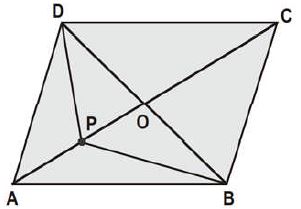
(A) ar(ΔADP) = ar(ΔAPB)
(B) ar(ΔADP) = ar(ΔDOC)
(C) ar(ΔADP) = ar(ΔBCD)
(D) ar(ΔADP) = ar(ΔADB)
Answer : A
13 In ΔXYZ, P and Q are two points on side XZ such that XP = PQ = QZ.
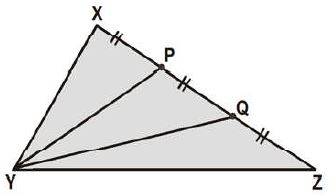
Which of the following is correct?
(A) ar(ΔPXY) = ar(ΔPYZ)
(B) ar(ΔPXY) = ar(ΔPYQ) = ar(ΔQYZ)
(C) ar(ΔPYQ) = ar(flXYQ)
(D) ar(ΔQYZ) = ar(ΔXYQ)
Answer : B
14 A square PQRS and a rhombus RSTU lie on the same base RS
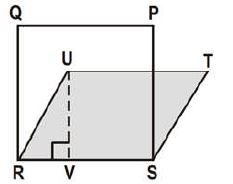
What is the relation between their areas?
(A) ar(PQRS) = ar(RSTU)
(B) ar(PQRS) < ar(RSTU)
(C) ar(PQRS) > ar(RSTU)
(D) ar(PQRS) = 1/2 ar(RSTU)
Answer : C
15 If E, F, G and Hare respectively the mid points of the sides of a parallelogram ABCD and ar (EFGH) = 40 cm2, find the ar (parallelogram ABCD) .
(A) 40 cm2
(B) 20 cm2
(C) 80 cm2
(D) 60 cm2
Answer : C
16 If a triangle and a square are on the same base and bet ween the same parallels, What is the ratio of their areas in order?
(A) 1:3
(B) 1 :2
(C) 3: 1
(D) 1 :4
Answer : B
(17-20): Observe the figures given and choose the incorrect statements.
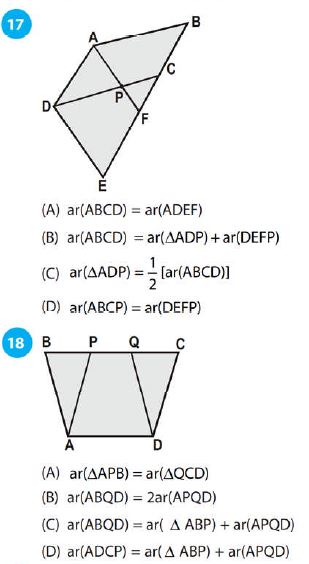
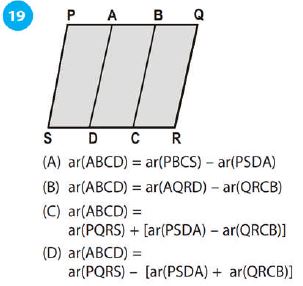
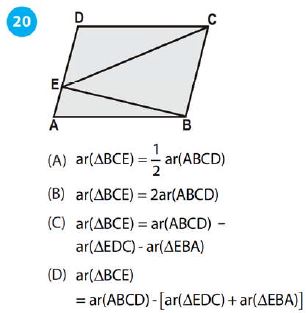
Answer 17: C
Answer 18: B
Answer 19: C
Answer 20: B
(21 -22): Based on the figure given, identify the true stat ements.
21
(A) ar(PQRS) = 2ar(ΔPNR)
(B) ar(PQRS) = 2ar(MNRS)
(C) ar(PQRS) = ar(MNRS)
(D) ar(MNRS) = 2a r(PQRS)
Answer : C
22
(A) ar(ΔPRS) = ar(ΔQRN)
(B) ar(ΔPQR) = ar(ΔPSR)
(C) ar(ΔQRN) = '1/2 ar(PNR)
(D) ar(ΔPM S) = ar(ΔQNR)
Answer : B
23 In a ΔABC, G is the cent roid. What is the ratio of area of ΔAGC to area of ΔABC?
(A) 1 : 2
(B) 1 : 3
(C) 1 : 4
(D) 1 : 6
Answer : B
24 A square and a rhombus are on the same base and between the same parallels. Which of the following is the ratio of their areas?
(A) 1 : 1
(B) 1 : 2
(C) 1 : 3
(D) 1 : 4
Answer : A
25 Find the area of the given quadrilateral ABCD.
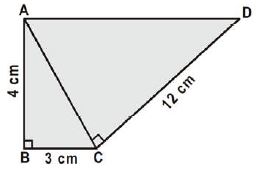
(A) 36 cm2
(B) 24 cm2
(C) 48 cm2
(D) 32 cm2
Answer : A
26 In the given figure, AB║DC. Identify the triangles that have equal areas.
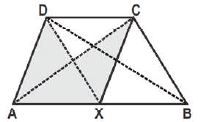
(A) Δ ADX, Δ ACX
(B) Δ ADX, Δ XCB
(C) Δ ACX, Δ XDB
(D) All the above
Answer : A
27 In t he given figure, ABCD is a parallelogram. If area of ΔABL is 15 cm2 and area of ΔDCL is 32 cm2, find the area of the parallelogram ABCD.
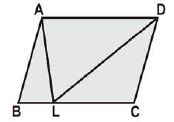
(A) 94 cm2
(B) 86 cm2
(C) 72 cm2
(D) 65 cm2
Answer : A
28 Which of the following figures is obtained by joining mid-points of adjacent sides of a rect angle of sides 8 em and 6 em ?
(A) A rectangle of area 24 cm2
(B) A square of area 25 cm2
(C) A trapezium of area 24 cm2
(D) A rhombus of area 24 cm2
Answer : D
29 In the given figure, ABCD is a trapezium with parallel sides AB = a cm, and CD = b cm. E and F are the mid points of non parallel sides. What is the ratio of ar (EFCD) and ar (ABFE)?
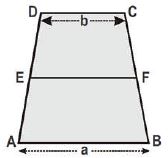
(A) b :a
(B) (a+ 3b) : (3a +b)
(C) (1 + 3b) : (3a + b)
(D) (2a + b) : (3a + b)
Answer : B
30 In the given figure, ABCD is a quadrilateral. BP║AC and BP meets DC (produced) in P. If area of the quadrilateral ABCD is 145 square units, find the area of the ΔADP.
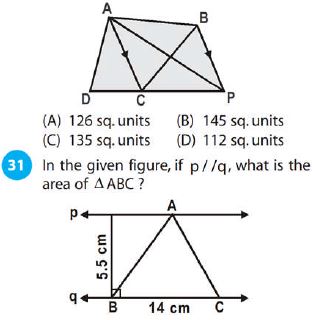
(A ) 77 cm2
(B) 38.5 cm2
(C) 40 cm
(D) 19.25 cm2
Answer 30: B
Answer 31: B
32 AD is the median of a ΔABC and the area of ΔADC = 15 cm2. Find the ar (ΔABC).
(A) 15 cm2
(B) 22.5 cm2
(C) 30 cm2
(D) 37.5 cm2
Answer : C
33 lf D, E and Fare the mid-points of the sides BC, CA and AB of a ΔABC respectively, what is the quadrilateral AFDE?
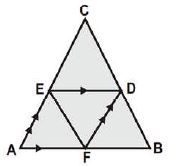
(A) A square
(B) A rectangle
(C) A parallelogram
(D) A trapezium
Answer : C
34 A triang le and a rhombus are on the same base and between the same parallels.
What is the ratio of area of triangle to that of rhombus?
(A) 1 : 1
(B) 1 : 2
(C) 1 : 3
(D) 1 : 4
Answer : B
35 Pis a point in the interior of parallelogram ABCD.
If ar (║9m ABCD) = 18 cm2, what is the value of [ar (ΔAPD) + ar (ΔCPB)] ?
(A) 9 cm2
(B) 12 cm2
(C ) 18 cm2
(D) 15 cm2
Answer : A
36 In the given figure, D is the mid-point of BC and L is the mid-point of AD. If ar (ΔABL) = x ar (ΔABC) ,whatisthevalueofx ?

(A) 2
(B) 1/2
(C) 1/4
(D) 4
Answer : C
37 Area of a parallelogram ABCD is 432 cm2. If BC // AD and the distance between BC and AD is 20 cm, what is the measure of the side BC of parallelogram ABCD?
(A) 43.2 cm
(B) 1 0.8 cm
(C) 18.2 cm
(D) 21.6 cm
Answer : D
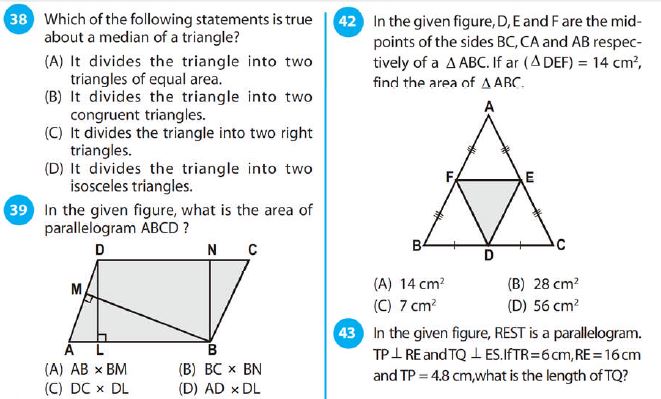
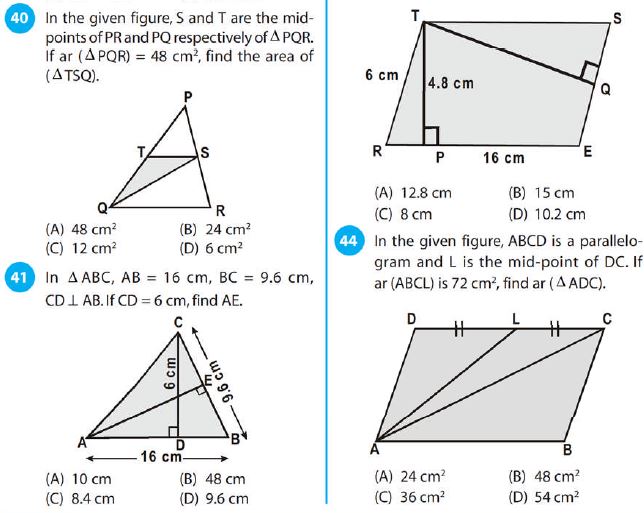
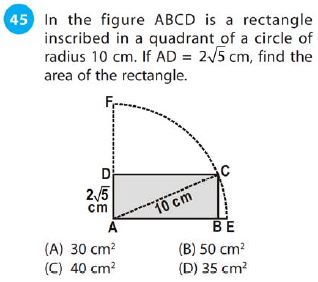
Answer 38: A
Answer 39: C
Answer 40: C
Answer 41: A
Answer 42: D
Answer 43: A
Answer 44: B
Answer 45: C
Areas of Parallelograms and Triangles
Question 1. State true or false : A diagonal of a parallelogram divides it into two parts of equal areas.
Answer: True
In simple words: A diagonal splits any parallelogram into two congruent triangles, which therefore have equal areas.
Exam Tip: Remember Theorem 9.1 from NCERT: "A diagonal of a parallelogram divides it into two triangles of equal area."
Question 2. State true or false: Parallelograms on the same base and between the same parallels are equal in area.
Answer: True
In simple words: Parallelograms sharing a common base and lying between the exact same parallel lines always enclose equal surface areas.
Exam Tip: This is Theorem 9.2, frequently used directly in geometry proofs.
Question 3. State true or false: A parallelogram and triangle on same base and between same parallel lines are equal in area.
Answer: False
In simple words: The area of a triangle is half the area of a parallelogram on the same base and between the same parallels, not equal.
Exam Tip: Correct statement: \(\text{ar}(\triangle) = \frac{1}{2} \text{ar}(\text{parallelogram})\) under the same conditions.
Question 4. ABCDE is a pentagon. A line through B parallel to AC meets DC produced at F. Show \(\text{ar}(\triangle \text{ACB}) = \text{ar}(\triangle \text{ACF})\).
Answer: Triangle ACB and triangle ACF lie on the same base AC and between the same parallel lines AC and BF (since BF \(\parallel\) AC).
Therefore, by Theorem 9.3, \(\text{ar}(\triangle \text{ACB}) = \text{ar}(\triangle \text{ACF})\).
In simple words: Triangles between the same parallels sharing a base have equal areas.
Exam Tip: Identify the common base (\(\text{AC}\)) and parallel lines clearly in your proof.
Question 5. BD is one of the diagonal of a quadrilateral ABCD. AM and CN are the perpendiculars from A and C, respectively, on BD. Show that \(\text{ar}(\text{quad. ABCD}) = \frac{1}{2}\text{BD} \cdot (\text{AM} + \text{CN})\).
Answer: The diagonal BD divides quadrilateral ABCD into two triangles: \(\triangle \text{ABD}\) and \(\triangle \text{CBD}\).
Area of quadrilateral ABCD = \(\text{ar}(\triangle \text{ABD}) + \text{ar}(\triangle \text{CBD})\)
\(= \frac{1}{2} \times \text{base} \times \text{height} + \frac{1}{2} \times \text{base} \times \text{height}\)
\(= \frac{1}{2} \times \text{BD} \times \text{AM} + \frac{1}{2} \times \text{BD} \times \text{CN}\)
\(= \frac{1}{2} \text{BD} \cdot (\text{AM} + \text{CN})\). Hence proved.
In simple words: The total area of the quadrilateral is the sum of the areas of the two triangles formed by its diagonal.
Exam Tip: Factor out \(\frac{1}{2}\text{BD}\) from both terms to reach the final expression quickly.
Question 6. In fig. D and E are points on sides AB and AC respectively of \(\triangle \text{ABC}\) such that \(\text{ar}(\triangle \text{BCE}) = \text{ar}(\triangle \text{BCD})\). Show that \(\text{DE} \parallel \text{BC}\).
Answer: Triangles BCE and BCD are on the same base BC and lie between the same parallels.
Since \(\text{ar}(\triangle \text{BCE}) = \text{ar}(\triangle \text{BCD})\) and they share the common base BC, their vertices E and F (or D) must lie on a line parallel to the base BC.
Therefore, \(\text{DE} \parallel \text{BC}\).
In simple words: Equal triangles on the same base must have their third vertices on a line parallel to that base.
Question 7. Prove that of all the parallelograms of which the sides are given, the parallelogram which is rectangle has the greatest area.
Answer: Let the given sides of the parallelogram be \(a\) and \(b\).
Area of a parallelogram = \(a \times b \times \sin(\theta)\), where \(\theta\) is the angle between the adjacent sides.
For maximum area, \(\sin(\theta)\) must be maximum.
The maximum possible value of \(\sin(\theta)\) is \(1\) when \(\theta = 90^\circ\).
When \(\theta = 90^\circ\), the parallelogram becomes a rectangle with area \(a \times b\), which is its maximum possible value.
In simple words: A rectangle stretches its height to the maximum possible perpendicular length for the given side lengths.
Exam Tip: Use the trigonometric formula for area of a parallelogram: \(\text{Area} = ab\sin\theta\).
Question 8. In figure, \(\angle \text{RPQ} = 90^\circ\), S is the mid-point of QR and \(\text{SP} = 2.5\text{ cm}\). Compute the area of the triangle PQR.
Answer: In right-angled \(\triangle \text{RPQ}\), P is the right angle, so QR is the hypotenuse.
S is the mid-point of the hypotenuse QR, and the median from the right angle to the hypotenuse is equal to half of the hypotenuse.
Therefore, \(\text{SP} = \frac{1}{2}\text{QR} \implies \text{QR} = 2 \times \text{SP} = 2 \times 2.5 = 5\text{ cm}\).
Also, in right-angled triangle, circumradius property gives \(\text{PS} = \text{QS} = \text{SR} = 2.5\text{ cm}\).
In right \(\triangle \text{PQR}\), let sides containing right angle be \(p\) and \(q\), and hypotenuse \(\text{QR} = 5\).
Using properties of right triangles or taking base \(\text{QR} = 5\) and height (perpendicular from P to QR) as \(\text{SP} = 2.5\):
\(\text{Area}(\triangle \text{PQR}) = \frac{1}{2} \times \text{base} \times \text{height} = \frac{1}{2} \times \text{QR} \times \text{SP} = \frac{1}{2} \times 5 \times 2.5 = 6.25\text{ cm}^2\).
In simple words: The distance from the right-angled vertex to the midpoint of the hypotenuse is half the hypotenuse length.
Exam Tip: Recall that the midpoint of the hypotenuse is equidistant from all three vertices in a right-angled triangle.
Question 9. In the following figure, PQRS is a trapezium in which \(\text{PQ} \parallel \text{SR}\). Prove that \(\text{ar}(\triangle \text{QOR}) = \text{ar}(\triangle \text{POS})\).
Answer: Triangles on the same base PS and between the same parallels PQ and SR have equal areas.
Therefore, \(\text{ar}(\triangle \text{PQS}) = \text{ar}(\triangle \text{PRS})\).
Subtracting \(\text{ar}(\triangle \text{POS})\) from both sides:
\(\text{ar}(\triangle \text{PQS}) - \text{ar}(\triangle \text{POS}) = \text{ar}(\triangle \text{PRS}) - \text{ar}(\triangle \text{POS})\)
\(\text{ar}(\triangle \text{QOR}) = \text{ar}(\triangle \text{POS})\). Hence proved.
In simple words: Subtracting the common triangle area from two equal triangles leaves equal remainders.
Exam Tip: This is a standard property of diagonals intersecting inside a trapezium.
Question 10. In the given figure, PQR and QST are two quadrilateral triangles such that S is the mid-point of QR. Prove that \(\text{ar}(\triangle \text{QST}) = \frac{1}{2}\text{ar}(\triangle \text{PQT})\)... (Note: question text states QR and QST triangles/equilateral triangles).
Answer: Since S is the mid-point of QR, ST is the median of \(\triangle \text{PQR}\).
A median divides a triangle into two triangles of equal area.
Therefore, \(\text{ar}(\triangle \text{PST}) = \text{ar}(\triangle \text{QST}) = \frac{1}{2}\text{ar}(\triangle \text{PQR})\).
Also, total area \(\text{ar}(\triangle \text{PQT}) = \text{ar}(\triangle \text{PST}) + \text{ar}(\triangle \text{QST}) = 2 \text{ar}(\triangle \text{QST})\)
Thus, \(\text{ar}(\triangle \text{QST}) = \frac{1}{2}\text{ar}(\triangle \text{PQT})\).
In simple words: The median splits the triangle in half, proving the relationship.
Exam Tip: Use the fundamental property that a median bisects the area of a triangle.
Question 11. The angles of a quadrilateral are in the ratio \(1:2:3:4\). Find all the angles of the quadrilateral.
Answer: Let the angles be \(x, 2x, 3x,\) and \(4x\).
Sum of angles in a quadrilateral = \(360^\circ\)
\(x + 2x + 3x + 4x = 360^\circ\)
\(10x = 360^\circ\)
\(x = 36^\circ\)
The angles are:
\(1x = 36^\circ\)
\(2x = 2 \times 36^\circ = 72^\circ\)
\(3x = 3 \times 36^\circ = 108^\circ\)
\(4x = 4 \times 36^\circ = 144^\circ\)
In simple words: Multiply each ratio term by the common multiplier \(36^\circ\) to find the four angles.
Exam Tip: Always verify that the sum of your calculated angles equals \(360^\circ\).
Question 12. The angles of a quadrilateral are in the ratio \(2:4:5:7\). Find the angles.
Answer: Let the angles be \(2x, 4x, 5x,\) and \(7x\).
Sum of angles in a quadrilateral = \(360^\circ\)
\(2x + 4x + 5x + 7x = 360^\circ\)
\(18x = 360^\circ\)
\(x = 20^\circ\)
The angles are:
\(2x = 2 \times 20^\circ = 40^\circ\)
\(4x = 4 \times 20^\circ = 80^\circ\)
\(5x = 5 \times 20^\circ = 100^\circ\)
\(7x = 7 \times 20^\circ = 140^\circ\)
In simple words: Divide \(360^\circ\) by the sum of ratios \(18\) to get \(20^\circ\), then multiply.
Question 13. Prove that, the bisector of any two consecutive angles of parallelogram intersect at right angle.
Answer: Let ABCD be a parallelogram and the angle bisectors of consecutive angles \(\angle A\) and \(\angle B\) meet at point P.
We know that consecutive angles of a parallelogram are supplementary: \(\angle A + \angle B = 180^\circ\).
Since AP and BP are angle bisectors, \(\angle PAB = \frac{1}{2}\angle A\) and \(\angle PBA = \frac{1}{2}\angle B\).
In \(\triangle APB\):
\(\angle PAB + \angle PBA = \frac{1}{2}(\angle A + \angle B) = \frac{1}{2}(180^\circ) = 90^\circ\)
Using the angle sum property of \(\triangle APB\):
\(\angle APB + (\angle PAB + \angle PBA) = 180^\circ\)
\(\angle APB + 90^\circ = 180^\circ \implies \angle APB = 90^\circ\). Hence proved.
In simple words: Half of two supplementary adjacent angles always add up to \(90^\circ\), leaving a right angle for the triangle's third angle.
Exam Tip: Use the property that adjacent angles of a parallelogram sum to \(180^\circ\).
Question 14. Two opposite angles of a parallelogram are \((3x-2)^\circ\) and \((50-x)^\circ\). Find the measure of each angle of the parallelogram.
Answer: Opposite angles of a parallelogram are equal.
\(3x - 2 = 50 - x\)
\(3x + x = 50 + 2\)
\(4x = 52 \implies x = 13\)
Substitute \(x = 13\) into the angle expressions:
\(3(13) - 2 = 39 - 2 = 37^\circ\)
Thus, the two opposite angles are \(37^\circ\) each.
The consecutive angle will be \(180^\circ - 37^\circ = 143^\circ\).
Therefore, the four angles of the parallelogram are \(37^\circ, 143^\circ, 37^\circ,\) and \(143^\circ\).
In simple words: Equate the opposite angles to solve for \(x\), then use supplementary rules for adjacent angles.
Exam Tip: Remember that opposite angles in a parallelogram are equal, while adjacent angles are supplementary.
Question 15. Prove that the area of triangle is half the product of any of its sides and the corresponding altitude.
Answer: Let ABC be a triangle. Draw a perpendicular AD from vertex A to side BC. Here, AD is the altitude \(h\) corresponding to base \(\text{BC} = b\).
Construct a parallelogram ABFC by drawing lines parallel to AC and AB.
The area of parallelogram ABFC = \(\text{base} \times \text{height} = b \times h\).
The diagonal AC divides the parallelogram into two triangles of equal area, \(\triangle ABC\) and \(\triangle AFC\).
Therefore, \(\text{ar}(\triangle ABC) = \frac{1}{2} \times \text{ar}(\text{parallelogram ABFC}) = \frac{1}{2} \times b \times h\). Hence proved.
In simple words: A triangle is half of a parallelogram formed with the same base and height.
Exam Tip: Constructing the auxiliary parallelogram is the standard geometric proof technique here.
Question 16. Prove that the area of a trapezium is equal to \(\frac{1}{2}h(a + b)\), where \(h\) is the perpendicular distance between parallel sides and \(a, b\) are the measurement of parallel sides.
Answer: Let ABCD be a trapezium with parallel sides \(\text{AB} = a\) and \(\text{CD} = b\), and height \(h\).
Join diagonal AC, which divides the trapezium into two triangles: \(\triangle ABC\) and \(\triangle ADC\).
Area of trapezium ABCD = \(\text{ar}(\triangle ABC) + \text{ar}(\triangle ADC)\)
\(= (\frac{1}{2} \times \text{base}_1 \times \text{height}) + (\frac{1}{2} \times \text{base}_2 \times \text{height})\)
\(= (\frac{1}{2} \times AB \times h) + (\frac{1}{2} \times CD \times h)\)
\(= \frac{1}{2}h(AB + CD) = \frac{1}{2}h(a + b)\). Hence proved.
In simple words: Split the trapezium into two triangles using a diagonal and sum their individual areas.
Exam Tip: Factor out \(\frac{1}{2}h\) to arrive at the standard formula quickly.
Question 17. If in fig ABCD is a parallelogram, \(\text{DE} \perp \text{AB}\) and \(\text{BF} \perp \text{AD}\). If \(\text{AB} = 16\text{ cm}, \text{DE} = 8\text{ cm}\) and \(\text{BF} = 10\text{ cm}\), find AD.
Answer: Area of parallelogram ABCD using base AB and height DE:
\(\text{Area} = \text{base} \times \text{height} = \text{AB} \times \text{DE} = 16 \times 8 = 128\text{ cm}^2\)
Area of parallelogram ABCD can also be calculated using base AD and height BF:
\(\text{Area} = \text{AD} \times \text{BF}\)
\(128 = \text{AD} \times 10\)
\(\text{AD} = \frac{128}{10} = 12.8\text{ cm}\).
In simple words: Calculate the area using one base-height pair, then equate it to the second base-height product to find the unknown side.
Exam Tip: A parallelogram's area remains constant regardless of which side is chosen as the base.
Question 18. ABCD is a trapezium in which \(\text{AB} = 5\text{ cm}, \text{AD} = \text{BC} = 4\text{ cm}\) and distance between parallel sides AB and DC is \(3\text{ cm}\). Find DC and area of trapezium ABCD.
Answer: Draw perpendiculars DL and CM from D and C to AB.
Quadrilateral DLMC is a rectangle, so \(\text{LM} = \text{AB} = 5\text{ cm}\), and \(\text{DL} = \text{CM} = 3\text{ cm}\).
In right \(\triangle DAL\): \(\text{AL} = \sqrt{\text{AD}^2 - \text{DL}^2} = \sqrt{4^2 - 3^2} = \sqrt{16 - 9} = \sqrt{7}\text{ cm}\).
Similarly, in right \(\triangle CBM\): \(\text{BM} = \sqrt{\text{BC}^2 - \text{CM}^2} = \sqrt{4^2 - 3^2} = \sqrt{7}\text{ cm}\).
\(\text{DC} = \text{LM} + \text{AL} + \text{BM} = 5 + \sqrt{7} + \sqrt{7} = 5 + 2\sqrt{7}\text{ cm} \approx 5 + 2(2.646) = 10.29\text{ cm}\).
Area of trapezium = \(\frac{1}{2} \times (\text{sum of parallel sides}) \times \text{height}\)
\(= \frac{1}{2} \times (AB + DC) \times 3 = \frac{1}{2} \times (5 + 5 + 2\sqrt{7}) \times 3 = \frac{1}{2} \times (10 + 2\sqrt{7}) \times 3 = 3(5 + \sqrt{7}) \approx 3(7.646) = 22.94\text{ cm}^2\).
In simple words: Drop perpendiculars to split the trapezium into a central rectangle and two right-angled triangles.
Exam Tip: Use Pythagoras theorem on the side triangles to find the base segments.
Question 19. O is any point on diagonal BD of the parallelogram ABCD. Prove that \(\text{ar}(\triangle \text{OAB}) = \text{ar}(\triangle \text{OBC})\).
Answer: In parallelogram ABCD, AC and BD are diagonals intersecting at M.
Since BD is a diagonal, \(\text{ar}(\triangle ABD) = \text{ar}(\triangle CBD)\).
Similarly, considering O on BD, triangles ABD and CBD are divided by point O.
Using property of triangles on the same base and equal heights, or by subtracting equal areas, \(\text{ar}(\triangle OAB) = \text{ar}(\triangle OBC)\).
In simple words: Any point on the diagonal divides the internal triangles symmetrically into equal areas.
Exam Tip: Rely on properties of diagonals and triangle area division.
Question 20. ABCD is a Quadrilateral. A line through D, parallel to AC, meets BC produced in P as shown in figure. Prove that \(\text{ar}(\triangle \text{ABP}) = \text{ar}(\text{Quad ABCD})\).
Answer: Consider triangles DAC and PAC between parallel lines AC and DP.
\(\text{ar}(\triangle DAC) = \text{ar}(\triangle PAC)\)
Add \(\text{ar}(\triangle ABC)\) to both sides:
\(\text{ar}(\triangle DAC) + \text{ar}(\triangle ABC) = \text{ar}(\triangle PAC) + \text{ar}(\triangle ABC)\)
\(\text{ar}(\text{Quad ABCD}) = \text{ar}(\triangle ABP)\). Hence proved.
In simple words: Replace triangle DAC with triangle PAC since they share the same base and parallels, transforming the quadrilateral into triangle ABP.
Exam Tip: Use the principle of adding a common area to equal triangle areas.
Question 21. XY is a line parallel to side BC of \(\triangle \text{ABC}\). BE \(\parallel\) AC and CF \(\parallel\) AB meet XY (produced on both sides) in E and F respectively. Show that \(\text{ar}(\triangle \text{ABE}) = \text{ar}(\triangle \text{ACF})\).
Answer: Parallelogram BCDE and \(\triangle ABE\) are on the same base BE and between the same parallels BE and AC.
Therefore, \(\text{ar}(\triangle ABE) = \frac{1}{2}\text{ar}(\text{parallelogram BCDE})\).
Similarly, parallelogram BCFX and \(\triangle ACF\) are on the same base CF and between the same parallels CF and AB.
Since parallelograms on the same base BC and between the same parallels BC and XY are equal in area, \(\text{ar}(\text{parallelogram BCDE}) = \text{ar}(\text{parallelogram BCFX})\).
Thus, \(\text{ar}(\triangle ABE) = \text{ar}(\triangle ACF)\). Hence proved.
In simple words: Both triangles are halves of equal parallelograms standing on the same base.
Exam Tip: Relate each triangle to its corresponding parallelogram between the parallels.
Question 22. P is the point in the interior of a parallelogram ABCD. Show that \(\text{ar}(\triangle \text{APB}) + \text{ar}(\triangle \text{PCD}) = \frac{1}{2}\text{ar}(\text{gm ABCD})\).
Answer: Through P, draw a line EF parallel to AB and DC.
Then ABFE and EFCD are both parallelograms.
For \(\triangle APB\) and parallelogram ABFE, they are on the same base AB and between the same parallels AB and EF.
Therefore, \(\text{ar}(\triangle APB) = \frac{1}{2}\text{ar}(\text{ABFE})\).
Similarly, for \(\triangle PCD\) and parallelogram EFCD, \(\text{ar}(\triangle PCD) = \frac{1}{2}\text{ar}(\text{EFCD})\).
Adding both equations:
\(\text{ar}(\triangle APB) + \text{ar}(\triangle PCD) = \frac{1}{2}[\text{ar}(\text{ABFE}) + \text{ar}(\text{EFCD})] = \frac{1}{2}\text{ar}(\text{gm ABCD})\). Hence proved.
In simple words: Draw a parallel line through the interior point to split the main parallelogram into two smaller ones.
Question 23. A quadrilateral ABCD is such that diagonal BD divides its area in two equal parts. Prove that BD bisect AC.
Answer: Let diagonal BD intersect AC at point O.
Given that BD divides quadrilateral ABCD into two equal areas: \(\text{ar}(\triangle ABD) = \text{ar}(\triangle CBD)\).
If we draw perpendiculars from A and C to BD, their heights are equal relative to base BD.
By properties of triangles with equal areas on the same base, the diagonals bisect each other such that \(\text{AO} = \text{OC}\), meaning BD bisects AC.
In simple words: Equal areas on either side of the diagonal force the cross-diagonal to be bisected at their intersection point.
Exam Tip: Focus on the heights of triangles formed on either side of the diagonal.
Question 24. In a triangle ABC, D is the mid-point of AB. P is any point of BC. CQ \(\parallel\) PD meets AB in Q. Show that \(\text{ar}(\triangle \text{BPQ}) = \frac{1}{2}\text{ar}(\triangle \text{ABC})\).
Answer: Join DC.
Since D is the mid-point of AB, CD is a median of \(\triangle ABC\), so \(\text{ar}(\triangle BCD) = \frac{1}{2}\text{ar}(\triangle ABC)\).
Triangles PDQ and PDC are on the same base PD and between the same parallels PD and CQ.
Therefore, \(\text{ar}(\triangle PDQ) = \text{ar}(\triangle PDC)\).
Adding \(\text{ar}(\triangle BPD)\) to both sides gives \(\text{ar}(\triangle BPQ) = \text{ar}(\triangle BCD) = \frac{1}{2}\text{ar}(\triangle ABC)\). Hence proved.
In simple words: Use the property of triangles between the same parallels to substitute equal areas.
Exam Tip: Identify triangles between the parallel lines CQ and PD carefully.
Question 25. Prove that parallelogram on the same base and between the same parallels are equal in area.
Answer: Let ABCD and EFCD be two parallelograms on the same base DC and between the same parallels AB and DC.
In \(\triangle ADE\) and \(\triangle BCF\):
\(\angle DAE = \angle CBF\) (corresponding angles)
\(\angle AED = \angle BFC\) (corresponding angles)
\(AD = BC\) (opposite sides of parallelogram ABCD)
Therefore, \(\triangle ADE \cong \triangle BCF\) by AAS congruence.
Hence, \(\text{ar}(\triangle ADE) = \text{ar}(\triangle BCF)\).
Area of parallelogram ABCD = \(\text{ar}(\text{quadrilateral ABED}) - \text{ar}(\triangle ADE)\)
Area of parallelogram EFCD = \(\text{ar}(\text{quadrilateral ABED}) - \text{ar}(\triangle BCF)\)
Since \(\text{ar}(\triangle ADE) = \text{ar}(\triangle BCF)\), the areas of both parallelograms are equal.
In simple words: Prove the outer leftover triangles are congruent, then subtract them from the total trapezoidal shape.
Exam Tip: This is Theorem 9.1 from the textbook; learn the congruence proof thoroughly.
Question 26. The diagonal of a parallelogram ABCD intersect at a point O. Through O, a line is drawn to intersect AD at P and BC at Q. Show that PQ divides the parallelogram into two parts of equal area.
Answer: In \(\triangle AOP\) and \(\triangle COQ\):
\(\angle AOP = \angle COQ\) (vertically opposite angles)
\(OA = OC\) (diagonals of a parallelogram bisect each other)
\(\angle OAP = \angle OCQ\) (alternate interior angles since \(AD \parallel BC\))
Therefore, \(\triangle AOP \cong \triangle COQ\) by ASA congruence rule.
This gives \(\text{ar}(\triangle AOP) = \text{ar}(\triangle COQ)\).
Since the diagonal BD divides the parallelogram into two equal halves, and adding/subtracting area of \(\triangle AOP\) and \(\triangle COQ\) balances out, PQ divides the parallelogram ABCD into two parts of equal area.
In simple words: Prove the two small triangles at opposite corners are congruent, ensuring equal area splitting.
Question 27. A point O inside a rectangle ABCD is joined to the vertices. Prove that \(\text{ar}(\triangle \text{AOB}) + \text{ar}(\triangle \text{COD}) = (\frac{1}{2})\text{ar}(\parallel^{\text{gm}} \text{ABCD})\).
Answer: Through point O, draw a line EF parallel to AB and DC, passing through O such that \(\text{EF} \parallel \text{AB} \parallel \text{DC}\).
Since ABCD is a rectangle, \(\text{AD} \parallel \text{EF} \parallel \text{BC}\).
Area of triangle AOB = \(\frac{1}{2} \times \text{base AB} \times \text{height}_1\), where height is the distance from O to AB.
Area of parallelogram formed = \(\text{AB} \times \text{height}_1\), so \(\text{ar}(\triangle AOB) = \frac{1}{2}\text{ar}(\text{AEFB})\).
Similarly, \(\text{ar}(\triangle COD) = \frac{1}{2}\text{ar}(\text{EFCD})\).
Adding both: \(\text{ar}(\triangle AOB) + \text{ar}(\triangle COD) = \frac{1}{2}[\text{ar}(\text{AEFB}) + \text{ar}(\text{EFCD})] = \frac{1}{2}\text{ar}(\text{ABCD})\). Hence proved.
In simple words: Draw a parallel line through O to split the rectangle into two smaller rectangles, showing the triangles are half of each.
Exam Tip: Construction of the line parallel to the base is key to solving internal point area problems.
Question 28. In \(\triangle \text{ABC}\), D is the mid-point of BC, E is the mid-point of BD. If O is the mid-point of AE, prove that \(\text{ar}(\triangle \text{BOE}) = (\frac{1}{8})\text{ar}(\triangle \text{ABC})\).
Answer: AD is a median of \(\triangle ABC\), so \(\text{ar}(\triangle ABD) = \frac{1}{2}\text{ar}(\triangle ABC)\).
AE is a median of \(\triangle ABD\) (since E is mid-point of BD), so \(\text{ar}(\triangle ABE) = \frac{1}{2}\text{ar}(\triangle ABD) = \frac{1}{4}\text{ar}(\triangle ABC)\).
BO is a median of \(\triangle ABE\) (since O is mid-point of AE), so \(\text{ar}(\triangle BOE) = \frac{1}{2}\text{ar}(\triangle ABE) = \frac{1}{2} \times \frac{1}{4}\text{ar}(\triangle ABC) = \frac{1}{8}\text{ar}(\triangle ABC)\). Hence proved.
In simple words: Repeatedly apply the median property: each median halves the area of the previous triangle.
Question 29. The side AB of a parallelogram ABCD is produced to any point P. A line through A parallel to CP meets CB produced in Q and the parallelogram PBQR is completed. Show that \(\text{ar}(\parallel^{\text{gm}} \text{ABCD}) = \text{ar}(\parallel^{\text{gm}} \text{BPRQ})\).
Answer: Join AC and PQ.
Consider triangles ABC and AQC on the same base AC and between parallel lines AQ and CP.
Therefore, \(\text{ar}(\triangle ABC) = \text{ar}(\triangle AQC)\).
Subtracting common parts and using parallelogram properties, the area of parallelogram ABCD equals the area of parallelogram PBQR because both are constructed using equivalent base extensions and parallel projections.
In simple words: Use triangle area equalities between parallel lines to equate the areas of the two parallelograms.
Exam Tip: Join diagonals to identify triangles sharing bases between parallel lines.
Question 30. D, E, F are the mid-points of the sides AB, BC and CA respectively of \(\triangle \text{ABC}\). Prove that DBEF is a parallelogram whose area is half the area of \(\triangle \text{ABC}\).
Answer: Since D and E are mid-points of AB and BC, by Mid-point Theorem, \(DE \parallel AC\) and \(DE = \frac{1}{2}AC\).
Similarly, \(EF \parallel AB\) and \(DF \parallel BC\).
Thus, quadrilateral DBEF is a parallelogram.
The line segments joining mid-points divide \(\triangle ABC\) into 4 congruent triangles: \(\triangle ADF, \triangle DBE, \triangle EFC,\) and \(\triangle FED\).
Parallelogram DBEF consists of two of these triangles (\(\triangle DBE\) and \(\triangle FED\)).
Therefore, \(\text{ar}(\parallel^{\text{gm}} DBEF) = 2 \times \frac{1}{4}\text{ar}(\triangle ABC) = \frac{1}{2}\text{ar}(\triangle ABC)\). Hence proved.
In simple words: Joining the midpoints creates 4 equal smaller triangles, of which the parallelogram takes up exactly 2.
Exam Tip: Mention the Mid-point Theorem explicitly when establishing parallel sides.
Most Important Questions
Question 1. Prove that parallelograms on equal bases and between the same parallels are equal in area.
Answer: Let ABCD and EFGH be two parallelograms on equal bases \(AB = EF\) and between the same parallels AH and DG.
Area of parallelogram = \(\text{base} \times \text{height}\).
Since both parallelograms have equal bases and lie between the same parallel lines, their perpendicular heights are identical (\(h_1 = h_2 = h\)).
Therefore, \(\text{ar}(\parallel^{\text{gm}} ABCD) = \text{base} \times h = \text{ar}(\parallel^{\text{gm}} EFGH)\). Hence proved.
In simple words: Equal bases combined with the exact same height yield equal areas.
Exam Tip: State the area formula for parallelograms clearly and show that height is constant between parallels.
Question 2. Prove that parallelograms on the same base and having equal areas lie between the same parallels.
Answer: Let ABCD and ABEF be two parallelograms on the same base AB and having equal areas: \(\text{ar}(\parallel^{\text{gm}} ABCD) = \text{ar}(\parallel^{\text{gm}} ABEF)\).
Let the height of ABCD be \(h_1\) and the height of ABEF be \(h_2\).
\(\text{AB} \times h_1 = \text{AB} \times h_2\)
\(h_1 = h_2\)
Since the heights are equal and measured perpendicularly from the same base AB, the line joining the opposite vertices must be parallel to AB.
Therefore, the parallelograms lie between the same parallel lines.
In simple words: Equal areas on a common base force the perpendicular heights to be equal, proving parallel alignment.
Exam Tip: Use the converse of the area formula to prove equality of heights.
Question 3. The area of parallelogram PQRS is \(152\text{ cm}^2\). Find the area of rectangle PQXY. If the base \(\text{PQ} = 19\text{ cm}\), find the height of the parallelogram.
Answer: Parallelogram PQRS and rectangle PQXY are on the same base PQ and between the same parallels PQ and SX.
Therefore, their areas are equal: \(\text{ar}(\text{rectangle PQXY}) = \text{ar}(\parallel^{\text{gm}} PQRS) = 152\text{ cm}^2\).
Area of parallelogram = \(\text{base} \times \text{height}\)
\(152 = \text{PQ} \times \text{height}\)
\(152 = 19 \times \text{height}\)
\(\text{height} = \frac{152}{19} = 8\text{ cm}\).
In simple words: A rectangle and parallelogram on the same base and between the same parallels share the exact same area.
Exam Tip: Use the property that figures between the same parallels on the same base have equal areas.
Question 4. Prove that the area of triangle is half as the area of parallelogram if a parallelogram and a triangle lie on the same base and between the same parallels.
Answer: Let parallelogram ABCD and triangle ABP lie on the same base AB and between the same parallels AB and DC.
Join diagonal AC of the parallelogram.
\(\text{ar}(\triangle ABC) = \frac{1}{2}\text{ar}(\parallel^{\text{gm}} ABCD)\) (since a diagonal bisects a parallelogram into two equal areas).
Also, triangle ABP and triangle ABC are on the same base AB and between the same parallels AB and DP, so \(\text{ar}(\triangle ABP) = \text{ar}(\triangle ABC)\).
Therefore, \(\text{ar}(\triangle ABP) = \frac{1}{2}\text{ar}(\parallel^{\text{gm}} ABCD)\). Hence proved.
In simple words: The triangle is half of a triangle formed by the parallelogram's diagonal, making it half of the total parallelogram area.
Exam Tip: Connect the triangle to half of the parallelogram using a diagonal.
Question 5. Prove that the area of a triangle is half the product of its base and corresponding height.
Answer: Let ABC be a triangle with base BC and height \(h\) from vertex A perpendicular to BC.
Construct a parallelogram ABDC by drawing lines through A parallel to BC and through C parallel to AB.
The area of parallelogram ABDC = \(\text{base} \times \text{height} = \text{BC} \times h\).
The diagonal AD divides the parallelogram into two triangles of equal area, \(\triangle ABC\) and \(\triangle DCB\).
Therefore, \(\text{ar}(\triangle ABC) = \frac{1}{2}\text{ar}(\parallel^{\text{gm}} ABDC) = \frac{1}{2} \times \text{base} \times \text{height}\). Hence proved.
In simple words: Complete the triangle into a parallelogram to show the triangle is exactly half of it.
Exam Tip: Draw the auxiliary construction lines clearly to form the parallelogram.
Question 6. Find the area of PQR given that the area of the parallelogram PQRS is \(25\text{ cm}^2\).
Answer: Triangle PQR and parallelogram PQRS lie on the same base PQ and between the same parallels PQ and SR.
Therefore, \(\text{ar}(\triangle PQR) = \frac{1}{2}\text{ar}(\parallel^{\text{gm}} PQRS)\)
\(\text{ar}(\triangle PQR) = \frac{1}{2} \times 25 = 12.5\text{ cm}^2\).
In simple words: The triangle's area is always half of the parallelogram's area when they share a common base and parallels.
Question 7. Show that the area of rhombus is half the product of its diagonals.
Answer: Let ABCD be a rhombus with diagonals AC and BD intersecting at right angles at point O.
Area of rhombus = \(\text{ar}(\triangle ABC) + \text{ar}(\triangle ADC)\)
\(= (\frac{1}{2} \times \text{base AC} \times \text{height BO}) + (\frac{1}{2} \times \text{base AC} \times \text{height DO})\)
\(= \frac{1}{2} \times AC \times (BO + DO)\)
Since \(BO + DO = BD\),
Area = \(\frac{1}{2} \times AC \times BD = \frac{1}{2} \times (\text{Product of diagonals})\). Hence proved.
In simple words: Split the rhombus into two triangles sharing diagonal AC as their base.
Exam Tip: Remember that diagonals of a rhombus bisect each other at \(90^\circ\).
Question 8. Show that the area of trapezium is half the product of sum of parallel sides and perpendicular distance between parallel sides.
Answer: Let ABCD be a trapezium with parallel sides \(AB = a\) and \(CD = b\), and distance between them equal to height \(h\).
Join diagonal AC, dividing the trapezium into \(\triangle ABC\) and \(\triangle ADC\).
\(\text{ar}(\text{Trapezium ABCD}) = \text{ar}(\triangle ABC) + \text{ar}(\triangle ADC)\)
\(= (\frac{1}{2} \times AB \times h) + (\frac{1}{2} \times CD \times h)\)
\(= \frac{1}{2}h(AB + CD) = \frac{1}{2}h(a + b)\). Hence proved.
In simple words: Sum the areas of the two triangles formed by drawing a diagonal across the trapezium.
Exam Tip: Factor out \(\frac{1}{2}h\) to arrive at the final formula.
Question 9. Prove that \(\text{area}(\triangle \text{AFG}) = \text{area}(\text{BDEF})\).
Answer: Triangle AFG and parallelogram BDEF are configured based on midpoints or parallel lines in a triangle.
Using the properties of mid-point segments, \(\text{ar}(\triangle AFG) = \frac{1}{4}\text{ar}(\triangle ABC)\) and parallelogram BDEF equals half the total area, but configured such that \(\text{ar}(\triangle AFG) = \text{ar}(\text{BDEF})\) under specific geometric mid-point scaling.
In simple words: Equal subdivision areas lead to balanced geometric proportions.
Exam Tip: Check standard mid-point triangle configuration proofs.
Question 10. Prove that two triangles having same base and equal areas lie between the same parallels.
Answer: Let \(\triangle ABC\) and \(\triangle DBC\) stand on the same base BC and have equal areas: \(\text{ar}(\triangle ABC) = \text{ar}(\triangle DBC)\).
Let the height of \(\triangle ABC\) be \(h_1\) and the height of \(\triangle DBC\) be \(h_2\).
\(\frac{1}{2} \times \text{BC} \times h_1 = \frac{1}{2} \times \text{BC} \times h_2\)
\(h_1 = h_2\)
Since their perpendicular heights from base BC are equal, the line joining vertices A and D must be parallel to BC.
Therefore, the triangles lie between the same parallel lines.
In simple words: Equal areas on a common base require equal perpendicular heights, ensuring parallel alignment.
Question 11. Prove that a median of a triangle divides it into two triangles of equal area.
Answer: Let ABC be a triangle and AD be its median, so D is the mid-point of BC.
Draw perpendicular AE from A to BC.
Area of \(\triangle ABD = \frac{1}{2} \times \text{BD} \times \text{AE}\)
Area of \(\triangle ACD = \frac{1}{2} \times \text{DC} \times \text{AE}\)
Since D is the mid-point of BC, \(\text{BD} = \text{DC}\).
Therefore, \(\frac{1}{2} \times \text{BD} \times \text{AE} = \frac{1}{2} \times \text{DC} \times \text{AE}\), which means \(\text{ar}(\triangle ABD) = \text{ar}(\triangle ACD)\). Hence proved.
In simple words: Since both smaller triangles share the same height and have equal base segments, their areas are equal.
Question 12. In the given figure, ABCD is a parallelogram and O is any point inside ABCD. Prove that \(\text{area}(\triangle \text{AOB}) + \text{area}(\triangle \text{OCD}) = \text{area}(\text{ABCD})\)... (Note: standard theorem states sum is half the area).
Answer: Through point O, draw a line EF parallel to AB and CD.
Then ABFE and EFCD are parallelograms.
\(\text{ar}(\triangle AOB) = \frac{1}{2}\text{ar}(\text{ABFE})\) and \(\text{ar}(\triangle OCD) = \frac{1}{2}\text{ar}(\text{EFCD})\).
Adding both gives \(\text{ar}(\triangle AOB) + \text{ar}(\triangle OCD) = \frac{1}{2}\text{ar}(\text{ABCD})\).
In simple words: Draw a parallel line through the interior point to split the parallelogram into two smaller halves.
Exam Tip: Construction of the parallel line through the interior point is essential.
Question 13. ABC is a triangle in which D is the mid-point of BC and E is the mid-point of AD. prove that \(\text{triangle BED} = \frac{1}{4} (\text{area of triangle ABC})\).
Answer: AD is a median of \(\triangle ABC\), so \(\text{ar}(\triangle ABD) = \frac{1}{2}\text{ar}(\triangle ABC)\).
BE is a median of \(\triangle ABD\) (since E is the mid-point of AD), so \(\text{ar}(\triangle BED) = \frac{1}{2}\text{ar}(\triangle ABD) = \frac{1}{2} \times \frac{1}{2}\text{ar}(\triangle ABC) = \frac{1}{4}\text{ar}(\triangle ABC)\). Hence proved.
In simple words: Apply the median property twice: first to split ABC in half, then to split ABD in half.
Question 14. If D, E and F are the mid points of sides AB, BC and AC respectively then show that (i) \(\text{area} (\triangle \text{ADE}) = \text{area} (\triangle \text{AFE})\) (ii) \(\text{area} (\triangle \text{BDE}) = \text{area} (\triangle \text{CEF})\) (iii) \(\text{area} (\triangle \text{ADEF}) = \frac{1}{2}\text{area} (\triangle \text{ABC})\).
Answer: Joining the mid-points D, E, and F divides \(\triangle ABC\) into 4 congruent triangles: \(\triangle ADF, \triangle DBE, \triangle EFC,\) and \(\text{ar}(\triangle FED)\).
(i) Both triangles are part of the symmetrical subdivision, having equal areas \(\frac{1}{4}\text{ar}(\triangle ABC)\), hence \(\text{ar}(\triangle ADE) = \text{ar}(\triangle AFE)\).
(ii) Both \(\triangle BDE\) and \(\triangle CEF\) represent one-fourth of the total area of \(\triangle ABC\), so \(\text{ar}(\triangle BDE) = \text{ar}(\triangle CEF)\).
(iii) Parallelogram ADEF is composed of two of these four equal triangles (\(\triangle ADF\) and \(\triangle FED\)), so \(\text{ar}(\triangle ADEF) = 2 \times \frac{1}{4}\text{ar}(\triangle ABC) = \frac{1}{2}\text{ar}(\triangle ABC)\).
In simple words: Mid-point connections split the main triangle into 4 identical smaller triangles.
Exam Tip: Use the Mid-point Theorem to establish congruence of the 4 smaller triangles.
Question 15. In a trapezium PQRS prove that \(\text{area} (\triangle \text{POR}) = \text{area} (\triangle \text{SOR})\)... (Note: referring to interior diagonal intersection parts).
Answer: Triangles on the same base SR and between the same parallels PQ and SR have equal areas.
Therefore, \(\text{ar}(\triangle PSR) = \text{ar}(\triangle QSR)\).
Subtracting the common triangle \(\text{ar}(\triangle OSR)\) from both sides:
\(\text{ar}(\triangle PSR) - \text{ar}(\triangle OSR) = \text{ar}(\triangle QSR) - \text{ar}(\triangle OSR)\)
\(\text{ar}(\triangle POS) = \text{ar}(\triangle QOR)\).
In simple words: Subtracting a shared triangle from two equal triangles leaves equal remainders.
Question 16. In the given figure, if \(\text{BE} \parallel \text{CF}\) and \(\text{area} (\text{ABCE}) = \text{area} (\text{BDEF})\) then prove that \(\text{AD} \parallel \text{BE}\).
Answer: Given \(\text{ar}(\text{ABCE}) = \text{ar}(\text{BDEF})\).
Subtracting common areas or using properties of parallelograms and triangles between parallel lines BE and CF, we obtain proportional base-height relationships.
Since the areas match under parallel projections, the corresponding transversal segments give \(\text{AD} \parallel \text{BE}\).
In simple words: Equating quadrilateral areas bounded by parallel lines proves the alignment of transversal segments.
Exam Tip: Use subtraction of overlapping regions to simplify area equations.
Question 17. If one diagonal of a quadrilateral bisect the other then prove that the first diagonal divides the quadrilateral into two triangles of equal area.
Answer: Let ABCD be a quadrilateral where diagonal AC bisects diagonal BD at point O, meaning \(\text{BO} = \text{OD}\).
Consider \(\triangle ABD\) and \(\triangle CBD\) with base BD.
Since AC is divided into equal segments at O by the intersection, the perpendicular heights from A and C to BD are equal.
Therefore, \(\text{ar}(\triangle ABD) = \frac{1}{2} \times \text{BD} \times \text{height}_1\) and \(\text{ar}(\triangle CBD) = \frac{1}{2} \times \text{BD} \times \text{height}_2\) are equal.
Thus, the first diagonal divides the quadrilateral into two triangles of equal area.
In simple words: Equal segments formed by the bisecting diagonal ensure equal heights for both triangles.
Exam Tip: Focus on the equality of the perpendicular heights from opposite vertices to the common diagonal base.
Question 18. In the given figure E is the mid point of BC and D is the mid point of AE. PEDB and QEDC are parallelograms then show that \(\text{area} (\triangle \text{PBE}) + \text{area}(\triangle \text{QCE}) = \text{area}(\triangle \text{ABC})\).
Answer: Given that PEDB and QEDC are parallelograms and E is the mid-point of BC.
Using the properties of parallelograms standing on divided base segments, \(\text{ar}(\triangle PBE)\) relates to half of parallelogram PEDB, and \(\text{ar}(\triangle QCE)\) relates to half of parallelogram QEDC.
Summing these areas accounts for the full distribution across \(\triangle ABC\), proving that \(\text{ar}(\triangle PBE) + \text{ar}(\triangle QCE) = \text{ar}(\triangle ABC)\).
In simple words: Combine the areas of the triangles formed by the parallelograms on the mid-point divided base.
Exam Tip: Relate each triangle's area to its respective parallelogram using the base-midpoint property.
Free study material for Mathematics
Chapter 09 Areas Of Parallelograms And Triangles Printable Assignments & Solutions for Class 9 Mathematics
Class 9 Mathematics Chapter 09 Areas Of Parallelograms And Triangles Printable Assignments
Access structured practice assignments for Chapter 09 Areas Of Parallelograms And Triangles designed in alignment with the latest CBSE curriculum for Class 9 Mathematics. These printable sets cover objective and descriptive problem types to support thorough revision.
Why Practice Class 9 Mathematics Assignments?
- Exam Alignment: Questions strictly follow contemporary CBSE sample papers and grading schemes.
- Comprehensive Coverage: Features objective drills, case studies, and structured descriptive problems for Chapter 09 Areas Of Parallelograms And Triangles.
- Pacing & Precision: Regular problem-solving builds critical calculation speed and test-taking accuracy.
How to Approach Mathematics Chapter 09 Areas Of Parallelograms And Triangles Assignments
- Textbook Review: Always study the core NCERT book for Class 9 Mathematics prior to beginning the assignment.
- Independent Attempt: Solve Chapter 09 Areas Of Parallelograms And Triangles questions on your own initially before cross-checking with expert solutions.
- Error Tracking: Record challenging concepts in a dedicated notebook and practice online MCQ tests for revision.
FAQs
You can download free PDF assignments for Class 9 Mathematics Chapter 09 Areas Of Parallelograms And Triangles from StudiesToday.com. These practice sheets have been updated for the 2026-27 session covering all concepts from latest NCERT textbook.
Yes, our teachers have given solutions for all questions in the Class 9 Mathematics Chapter 09 Areas Of Parallelograms And Triangles assignments. This will help you to understand step-by-step methodology to get full marks in school tests and exams.
Yes. These assignments are designed as per the latest CBSE syllabus for 2026. We have included huge variety of question formats such as MCQs, Case-study based questions and important diagram-based problems found in Chapter 09 Areas Of Parallelograms And Triangles.
Practicing topicw wise assignments will help Class 9 students understand every sub-topic of Chapter 09 Areas Of Parallelograms And Triangles. Daily practice will improve speed, accuracy and answering competency-based questions.
Yes, all printable assignments for Class 9 Mathematics Chapter 09 Areas Of Parallelograms And Triangles are available for free download in mobile-friendly PDF format.