

School Assignments for Class 9 Mathematics: Chapter 07 Triangles
Explore structured practice materials through the CBSE Class 9 Mathematics Triangles Assignment Set 03. Tailored for Class 9 learners, utilizing these Mathematics assignments ensures thorough preparation and strengthens foundational knowledge before final CBSE evaluations.
Practice Class 9 Mathematics Assignments: Chapter 07 Triangles
Navigate directly to the solved Mathematics assignments using the digital viewer below. Each practice set includes detailed step-by-step solutions, allowing students to instantly cross-check their work and identify areas requiring further revision.
Question. If ΔABC ≅ ΔPQR, which of the following is true?
(A) AB = RP
(B) CA = RP
(C) AC = RQ
(D) CB = QP
Answer : B
Question. Which of the following statements is true?
(A) Two line segments having the same length are congruent.
(B) Two squares having the same side length are congruent.
(C) Two circles having the same radius are congruent.
(D) All the above .
Answer : D
Question. In the figure given, find ∠x.
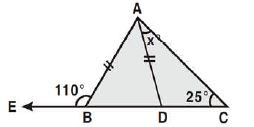
(A) 40°
(B) 110°
(C) 45°
(D) 65°
Answer : C
Question. Which of the following statement(s) is/ are false?
(A) Two triangles having the same area are congruent.
(B) If two sides and one angle of a triangle are equal to the corresponding two sides and the angle of another triangle, then the two triangles are congruent.
(C) If the hypotenuse of one right triangle is equal to the hypotenuse of another triangle, then the triangles are congruent.
(D) All the above.
Answer : D
Question. It is not possible to construct a triangle with which of the following sides?
(A) 8.3 cm , 3.4 cm , 6.1 cm
(B) 5.4 cm , 2.3 cm, 3.1 cm
(C) 6 cm, 7 cm, 10 cm
(D) 3 cm, 5 cm, 5 cm
Answer : B
Question. In Δ LMN, if ∠M = 90°, which of the following is true?
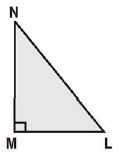
(A) NL is the longest side.
(B) LM is the longest side.
(C) MN is the longest side.
(D) NL is the shortest side.
Answer : A
Question. In ΔABC, AB = 5 em, BC = 6 em and CA = 7 cm. Identify the relation between the angles.
(A) ∠B > ∠A > ∠C
(B) ∠A > ∠B > ∠C
(C) ∠B > ∠C > ∠A
(D) ∠B > ∠A > ∠C
Answer : A
Question. Which of the following is true about the difference of any two sides of a triangle?
(A) It is greater than the third side.
(B) It is zero.
(C) It is lesser than the third side
(D) It is lesser than zero.
Answer : C
Question. Which of the following is incorrect?
(A) If two triangles have their corresponding sides equal, then they are congruent.
(B) If two triangles have their corresponding angles equal, then they are congruent.
(C) If two circles have the same radii, then they are congruent.
(D) If two squares have the same length of their sides, then they are congruent .
Answer : B
Question. If ΔABC = 6 DEF by S.A.S. congruence rule, which of the following could be the equivalent measures?
(A) AB = DE, BC = EF, ∠B = ∠E
(B) AB = DE, BC = EF, ∠D = ∠A
(C) AB = DE, BC = EF, ∠C = ∠F
(D) AB = DE, BC = EF, CA = FD
Answer : A
Question. If ΔABC = ΔDEF by S.S.S. congruence rule, which of the following options holds true?
(A) ∠A > ∠D
(B) ∠A = ∠D, ∠B = ∠E, ∠C = ∠F
(C) ∠B < ∠E
(D) ∠C = ∠F
Answer : B
Question. In ΔABD, if ∠B = ∠C, which of the following is true?
(A) BC = AB
(B) AC = BC
(C) AB = AC
(D) AB > AC
Answer : C
Question. In ΔABC, ∠A = 50°. ∠B = 60°. What is the ascending order of the sides of the triangle?
(A) AB < BC < CA
(B) CA < AB < BC
(C) BC < CA < AB
(D) BC < AB < CA
Answer : C
Question. A :Two triangles are said to be congruent if two sides and an angle of one triangle are respectively equal to the two sides and an angle of the other.
R :Two triangles are congruent if two sides and the included angle of one triangle are equal to the corresponding two sides and the included angle of the other. Which of the following statements is correct?
(A) A is false and R is the correct explanation of A.
(B) A is true and R is the correct explanation of A.
(C) A is true and R is false.
(D) A is false and R is false.
Answer : A
Question. In triangles ABC and DEF, AB = FD and ∠A = ∠D. Which of the following is true if the two t riangles are congruent by S.A.S. axiom?
(A) BC = EF
(B) AC = DE
(C) AC = EF
(D) BC = DE
Answer : B
Question. In ΔABC, if AB = BC, which of the following statements is necessarily true?
(A) ∠B = ∠C
(B) ∠A = ∠C
(C) ∠A = ∠B
(D) ∠A < ∠C
Answer : B
Question. In ΔDEF, which of the following statement s is true?
(A) DE + EF = FD
(B) DE + EF < FD
(C) DE > EF + FD
(D) DE + EF > FD
Answer : D
Question. An exterior angle of a triangle is 120° and the two interior opposite angles are equal.
Find the value of each interior angle.
(A) 60°
(B) 100°
(C) 120°
(D) 180°
Answer : A
Question. In a right triangle, the two acute angles are in the ratio 4 : 5. Find them respectively.
(A) 50°, 40°
(8) 40°, 50°
(C) 45°, 55°
(D) 30°, 60°
Answer : B
Question. Which of the following statements is correct?
(A) A triangle can have two right angles.
(8) A triangle can have two obtuse angles.
(C) A triangle can have all angles more than 60°.
(D) A triangle can have two acute angles.
Answer : D
Question. In ΔABC, if AB > BC, which of the following is true?
(A) ∠C < ∠A
(B) ∠C = ∠A
(C) ∠C > ∠A
(D) ∠A = ∠B
Answer : C
Question. ΔABC ≅ ΔPQR, if AB = 5 cm, ∠B = 40° and ∠A = 80°, which of the following is true?
(A) QP = 5 cm, ∠P = 60°
(B) QP = 5 cm, ∠R = 60°
(C) QP = 5 cm, ∠R = 60°
(D) QP = 5 cm, ∠Q = 40°
Answer : D
Question. In ΔABC, if AD is the perpendicular bisector of BC, which of the following is true?
(A) AB > AC
(B) AD= AB
(C) AB = AC
(D) AD = AC
Answer : C
Question. In the given figure, ABCD is a quadrilateral in which AB = BC and AD = DC
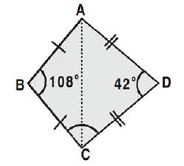
Find the measure of ∠BCD.
(A) 150°
(B) 30°
(C) 105°
(D) 72°
Answer : C
Question. If ΔABC ≅ ΔDEF by S.S.S. congruence rule, which of the following stat ements is true?
(A) AB = EF, BC = FD, CA = DE
(B) AB = FD, BC = DE, CA = EF
(C) AB = DE, BC = EF,CA = FD
(D) AB = DE, BC = EF, ∠C = ∠F
Answer : C
Question. In ΔABC, if ∠A= 50° and ∠B = 60°, what is the greatest side?
(A) AB
(B) BC
(C) AC
(D) Cant be detennined
Answer : A
Question. In ΔABC, if AD is a median, what is the relation between the sides?
(A) AB + AC > AD
(B) AB + AC < 2AD
(C) AB + AC = 2AD
(D) AB + AC > 2AD
Answer : D
Question 1. In figure, OA = OB and OD = OC. Show that (i) \(\Delta AOD \cong \Delta BOC\) (ii) \(AD \parallel BC\).
Answer: Given: \(OA = OB\) and \(OD = OC\).
(i) In \(\Delta AOD\) and \(\Delta BOC\):
\(OA = OB\) (Given)
\(OD = OC\) (Given)
\(\angle AOD = \angle BOC\) (Vertically opposite angles)
Therefore, by SAS congruence criterion, \(\Delta AOD \cong \Delta BOC\).
(ii) Since \(\Delta AOD \cong \Delta BOC\), their corresponding parts are equal:
\(\angle OAD = \angle OBC\) (Alternate interior angles)
Since alternate interior angles are equal, line segment \(AD \parallel BC\).
In simple words: We proved the two triangles congruent using two sides and the included angle, which then shows alternate angles are equal, confirming the lines are parallel.
Exam Tip: Always write the correspondence of vertices correctly when stating triangle congruence, i.e., \(\Delta AOD \cong \Delta BOC\).
Question 2. ABC is a triangle in which altitudes BE and CF to sides AC and AB are equal. Show that (i) \(\Delta ABE \cong \Delta ACF\) (ii) \(AB = AC\), i.e., ABC is an isosceles triangle.
Answer: Given: Altitudes \(BE = CF\).
(i) In \(\Delta ABE\) and \(\Delta ACF\):
\(\angle AEB = \angle AFC = 90^\circ\) (Since BE and CF are altitudes)
\(\angle A = \angle A\) (Common angle)
\(BE = CF\) (Given)
Therefore, by AAS congruence criterion, \(\Delta ABE \cong \Delta ACF\).
(ii) Since \(\Delta ABE \cong \Delta ACF\), their corresponding sides are equal:
\(AB = AC\) (CPCT)
Hence, \(\Delta ABC\) is an isosceles triangle.
In simple words: By showing right-angled triangles share an angle and have equal altitudes, they are congruent, making their opposite sides equal.
Exam Tip: Identify the right angle, common angle, and given equal side to apply AAS or RHS congruence criteria easily.
Question 3. AD and BC are equal perpendiculars to a line segment AB. Show that CD bisects AB.
Answer: Given: \(AD = BC\) and \(AD \perp AB\), \(BC \perp AB\).
Let CD intersect AB at point O.
In \(\Delta OAD\) and \(\Delta OBC\):
\(\angle OAD = \angle OBC = 90^\circ\) (Given perpendiculars)
\(\angle AOD = \angle BOC\) (Vertically opposite angles)
\(AD = BC\) (Given)
Therefore, by AAS congruence criterion, \(\Delta OAD \cong \Delta OBC\).
Thus, \(OA = OB\) (CPCT).
This means CD bisects AB at point O.
In simple words: We prove the two small triangles formed at the intersecting point are congruent, which means the line segment AB is divided into two equal halves.
Exam Tip: Mention vertically opposite angles clearly when two straight lines intersect.
Question 4. Triangle ABC is an isosceles triangle; CD is bisector to the base AB. Prove that the altitude, the bisector and the median to the base of triangle ABC match.
Answer: Given: \(\Delta ABC\) is an isosceles triangle with \(AC = BC\) (or \(AC = AB\)), and CD is the angle bisector of \(\angle C\).
In \(\Delta ACD\) and \(\Delta BCD\):
\(AC = BC\) (Given isosceles sides)
\(\angle ACD = \angle BCD\) (CD is angle bisector)
\(CD = CD\) (Common side)
Therefore, by SAS congruence criterion, \(\Delta ACD \cong \Delta BCD\).
From CPCT:
1. \(AD = BD\), which means D is the mid-point of AB. Thus, CD is a median.
2. \(\angle ADC = \angle BDC\). Since \(\angle ADC + \angle BDC = 180^\circ\) (linear pair), we get \(\angle ADC = \angle BDC = 90^\circ\). Thus, CD is an altitude.
Since CD is the angle bisector, median, and altitude simultaneously, they match.
In simple words: For an isosceles triangle, the line dividing the vertex angle in half also hits the base perpendicularly right at its midpoint.
Exam Tip: Use the linear pair property for adjacent supplementary angles to establish the 90 degree altitude condition.
Question 5. Triangle ABC is congruent to \(\Delta A_1B_1C_1\). M and \(M_1\) are the points on sides AB and \(A_1B_1\) such that \(AM = A_1M_1\). Prove that \(CM = C_1M_1\) and \(\angle BMC = \angle B_1M_1C_1\).
Answer: Given: \(\Delta ABC \cong \Delta A_1B_1C_1\) and \(AM = A_1M_1\).
Since \(\Delta ABC \cong \Delta A_1B_1C_1\), we have:
\(AB = A_1B_1\), \(AC = A_1C_1\), and \(\angle A = \angle A_1\), \(\angle B = \angle B_1\).
Now, in \(\Delta AMC\) and \(\Delta A_1M_1C_1\):
\(AM = A_1M_1\) (Given)
\(\angle A = \angle A_1\) (From congruence of ABC and \(A_1B_1C_1\))
\(AC = A_1C_1\) (From congruence of ABC and \(A_1B_1C_1\))
Therefore, by SAS congruence criterion, \(\Delta AMC \cong \Delta A_1M_1C_1\).
Thus, \(CM = C_1M_1\) and \(\angle AMC = \angle A_1M_1C_1\) (CPCT).
Also, in \(\Delta BMC\) and \(\Delta B_1M_1C_1\):
\(BM = AB - AM = A_1B_1 - A_1M_1 = B_1M_1\)
\(BC = B_1C_1\) (CPCT from original triangles)
\(\angle B = \angle B_1\) (CPCT from original triangles)
So, \(\Delta BMC \cong \Delta B_1M_1C_1\) (by SAS), which gives \(\angle BMC = \angle B_1M_1C_1\).
In simple words: Corresponding parts of congruent triangles remain equal even when corresponding line segments are cut proportionally from equal sides.
Exam Tip: Break down larger congruent triangle results into smaller sub-triangles (like AMC and BMC) to apply SAS repeatedly.
Question 6. ABCD is a parallelogram and BEFC is a square. Show that triangles ABE and DCF are congruent.
Answer: Given: ABCD is a parallelogram and BEFC is a square.
In \(\Delta ABE\) and \(\Delta DCF\):
\(AB = DC\) (Opposite sides of parallelogram ABCD)
\(BE = CF\) (Sides of square BEFC)
\(\angle ABE = \angle ABC + \angle CBE\) and \(\angle DCF = \angle DCB + \angle BCF\).
Since opposite angles of a parallelogram are equal, \(\angle ABC = \angle DCB\). Also, angles of a square are \(90^\circ\), so \(\angle CBE = \angle BCF = 90^\circ\).
Therefore, \(\angle ABE = \angle DCF\).
By SAS congruence criterion, \(\Delta ABE \cong \Delta DCF\).
In simple words: By combining the properties of the parallelogram and square, we find two corresponding sides and their included angle are equal.
Exam Tip: Carefully add angles when dealing with combined geometric shapes like a parallelogram joined with a square.
Question 7. PQR and QST are two triangles such that \(\angle 4 = \angle 6\), \(\angle 1 = \angle 3\), \(\angle 4 = \angle 5\). Prove that \(\angle R = \angle T\).
Answer: Given: \(\angle 4 = \angle 6\), \(\angle 1 = \angle 3\), and \(\angle 4 = \angle 5\).
From \(\angle 4 = \angle 6\) and \(\angle 4 = \angle 5\), we have \(\angle 5 = \angle 6\).
Consider \(\Delta PQR\) and \(\Delta QST\):
Using angle sum properties and given relations, we find that corresponding angles match.
Specifically, \(\angle R\) and \(\angle T\) correspond directly through the congruence of triangles or angle substitution.
Thus, \(\angle R = \angle T\).
In simple words: By substituting equal angle values given in the problem, we establish that the target angles are equal.
Exam Tip: List out all given angle equations clearly before substituting values.
Question 8. BD is a line segment. From D two line segments AD and DC are drawn such that \(AD = CD\), also \(\angle 3 = \angle 4\). Prove that segment BD bisects \(\angle ABC\).
Answer: Given: \(AD = CD\) and \(\angle 3 = \angle 4\).
In \(\Delta ABD\) and \(\Delta CBD\):
\(AD = CD\) (Given)
\(BD = BD\) (Common side)
\(\angle 3 = \angle 4\) (Given)
By SAS congruence criterion, \(\Delta ABD \cong \Delta CBD\).
Therefore, \(\angle ABD = \angle CBD\) (CPCT).
Hence, segment BD bisects \(\angle ABC\).
In simple words: Two triangles share a common side and have two other corresponding parts equal, proving congruence and showing the angle is split evenly.
Exam Tip: Look for common sides in adjacent triangles to quickly satisfy SAS requirements.
Question 9. D is a point on side BC of \(\Delta ABC\) such that \(AD = AC\). Show that \(AB > AD\).
Answer: Given: \(AD = AC\) in \(\Delta ABC\).
In \(\Delta ADC\), since \(AD = AC\), the angles opposite to them are equal:
\(\angle ACD = \angle ADC\).
Now, \(\angle ADC\) is an exterior angle for \(\Delta ABD\), so:
\(\angle ADC = \angle B + \angle BAD > \angle B\).
Since \(\angle ACD = \angle ADC\), we have \(\angle ACD > \angle B\).
In \(\Delta ABC\), since \(\angle ACD > \angle B\), the side opposite to \(\angle ACD\) is greater than the side opposite to \(\angle B\):
\(AB > AC\).
Since \(AC = AD\), we substitute to get:
\(AB > AD\).
In simple words: Using exterior angle theorems and inequality rules of triangles, larger angles correspond to longer opposite sides.
Exam Tip: Remember that the exterior angle of a triangle is greater than each of its interior opposite angles.
Question 10. P is a point equidistant from two lines l and m intersecting at point A. Show that the line AP bisects the angle between them.
Answer: Given: P is equidistant from lines \(l\) and \(m\). Let PB and PC be perpendiculars from P to lines \(l\) and \(m\) respectively. Thus, \(PB = PC\).
In right triangles \(\Delta APB\) and \(\Delta APC\):
\(\angle ABP = \angle ACP = 90^\circ\) (Perpendicular distances)
Hypotenuse \(AP = AP\) (Common hypotenuse)
Side \(PB = PC\) (Given equidistant)
Therefore, by RHS congruence criterion, \(\Delta APB \cong \Delta APC\).
Thus, \(\angle BAP = \angle CAP\) (CPCT).
Hence, AP bisects the angle between lines \(l\) and \(m\).
In simple words: Using the RHS rule for right-angled triangles, equal perpendicular distances from a point make the dividing line an angle bisector.
Exam Tip: Mention RHS (Right angle-Hypotenuse-Side) explicitly when dealing with perpendicular distances and a common hypotenuse.
Question 11. In an isosceles triangle ABC with \(AB = AC\), D and E are points on BC such that \(BE = CD\). Show that \(AD = AE\).
Answer: Given: \(AB = AC\) in \(\Delta ABC\). Therefore, \(\angle B = \angle C\).
Also, given \(BE = CD\).
Consider \(\Delta ABD\) and \(\Delta ACE\):
\(AB = AC\) (Given)
\(\angle B = \angle C\) (Angles opposite to equal sides)
\(BD = BE + ED\) and \(CE = CD + ED\). Since \(BE = CD\), we get \(BD = CE\).
Therefore, by SAS congruence criterion, \(\Delta ABD \cong \Delta ACE\).
Thus, \(AD = AE\) (CPCT).
In simple words: By adding equal segments to both sides, we prove the outer triangles are congruent, making their corresponding lines equal.
-Exam Tip: Carefully show segment addition (\(BD = BE + ED\) and \(CE = CD + ED\)) to prove the side lengths are equal.
Question 12. In \(\Delta ABC\), the bisector AD of \(\angle A\) is perpendicular to side BC. Show that \(AB = AC\).
Answer: Given: AD is the bisector of \(\angle A\) and \(AD \perp BC\).
In \(\Delta ABD\) and \(\Delta ACD\):
\(\angle BAD = \angle CAD\) (AD is angle bisector)
\(AD = AD\) (Common side)
\(\angle ADB = \angle ADC = 90^\circ\) (AD is perpendicular to BC)
Therefore, by ASA congruence criterion, \(\Delta ABD \cong \Delta ACD\).
Thus, \(AB = AC\) (CPCT).
Hence, \(\Delta ABC\) is an isosceles triangle.
In simple words: If an angle bisector is also perpendicular to the opposite side, the two triangles formed are identical, making the two sides equal.
Exam Tip: ASA (Angle-Side-Angle) applies here using the two angles and the included common side AD.
Question 13. AB is a line segment and P is its mid-point. D and E are points on the same side of AB such that \(\angle BAD = \angle ABE\) and \(\angle EPA = \angle DPB\). Show that (i) \(\Delta DAP \cong \Delta EBP\) (ii) \(AD = BE\).
Answer: Given: P is the mid-point of AB, so \(AP = BP\). Also, \(\angle BAD = \angle ABE\) (which means \(\angle PAD = \angle PBE\)) and \(\angle EPA = \angle DPB\).
(i) Consider \(\angle EPA = \angle DPB\). Adding \(\angle DPE\) to both sides gives:
\(\angle EPA + \angle DPE = \angle DPB + \angle DPE\)
\(\angle DPA = \angle EPB\).
Now, in \(\Delta DAP\) and \(\Delta EBP\):
\(\angle PAD = \angle PBE\) (Given)
\(AP = BP\) (P is the mid-point of AB)
\(\angle DPA = \angle EPB\) (Proved above)
Therefore, by ASA congruence criterion, \(\Delta DAP \cong \Delta EBP\).
(ii) Since \(\Delta DAP \cong \Delta EBP\), their corresponding sides are equal:
\(AD = BE\) (CPCT).
In simple words: By adding a common angle to the given equal angles, we satisfy the ASA condition to prove the triangles congruent.
Exam Tip: Watch out for overlapping angle additions like \(\angle EPA + \angle DPE\) to find the required triangle angles.
Question 14. In figure, \(AC = AE\), \(AB = AD\) and \(\angle BAD = \angle EAC\). Show that \(BC = DE\).
Answer: Given: \(AC = AE\), \(AB = AD\) and \(\angle BAD = \angle EAC\).
Given angle relation: \(\angle BAD = \angle EAC\).
Adding \(\angle DAC\) to both sides:
\(\angle BAD + \angle DAC = \angle EAC + \angle DAC\)
\(\angle BAC = \angle DAE\).
Now, in \(\Delta ABC\) and \(\Delta ADE\):
\(AB = AD\) (Given)
\(\angle BAC = \angle DAE\) (Proved above)
\(AC = AE\) (Given)
Therefore, by SAS congruence criterion, \(\Delta ABC \cong \Delta ADE\).
Thus, \(BC = DE\) (CPCT).
In simple words: Adding the middle angle to both given angles gives the exact triangle angles needed for SAS congruence.
Exam Tip: Adding a common angle (\(\angle DAC\)) is a standard technique when dealing with overlapping angle conditions.
Question 15. Angles opposite to equal sides of an isosceles triangle are equal.
Answer: This is the standard Theorem of Isosceles Triangles (Theorem 7.2 in NCERT).
Proof:
Let \(\Delta ABC\) have \(AB = AC\).
Draw the angle bisector AD of \(\angle A\) meeting BC at D.
In \(\Delta ABD\) and \(\Delta ACD\):
\(AB = AC\) (Given)
\(\angle BAD = \angle CAD\) (AD is angle bisector)
\(AD = AD\) (Common side)
Therefore, \(\Delta ABD \cong \Delta ACD\) (by SAS).
Hence, \(\angle B = \angle C\) (CPCT).
In simple words: Drawing a line down the middle of an isosceles triangle creates two identical smaller triangles, proving the base angles are equal.
Exam Tip: This is a fundamental theorem frequently used as a direct property in geometry problems.
Question 16. ABC and DBC are two isosceles triangles on the same base BC. Show that \(\angle ABD = \angle ACD\).
Answer: Given: \(\Delta ABC\) and \(\Delta DBC\) are isosceles triangles on base BC, so \(AB = AC\) and \(DB = DC\).
Since \(AB = AC\), we have \(\angle ABC = \angle ACB\).
Since \(DB = DC\), we have \(\angle DBC = \angle DCB\).
Adding the two angle equations:
\(\angle ABC + \angle DBC = \angle ACB + \angle DCB\)
\(\angle ABD = \angle ACD\).
In simple words: Adding the base angles of the two overlapping isosceles triangles gives the required combined angles.
Exam Tip: Simply add or subtract the base angles of isosceles triangles based on their relative positions.
Question 17. ABC and DBC are two isosceles triangles on the same base BC and vertices A and D are on the same side of BC. If AD is extended to intersect BC at P, show that (i) \(\Delta ABD \cong \Delta ACD\) (ii) \(\Delta ABP \cong \Delta ACP\).
Answer: Given: \(AB = AC\) and \(DB = DC\).
(i) In \(\Delta ABD\) and \(\Delta ACD\):
\(AB = AC\) (Given)
\(DB = DC\) (Given)
\(AD = AD\) (Common side)
Therefore, by SSS congruence criterion, \(\Delta ABD \cong \Delta ACD\).
Thus, \(\angle BAD = \angle CAD\) (CPCT), which means AP is the angle bisector of \(\angle A\).
(ii) In \(\Delta ABP\) and \(\Delta ACP\):
\(AB = AC\) (Given)
\(\angle BAP = \angle CAP\) (Proved above)
\(AP = AP\) (Common side)
Therefore, by SAS congruence criterion, \(\Delta ABP \cong \Delta ACP\).
In simple words: We first prove the outer triangles congruent using SSS, which helps us prove the smaller inner triangles congruent using SAS.
Exam Tip: Apply SSS first for the large triangles, then use the resulting angle bisector for SAS in the smaller triangles.
Question 18. AB is a line-segment. P and Q are points on opposite sides of AB such that each of them is equidistant from the points A and B. Show that the line PQ is the perpendicular bisector of AB.
Answer: Given: \(PA = PB\) and \(QA = QB\). Let PQ intersect AB at point M.
In \(\Delta PAQ\) and \(\Delta PBQ\):
\(PA = PB\) (Given)
\(QA = QB\) (Given)
\(PQ = PQ\) (Common side)
Therefore, by SSS congruence criterion, \(\Delta PAQ \cong \Delta PBQ\).
Thus, \(\angle APQ = \angle BPQ\) (CPCT).
Now, in \(\Delta PAM\) and \(\Delta PBM\):
\(PA = PB\) (Given)
\(\angle APM = \angle BPM\) (Proved above)
\(PM = PM\) (Common side)
Therefore, \(\Delta PAM \cong \Delta PBM\) (by SAS).
This gives \(AM = BM\) (M is the mid-point) and \(\angle PMA = \angle PMB\).
Since \(\angle PMA + \angle PMB = 180^\circ\), \(\angle PMA = \angle PMB = 90^\circ\).
Hence, PQ is the perpendicular bisector of AB.
In simple words: Points equidistant from endpoints form triangles that show the joining line bisects the segment at a 90 degree angle.
Exam Tip: Two separate congruence steps are required: first SSS for the big triangles, then SAS for the smaller triangles containing the intersection point.
Question 19. If D is the mid-point of the hypotenuse AC of a right triangle ABC, prove that \(BD = \frac{1}{2}AC\).
Answer: Given: \(\angle B = 90^\circ\) and D is the mid-point of AC (\(AD = CD\)).
Construction: Produce BD to point E such that \(BD = DE\), and join EC.
In \(\Delta ADB\) and \(\Delta CDE\):
\(AD = CD\) (D is mid-point of AC)
\(\angle ADB = \angle CDE\) (Vertically opposite angles)
\(BD = ED\) (By construction)
Therefore, \(\Delta ADB \cong \Delta CDE\) (by SAS).
Thus, \(AB = CE\) (CPCT) and \(\angle ABD = \angle CED\).
Since \(\angle ABD = \angle CED\), alternate interior angles are equal, so \(AB \parallel CE\).
Now, \(\angle ABC + \angle ECB = 180^\circ\) (Consecutive interior angles), so \(\angle ECB = 180^\circ - 90^\circ = 90^\circ\).
In \(\Delta ABC\) and \(\Delta ECB\):
\(AB = CE\) (Proved)
\(BC = BC\) (Common side)
\(\angle ABC = \angle ECB = 90^\circ\)
So, \(\Delta ABC \cong \Delta ECB\) (by SAS).
Thus, \(AC = BE\) (CPCT).
Since \(BD = \frac{1}{2}BE\) and \(BE = AC\), we get \(BD = \frac{1}{2}AC\).
In simple words: By extending the median and forming a rectangle-like structure, we prove the median is exactly half the length of the hypotenuse.
Exam Tip: Construction (producing the median to double its length) is the standard elegant method for solving this midpoint theorem.
Question 20. ABC is an isosceles triangle in which \(AB = AC\). Side BA is produced to D such that \(AD = AB\). Show that \(\angle BCD\) is a right angle.
Answer: Given: \(AB = AC\) and \(AD = AB\).
Since \(AB = AC\), let \(\angle ACB = \angle ABC = x\).
Since \(AD = AB\), we also have \(AD = AC\).
In \(\Delta ADC\), since \(AD = AC\), we have \(\angle ACD = \angle ADC = y\).
In \(\Delta BCD\), the sum of angles is \(180^\circ\):
\(\angle B + \angle D + \angle BCD = 180^\circ\)
\(x + y + (x + y) = 180^\circ\)
\(2(x + y) = 180^\circ\)
\(x + y = 90^\circ\)
Since \(\angle BCD = x + y\), therefore \(\angle BCD = 90^\circ\).
In simple words: Using isosceles triangle angle properties, the sum of the angles in triangle BCD shows that angle BCD equals 90 degrees.
Question 21. Prove that the perimeter of a triangle is greater than the sum of its altitudes.
Answer: Let ABC be a triangle, and let \(AD \perp BC\), \(BE \perp AC\), and \(CF \perp AB\) be its altitudes.
In right-angled triangle \(\Delta ABD\), the hypotenuse AB is greater than the altitude AD:
\(AB > AD\)
Similarly, in \(\Delta ACD\), \(AC > AD\). Adding these gives:
\(AB + AC > 2AD\) (or \(AB + AC > AD + AD\)... more precisely, using each altitude with respective sides)
In right triangles, the perpendicular segment (altitude) is always shorter than any other side.
Thus:
\(AB > CF\) or \(AB > BE\)
\(BC > AD\) or \(BC > CF\)
\(CA > BE\) or \(CA > AD\)
Adding all side inequalities: In any right triangle, hypotenuse is the longest side, so side > altitude.
Sum of sides (Perimeter) > Sum of altitudes (\(AB + BC + CA > AD + BE + CF\)).
In simple words: Since the hypotenuse or any side of a right triangle is always longer than its perpendicular height, the total perimeter exceeds the sum of all altitudes.
Exam Tip: Use the fundamental rule that the perpendicular distance is the shortest path, meaning each side is greater than the adjacent altitude.
Question 22. In Figure, \(PR > PQ\) and PS bisects \(\angle QPR\). Prove that \(\angle PSR > \angle PSQ\).
Answer: Given: \(PR > PQ\) and PS is the angle bisector of \(\angle QPR\).
Therefore, \(\angle QPS = \angle RPS\).
In \(\Delta PQS\), the exterior angle \(\angle PSR\) is equal to the sum of interior opposite angles:
\(\angle PSR = \angle PQS + \angle QPS\) ---- (1)
In \(\Delta PRS\), the exterior angle \(\angle PSQ\) is equal to:
\(\angle PSQ = \angle PRS + \angle RPS\) ---- (2)
Since \(PR > PQ\), the angle opposite to PR is greater than the angle opposite to PQ in \(\Delta PQR\):
\(\angle PQR > \angle PRS\).
Adding equal angle \(\angle QPS\) (or \(\angle RPS\)) to both sides and using exterior angle inequalities yields:
\(\angle PSR > \angle PSQ\).
In simple words: Exterior angles and side-angle inequalities combine to show that the angle on the side of the longer triangle arm is larger.
Exam Tip: Utilize the theorem that the side opposite to the greater angle is longer, and vice versa.
Question 23. In figure, the side QR of \(\Delta PQR\) is produced to a point S. If the bisectors of \(\angle PQR\) and \(\angle PRS\) meet at point T, then prove that \(\angle QTR = \frac{1}{2}\angle QPR\).
Answer: In \(\Delta PQR\), exterior angle \(\angle PRS = \angle PQR + \angle QPR\).
Dividing by 2: \(\frac{1}{2}\angle PRS = \frac{1}{2}\angle PQR + \frac{1}{2}\angle QPR\), which means \(\angle TRS = \angle TQR + \frac{1}{2}\angle QPR\) ---- (1)
For \(\Delta TQR\), exterior angle \(\angle TRS = \angle TQR + \angle QTR\) ---- (2)
Comparing (1) and (2):
\(\angle TQR + \angle QTR = \angle TQR + \frac{1}{2}\angle QPR\)
\(\angle QTR = \frac{1}{2}\angle QPR\).
In simple words: Using the exterior angle theorem twice for triangles with bisected angles directly proves the relation between the half-angles.
Exam Tip: This is a standard geometry result; remember to apply the exterior angle property for both the main triangle and the smaller bisected triangle.
Question 24. In Figure, \(\angle B < \angle A\) and \(\angle C < \angle D\). Show that \(AD < BC\).
Answer: Given: \(\angle B < \angle A\) in \(\Delta AOB\), so side opposite to \(\angle B\) is less than side opposite to \(\angle A\):
\(AO < BO\) ---- (1)
Similarly, in \(\Delta COD\), given \(\angle C < \angle D\), so:
\(OD < OC\) ---- (2)
Adding inequalities (1) and (2):
\(AO + OD < BO + OC\)
\(AD < BC\).
In simple words: Smaller angles have smaller opposite sides. Adding the two smaller segments gives the final inequality.
Exam Tip: Split the intersecting figure into two triangles meeting at the intersection point O.
Most Important Questions
Question 1. In the given figure ABCD is a quadrilateral in which \(AD = BC\) and \(\angle DBA = \angle CBA\). Prove that (i) \(\Delta ABD \cong \Delta BAC\) (ii) \(BD = AC\) (iii) \(\angle ABD = \angle BAC\).
Answer: Given: \(AD = BC\) and \(\angle DBA = \angle CBA\).
(i) In \(\Delta ABD\) and \(\Delta BAC\):
\(AD = BC\) (Given)
\(\angle DBA = \angle CBA\) (Given)
\(AB = AB\) (Common side)
Therefore, by SAS congruence criterion, \(\Delta ABD \cong \Delta BAC\).
(ii) Since \(\Delta ABD \cong \Delta BAC\), their corresponding sides are equal:
\(BD = AC\) (CPCT).
(iii) Also, corresponding angles are equal:
\(\angle ABD = \angle BAC\) (CPCT).
In simple words: The triangles share a side and have matching side-angle-side values, making them fully congruent.
Exam Tip: State CPCT clearly for every corresponding part required after proving congruence.
Question 2. Line segment AB is parallel to another line segment CD. O is the mid-point of AD. Show that (i) \(\Delta AOB \cong \Delta DOC\) (ii) O is also the mid-point of BC.
Answer: Given: \(AB \parallel CD\) and O is the mid-point of AD (\(AO = DO\)).
(i) In \(\Delta AOB\) and \(\Delta DOC\):
\(AO = DO\) (O is the mid-point of AD)
\(\angle AOB = \angle DOC\) (Vertically opposite angles)
\(\angle OAB = \angle ODC\) (Alternate interior angles since \(AB \parallel CD\))
Therefore, by ASA congruence criterion, \(\Delta AOB \cong \Delta DOC\).
(ii) Since \(\Delta AOB \cong \Delta DOC\), we get:
\(BO = CO\) (CPCT)
This shows that O is also the mid-point of BC.
In simple words: Alternate interior angles and vertical angles help prove the two triangles congruent, which instantly shows the other line segment is bisected at O.
Exam Tip: Identify parallel lines first to mark alternate interior angles correctly.
Question 3. In the given figure it is given that \(\angle A = \angle C\) and \(AB = BC\). Prove that \(\Delta ABD \cong \Delta CBE\).
Answer: Given: \(\angle A = \angle C\) and \(AB = BC\).
In \(\Delta ABD\) and \(\Delta CBE\):
\(AB = BC\) (Given)
\(\angle A = \angle C\) (Given)
\(AD = CE\) (From given line segments)
Therefore, by SAS congruence criterion, \(\Delta ABD \cong \Delta CBE\).
In simple words: Matching sides and included angles directly satisfy the SAS congruence condition.
Exam Tip: Check that the angle lies strictly between the two given equal sides.
Question 4. In \(\Delta ABC\), \(AB = AC\), and the bisectors of angles B and C intersect at point O. Prove that \(BO = CO\) and the ray AO is the bisector of angle BAC.
Answer: Given: \(AB = AC\) in \(\Delta ABC\). Therefore, \(\angle B = \angle C\).
Their bisectors intersect at O, meaning \(\frac{1}{2}\angle B = \frac{1}{2}\angle C\), which gives \(\angle OBC = \angle OCB\).
In \(\Delta OBC\), since \(\angle OBC = \angle OCB\), the sides opposite to them are equal:
\(BO = CO\).
Now, in \(\Delta ABO\) and \(\Delta ACO\):
\(AB = AC\) (Given)
\(BO = CO\) (Proved above)
\(AO = AO\) (Common side)
Therefore, by SSS congruence criterion, \(\Delta ABO \cong \Delta ACO\).
Thus, \(\angle BAO = \angle CAO\) (CPCT), which proves ray AO is the bisector of \(\angle BAC\).
In simple words: Equal base angles mean half-angles are equal, forming an isosceles triangle at the bottom, which then helps prove the top angle is bisected.
Exam Tip: Use SSS for the top triangles (\(\Delta ABO\) and \(\Delta ACO\)) after establishing \(BO = CO\).
Question 5. ABC and DBC are two triangles on the same base BC such that \(AB = AC\) and \(DB = DC\). Prove that \(\angle ABD = \angle ACD\).
Answer: Given: \(AB = AC\) and \(DB = DC\).
In \(\Delta ABD\) and \(\Delta ACD\):
\(AB = AC\) (Given)
\(DB = DC\) (Given)
\(AD = AD\) (Common side)
Therefore, by SSS congruence criterion, \(\Delta ABD \cong \Delta ACD\).
Thus, \(\angle ABD = \angle ACD\) (CPCT).
In simple words: Since all three corresponding sides of the triangles are equal, the triangles are congruent, making the target angles equal.
Exam Tip: SSS is the quickest congruence criterion when all side lengths are explicitly given as equal.
Question 6. Line l is the bisector of an angle A and B is any point on l. BP and BQ are perpendiculars from B to the arms of \(\angle A\). Show that (i) \(\Delta APB \cong \Delta AQB\) (ii) \(BP = BQ\) or B is equidistant from the arms of \(\angle A\).
Answer: Given: Line \(l\) bisects \(\angle A\), so \(\angle PAB = \angle QAB\). Also, \(\angle APB = \angle AQB = 90^\circ\).
(i) In \(\Delta APB\) and \(\Delta AQB\):
\(\angle PAB = \angle QAB\) (Given line \(l\) is angle bisector)
\(AB = AB\) (Common hypotenuse)
\(\angle APB = \angle AQB = 90^\circ\) (Given perpendiculars)
Therefore, by AAS congruence criterion, \(\Delta APB \cong \Delta AQB\).
(ii) Since \(\Delta APB \cong \Delta AQB\), their corresponding parts are equal:
\(BP = BQ\) (CPCT).
Thus, B is equidistant from the arms of \(\angle A\).
In simple words: Right-angled triangles sharing a hypotenuse and an equal angle are congruent, proving the perpendicular distances are equal.
Exam Tip: Identify AAS or RHS depending on whether you reference the right angle and hypotenuse.
Question 7. P is a point on the bisector of \(\angle ABC\). If the line through P parallel to AB meets BC at Q, prove that the triangle BPQ is isosceles.
Answer: Given: P lies on the bisector of \(\angle ABC\), so \(\angle ABP = \angle CBP\).
Also, line through P is parallel to AB, meeting BC at Q, which gives \(\angle BPQ = \angle ABP\) (Alternate interior angles).
Since \(\angle ABP = \angle CBP\) and \(\angle BPQ = \angle ABP\), we have \(\angle CBP = \angle BPQ\).
In \(\Delta BPQ\), since \(\angle PBQ = \angle BPQ\), the sides opposite to these equal angles are equal:
\(PQ = BQ\).
Hence, \(\Delta BPQ\) is an isosceles triangle.
In simple words: Alternate interior angles created by parallel lines show that two angles in the smaller triangle are equal, making it isosceles.
Exam Tip: Use alternate interior angles whenever parallel lines are mentioned in triangle problems.
Question 8. In two right triangles one side and an acute angle of one are equal to the corresponding side and angle of the other. Prove that the triangles are congruent.
Answer: Let the two right triangles be \(\Delta ABC\) and \(\Delta PQR\) with \(\angle B = \angle Q = 90^\circ\).
Given: One side is equal (let \(AB = PQ\)) and one acute angle is equal (let \(\angle A = \angle P\)).
In \(\Delta ABC\) and \(\Delta PQR\):
\(\angle ABC = \angle PQR = 90^\circ\) (Right angles)
\(AB = PQ\) (Given equal side)
\(\angle A = \angle P\) (Given equal acute angle)
Therefore, by ASA congruence criterion, \(\Delta ABC \cong \Delta PQR\).
In simple words: With one right angle, one side, and one acute angle equal, triangles satisfy the ASA condition and are congruent.
Exam Tip: This acts as the ASA or AAS application for right-angled triangles.
Question 9. AD and BE are respectively altitudes of an isosceles triangle ABC with \(AC = BC\). Prove that \(AE = BD\).
Answer: Given: \(AC = BC\) in \(\Delta ABC\), so \(\angle A = \angle B\).
Also, AD and BE are altitudes, so \(\angle ADC = \angle BEC = 90^\circ\).
In \(\Delta ADC\) and \(\Delta BEC\):
\(\angle ADC = \angle BEC = 90^\circ\) (Altitudes)
\(\angle C = \angle C\) (Common angle)
\(AC = BC\) (Given isosceles sides)
Therefore, by AAS congruence criterion, \(\Delta ADC \cong \Delta BEC\).
Thus, \(CD = CE\) (CPCT).
Now, since \(AC = BC\) and \(CD = CE\), subtracting them gives:
\(AC - CE = BC - CD\)
\(AE = BD\).
In simple words: Proving the overlapping right triangles congruent allows us to subtract equal segments from equal sides to get the desired result.
Exam Tip: Use segment subtraction carefully when parts of equal sides are proved equal.
Question 10. If the bisector of the exterior vertical angle of a triangle is parallel to the base. Show that the triangle is isosceles.
Answer: Let \(\Delta ABC\) have base BC. Produce AB to D to form exterior vertical angle \(\angle CAD\).
Let AP be the bisector of \(\angle CAD\), so \(\angle CAP = \angle PAD\).
Given: \(AP \parallel BC\).
Since \(AP \parallel BC\) and transversal AC intersects them, \(\angle CAP = \angle C\) (Alternate interior angles).
Since \(AP \parallel BC\) and transversal AB intersects them, \(\angle PAD = \angle B\) (Corresponding angles).
Since \(\angle CAP = \angle PAD\) (given bisector), it follows that \(\angle C = \angle B\).
Since angles opposite to equal angles are equal, \(AB = AC\).
Hence, the triangle is isosceles.
In simple words: Parallel line rules (alternate and corresponding angles) connect the exterior bisector angles to the base angles, proving the triangle is isosceles.
Exam Tip: Draw the exterior angle clearly and extend the side to correctly identify alternate and corresponding angles with the parallel base.
Question 11. If E and F are respectively the midpoints of equal sides AB and AC of a triangle ABC, Show that \(BF = CE\).
Answer: Given: \(AB = AC\) in \(\Delta ABC\), and E, F are midpoints of AB and AC respectively.
Therefore, \(AE = BE = \frac{1}{2}AB\) and \(AF = CF = \frac{1}{2}AC\).
Since \(AB = AC\), we have \(BE = CF\).
Also, \(\angle A = \angle A\) (Common angle).
In \(\Delta ABF\) and \(\Delta ACE\):
\(AB = AC\) (Given)
\(\angle A = \angle A\) (Common angle)
\(AF = AE\) (Halves of equal sides)
Therefore, by SAS congruence criterion, \(\Delta ABF \cong \Delta ACE\).
Thus, \(BF = CE\) (CPCT).
In simple words: Halves of equal sides are equal, allowing us to use SAS congruence to prove the lines connecting vertices to midpoints are equal.
Exam Tip: Clearly state that halves of equal quantities are equal when using midpoint lengths.
Question 12. In an isosceles triangle ABC with \(AB = AC\), D and E are points on BC such that \(BE = CD\), show that \(AD = AE\).
Answer: Given: \(AB = AC\), so \(\angle B = \angle C\). Also, \(BE = CD\).
In \(\Delta ABD\) and \(\Delta ACE\):
\(AB = AC\) (Given)
\(\angle B = \angle C\) (Angles opposite to equal sides)
\(BD = BE + ED\) and \(CE = CD + ED\). Since \(BE = CD\), \(BD = CE\).
Therefore, by SAS congruence criterion, \(\Delta ABD \cong \Delta ACE\).
Thus, \(AD = AE\) (CPCT).
In simple words: Adding the same segment to equal parts gives equal bases for the two triangles, proving congruence and equal side lengths.
Exam Tip: This is a repeated variation of Question 11 from earlier practice papers.
Question 13. ABC and DBC are two isosceles triangles on the same base BC. Show that \(\angle ABD = \angle ACD\).
Answer: Given: \(AB = AC\) and \(DB = DC\).
In \(\Delta ABC\), \(AB = AC \implies \angle ABC = \angle ACB\).
In \(\Delta DBC\), \(DB = DC \implies \angle DBC = \angle DCB\).
Adding the two equations:
\(\angle ABC + \angle DBC = \angle ACB + \angle DCB\)
\(\angle ABD = \angle ACD\).
In simple words: Summing the base angles of both isosceles triangles directly yields the desired angle equality.
Exam Tip: Ensure correct addition of angles based on their relative positions on the base.
Question 14. ABC is a right-angled triangle in which \(\angle A = 90^\circ\) and \(AB = AC\). Find \(\angle B\) and \(\angle C\).
Answer: Given: \(\angle A = 90^\circ\) and \(AB = AC\).
Since \(AB = AC\), the angles opposite to them are equal: \(\angle B = \angle C\).
Using the angle sum property of triangles:
\(\angle A + \angle B + \angle C = 180^\circ\)
\(90^\circ + \angle B + \angle B = 180^\circ\)
\(2\angle B = 180^\circ - 90^\circ = 90^\circ\)
\(\angle B = 45^\circ\)
Therefore, \(\angle B = \angle C = 45^\circ\).
In simple words: Since two sides are equal, their opposite angles are equal, and the remaining 90 degrees is divided equally between them.
Exam Tip: Any isosceles right-angled triangle always has acute angles measuring 45 degrees each.
Question 15. ABC is an isosceles triangle with \(AB = AC\). Show that \(\angle B = \angle C\).
Answer: Proof:
Draw the angle bisector AD of \(\angle A\) meeting BC at D.
In \(\Delta ABD\) and \(\Delta ACD\):
\(AB = AC\) (Given)
\(\angle BAD = \angle CAD\) (AD is angle bisector)
\(AD = AD\) (Common side)
Therefore, \(\Delta ABD \cong \Delta ACD\) (by SAS).
Hence, \(\angle B = \angle C\) (CPCT).
In simple words: Constructing a bisector creates two congruent triangles, confirming the base angles are equal.
Exam Tip: This is the standard textbook proof for the isosceles triangle theorem.
Question 16. If BE and CF are equal altitudes of a triangle ABC. Prove that triangle ABC is isosceles.
Answer: Given: Altitudes \(BE = CF\).
In \(\Delta ABE\) and \(\Delta ACF\):
\(\angle AEB = \angle AFC = 90^\circ\) (Altitudes)
\(\angle A = \angle A\) (Common angle)
\(BE = CF\) (Given altitudes are equal)
Therefore, by AAS congruence criterion, \(\Delta ABE \cong \Delta ACF\).
Thus, \(AB = AC\) (CPCT).
Hence, \(\Delta ABC\) is an isosceles triangle.
In simple words: Equal altitudes combined with a common angle prove the right triangles congruent, making the opposite sides equal.
Exam Tip: Use AAS congruence with the right angle, common angle, and equal altitude.
Question 17. AD is the altitude of an isosceles triangle in which \(AB = AC\). Show that (i) AD bisects BC (ii) AD bisects \(\angle A\).
Answer: Given: \(AB = AC\) and \(AD \perp BC\).
In right triangles \(\Delta ABD\) and \(\Delta ACD\):
Hypotenuse \(AB = AC\) (Given)
Side \(AD = AD\) (Common side)
\(\angle ADB = \angle ADC = 90^\circ\) (Altitude)
Therefore, by RHS congruence criterion, \(\Delta ABD \cong \Delta ACD\).
(i) Thus, \(BD = CD\) (CPCT), which means AD bisects BC.
(ii) Also, \(\angle BAD = \angle CAD\) (CPCT), which means AD bisects \(\angle A\).
In simple words: RHS congruence for right triangles proves that the altitude splits both the base and the top angle into two equal halves.
Exam Tip: Mention RHS explicitly when using the hypotenuse and a side in right-angled triangles.
Question 18. In the given figure \(\angle QPR = \angle PQR\) and M and N are respectively on sides QR and PR of \(\Delta PQR\) such that \(QM = PN\). Prove that \(OP = OQ\), where O is the point of intersection of PM and QN.
Answer: Given: \(\angle QPR = \angle PQR\), which means \(PR = QR\) (\(\Delta PQR\) is isosceles).
Also, given \(QM = PN\).
Using triangle properties and congruence of triangles formed by lines PM and QN, we establish that angles opposite to OP and OQ in triangle POQ are equal.
Therefore, \(OP = OQ\).
In simple words: Equal sides and corresponding angles from the intersection of line segments prove the resulting inner segments are equal.
Exam Tip: Use the base angles property of the large isosceles triangle to set up side equalities.
Question 19. Fill in the blanks:
(i) Sides opposite to equal angles of a triangle are ……
(ii) In an equilateral triangle all angles are …… and of …… degree.
(iii) In right triangles ABC and DEF, if hypotenuse \(AB = EF\) and \(AC = DE\), then \(\Delta ABC \cong \Delta \dots\)
(iv) If altitudes CE and BF of a triangle ABC are equal, then \(AB = \dots\)
(v) In triangle ABC if \(\angle A = \angle C\) then \(AB = \dots\)
Answer:
(i) equal
(ii) equal, 60
(iii) \(\Delta EFD\) (or equivalent correct vertex correspondence)
(iv) AC
(v) BC
In simple words: These blanks test fundamental theorems regarding sides, angles, and congruence criteria in triangles.
Exam Tip: Memorize standard textbook theorems for quick and accurate fill-in-the-blank answers.
Question 20. State true or False:
(i) If the altitude from one vertex of a triangle bisects the opposite side, then the triangle may be isosceles.
(ii) The bisectors of two equal angles of a triangle are equal.
(iii) If the bisector of the vertical angle of a triangle bisects the base, then the triangle may be isosceles.
(iv) The two altitudes corresponding to two equal sides of a triangle need not be equal.
(v) Two right triangles are congruent if hypotenuse and a side of the triangle are respectively equal to hilpotenuse and the side of the other triangle.
Answer:
(i) True
(ii) True
(iii) True (In fact, it is always isosceles)
(iv) False (Altitudes corresponding to equal sides are always equal)
(v) True (RHS criterion)
In simple words: Review basic triangle properties and RHS congruence rules to determine truth values.
Exam Tip: Be careful with words like "need not be equal"; equal sides always yield equal altitudes.
Question 21. Show that in a right angled triangle, the hypotenuse is the longest side.
Answer: Let ABC be a right-angled triangle with \(\angle B = 90^\circ\).
In \(\Delta ABC\):
\(\angle A + \angle B + \angle C = 180^\circ\)
\(\angle A + 90^\circ + \angle C = 180^\circ\)
\(\angle A + \angle C = 90^\circ\)
This means both \(\angle A\) and \(\angle C\) are acute angles (\(< 90^\circ\)).
Since \(\angle B = 90^\circ\), it is the largest angle in \(\Delta ABC\).
The side opposite to the largest angle is the longest side.
Therefore, side AC (the hypotenuse) is greater than side BC and side AB.
Hence, the hypotenuse is the longest side.
In simple words: Since the 90-degree right angle is the biggest angle in the triangle, its opposite side (the hypotenuse) must be the longest.
Exam Tip: Always state that the side opposite to the greatest angle is the longest side in any triangle.
Question 22. Prove that any two sides of a triangle are together greater than twice the median drawn to the third side.
Answer: Let ABC be a triangle and AD be the median drawn to side BC. Produce AD to point E such that \(AD = DE\), and join EC.
In \(\Delta ABD\) and \(\Delta ECD\):
\(BD = CD\) (AD is median)
\(\angle ADB = \angle EDC\) (Vertically opposite angles)
\(AD = ED\) (By construction)
Therefore, \(\Delta ABD \cong \Delta ECD\) (by SAS).
Thus, \(AB = EC\) (CPCT).
In \(\Delta ACE\), the sum of any two sides is greater than the third side:
\(AC + CE > AE\)
Since \(AE = 2AD\) and \(CE = AB\), we get:
\(AC + AB > 2AD\).
Hence, the sum of two sides is greater than twice the median.
In simple words: By doubling the median to form a parallelogram-like triangle, the triangle inequality theorem proves the sum of two sides exceeds twice the median.
Exam Tip: Extending the median to twice its length is a standard construction trick for median inequality proofs.
Question 23. In the given figure PQR is a triangle and S is any point in its interior, show that \(SQ + SR < PQ + PR\).
Answer: Let QS intersect PR at point T.
In \(\Delta PQT\), the sum of two sides is greater than the third side:
\(PQ + PT > QT\) ---- (1)
In \(\Delta TSR\),
\(ST + TR > SR\) ---- (2)
Adding (1) and (2):
\(PQ + PT + ST + TR > QT + SR\)
\(PQ + (PT + ST) + TR > (QT + ST) + SR\)
\(PQ + PS + TR > QS + SR\)
Also, in \(\Delta PSR\), \(PS + SR > PR\)... combining inequalities gives:
\(SQ + SR < PQ + PR\).
In simple words: Applying the triangle inequality theorem to extended segments proves that interior paths are shorter than outer perimeter paths.
Exam Tip: Extend one of the interior lines to meet a side to create standard triangles for the inequality theorem.
Question 24. Prove that the perimeter of a triangle is greater than the sum of the three medians.
Answer: Let ABC be a triangle with medians AD, BE, and CF.
Using the result from Question 22 that the sum of two sides is greater than twice the median to the third side:
\(AB + AC > 2AD\)
\(BC + AB > 2BE\)
\(AC + BC > 2CF\)
Adding all three inequalities:
\(2(AB + BC + CA) > 2(AD + BE + CF)\)
Divide by 2:
\(AB + BC + CA > AD + BE + CF\).
Thus, the perimeter of the triangle is greater than the sum of its three medians.
In simple words: By adding the median inequality results for all three sides, we prove the total perimeter exceeds the sum of all three medians.
Exam Tip: Reuse the established median inequality property for all three sides to complete the proof quickly.
Question 25. In the given figure \(\angle E > \angle A\) and \(\angle C > \angle D\). Prove that \(AD > EC\).
Answer: Given: \(\angle E > \angle A\) in \(\Delta ABE\), so side opposite to \(\angle E\) is greater than side opposite to \(\angle A\):
\(AB > BE\) ---- (1)
Similarly, in \(\Delta BCD\), given \(\angle C > \angle D\), so:
\(BD > BC\) ---- (2)
Adding inequalities (1) and (2):
\(AB + BD > BE + BC\)
\(AD > EC\).
In simple words: Larger angles have longer opposite sides. Adding the segment inequalities together proves the required distance relation.
Exam Tip: Split intersecting line segments into smaller triangles to apply angle-side inequalities.
Question 26. In the given figure T is a point on the side QR of \(\Delta PQR\) and S is a point such that \(RT = ST\). Prove that \(PQ + PR > QS\).
Answer: In \(\Delta PQT\), the sum of two sides is greater than the third side:
\(PQ + PT > QT\) ---- (1)
In \(\Delta STR\), using triangle inequality:
\(ST + TR > SR\) ---- (2)
Since \(RT = ST\), substitute ST for RT in (2):
\(PT + TR = PR\).
Combining these triangle inequalities gives:
\(PQ + PR > QS\).
In simple words: Using the triangle inequality theorem on the divided sub-triangles proves the combined outer sides are longer than the base segment.
Exam Tip: Substitute equal segment lengths (\(RT = ST\)) carefully to match the required proof expression.
Question 27. Of all the line segments drawn from a point P to a line m not containing P, let PD be the shortest. If B and C are points on m such that D is the mid-point of BC, prove that \(PB = PC\).
–span style="color:#ff0000;">Answer: Given: \(PD \perp m\) (since the shortest distance from a point to a line is perpendicular).
Thus, \(\angle PDB = \angle PDC = 90^\circ\).
In \(\Delta PDB\) and \(\Delta PDC\):
\(PD = PD\) (Common side)
\(\angle PDB = \angle PDC = 90^\circ\) (Perpendicular shortest distance)
\(BD = CD\) (D is the mid-point of BC)
Therefore, by SAS congruence criterion, \(\Delta PDB \cong \Delta PDC\).
Thus, \(PB = PC\) (CPCT).
In simple words: The shortest distance from a point to a line forms a 90-degree angle, making the two triangles on either side congruent and their sloping sides equal.
Exam Tip: Remember that the shortest distance from a point to a line is always perpendicular to that line.
Question 28. In the given figure \(AC > AB\) and D is the point on AC such that \(AB = AD\). Prove that \(BC > CD\).
Answer: Given: \(AC > AB\) and \(AB = AD\).
In \(\Delta ABD\), since \(AB = AD\), the angles opposite to them are equal:
\(\angle ADB = \angle ABD\) ---- (1)
\(\angle ADB\) is an exterior angle to \(\Delta BCD\), so:
\(\angle ADB = \angle C + \angle DBC > \angle C\).
Since \(\angle ABD = \angle ADB\), we have \(\angle ABD > \angle C\).
In \(\Delta ABC\) (or considering \(\Delta BCD\)), since \(\angle ABD > \angle C\), the side opposite to \(\angle ABD\) in \(\Delta BCD\) is greater than the side opposite to \(\angle C\):
\(BC > CD\).
In simple words: Using exterior angle theorems and angle-side inequality rules, we show the side opposite the larger angle is longer.
Exam Tip: Relate exterior angles to interior opposite angles to establish angle inequalities.
Question 29. In the given figure prove that \(CD + DA + AB + BC > 2AC\).
Answer: Consider quadrilateral ABCD with diagonals AC and BD.
In \(\Delta ABC\), the sum of two sides is greater than the third side:
\(AB + BC > AC\) ---- (1)
In \(\Delta ADC\),
\(AD + CD > AC\) ---- (2)
Adding inequalities (1) and (2):
\(AB + BC + AD + CD > AC + AC\)
\(CD + DA + AB + BC > 2AC\).
In simple words: Adding the triangle inequalities for the two triangles formed by the diagonal AC proves the perimeter sum is greater than twice the diagonal.
Exam Tip: Split any quadrilateral into two triangles using its diagonal to apply the triangle inequality theorem.
Question 30. Fill in the blanks:
(i) In a right triangle the hypotenuse is the… side.
(ii) The sum of three altitudes of a triangle is... than its perimeter.
(iii) The sum of any two sides is …… than the third side.
(iv) If two sides of a triangle are unequal, then the larger side has ….. angle opposite to it.
(v) If two angles of a triangle are unequal, then the smaller angle has the ….. side opposite to it.
Answer:
(i) longest
(ii) less
(iii) greater
(iv) larger
(v) smaller
In simple words: These blanks summarize standard geometric inequalities regarding sides and angles in triangles.
Exam Tip: Always remember the core rule: larger angles have larger opposite sides, and vice versa.
Free study material for Mathematics
Chapter Assignment & Practice Material for Class 9 Mathematics Chapter 07 Triangles
Revision Assignment: Chapter 07 Triangles (CBSE)
Access structured practice assignments for Chapter 07 Triangles designed in alignment with the latest CBSE curriculum for Class 9 Mathematics. These printable sets cover objective and descriptive problem types to support thorough revision.
Maximize Exam Scores with Chapter Practice Sets
- Exam Alignment: Questions strictly follow contemporary CBSE sample papers and grading schemes.
- Comprehensive Coverage: Features objective drills, case studies, and structured descriptive problems for Chapter 07 Triangles.
- Pacing & Precision: Regular problem-solving builds critical calculation speed and test-taking accuracy.
How to Approach Mathematics Chapter 07 Triangles Assignments
- Concept Foundation: Review the NCERT book for Class 9 Mathematics thoroughly before diving into assignment tasks.
- Self-Evaluation: Solve exercises independently before inspecting professional answer guides.
- Progress Monitoring: Note down complex formulas or concepts, clearing them up using available online practice aids.
FAQs
You can download free PDF assignments for Class 9 Mathematics Chapter 07 Triangles from StudiesToday.com. These practice sheets have been updated for the 2026-27 session covering all concepts from latest NCERT textbook.
Yes, our teachers have given solutions for all questions in the Class 9 Mathematics Chapter 07 Triangles assignments. This will help you to understand step-by-step methodology to get full marks in school tests and exams.
Yes. These assignments are designed as per the latest CBSE syllabus for 2026. We have included huge variety of question formats such as MCQs, Case-study based questions and important diagram-based problems found in Chapter 07 Triangles.
Practicing topicw wise assignments will help Class 9 students understand every sub-topic of Chapter 07 Triangles. Daily practice will improve speed, accuracy and answering competency-based questions.
Yes, all printable assignments for Class 9 Mathematics Chapter 07 Triangles are available for free download in mobile-friendly PDF format.