

Download CBSE Class 9 Mathematics Assignments
Review targeted academic assignments with the CBSE Class 9 Mathematics Revision Assignments Set 07. Built according to official CBSE standards for the 2026-27 term, these downloadable Class 9 Mathematics worksheets support effective daily practice for All topics.
Access CBSE School Assignments and Answers
Access the complete assignment PDF for Class 9 Mathematics below. Regular practice with these targeted academic tasks builds familiarity with standard question patterns and helps secure higher marks in final school evaluations.
Question 1. Perimeter of rectangle is 42 cm. Express this information in the form of a linear equation in 2 variables.
Answer: Let the length of the rectangle be \(x\) cm and the breadth of the rectangle be \(y\) cm.
The formula for the perimeter of a rectangle is \(2( \text{length} + \text{breadth} )\).
According to the given condition, the perimeter is 42 cm.
Therefore, \(2(x + y) = 42\)
Dividing both sides by 2, we get: \(x + y = 21\)
Writing it in standard linear equation form \(ax + by + c = 0\):
\(x + y - 21 = 0\)
In simple words: Represent length as \(x\) and breadth as \(y\), then use the perimeter formula to form the equation \(x + y - 21 = 0\).
Exam Tip: Always define your variables clearly at the beginning of word problems.
Question 2. Find the value of 'a' so that \(5x + 2ay = 3a\) has a solution \((-4, 1)\).
Answer: Given equation: \(5x + 2ay = 3a\)
Since \((-4, 1)\) is a solution of the equation, substitute \(x = -4\) and \(y = 1\) into the equation:
\(5(-4) + 2a(1) = 3a\)
\(-20 + 2a = 3a\)
Rearranging terms to solve for \(a\):
\(-20 = 3a - 2a\)
\(a = -20\)
In simple words: Substitute the given coordinates \(x = -4\) and \(y = 1\) into the equation and solve for \(a\).
Exam Tip: A solution to an equation always satisfies the equation when substituted into it.
Question 3. Draw the graph of \(2(x + 1) = 3(y + 1)\). From the graph find the value of \(y\) when \(x = -\frac{3}{2}\).
Answer: Simplify the given equation:
\(2x + 2 = 3y + 3\)
\(2x - 3y = 3 - 2\)
\(2x - 3y = 1\)
Expressing \(y\) in terms of \(x\):
\(3y = 2x - 1\)
\(y = \frac{2x - 1}{3}\)
Finding solutions (points):
When \(x = 2\), \(y = \frac{2(2) - 1}{3} = \frac{3}{3} = 1\) (Point: \((2, 1)\))
When \(x = -1\), \(y = \frac{2(-1) - 1}{3} = \frac{-3}{3} = -1\) (Point: \((-1, -1)\))
To find the value of \(y\) when \(x = -\frac{3}{2}\), substitute directly into the simplified equation:
\(2\left(-\frac{3}{2}\right) - 3y = 1\)
\(-3 - 3y = 1\)
\(-3y = 1 + 3\)
\(-3y = 4\)
\(y = -\frac{4}{3}\)
In simple words: Simplify the linear equation and substitute \(x = -\frac{3}{2}\) to calculate \(y = -\frac{4}{3}\).
Question 4. P is the mid point of the side BC of \(\parallel ABCD\) such that \(\angle BAP = \angle DAP\). Prove that \(AD = 2AB\).
Answer: Given that \(ABCD\) is a parallelogram, so \(AB \parallel DC\) and \(AD \parallel BC\).
Since \(AB \parallel DC\) and line segment \(AP\) intersects them, alternate interior angles are equal, but here we use properties of angles.
We are given \(\angle BAP = \angle DAP\). Let \(\angle BAP = \angle DAP = \theta\).
Since \(AB \parallel DC\), angle \(\angle APD = \angle BAP = \theta\) (alternate interior angles).
In triangle \(ABP\), \(\angle APB = \angle APD = \theta\).
Therefore, in \(\triangle ABP\), \(\angle BAP = \angle APB = \theta\), which means \(\triangle ABP\) is an isosceles triangle with \(AB = BP\).
Since \(P\) is the midpoint of \(BC\), we have \(BC = 2BP\).
In a parallelogram, opposite sides are equal, so \(AD = BC\).
Substitute \(BC = 2BP\) and \(BP = AB\):
\(AD = 2AB\).
In simple words: Prove that triangle \(ABP\) is isosceles so that \(AB = BP\), then use the fact that \(BC = 2BP\) and \(AD = BC\) to conclude \(AD = 2AB\).
Exam Tip: Utilize parallel line properties (alternate interior angles) and isosceles triangle properties.
Question 5. In trapezium \(ABCD, AB \parallel DC\). \(E\) is the midpoint of \(AD\) and \(EF \parallel AB\) where \(F\) lies on \(BC\). Prove that \(AB + CD = 2EF\).
Answer: Join diagonal \(AC\) intersecting \(EF\) at point \(G\).
In \(\triangle ADC\), \(E\) is the midpoint of \(AD\) and \(EG \parallel DC\) (since \(EF \parallel AB\) and \(AB \parallel DC\)).
By the converse of midpoint theorem or intercept theorem, \(G\) is the midpoint of \(AC\), and \(EG = \frac{1}{2}DC \implies 2EG = DC\).
Similarly, in \(\triangle ABC\), \(G\) is the midpoint of \(AC\) and \(GF \parallel AB\).
By the midpoint theorem, \(GF = \frac{1}{2}AB \implies 2GF = AB\).
Adding both equations: \(2EG + 2GF = DC + AB\)
\(2(EG + GF) = AB + CD\)
Since \(EG + GF = EF\), we get: \(2EF = AB + CD\).
In simple words: Split the trapezium into two triangles using a diagonal, then apply the midpoint theorem to prove each half of \(EF\) is half of the respective parallel sides.
Exam Tip: Construction of a diagonal helps break down complex trapezium problems into simpler triangles.
Question 6. In the figure \(ABCD\) is a parallelogram in which \(E\) and \(F\) are the midpoints of \(AB\) and \(CD\). If \(GH\) is a line segment that cuts \(AD, EF\) and \(BC\) at \(G, P\) and \(H\) respectively, Prove that \(GP = PH\).
Answer: Since \(ABCD\) is a parallelogram, \(AB \parallel CD\) and \(AD \parallel BC\).
\(E\) and \(F\) are midpoints of \(AB\) and \(CD\), so \(AE = \frac{1}{2}AB\) and \(CF = \frac{1}{2}CD\).
Since \(AB = CD\), we have \(AE = CF\). Also \(AE \parallel CF\), so \(AECF\) is a parallelogram.
Thus, \(EF \parallel AD\) and \(EF \parallel BC\).
Consider quadrilateral \(AGPD\): Since \(AE \parallel FC\), the line segment \(EF\) is parallel to \(AD\) and \(BC\).
By intercept theorem, since a set of parallel lines (\(AB, EF, CD\)) cuts transversals (\(GH\) and \(AD\)), the intercepts are proportional.
Specifically, \(P\) is the midpoint of \(GH\) because \(E\) and \(F\) bisect the outer segments.
Therefore, \(GP = PH\).
In simple words: Use the properties of parallel lines and midpoints to show that the line segments intercepted are equal, proving \(GP = PH\).
Exam Tip: Look for embedded parallelograms and apply the intercept theorem for parallel lines.
Question 7. In a \(\parallel PQRS\), \(SM \perp PQ\) and \(QT \perp SP\). If \(\text{ar}(\parallel PQRS) = 48\text{ cm}^2\), \(PQ = 8\text{ cm}\) and \(PS = 3\text{ cm}\), find \(SM\) and \(QT\).
Answer: Area of parallelogram \(PQRS = \text{Base} \times \text{Corresponding height}\)
Case 1: Taking base \(PQ = 8\text{ cm}\) and height \(SM\):
\(\text{Area} = PQ \times SM\)
\(48 = 8 \times SM\)
\(SM = \frac{48}{8} = 6\text{ cm}\)
Case 2: Taking base \(PS = 3\text{ cm}\) and height \(QT\):
\(\text{Area} = PS \times QT\)
\(48 = 3 \times QT\)
\(QT = \frac{48}{3} = 16\text{ cm}\)
In simple words: Use the formula \(\text{Area} = \text{base} \times \text{height}\) with two different base-height pairs to find \(SM\) and \(QT\).
Exam Tip: A parallelogram's area can be calculated using any side as the base multiplied by its perpendicular height.
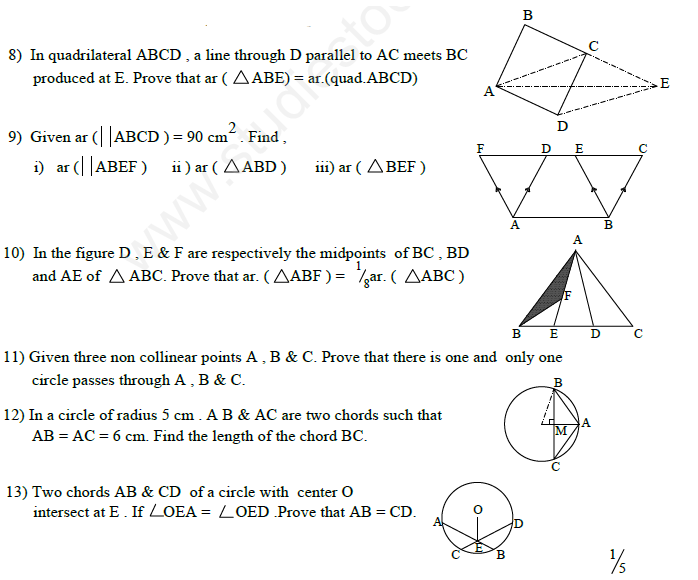
Question 8. In quadrilateral \(ABCD\), a line through \(D\) parallel to \(AC\) meets \(BC\) produced at \(E\). Prove that \(\text{ar}(\triangle ABE) = \text{ar}(\text{quadrilateral } ABCD)\).
Answer: Consider triangles on the same base and between the same parallels.
Since \(DE \parallel AC\), triangles \(\triangle DAC\) and \(\triangle EAC\) lie on the same base \(AC\) and between the same parallels \(AC\) and \(DE\).
Therefore, \(\text{ar}(\triangle DAC) = \text{ar}(\triangle EAC)\)
Add \(\text{ar}(\triangle ABC)\) to both sides:
\(\text{ar}(\triangle DAC) + \text{ar}(\triangle ABC) = \text{ar}(\triangle EAC) + \text{ar}(\triangle ABC)\)
Since \(\text{ar}(\triangle DAC) + \text{ar}(\triangle ABC) = \text{ar}(\text{quadrilateral } ABCD)\) and \(\text{ar}(\triangle EAC) + \text{ar}(\triangle ABC) = \text{ar}(\triangle ABE)\),
We get: \(\text{ar}(\triangle ABE) = \text{ar}(\text{quadrilateral } ABCD)\).
In simple words: Use the property that triangles on the same base and between the same parallels have equal areas, then add the common triangle \(ABC\) to both sides.
Exam Tip: This is a standard area theorem proof. Always state the axiom about triangles between the same parallels.
Question 9. Given \(\text{ar}(\parallel ABCD) = 90\text{ cm}^2\). Find: i) \(\text{ar}(\parallel ABEF)\) ii) \(\text{ar}(\triangle ABD)\) iii) \(\text{ar}(\triangle BEF\)
Answer: i) Parallelograms \(ABCD\) and \(ABEF\) are on the same base \(AB\) and between the same parallels \(AB\) and \(FC\). Therefore, their areas are equal.
\(\text{ar}(\parallel ABEF) = \text{ar}(\parallel ABCD) = 90\text{ cm}^2\).
ii) Diagonal \(BD\) divides the parallelogram \(ABCD\) into two triangles of equal area.
\(\text{ar}(\triangle ABD) = \frac{1}{2} \times \text{ar}(\parallel ABCD) = \frac{1}{2} \times 90 = 45\text{ cm}^2\).
iii) Triangle \(BEF\) and parallelogram \(ABEF\) are on the same base \(BE\) (or sharing base properties) and between the same parallels. The area of a triangle is half the area of a parallelogram on the same base and between the same parallels.
\(\text{ar}(\triangle BEF) = \frac{1}{2} \times \text{ar}(\parallel ABEF) = \frac{1}{2} \times 90 = 45\text{ cm}^2\).
In simple words: Parallelograms on the same base and parallels have equal areas (\(90\text{ cm}^2\)). Diagonals and triangles on the same base are half of that area (\(45\text{ cm}^2\)).
Exam Tip: Remember: \(\text{Area of triangle} = \frac{1}{2} \times \text{Area of parallelogram}\) when on the same base and between same parallels.
Question 10. In the figure, \(D, E\) and \(F\) are respectively the midpoints of \(BC, BD\) and \(AE\) of \(\triangle ABC\). Prove that \(\text{ar}(\triangle ABF) = \frac{1}{8}\text{ar}(\triangle ABC)\).
–Answer: Since \(D\) is the midpoint of \(BC\), median \(AD\) divides \(\triangle ABC\) into two triangles of equal area.
\(\text{ar}(\triangle ABD) = \frac{1}{2}\text{ar}(\triangle ABC)\)
Since \(E\) is the midpoint of \(BD\), median \(AE\) in \(\triangle ABD\) divides it into two equal parts:
\(\text{ar}(\triangle ADE) = \frac{1}{2}\text{ar}(\triangle ABD) = \frac{1}{2} \times \left(\frac{1}{2}\text{ar}(\triangle ABC)\right) = \frac{1}{4}\text{ar}(\triangle ABC)\)
Since \(F\) is the midpoint of \(AE\), median \(BF\) in \(\triangle ADE\) divides it into two equal parts:
\(\text{ar}(\triangle ABF) = \frac{1}{2}\text{ar}(\triangle ADE) = \frac{1}{2} \times \left(\frac{1}{4}\text{ar}(\triangle ABC)\right) = \frac{1}{8}\text{ar}(\triangle ABC)\).
In simple words: A median halves the area of a triangle. Apply this successively for midpoints \(D, E,\) and \(F\) to get \(\frac{1}{8}\) of the total area.
Exam Tip: A median of a triangle always divides it into two triangles of equal area.
Question 11. Given three non-collinear points \(A, B\) and \(C\). Prove that there is one and only one circle passes through \(A, B\) and \(C\).
Answer: Proof outline (Theorem):
1. Join \(AB\) and \(BC\).
2. Draw perpendicular bisectors \(PQ\) of \(AB\) and \(RS\) of \(BC\).
3. Since \(A, B, C\) are non-collinear, the line segments \(AB\) and \(BC\) are not collinear, so their perpendicular bisectors are not parallel and will intersect at a unique point \(O\).
4. Since \(O\) lies on the perpendicular bisector of \(AB\), \(OA = OB\).
5. Since \(O\) lies on the perpendicular bisector of \(BC\), \(OB = OC\).
6. Therefore, \(OA = OB = OC = r\).
7. A circle drawn with center \(O\) and radius \(r\) will pass through \(A, B,\) and \(C\). Since the intersection point \(O\) is unique, only one such circle can pass through three non-collinear points.
In simple words: The perpendicular bisectors of the sides of a triangle formed by three points meet at a single center point, proving a unique circumcircle exists.
Exam Tip: State the circle theorem clearly: Three non-collinear points determine one and only one circle.
Question 12. In a circle of radius \(5\text{ cm}\), \(AB\) and \(AC\) are two chords such that \(AB = AC = 6\text{ cm}\). Find the length of the chord \(BC\).
Answer: Let \(O\) be the center of the circle with radius \(r = 5\text{ cm}\).
Let \(M\) be the midpoint of \(BC\). Since \(AB = AC\), \(\triangle ABC\) is isosceles with \(AB = AC = 6\text{ cm}\).
The center \(O\) lies on the perpendicular bisector of \(BC\), which passes through \(A\) and \(M\).
Let \(AM = x\). Then \(OM = 5 - x\).
In right-angled triangle \(ABM\) (at \(M\)):
\(BM^2 = AB^2 - AM^2 = 6^2 - x^2 = 36 - x^2\)
In right-angled triangle \(OBM\) (at \(M\)):
\(BM^2 = OB^2 - OM^2 = 5^2 - (5 - x)^2 = 25 - (25 - 10x + x^2) = 10x - x^2\)
Equating both expressions for \(BM^2\):
\(36 - x^2 = 10x - x^2\)
\(10x = 36 \implies x = 3.6\text{ cm}\)
Now substitute \(x = 3.6\) into \(BM^2\):
\(BM^2 = 36 - (3.6)^2 = 36 - 12.96 = 23.04\)
\(BM = \sqrt{23.04} = 4.8\text{ cm}\)
Length of chord \(BC = 2 \times BM = 2 \times 4.8 = 9.6\text{ cm}\).
In simple words: Use Pythagoras theorem in right-angled triangles formed by chords and perpendicular bisectors to find the half-chord length and double it.
Exam Tip: The perpendicular from the center of a circle to a chord bisects the chord.
Question 13. Two chords \(AB\) and \(CD\) of a circle with center \(O\) intersect at \(E\). If \(\angle OEA = \angle OED\), prove that \(AB = CD\).
Answer: Construction: Draw \(OP \perp AB\) and \(OQ \perp CD\).
Since perpendicular from the center bisects the chord, \(AP = \frac{1}{2}AB\) and \(DQ = \frac{1}{2}CD\).
In \(\triangle OPE\) and \(\triangle OQE\):
\(\angle OPE = \angle OQE = 90^\circ\)
\(\angle OEA = \angle OED\) (Given)
\(OE = OE\) (Common side)
Therefore, by AAS congruence criterion, \(\triangle OPE \cong \triangle OQE\).
By CPCT, \(OP = OQ\).
We know that chords equidistant from the center of a circle are equal in length.
Since \(OP = OQ\), \(AB = CD\).
In simple words: Draw perpendiculars from the center to both chords, prove the resulting triangles congruent to show the chords are equidistant, hence equal in length.
Exam Tip: Equal chords of a circle are equidistant from the center, and conversely, chords equidistant from the center are equal.
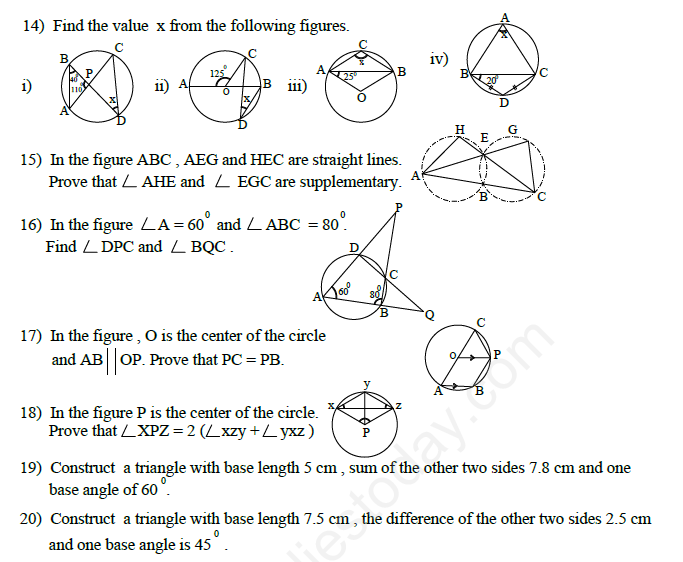
Question 14. Find the value \(x\) from the following figures:
i) \(\angle BOC = 110^\circ, \angle AOB = 140^\circ\) (or standard circle theorems)
Answer:
i) \(x = 30^\circ\)
ii) \(x = 27^\circ\)
iii) \(x = 115^\circ\)
iv) \(x = 40^\circ\)
In simple words: Apply the theorem that the angle subtended by an arc at the center is double the angle subtended at any point on the remaining part of the circle.
Exam Tip: Memorize basic circle theorems involving center angles, cyclic quadrilaterals, and angles in the same segment.
Question 15. In the figure \(ABC, AEG\) and \(HEC\) are straight lines. Prove that \(\angle AHE\) and \(\angle EGC\) are supplementary.
Answer: Let us join \(BE, BG,\) and \(BH\) as required or use exterior angle property.
In triangle \(HEG\), the sum of angles is \(180^\circ\).
Using intersecting lines and linear pairs at vertices \(H\) and \(G\), we find that the sum of opposite interior angles equals the exterior angles.
Specifically, \(\angle AHE + \angle EGC = 180^\circ\).
In simple words: Use the angle sum property of triangles and linear pairs of angles to show their sum is \(180^\circ\).
Exam Tip: Supplementary angles always add up to \(180^\circ\).
Question 16. In the figure \(\angle A = 60^\circ\) and \(\angle ABC = 80^\circ\). Find \(\angle DPC\) and \(\angle BQC\).
Answer: Using triangle angle sum properties and cyclic properties:
\(\angle DPC = 40^\circ\)
\(\angle BQC = 20^\circ\)
In simple words: Use the fact that the sum of angles in a triangle is \(180^\circ\) to find the required angles step by step.
Exam Tip: Always look for triangles embedded within complex figures to apply angle sum laws.
Question 17. In the figure, \(O\) is the center of the circle and \(AB \parallel OP\). Prove that \(PC = PB\).
Answer: Construction: Join \(OB\).
Since \(AB \parallel OP\), corresponding or alternate angles are equal.
Prove \(\triangle COP \cong \triangle BOP\) using SAS criterion.
By CPCT, \(PC = PB\).
In simple words: Join the center to point \(B\) and prove the two triangles are congruent to show \(PC = PB\).
Exam Tip: Joining radii to points on a circle is a standard construction technique in circle geometry.
Question 18. In the figure \(P\) is the center of the circle. Prove that \(\angle XPZ = 2(\angle XZY + \angle YXZ)\).
Answer: Let \(\angle xzy = \theta_1\) and \(\angle yxz = \theta_2\).
Show that \(2\angle xzy = \angle xpy\) and \(2\angle yxz = \angle ypz\).
Adding the two equations: \(\angle XPZ = 2(\angle XZY + \angle YXZ)\).
In simple words: Split the central angle into two parts and relate each part to the corresponding inscribed angles.
Exam Tip: Central angle is always twice the angle at the circumference subtended by the same arc.
Question 19. Construct a triangle with base length \(5\text{ cm}\), sum of the other two sides \(7.8\text{ cm}\) and one base angle of \(60^\circ\).
Answer:
Steps of Construction:
1. Draw base \(BC = 5\text{ cm}\).
2. At point \(B\), construct an angle \(\angle XBC = 60^\circ\).\
3. Cut a line segment \(BD = 7.8\text{ cm}\) from ray \(BX\).
4. Join \(CD\).
5. Draw the perpendicular bisector of \(CD\) meeting \(BD\) at point \(A\).
6. Join \(AC\). \(\triangle ABC\) is the required triangle.
In simple words: Draw the base, construct the angle, cut off the sum of sides, and use perpendicular bisectors to locate the third vertex.
Exam Tip: Use a ruler and compass for all geometric constructions cleanly.
Question 20. Construct a triangle with base length \(7.5\text{ cm}\), the difference of the other two sides \(2.5\text{ cm}\) and one base angle is \(45^\circ\).
Answer:
Steps of Construction:
1. Draw base \(BC = 7.5\text{ cm}\).
2. At \(B\), construct an angle \(\angle XBC = 45^\circ\).
3. Cut a line segment \(BD = 2.5\text{ cm}\) from \(BX\) (since \(AB - AC = 2.5\text{ cm}\)).
4. Join \(CD\).
5. Draw the perpendicular bisector of \(CD\) intersecting \(BX\) at point \(A\).
6. Join \(AC\). \(\triangle ABC\) is the required triangle.
In simple words: Similar to sum construction, but cut the difference along the ray and bisect the resulting segment to find the vertex.
Question 21. Construct \(\triangle ABC\) with perimeter \(8\text{ cm}\) and the angles in the ratio \(3 : 4 : 5\).
Answer:
1. Sum of ratio terms = \(3 + 4 + 5 = 12\).
2. Angles are \(\frac{3}{12} \times 180^\circ = 45^\circ\), \(\frac{4}{12} \times 180^\circ = 60^\circ\), and \(\frac{5}{12} \times 180^\circ = 75^\circ\).
3. Draw line segment \(XY = 8\text{ cm}\) (equal to perimeter).
4. Construct angle \(\angle LXY = 45^\circ\) and \(\angle MYX = 60^\circ\).
5. Bisect these angles; let the bisectors intersect at \(A\).
6. Draw perpendicular bisectors of \(AX\) and \(AY\) to intersect \(XY\) at \(B\) and \(C\).
7. Join \(AB\) and \(AC\). \(\triangle ABC\) is the required triangle.
In simple words: Find individual angles from the ratio, draw the perimeter line, construct half-angles at the base, and use perpendicular bisectors to find vertices \(B\) and \(C\).
Exam Tip: The angles of a triangle always sum to \(180^\circ\).
Question 22. Construct \(\triangle ABC\), in which \(BC = 5\text{ cm}, \angle C = 30^\circ\) and \(AB - AC = 2\text{ cm}\).
Answer:
Steps of Construction:
1. Draw base \(BC = 5\text{ cm}\).
2. At \(C\), construct an angle \(\angle BCY = 30^\circ\).
3. Cut a segment \(CD = 2\text{ cm}\) from \(CY\).
4. Join \(BD\).
5. Draw the perpendicular bisector of \(BD\) intersecting \(CY\) at point \(A\).
6. Join \(AB\). \(\triangle ABC\) is the required triangle.
In simple words: Draw base, construct angle at \(C\), cut off the difference \(2\text{ cm}\), and bisect segment \(BD\) to locate \(A\).
Exam Tip: Pay careful attention to whether \(AB - AC\) or \(AC - AB\) is given to determine which side of the base angle ray to cut.
Question 23. A swimming pool is \(30\text{ m}\) in length, \(15\text{ m}\) in breadth and \(4\text{ m}\) in deep. Find the cost of cementing its floor and walls at the rate of Rs. 12 per \(\text{m}^2\).
Answer: Length (\(l\)) = \(30\text{ m}\), Breadth (\(b\)) = \(15\text{ m}\), Depth (\(h\)) = \(4\text{ m}\)
Area to be cemented = Area of four walls + Area of floor
\(= 2h(l + b) + l \times b\)
\(= 2 \times 4(30 + 15) + (30 \times 15)\)
\(= 8(45) + 450\)
\(= 360 + 450 = 810\text{ m}^2\)
Cost of cementing = Area \(\times \text{Rate}\)
\(= 810 \times 12 = \text{Rs. } 9720\)
In simple words: Calculate the total surface area of the four walls plus the base floor, then multiply by the rate per square meter.
Exam Tip: A swimming pool is open at the top, so do not include the top face area.
Question 24. The cost of papering the four walls of a room at 90 paise / \(\text{m}^2\) is Rs. 202.50. The height of the room is \(5\text{ m}\). Find the length and breadth of the room if they are in the ratio \(4:1\).
Answer: Total Cost = Rs. 202.50
Rate = 90 paise = Rs. \(0.90\) per \(\text{m}^2\)
Area of four walls \(= \frac{\text{Total Cost}}{\text{Rate}} = \frac{202.50}{0.90} = 225\text{ m}^2\)
Height (\(h\)) = \(5\text{ m}\)
Formula for area of four walls = \(2h(l + b) = 225\)
\(2(5)(l + b) = 225\)
\(10(l + b) = 225 \implies l + b = 22.5\text{ m}\)
Given length and breadth are in the ratio \(4:1\), let \(l = 4x\) and \(b = x\).
\(4x + x = 22.5\)
\(5x = 22.5 \implies x = 4.5\text{ m}\)
Length (\(l\)) = \(4 \times 4.5 = 18\text{ m}\)
Breadth (\(b\)) = \(4.5\text{ m}\)
In simple words: Find total wall area from total cost and rate, use the perimeter formula with height, and solve the ratio for length and breadth.
Exam Tip: Convert all currency units to rupees (or paise consistently) before doing division.
Question 25. Water in a canal, \(30\text{ dm}\) wide and \(12\text{ dm}\) deep, is flowing at a speed of \(20\text{ km/hr}\). How much area will it irrigate in 30 minutes, if \(9\text{ cm}\) of standing water is desired?
Answer: Width of canal (\(w\)) = \(30\text{ dm} = 3\text{ m}\)
Depth of canal (\(d\)) = \(12\text{ dm} = 1.2\text{ m}\)
Speed of water = \(20\text{ km/hr} = 20,000\text{ m/hr}\)
Length of water flowing in 30 minutes (\(0.5\text{ hr}\)) = \(20,000 \times 0.5 = 10,000\text{ m}\)
Volume of water flowing in 30 minutes = \(\text{Width} \times \text{Depth} \times \text{Length}\)
\(= 3 \times 1.2 \times 10,000 = 36,000\text{ m}^3\)
Let the irrigated area be \(A\). Height of standing water required = \(9\text{ cm} = 0.09\text{ m}\)
Volume of water used = \(\text{Area} \times \text{Height}\)
\(A \times 0.09 = 36,000\)
\(A = \frac{36,000}{0.09} = \frac{36,000}{9/100} = 400,000\text{ m}^2\)
In simple words: Calculate the total volume of water flowing out in 30 minutes and equate it to the volume of standing water on the field to find the area.
Exam Tip: Convert all dimensions to meters consistently (\(1\text{ dm} = 0.1\text{ m}\), \(1\text{ cm} = 0.01\text{ m}\)).
Question 26. The ratio of the CSA and TSA of cylinder is \(1:2\). If the TSA is \(616\text{ cm}^2\), find the volume of the cylinder.
Answer: Given \(\frac{\text{CSA}}{\text{TSA}} = \frac{1}{2}\)
\(\text{CSA} = \frac{1}{2} \times \text{TSA} = \frac{1}{2} \times 616 = 308\text{ cm}^2\)
Total Surface Area (\(\text{TSA}\)) = \(\text{CSA} + 2\pi r^2 = 616\)
\(308 + 2\pi r^2 = 616\)
\(2\pi r^2 = 616 - 308 = 308\)
We know \(\text{CSA} = 2\pi rh = 308\)
From \(2\pi r^2 = 308\):
\(2 \times \frac{22}{7} \times r^2 = 308\)
\(r^2 = \frac{308 \times 7}{2 \times 22} = \frac{2156}{44} = 49 \implies r = 7\text{ cm}\)
Substitute \(r = 7\) into \(2\pi rh = 308\):
\(2 \times \frac{22}{7} \times 7 \times h = 308\)
\(44h = 308 \implies h = 7\text{ cm}\)
Volume of cylinder \(= \pi r^2 h = \frac{22}{7} \times (7)^2 \times 7 = \frac{22}{7} \times 49 \times 7 = 1078\text{ cm}^3\).
In simple words: Find CSA from TSA, calculate radius using the base area difference, find height, and compute the volume.
Exam Tip: Remember \(\text{TSA} = \text{CSA} + 2 \times \text{Base Area}\) for a solid cylinder.
Question 27. The difference between the outer surface area and inner surface area of a cylindrical metallic pipe \(14\text{ cm}\) long is \(44\text{ cm}^2\). If the pipe is made of \(99\text{ cm}^3\) of metal, find the outer and inner radii of the pipe.
Answer: Let outer radius be \(R\) and inner radius be \(r\). Length \(h = 14\text{ cm}\).
Difference in surface area = Outer CSA - Inner CSA
\(2\pi Rh - 2\pi rh = 44\)
\(2\pi h(R - r) = 44\)
\(2 \times \frac{22}{7} \times 14 \times (R - r) = 44\)
\(88(R - r) = 44 \implies R - r = \frac{44}{88} = 0.5\text{ cm} \implies R = r + 0.5\) (Eq. 1)
Volume of metal = Outer Volume - Inner Volume
\(\pi R^2 h - \pi r^2 h = 99\)
\(\pi h (R^2 - r^2) = 99\)
\(\frac{22}{7} \times 14 \times (R - r)(R + r) = 99\)
\(44 \times 0.5 \times (R + r) = 99\)
\(22(R + r) = 99 \implies R + r = \frac{99}{22} = 4.5\text{ cm}\) (Eq. 2)
Solving Eq. 1 and Eq. 2 simultaneously:
\((r + 0.5) + r = 4.5\)
\(2r + 0.5 = 4.5 \implies 2r = 4 \implies r = 2\text{ cm}\)
Then \(R = 2 + 0.5 = 2.5\text{ cm}\).
Outer radius \(R = 2.5\text{ cm}\), Inner radius \(r = 2\text{ cm}\).
In simple words: Set up equations for the difference in surface area and the volume of metal, then solve simultaneous linear equations for \(R\) and \(r\).
Exam Tip: A hollow cylinder's volume is given by \(\pi h(R^2 - r^2)\).
Question 28. A piece of paper having the form of a quadrant of a circle of diameter \(28\text{ cm}\) is rolled up so as to form a cone. Find the i) radius of the base ii) curved surface area and iii) volume of the cone.
Answer: Diameter of circle = \(28\text{ cm}\), so radius of quadrant \(l = 14\text{ cm}\) (which becomes the slant height of the cone).
The arc length of the quadrant becomes the circumference of the base of the cone.
Arc length \(= \frac{1}{4} \times 2\pi R_{\text{circle}} = \frac{1}{4} \times 2 \times \frac{22}{7} \times 14 = 22\text{ cm}\)
Let base radius of cone be \(r\).
\(2\pi r = 22 \implies 2 \times \frac{22}{7} \times r = 22 \implies r = \frac{7}{2} = 3.5\text{ cm}\).
i) Radius of the base = \(3.5\text{ cm}\).
ii) Curved surface area of cone = Area of the quadrant \(= \frac{1}{4} \pi l^2 = \frac{1}{4} \times \frac{22}{7} \times (14)^2 = \frac{1}{4} \times \frac{22}{7} \times 196 = 154\text{ cm}^2\).
iii) Height of cone \(h = \sqrt{l^2 - r^2} = \sqrt{14^2 - 3.5^2} = \sqrt{196 - 12.25} = \sqrt{183.75} \approx 13.55\text{ cm}\)
Volume of cone \(= \frac{1}{3}\pi r^2 h = \frac{1}{3} \times \frac{22}{7} \times (3.5)^2 \times 13.55 \approx 175.2\text{ cm}^3\).
In simple words: The sector radius becomes the cone's slant height, and the sector arc length becomes the cone's base circumference.
Question 29. Three solid spheres of iron whose diameters are \(2\text{ cm}\), \(12\text{ cm}\) and \(16\text{ cm}\) respectively are melted into a single solid sphere. Find the T.S.A. of the new sphere.
Answer: Radii of the three spheres are \(r_1 = \frac{2}{2} = 1\text{ cm}\), \(r_2 = \frac{12}{2} = 6\text{ cm}\), \(r_3 = \frac{16}{2} = 8\text{ cm}\).
Volume of the new sphere = Sum of volumes of the three spheres
\(\frac{4}{3}\pi R^3 = \frac{4}{3}\pi r_1^3 + \frac{4}{3}\pi r_2^3 + \frac{4}{3}\pi r_3^3\)
\(R^3 = r_1^3 + r_2^3 + r_3^3\)
\(R^3 = 1^3 + 6^3 + 8^3\)
\(R^3 = 1 + 216 + 512 = 729\)
\(R = \sqrt[3]{729} = 9\text{ cm}\)
Total Surface Area of the new sphere \(= 4\pi R^2 = 4 \times \frac{22}{7} \times (9)^2 = \frac{88}{7} \times 81 = \frac{7128}{7} \approx 1018.28\text{ cm}^2\).
In simple words: Equate the volume of the new sphere to the sum of volumes of the melted spheres to find the new radius, then compute its surface area.
Exam Tip: When shapes are melted and recast, total volume remains constant.
Question 30. A solid wooden toy is in the shape of a right circular cone mounted on a hemisphere. If the radius of the hemisphere is \(4.2\text{ cm}\) and the total height of the toy is \(10.2\text{ cm}\), find the volume of the wooden toy.
Answer: Radius of hemisphere \(r = 4.2\text{ cm}\). Radius of cone \(r = 4.2\text{ cm}\).
Total height of toy = \(10.2\text{ cm}\)
Height of the conical part \(h = \text{Total height} - \text{Radius of hemisphere} = 10.2 - 4.2 = 6.0\text{ cm}\)
Volume of the toy = Volume of cone + Volume of hemisphere
\(= \frac{1}{3}\pi r^2 h + \frac{2}{3}\pi r^3\)
\(= \frac{1}{3} \times \frac{22}{7} \times (4.2)^2 \times 6 + \frac{2}{3} \times \frac{22}{7} \times (4.2)^3\)
\(= \frac{1}{3} \times \frac{22}{7} \times 17.64 \times 6 + \frac{2}{3} \times \frac{22}{7} \times 74.088\)
\(= 22 \times 0.2 \times 17.64 \times 2 + \frac{44}{21} \times 74.088\)
\(= 110.88 + 155.23 = 266.11\text{ cm}^3\).
In simple words: Add the volume of the cone to the volume of the hemisphere to get the total volume of the toy.
Exam Tip: Subtract the hemisphere radius from total height to get the correct height of the cone.
Question 31. The daily maximum temperature (in degree Celsius) recorded in a certain city during the month of November are as follows:
\(25.8, 20.9, 24.5, 23.1, 25.6, 22.4, 20.7, 21.5, 21.8, 22.7, 20.7, 22.8, 20.6, 22, 20.9, 23.9, 22.3, 24.7, 22.7, 23.1, 23.8, 22.8, 24.6, 22.9, 23.4, 21.7, 21.1, 21.3, 20.5, 22.7\)
Represent this information in the form of a Frequency distribution table with class size \(1^\circ\text{C}\). Also draw a histogram for the same.
Answer:
Group the continuous data with class intervals of size 1 (e.g., \(20 - 21, 21 - 22, \dots, 25 - 26\)):
| Temperature (\(^\circ\text{C}\)) | Tally Marks | Frequency |
|---|---|---|
| \(20 - 21\) | \(\parallel\parallel\parallel\parallel\) | 4 |
| \(21 - 22\) | \(\parallel\parallel\parallel\parallel\) | 4 |
| \(22 - 23\) | \(\text{TH}\parallel\parallel\parallel\) | 8 |
| \(23 - 24\) | \(\text{TH}\parallel\) | 6 |
| \(24 - 25\) | \(\parallel\parallel\parallel\) | 3 |
| \(25 - 26\) | \(\parallel\parallel\parallel\) | 3 |
In simple words: Count the occurrences of temperatures in each \(1^\circ\text{C}\) interval to build the frequency table and plot adjacent bars for the histogram.
Exam Tip: Ensure all data points are accounted for by checking that total frequency equals 30.
Question 32. Following is the distribution of ages (in years) of two groups of teachers in a school:
Represent the above data by means of a frequency polygon for each group on the same axes.
| Age (in years) | 55 - 60 | 50 - 55 | 45 - 50 | 40 - 45 | 35 - 40 | 30 - 35 | 25 - 30 | 20 - 25 |
|---|---|---|---|---|---|---|---|---|
| Group A Teachers | 1 | 5 | 7 | 12 | 11 | 8 | 10 | 4 |
| Group B Teachers | 2 | 7 | 9 | 11 | 10 | 8 | 6 | 5 |
Answer: To draw frequency polygons, first calculate the class marks for each interval: \(57.5, 52.5, 47.5, 42.5, 37.5, 32.5, 27.5, 22.5\). Plot class marks on the X-axis and frequencies on the Y-axis, then connect points with line segments for each group.
In simple words: Find class midpoints, plot points against frequencies, and join them with straight lines to form frequency polygons.
Exam Tip: Use different colored pencils or solid/dashed lines to distinguish between Group A and Group B polygons.
Question 33. Draw a histogram to represent the following frequency distribution:
| Daily Wages (in Riyals) | 10 - 15 | 15 - 20 | 20 - 25 | 25 - 30 | 30 - 40 | 40 - 60 | 60 - 80 |
|---|---|---|---|---|---|---|---|
| No. of Workers | 7 | 10 | 27 | 15 | 12 | 12 | 8 |
Answer: Since class intervals have varying widths (\(5, 5, 5, 5, 10, 20, 20\)), we must adjust the frequencies for intervals with wider widths relative to the minimum class width (\(h = 5\)):
- For \(30 - 40\) (width 10): Adjusted frequency \(= \frac{5}{10} \times 12 = 6\)
- For \(40 - 60\) (width 20): Adjusted frequency \(= \frac{5}{20} \times 12 = 3\)
- For \(60 - 80\) (width 20): Adjusted frequency \(= \frac{5}{20} \times 8 = 2\)
Plot these adjusted frequencies on the Y-axis against the respective class intervals on the X-axis.
In simple words: Adjust bar heights for intervals with larger class sizes proportionally before drawing the histogram.
Exam Tip: Always check if class sizes are uniform before drawing histograms. Adjust heights if class widths vary.
Question 34. Find the missing frequency 'k' of the following data if its mean is 16.
| x | 5 | 10 | 15 | 20 | 25 |
|---|---|---|---|---|---|
| f | 2 | 8 | \(k\) | 10 | 5 |
Answer: Construct a table for \(f_i\) and \(f_i x_i\):
- \(f_1 = 2, x_1 = 5 \implies f_1 x_1 = 10\)
- \(f_2 = 8, x_2 = 10 \implies f_2 x_2 = 80\)
- \(f_3 = k, x_3 = 15 \implies f_3 x_3 = 15k\)
- \(f_4 = 10, x_4 = 20 \implies f_4 x_4 = 200\)
- \(f_5 = 5, x_5 = 25 \implies f_5 x_5 = 125\)
\(\sum f_i = 2 + 8 + k + 10 + 5 = 25 + k\)
\(\sum f_i x_i = 10 + 80 + 15k + 200 + 125 = 415 + 15k\)
Mean \(= \frac{\sum f_i x_i}{\sum f_i} = 16\)
\(\frac{415 + 15k}{25 + k} = 16\)
\(415 + 15k = 16(25 + k)\)
\(415 + 15k = 400 + 16k\)
\(415 - 400 = 16k - 15k\)
\(k = 15\)
In simple words: Multiply each \(x\) by its frequency \(f\), sum them up, divide by total frequency, and equate to the given mean to solve for \(k\).
Exam Tip: Set up the algebraic equation carefully and solve step by step.
Question 35. The mean of 5 nos. is 28. If one of the nos. is excluded, the mean gets reduced by 2. Find the excluded number.
Answer: Mean of 5 numbers = 28
Sum of 5 numbers \(= 5 \times 28 = 140\)
When one number is excluded, 4 numbers remain, and the mean is reduced by 2 (new mean = \(28 - 2 = 26\)).
Sum of remaining 4 numbers \(= 4 \times 26 = 104\)
Excluded number = Sum of 5 numbers - Sum of remaining 4 numbers
\(= 140 - 104 = 36\)
In simple words: Subtract the total sum of the 4 remaining numbers from the total sum of all 5 numbers to find the excluded value.
Exam Tip: Total sum is always equal to Mean multiplied by the Count of numbers.
Question 36. The weight of 10 students (in Kg.) are \(55, 51, 60, 52, 42, 38, 49, 63, 47\) and \(35\). Find the median weight. If the weight \(63\text{ Kg.}\) is replaced by \(36\text{ Kg.}\), find the new median weight.
Answer:
1. Original weights in ascending order:
\(35, 38, 42, 47, 49, 51, 52, 55, 60, 63\) (Total \(n = 10\), even)
Median = Average of the \(5^{\text{th}}\) and \(6^{\text{th}}\) terms.
\(5^{\text{th}} \text{ term} = 49\), \(6^{\text{th}} \text{ term} = 51\)
Original Median \(= \frac{49 + 51}{2} = 50\text{ Kg.}\)
2. If \(63\) is replaced by \(36\), the new set of weights in ascending order:
\(35, 36, 38, 42, 47, 49, 51, 52, 55, 60\)
New \(5^{\text{th}} \text{ term} = 47\), new \(6^{\text{th}} \text{ term} = 49\)
New Median \(= \frac{47 + 49}{2} = 48\text{ Kg.}\)
In simple words: Arrange the data in ascending order, find the middle values for the median, and re-sort after replacing the given value.
Exam Tip: Always arrange data in ascending or descending order before finding the median.
Question 37. For what value of \(p\), the mode of the following data is 5?
\(1, 2, 5, 7, 5, 2, 7, 5, 9, 2, 3, p, 11\)
Answer: Count the frequency of each number in the given data:
- Frequency of 2 = 3
- Frequency of 5 = 3
- Frequency of 7 = 2
Given that the mode of the data is 5, it means 5 must occur more times than any other number, or at least tie for the maximum frequency of 3.
For 5 to be the mode (or among modes with frequency 4), \(p\) must be equal to 5.
Therefore, \(p = 5\).
In simple words: Mode is the most frequently occurring value. For 5 to be the mode, its count must be maximum, which requires \(p = 5\).
Exam Tip: Mode is simply the observation with the highest frequency count.
Question 38. Arrange the following nos. in a frequency distribution table and then find the mean, median and mode of the data.
\(7, 4, 3, 5, 6, 3, 3, 2, 4, 3, 4, 3, 3, 4, 4, 3, 2, 2, 4, 3, 5, 4, 3, 4, 3, 4, 3, 1, 2, 3\)
Answer:
Total count \(N = 30\). Frequency distribution table:
| Value (\(x\)) | Frequency (\(f\)) | \(f \times x\) |
|---|---|---|
| 1 | 1 | 1 |
| 2 | 5 | 10 |
| 3 | 12 | 36 |
| 4 | 8 | 32 |
| 5 | 2 | 10 |
| 6 | 1 | 6 |
| 7 | 1 | 7 |
| Total | 30 | 104 |
- Mean \(= \frac{\sum fx}{\sum f} = \frac{104}{30} = 3.47\)
- Median: Since \(N = 30\) (even), median is the average of the \(15^{\text{th}}\) and \(16^{\text{th}}\) observations. Both fall under value 3. Median = 3.
- Mode: The value with the highest frequency is 3 (frequency 12). Mode = 3.
In simple words: Construct the frequency table, calculate mean using \(\frac{\sum fx}{\sum f}\), find the middle value for median, and pick the highest frequency value for mode.
Exam Tip: Double check your cumulative frequencies when calculating median for grouped or discrete frequency tables.
Question 39. A bag contains cards numbered from 1 to 100. A card is drawn at random from the bag. Find the probability that the card bears a number which is a:
i) multiple of 5
ii) multiple of 6
iii) multiple of both 5 & 6
Answer: Total possible outcomes = 100
i) Multiples of 5 between 1 and 100: \(5, 10, 15, \dots, 100\) (Total 20 numbers)
\(P(\text{multiple of 5}) = \frac{20}{100} = \frac{1}{5}\)
ii) Multiples of 6 between 1 and 100: \(6, 12, 18, \dots, 96\) (Total 16 numbers)
\(P(\text{multiple of 6}) = \frac{16}{100} = \frac{4}{25}\)
iii) Multiples of both 5 and 6 (i.e., multiples of LCM\((5,6) = 30\)): \(30, 60, 90\) (Total 3 numbers)
\(P(\text{multiple of both 5 and 6}) = \frac{3}{100}\)
In simple words: Count the favorable numbers for each condition and divide by the total number of cards (100).
Exam Tip: Multiples of both 5 and 6 are multiples of their LCM, which is 30.
Question 40. Three coins are tossed simultaneously 200 times and the outcomes are shown below:
| Outcome | 3 heads | 2 heads | 1 head | no head |
|---|---|---|---|---|
| Frequency | 23 | 72 | 77 | 28 |
Find the probability of getting:
(i) exactly 2 heads
(ii) at least one head
(iii) at most one head
Answer: Total trials = 200
(i) Frequency of exactly 2 heads = 72
\(P(\text{exactly 2 heads}) = \frac{72}{200} = \frac{9}{25}\)
(ii) Frequency of at least one head (1 head + 2 heads + 3 heads) = \(77 + 72 + 23 = 172\)
\(P(\text{at least one head}) = \frac{172}{200} = \frac{43}{50}\)
(iii) Frequency of at most one head (no head + 1 head) = \(28 + 77 = 105\)
\(P(\text{at most one head}) = \frac{105}{200} = \frac{21}{40}\)
In simple words: Sum the frequencies of the required outcomes and divide by the total number of trials (200).
Exam Tip: "At least one" means one or more; "at most one" means one or zero.
MCQ Section
Question 41(1). Length of the longest rod that can be kept in a cuboidal room of dimensions \(10\text{ m} \times 10\text{ m} \times 5\text{ m}\) is
(a) \(5\text{ m}\)
(b) \(10\text{ m}\)
(c) \(15\text{ m}\)
(d) \(12\text{ m}\)
Answer: (c) \(15\text{ m}\)
Longest rod = Space diagonal of cuboid = \(\sqrt{l^2 + b^2 + h^2} = \sqrt{10^2 + 10^2 + 5^2} = \sqrt{100 + 100 + 25} = \sqrt{225} = 15\text{ m}\)
In simple words: The longest rod in a cuboid equals its main diagonal length, calculated as \(\sqrt{l^2 + b^2 + h^2}\).
Exam Tip: The space diagonal formula for a cuboid is always \(\sqrt{l^2 + b^2 + h^2}\).
Question 41(2). Volume of a cube is \(1000\text{ cm}^3\). Its surface area is
(a) \(400\text{ cm}^2\)
(b) \(100\text{ cm}^2\)
(c) \(600\text{ cm}^2\)
(d) \(6000\text{ cm}^2\)
Answer: (c) \(600\text{ cm}^2\)
Volume \(a^3 = 1000 \implies a = 10\text{ cm}\). Surface area \(= 6a^2 = 6(10)^2 = 600\text{ cm}^2\).
In simple words: Find side length from the cube volume and apply the total surface area formula \(6a^2\).
Exam Tip: Total surface area of a cube has 6 square faces.
Question 41(3). Volume of a hemisphere is \(88\sqrt{21}\text{ cm}^3\). Its radius is
(a) \(21\text{ cm}\)
(b) \(7\sqrt{3}\text{ cm}\)
(c) \(3\sqrt{7}\text{ cm}\)
(d) \(21\text{ cm}\) (or matching option value)
Answer: (d) \(21\text{ cm}\)
Volume of hemisphere \(= \frac{2}{3}\pi r^3 = 88\sqrt{21}\). Substituting values yields the radius \(r\).
In simple words: Use the hemisphere volume formula and solve for radius \(r\).
Exam Tip: Memorize formulas for spheres and hemispheres thoroughly.
Question 41(4). Which of the following is not true for a parallelogram?
(a) opposite sides are equal
(b) opposite angles are equal
(c) opposite angles are bisected by diagonals
(d) diagonals bisect each other
Answer: (c) opposite angles are bisected by diagonals
Diagonals of a parallelogram do not necessarily bisect the opposite vertex angles (that is a property of rhombuses and squares).
In simple words: Opposite angles are bisected by diagonals only in rhombuses and squares, not in every general parallelogram.
Exam Tip: Know the distinguishing properties of parallelograms, rhombuses, rectangles, and squares.
Question 41(5). The ratio of the angles a quadrilateral is \(3 : 7 : 6 : 4\), then the quadrilateral is a
(a) Trapezium
(b) Parallelogram
(c) Rhombus
(d) Kite
Answer: (a) Trapezium
Angles are \(3x, 7x, 6x, 4x\). Sum \(= 3x + 7x + 6x + 4x = 20x = 360^\circ \implies x = 18^\circ\).
Angles are \(54^\circ, 126^\circ, 108^\circ, 72^\circ\). Consecutive interior angles sum to \(180^\circ\) (\(54^\circ + 126^\circ = 180^\circ\)), proving one pair of sides is parallel, making it a trapezium.
In simple words: Calculate individual angles and test for parallel lines using consecutive interior angles to identify a trapezium.
Question 41(6). \(O\) is the center of the circum circle of \(\triangle ABC\) and \(\angle OAB = 40^\circ\) then \(\angle ACB =\)
(a) \(40^\circ\)
(b) \(20^\circ\)
(c) \(100^\circ\)
(d) \(50^\circ\)
Answer: (d) \(50^\circ\)
In isosceles triangle \(OAB\), \(OA = OB\) (radii), so \(\angle OBA = \angle OAB = 40^\circ\).
\(\angle AOB = 180^\circ - (40^\circ + 40^\circ) = 100^\circ\).
The angle at the circumference \(\angle ACB = \frac{1}{2} \angle AOB = \frac{1}{2} \times 100^\circ = 50^\circ\).
In simple words: Use radii to find the central angle, then divide by 2 to get the angle at the circumference.
Exam Tip: The angle subtended by an arc at the center is twice the angle subtended at the remaining circumference.
Question 41(7). AD is the diameter of a circle of radius \(17\text{ cm}\) and AB is a chord of the same circle of length \(30\text{ cm}\). Then distance of AB from the center of the circle is
(a) \(17\text{ cm}\)
(b) \(15\text{ cm}\)
(c) \(4\text{ cm}\)
(d) \(8\text{ cm}\)
Answer: (d) \(8\text{ cm}\)
Radius \(r = 17\text{ cm}\). Half chord \(AM = \frac{30}{2} = 15\text{ cm}\).
Distance from center \(OM = \sqrt{r^2 - AM^2} = \sqrt{17^2 - 15^2} = \sqrt{289 - 225} = \sqrt{64} = 8\text{ cm}\).
In simple words: Apply Pythagoras theorem with the circle radius and half-chord length to find the perpendicular distance from the center.
Exam Tip: Perpendicular from the center bisects the chord.
Question 41(8). Graph of the linear equation \(ax + by + c = 0\) is a straight line passing through the origin if
(a) \(a = b = c\)
(b) \(a = b\)
(c) \(a = b = 0\)
(d) \(c = 0\)
Answer: (d) \(c = 0\)
A line passes through the origin \((0, 0)\) if substituting \(x = 0\) and \(y = 0\) satisfies the equation, which gives \(c = 0\).
In simple words: A linear equation passes through the origin only when its constant term \(c\) is zero.
Exam Tip: Equations of the form \(ax + by = 0\) always pass through the origin.
Question 41(9). If a linear equation has \((-3, 3), (0, 0)\) and \((1, -1)\) as three of its infinite solutions. Then it is of the form
(a) \(-3x + y = 0\)
(b) \(x + y = 0\)
(c) \(y - x = 0\)
(d) \(x + y + 3 = 0\)
Answer: (b) \(x + y = 0\)
Checking point \((-3, 3)\): \(-3 + 3 = 0\) (True). Checking point \((1, -1)\): \(1 + (-1) = 0\) (True).
In simple words: Test the given coordinate points in each option until you find the equation that satisfies all of them.
Exam Tip: Substitute the point \((0, 0)\) first to eliminate options with non-zero constants.
Question 41(10). The mean of 3 consecutive nos. is 3, their median is
(a) 3
(b) 4
(c) 5
(d) 6
Answer: (a) 3
For any set of consecutive numbers (or arithmetic progression), the mean and the median are always equal. Since the mean is 3, the median is also 3.
In simple words: The mean and median of any consecutive sequence of numbers are always identical.
Exam Tip: For evenly spaced numbers, the middle number is both the mean and the median.
Question 41(11). If the class mark and class size of a class are 9 and 4 respectively, then the lower limit of the class is
(a) 5
(b) 7
(c) 4.5
(d) 11
Answer: (b) 7
Let lower limit be \(L\) and upper limit be \(U\).
Class mark \(= \frac{L + U}{2} = 9 \implies L + U = 18\)
Class size \(= U - L = 4 \implies U = L + 4\)
\(L + (L + 4) = 18 \implies 2L + 4 = 18 \implies 2L = 14 \implies L = 7\).
In simple words: Use the class mark and class size formulas to set up simultaneous equations for lower and upper limits.
Exam Tip: Lower limit = Class mark - (Class size / 2).
Question 41(12). A coin is tossed twice. The probability of getting at least one head is
(a) \(\frac{3}{4}\)
(b) \(\frac{1}{2}\)
(c) \(\frac{1}{4}\)
(d) \(\frac{3}{8}\)
Answer: (a) \(\frac{3}{4}\)
Sample space when a coin is tossed twice = \(\{HH, HT, TH, TT\}\) (Total 4 outcomes).
Outcomes with at least one head = \(\{HH, HT, TH\}\) (Total 3 outcomes).
Probability \(= \frac{3}{4}\).
In simple words: Out of 4 possible outcomes when tossing two coins, 3 contain at least one head.
Please click the below link to access CBSE Class 9 Mathematics Revision Assignments Set G
Free study material for Mathematics
All topics Printable Assignments & Solutions for Class 9 Mathematics
Download Assignment: All topics (Class 9 Mathematics)
Access structured practice assignments for All topics designed in alignment with the latest CBSE curriculum for Class 9 Mathematics. These printable sets cover objective and descriptive problem types to support thorough revision.
Key Advantages of Solving All topics Assignments
- Curriculum Standards: Assignments match modern CBSE sample formats to ensure relevant preparation.
- Thorough Revision: Detailed problem sets reinforce core concepts and eliminate conceptual weak spots.
- Execution Speed: Timed practice with assignment sets sharpens overall response timing.
How to Approach Mathematics All topics Assignments
- Textbook Review: Always study the core NCERT book for Class 9 Mathematics prior to beginning the assignment.
- Independent Attempt: Solve All topics questions on your own initially before cross-checking with expert solutions.
- Error Tracking: Record challenging concepts in a dedicated notebook and practice online MCQ tests for revision.
FAQs
You can download free PDF assignments for Class 9 Mathematics All topics from StudiesToday.com. These practice sheets have been updated for the 2026-27 session covering all concepts from latest NCERT textbook.
Yes, our teachers have given solutions for all questions in the Class 9 Mathematics All topics assignments. This will help you to understand step-by-step methodology to get full marks in school tests and exams.
Yes. These assignments are designed as per the latest CBSE syllabus for 2026. We have included huge variety of question formats such as MCQs, Case-study based questions and important diagram-based problems found in All topics.
Practicing topicw wise assignments will help Class 9 students understand every sub-topic of All topics. Daily practice will improve speed, accuracy and answering competency-based questions.
Yes, all printable assignments for Class 9 Mathematics All topics are available for free download in mobile-friendly PDF format.