

Class 9 Mathematics Practice Assignments: CBSE Class 9 Mathematics Linear Equations in two variables Assignment Set 01
Review targeted academic assignments with the CBSE Class 9 Mathematics Linear Equations in two variables Assignment Set 01. Built according to official CBSE standards for the 2026-27 term, these downloadable Class 9 Mathematics worksheets support effective daily practice for Chapter 04 Linear Equations In Two Variables.
Download Chapter 04 Linear Equations In Two Variables Assignment PDF with Solutions
Navigate directly to the solved Mathematics assignments using the digital viewer below. Each practice set includes detailed step-by-step solutions, allowing students to instantly cross-check their work and identify areas requiring further revision.
Question. If x + 1/x = 3, what would the value of x2 + 1/x2 be?
(a) 18
(b) 9
(c) 7
(d) 6
Answer : C
Question. There are only 1-rupee and 2-rupee coins in a bag. The total value of the 1-rupee coins is the same as the total value of the 2-rupee coins. If the bag has x coins in all, what is their total value (in Rs.)?
(a) 3x
(b) 4x/3
(c) 3x/4
(d) 3x/2
Answer : B
Question. A 3 kg bag of rice lasts exactly 30 days for Mrs. and Mr. Pestonjee when both consume equal amounts. If Mr. Pestonjee cuts down his rice intake by half on his doctor's advice, how many days would a 3 kg bag last them?
(a) 35
(b) 40
(c) 42
(d) 45
Answer : B
Question. A 200 metre long train running at a speed of 10 metre/second starts passing by a 200 metre long platform at exactly 11:00:10. See the adjoining images.What would be the time when the entire train just finishes crossing the platform?

(a) 11:00:20
(b) 11:00:30
(c) 11:00:44
(d) 11:00:50
Answer : D
Question. A shopkeeper decreases the selling price of a ceiling fan by 10% at the start of winter. When winter is over, he decides to raise the price back to the original selling price. By what percent would he need to increase the lowered price in order to do this?
(a) 20%
(b) 11.11%
(c) 10%
(d) 9.99%
Answer : B
Question. Sohail's autumn break lasted x days. Of these, he was out of station for 8 days. For the remaining days, his mother promised him Rs. 10 per day to clean up the whole house. At the end of the break, she was so happy with his work, that she decided to square the amount due to him. What is the amount that Sohail got?
(a) Rs. (100x2 - 8)
(b) Rs. [10+x - 8)2
(c) Rs. 10(x - 8)2
(d) Rs. 100(x - 8)2
Answer : D
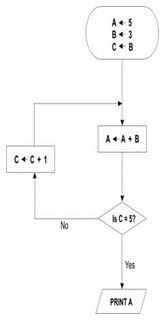
Question. What value of A will be printed if flowchart shown in the image , is executed?(A← 5 means that the value of A is set to 5)
(a) 8
(b) 12
(c) 10
(d) 17
Answer : C
Question. The graph of y = p is shown in the adjoining image. Which of the following depicts the graph of y = p - 2?

Answer : B
Question. Mrs. Nair opts for a mobile phone offer that charges a monthly fee of Rs. 250 plus a charge of Rs. 1.25 per minute for local calls.She fixes a budget of Rs. 400 per month for her mobile phone bill. At most how many minutes can she use the phone (local) each month while staying within her budget
(a) 100
(b) 110
(c) 120
(d) 150
Answer : C
Question. The graph in the adjoining image shows the average maximum and minimum monthly temperatures in Ahmedabad in a year.In which of the following periods did the average maximum temperature record a steady fall?

(a) July to Sep
(b) Sep to Nov
(c) Feb to Apr
(d) May to July
Answer : D
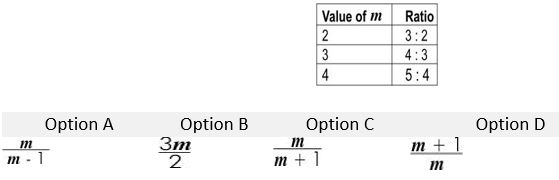
Question. The ratio of the sum of the first m even natural numbers to that of the first m odd numbers is given in the table. According to this, the ratio of the sum of the first m even numbers and that of the first m odd numbers is given by the expression
Answer : D
Question. While doing her Physics homework, Archana has to use the formula 1/R = 1/R1+ 1/R2 . How could she rewrite this formula to get the correct value of R2 when R and R1 are given?
(a) R2 = R - R1
(b) R2 = 1/(R-R1)
(c) R2 = (R-R1-RR1)
(d) R2 = RR1/(R1-R)
Answer : D
Question. A painter is able to paint a flat in 8 days. How many days would it have taken to paint the flat if he had two more painters working with him - one working at the same speed as him, and another working at double that speed ?
(a) 11
(b) 5
(c) 4
(d) 2
Answer : D
Question. The ratio of the height of two plants X and Y is 2:1. If plant X grows at the rate of 2 metres per year, at what rate should plant Y grow so that after 4 years they are of the same height?
(a) 1.5 metres per year
(b) 2.25 metres per year
(c) 2.5 metres per year
(d) It will vary depending on the height of Y.
Answer : D
Question. The light signals at a traffic crossing (in a particular direction) were timed in such a way that the traffic had the 'STOP' signal for s seconds and the 'GO' signal for g seconds. Rajat stopped at the signal when the light had just turned RED. Due to heavy traffic at the crossing, he misses the green signal twice and starts exactly when the light turns GREEN the third time. For how many seconds was he at the crossing?
(a) 2s + g
(b) 2(s + g)
(c) 3s + 2g
(d) 3(s + g)
Answer : C
Question. Jamal's house (J) and Tarang's house (T) are 10 km apart on a straight road. One day, both of them started from their houses at the same moment and met on the road after half an hour. If Jamal walked 2 km/hr faster than Tarang, which diagram correctly shows the position of their meeting point, P?

Answer : C
Question. A cake is cut into 3 pieces whose weights are in the ratio 2:1:4.If the third piece weighs 360 g more than the second, how much did the whole cake weigh?
(a) 1.44 kg
(b) 1.26 kg
(c) 840 g
(d) 630 g
Answer : C
Question. If 1/x = 2/y-2 then y is equal to
(a) 2/(x + 2)
(b) 2/2(x + 2)
(c) (x + 2)/2
(d) 2x + 2
Answer : D
ASSERTION & REASONING QUESTIONS
DIRECTION : In the following questions, a statement of assertion (A) is followed by a
statement of reason (R) . Mark the correct choice as:
(a) Both assertion (A) and reason (R) are true and reason (R) is the correct explanation of assertion (A) .
(b) Both assertion (A) and reason (R) are true but reason (R) is not the correct explanation of assertion (A) .
(c) Assertion (A) is true but reason (R) is false.
(d) Assertion (A) is false but reason (R) is true.
Question. Assertion : A linear equation 3x + 5y = 2 has a unique solution.
Reason : A linear equation in two variables has infinitely many solutions.
(a) Both assertion (A) and reason (R) are true and reason (R) is the correct explanation of assertion (A) .
(b) Both assertion (A) and reason (R) are true but reason (R) is not the correct explanation of assertion (A) .
(c) Assertion (A) is true but reason (R) is false.
(d) Assertion (A) is false but reason (R) is true.
Answer : We know that a linear equation in two variables has infinitely many solutions.
So, Reason is correct.
Hence, Assertion is not correct
Correct option is (d) Assertion (A) is false but reason (R) is true.
Question. Assertion: x = 2 is a line parallel to the y-axis.
Reason: The equation of a line parallel to the y-axis is x = a.
(a) Both assertion (A) and reason (R) are true and reason (R) is the correct explanation of assertion (A) .
(b) Both assertion (A) and reason (R) are true but reason (R) is not the correct explanation of assertion (A) .
(c) Assertion (A) is true but reason (R) is false.
(d) Assertion (A) is false but reason (R) is true.
Answer : We know that equation of a line parallel to the y-axis is x = a.
So, Reason (R) is true.
Also, x = 2 is a line parallel to the y-axis.
So, Assertion (A) is true.
Thus, Reason (R) and Assertion (A) are true and Reason (R) is a correct explanation of Assertion (A) .
Correct option is (a) Both assertion (A) and reason (R) are true and reason
(R) is the correct explanation of assertion (A) .
Question. Assertion: x = 3 and y = 2 is a solution of the linear equation 2x + 3y = 12.
Reason: x = 4 and y = 2 is a solution of the linear equation x + 3y = 10.
Answer : For Assertion: The given linear equation is 2x + 3y = 12
Substituting x = 3 and y = 2, we get
LHS = 2 x 3 + 3 x 2 = 6 + 6 = 12 = RHS
So, Assertion is correct.
For Reason: The given linear equation is x + 3y = 10
Substituting x = 4 and y = 2, we get
LHS = 4 + 3 x 2 = 4 + 6 = 10 = RHS
So, Reason is also correct.
But reason (R) is not the correct explanation of assertion (A) .
Correct option is (b) Both assertion (A) and reason (R) are true and reason (R) is not the correct explanation of assertion (A) .
Question. Assertion: x + y = 3 is the equation of a line passing through the origin.
Reason: y = 2x is the equation of a line passing through the origin.
(a) Both assertion (A) and reason (R) are true and reason (R) is the correct explanation of assertion (A) .
(b) Both assertion (A) and reason (R) are true but reason (R) is not the correct explanation of assertion (A) .
(c) Assertion (A) is true but reason (R) is false.
(d) Assertion (A) is false but reason (R) is true.
Answer : For Assertion: The given linear equation is x + y = 3
Since x = 0 and y = 0 is not satisfying x + y = 3, therefore it is not passing through the origin.
So, Assertion is not correct.
Since x = 0 and y = 0 is not satisfying y = 2x, therefore it is passing through the origin.
So, Reason is correct.
Correct option is (d) Assertion (A) is false but reason (R) is true.
Question. Assertion : If x = 2, y = 1 is a solution of the equation 2x + 3y = k, then the value of k is 7.
Reason : The solution of the line will satisfy the equation of the line
(a) Both assertion (A) and reason (R) are true and reason (R) is the correct explanation of assertion (A) .
(b) Both assertion (A) and reason (R) are true but reason (R) is not the correct explanation of assertion (A) .
(c) Assertion (A) is true but reason (R) is false.
(d) Assertion (A) is false but reason (R) is true.
Answer : We know that the solution of the line will satisfy the equation of the line.
So, Reason is correct.
Since x = 2, y =1 is a solution of the given linear equation, we have
2 x 2 + 3 x 1 – k = 0 ⇒ 4 + 3 – k = 0 ⇒ k =7.
So, Assertion is also correct
Correct option is (a) Both assertion (A) and reason (R) are true and reason (R) is the correct explanation of assertion (A) ..
Question. Assertion : There are infinite number of lines which passes through (3, 2) .
Reason : A linear equation in two variables has infinitely many solutions.
(a) Both assertion (A) and reason (R) are true and reason (R) is the correct explanation of assertion (A) .
(b) Both assertion (A) and reason (R) are true but reason (R) is not the correct explanation of assertion (A) .
(c) Assertion (A) is true but reason (R) is false.
(d) Assertion (A) is false but reason (R) is true.
Answer : We know that a linear equation in two variables has infinitely many solutions. So, Reason is correct.
Through a point infinite lines can be drawn.
Through (3, 2) infinite number of lines can be drawn.
Hence, Assertion is also correct.
But reason (R) is not the correct explanation of assertion (A) .
Correct option is (b) Both assertion (A) and reason (R) are true and reason
(R) is not the correct explanation of assertion (A) .
Question. Assertion: y = 3x represents a line passing through the origin.
Reason: Any line parallel to the x-axis is y = a.
(a) Both assertion (A) and reason (R) are true and reason (R) is the correct explanation of assertion (A) .
(b) Both assertion (A) and reason (R) are true but reason (R) is not the correct explanation of assertion (A) .
(c) Assertion (A) is true but reason (R) is false.
(d) Assertion (A) is false but reason (R) is true.
Answer : Since x = 0 and y = 0 is not satisfying y = 3x, therefore it is passing through the origin.
So, Assertion (A) is true.
Also, we know that equation of a line parallel to the x-axis is y = a.
So, Reason (R) is also true.
But Reason is not the correct explanation of Assertion.
Correct option is (b) Both assertion (A) and reason (R) are true and reason
(R) is not the correct explanation of assertion (A) .
Question. Assertion : If x = 2k – 1 and y = k is a solution of the equation 3x – 5y – 7 = 0, then the value of k is 10
Reason : A linear equation in two variables has infinitely many solutions.
(a) Both assertion (A) and reason (R) are true and reason (R) is the correct explanation of assertion (A) .
(b) Both assertion (A) and reason (R) are true but reason (R) is not the correct explanation of assertion (A) .
(c) Assertion (A) is true but reason (R) is false.
(d) Assertion (A) is false but reason (R) is true.
Answer : We know that a linear equation in two variables has infinitely many solutions. So, Reason is correct.
Since x = 2k - 1 and y = k is solution of the given linear equation, we have
3 x (2k – 1) – 5k – 7 = 0 ⇒ 6k – 3 – 5k – 7 = 0 ⇒ k – 10 = 0 ⇒ k = 10.
So, Assertion is also correct
But reason (R) is not the correct explanation of assertion (A) .
Correct option is (b) Both assertion (A) and reason (R) are true and reason (R) is not the correct explanation of assertion (A) .
Question. Assertion: x = 3 and y = 2 is a solution of the linear equation 2x + 3y = 12.
Reason: x = 4 and y = 2 is a solution of the linear equation x + 3y = 10.
Answer : For Assertion: The given linear equation is 2x + 3y = 12
Substituting x = 3 and y = 2, we get
LHS = 2 x 3 + 3 x 2 = 6 + 6 = 12 = RHS
So, Assertion is correct.
For Reason: The given linear equation is x + 3y = 10
Substituting x = 4 and y = 2, we get
LHS = 4 + 3 x 2 = 4 + 6 = 10 = RHS
So, Reason is also correct.
But reason (R) is not the correct explanation of assertion (A) .
Correct option is (b) Both assertion (A) and reason (R) are true and reason (R) is not the correct explanation of assertion (A) .
Question. Assertion : The point (2, 2) is the solution of x + y = 4.
Reason : Every point which satisfy the linear equation is a solution of the equation.
Answer : We know every point which satisfy the linear equation is a solution of the equation.
So, Reason (R) is true.
Substituting x = 2 and y = 2, we get
LHS = 2 + 2 = 4 = RHS
Since (3, 0) satisfies the equation 4x + 3y = 12, therefore the point (2, 2) is the solution of x + y = 4
So, Assertion (A) is also true.
Here, Reason is the correct explanation of Assertion.
Correct option is (a) Both assertion (A) and reason (R) are true and reason
(R) is the correct explanation of assertion (A) .
Question. Assertion : The graph of the linear equation 2x – y = 1 passes through the point (2, 3) .
Reason : Every point lying on graph is not a solution of 2x – y = 1.
(a) Both assertion (A) and reason (R) are true and reason (R) is the correct explanation of assertion (A) .
(b) Both assertion (A) and reason (R) are true but reason (R) is not the correct explanation of assertion (A) .
(c) Assertion (A) is true but reason (R) is false.
(d) Assertion (A) is false but reason (R) is true.
Answer : For Assertion: The given linear equation is 2x – y = 1
Substituting x = 2 and y = 3, we get
LHS = 2 x 2 – 3 = 4 – 3 = 1 = RHS
Since (3, 0) satisfies the equation 4x + 3y = 12, therefore graph of the
linear equation 2x – y = 1 passes through the point (2, 3) .
So, Assertion is correct.
But Reason is not correct as every point lying on graph is a solution of
2x – y = 1.
Correct option is (c) Assertion (A) is true but reason (R) is false.
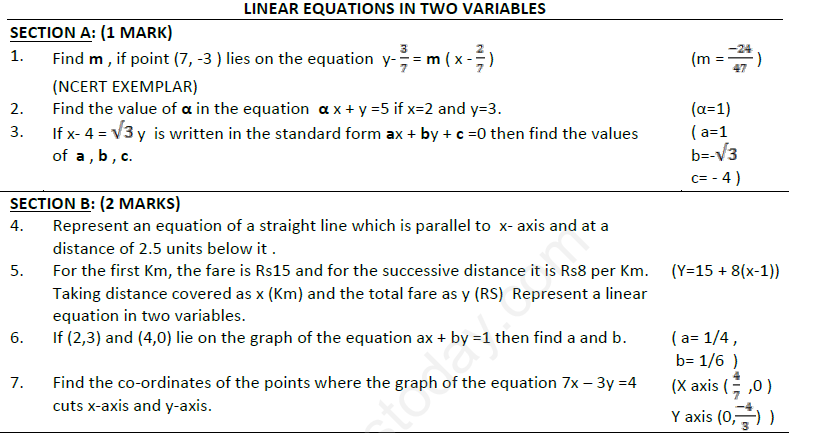

Please click the link below to download CBSE Class 9 Mathematics Linear Equations in two variables Assignment Set A
Free study material for Mathematics
CBSE Class 9 Mathematics Assignments for Chapter 04 Linear Equations In Two Variables
Chapter Practice Questions for Class 9 Mathematics
Explore reliable practice questions for Chapter 04 Linear Equations In Two Variables tailored for Class 9 learners. Use these structured worksheets to evaluate preparedness and strengthen core problem-solving skills.
Why Practice Class 9 Mathematics Assignments?
- Exam Alignment: Questions strictly follow contemporary CBSE sample papers and grading schemes.
- Comprehensive Coverage: Features objective drills, case studies, and structured descriptive problems for Chapter 04 Linear Equations In Two Variables.
- Pacing & Precision: Regular problem-solving builds critical calculation speed and test-taking accuracy.
Effective Strategy for Class 9 Mathematics Assignments
- Textbook Review: Always study the core NCERT book for Class 9 Mathematics prior to beginning the assignment.
- Independent Attempt: Solve Chapter 04 Linear Equations In Two Variables questions on your own initially before cross-checking with expert solutions.
- Error Tracking: Record challenging concepts in a dedicated notebook and practice online MCQ tests for revision.
FAQs
You can download free PDF assignments for Class 9 Mathematics Chapter 04 Linear Equations In Two Variables from StudiesToday.com. These practice sheets have been updated for the 2026-27 session covering all concepts from latest NCERT textbook.
Yes, our teachers have given solutions for all questions in the Class 9 Mathematics Chapter 04 Linear Equations In Two Variables assignments. This will help you to understand step-by-step methodology to get full marks in school tests and exams.
Yes. These assignments are designed as per the latest CBSE syllabus for 2026. We have included huge variety of question formats such as MCQs, Case-study based questions and important diagram-based problems found in Chapter 04 Linear Equations In Two Variables.
Practicing topicw wise assignments will help Class 9 students understand every sub-topic of Chapter 04 Linear Equations In Two Variables. Daily practice will improve speed, accuracy and answering competency-based questions.
Yes, all printable assignments for Class 9 Mathematics Chapter 04 Linear Equations In Two Variables are available for free download in mobile-friendly PDF format.