

Download CBSE Class 9 Mathematics Assignments
Access comprehensive school assignments for Chapter 06 Lines And Angles using the CBSE Class 9 Mathematics Lines and Angles Assignment Set 01. Designed to align with the 2026-27 CBSE academic guidelines, these practice sets help Class 9 Mathematics students reinforce core concepts and improve their problem-solving accuracy.
Access CBSE School Assignments and Answers
View or download the dedicated CBSE Class 9 Mathematics Lines and Angles Assignment Set 01 resource below. Engaging with these assignments under focused study conditions ensures continuous academic progress and mastery of the 2026-27 curriculum.
Lines and Angles
ASSERTION & REASONING QUESTIONS
DIRECTION : In the following questions, a statement of assertion (A) is followed by a statement of reason (R). Mark the correct choice as:
(a) Both assertion (A) and reason (R) are true and reason (R) is the correct explanation of assertion (A).
(b) Both assertion (A) and reason (R) are true but reason (R) is not the correct explanation of assertion (A).
(c) Assertion (A) is true but reason (R) is false.
(d) Assertion (A) is false but reason (R) is true.
Question. Assertion: Two angles measures a – 60° and 123° – 2a. If each one is opposite to equal sides of an isosceles triangle, then the value of a is 61°.
Reason: Sides opposite to equal angles of a triangle are equal.
Answer : We know that Sides opposite to equal angles of a triangle are equal.
So, Reason is correct.
Since angles opposite to equal sides of an isosceles triangle are equal, therefore a – 60° = 123° – 2a
⇒ 3a = 123° + 60° = 183°
⇒ a = = 61°
So, Assertion is also correct.
But reason (R) is not the correct explanation of assertion (A)
Correct option is (b) Both assertion (A) and reason (R) are true and reason
(R) is not the correct explanation of assertion (A) .
Question. Assertion : In ΔABC, AB = AC and ∠B = 50⁰, then ∠C is 50⁰.
Reason : Angles opposite to equal sides of a triangle are equal.
(a) Both assertion (A) and reason (R) are true and reason (R) is the correct explanation of assertion (A) .
(b) Both assertion (A) and reason (R) are true but reason (R) is not the correct explanation of assertion (A) .
(c) Assertion (A) is true but reason (R) is false.
(d) Assertion (A) is false but reason (R) is true.
Answer : We know that Angles opposite to equal sides of a triangle are equal.
So, Reason is correct.
Now, In ΔABC, AB = AC
∠B = ∠C (Angles opposite to equal sides)
⇒ ∠C = 50⁰
So, Assertion is also correct.
Correct option is (a) Both assertion (A) and reason (R) are true and reason
(R) is the correct explanation of assertion (A) .
Question. Assertion : If the altitudes from two vertices of a triangle to the opposite sides are equal, then the triangle is an isosceles triangle.
Reason: If two angles and one side of one triangle are equal to two angles and the corresponding side of the other triangle, then the two triangles are congruent.
Answer : We know that “If two angles and one side of one triangle are equal to two angles and the corresponding side of the other triangle, then the two triangles are congruent.” – This is AAS Congruence Rule
So, Reason is correct
In △ABL and △ACM,
BL = CM (Given)
∠BAL = ∠CAM (Common angle)
∠ALB = ∠AMC = 90°
∴ △ABL ≅ △ACM (AAS criterion)
Hence, ΔABC is an isosceles triangle.
So, Assertion (A) is also true.
Correct option is (a) Both assertion (A) and reason (R) are true and reason (R) is the correct explanation of assertion (A) .
Question. Assertion : In triangles ABC and PQR,∠A = ∠P, ∠C = ∠R and AC = PR. The two triangles are congruent by ASA congruence.
Reason : If two angles and the included side of one triangle are equal to two angles and the included side of the other triangle, then the two triangles are congruent.
Answer : We know that “If two angles and the included side of one triangle are equal to two angles and the included side of the other triangle, then the two triangles are congruent.” – This is ASA Congruence Rule
So, Reason is correct
Now, In triangles ABC and PQR,∠A = ∠P, ∠C = ∠R and AC = PR.
∴ By ASA congruence criteria, Δ ABC ≅ Δ PQR
So, Assertion is also correct.
Correct option is (a) Both assertion (A) and reason (R) are true and reason (R) is the correct explanation of assertion (A) .
Question. Assertion : ΔABC and ΔDBC are two isosceles triangles on the same base BC and vertices A and D are on the same side of BC. If AD is extended to intersect BC at E, then ΔABD ≅ ΔACD
Reason : If in two right triangles, hypotenuse and one side of a triangle are equal to the hypotenuse and one side of other triangle, then the two triangles are congruent.
Answer : We know that “If in two right triangles, hypotenuse and one side of a triangle are equal to the hypotenuse and one side of other triangle, then the two triangles are congruent.” – This is RHS Congruence Rule
So, Reason is correct
In ΔABD and ΔACD,
BD = CD (Given)
AB = AC (Given)
and AD = AD (Common side)
∴ By SSS congruence criteria, ΔABD ≅ ΔACD
So, Assertion is also correct.
Correct option is (b) Both assertion (A) and reason (R) are true and reason (R) is not the correct explanation of assertion (A) .
Question. Assertion : In ΔABC, D is the midpoint of BC. If DL ⊥ AB and DM ⊥ AC such that DL = DM, then BL = CM
Reason : If two angles and the included side of one triangle are equal to two angles and the included side of the other triangle, then the two triangles are congruent.
Answer : We know that “If two angles and the included side of one triangle are equal to two angles and the included side of the other triangle, then the two
triangles are congruent.” - This is ASA Congruence Rule. So, Reason is correct.
In △BDL and △CDM, we have
BD = CD (D is midpoint)
DL = DM (Given)
and ∠BLD = ∠CMD (90° each)
∴ △BDL ≅ △CDM (RHS criterion) ⇒ BL = CM (CPCT)
So, Assertion is also correct
Correct option is (b) Both assertion (A) and reason (R) are true and reason (R) is not the correct explanation of assertion (A) .
Question. Assertion: In ABC, ∠A = ∠ C and BC = 4 cm and AC = 3 cm then the length of side AB = 3 cm.
Reason: Sides opposite to equal angles of a triangle are equal.
Answer : We know that Sides opposite to equal angles of a triangle are equal.
So, Reason is correct.
Now, In ΔABC, ∠A = ∠C (Given)
AB = CB (Sides opposite to equal sides)
⇒ AB = 4 cm
So, Assertion is not correct.
Correct option is (d) Assertion (A) is false but reason (R) is true.
Question. Assertion: In the given figure, BE and CF are two equal altitudes of ΔABC then ΔABE ≅ ΔACF
Reason: If two angles and one side of one triangle are equal to two angles and the corresponding side of the other triangle, then the two triangles are congruent.
Answer : We know that “If two angles and one side of one triangle are equal to two angles and the corresponding side of the other triangle, then the two triangles are congruent.” – This is AAS Congruence Rule
So, Reason (R) is true.
In △ABE and △ACF, we have
BE = CF (Given)
∠BEA = ∠CFA = 90°
∠A = ∠A (Common)
∴ △ABE ≅ △ACF (By AAS Congruence rule)
So, Assertion (A) is also true.
Correct option is (a) Both assertion (A) and reason (R) are true and reason
(R) is the correct explanation of assertion (A) .
Question. Assertion : In the adjoining figure, X and Y are respectively two points on equal sides AB and AC of ΔABC such that AX = AY then CX = BY.
Reason : If two sides and the included angle of one triangle are equal to two sides and the included angle of the other triangle, then the two triangles are congruent
Answer : We know that “If two sides and the included angle of one triangle are equal to two sides and the included angle of the other triangle, then the two triangles are congruent” - This is SAS Congruence Rule.
So, Reason is correct.
In △AXC and △AYB, we have
AC = AB (Given)
AX = AY (Given)
and ∠BAC = ∠CAB (Common)
∴ △AXC ≅ △AYB (SAS criterion) ⇒ CX = BY (CPCT)
So, Assertion is also correct
Correct option is (a) Both assertion (A) and reason (R) are true and reason (R) is the correct explanation of assertion (A) .
Question. Assertion : In ΔABC and ΔPQR, AB = PQ, AC = PR and ∠BAC = ∠QPR then ΔABC ≅ ΔPQR
Reason : Both the triangles are congruent by SSS congruence.
(a) Both assertion (A) and reason (R) are true and reason
(R) is the correct explanation of assertion (A) .
(b) Both assertion (A) and reason (R) are true but reason
(R) is not the correct explanation of assertion (A) .
(c) Assertion (A) is true but reason (R) is false.
(d) Assertion (A) is false but reason (R) is true.
Answer : In ΔABC and ΔPQR,
AB = PQ, AC = PR and ∠BAC = ∠QPR (Given)
then ΔABC ≅ ΔPQR by ASA Congruence Rule
So, Assertion (A) is true.
But Reason (R) is false.
Correct option is (c) Assertion (A) is true but reason (R) is false.
Question. Assertion : In ΔABC, BC = AB and ∠B = 80°. Then, ∠A = 50°
Reason : In a triangle, angles opposite to two equal sides are equal.
Answer : We know that “In a triangle, angles opposite to two equal
sides are equal.”
So, Reason is correct.
In ΔABC, AB = BC
⇒ ∠A = ∠C (Angles opposite to equal sides)
Let ∠A = ∠C = x
Using angle sum property of a triangle,
∠A + ∠B + ∠C = 180° ⇒ x + 80°+ x = 180° ⇒ 2x = 180°− 80°
⇒ 2x = 100° ⇒ x = 50° ⇒ ∠A = 50°
So, Assertion is also correct
Correct option is (a) Both assertion (A) and reason (R) are true and reason (R) is the correct explanation of assertion (A) .
Question. Assertion : Angles opposite to equal sides of a triangle are not equal.
Reason : Sides opposite to equal angles of a triangle are equal.
(a) Both assertion (A) and reason (R) are true and reason (R) is the correct explanation of assertion (A) .
(b) Both assertion (A) and reason (R) are true but reason (R) is not the correct explanation of assertion (A) .
(c) Assertion (A) is true but reason (R) is false.
(d) Assertion (A) is false but reason (R) is true.
Answer : We know that Angles opposite to equal sides of a triangle are equal.
So, Assertion is not correct.
Also, we know that Sides opposite to equal angles of a triangle are equal.
So, Reason is correct.
Correct option is (d) Assertion (A) is false but reason (R) is true.
Question. Assertion : In the given figure, ABCD is a quadrilateral in which AB || DC and P is the midpoint of BC. On producing, AP and DC meet at Q then DQ = DC + AB.
Reason : If two sides and the included angle of one triangle are equal to two sides and the included angle of the other triangle, then the two triangles are congruent
Answer : We know that “If two sides and the included angle of one triangle are equal to two sides and the included angle of the other triangle, then the two triangles are congruent” - This is SAS Congruence Rule.
So, Reason is correct.
In △ABP and △QCP, we have
∠BPA = ∠CPQ (Vertically opposite angle)
∠PAB = ∠PQC (Alternate angles)
and PB = PC (P is the midpoint)
∴ △ABP ≅ △QCP (AAS criterion) ⇒ AB = CQ (CPCT)
Now, DQ = DC + CQ ⇒ DQ = DC + AB (AB = CQ prove above)
So, Assertion is also correct
Correct option is (b) Both assertion (A) and reason (R) are true but reason (R) is not the correct explanation of assertion (A) .
Question. Assertion : In ΔABC, ∠C = ∠A, BC = 4 cm and AC = 5 cm. Then, AB = 4 cm
Reason : In a triangle, angles opposite to two equal sides are equal.
Answer : We know that “In a triangle, angles opposite to two equal sides are equal.”
So, Reason is correct.
In ΔABC, ∠C = ∠A (Given)
Therefore, BC = AB (Sides opposite to equal angles.)
⇒ BC = AB = 4 cm
So, Assertion is also correct
But reason (R) is not the correct explanation of assertion (A) .
Correct option is (b) Both assertion (A) and reason (R) are true but reason (R) is not the correct explanation of assertion (A) .
QUESTION
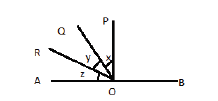
1. In the given figure PO is perpendicular to AB. If x: Y: Z = 1:3:5,then find the degree measure of x,y & z.
2. Prove that if two lines intersect each other, then the vertically opposite angles are equal.
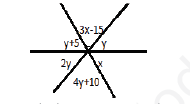
3. In the figure if y =200 , prove that the line AOB is a straight line.
4. Two complementary angles are such that two times the measure of one angle is equal to three times the measure of the other .Find the measure of the larger angle.ss
5. Find the supplement of 4/3 of right angle.
6. If (3x-580) &(x+380) are supplementary angles. Find x & the angles.
7. Out of the four angles formed by two intersecting lines, one is 900. Prove that the other three angles will be 900 each.
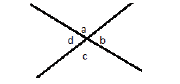
8. Lines PQ &RS intersect each other at O. If ∠POR:∠ROQ =3:7.Find the angles a, b, c & d.
9. If two lines are perpendicular to the same line. Prove that they are parallel to each other.
10. If l,m,n are three lines such that l is parallel to m & n is perpendicular to l , then prove that n is perpendicular to m.
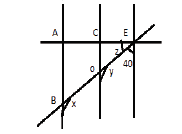
11. In figure AB‖CD & CD‖EF. ALSO EA is perpendicular to AB. If ∠BEF=400.Then find x, y, z.
12. EF is a transversal to two parallel lines AB& CD .GM & HL are the bisectors of the corresponding angles∠ EGB &∠EHD. Prove that GM‖HL.
13. AB & CD are the bisectors of the two alternate interior angles formed by the intersection of a transversal ‘t’ with parallel lines ‘l’ & ‘m’.Show that AB‖CD.
14. Prove that if one angle of a triangle is equal to the sum of the other two angles, the triangle is right angled triangle.
15. In the given figure find a+b.
16. The sides BA & DC of a quadrilateral ABCD are produced as shown in figure. Show that ∠x +∠y =∠a+∠b.
17. In figure, find the value of x.
18. In figure AP &DP are bisectors of two adjacent angles A & D of a quadrilateral ABCD .Prove that 2∠APD =∠B+∠C.
19. If the side BC of a triangle ABC is produced to D. The bisectors of ∠BAC intersects the side BC at E. Prove that ∠ABC +∠ACD=2∠AEC.
20. Prove that the sum of the angles of a hexagon is 7200.
21.In figure PS is the bisector of ∠QPR & PT is perpendicular to QR. Show that ∠TPS = ½ (∠Q-∠R).
22. Two parallel lines are intersected by a transversal. Then, prove that the bisector of two pair of interior angles enclose a rectangle.
23. The bisectors of ∠ABC & ∠BCA intersect each other at point O. Prove that ∠BOC = 900+1/2∠A.
24. The sides AB & AC of a triangle ABC are produced to point E &D respectively. If bisectors BO & CO of ∠CBE & ∠BCD respectively meet at point O, then prove that ∠BOC = 900- ½ ∠BAC.
25. The side AB & AC of triangle ABC are produced to points P & Q respectively. If bisectors BO & CO of ∠CBP & ∠BCQ respectively meet at O, then prove that ∠BOC = ½(y+z).
26. ABCD is a quadrilateral & bisectors of ∠A & ∠D meet at O. Prove that ∠AOD =1/2(∠B+∠C).
27. What is the value of y, if P & q are parallel to each other?
Please click the link below to download CBSE Class 9 Mathematics Lines and Angles Assignment Set A
Free study material for Mathematics
Download Practice Assignments: Class 9 Mathematics Chapter 06 Lines And Angles
Chapter Practice Questions for Class 9 Mathematics
Review targeted chapter assignments for Class 9 Mathematics Chapter 06 Lines And Angles. Built according to official CBSE guidelines, these downloadable problem sets help students build accuracy and prepare effectively for school tests.
Key Advantages of Solving Chapter 06 Lines And Angles Assignments
- Exam Alignment: Questions strictly follow contemporary CBSE sample papers and grading schemes.
- Comprehensive Coverage: Features objective drills, case studies, and structured descriptive problems for Chapter 06 Lines And Angles.
- Pacing & Precision: Regular problem-solving builds critical calculation speed and test-taking accuracy.
Effective Strategy for Class 9 Mathematics Assignments
- Textbook Review: Always study the core NCERT book for Class 9 Mathematics prior to beginning the assignment.
- Independent Attempt: Solve Chapter 06 Lines And Angles questions on your own initially before cross-checking with expert solutions.
- Error Tracking: Record challenging concepts in a dedicated notebook and practice online MCQ tests for revision.
FAQs
You can download free PDF assignments for Class 9 Mathematics Chapter 06 Lines And Angles from StudiesToday.com. These practice sheets have been updated for the 2026-27 session covering all concepts from latest NCERT textbook.
Yes, our teachers have given solutions for all questions in the Class 9 Mathematics Chapter 06 Lines And Angles assignments. This will help you to understand step-by-step methodology to get full marks in school tests and exams.
Yes. These assignments are designed as per the latest CBSE syllabus for 2026. We have included huge variety of question formats such as MCQs, Case-study based questions and important diagram-based problems found in Chapter 06 Lines And Angles.
Practicing topicw wise assignments will help Class 9 students understand every sub-topic of Chapter 06 Lines And Angles. Daily practice will improve speed, accuracy and answering competency-based questions.
Yes, all printable assignments for Class 9 Mathematics Chapter 06 Lines And Angles are available for free download in mobile-friendly PDF format.