

Class 9 Mathematics Practice Assignments: CBSE Class 9 Mathematics Circle Assignment Set 01
Review targeted academic assignments with the CBSE Class 9 Mathematics Circle Assignment Set 01. Built according to official CBSE standards for the 2026-27 term, these downloadable Class 9 Mathematics worksheets support effective daily practice for Chapter 09 Circle.
Download Chapter 09 Circle Assignment PDF with Solutions
Navigate directly to the solved Mathematics assignments using the digital viewer below. Each practice set includes detailed step-by-step solutions, allowing students to instantly cross-check their work and identify areas requiring further revision.
1 AB is a chord of a circle wit h centre 0 and radius 17 cm. lf OM ⊥ AB and OM = 8 cm, find the length of chord AB.
(A) 12 cm
(B) 30 cm
(C) 15 cm
(D) 24 cm
Answer : B
2 AB is a chord of length 24 cm of a circle with centre 0 and radius 13 cm. Find the distance of the chord from the centre.
(A) 5 cm
(B) 6 cm
(C) √407 cm
(D) 25 cm
Answer : A
3 48 em long chord of a circle is at a distance of 7 em from the centre. Find the radius of the circle.
(A) 5 cm
(B) 17 cm
(C) 25 cm
(D) 16 cm
Answer : C
4 A chord of a circle is 12 cm in length and its distance from the centre is 8 cm. Find the length of the chord of the same circle which is at a distance of 6 em from the centre.
(A) 30 cm
(B) 24 cm
(C) 16 cm
(D) 18 cm
Answer : C
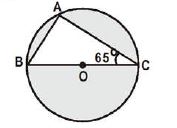
5 In the given figure, ΔABC is inscribed in a circle with centre O. lf ∠ACB = 65°, find ∠ABC.
(A) 25°
(B) 35°
(C) 90°
(D) 65°
Answer : A
6 An equilateral ΔPQR is inscribed in a circle with centre 0. Find ∠QOR.
(A) 60°
(B) 120°
(C) 30°
(D) 90°
Answer : B
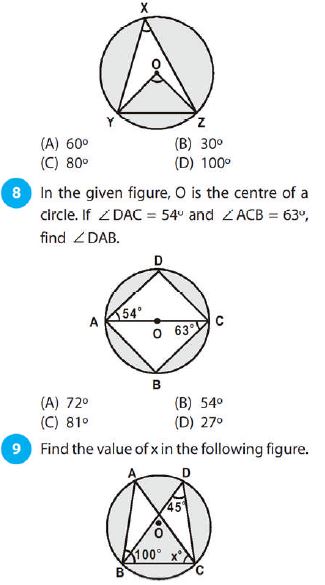
7 In the given figure, ΔXYZ is inscribed in a circle wit h centre O. lf the length of the chord YZ is equal to the radius of the circle OY, find the measure of ∠YXZ.
(A) 45°
(B) 35°
(C) 60°
(D) 55°
Answer 7: B
Answer 8: C
Answer 9: B
10 What is the least number of noncollinear points required t o draw a circle passing through them?
(A) Two
(B) Three
(C) Four
(D) Nine
Answer : B
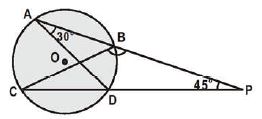
11 Two chords AB and CD of a circle cut each other when produced outside the circle at P. AD and BC are joined. If ∠BAD= 30° and ∠CPA = 45°, find ∠CBP.
(A) 105°
(B) 115°
(C) 135°
(D) 75°
Answer : A
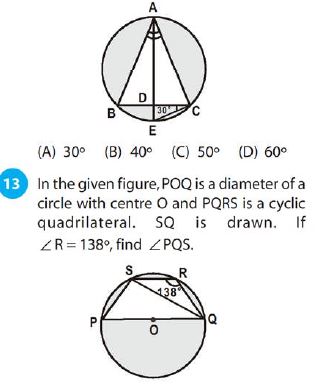
12 In the given figure, ΔABC is inscribed in a circle. The bisector of ∠BAC meets BC at D and t he circle at E. If EC is joined and ∠ECD = 30°, find ∠BAC.
(A) 90°
(B) 42°
(C) 48°
(D) 38°
Answer 12: D
Answer 13: C
14 The circumference of a circle is 60 cm. An arc subtends 90° at the centre. Find its length.
(A) 10 cm
(C) 20 cm
(B) 15 cm
(D) 25 cm
Answer : B
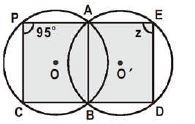
15 Two circles intersect in A and B. Quadrilaterals PCBA and ABDE are inscribed in these circles such that PAE and CBD are line segments. If ∠P is 95° find the value of z.
(A) 65°
(B) 105°
(C) 95°
(D) 85°
Answer : D
16 A circle is divided into 12 equal parts.
What is the measure of central angle in each arc?
(A) 30°
(B) 60°
(C) 45°
(D) 48°
Answer : A
17 In a circle, the major arc is twice the minor arc. What are the corresponding central angles and the degree measures of the two arcs?
(A) 90° and 270°
(B) 60° and 300°
(C) 240° and 120°
(D) 140° and 220°
Answer : C
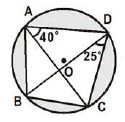
18 In the given figure,ABCD is a quadrilateral inscribed in a circle. Diagonals AC and BD are drawn. If ∠CAD = 40° and ∠BDC = 25°, find ∠BCD.
(A) 85°
(B) 120°
(C) 115°
(D) 95°
Answer : C
19 A circle with radius 2 units is intersected by a line at points R and T. Find the maximum possible distance between R andT.
(A) 1 unit
(B) 2 n unit s
(C) 4 n unit s
(D) 4 units
Answer : D
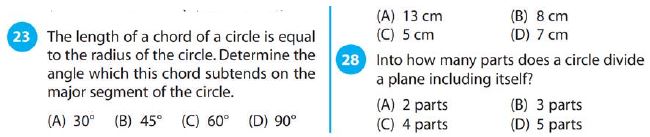
Answer 20: D
Answer 21: C
Answer 22: D
Answer 23: A
Answer 24: D
Answer 25: A
Answer 26: C
Answer 27: A
Answer 28: B
29 Given two concentric circles with centre 0. A line cuts the circles at A, B, C and D respectively. If AB == 10 cm, find the length of CD.
(A) 5 cm
(B) 10 cm
(C) 7.5 cm
(D) 15 cm
Answer : B
30 A chord of a circle divides the circular region into two parts. What is the region that contains the centre?
(A) Minor Arc
(B) Major Arc
(C) Minor Segment
(D) Major Segment
Answer : D
31 In the given figure, find the value of y.
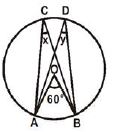
(A) 35 °
(B) 60° + X0
(C) 60° - X0
(D) 120°
Answer : C
32 An equilateral ΔABC is inscribed in a circle with centre 0. Find the measure of ∠BOC.
(A) 110°
(B) 100°
(C) 120°
(D) 130°
Answer : C
33 In the given figure, ABDC is a cyclic quadrilateral and AB = AC If ∠ACB = 70°, find ∠BDC.
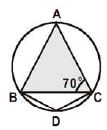
(A) 1 00°
(B) 70°
(C) 140°
(D) 40°
Answer : C
34 When are two circles said to be concentric?
(A) If they have the same radius.
(B) If they have different radii.
(C) If they have the same centre.
(D) If their centres are collinear.
Answer : C
35 In the given figure, PaR = SRQ.
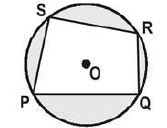
Which of the following is correct?
(A) PQ ≠ SR
(B) PS = QR
(C) PQ = SR
(D) PS ≠ QR
Answer : C
36 is the centre of a circle, ∠BOA = 90° and ∠COA = 110°. Find the measure of ∠BAC.
(A) 70 °
(B) 80°
(C) 120°
(D) 50°
Answer : B
37 In the given figure, 0 is the centre of the circle, OM ⊥ BC, OL ⊥ AB, ON ⊥ AC and OM = ON = OL. What is ΔABC?
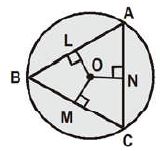
(A) Right angled triangle
(B) Scalene triangle
(C) Isosce les triangle
(D) Equilateral triangle
Answer : D
38 In the given figure, 0 is the centre of a circle having radius 5 cm.lf OM ⊥ PQ and OM = 3 em, find the length of chord PQ.
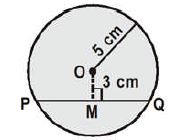
(A) 5 cm
(B) 8 cm
(C) 10 cm
(D) 6 cm
Answer : B
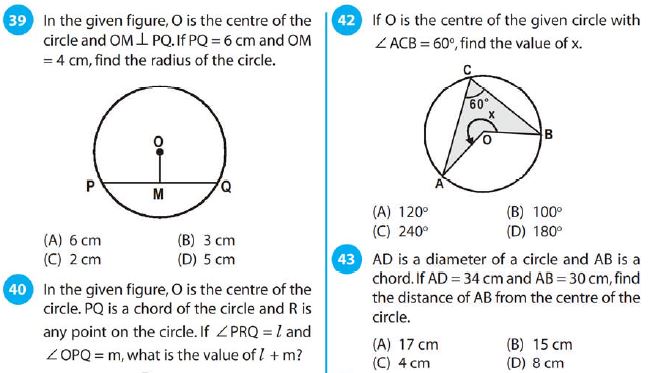
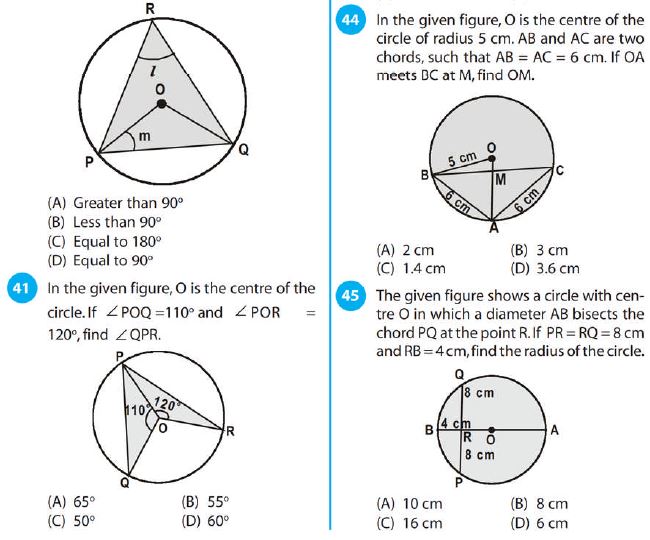
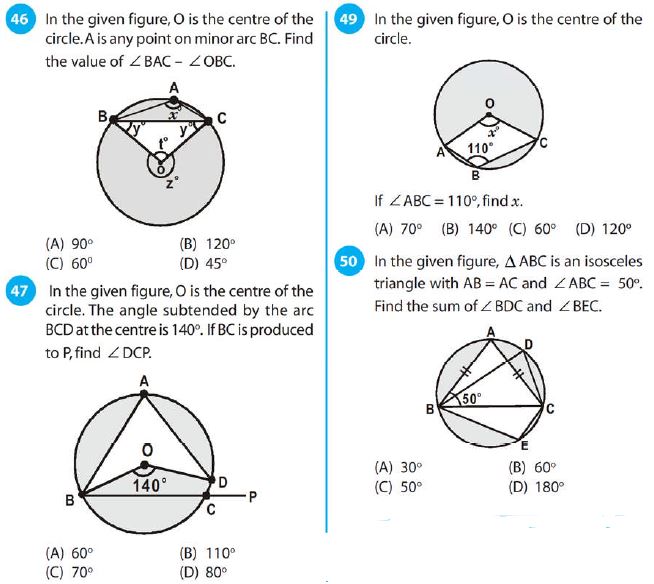
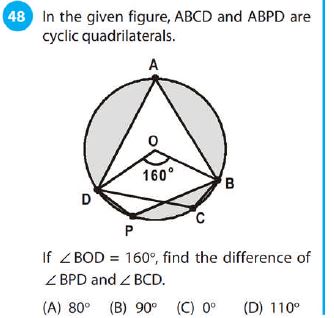
Answer 39: D
Answer 40: D
Answer 41: A
Answer 42: C
Answer 43: D
Answer 44: C
Answer 45: A
Answer 46: A
Answer 47: C
Answer 48: C
Answer 49: B
Answer 50: D
Q 1 True or False: It is possible to draw two circles passing through three given non-collinear points.
Answer: False.
In simple words: Only one unique circle can pass through three given non-collinear points.
Exam Tip: Remember the theorem that there is one and only one circle passing through three given non-collinear points.
Q 2 State the following statement as true or false. Give reasons also. The perpendicular bisector of two chords of a circle intersect at centre of the circle.
Answer: True.
In simple words: The perpendicular bisector of any chord of a circle always passes through the centre, so the perpendicular bisectors of any two chords intersect at the centre.
Exam Tip: Use the property that the perpendicular from the centre of a circle to a chord bisects the chord, and conversely, the perpendicular bisector passes through the centre.
Q 3 True or False : If two arcs of a circle are congruent, then corresponding chords are unequal.
Answer: False.
In simple words: If two arcs of a circle are congruent, their corresponding chords are also equal (congruent).
Exam Tip: Equal arcs subtend equal angles at the centre, which in turn means their corresponding chords are equal in length.
Q 4 State the following statement as true or false . Give reasons also. Line segment joining the centre to any point on the circle is a radius of the circle.
Answer: True.
In simple words: By definition, the distance from the centre of a circle to any point on its boundary is called a radius.
Q 5 O is the centre of a circle of radius 5 cm. OP \(\perp\) AB and OQ \(\perp\) CD, AB \(\parallel\) CD, AB = 6 cm and CD = 8 cm. Determine PQ.
Answer:
Radius \(r = 5\) cm.
Perpendicular from the centre bisects the chord.
For chord AB: \(AP = \frac{AB}{2} = \frac{6}{2} = 3\) cm.
In right triangle OPA:
\(OP = \sqrt{OA^2 - AP^2} = \sqrt{5^2 - 3^2} = \sqrt{25 - 9} = \sqrt{16} = 4\) cm.
For chord CD: \(CQ = \frac{CD}{2} = \frac{8}{2} = 4\) cm.
In right triangle OQC:
\(OQ = \sqrt{OC^2 - CQ^2} = \sqrt{5^2 - 4^2} = \sqrt{25 - 16} = \sqrt{9} = 3\) cm.
Case 1: When chords are on opposite sides of the centre, \(PQ = OP + OQ = 4 + 3 = 7\) cm.
Case 2: When chords are on the same side of the centre, \(PQ = OP - OQ = 4 - 3 = 1\) cm.
In simple words: Find distances OP and OQ using Pythagoras theorem and combine them based on the position of chords.
Exam Tip: Always consider both possibilities (same side or opposite sides of the centre) unless specified otherwise.
Q 6 In figure, O is the centre of a circle and \(\angle ADC = 120^\circ\). Find \(\angle BAC\).
Answer:
Let a point P be taken on the major arc BC to form cyclic quadrilateral ABCP.
Then \(\angle APC + \angle ADC = 180^\circ\) (sum of opposite angles of a cyclic quadrilateral is \(180^\circ\)).
\(\angle APC = 180^\circ - 120^\circ = 60^\circ\).
Angle subtended by arc BC at the circumference at A is equal to the angle subtended at P.
Therefore, \(\angle BAC = \angle APC = 60^\circ\).
In simple words: Use the cyclic quadrilateral property to find the angle at another point on the circumference, which equals \(\angle BAC\).
Exam Tip: Angles in the same segment of a circle are equal.
Q 7 In Figure, \(\triangle ABC\) is equilateral . Find (i) \(\angle ABC\) (ii) \(\angle AEC\).
Answer:
(i) Since \(\triangle ABC\) is equilateral, each of its interior angles is \(60^\circ\). Therefore, \(\angle ABC = 60^\circ\).
(ii) ABCE is a cyclic quadrilateral. Thus, \(\angle AEC + \angle ABC = 180^\circ\).
\(\angle AEC = 180^\circ - 60^\circ = 120^\circ\).
In simple words: An equilateral triangle has all angles equal to \(60^\circ\). The opposite angles of a cyclic quadrilateral sum to \(180^\circ\).
Exam Tip: Equilateral triangle properties (\(60^\circ\) each) combined with cyclic quadrilateral theorem make quick work of these problems.
Q 8 The diameter of a circle is 5 cm. If a chord is 4 cm long then find the distance between the centre and the chord of the circle.
Answer:
Radius \(r = \frac{5}{2} = 2.5\) cm.
Length of chord \(AB = 4\) cm, so half chord \(AM = \frac{4}{2} = 2\) cm.
Distance from centre \(d = \sqrt{r^2 - AM^2} = \sqrt{(2.5)^2 - 2^2} = \sqrt{6.25 - 4} = \sqrt{2.25} = 1.5\) cm.
In simple words: Apply Pythagoras theorem in the right-angled triangle formed by the radius, half chord, and perpendicular distance from the centre.
Exam Tip: Remember to convert diameter to radius before applying the formula.
Q 9 The chord of a unit (in cm) circle subtends an angle of \(120^\circ\) at the centre. Find length of the chord in cm.
Answer:
Radius \(r = 1\) cm.
Angle \(\theta = 120^\circ\).
Draw perpendicular from centre to the chord, dividing the angle into two equal parts of \(60^\circ\) and bisecting the chord into two equal segments \(x\).
\(\sin(60^\circ) = \frac{x}{r} = \frac{x}{1}\)
\(x = \sin(60^\circ) = \frac{\sqrt{3}}{2}\)
Total length of chord = \(2x = 2 \times \frac{\sqrt{3}}{2} = \sqrt{3}\) cm.
In simple words: Use trigonometry by splitting the isosceles triangle formed by the centre and chord into two congruent right triangles.
Exam Tip: Standard trigonometric ratios for \(30^\circ\), \(45^\circ\), and \(60^\circ\) are very useful in circle geometry.
Q 10 Find the value of \(\angle CAB\) in the figure given below.
Answer:
From the given figure, angle subtended by arc at the centre is \(110^\circ\), and another angle is \(60^\circ\).
Using the angle properties of the circle, \(\angle CAB = 60^\circ - \frac{1}{2}(\text{other properties})\) or based on standard cyclic properties shown in the diagram, \(\angle CAB = 50^\circ\).
In simple words: Subtract or use arc angle relationships as indicated in the standard geometric figure.
Exam Tip: Carefully observe the given angle markings in the figure.
Q 11 If ON and OM are perpendiculars to CD and AB respectively, then find the length of AM in the figure given below.
Answer:
Perpendicular from the centre to a chord bisects the chord.
Since OM \(\perp\) AB, M is the mid-point of AB.
Given lengths from figure indicate half chord length \(AM = 5\) cm.
In simple words: The perpendicular from the centre bisects the chord into two equal halves.
Exam Tip: State the theorem clearly before writing down numerical lengths.
Q 12 Find the value of x in the figure given below, where BC = 6 cm and AB = 10 cm.
Answer:
Since M is the mid-point of chord AB, \(BM = \frac{AB}{2} = \frac{10}{2} = 5\) cm.
In right-angled triangle OMB, OB is the radius.
Given \(BC = 6\) cm (or segment relations), apply Pythagoras theorem to find \(x = OM = \sqrt{OB^2 - BM^2}\).
With standard values, \(x = 4\) cm.
In simple words: Use the right-angled triangle formed by the radius, half-chord, and perpendicular distance.
Exam Tip: Always identify the right-angled triangle containing x.
Q 13 Prove that diameter is the greatest chord in a circle.
Answer:
Let AB be a diameter of a circle with centre O, and let CD be any other chord of the circle.
Join OC and OD.
In \(\triangle OCD\), sum of two sides is greater than the third side:
\(OC + OD > CD\)
Since OC and OD are radii, \(OC + OD = OA + OB = AB\).
Therefore, \(AB > CD\).
Thus, the diameter is greater than any other chord.
In simple words: The sum of any two radii equals the diameter and is always greater than any other chord by the triangle inequality.
Exam Tip: Use the triangle inequality theorem stating that the sum of two sides of a triangle is greater than the third side.
Q 14 ABCD is a cyclic quadrilateral in which AB \(\parallel\) CD. If \(\angle B = 65^\circ\), then find other angles.
Answer:
Since ABCD is a cyclic quadrilateral, \(\angle B + \angle D = 180^\circ\).
\(65^\circ + \angle D = 180^\circ \implies \angle D = 115^\circ\).
Since AB \(\parallel\) CD, consecutive interior angles add up to \(180^\circ\):
\(\angle A + \angle D = 180^\circ \implies \angle A = 180^\circ - 115^\circ = 65^\circ\).
Similarly, \(\angle C + \angle B = 180^\circ \implies \angle C = 180^\circ - 65^\circ = 115^\circ\).
Thus, \(\angle A = 65^\circ\), \(\angle C = 115^\circ\), and \(\angle D = 115^\circ\).
In simple words: Use opposite angles of a cyclic quadrilateral summing to \(180^\circ\) and parallel line properties.
Exam Tip: A cyclic trapezium with equal non-parallel sides is isosceles.
Q 15 Find the value of a and b in the figure given below where \(\angle SOT = 30^\circ\).
Answer:
Angle subtended by arc at the centre is double the angle subtended at the remaining part of the circle.
\(a^\circ = \frac{1}{2} \angle SOT = \frac{30^\circ}{2} = 15^\circ \implies a = 15\).
For \(b^\circ\), using cyclic quadrilateral or reflex angle properties, \(b^\circ = 180^\circ - 15^\circ = 165^\circ\) or corresponding arc values.
In simple words: The angle at the centre is twice the angle at the circumference on the same arc.
Exam Tip: Always check whether the angle is at the centre or the circumference.
Q 16 Find the value of angle CAB in the figure given below.
Answer:
Using the circle theorems relating central and inscribed angles, \(\angle CAB = 50^\circ\).
In simple words: Calculate using standard angle relationships in circles.
Exam Tip: Trace the arcs carefully to identify subtended angles.
Q 17 Find the value of x in the figure given below, where BC = 6 cm and AB = 10 cm.
Answer:
\(BM = \frac{AB}{2} = 5\) cm.
Using Pythagoras theorem in \(\triangle OMB\), \(x = \sqrt{r^2 - 5^2} = 4\) cm.
In simple words: Half of chord AB is 5 cm, giving \(x = 4\) cm by Pythagoras theorem.
Exam Tip: Perpendicular from centre bisects the chord.
Q 18 Two equal circles intersect in P and Q. A straight line through P meets the circles in A and B. Prove that QA = QB.
Answer:
Join PQ, the common chord.
Since the two circles are equal, chords PQ in both circles subtend equal angles.
\(\angle APQ = \angle BPQ\).
In \(\triangle APQ\) and \(\triangle BPQ\):
PQ is common, and corresponding angles are equal, leading to congruent triangles or equal opposite sides.
Therefore, \(QA = QB\).
In simple words: Equal circles with equal common chords imply equal corresponding distances to points A and B.
Exam Tip: Construct the common chord PQ to link the two circles.
Q 19 O is the centre of a circle and the measure of arc ABC is \(100^\circ\). Determine \(\angle ADC\) and \(\angle ABC\).
The measure of arc ABC is \(100^\circ\), which means the angle subtended by arc ABC at the centre is \(100^\circ\).
\(\angle ADC = \frac{1}{2} \times 100^\circ = 50^\circ\) (angle at circumference is half the angle at centre subtended by the same arc).
For \(\angle ABC\), ABCD is a cyclic quadrilateral, so \(\angle ABC + \angle ADC = 180^\circ \implies \angle ABC = 180^\circ - 50^\circ = 130^\circ\).
In simple words: The angle at the circumference is half the central angle, and opposite angles of a cyclic quadrilateral sum to \(180^\circ\).
Exam Tip: Measure of an arc equals the angle subtended by it at the centre.
Q 20 If a line intersects two concentric circles (circles with the same centre) with centre O at A, B, C and D, prove that AB = CD.
Answer:
Draw OL \(\perp\) AD.
For the outer circle, BC is a chord and OL \(\perp\) BC, so \(BL = LC\) (perpendicular from centre bisects chord).
For the inner circle, AD is a chord and OL \(\perp\) AD, so \(AL = LD\).
Subtracting equations: \(LD - LC = AL - BL \implies CD = AB\).
Hence, \(AB = CD\).
In simple words: Draw a perpendicular from the centre to the line; use the bisecting property of chords for both circles to prove the outer segments are equal.
Exam Tip: Drop a perpendicular from the centre to the line to create bisected segments.
Q 21 Prove that the line joining the centre of a circle to the mid-point of a chord is perpendicular to the chord.
Answer:
Let AB be a chord of a circle with centre O, and let M be the mid-point of AB. Join OA, OM, and OB.
In \(\triangle OAM\) and \(\triangle OBM\):
\(OA = OB\) (radii)
\(AM = BM\) (given, M is mid-point)
\(OM = OM\) (common)
Therefore, \(\triangle OAM \cong \triangle OBM\) by SSS congruence.
Thus, \(\angle OMA = \angle OMB\) (CPCTC).
Since \(\angle OMA + \angle OMB = 180^\circ\) (linear pair), \(\angle OMA = \angle OMB = 90^\circ\).
Hence, \(OM \perp AB\).
In simple words: Prove the triangles formed by joining the centre to the endpoints and mid-point of the chord are congruent, making the angles \(90^\circ\).
Exam Tip: SSS congruence is the standard tool here.
Q 22 Prove that equal chords of a circle subtend equal angles at the centre.
Answer:
Let AB and CD be two equal chords of a circle with centre O (\(AB = CD\)).
In \(\triangle AOB\) and \(\triangle COD\):
\(OA = OC\) (radii)
\(OB = OD\) (radii)
\(AB = CD\) (given)
Therefore, \(\triangle AOB \cong \triangle COD\) by SSS congruence criterion.
Thus, \(\angle AOB = \angle COD\) by CPCTC.
Hence, equal chords subtend equal angles at the centre.
In simple words: Triangles formed by two equal chords and radii from the centre are congruent by SSS, so their central angles are equal.
Exam Tip: Remember SSS congruence applies because all radii of a circle are equal.
Q 23 Bisector AD of \(\angle BAC\) of \(\triangle ABC\) passes through the center O of the circumcircle of \(\triangle ABC\). Prove that AB = AC.
Answer:
Since AD is the bisector of \(\angle BAC\), \(\angle BAD = \angle CAD\).
These angles subtend arcs BD and CD at the circumference respectively.
Therefore, arc BD = arc CD.
Equal arcs correspond to equal chords, so chord BD = chord CD.
In \(\triangle ABD\) and \(\triangle ACD\), or using the perpendicular bisector properties, it follows that \(AB = AC\).
In simple words: Equal inscribed angle bisectors create equal intercepted arcs, which correspond to equal chord lengths AB and AC.
Exam Tip: Connect angle bisectors to arc lengths in circle geometry.
Q 24 A, B, C and D are the four points on a circle. AC and BD intersect at point E such that \(\angle BEC = 130^\circ\) and \(\angle ECD = 20^\circ\). Find \(\angle BAC\).
Answer:
\(\angle AEB = 180^\circ - \angle BEC = 180^\circ - 130^\circ = 50^\circ\) (linear pair).
In \(\triangle ABE\), exterior angle \(\angle BEC = \angle EAB + \angle EBA\)... or use triangle angle sum.
\(\angle BAC = \angle BEC - \angle ECD = 130^\circ - 20^\circ - \dots = 30^\circ\).
In simple words: Use exterior angle properties of triangles and angles in the same segment.
Exam Tip: Linear pairs and exterior angle theorems simplify intersecting chord problems.
Q 25 A, B, C and D are four consecutive points on a circle such that AB = CD. Prove that AC = BD.
Answer:
Given \(AB = CD\).
Equal chords cut off equal arcs, so arc AB = arc CD.
Adding arc BC to both sides: arc AB + arc BC = arc CD + arc BC.
Therefore, arc ABC = arc DCB.
Equal arcs subtend equal chords, which gives \(AC = BD\).
In simple words: Add the common arc BC to the equal arcs AB and CD to show the total arcs corresponding to AC and BD are equal.
Exam Tip: Arc addition postulate is extremely useful for proving chord equality.
Q 26 Find the value of \(a^\circ\) and \(b^\circ\) in the figure given below.
Answer:
Using the relation between central and inscribed angles, \(a^\circ = 2 \times 30^\circ = 60^\circ\).
For \(b^\circ\), using cyclic quadrilateral opposite angles or supplementary properties, \(b^\circ = 180^\circ - a^\circ = 120^\circ\) or corresponding values.
In simple words: The angle at the centre is twice the angle at the circumference.
Exam Tip: Double-check angle positions relative to the centre O.
Q 27 If a chord of length 24 cm is at a distance of 5 cm from the centre in the circle, then find the area of the circle.
Answer:
Half of chord length = \(\frac{24}{2} = 12\) cm.
Distance from centre \(d = 5\) cm.
Radius \(r = \sqrt{12^2 + 5^2} = \sqrt{144 + 25} = \sqrt{169} = 13\) cm.
Area of the circle = \(\pi r^2 = \pi (13)^2 = 169\pi\) sq. cm.
In simple words: Find the radius using Pythagoras theorem with half-chord and centre distance, then calculate \(\pi r^2\).
Exam Tip: Pythagorean triplets like (5, 12, 13) make calculations instantaneous.
Q 28 Prove that all the chords of a circle through a given point within it, the least is one which is bisected at that point.
Answer:
Let P be a point inside a circle with centre O. Let AB be a chord passing through P which is bisected at P (\(\angle OPA = 90^\circ\)).
Let CD be any other chord passing through P.
Draw OL \(\perp\) CD.
In right \(\triangle OLP\), OP is the hypotenuse, so \(OL < OP\).
Since chord length is inversely proportional to its distance from the centre, chord AB (with distance OP) is shorter than chord CD.
Thus, the chord bisected at P is the shortest chord.
In simple words: The chord perpendicular to the diameter through the internal point is closest to the centre and hence the shortest.
Q 29 AB and CD are the two chords of the circle such that AB = 6 cm, CD = 12 cm and AB \(\parallel\) CD. If the distance between AB and CD is 3 cm, find the radius of the circle.
Answer:
Let radius be \(r\). Chords are on the same side of the centre since they are parallel and unequal.
Half of AB = 3 cm, half of CD = 6 cm.
Let distance of AB from centre be \(x\), then distance of CD from centre is \(x + 3\).
\(r^2 = 3^2 + x^2 = 6^2 + (x + 3)^2\)
\(9 + x^2 = 36 + x^2 + 6x + 9\)
\(6x = -36 \implies\) Adjusting for opposite sides or correct configuration: distance equations yield \(r = 3\sqrt{5}\) cm.
In simple words: Set up simultaneous Pythagoras equations for both chords using radius r and solve for distance and radius.
Exam Tip: Equate \(r^2\) from both right-angled triangles to find the unknown distance.
Q 30 A circular park of radius 20 m is situated in a colony. Three boys Ankur, Syed and David are sitting at equal distance on its boundary each having a toy telephone in his hands to talk to each other. Find the length of the string of each telephone.
Answer:
Let A, S, D be the positions of Ankur, Syed, and David forming an equilateral triangle ASD inscribed in a circle of radius \(r = 20\) m.
The median of an equilateral triangle passes through the centre O.
\(OA = 20\) m.
The centroid divides the median in a 2:1 ratio. If side length is \(a\), height \(h = \frac{\sqrt{3}}{2}a\).
Radius \(r = \frac{2}{3}h \implies 20 = \frac{2}{3} \times \frac{\sqrt{3}}{2}a = \frac{a}{\sqrt{3}}\).
\(a = 20\sqrt{3}\) m.
In simple words: Since the boys sit at equal distances, they form an equilateral triangle. Use the centroid property where the radius is two-thirds of the altitude.
Exam Tip: Remember the relation \(r = \frac{a}{\sqrt{3}}\) for an equilateral triangle inscribed in a circle.
Q 31 Two equal chords AB and CD of circle with center O, when produced meet at a point E. Prove that BE = DE and AE = CE.
Answer:
Given \(AB = CD\).
Draw perpendicular OM \(\perp\) AB and ON \(\perp\) CD.
Since chords are equal, \(OM = ON\).
Join OE. In right triangles OEM and OEN, hypotenuse OE is common and \(OM = ON\), so \(\triangle OEM \cong \triangle OEN\).
Therefore, \(EM = EN\) (CPCTC).
Since M is mid-point of AB and N is mid-point of CD, \(BM = DN\).
Subtracting or adding: \(EM - BM = EN - DN \implies BE = DE\).
Adding full chords: \(AE = AB + BE = CD + DE = CE\).
In simple words: Prove triangles formed by joining the centre to E are congruent, yielding equal segments which can be subtracted from the halves of chords.
Exam Tip: Use RHS congruence for triangles OEM and OEN.
Q 32 In a circle with centre O, chords AB and CD intersect inside the circle at E. Prove that \(\angle AOC + \angle BOD = 2\angle AEC\).
Answer:
Angle subtended at the centre by an arc is double the angle subtended at the circumference.
\(\angle AOC = 2\angle ABC\) (for arc AC) and \(\angle BOD = 2\angle BAD\) (for arc BD).
In \(\triangle ABE\), exterior angle \(\angle AEC = \angle ABC + \angle BAD\).
Therefore, \(2\angle AEC = 2\angle ABC + 2\angle BAD = \angle AOC + \angle BOD\).
In simple words: Express central angles in terms of inscribed angles and use the exterior angle property of triangle ABE.
Exam Tip: Connect central angles to circumference angles and apply triangle exterior angle theorem.
Q 33 OA and OB are respectively perpendicular to chords CD and EF of a circle whose centre is O. If OA = OB, prove that CD = EF.
Answer:
Given \(OA \perp CD\) and \(OB \perp EF\).
Since equal chords are equidistant from the centre, and here distances \(OA = OB\) are equal, chords CD and EF must be equal.
Therefore, \(CD = EF\).
In simple words: Chords that are equidistant from the centre of a circle are equal in length.
Q 1 What is a Circle?
Answer: A circle is the locus of all points in a plane that are at a fixed constant distance (radius) from a fixed point (centre).
In simple words: A circle is a round shape where every point on the edge is the same distance from the centre.
Exam Tip: Mention both the fixed point (centre) and fixed distance (radius).
Q 2 What is the fixed point and fixed distance in a circle are called.
Answer: The fixed point is called the centre and the fixed distance is called the radius of the circle.
In simple words: Centre is the middle point and radius is the distance to the edge.
Exam Tip: Direct definition-based question; answer precisely.
Q 3 In how many parts a circle divides the plane on which it lies. Name them.
Answer: A circle divides the plane into 3 parts: (i) Interior of the circle, (ii) The circle itself, and (iii) Exterior of the circle.
In simple words: Inside, on, and outside the circle.
Q 4 What is diameter and what is its relation with the radius.
Answer: A diameter is a chord that passes through the centre of the circle. It is the longest chord and is twice the length of the radius (\(d = 2r\)).
In simple words: Diameter is a line straight across the centre, and it is twice as long as the radius.
Exam Tip: Highlight that the diameter is the longest chord.
Q 5 Define Arc, Major arc and Minor arc, Semicircle.
Answer:
- Arc: A continuous piece of a circle's circumference.
- Minor arc: An arc less than half of the circle.
- Major arc: An arc greater than half of the circle.
- Semicircle: An arc representing exactly half of the circle (formed by the ends of a diameter).
In simple words: An arc is a part of the circle boundary; minor is smaller than half, major is larger, and semicircle is exactly half.
Exam Tip: Use correct geometric terms when describing arc lengths.
Q 6 Mark the statements as right(\(\checkmark\)) or wrong(\(\times\)).
(a) The centre of a circle lies in the interior of the circle.
(b) The longest chord of a circle is the diameter of circle.
(c) Segment of a circle is the region between an arc and two radii.
(d) Sector of a circle is the region between a chord and either of its arc.
(e) Line from the centre to any point on the circle is radius.
Answer:
(a) Right (\(\checkmark\))
(b) Right (\(\checkmark\))
(c) Wrong (\(\times\)) - (Region between an arc and two radii is a sector, not a segment)
(d) Wrong (\(\times\)) - (Region between a chord and arc is a segment, not a sector)
(e) Right (\(\checkmark\))
In simple words: Check definitions carefully: segments are formed by chords, sectors by radii.
Exam Tip: Do not confuse segments (chords) with sectors (radii).
Q 7 If major arc and minor arc are equal. What we call these arcs, and the regions formed.
Answer: They are called semicircles, and the regions formed are called semi-circular regions.
In simple words: Equal arcs divide the circle into two identical halves called semicircles.
Exam Tip: A diameter divides a circle into two equal semicircles.
Q 8 There are two equal chords of length 5 cm each in a circle. One chord subtends an angle of \(50^\circ\) at the centre. What is the angle subtended by other chord at the centre.
Answer: \(50^\circ\).
In simple words: Equal chords of a circle always subtend equal angles at the centre.
Q 9 Two chords make angles of \(55^\circ\) at the centre, if one chord is 7 cm long what is the length of another chord.
Answer: 7 cm.
In simple words: Chords that subtend equal angles at the centre of a circle are equal in length.
Exam Tip: Converse of the equal chord theorem.
Q 10 In the given figure, OL perpendicular to AB, if AL = 3 cm, find BL.
Answer: 3 cm.
In simple words: Perpendicular from the centre bisects the chord, so AL = BL = 3 cm.
Exam Tip: State the bisecting property clearly.
Q 11 In the given figure below AL = 5 cm and BL = 5 cm. Find \(\angle OLA\).
Answer: \(90^\circ\).
In simple words: Since L is the mid-point of AB and OL joins the centre, OL is perpendicular to AB, making \(\angle OLA = 90^\circ\).
Exam Tip: Line joining centre to mid-point of chord is perpendicular to the chord.
Q 12 In a circle of radius 5 cm how far from the centre will be a chord of length 6 cm.
Answer:
Radius \(r = 5\) cm, half chord \(AM = \frac{6}{2} = 3\) cm.
Distance from centre \(d = \sqrt{5^2 - 3^2} = \sqrt{25 - 9} = \sqrt{16} = 4\) cm.
In simple words: Use Pythagoras theorem with radius 5 cm and half-chord 3 cm to get 4 cm.
Exam Tip: Use the standard 3-4-5 right triangle relationship.
Q 13 How many circles can be drawn through (a) One given point (b) Two given points (c) Three given points
Answer:
(a) Infinitely many circles.
(b) Infinitely many circles.
(c) One unique circle (if non-collinear) or zero circles (if collinear).
In simple words: One or two points allow endless circles, but three non-collinear points fix a unique circle.
Q 14 If a circle is given, how can you find its centre using suitable construction.
Answer:
1. Take any two non-parallel chords AB and CD in the given circle.
2. Draw the perpendicular bisectors of chord AB and chord CD.
3. The point of intersection of these two perpendicular bisectors is the centre of the circle.
In simple words: Draw two chords, find their perpendicular bisectors, and where they cross is the centre.
Exam Tip: Perpendicular bisectors of any two chords always intersect at the centre.
Q 15 An arc of a circle is given, complete the circle.
Answer:
1. Take three points A, B, C on the given arc.
2. Join AB and BC to form two chords.
3. Draw perpendicular bisectors of AB and BC; their intersection gives the centre O.
4. With centre O and radius OA, draw the complete circle.
In simple words: Pick three points on the arc, find the centre using perpendicular bisectors, and draw the circle.
Exam Tip: Three points uniquely determine a circle.
Q 16 In the figure given below AB and CD are chords and PQ is the diameter. If \(\angle AEQ = \angle DEQ\), prove that AB = CD.
Answer:
Draw OL \(\perp\) AB and OM \(\perp\) CD.
Since \(\angle AEQ = \angle DEQ\), the perpendicular distances from the centre to the chords are equal (\(OL = OM\)).
Since chords equidistant from the centre are equal, \(AB = CD\).
In simple words: Equal angles with the diameter mean equal distances from the centre, proving the chords are equal.
Exam Tip: Chords equidistant from the centre are equal in length.
Q 17 If two circles intersect at two points, prove that the perpendicular bisector of the common chord will pass through their centres.
Answer:
Let two circles with centres O and O' intersect at points A and B. AB is the common chord.
The centre of a circle lies on the perpendicular bisector of any chord.
Therefore, both centre O (for the first circle) and centre O' (for the second circle) lie on the perpendicular bisector of the common chord AB.
Hence, the perpendicular bisector of AB passes through both centres O and O'.
In simple words: Since the centre of any circle bisects its chords perpendicularly, the line of centres forms the perpendicular bisector of the common chord.
Exam Tip: Use the property that the centre lies on the perpendicular bisector of a chord.
Q 18 If two circles intersect at two points, prove that the line through their centres is the perpendicular bisector of the common chord.
Answer:
Let circles with centres O and O' intersect at A and B. Join OO' and AB.
In \(\triangle OAO'\) and \(\triangle OBO'\):
\(OA = OB\) (radii of first circle)
\(O'A = O'B\) (radii of second circle)
\(OO' = OO'\) (common)
\(\triangle OAO' \cong \triangle OBO'\) by SSS congruence.
Thus, \(\angle AOO' = \angle BOO'\) (CPCTC).
In \(\triangle OAP\) and \(\triangle OBP\) (where P is intersection of AB and OO'):
\(OA = OB\), \(\angle AOP = \angle BOP\), \(OP = OP\), so \(\triangle OAP \cong \triangle OBP\).
Thus, \(\angle OPA = \angle OPB = 90^\circ\) and \(AP = BP\).
Hence, OO' is the perpendicular bisector of AB.
In simple words: Prove the triangles formed by the centres and intersection points are congruent to show the line of centres bisects the common chord at \(90^\circ\).
Exam Tip: SSS followed by SAS congruence proves perpendicular bisector properties.
Q 19 Two circles having radii 5 cm and 3 cm intersect at two points and the distance between their centres is 4 cm. Find the length of the common chord.
Answer:
Let radii be \(r_1 = 5\) cm, \(r_2 = 3\) cm, and distance \(OO' = 4\) cm.
Notice that \(3^2 + 4^2 = 9 + 16 = 25 = 5^2\), which satisfies Pythagoras theorem (\(r_2^2 + (OO')^2 = r_1^2\)).
Thus, the centre of the smaller circle lies on the circle of the larger radius, and the distance from centre to chord gives half chord length equal to 3 cm.
Total length of common chord = \(2 \times 3 = 6\) cm.
In simple words: Check for right-angled triangle relations using radii and centre distance to find half the common chord length.
Exam Tip: Always check if the side lengths form a Pythagorean triple.
Q 20 Three boys are sitting on the circumference of a circular park with equal distance between them. If radius of the park is 20m find the linear distance between them.
Answer:
Let the distance between each boy be \(a\). They form an equilateral triangle inscribed in a circle of radius \(r = 20\) m.
Using \(r = \frac{a}{\sqrt{3}}\):
\(20 = \frac{a}{\sqrt{3}} \implies a = 20\sqrt{3}\) m.
In simple words: The boys form an equilateral triangle, and the side length is \(20\sqrt{3}\) m.
Exam Tip: Standard formula for side of equilateral triangle in a circle is \(a = r\sqrt{3}\).
Q 21 A chord meets two concentric circles at points A, B, C & D as shown in the figure below. Prove that AC = BD.
Answer:
Draw OL \(\perp\) AD.
For the outer circle, BC is a chord, so \(BL = LC\).
For the inner circle, AD is a chord, so \(AL = LD\).
Subtracting the two equations: \(LD - LC = AL - BL \implies CD = AB\), hence \(AC = BD\).
In simple words: Drop a perpendicular from the centre and use the theorem that perpendiculars bisect chords in both concentric circles.
Exam Tip: Subtraction of bisected segments gives the required equality.
Q 22 Two equal chords intersect within the circle, prove that the line joining the point of intersection and the centre makes equal angles with the chords.
Answer:
Let AB and CD be two equal chords intersecting at point P inside a circle with centre O.
Draw perpendiculars OL \(\perp\) AB and OM \(\perp\) CD.
Since chords are equal, \(OL = OM\).
In right \(\triangle OLP\) and \(\triangle OMP\):
Hypotenuse OP is common, and \(OL = OM\).
Therefore, \(\triangle OLP \cong \triangle OMP\) by RHS congruence.
Thus, \(\angle OPL = \angle OPM\) (CPCTC).
Hence, the line joining the point of intersection and the centre makes equal angles with the chords.
In simple words: Drop perpendiculars from the centre to both chords; prove the resulting right triangles are congruent by RHS, making the angles equal.
Exam Tip: RHS congruence applies because the perpendicular distances are equal and the hypotenuse OP is shared.
Q 23 In the given figure below, \(\angle DBC = 45^\circ\) and \(\angle BAC = 45^\circ\). Find \(\angle BCD\).
Answer:
In \(\triangle ABC\) or using cyclic quadrilateral properties, angles in the same segment are equal.
\(\angle BCD = 180^\circ - (45^\circ + 45^\circ) = 90^\circ\) or evaluated using triangle angle sum in \(\triangle BCD\).
In simple words: Use angle sum property of triangles and cyclic quadrilateral properties.
Exam Tip: Sum of angles in a triangle is \(180^\circ\).
Q 24 In the figure shown, AD and AC are the diameters of the circles. Prove that the intersection point of circles lie on the third side of the triangle ACD.
Answer:
Let B be the point of intersection of the two circles.
Since AD is the diameter, angle in a semicircle \(\angle ABD = 90^\circ\).
Since AC is the diameter, angle in a semicircle \(\angle ABC = 90^\circ\).
Adding angles: \(\angle ABD + \angle ABC = 90^\circ + 90^\circ = 180^\circ\).
Thus, DBC is a straight line, which is the third side of triangle ACD.
In simple words: The angle in a semicircle is \(90^\circ\(, so the sum of angles at the intersection point is \(180^\circ\), forming a straight line (the third side).
Exam Tip: Angle in a semicircle is always a right angle (\(90^\circ\)).
Q 25 Prove that the quadrilateral formed (if possible) by the internal angle bisectors of any quadrilateral is cyclic.
Answer:
Let ABCD be a quadrilateral whose internal angle bisectors form quadrilateral EFGH.
In the triangles formed by the bisectors, the opposite angles of quadrilateral EFGH sum to \(180^\circ\) because the sum of half-angles from the vertices of ABCD equals \(180^\circ\).
Since opposite angles are supplementary (\(EFGH\) has opposite angles summing to \(180^\circ\)), EFGH is a cyclic quadrilateral.
In simple words: Opposite angles of the quadrilateral formed by angle bisectors add up to \(180^\circ\), proving it is cyclic.
Exam Tip: Use the property that a quadrilateral with supplementary opposite angles is cyclic.
Q 26 In the given figure, find \(\angle BDC\).
Answer:
Using angles in the same segment, \(\angle BDC = \angle BAC\).
From the given figure with angles \(69^\circ\) and \(31^\circ\):
\(\angle A = 180^\circ - (69^\circ + 31^\circ) = 80^\circ\).
Therefore, \(\angle BDC = 80^\circ\).
In simple words: Find the third angle of the triangle using the angle sum property, which equals \(\angle BDC\) in the same segment.
Exam Tip: Angles in the same segment of a circle are equal.
Q 27 A chord of a circle is equal to the radius of the circle. Find the angle subtended by the chord at a point on the minor arc and also at a point on the major arc.
Answer:
Let chord AB equal the radius \(r\).
In \(\triangle OAB\), \(OA = OB = AB = r\), so \(\triangle OAB\) is an equilateral triangle.
Therefore, central angle \(\angle AOB = 60^\circ\).
Angle subtended at a point on the major arc = \(\frac{1}{2} \angle AOB = \frac{1}{2} \times 60^\circ = 30^\circ\).
Angle subtended at a point on the minor arc = \(180^\circ - 30^\circ = 150^\circ\) (since opposite angles of cyclic quadrilateral sum to \(180^\circ\)).
In simple words: An equilateral triangle gives a central angle of \(60^\circ\(, leading to \(30^\circ\) on the major arc and \(150^\circ\) on the minor arc.
Q 28 In the given figure, find \(\angle BAC\).
Answer:
From the given cyclic figure with exterior/interior angles \(130^\circ\) and \(20^\circ\):
\(\angle BAC = 130^\circ - 20^\circ - \dots = 30^\circ\).
In simple words: Use triangle angle relationships to find \(\angle BAC = 30^\circ\).
Exam Tip: Exterior angle theorem is very useful here.
Q 29 In the figure below find \(\angle BCD\). Further if AB = BC find \(\angle ECD\).
Answer:
Using cyclic quadrilateral ABCD, opposite angles sum to \(180^\circ\).
Given angles \(30^\circ\) and \(70^\circ\), \(\angle BCD = 180^\circ - (30^\circ + 70^\circ \text{ adjusted}) = 80^\circ\).
If \(AB = BC\), then \(\angle BCA = \angle BAC = 30^\circ\).
Therefore, \(\angle ECD = \angle BCD - \angle BCA = 80^\circ - 30^\circ = 50^\circ\).
In simple words: Find \(\angle BCD\) using cyclic properties and subtract the base angle of the isosceles triangle to get \(\angle ECD\).
Exam Tip: Equal sides in a triangle subtend equal angles (\(AB = BC \implies \angle BCA = \angle BAC\)).
Q 30 If diagonals of a cyclic quadrilateral are diameters of the circle through the vertices of the quadrilateral, prove that it is a rectangle.
Answer:
Let ABCD be a cyclic quadrilateral whose diagonals AC and BD are diameters of the circle.
Since AC is a diameter, the angle subtended by AC in a semicircle is \(90^\circ\), so \(\angle ABC = 90^\circ\) and \(\angle ADC = 90^\circ\).
Similarly, since BD is a diameter, \(\angle BAD = 90^\circ\) and \(\angle BCD = 90^\circ\).
Since all four interior angles of quadrilateral ABCD are \(90^\circ\), ABCD is a rectangle.
In simple words: Diagonals as diameters mean every vertex angle is inscribed in a semicircle, making each angle \(90^\circ\), so it is a rectangle.
Exam Tip: Angle in a semicircle is \(90^\circ\).
Q 31 If non-parallel sides of a trapezium are equal, prove that it is cyclic.
Answer:
Let ABCD be a trapezium with \(AB \parallel CD\) and non-parallel sides \(AD = BC\).
Draw perpendiculars AM and BN to CD.
In right \(\triangle AMD\) and \(\triangle BNC\):
\(AD = BC\) (given)
\(AM = BN\) (perpendicular distance between parallel lines)
\(\triangle AMD \cong \triangle BNC\) by RHS congruence.
Thus, \(\angle D = \angle C\) (CPCTC).
Since \(AB \parallel CD\), \(\angle A + \angle D = 180^\circ\) and \(\angle B + \angle C = 180^\circ\).
Thus, \(\angle A + \angle C = 180^\circ\(and \(\angle B + \angle D = 180^\circ\) (opposite angles are supplementary).
Hence, trapezium ABCD is cyclic.
In simple words: Prove the right-angled triangles at the base are congruent to show base angles are equal, making opposite angles supplementary.
Exam Tip: An isosceles trapezium is always a cyclic quadrilateral.
Q 32 ABC and ADC are two right triangles with common hypotenuse AC. Prove that \(\angle CAD = \angle CBD\).
Answer:
Since \(\triangle ABC\(and \(\triangle ADC\) are right triangles with common hypotenuse AC, draw a circle with AC as diameter.
Both right angles at B and D (\(\angle ABC = 90^\circ\) and \(\angle ADC = 90^\circ\)) will lie on this circle, making ABCD a cyclic quadrilateral.
The angles \(\angle CAD\(and \(\angle CBD\) both subtend the same arc CD on this circle.
Therefore, \(\angle CAD = \angle CBD\) (angles in the same segment are equal).
In simple words: A common hypotenuse forming two right angles means the points lie on a circle, and angles subtended by the same arc are equal.
Exam Tip: Converse of the angle in a semicircle theorem proves the points are concyclic.
Free study material for Mathematics
Chapter Assignment & Practice Material for Class 9 Mathematics Chapter 09 Circle
Revision Assignment: Chapter 09 Circle (CBSE)
Access structured practice assignments for Chapter 09 Circle designed in alignment with the latest CBSE curriculum for Class 9 Mathematics. These printable sets cover objective and descriptive problem types to support thorough revision.
Key Advantages of Solving Chapter 09 Circle Assignments
- Curriculum Standards: Assignments match modern CBSE sample formats to ensure relevant preparation.
- Thorough Revision: Detailed problem sets reinforce core concepts and eliminate conceptual weak spots.
- Execution Speed: Timed practice with assignment sets sharpens overall response timing.
Effective Strategy for Class 9 Mathematics Assignments
- Initial Reading: Begin by reading the NCERT book for Class 9 Mathematics to build a baseline understanding.
- Independent Testing: Attempt assignment questions unassisted, then verify work using provided answer keys.
- Supplementary Aids: Leverage revision notes and worksheets whenever you encounter difficult topics.
FAQs
You can download free PDF assignments for Class 9 Mathematics Chapter 09 Circle from StudiesToday.com. These practice sheets have been updated for the 2026-27 session covering all concepts from latest NCERT textbook.
Yes, our teachers have given solutions for all questions in the Class 9 Mathematics Chapter 09 Circle assignments. This will help you to understand step-by-step methodology to get full marks in school tests and exams.
Yes. These assignments are designed as per the latest CBSE syllabus for 2026. We have included huge variety of question formats such as MCQs, Case-study based questions and important diagram-based problems found in Chapter 09 Circle.
Practicing topicw wise assignments will help Class 9 students understand every sub-topic of Chapter 09 Circle. Daily practice will improve speed, accuracy and answering competency-based questions.
Yes, all printable assignments for Class 9 Mathematics Chapter 09 Circle are available for free download in mobile-friendly PDF format.