

Class 9 Mathematics Practice Assignments: CBSE Class 9 Mathematics Quadrilaterals Assignment Set 02
Explore structured practice materials through the CBSE Class 9 Mathematics Quadrilaterals Assignment Set 02. Tailored for Class 9 learners, utilizing these Mathematics assignments ensures thorough preparation and strengthens foundational knowledge before final CBSE evaluations.
Download Chapter 08 Quadrilaterals Assignment PDF with Solutions
Access the complete assignment PDF for Class 9 Mathematics below. Regular practice with these targeted academic tasks builds familiarity with standard question patterns and helps secure higher marks in final school evaluations.
Question. How many angles are there in a quadrilateral?
(a) 4
(b) 2
(c) 1
(d) 3
Answer : A
Question. One of the angles of a quadrilateral is 90° and the remaining three angles are in the ratio 2 : 3 : 4. Find the largest angle of the quadrilateral.
(a) 120°
(b) 90°
(c) 140°
(d) 100°
Answer : A
Question. A blackboard is in the shape of a
(a) Parallelogram
(b) Rhombus
(c) Rectangle
(d) Kite
Answer : C
Question. Which of the following is not true?
(a) The diagonals of a rectangle are equal.
(b) Diagonals of a square are equal.
(c) Diagonals of a parallelogram are not always equal.
(d) Diagonals of a kite are equal.
Answer : D
Question. In parallelogram ABCD, ∠DAB = 70°, ∠DBC = 70°, then ∠CDB is equal to
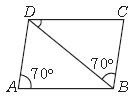
(a) 40°
(b) 60°°
(c) 70°
(d) 30°
Answer : A
Question. The angle between the diagonals of a rhombus is
(a) 45°
(b) 90°
(c) 30°
(d) 60°
Answer : B
Question. In DABC, EF || BC, F is the midpoint of AC and AE = 3.5 cm. Then AB is equal to
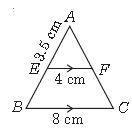
(a) 7 cm
(b) 5 cm
(c) 5.5 cm B C
(d) 4.5 cm
Answer : A
Question. Which type of quadrilateral is formed when the angles A, B, C and D are in the ratio 2 : 4 : 5 : 7 ?
(a) Rhombus
(b) Square
(c) Trapezium
(d) Rectangle
Answer : C
Question. A quadrilateral whose all the four sides and all the four angles are equal is called a
(a) Rectangle
(b) Rhombus
(c) Square
(d) Parallelogram
Answer : C
Question. In a quadrilateral ABCD, diagonals bisect each other at right angle. Also, AB = BC = AD = 5 cm, then find the length of CD.
(a) 5 cm
(b) 4 cm
(c) 2 cm
(d) 6 cm
Answer : A
Question. In the adjoining figure, ABCD is a square. A line segment DX cuts the side BC at X and the diagonal AC at O such that ∠COD = 105° and ∠OXC = x°. Find the value of x.
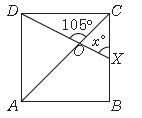
(a) 75°
(b) 80°
(c) 60°
(d) 45°
Answer : C
Question. The three consecutive angles of a quadrilateral are 70°, 120° and 50°. The fourth angle of the quadrilateral is
(a) 45°
(b) 60°
(c) 120°
(d) 30°
Answer : C
Question. In the figure, ABCD is a quadrilateral whose sides AB, BC, CD and DA are produced in order to P, Q, R and S. Then x + y + z + t is equal to
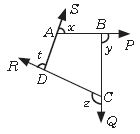
(a) 180°
(b) 360°
(c) 380°
(d) 270°
Answer : B
Question. If angles A, B, C and D of the quadrilateral ABCD, taken in order, are in the ratio 3 : 7 : 6 : 4, then ABCD is a
(a) rhombus
(b) parallelogram
(c) trapezium
(d) kite
Answer : C
Question. In the given figure, ABCD is a parallelogram. E and F are points on opposite sides AD and BC respectively, such that ED = 1/2 AD and BF = 1/3 BC. If ∠ADF = 60°, then find ∠BFD.
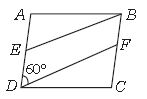
(a) 120°
(b) 130°
(c) 125°
(d) 115°
Answer : A
Question. If only one pair of opposite sides of a quadrilateral are parallel, then the quadrilateral is a
(a) Parallelogram
(b) Trapezium
(c) Rhombus
(d) Rectangle
Answer : B
Question. If the sum of angles of a triangle is X and the sum of the angles of a quadrilateral is Y, then
(a) X = 2Y
(b) 2X = Y
(c) X = Y
(d) X +Y = 360°
Answer : B
Question. Two angles of a quadrilateral are 55° and 65°. The other two angles are in the ratio 3 : 5.
The two angles are
(a) 100°, 110°
(b) 85°, 125°
(c) 100°, 120°
(d) 90°, 150°
Answer : D
Question. If a pair of opposite sides of a quadrilateral is equal and parallel, then the quadrilateral is a
(a) parallelogram
(b) rectangle
(c) rhombus
(d) square
Answer : A
Question. If M and N are the mid-points of non parallel sides of a trapezium PQRS, then which of the following conditions is/are true?
(a) MN || PQ
(b) MN = 1/2 (PQ + RS)
(c) MN = 1/2 (PQ – RS)
(d) Both (a) and(b)
Answer : D
Question. In figure, ABCD is a trapezium. Find the values of x and y.
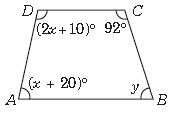
(a) x = 50°, y = 80°
(b) x = 50°, y = 88°
(c) x = 80°, y = 50°
(d) None of these
Answer : B
Question. In DPQR, A and B are respectively the midpoints of sides PQ and PR. If ∠PAB = 60°, then ∠PQR =
(a) 40°
(b) 80°
(c) 60°
(d) 70°
Answer : C
Question. The triangle formed by joining the midpoints of the sides of an equilateral triangle is
(a) scalene
(b) right angled
(c) equilateral
(d) isosceles
Answer : C
Question. In a parallelogram ABCD, if ∠A = 75°, then the measure of ∠B is
(a) 10°
(b) 20°
(c) 105°
(d) 90°
Answer : C
Question. In the given figure, ABCD is a parallelogram, what is the sum of the angles x, y and z?
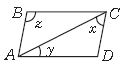
(a) 180°
(b) 45°
(c) 60°
(d) 90°
Answer : A
Question. The four triangles formed by joining the mid-points of the sides of a triangle are
(a) congruent to each other
(b) non- congruent to each other
(c) always right angled triangle
(d) can’t be determined
Answer : A
Question. In a quadrilateral ABCD, ∠A + ∠C is 2 times ∠B + ∠D. If ∠A = 140° and ∠D = 60°, then ∠B =
(a) 60°
(b) 80°
(c) 120°
(d) None of these
Answer : A
Question. In the given figure, ABCD is a rhombus. If ∠A = 70°, then ∠CDB is equal to
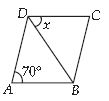
(a) 65°
(b) 55°
(c) 75°
(d) 80°
Answer : B
Question. Two adjacent angles of a parallelogram are (2x + 25)° and (3x – 5)°. The value of x is
(a) 28
(b) 32
(c) 36
(d) 42
Answer : B
Question. If consecutive sides of a parallelogram are equal, then it is necessarily a
(a) Rectangle
(b) Rhombus
(c) Trapezium
(d) None of these
Answer : B
Question. The measure of all the angles of a parallelogram, if an angle is 24° less than twice the smallest angle, is
(a) 37°, 143°, 37°, 143°
(b) 108°, 72°, 108°, 72°
(c) 68°, 112°, 68°, 112°
(d) None of these
Answer : C
Question. Sides AB and CD of a quadrilateral ABCD are extended as in figure. Then a + b is equal to
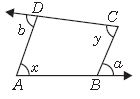
(a) x + 2y
(b) x – y
(c) x + y
(d) 2x + y
Answer : C
Question. The triangle formed by joining the midpoints of the sides of a right angled triangle is
(a) scalene
(b) isosceles
(c) equilateral
(d) right angled
Answer : D
Question. In a quadrilateral STAR, if ∠S = 120°, and ∠T : ∠A : ∠R = 5 : 3 : 7, then measure of ∠R =
(a) 112°
(b) 120°
(c) 110°
(d) None of these
Answer : A
Question. In the adjoining figure, PQRS is a parallelogram in which PQ is produced to T such that QT = PQ. Then, OQ is equal to
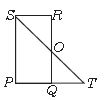
(a) OS
(b) OR
(c) OT
(d) None of these
Answer : B
Short Answer Type Questions
Question 1. Name a quadrilateral whose each pair of opposite sides is equal.
Answer: A parallelogram is a quadrilateral where both pairs of opposite sides are equal in length. Rectangles, rhombuses, and squares are also special types of parallelograms that share this property.
In simple words: A parallelogram is a four-sided shape where opposite sides are equal to each other.
Exam Tip: Remember that while a parallelogram is the most general answer, special cases like rectangles, squares, or rhombuses also satisfy this condition.
Question 2. What is the sum of two consecutive angles in a parallelogram?
Answer: In any parallelogram, consecutive interior angles are supplementary, which means they add up to \( 180^\circ \).
In simple words: Any two adjacent angles in a parallelogram add up to 180 degrees.
Exam Tip: The term "supplementary" is a key vocabulary word that examiners look for when grading this question.
Question 3. The angles of quadrilateral are respectively 100°, 30°, 92° and x. Find the value of x.
Answer: The sum of all interior angles in any quadrilateral is \( 360^\circ \). Therefore: \[ 100^\circ + 30^\circ + 92^\circ + x = 360^\circ \]
\( \implies 222^\circ + x = 360^\circ \)
\( \implies x = 360^\circ - 222^\circ \)
\( \implies x = 138^\circ \)
So, the value of x is \( 138^\circ \).
In simple words: Add the three known angles together to get 222 degrees, then subtract that from 360 degrees to find the missing angle, which is 138 degrees.
Exam Tip: Always state the Angle Sum Property of a quadrilateral clearly at the start of your calculation to secure full marks.
Question 4. The angles of quadrilateral are in the ratio 3:5:9:13. Find all the angles of the quadrilateral.
Answer: Let the common multiplier for the ratios be \( k \). Then the four angles of the quadrilateral are \( 3k \), \( 5k \), \( 9k \), and \( 13k \). By the angle sum property of a quadrilateral, their sum is \( 360^\circ \): \[ 3k + 5k + 9k + 13k = 360^\circ \]
\( \implies 30k = 360^\circ \)
\( \implies k = 12^\circ \) Now, calculate each individual angle:
- First angle: \( 3 \times 12^\circ = 36^\circ \)
- Second angle: \( 5 \times 12^\circ = 60^\circ \)
- Third angle: \( 9 \times 12^\circ = 108^\circ \)
- Fourth angle: \( 13 \times 12^\circ = 156^\circ \) The four angles of the quadrilateral are \( 36^\circ \), \( 60^\circ \), \( 108^\circ \), and \( 156^\circ \).
In simple words: Divide 360 degrees by the sum of the ratio parts (which is 30) to find that each share is 12 degrees. Then multiply each ratio number by 12 to get the four angles.
Exam Tip: To verify your final values, quickly sum the four calculated angles to confirm they equal exactly 360 degrees.
Question 5. Thee sides AB and CD of a parallelogram ABCD are bisected at E and F. Prove that EBFD is a parallelogram.
Answer: In the parallelogram ABCD, we have \( AB \parallel CD \) and \( AB = CD \). Since E and F are the midpoints of AB and CD respectively:
- \( EB = \frac{1}{2} AB \)
- \( DF = \frac{1}{2} CD \) Since \( AB = CD \), their halves are also equal, meaning \( EB = DF \). Furthermore, since the line segments EB and DF are parts of the parallel lines AB and CD, we have \( EB \parallel DF \). In quadrilateral EBFD, a pair of opposite sides (EB and DF) is both equal and parallel. Therefore, EBFD is a parallelogram.
In simple words: Because the top and bottom of the original shape are equal and parallel, their halves must also be equal and parallel. This makes the smaller inner shape a parallelogram too.
Exam Tip: State clearly that if one pair of opposite sides in a quadrilateral is both equal and parallel, then the quadrilateral is guaranteed to be a parallelogram.
Question 6. In a triangle ABC, P,Q and R are the mid-points of sides BC, CA and AB respectively. If AC = 21 cm, BC = 29 cm and AB = 30 cm, find the perimeter of the quadrilateral ARPQ.
Answer: By the Midpoint Theorem, the line segment joining the midpoints of two sides of a triangle is parallel to the third side and is half of its length.
- In \( \triangle ABC \), since R and P are the midpoints of AB and BC respectively:
\( RP \parallel AC \) and \( RP = \frac{1}{2} AC = \frac{21}{2} = 10.5\text{ cm} \)
- Since P and Q are the midpoints of BC and CA respectively:
\( PQ \parallel AB \) and \( PQ = \frac{1}{2} AB = \frac{30}{2} = 15\text{ cm} \)
- Since R is the midpoint of AB:
\( AR = \frac{1}{2} AB = 15\text{ cm} \)
- Since Q is the midpoint of AC:
\( AQ = \frac{1}{2} AC = 10.5\text{ cm} \) Now, calculate the perimeter of the quadrilateral ARPQ:
\( \text{Perimeter} = AR + RP + PQ + AQ \)
\( \implies \text{Perimeter} = 15 + 10.5 + 15 + 10.5 = 51\text{ cm} \). Thus, the perimeter of the quadrilateral ARPQ is \( 51\text{ cm} \).
In simple words: The sides of the new inner shape are made of half-sides of the big triangle. Adding up these halves (15 + 10.5 + 15 + 10.5) gives a total perimeter of 51 cm.
Exam Tip: Remember to write down the Midpoint Theorem explicitly to get full marks for showing how you found the lengths of RP and PQ.
Question 7. Find the four angles P, Q, R and S in the parallelogram PQRS as shown below.
Answer: In the given parallelogram PQRS, we can analyze the triangle QRS. By the properties of a parallelogram, \( PQ \parallel SR \). With the diagonal SQ acting as a transversal, alternate interior angles are equal:
\( \angle PQS = \angle RSQ = 3a \). Also, \( PS \parallel QR \), which gives \( \angle PSQ = \angle RQS \). Since \( \angle PQS = \angle RQS = 3a \), in the triangle QRS, we have the following angles:
- \( \angle QSR = 3a \)
- \( \angle SRQ = 6a \)
- \( \angle RQS = 3a \) Using the Angle Sum Property of a triangle for \( \triangle QRS \): \[ \angle QSR + \angle SRQ + \angle RQS = 180^\circ \]
\( \implies 3a + 6a + 3a = 180^\circ \)
\( \implies 12a = 180^\circ \)
\( \implies a = 15^\circ \) Now we can calculate the four angles of the parallelogram:
- \( \angle R = 6a = 6 \times 15^\circ = 90^\circ \)
- Since opposite angles of a parallelogram are equal, we have \( \angle P = \angle R = 90^\circ \).
- Since consecutive angles in a parallelogram are supplementary:
\( \angle S + \angle R = 180^\circ \implies \angle S + 90^\circ = 180^\circ \implies \angle S = 90^\circ \)
- Since opposite angles are equal, we have \( \angle Q = \angle S = 90^\circ \). Therefore, the four angles of the parallelogram are \( \angle P = 90^\circ, \angle Q = 90^\circ, \angle R = 90^\circ \), and \( \angle S = 90^\circ \). In simple words: The angles of the bottom triangle add up to 180 degrees, which helps us find that a is 15 degrees. Multiplying this out shows that all four corners of the parallelogram are exactly 90 degrees.
Exam Tip: Mention that because opposite angles are equal and consecutive angles sum to 180 degrees, showing one angle is 90 degrees proves all other angles are also 90 degrees.
Question 8. Two opposite angles of a parallelogram are (5x + 1)° and (49 – 3x)°. Find the measure of these opposite angles of the parallelogram.
Answer: In any parallelogram, opposite angles are equal in measure. Therefore: \[ 5x + 1 = 49 - 3x \]
\( \implies 5x + 3x = 49 - 1 \)
\( \implies 8x = 48 \)
\( \implies x = 6 \) Now, substitute \( x = 6 \) back to find the angle measure:
\( \text{Angle} = 5(6) + 1 = 30 + 1 = 31^\circ \). The measure of each of these opposite angles is \( 31^\circ \).
In simple words: Set the two angle expressions equal to each other because opposite angles in a parallelogram are the same. Solve for x to get 6, then plug it in to find the angles are 31 degrees.
Exam Tip: Always write down the geometric reason (e.g., "opposite angles of a parallelogram are equal") before starting the algebraic equation.
Question 9. Prove that each of the four sides of a rhombus is of the same length.
Answer: Let ABCD be a rhombus whose diagonals AC and BD intersect at O. By definition, a rhombus is a parallelogram whose diagonals intersect at right angles (\( 90^\circ \)). Also, the diagonals of a parallelogram bisect each other, which means \( OA = OC \) and \( OB = OD \). Now, compare \( \triangle AOB \) and \( \triangle COB \):
- \( OA = OC \) (diagonals bisect each other)
- \( \angle AOB = \angle COB = 90^\circ \) (diagonals are perpendicular)
- \( OB = OB \) (common side) By the SAS congruence criterion, \( \triangle AOB \cong \triangle COB \). Consequently, by CPCTC, we have:
\( AB = BC \) Similarly, by comparing adjacent triangles, we can prove:
\( BC = CD \), \( CD = DA \), and \( DA = AB \). Therefore, all four sides of a rhombus are equal in length:
\( AB = BC = CD = DA \).
In simple words: The diagonals of a rhombus cross each other at right angles and cut each other in half. This makes the four triangles inside identical, which means all outer sides are equal.
Exam Tip: State clearly that the diagonals of a rhombus bisect each other at right angles to establish the SAS congruence condition.
Question 10. ABCD is a rhombus. Show that diagonals AC bisects angle A as well as angle C.
Answer: In the rhombus ABCD, all sides are equal in length: \( AB = BC = CD = DA \). Consider \( \triangle ADC \): Since \( AD = CD \), the angles opposite to these sides must be equal:
\( \angle DAC = \angle DCA \) (1) Since ABCD is a parallelogram, \( AB \parallel CD \) with AC as a transversal, which gives:
\( \angle BAC = \angle DCA \) (alternate interior angles) (2) Comparing (1) and (2), we get:
\( \angle DAC = \angle BAC \) This proves that the diagonal AC bisects \( \angle A \). Similarly, since \( AD \parallel BC \) with AC as a transversal:
\( \angle DAC = \angle BCA \) (alternate interior angles) (3) Comparing (1) and (3), we get:
\( \angle DCA = \angle BCA \) This proves that the diagonal AC bisects \( \angle C \). Therefore, the diagonal AC bisects both \( \angle A \) and \( \angle C \).
In simple words: Because a rhombus has equal sides, the triangles formed by the diagonal are isosceles. Using alternate interior angles, we can show the diagonal splits both corner angles perfectly in half.
Exam Tip: You can also solve this by proving \( \triangle ABC \cong \triangle ADC \) using SSS congruence, which automatically shows the corresponding split angles are equal.
Question 11. In the figure given below ,ABCD and PQRC are rectangles and Q is the mid – point of AC. Prove that PR = ½ AC.
Answer: In the rectangle PQRC, the diagonals are equal in length. Therefore:
\( PR = QC \) (1) We are given that Q is the midpoint of the diagonal AC of rectangle ABCD. This means:
\( QC = \frac{1}{2} AC \) (2) Substituting equation (2) into equation (1), we get:
\( PR = \frac{1}{2} AC \). Hence proved. In simple words: In any rectangle, the two diagonals are equal. This means PR is equal to QC. Since Q is the middle of AC, QC is half of AC, which makes PR half of AC as well.
Exam Tip: Mentioning that "diagonals of a rectangle are equal" is the crucial step that simplifies this proof.
Question 12. Find the values of a and also find angles related to a as shown in the figure.
Answer: In the right-angled trapezoid ABCD, the angle at C is a right angle, as indicated by the square marker. Therefore:
\( 5a = 90^\circ \implies a = 18^\circ \) Using \( a = 18^\circ \), we can find the angles related to a:
- Angle \( 2a = 2 \times 18^\circ = 36^\circ \)
- Angle \( 3a = 3 \times 18^\circ = 54^\circ \)
- Angle \( 5a = 5 \times 18^\circ = 90^\circ \) In simple words: The corner with the right-angle marker is labeled 5a, which means 5a is 90 degrees, making a equal to 18 degrees. From this, we find the other angles are 36 degrees and 54 degrees.
Exam Tip: Always pay close attention to geometric symbols like square corner markers, as they provide critical numerical values (such as 90 degrees) for your equations.
Question 13. Prove that angle bisectors of a parallelogram form a rectangle.
Answer: Let ABCD be a parallelogram. Let the bisectors of \( \angle A \) and \( \angle D \) intersect at S, the bisectors of \( \angle A \) and \( \angle B \) intersect at P, the bisectors of \( \angle B \) and \( \angle C \) intersect at Q, and the bisectors of \( \angle C \) and \( \angle D \) intersect at R. In parallelogram ABCD, consecutive interior angles are supplementary:
\( \angle A + \angle D = 180^\circ \) Multiply both sides by \( \frac{1}{2} \):
\( \frac{1}{2} \angle A + \frac{1}{2} \angle D = 90^\circ \) Now, in \( \triangle ASD \), using the angle sum property:
\( \angle DAS + \angle ADS + \angle ASD = 180^\circ \) Since AS and DS are bisectors, \( \angle DAS = \frac{1}{2} \angle A \) and \( \angle ADS = \frac{1}{2} \angle D \). Therefore:
\( 90^\circ + \angle ASD = 180^\circ \implies \angle ASD = 90^\circ \) Since \( \angle PSR = \angle ASD \) (vertically opposite angles), we have:
\( \angle PSR = 90^\circ \) By applying the same logic to \( \triangle APB \), \( \triangle BQC \), and \( \triangle CRD \), we can prove:
\( \angle SPQ = 90^\circ \), \( \angle PQR = 90^\circ \), and \( \angle QRS = 90^\circ \). Since all four angles of the quadrilateral PQRS are right angles (\( 90^\circ \)), PQRS is a rectangle.
In simple words: Any two adjacent corners of a parallelogram add up to 180 degrees. Their halves must add up to 90 degrees. This leaves exactly 90 degrees for the corner of the inner shape, making all its corners right angles.
Exam Tip: Proving that all four angles of an intersecting quadrilateral are 90 degrees is the standard way to prove it is a rectangle.
Question 14. ABC is an isosceles triangle with AB = AC and let D, F, E be the mid-points of BC, CA and AB respectively. Show that AD is perpendicular to EF and AD bisects EF.
Answer: Since E and F are the midpoints of AB and AC respectively: By the Midpoint Theorem, \( EF \parallel BC \). In the isosceles triangle ABC with \( AB = AC \), the median AD drawn to the base BC is also the altitude. Therefore:
\( AD \perp BC \) Since \( EF \parallel BC \) and \( AD \perp BC \), it follows that:
\( AD \perp EF \) Now let AD intersect EF at point O. In \( \triangle ABD \), E is the midpoint of AB and \( EO \parallel BD \) (since \( EF \parallel BC \)). By the Converse of the Midpoint Theorem, O is the midpoint of AD, and:
\( EO = \frac{1}{2} BD \) (1) Similarly, in \( \triangle ACD \), F is the midpoint of AC and \( OF \parallel CD \). Therefore:
\( OF = \frac{1}{2} CD \) (2) Since D is the midpoint of BC, we have \( BD = CD \). Comparing (1) and (2), we get \( EO = OF \), which means O is the midpoint of EF. Therefore, AD bisects EF. Since \( AD \perp EF \) and AD bisects EF, AD is the perpendicular bisector of EF.
In simple words: Because the triangle is isosceles, the line straight down the middle is perpendicular to the base. Since the line EF is parallel to the base, AD must also be perpendicular to EF and cut it exactly in half.
Exam Tip: Use the Converse of the Midpoint Theorem to prove that the line segments EO and OF are equal to establish that AD bisects EF.
Question 15. In a triangle ABC median AD is produced to X such that AD = DX. Prove that ABXC is a parallelogram.
Answer: Consider the quadrilateral ABXC. The diagonals of this quadrilateral are AX and BC, which intersect each other at point D. Since AD is the median of \( \triangle ABC \), D is the midpoint of the side BC:
\( BD = CD \) (1) We are also given that:
\( AD = DX \) (which means D is the midpoint of diagonal AX) (2) From (1) and (2), we can see that the diagonals AX and BC bisect each other at their point of intersection D. If the diagonals of a quadrilateral bisect each other, then the quadrilateral is a parallelogram. Therefore, ABXC is a parallelogram.
In simple words: The diagonals of the four-sided shape are AX and BC. We know they cut each other in half at point D. Since any shape whose diagonals bisect each other is a parallelogram, ABXC must be one.
Exam Tip: This is a classic 2-mark question. Simply stating the diagonal bisecting property of a parallelogram is enough to secure full marks.
Question 16. ABCD is parallelogram. P is a point on AD such that AP = 1/3 AD and Q is a point on BC such that CQ = 1/3 BC. Prove that AQCP is a parallelogram.
Answer: Since ABCD is a parallelogram:
\( AD \parallel BC \) and \( AD = BC \) Since P lies on AD and Q lies on BC, their segments must also be parallel:
\( AP \parallel CQ \) (1) We are given:
- \( AP = \frac{1}{3} AD \)
- \( CQ = \frac{1}{3} BC \) Since \( AD = BC \), their one-third parts are also equal:
\( \frac{1}{3} AD = \frac{1}{3} BC \implies AP = CQ \) (2) In quadrilateral AQCP, we have a pair of opposite sides (AP and CQ) that are both parallel and equal to each other. Therefore, AQCP is a parallelogram.
In simple words: Since the top and bottom lines of the big parallelogram are parallel and equal, their one-third pieces (AP and CQ) are also parallel and equal. This makes the inner shape a parallelogram.
Exam Tip: Mention that if a quadrilateral has one pair of opposite sides both equal and parallel, it is a parallelogram.
Question 17. In the figure given below , triangle ABC is right – angled at B. Given that AB = 9 cm, AC = 15 cm and D, E are the mid – points of the sides AB and AC respectively, calculate the area of trapezium DECB.
Answer: In the right-angled triangle ABC, apply Pythagoras theorem:
\( BC^2 = AC^2 - AB^2 \)
\( \implies BC^2 = 15^2 - 9^2 = 225 - 81 = 144 \)
\( \implies BC = 12\text{ cm} \) Now, find the area of \( \triangle ABC \):
\( \text{Area}(\triangle ABC) = \frac{1}{2} \times \text{base} \times \text{height} = \frac{1}{2} \times 12 \times 9 = 54\text{ cm}^2 \) Since D and E are the midpoints of AB and AC: By the Midpoint Theorem, the line DE is parallel to BC and \( DE = \frac{1}{2} BC = 6\text{ cm} \). The smaller triangle ADE has sides that are exactly half of \( \triangle ABC \). Therefore:
\( \text{Area}(\triangle ADE) = \frac{1}{4} \times \text{Area}(\triangle ABC) = \frac{1}{4} \times 54 = 13.5\text{ cm}^2 \) Now, calculate the area of the trapezium DECB:
\( \text{Area(trapezium DECB)} = \text{Area}(\triangle ABC) - \text{Area}(\triangle ADE) \)
\( \implies \text{Area(trapezium DECB)} = 54 - 13.5 = 40.5\text{ cm}^2 \). In simple words: First use Pythagoras to find the base of the big triangle is 12 cm. Then, the area of the big triangle is 54 square cm. The small top triangle is a quarter of that size (13.5 square cm). Subtracting them leaves 40.5 square cm for the bottom shape.
Exam Tip: Alternatively, you can use the formula for the area of a trapezium: \( \frac{1}{2} \times (a + b) \times h \), where \( a = 6\text{ cm}, b = 12\text{ cm} \), and height \( h = BD = 4.5\text{ cm} \), which gives \( 40.5\text{ cm}^2 \). Show your steps clearly.
Question 18. ABCD is a rhombus. AD is produced to E so that DE = DC and EC produced meets AB produced in F. Prove that BF = BC.
Answer: In \( \triangle DCE \), we are given that \( DE = DC \). Therefore, the angles opposite to these sides are equal:
\( \angle DEC = \angle DCE \) (1) Since ABCD is a rhombus, it is also a parallelogram, which means \( AB \parallel CD \). Since AF is along the line AB produced, we have \( AF \parallel CD \). Using the transversal EF crossing the parallel lines AF and CD:
\( \angle BFC = \angle DCE \) (corresponding angles) (2) From equations (1) and (2), we get:
\( \angle DEC = \angle BFC \), which is the same as \( \angle AEF = \angle AFE \). In \( \triangle AFE \), since \( \angle AEF = \angle AFE \), the sides opposite to these angles must be equal:
\( AE = AF \) (3) We can write \( AE \) and \( AF \) as:
- \( AE = AD + DE \)
- \( AF = AB + BF \) Substituting these into (3):
\( AD + DE = AB + BF \) (4) Since ABCD is a rhombus, all its sides are equal: \( AD = AB = CD \). We are also given \( DE = CD \), which means \( DE = AB \). Substitute these values back into (4):
\( BC + AB = AB + BF \implies BC = BF \) (or \( BF = BC \)). Hence proved.
In simple words: Because the triangle at the top has two equal sides, its base angles are equal. Since the lines are parallel, these match up with the angles of the big triangle, making its outer sides equal too. Subtracting the equal parts shows BC equals BF.
Exam Tip: Clearly state the properties of the rhombus (especially that all sides are equal) to explain why \( AD = AB = CD \) during the substitution step.
Question 19. In a quadrilateral ABCD, CO and DO are the bisectors of C and D respectively. Prove that \angle COD = \frac{1}{2} (\angle A + \angle B).
Answer: In \( \triangle COD \), the sum of angles is \( 180^\circ \):
\( \angle COD + \angle OCD + \angle ODC = 180^\circ \) Since CO and DO are the angle bisectors of \( \angle C \) and \( \angle D \) respectively:
- \( \angle OCD = \frac{1}{2} \angle C \)
- \( \angle ODC = \frac{1}{2} \angle D \) Substituting these values:
\( \angle COD + \frac{1}{2} \angle C + \frac{1}{2} \angle D = 180^\circ \)
\( \implies \angle COD = 180^\circ - \frac{1}{2} (\angle C + \angle D) \) (1) By the angle sum property of the quadrilateral ABCD, the sum of all interior angles is \( 360^\circ \):
\( \angle A + \angle B + \angle C + \angle D = 360^\circ \)
\( \implies \angle C + \angle D = 360^\circ - (\angle A + \angle B) \) (2) Now substitute equation (2) into equation (1):
\( \angle COD = 180^\circ - \frac{1}{2} [360^\circ - (\angle A + \angle B)] \)
\( \implies \angle COD = 180^\circ - 180^\circ + \frac{1}{2} (\angle A + \angle B) \)
\( \implies \angle COD = \frac{1}{2} (\angle A + \angle B) \). Hence proved.
In simple words: The three angles of the inner triangle add up to 180 degrees. Since the bottom two angles are halves of the big quadrilateral's corners, we can use the 360-degree total of the quadrilateral to show that the top corner is exactly half of the remaining two angles.
Exam Tip: This is a classic algebraic geometry proof. Grouping \( (\angle A + \angle B) \) together as a single term is the easiest way to avoid algebraic errors.
Question 20. AD is the median of \triangle ABC. E is the mid point of AD. BE produced meet AC at F. Show that AF=(1/3)AC.
Answer: Construction: Draw a line segment DG parallel to BF, meeting the side AC at point G.
Proof: In \( \triangle ADG \): E is the midpoint of AD (given). \( EF \parallel DG \) (by construction, since EF is part of BF and \( BF \parallel DG \)). By the Converse of the Midpoint Theorem, F is the midpoint of AG:
\( AF = FG \) (1) In \( \triangle CBF \): D is the midpoint of BC (since AD is the median of \( \triangle ABC \)). \( DG \parallel BF \) (by construction). By the Converse of the Midpoint Theorem, G is the midpoint of CF:
\( FG = GC \) (2) From equations (1) and (2), we get:
\( AF = FG = GC \) Since \( AC = AF + FG + GC \):
\( AC = AF + AF + AF = 3AF \)
\( \implies AF = \frac{1}{3} AC \). Hence proved.
In simple words: By drawing a helper line parallel to BF, we can use the midpoint rules to show that the line AC is divided into three identical segments. This makes the first segment, AF, exactly one-third of the whole line.
Exam Tip: Adding the parallel line DG is the essential construction step required to make this proof possible. Do not forget to draw and label it in your exam paper.
Question 21. Show that the quadrilateral formed by joining the mid point of the consecutive sides of a rectangle is a rhombus.
Answer: Let ABCD be a rectangle and P, Q, R, and S be the midpoints of the sides AB, BC, CD, and DA respectively. We want to prove that PQRS is a rhombus. First, draw the diagonals AC and BD of the rectangle. In \( \triangle ABC \): P and Q are the midpoints of AB and BC respectively. By the Midpoint Theorem:
\( PQ \parallel AC \) and \( PQ = \frac{1}{2} AC \) (1) In \( \triangle ADC \): S and R are the midpoints of AD and CD respectively. By the Midpoint Theorem:
\( SR \parallel AC \) and \( SR = \frac{1}{2} AC \) (2) From (1) and (2), we have \( PQ \parallel SR \) and \( PQ = SR \). Since one pair of opposite sides is equal and parallel, PQRS is a parallelogram. Now, in \( \triangle ABD \): S and P are the midpoints of AD and AB respectively. By the Midpoint Theorem:
\( SP = \frac{1}{2} BD \) (3) Since ABCD is a rectangle, its diagonals are equal in length: \( AC = BD \). This implies:
\( \frac{1}{2} AC = \frac{1}{2} BD \) Using (1) and (3), we get:
\( PQ = SP \) Since adjacent sides of the parallelogram PQRS are equal, PQRS is a rhombus.
In simple words: The midpoint theorem shows that the outer sides of the inner shape are parallel and half the length of the rectangle's diagonals. Since a rectangle's diagonals are equal, all four outer sides of the inner shape are equal, making it a rhombus.
Exam Tip: Remember to state both steps: first prove that the inner shape is a parallelogram, then use the equality of the diagonals to prove all sides are equal.
Question 22. P is the mid-point of side AB of a parallelogram ABCD. A line through B parallel to PD meets DC at Q and AD produced at R. prove that AR = 2BC.
Answer: In the parallelogram ABCD, we have \( AB \parallel CD \). Therefore, the subsegments are also parallel:
\( AP \parallel DQ \) and \( PB \parallel DQ \). We are given that the line through B is parallel to PD, which means:
\( PD \parallel BQ \) In quadrilateral PBQD, both pairs of opposite sides are parallel (\( PB \parallel DQ \) and \( PD \parallel BQ \)). Therefore, PBQD is a parallelogram. Now, in \( \triangle ARB \): P is the midpoint of the side AB (given).
\( PD \parallel BR \) (since PD is parallel to the line BQR). By the Converse of the Midpoint Theorem, D must be the midpoint of AR:
\( AD = DR \) This means:
\( AR = AD + DR = 2AD \) Since opposite sides of the parallelogram ABCD are equal, we have \( AD = BC \). Therefore:
\( AR = 2BC \). Hence proved.
In simple words: Because PD is parallel to the line BR and starts from the middle of AB, it must hit the middle of AR. This means AR is twice as long as AD. Since AD is equal to BC, AR is twice as long as BC.
Exam Tip: Use the converse of the midpoint theorem in \( \triangle ARB \) to quickly show that D is the midpoint of AR.
Question 23. P,Q,R are, respectively, the mid points of sides AB, BC and CA and of a triangle ABC. PR and AQ meet at X. BR and PQ meet at Y. Prove that XY = ¼ AB.
Answer: In \( \triangle ABC \), since P and R are the midpoints of AB and CA respectively: By the Midpoint Theorem, \( PR \parallel BC \) and \( PR = \frac{1}{2} BC \). Since Q is the midpoint of BC, we have \( BQ = \frac{1}{2} BC \). Therefore:
\( PR \parallel BQ \) and \( PR = BQ \). This implies that BPQR is a parallelogram. Since the diagonals of a parallelogram bisect each other, and BR and PQ intersect at Y, Y must be the midpoint of PQ. Similarly, since P and Q are the midpoints of AB and BC respectively: By the Midpoint Theorem, \( PQ \parallel AC \) and \( PQ = \frac{1}{2} AC \). Since R is the midpoint of CA, we have \( AR = \frac{1}{2} AC \). Therefore:
\( PQ \parallel AR \) and \( PQ = AR \). This implies that APRQ is a parallelogram. Since the diagonals of a parallelogram bisect each other, and PR and AQ intersect at X, X must be the midpoint of PR. Now, in \( \triangle PQR \): X is the midpoint of PR, and Y is the midpoint of PQ. By the Midpoint Theorem applied to \( \triangle PQR \):
\( XY = \frac{1}{2} RQ \) (1) In \( \triangle ABC \), R and Q are the midpoints of CA and BC respectively. By the Midpoint Theorem:
\( RQ = \frac{1}{2} AB \) (2) Substituting (2) into (1), we get:
\( XY = \frac{1}{2} \left( \frac{1}{2} AB \right) = \frac{1}{4} AB \). Hence proved.
In simple words: By showing that the inner shapes are parallelograms, we find that X and Y are midpoints of the sides of the small triangle PQR. This means XY is half of RQ, and since RQ is half of AB, XY is a quarter of AB.
Exam Tip: This is a 4-mark question. Be sure to systematically show that both BPQR and APRQ are parallelograms to justify why X and Y are midpoints.
Most Important Questions
Question 1. The angle of a quadrilateral are respectively 100°, 90°, 95°. Find the fourth angle.
Answer: Let the fourth angle of the quadrilateral be \( x \). The sum of the angles of a quadrilateral is always \( 360^\circ \). Therefore: \[ 100^\circ + 90^\circ + 95^\circ + x = 360^\circ \]
\( \implies 285^\circ + x = 360^\circ \)
\( \implies x = 360^\circ - 285^\circ = 75^\circ \) So, the fourth angle is \( 75^\circ \).
In simple words: Add the three given angles together to get 285 degrees, then subtract this sum from 360 degrees to find the final angle, which is 75 degrees.
Exam Tip: Ensure you perform the basic subtraction carefully to avoid losing easy marks on arithmetic.
Question 2. In a quadrilateral ABCD, the angles A, B, C and D are in the ratio 1:2:3:4. Find the measure of each angles of the quadrilateral.
Answer: Let the angles be \( k \), \( 2k \), \( 3k \), and \( 4k \), where \( k \) is a common constant multiplier. By the Angle Sum Property of a quadrilateral: \[ k + 2k + 3k + 4k = 360^\circ \]
\( \implies 10k = 360^\circ \)
\( \implies k = 36^\circ \) Now, find the measure of each angle:
- \( \angle A = k = 36^\circ \)
- \( \angle B = 2k = 2 \times 36^\circ = 72^\circ \)
- \( \angle C = 3k = 3 \times 36^\circ = 108^\circ \)
- \( \angle D = 4k = 4 \times 36^\circ = 144^\circ \) The measures of the angles of the quadrilateral are \( 36^\circ \), \( 72^\circ \), \( 108^\circ \), and \( 144^\circ \).
In simple words: Set up the ratio parts to sum to 360 degrees. This gives us a base value of 36 degrees, which we multiply by 1, 2, 3, and 4 to find the four angles.
Exam Tip: Double-check that the sum of your four final angles (\( 36 + 72 + 108 + 144 \)) is exactly 360 degrees.
Question 3. The sides BA and DC of a quadrilateral ABCD are produced as shown in fig. Prove that a + b = x + y.
Answer: In quadrilateral ABCD:
- The interior angle at A is supplementary to the exterior angle \( b \), so \( \angle DAB = 180^\circ - b \).
- The interior angle at C is supplementary to the exterior angle \( a \), so \( \angle BCD = 180^\circ - a \).
- The interior angles at B and D are \( x \) and \( y \) respectively. By the Angle Sum Property of a quadrilateral: \[ \angle DAB + \angle B + \angle BCD + \angle D = 360^\circ \]
\( \implies (180^\circ - b) + x + (180^\circ - a) + y = 360^\circ \)
\( \implies 360^\circ - a - b + x + y = 360^\circ \) Subtracting \( 360^\circ \) from both sides:
\( -a - b + x + y = 0 \)
\( \implies x + y = a + b \)
\( \implies a + b = x + y \). Hence proved. In simple words: The inside corners of any quadrilateral must add up to 360 degrees. By writing the inside corners at A and C using the outside angles a and b, we can easily simplify the equation to show that x + y equals a + b.
Exam Tip: Remember to write down the linear pair relations (\( \text{interior} + \text{exterior} = 180^\circ \)) clearly at the beginning of the proof.
Question 4. The angles of a quadrilateral are in the ratio 3 : 5 : 9 : 13. Find all the angles of the quadrilateral.
Answer: Let the four angles of the quadrilateral be \( 3k \), \( 5k \), \( 9k \), and \( 13k \). By the Angle Sum Property of a quadrilateral: \[ 3k + 5k + 9k + 13k = 360^\circ \]
\( \implies 30k = 360^\circ \)
\( \implies k = 12^\circ \) Now, calculate each angle:
- First angle: \( 3 \times 12^\circ = 36^\circ \)
- Second angle: \( 5 \times 12^\circ = 60^\circ \)
- Third angle: \( 9 \times 12^\circ = 108^\circ \)
- Fourth angle: \( 13 \times 12^\circ = 156^\circ \) Therefore, the angles of the quadrilateral are \( 36^\circ \), \( 60^\circ \), \( 108^\circ \), and \( 156^\circ \).
In simple words: Add up the ratio shares (30 parts) and divide 360 degrees by 30 to get 12 degrees per part. Then multiply each ratio part by 12 to find the angles.
Exam Tip: This question commonly appears as a 2-mark question. Be sure to write down the basic algebraic steps of the division clearly.
Question 5. In a quadrilateral ABCD, AO and BO are the bisectors of \angle A and \angle B respectively. Prove that \angle AOB = \frac{1}{2}(\angle C + \angle D).
Answer: In \( \triangle AOB \), using the angle sum property:
\( \angle AOB + \angle OAB + \angle OBA = 180^\circ \) Since AO and BO are the angle bisectors of \( \angle A \) and \( \angle B \) respectively:
- \( \angle OAB = \frac{1}{2} \angle A \)
- \( \angle OBA = \frac{1}{2} \angle B \) Substituting these values:
\( \angle AOB + \frac{1}{2} \angle A + \frac{1}{2} \angle B = 180^\circ \)
\( \implies \angle AOB = 180^\circ - \frac{1}{2} (\angle A + \angle B) \) (1) In the quadrilateral ABCD, the sum of all interior angles is \( 360^\circ \):
\( \angle A + \angle B + \angle C + \angle D = 360^\circ \)
\( \implies \angle A + \angle B = 360^\circ - (\angle C + \angle D) \) (2) Now substitute equation (2) into equation (1):
\( \angle AOB = 180^\circ - \frac{1}{2} [360^\circ - (\angle C + \angle D)] \)
\( \implies \angle AOB = 180^\circ - 180^\circ + \frac{1}{2} (\angle C + \angle D) \)
\( \implies \angle AOB = \frac{1}{2} (\angle C + \angle D) \). Hence proved.
In simple words: The angles of the bottom triangle add up to 180 degrees. Since its bottom corners are halves of the quadrilateral's corners A and B, we can use the 360-degree total of the quadrilateral to show that the top corner is half of the remaining corners C and D.
Exam Tip: Keep the terms \( \angle C \) and \( \angle D \) grouped together throughout your algebraic steps to keep the proof clean and simple.
Question 6. In a parallelogram ABCD, prove that sum of any two consecutive angles is 180°.
Answer: In any parallelogram ABCD, opposite sides are parallel by definition:
\( AD \parallel BC \) and \( AB \parallel CD \). Consider the parallel lines AD and BC cut by the transversal line AB: The consecutive interior angles on the same side of a transversal are supplementary. Therefore:
\( \angle A + \angle B = 180^\circ \) Similarly, considering parallel lines AB and CD cut by the transversal AD:
\( \angle A + \angle D = 180^\circ \) By applying this same logic to each pair of adjacent vertices, we find:
\( \angle B + \angle C = 180^\circ \) and \( \angle C + \angle D = 180^\circ \). Thus, the sum of any two consecutive angles in a parallelogram is \( 180^\circ \). Hence proved.
In simple words: Since the opposite sides of a parallelogram are parallel lines, the corners next to each other act as interior angles on the same side of a crossing line, which always add up to 180 degrees.
Exam Tip: Mention "consecutive interior angles of parallel lines" as the primary reason to justify why the sum is 180 degrees.
Question 7. In a parallelogram ABCD, \angle D = 115°, determine the measure of \angle A and \angle B.
Answer: Since ABCD is a parallelogram: 1. Consecutive interior angles are supplementary. Therefore:
\( \angle A + \angle D = 180^\circ \)
\( \implies \angle A + 115^\circ = 180^\circ \)
\( \implies \angle A = 180^\circ - 115^\circ = 65^\circ \) 2. Opposite angles of a parallelogram are equal. Therefore:
\( \angle B = \angle D = 115^\circ \). Thus, \( \angle A = 65^\circ \) and \( \angle B = 115^\circ \).
In simple words: The adjacent corners add up to 180 degrees, which means angle A is 65 degrees. The opposite corners are equal, which means angle B is 115 degrees.
Exam Tip: Always state the specific properties of parallelograms you are using to justify your calculations.
Question 8. In the given figure, ABCD is a parallelogram. Compute the values of x and y.
Answer: Since ABCD is a parallelogram, its opposite sides are parallel:
- \( AB \parallel CD \)
- \( AD \parallel BC \) With diagonal BD acting as a transversal: 1. For parallel lines AB and CD, alternate interior angles are equal:
\( \angle ABD = \angle BDC \)
\( \implies 12x = 60^\circ \implies x = 5 \) 2. For parallel lines AD and BC, alternate interior angles are equal:
\( \angle ADB = \angle DBC \)
\( \implies 28^\circ = 7y \implies y = 4 \). Therefore, the calculated values are \( x = 5 \) and \( y = 4 \). In simple words: Because opposite sides are parallel, the angles across from each other along the diagonal must be equal. This means 12x is equal to 60 degrees (giving x = 5) and 7y is equal to 28 degrees (giving y = 4).
Exam Tip: Identifying "alternate interior angles" is the key step to setting up the correct linear equations.
Question 9. In the given figure, AN and CP are perpendicular to the diagonal BD of a parallelogram ABCD. Prove that : (i) \triangle ADN \cong \triangle CBP, (ii) AN = CP.
Answer: Since ABCD is a parallelogram:
\( AD = BC \) (opposite sides of a parallelogram are equal) Also, \( AD \parallel BC \), and with diagonal BD as a transversal, alternate interior angles are equal:
\( \angle ADN = \angle CBP \) Now, compare \( \triangle ADN \) and \( \triangle CBP \):
- \( \angle AND = \angle CPB = 90^\circ \) (given that AN and CP are perpendicular to BD)
- \( \angle ADN = \angle CBP \) (alternate interior angles)
- \( AD = BC \) (opposite sides of a parallelogram) By the AAS (Angle-Angle-Side) congruence criterion:
\( \triangle ADN \cong \triangle CBP \) This completes the proof for part (i). Since the triangles are congruent, their corresponding parts are also equal by CPCTC:
\( AN = CP \) This completes the proof for part (ii). In simple words: Since the opposite sides of the parallelogram are equal and parallel, they form identical angles with the diagonal. This makes the two right-angled triangles congruent, meaning their heights AN and CP are equal.
Exam Tip: AAS (Angle-Angle-Side) is the most direct congruence criterion to use here. Be sure to list each of the three matching parts clearly.
Question 10. If ABCD is a quadrilateral in which AB || CD and AD = BC, prove that \angle A = \angle B.
Answer: Construction: Draw a line segment CE parallel to AD, meeting the side AB at point E.
Proof: Since \( AB \parallel CD \), we have \( AE \parallel CD \). By construction, we also have \( AD \parallel CE \). Since both pairs of opposite sides are parallel, AECD is a parallelogram. Therefore:
\( AD = CE \) (opposite sides of a parallelogram are equal) (1) We are given:
\( AD = BC \) (2) From (1) and (2), we get:
\( CE = BC \) In \( \triangle CBE \), since \( CE = BC \), the angles opposite to these sides are equal:
\( \angle CEB = \angle B \) (3) For parallel lines AD and CE with transversal AB, the corresponding angles are equal:
\( \angle A = \angle CEB \) (4) Comparing equations (3) and (4), we get:
\( \angle A = \angle B \). Hence proved.
In simple words: By drawing a helper line parallel to AD, we form a small parallelogram on the left and an isosceles triangle on the right. Since the triangle has equal sides, its base angles are equal, which helps us show that angle A is equal to angle B.
Exam Tip: This is a standard proof for an isosceles trapezium. The construction step of drawing CE parallel to AD is essential.
Question 11. In the given figure, find the four angles A, B, C and D in the parallelogram ABCD.
Answer: In the given parallelogram ABCD, the diagonal BD is drawn. Consider \( \triangle BCD \): The interior angles shown are:
- \( \angle BDC = 2a \)
- \( \angle CBD = 3a \)
- \( \angle C = 5a \) Using the Angle Sum Property in \( \triangle BCD \):
\( \angle BDC + \angle CBD + \angle C = 180^\circ \)
\( \implies 2a + 3a + 5a = 180^\circ \)
\( \implies 10a = 180^\circ \implies a = 18^\circ \) Now calculate each angle value:
- \( \angle C = 5a = 5 \times 18^\circ = 90^\circ \) Since ABCD is a parallelogram:
- Opposite angles are equal:
\( \angle A = \angle C = 90^\circ \)
- Consecutive angles are supplementary:
\( \angle B + \angle C = 180^\circ \implies \angle B + 90^\circ = 180^\circ \implies \angle B = 90^\circ \)
- Opposite angles are equal:
\( \angle D = \angle B = 90^\circ \). Therefore, the four angles of the parallelogram are \( \angle A = 90^\circ \), \( \angle B = 90^\circ \), \( \angle C = 90^\circ \), and \( \angle D = 90^\circ \). *(Note: This means ABCD is a rectangle.)* In simple words: The angles in the bottom triangle add up to 180 degrees, which helps us find that a is 18 degrees. Since angle C is 5a, it is 90 degrees. In a parallelogram, if one corner is 90 degrees, all four corners must be 90 degrees.
Exam Tip: Mention that since one angle of a parallelogram is shown to be 90 degrees, the parallelogram is classified as a rectangle, making all its angles 90 degrees.
Question 12. In the figure given below,find all the angles of triangle BCD.
Answer: In \( \triangle BCD \), the interior angles are given in terms of \( a \):
- \( \angle DBC = 2a \)
- \( \angle BDC = 3a \)
- \( \angle C = 5a \) By the Angle Sum Property of a triangle:
\( \angle DBC + \angle BDC + \angle C = 180^\circ \)
\( \implies 2a + 3a + 5a = 180^\circ \)
\( \implies 10a = 180^\circ \implies a = 18^\circ \) Now, calculate the three angles of \( \triangle BCD \):
- \( \angle C = 5a = 5 \times 18^\circ = 90^\circ \)
- \( \angle DBC = 2a = 2 \times 18^\circ = 36^\circ \)
- \( \angle BDC = 3a = 3 \times 18^\circ = 54^\circ \) The angles of \( \triangle BCD \) are \( 36^\circ \), \( 54^\circ \), and \( 90^\circ \). In simple words: The three angles of the triangle BCD must add up to 180 degrees. By adding 2a, 3a, and 5a, we find that a is 18 degrees, which gives us the individual angles as 36, 54, and 90 degrees.
Exam Tip: Show the addition of the terms in a single step to make your work neat and easy to follow.
Question 13. Prove that angle bisectors of a parallelogram forms a rectangle.
Answer: Let ABCD be a parallelogram. Let the angle bisectors of \( \angle A, \angle B, \angle C \), and \( \angle D \) intersect to form a quadrilateral PQRS. Specifically, let the bisectors of \( \angle A \) and \( \angle D \) meet at S, and those of \( \angle A \) and \( \angle B \) meet at P. Since ABCD is a parallelogram, adjacent angles are supplementary:
\( \angle A + \angle D = 180^\circ \) Multiply by \( \frac{1}{2} \):
\( \frac{1}{2} \angle A + \frac{1}{2} \angle D = 90^\circ \) In \( \triangle ASD \), using the angle sum property:
\( \angle DAS + \angle ADS + \angle ASD = 180^\circ \) Since AS and DS are bisectors, \( \angle DAS = \frac{1}{2} \angle A \) and \( \angle ADS = \frac{1}{2} \angle D \). Therefore:
\( 90^\circ + \angle ASD = 180^\circ \implies \angle ASD = 90^\circ \) Since \( \angle PSR \) and \( \angle ASD \) are vertically opposite angles:
\( \angle PSR = \angle ASD = 90^\circ \) Similarly, by applying the same logic to \( \triangle APB \), \( \triangle BQC \), and \( \triangle CRD \), we find:
\( \angle SPQ = 90^\circ \), \( \angle PQR = 90^\circ \), and \( \angle QRS = 90^\circ \). Since all four angles of the quadrilateral PQRS are \( 90^\circ \), PQRS is a rectangle.
In simple words: The adjacent angles of a parallelogram always add up to 180 degrees. This means their halves add up to 90 degrees, leaving exactly 90 degrees for the inner shape's corner. Since all its corners are 90 degrees, it is a rectangle.
Exam Tip: This standard theorem is highly likely to be tested. Practicing writing it down in 4 or 5 clean steps is a great way to secure full marks.
Question 14. AB and CD are the two parallel lines which are cut by a transversal l in point X and Y respectively. The bisectors of interior angles intersect in P and Q. form a parallelogram. Is it a rectangle?
Answer: Let the parallel lines AB and CD be cut by the transversal line l at X and Y respectively. The bisectors of the interior angles \( \angle AXY \), \( \angle BXY \), \( \angle CYX \), and \( \angle DYX \) intersect to form the quadrilateral XPYQ. 1. Since \( AB \parallel CD \), alternate interior angles are equal:
\( \angle AXY = \angle DYX \) Since XP and YQ are bisectors:
\( \angle PXY = \frac{1}{2} \angle AXY \) and \( \angle QYX = \frac{1}{2} \angle DYX \) Therefore, \( \angle PXY = \angle QYX \). Since these are equal alternate interior angles, the lines must be parallel:
\( XP \parallel YQ \) (1) 2. Similarly, we have:
\( \angle BXY = \angle CYX \) Since XQ and YP are bisectors:
\( \angle QXY = \frac{1}{2} \angle BXY \) and \( \angle PYX = \frac{1}{2} \angle CYX \) Therefore, \( \angle QXY = \angle PYX \), which gives:
\( XQ \parallel YP \) (2) 3. From (1) and (2), both pairs of opposite sides are parallel, which means XPYQ is a parallelogram. 4. Now, check the corner angle \( \angle PXQ \):
Since \( \angle AXY + \angle BXY = 180^\circ \) (linear pair):
\( \frac{1}{2} \angle AXY + \frac{1}{2} \angle BXY = 90^\circ \)
\( \angle PXY + \angle QXY = 90^\circ \implies \angle PXQ = 90^\circ \). Since one angle of the parallelogram XPYQ is a right angle (\( 90^\circ \")), XPYQ is a rectangle. **Yes, it is a rectangle.**
In simple words: The bisectors of the alternate interior angles are parallel, which forms a parallelogram. Since the angles along a straight line add up to 180 degrees, their halves add up to 90 degrees, making the corner of the shape a right angle. This proves it is a rectangle.
Exam Tip: State clearly that a parallelogram with at least one right angle is a rectangle.
Question 15. ABCD is a Rhombus AD is produced to E so that DE = DC and EC produced meets AB produced in F. prove that BF = BC.
Answer: In \( \triangle DCE \), since \( DE = DC \), we have:
\( \angle DEC = \angle DCE \) (angles opposite to equal sides are equal) (1) Since ABCD is a rhombus, it is also a parallelogram, which means \( AB \parallel CD \). Since AF lies along the line AB produced, \( AF \parallel CD \). With EF as a transversal crossing parallel lines AF and CD, the corresponding angles are equal:
\( \angle BFC = \angle DCE \) (2) From (1) and (2), we get:
\( \angle DEC = \angle BFC \), which is the same as \( \angle AEF = \angle AFE \). In \( \triangle AFE \), since \( \angle AEF = \angle AFE \), the sides opposite to these angles are equal:
\( AE = AF \) (3) We can expand both sides as:
- \( AE = AD + DE \)
- \( AF = AB + BF \) Substituting these into (3):
\( AD + DE = AB + BF \) (4) Since ABCD is a rhombus, all its sides are equal: \( AD = AB = CD \). We are also given \( DE = CD \), which means \( DE = AB \). Substituting these into (4):
\( BC + AB = AB + BF \implies BC = BF \) (or \( BF = BC \)). Hence proved.
In simple words: The small triangle at the top is isosceles, meaning its base angles are equal. Because of parallel lines, these match up with the angles of the big triangle, making its outer sides equal as well. Subtracting the equal pieces shows BC is equal to BF.
Exam Tip: This is a 4-mark proof. Make sure to list every geometric reason (like "corresponding angles" and "sides opposite to equal angles") to secure full marks.
Question 16. In a quadrilateral ABCD, CO and DO are the bisector of C and D respectively. Prove that COD = (1/2)( A + B
Answer: In \( \triangle COD \), by the angle sum property:
\( \angle COD + \angle OCD + \angle ODC = 180^\circ \) Since CO and DO are the angle bisectors of \( \angle C \) and \( \angle D \):
- \( \angle OCD = \frac{1}{2} \angle C \)
- \( \angle ODC = \frac{1}{2} \angle D \) Substituting these:
\( \angle COD + \frac{1}{2} \angle C + \frac{1}{2} \angle D = 180^\circ \)
\( \implies \angle COD = 180^\circ - \frac{1}{2}(\angle C + \angle D) \) (1) In the quadrilateral ABCD, the sum of all interior angles is \( 360^\circ \):
\( \angle A + \angle B + \angle C + \angle D = 360^\circ \)
\( \implies \angle C + \angle D = 360^\circ - (\angle A + \angle B) \) (2) Now substitute equation (2) into equation (1):
\( \angle COD = 180^\circ - \frac{1}{2}[360^\circ - (\angle A + \angle B)] \)
\( \implies \angle COD = 180^\circ - 180^\circ + \frac{1}{2}(\angle A + \angle B) \)
\( \implies \angle COD = \frac{1}{2}(\angle A + \angle B) \). Hence proved.
In simple words: The three angles of the inner triangle add up to 180 degrees. Since the bottom corners of this triangle are halves of the quadrilateral's corners C and D, we can use the 360-degree total of the quadrilateral to show the top corner is half of the remaining corners A and B.
Exam Tip: Keep your algebraic substitutions neat by grouping \( (\angle A + \angle B) \) as a single unit.
Question 17. ABC be an isosceles triangle with AB = AC and let D, E, F are the mid-points of BC, CA and AB respectively. Show that AD perpendicular to EF ad AD bisector of EF.
Answer: Since F and E are the midpoints of AB and AC respectively: By the Midpoint Theorem, \( EF \parallel BC \). In the isosceles triangle ABC with \( AB = AC \), the median AD drawn to the base BC is also the altitude. Therefore:
\( AD \perp BC \) Since \( EF \parallel BC \) and \( AD \perp BC \), it follows that:
\( AD \perp EF \) Now let AD intersect EF at point O. In \( \triangle ABD \), F is the midpoint of AB and \( FO \parallel BD \) (since \( EF \parallel BC \)). By the Converse of the Midpoint Theorem, O is the midpoint of AD, and:
\( FO = \frac{1}{2} BD \) (1) Similarly, in \( \triangle ACD \), E is the midpoint of AC and \( EO \parallel CD \). Therefore:
\( EO = \frac{1}{2} CD \) (2) Since D is the midpoint of BC, we have \( BD = CD \). Comparing (1) and (2), we get \( FO = EO \), which means O is the midpoint of EF. Therefore, AD bisects EF. Since \( AD \perp EF \) and AD bisects EF, AD is the perpendicular bisector of EF.
In simple words: Because the triangle is isosceles, the line straight down the middle is perpendicular to the base. Since the line EF is parallel to the base, AD must also be perpendicular to EF and cut it exactly in half.
Exam Tip: Be careful with the lettering of the midpoints (D on BC, E on CA, F on AB) to make sure your proof matches the question's specific labels.
Question 18. In triangle ABC, AD is the median through A and E is the mid-point of AD. BE produced meets AC in F proved that AF = 1/3 AC
Answer: Construction: Draw a line segment DG parallel to BF, meeting AC at G.
Proof: In \( \triangle ADG \): E is the midpoint of AD (given). \( EF \parallel DG \) (by construction, since EF is part of BF and \( BF \parallel DG \)). By the Converse of the Midpoint Theorem, F is the midpoint of AG:
\( AF = FG \) (1) In \( \triangle CBF \): D is the midpoint of BC (since AD is the median of \( \triangle ABC \)). \( DG \parallel BF \) (by construction). By the Converse of the Midpoint Theorem, G is the midpoint of CF:
\( FG = GC \) (2) From equations (1) and (2), we get:
\( AF = FG = GC \) Since \( AC = AF + FG + GC \):
\( AC = AF + AF + AF = 3AF \)
\( \implies AF = \frac{1}{3} AC \). Hence proved.
In simple words: By drawing a helper line parallel to BF, we can use the midpoint rules to show that the line AC is divided into three equal segments. This makes the first segment, AF, exactly one-third of the whole line.
Exam Tip: Clearly label the helper line DG on your diagram as part of the construction steps to ensure you get full credit.
Question 19. Show that the quadrilateral formed by joining the mid point of the consecutive sides of a rectangle is a rhombus.
Answer: Let ABCD be a rectangle and P, Q, R, and S be the midpoints of the sides AB, BC, CD, and DA respectively. We want to prove that PQRS is a rhombus. Draw the diagonals AC and BD of the rectangle. In \( \triangle ABC \): P and Q are the midpoints of AB and BC respectively. By the Midpoint Theorem:
\( PQ \parallel AC \) and \( PQ = \frac{1}{2} AC \) (1) In \( \triangle ADC \): S and R are the midpoints of AD and CD respectively. By the Midpoint Theorem:
\( SR \parallel AC \) and \( SR = \frac{1}{2} AC \) (2) From (1) and (2), we have \( PQ \parallel SR \) and \( PQ = SR \). Since one pair of opposite sides is equal and parallel, PQRS is a parallelogram. Now, in \( \triangle ABD \): S and P are the midpoints of AD and AB respectively. By the Midpoint Theorem:
\( SP = \frac{1}{2} BD \) (3) Since ABCD is a rectangle, its diagonals are equal in length: \( AC = BD \). This implies:
\( \frac{1}{2} AC = \frac{1}{2} BD \) Using (1) and (3), we get:
\( PQ = SP \) Since adjacent sides of the parallelogram PQRS are equal, PQRS is a rhombus.
In simple words: The midpoint theorem shows that the sides of the inner shape are parallel to and half the length of the rectangle's diagonals. Since a rectangle's diagonals are equal, all four sides of the inner shape are equal, making it a rhombus.
Exam Tip: This is a 4-mark question. Be sure to establish that PQRS is a parallelogram before proving all its sides are equal.
Question 20. ABCD is parallelogram. P is a point on AD such that AP = 1/3 AD and Q is a point on BC such that CQ = 1/3 BC. Prove that AQCP is a parallelogram.
Answer: Since ABCD is a parallelogram:
\( AD \parallel BC \) and \( AD = BC \) Since P lies on AD and Q lies on BC, their segments must also be parallel:
\( AP \parallel CQ \) (1) We are given:
- \( AP = \frac{1}{3} AD \)
- \( CQ = \frac{1}{3} BC \) Since \( AD = BC \), their one-third parts are also equal:
\( \frac{1}{3} AD = \frac{1}{3} BC \implies AP = CQ \) (2) In quadrilateral AQCP, we have a pair of opposite sides (AP and CQ) that are both parallel and equal to each other. Therefore, AQCP is a parallelogram.
In simple words: Since the top and bottom lines of the big parallelogram are parallel and equal, their one-third pieces (AP and CQ) are also parallel and equal. This makes the inner shape a parallelogram.
Exam Tip: Write down the theorem that "a quadrilateral with one pair of opposite sides equal and parallel is a parallelogram" to justify the final step of the proof.
Question 21. In a triangle ABC median AD is produced to X such that AD = DX. Prove that ABXC is a parallelogram.
Answer: Consider the quadrilateral ABXC. The diagonals of this quadrilateral are AX and BC, which intersect each other at point D. Since AD is the median of \( \triangle ABC \), D is the midpoint of the side BC:
\( BD = CD \) (1) We are also given that:
\( AD = DX \) (which means D is the midpoint of diagonal AX) (2) From (1) and (2), we can see that the diagonals AX and BC bisect each other at their point of intersection D. If the diagonals of a quadrilateral bisect each other, then the quadrilateral is a parallelogram. Therefore, ABXC is a parallelogram.
In simple words: The diagonals of the four-sided shape are AX and BC. We know they cut each other in half at point D. Since any shape whose diagonals bisect each other is a parallelogram, ABXC must be one.
Exam Tip: This is a very common 3-mark question. Stating the bisecting diagonals property is the most direct way to get full marks.
Question 22. P is the mid-point of side AB of a parallelogram ABCD. A line through B parallel to PD meets DC at Q and AD produced at R. prove that AR = 2BC.
Answer: In the parallelogram ABCD, we have \( AB \parallel CD \). Therefore, the subsegments are also parallel:
\( AP \parallel DQ \) and \( PB \parallel DQ \). We are given that the line through B is parallel to PD, which means:
\( PD \parallel BQ \) In quadrilateral PBQD, both pairs of opposite sides are parallel (\( PB \parallel DQ \) and \( PD \parallel BQ \)). Therefore, PBQD is a parallelogram. Now, in \( \triangle ARB \): P is the midpoint of the side AB (given).
\( PD \parallel BR \) (since PD is parallel to the line BQR). By the Converse of the Midpoint Theorem, D must be the midpoint of AR:
\( AD = DR \) This means:
\( AR = AD + DR = 2AD \) Since opposite sides of the parallelogram ABCD are equal, we have \( AD = BC \). Therefore:
\( AR = 2BC \). Hence proved.
In simple words: Because PD is parallel to the line BR and starts from the middle of AB, it must hit the middle of AR. This means AR is twice as long as AD. Since AD is equal to BC, AR is twice as long as BC.
Exam Tip: Use the converse of the midpoint theorem in \( \triangle ARB \) to quickly show that D is the midpoint of AR.
Question 23. P, Q, R are, respectively, the mid points of sides BC,CA and AB of a triangle ABC. PR and BQ meet at X. CR and PQ meet at Y. prove that XY = ¼ BC.
Answer: In \( \triangle ABC \), since R and P are the midpoints of AB and BC respectively: By the Midpoint Theorem, \( RP \parallel AC \) and \( RP = \frac{1}{2} AC \). Since Q is the midpoint of CA, we have \( CQ = \frac{1}{2} AC \). Therefore:
\( RP \parallel CQ \) and \( RP = CQ \). This implies that RPCQ is a parallelogram. Since the diagonals of a parallelogram bisect each other, and CR and PQ intersect at Y, Y must be the midpoint of PQ. Similarly, since R and Q are the midpoints of AB and CA respectively: By the Midpoint Theorem, \( RQ \parallel BC \) and \( RQ = \frac{1}{2} BC \). Since P is the midpoint of BC, we have \( BP = \frac{1}{2} BC \). Therefore:
\( RQ \parallel BP \) and \( RQ = BP \). This implies that BPQR is a parallelogram. Since the diagonals of a parallelogram bisect each other, and PR and BQ intersect at X, X must be the midpoint of PR. Now, in \( \triangle PQR \): X is the midpoint of PR, and Y is the midpoint of PQ. By the Midpoint Theorem applied to \( \triangle PQR \):
\( XY = \frac{1}{2} RQ \) (1) In \( \triangle ABC \), R and Q are the midpoints of AB and CA respectively. By the Midpoint Theorem:
\( RQ = \frac{1}{2} BC \) (2) Substituting (2) into (1), we get:
\( XY = \frac{1}{2} \left( \frac{1}{2} BC \right) = \frac{1}{4} BC \). Hence proved.
In simple words: By showing that the inner shapes are parallelograms, we find that X and Y are midpoints of the sides of the small triangle PQR. This means XY is half of RQ, and since RQ is half of BC, XY is a quarter of BC.
Exam Tip: This is a 4-mark question. Be sure to systematically show that both RPCQ and BPQR are parallelograms to justify why X and Y are midpoints.
Free study material for Mathematics
Chapter Assignment & Practice Material for Class 9 Mathematics Chapter 08 Quadrilaterals
Chapter Practice Questions for Class 9 Mathematics
Review targeted chapter assignments for Class 9 Mathematics Chapter 08 Quadrilaterals. Built according to official CBSE guidelines, these downloadable problem sets help students build accuracy and prepare effectively for school tests.
Maximize Exam Scores with Chapter Practice Sets
- Exam Alignment: Questions strictly follow contemporary CBSE sample papers and grading schemes.
- Comprehensive Coverage: Features objective drills, case studies, and structured descriptive problems for Chapter 08 Quadrilaterals.
- Pacing & Precision: Regular problem-solving builds critical calculation speed and test-taking accuracy.
Steps to Complete Chapter 08 Quadrilaterals Assignments Successfully
- Textbook Review: Always study the core NCERT book for Class 9 Mathematics prior to beginning the assignment.
- Independent Attempt: Solve Chapter 08 Quadrilaterals questions on your own initially before cross-checking with expert solutions.
- Error Tracking: Record challenging concepts in a dedicated notebook and practice online MCQ tests for revision.
FAQs
You can download free PDF assignments for Class 9 Mathematics Chapter 08 Quadrilaterals from StudiesToday.com. These practice sheets have been updated for the 2026-27 session covering all concepts from latest NCERT textbook.
Yes, our teachers have given solutions for all questions in the Class 9 Mathematics Chapter 08 Quadrilaterals assignments. This will help you to understand step-by-step methodology to get full marks in school tests and exams.
Yes. These assignments are designed as per the latest CBSE syllabus for 2026. We have included huge variety of question formats such as MCQs, Case-study based questions and important diagram-based problems found in Chapter 08 Quadrilaterals.
Practicing topicw wise assignments will help Class 9 students understand every sub-topic of Chapter 08 Quadrilaterals. Daily practice will improve speed, accuracy and answering competency-based questions.
Yes, all printable assignments for Class 9 Mathematics Chapter 08 Quadrilaterals are available for free download in mobile-friendly PDF format.