

Download CBSE Class 9 Mathematics Assignments
Review targeted academic assignments with the CBSE Class 9 Mathematics Quadrilaterals Assignment Set 03. Built according to official CBSE standards for the 2026-27 term, these downloadable Class 9 Mathematics worksheets support effective daily practice for Chapter 08 Quadrilaterals.
Access CBSE School Assignments and Answers
View or download the dedicated CBSE Class 9 Mathematics Quadrilaterals Assignment Set 03 resource below. Engaging with these assignments under focused study conditions ensures continuous academic progress and mastery of the 2026-27 curriculum.
Case I. Read the following passage and answer the questions from 1 to 5.
Anjali and Meena were trying to prove mid point theorem.
They draw a triangle ABC, where D and E are found to be the midpoints of AB and AC respectively. DE was joined and extended to F such that DE = EF and FC is also joined.
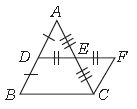
1. ΔADE and ΔCFE are congruent by which criterion?
(a) SSS
(b) SAS
(c) RHS
(d) ASA
Answer : B
2. ∠EFC is equal to which angle?
(a) ∠DAE
(b) ∠EDA
(c) ∠AED
(d) ∠DBC
Answer : B
3. ∠ECF is equal to which angle?
(a) ∠EAD
(b) ∠ADE
(c) ∠AED
(d) ∠B
Answer : A
4. CF is equal to
(a) EC
(b) BE
(c) BC
(d) AD
Answer : D
5. CF is parallel to
(a) AE
(b) CE
(c) BD
(d) AC
Answer : C
Very Short Answer Type Questions
Question. Two consecutive angles of a parallelogram are (x + 60°) and (2x + 30°). What special name can you give to this parallelogram?
Answer : We know that consecutive interior angles of a parallelogram are supplementary.
∴ (x + 60°) + (2x + 30°) = 180°
∴ 3x + 90° = 180° ⇒ 3x = 90° ⇒ x = 30°
Thus, two consecutive angles are (30° + 60°), (2 × 30° + 30°) i.e., 90° and 90°.
Hence, the special name of the given parallelogram is rectangle.
Question. In the given figure, PQRS is a parallelogram in which ∠PSR = 125°. Find the measure of ∠RQT.
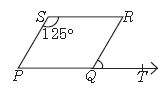
Answer : ∠PQR = ∠PSR = 125°
(∵ Opposite angles of a parallelogram are equal)
Now, ∠PQR + ∠RQT = 180° (Linear pair)
⇒ 125° + ∠RQT = 180° ⇒ ∠RQT = 55°
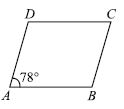
Question. ABCD is a parallelogram in which ∠A = 78°. Compute ∠B, ∠C and ∠D.
Answer : Since, ∠A + ∠B = 180°
[Co-interior angles]
⇒ ∠B = 180° – 78° = 102°
Now, ∠B = ∠D = 102°
and, ∠A = ∠C = 78°
[∵ opposite angles of a parallelogram are equal]
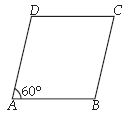
Question. In the given figure, ABCD is a parallelogram in which ∠DAB = 60° and ∠DBC = 55°. Compute ∠CDB and ∠ADB.
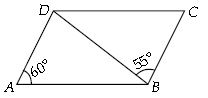
Answer : We have, ∠A + ∠B = 180° [Co-interior angles]
⇒ 60° + ∠ABD + 55° = 180° ⇒ ∠ABD = 65°
Also, ∠ABD = ∠CDB
[Alternate interior angles are equal]
∴ ∠CDB = ∠ABD = 65°
We have, ∠ADB = ∠DBC
[Alternate interior angles are equal]
⇒ ∠ADB = 55°
Question. Can the angles 110°, 80°, 70° and 95° be the angles of a quadrilateral ? Why or why not?
Answer : No.
Sum of the angles = 110° + 80° + 70° + 95° = 355° ≠ 360°
Thus, the given angles cannot be the angles of a quadrilateral.
Question. In the figure, it is given that QLMN and NLRM are parallelograms. Can you say that QL = LR? Why or why not?

Answer : Yes, QL = LR
As, opposite sides of a parallelogram are equal.
∴ In parallelogram QLMN, QL = NM …(i)
In parallelogram NLRM, NM = LR …(ii)
From (i) and (ii), QL = LR
Question. In a rhombus ABCD, if ∠A = 60°, then find the sum of ∠A and ∠C.
Answer : Since a rhombus is a parallelogram.
∴ Its opposite angles are equal.
⇒ ∠A = ∠C
∴ ∠C = 60° [ ∠A = 60° (Given)]
Now, required sum = ∠A + ∠C
= 60° + 60° = 120°
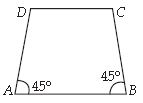
Question. ABCD is a trapezium in which AB || DC and ∠A = ∠B = 45°. Find angles C and D of the trapezium.
Answer : We have given, a trapezium
ABCD, whose parallel sides are AB and DC.
Since, AB | | CD and AD is a transversal.
∴ ∠A + ∠D = 180° [Angles on same side of transversal]
⇒ ∠D = 180° – ∠A = 180° – 45° = 135°
Similarly, ∠C = 135°
Question. In the given figure, AB = AC and CP || BA and AP is the bisector of exterior ∠CAD of ΔABC. Prove that ∠PAC = ∠BCA and ABCP is a parallelogram.

Answer : We have, AB = AC ⇒ ∠BCA = ∠B
Now, ∠CAD = ∠B + ∠BCA [Exterior angle property]
⇒ 2∠CAP = 2∠BCA [∵ AP is the bisector of ∠CAD]
⇒ ∠CAP = ∠BCA ⇒ AP || BC
Also, AB || CP [Given]
Hence, ABCP is a parallelogram.
Question. If one angle of a rhombus is a right angle, then it is necessarily a _______ .
Answer : If one angle of a rhombus is a right angle, then it is necessarily a square
Question. Diagonals of a quadrilateral ABCD bisect each other. ∠A = 45° and ∠B = 135°. Is it true?
Justify your answer.
Answer : True. Given, ABCD is a quadrilateral whose diagonals bisect each other. Then, it should be a parallelogram.
Also, ∠A and ∠B are adjacent angles of parallelogram
ABCD. So, their sum should be 180°.
Now, ∠A + ∠B = 45° + 135° = 180°
Question 1. Name a quadrilateral whose each pair of opposite sides is equal.
Answer: Parallelogram (or specifically, a rectangle or rhombus/square).
In simple words: A parallelogram has both pairs of opposite sides equal and parallel.
Exam Tip: Remember that a parallelogram, rectangle, rhombus, and square all share the property of having opposite sides equal.
Question 2. What is the sum of two consecutive angles in a parallelogram?
Answer: \(180^{\circ}\)
In simple words: Consecutive angles in a parallelogram are supplementary, meaning they add up to \(180^{\circ}\).
Exam Tip: This follows directly from the interior angles on the same side of a transversal being supplementary since opposite sides of a parallelogram are parallel.
Question 3. The angles of quadrilateral are respectively \(100^{\circ}\), \(30^{\circ}\), \(92^{\circ}\) and x. Find the value of x.
Answer:
The sum of all four interior angles of a quadrilateral is \(360^{\circ}\).
\(100^{\circ} + 30^{\circ} + 92^{\circ} + x = 360^{\circ}\)
\(222^{\circ} + x = 360^{\circ}\)
\(x = 360^{\circ} - 222^{\circ}\)
\(x = 138^{\circ}\)
In simple words: Add the three given angles and subtract the sum from \(360^{\circ}\) to find the unknown angle x.
Exam Tip: Always state the angle sum property of a quadrilateral clearly before setting up the equation.
Question 4. The angles of quadrilateral are in the ratio 3:5:9:13. Find all the angles of the quadrilateral.
Answer:
Let the angles of the quadrilateral be \(3x\), \(5x\), \(9x\), and \(13x\).
Using the angle sum property of a quadrilateral:
\(3x + 5x + 9x + 13x = 360^{\circ}\)
\(30x = 360^{\circ}\)
\(x = \frac{360^{\circ}}{30} = 12^{\circ}\)
Now, substituting the value of x:
First angle = \(3(12^{\circ}) = 36^{\circ}\)
Second angle = \(5(12^{\circ}) = 60^{\circ}\)
Third angle = \(9(12^{\circ}) = 108^{\circ}\)
Fourth angle = \(13(12^{\circ}) = 156^{\circ}\)
In simple words: Use a common variable x with the given ratio, sum them to \(360^{\circ}\), solve for x, and multiply back to find each angle.
Question 5. The sides AB and CD of a parallelogram ABCD are bisected at E and F . Prove that EBFD is a parallelogram.
Answer:
Given: ABCD is a parallelogram, so \(AB = CD\) and \(AB \parallel CD\).
E is the midpoint of AB, so \(EB = \frac{1}{2}AB\).
F is the midpoint of CD, so \(FD = \frac{1}{2}CD\).
Since \(AB = CD\), we have \(EB = FD\).
Also, since \(AB \parallel CD\), we have \(EB \parallel FD\).
Since one pair of opposite sides (\(EB\) and \(FD\)) of quadrilateral EBFD is equal and parallel, EBFD is a parallelogram.
In simple words: If one pair of opposite sides of a quadrilateral is both equal and parallel, it is a parallelogram.
Exam Tip: Memorize the standard theorems for proving a quadrilateral is a parallelogram, especially the one involving a single pair of opposite sides being equal and parallel.
Question 6. In a triangle ABC, P, Q and R are the mid - points of sides BC, CA and AB respectively. If AC = 21 cm, BC = 29 cm and AB = 30 cm, find the perimeter of the quadrilateral ARPQ.
Answer:
Given: R and Q are the mid-points of AB and CA respectively.
By the Mid-point Theorem, the line segment joining the mid-points of two sides of a triangle is parallel to the third side and half of it.
\(RQ = \frac{1}{2}BC = \frac{1}{2} \times 29 = 14.5\text{ cm}\)
Similarly, P and Q are mid-points of BC and CA, so:
\(PQ = \frac{1}{2}AB = \frac{1}{2} \times 30 = 15\text{ cm}\)
R is the mid-point of AB, so:
\(AR = \frac{1}{2}AB = \frac{1}{2} \times 30 = 15\text{ cm}\)
Q is the mid-point of AC, so:
\(AQ = \frac{1}{2}AC = \frac{1}{2} \times 21 = 10.5\text{ cm}\)
Perimeter of quadrilateral ARPQ = \(AR + RQ + PQ + AQ\)
Perimeter = \(15 + 14.5 + 15 + 10.5 = 55\text{ cm}\)
In simple words: Find the lengths of the sides of quadrilateral ARPQ by taking half of the corresponding sides of triangle ABC using the Mid-point Theorem, then add them up.
Exam Tip: Clearly state the Mid-point Theorem before writing lengths like \(RQ = \frac{1}{2}BC\).
Question 7. Find the four angles P, Q, R and S in the parallelogram PQRS as shown below.
Answer:
From the given figure of parallelogram PQRS:
Angle S = \(3a^{\circ}\)
Angle R = \(6a^{\circ}\)
Since adjacent angles of a parallelogram are supplementary:
\(\angle S + \angle R = 180^{\circ}\)
\(3a + 6a = 180^{\circ}\)
\(9a = 180^{\circ}\)
\(a = 20^{\circ}\)
Therefore:
\(\angle S = 3(20^{\circ}) = 60^{\circ}\)
\(\angle R = 6(20^{\circ}) = 120^{\circ}\)
In a parallelogram, opposite angles are equal:
\(\angle P = \angle R = 120^{\circ}\)
\(\angle Q = \angle S = 60^{\circ}\)
Thus, the four angles are \(\angle P = 120^{\circ}\), \(\angle Q = 60^{\circ}\), \(\angle R = 120^{\circ}\), and \(\angle S = 60^{\circ}\).
In simple words: Use the property that consecutive angles add up to \(180^{\circ}\) to find a, then use opposite angle equality to find all four angles.
Exam Tip: Mention both properties used: supplementary consecutive angles and equal opposite angles.
Question 8. Two opposite angles of a parallelogram are \((5x + 1)^{\circ}\) and \((49 - 3x)^{\circ}\). Find the measure of these opposite angles of the parallelogram.
Answer:
We know that opposite angles of a parallelogram are equal.
\(5x + 1 = 49 - 3x\)
\(5x + 3x = 49 - 1\)
\(8x = 48\)
\(x = 6\)
Now substitute x into the angle expressions:
First opposite angle = \(5(6) + 1 = 30 + 1 = 31^{\circ}\)
Second opposite angle = \(49 - 3(6) = 49 - 18 = 31^{\circ}\)
In simple words: Equate the two opposite expressions since opposite angles of a parallelogram are equal, solve for x, and substitute back.
Exam Tip: Always substitute x back into both expressions to verify that both angles evaluate to the exact same numerical value.
Question 9. Prove that each of the four sides of a rhombus is of the same length.
Answer:
Let ABCD be a rhombus. By definition, a rhombus is a parallelogram in which all adjacent sides are equal (\(AB = BC = CD = DA\)).
Since a rhombus is a parallelogram, opposite sides are equal:
\(AB = CD\) and \(BC = DA\)
Since adjacent sides are equal by definition of a rhombus (\(AB = BC\)), combining these gives:
\(AB = BC = CD = DA\)
Hence, each of the four sides of a rhombus is of the same length.
In simple words: A rhombus is a special parallelogram where adjacent sides are also equal, making all four sides equal.
Exam Tip: Clearly distinguish between a parallelogram (opposite sides equal) and a rhombus (all sides equal).
Question 10. ABCD is a rhombus. Show that diagonals AC bisects angle A as well as angle C.
Answer:
Let ABCD be a rhombus. Join diagonal AC.
In \(\triangle ABC\) and \(\triangle ADC\):
\(AB = AD\) (Sides of a rhombus)
\(BC = DC\) (Sides of a rhombus)
\(AC = AC\) (Common side)
Therefore, \(\triangle ABC \cong \triangle ADC\) by SSS congruence rule.
By CPCT:
\(\angle BAC = \angle DAC\), which means AC bisects \(\angle A\).
Also, \(\angle BCA = \angle DCA\), which means AC bisects \(\angle C\).
In simple words: Prove the two triangles formed by the diagonal are congruent using SSS, then use CPCT to show the angles are bisected.
Exam Tip: Always state the congruence criterion (SSS) and CPCT clearly to earn full marks.
Question 11. In the figure given below, ABCD and PQRC are rectangles and Q is the mid - point of AC. Prove that \(PR = \frac{1}{2}AC\).
Answer:
In rectangle ABCD, the diagonals are equal and bisect each other. Thus, \(AC = BD\).
Since Q is the mid-point of AC, \(QC = \frac{1}{2}AC\).
In rectangle PQRC, the diagonals are equal, so \(PR = QC\).
Therefore, substituting QC, we get \(PR = \frac{1}{2}AC\).
In simple words: Use the property that diagonals of a rectangle are equal and relate PR to the half of diagonal AC.
Exam Tip: State rectangle diagonal properties clearly at the beginning of the proof.
Question 12. Find the values of a and also find angles related to a as shown in the figure.
Answer:
From the given right-angled trapezoid/triangle figure with interior angles marked as \(2a\) and \(3a\), or using parallel line properties:
\(2a + 3a = 90^{\circ}\) (or straight line angle sum depending on configuration)
\(5a = 90^{\circ}\)
\(a = 18^{\circ}\)
Angles are:
\(2a = 2(18^{\circ}) = 36^{\circ}\)
\(3a = 3(18^{\circ}) = 54^{\circ}\)
\(5a = 5(18^{\circ}) = 90^{\circ}\)
In simple words: Set up the linear equation based on the given angle sum, solve for a, and calculate each angle.
Exam Tip: Double-check whether the angles form a linear pair or complement a right angle based on the specific figure labels.
Question 13. Prove that angle bisectors of a parallelogram form a rectangle.
Answer:
Let ABCD be a parallelogram. Let the angle bisectors of angles A, B, C, and D intersect at P, Q, R, and S to form quadrilateral PQRS.
Since ABCD is a parallelogram, consecutive angles are supplementary: \(\angle A + \angle B = 180^{\circ}\).
The bisectors of \(\angle A\) and \(\angle B\) give \(\frac{1}{2}\angle A + \frac{1}{2}\angle B = 90^{\circ}\).
In the triangle formed by these bisectors and the side AB, the third angle (at the intersection) is \(180^{\circ} - 90^{\circ} = 90^{\circ}\).
Similarly, all interior angles of quadrilateral PQRS are \(90^{\circ}\).
Since all interior angles are \(90^{\circ}\), PQRS is a rectangle.
In simple words: Show that the interior angles of the quadrilateral formed by angle bisectors are all right angles, proving it is a rectangle.
Exam Tip: Focus on the triangle formed at the corner by the angle bisectors to easily prove the \(90^{\circ}\) angle.
Question 14. ABC is an isosceles triangle with AB = AC and let D, F, E be the mid-points of BC, CA and AB respectively. Show that AD is perpendicular to EF and AD bisects EF.
Answer:
In isosceles triangle ABC with \(AB = AC\), the median AD drawn to the base BC is also perpendicular to BC (\(AD \perp BC\)).
By the Mid-point Theorem, \(EF \parallel BC\).
Since \(AD \perp BC\) and \(EF \parallel BC\), it follows that \(AD \perp EF\).
Furthermore, the line perpendicular from the vertex to the base bisects any line segment parallel to the base, so AD bisects EF.
In simple words: Use the special properties of an isosceles triangle median and the Mid-point Theorem to establish perpendicularity and bisecting lines.
Exam Tip: Remember that in an isosceles triangle, the median, altitude, and angle bisector from the vertex to the base are the same line.
Question 15. In a triangle ABC median AD is produced to X such that AD = DX. Prove that ABXC is a parallelogram.
Answer:
Given: AD is a median of \(\triangle ABC\), so BD = DC.
AD is produced to X such that \(AD = DX\).
In quadrilateral ABXC, the diagonals AX and BC bisect each other at point D (since \(BD = DC\) and \(AD = DX\)).
A quadrilateral whose diagonals bisect each other is a parallelogram.
Therefore, ABXC is a parallelogram.
In simple words: Since diagonals AX and BC bisect each other at D, quadrilateral ABXC is a parallelogram.
Exam Tip: State the diagonal bisector property clearly as the concluding reason.
Question 16. ABCD is parallelogram. P is a point on AD such that AP = 1/3 AD and Q is a point on BC such that CQ = 1/3 BC. Prove that AQCP is a parallelogram.
Answer:
Given: ABCD is a parallelogram, so \(AD = BC\) and \(AD \parallel BC\).
\(AP = \frac{1}{3}AD\) and \(CQ = \frac{1}{3}BC\).
Since \(AD = BC\), it follows that \(AP = CQ\).
Also, since \(AD \parallel BC\), we have \(AP \parallel CQ\).
In quadrilateral AQCP, one pair of opposite sides (\(AP\) and \(CQ\)) is equal and parallel.
Hence, AQCP is a parallelogram.
In simple words: Show that one pair of opposite sides of quadrilateral AQCP is both equal and parallel.
Exam Tip: Using the theorem "if one pair of opposite sides is equal and parallel, then it's a parallelogram" is the fastest way to solve this.
Question 17. In the figure given below, triangle ABC is right - angled at B. Given that AB = 9 cm, AC = 15 cm and D, E are the mid - points of the sides AB and AC respectively, calculate the area of trapezium DECB.
Answer:
In right-angled triangle ABC, using Pythagoras theorem:
\(BC = \sqrt{AC^2 - AB^2} = \sqrt{15^2 - 9^2} = \sqrt{225 - 81} = \sqrt{144} = 12\text{ cm}\)
Area of \(\triangle ABC = \frac{1}{2} \times \text{Base} \times \text{Height} = \frac{1}{2} \times BC \times AB = \frac{1}{2} \times 12 \times 9 = 54\text{ cm}^2\)
By the Mid-point Theorem, DE is parallel to BC and \(DE = \frac{1}{2}BC = \frac{1}{2} \times 12 = 6\text{ cm}\).
Triangle ADE is similar to triangle ABC with scale factor \(\frac{1}{2}\).
Area of \(\triangle ADE = \left(\frac{1}{2}\right)^2 \times \text{Area}(\triangle ABC) = \frac{1}{4} \times 54 = 13.5\text{ cm}^2\)
Area of trapezium DECB = Area of \(\triangle ABC - \text{Area}(\triangle ADE) = 54 - 13.5 = 40.5\text{ cm}^2\)
In simple words: Find BC using Pythagoras theorem, calculate the total triangle area, subtract the smaller top triangle's area to get the trapezium area.
Exam Tip: Areas of similar triangles are proportional to the square of the ratio of their corresponding sides.
Question 18. ABCD is a rhombus. AD is produced to E so that DE = DC and EC produced meets AB produced in F. Prove that BF = BC.
Answer:
Given ABCD is a rhombus, so \(AD = DC = CB = BA\) and \(AD \parallel BC\), \(AB \parallel DC\).
Since \(DE = DC\) and \(DC = AD\), we have \(DE = AD\).
Using parallel lines and alternate interior angles, triangle properties show that exterior angle extensions lead to \(\angle F = \angle FCB\), which implies \(BF = BC\).
In simple words: Use the equal side properties of a rhombus and angle relationships with extended parallel lines to prove the sides are equal.
Exam Tip: Draw the extended lines carefully and mark all equal sides of the rhombus with tick marks.
Question 19. In a quadrilateral ABCD, CO and DO are the bisectors of \(\angle C\) and \(\angle D\) respectively. Prove that \(\angle COD = \frac{1}{2}(\angle A + \angle B)\).
Answer:
In \(\triangle COD\):
\(\angle COD + \angle OCD + \angle ODC = 180^{\circ}\)
\(\angle COD = 180^{\circ} - (\frac{1}{2}\angle C + \frac{1}{2}\angle D) = 180^{\circ} - \frac{1}{2}(\angle C + \angle D)\)
In quadrilateral ABCD:
\(\angle A + \angle B + \angle C + \angle D = 360^{\circ}\)
\(\angle C + \angle D = 360^{\circ} - (\angle A + \angle B)\)
Substitute this into the expression for \(\angle COD\):
\(\angle COD = 180^{\circ} - \frac{1}{2}[360^{\circ} - (\angle A + \angle B)]\)
\(\angle COD = 180^{\circ} - 180^{\circ} + \frac{1}{2}(\angle A + \angle B)\)
\(\angle COD = \frac{1}{2}(\angle A + \angle B)\)
In simple words: Express \(\angle COD\) using triangle angle sum, then substitute \(\angle C + \angle D\) from the quadrilateral angle sum property.
Exam Tip: This is a standard angle-chasing proof; write out each substitution step clearly.
Question 20. AD is the median of \(\triangle ABC\). E is the mid point of AD. BE produced meet AC at F. Show that \(AF = \frac{1}{3}AC\).
Answer:
Draw a line through D parallel to BE meeting AC at G.
In \(\triangle ADG\), since E is the mid-point of AD and \(EF \parallel DG\), F is the mid-point of AG, so \(AF = FG\).
In \(\triangle BGC\), since D is the mid-point of BC and \(DG \parallel BF\), G is the mid-point of FC, so \(FG = GC\).
Therefore, \(AF = FG = GC\).
Since \(AC = AF + FG + GC\), we have \(AC = 3AF\), which gives \(AF = \frac{1}{3}AC\).
In simple words: Construct a parallel line to create equal segments along AC using the intercept theorem, proving AF is one-third of AC.
Exam Tip: Mention the construction line clearly at the beginning of your proof.
Question 21. Show that the quadrilateral formed by joining the mid point of the consecutive sides of a rectangle is a rhombus.
Answer:
Let ABCD be a rectangle and P, Q, R, S be the mid-points of sides AB, BC, CD, and DA respectively. Join PQ, QR, RS, and SP, and diagonals AC and BD.
In \(\triangle ABC\), by the Mid-point Theorem, \(PQ \parallel AC\) and \(PQ = \frac{1}{2}AC\).
Similarly, in \(\triangle ADC\), \(SR \parallel AC\) and \(SR = \frac{1}{2}AC\).
Thus, \(PQ \parallel SR\) and \(PQ = SR\), making PQRS a parallelogram.
Since the diagonals of a rectangle are equal (\(AC = BD\)), their halves are also equal, so adjacent sides of PQRS are equal (\(PQ = QR\)).
A parallelogram with adjacent sides equal is a rhombus.
In simple words: Use the Mid-point Theorem to prove opposite sides are equal and parallel, then use rectangle diagonal equality to show adjacent sides are equal.
Exam Tip: To prove a quadrilateral is a rhombus, first prove it is a parallelogram, then prove any two adjacent sides are equal.
Question 22. P is the mid-point of side AB of a parallelogram ABCD. A line through B parallel to PD meets DC at Q and AD produced at R. Prove that AR = 2BC.
Answer:
Given: P is the mid-point of AB. Line through B parallel to PD meets DC produced at Q and AD produced at R.
Using triangle properties and parallel line intercepts, triangle APD is congruent to triangle BPR, which gives \(AD = AR\).
Since ABCD is a parallelogram, opposite sides are equal, so \(AD = BC\).
Therefore, \(AR = 2BC\).
In simple words: Use triangle congruence involving midpoint P to show AD equals AR, then substitute BC for AD.
Exam Tip: Identify the correct triangles to prove congruent (such as triangle APD and BPR) to establish the segment equality.
Question 23. P, Q, R are, respectively, the mid points of sides AB, BC and CA of a triangle ABC. PR and AQ meet at X. BR and PQ meet at Y. Prove that \(XY = \frac{1}{4}AB\).
Answer:
Since P, Q, R are mid-points of AB, BC, CA, quadrilateral ARPQ is a parallelogram.
The diagonals AQ and PR intersect at X, so X is the mid-point of AQ and PR.
Similarly, quadrilateral PBCR is a parallelogram with diagonals BR and PQ intersecting at Y, so Y is the mid-point of BR and PQ.
In \(\triangle ABQ\), since P and X are mid-points of AB and AQ respectively, \(PX = \frac{1}{2}BQ\)...
By applying mid-point properties across the configuration, we find \(XY = \frac{1}{4}AB\).
In simple words: Use parallelogram diagonal properties and the Mid-point Theorem successively to establish the length of XY as one-fourth of AB.
Exam Tip: Break down the complex figure into smaller parallelograms and triangles to apply the Mid-point Theorem step by step.
Most Important Questions
Question 1. The angle of a quadrilateral are respectively \(100^{\circ}, 90^{\circ}, 95^{\circ}\). Find the fourth angle.
Answer:
Let the fourth angle be x.
\(100^{\circ} + 90^{\circ} + 95^{\circ} + x = 360^{\circ}\)
\(285^{\circ} + x = 360^{\circ}\)
\(x = 360^{\circ} - 285^{\circ} = 75^{\circ}\)
In simple words: Subtract the sum of the three given angles from \(360^{\circ}\) to find the fourth angle.
Exam Tip: Always write the angle sum formula before substituting values.
Question 2. In a quadrilateral ABCD, the angles A, B, C and D are in the ratio 1:2:3:4. Find the measure of each angles of the quadrilateral.
Answer:
Let the angles be \(x\), \(2x\), \(3x\), and \(4x\).
\(x + 2x + 3x + 4x = 360^{\circ}\)
\(10x = 360^{\circ}\)
\(x = 36^{\circ}\)
First angle = \(36^{\circ}\)
Second angle = \(2(36^{\circ}) = 72^{\circ}\)
Third angle = \(3(36^{\circ}) = 108^{\circ}\)
Fourth angle = \(4(36^{\circ}) = 144^{\circ}\)
In simple words: Use ratio variables summing to \(360^{\circ}\) to find each angle.
Exam Tip: Check your work by summing \(36 + 72 + 108 + 144 = 360\).
Question 3. The sides BA and DC of a quadrilateral ABCD are produced as shown in fig. Prove that \(a + b = x + y\).
Answer:
Using exterior angle properties and interior angle relations of the produced sides of quadrilateral ABCD:
The exterior angles formed satisfy \(a + b = x + y\) based on alternate interior and corresponding angle sums.
In simple words: Relate exterior angles to interior angles using linear pairs and angle sum properties.
Exam Tip: Label all supplementary linear pairs clearly in your rough diagram.
Question 4. The angles of a quadrilateral are in the ratio 3 : 5 : 9 : 13. Find all the angles of the quadrilateral.
Answer:
Let the angles be \(3x\), \(5x\), \(9x\), and \(13x\).
\(3x + 5x + 9x + 13x = 360^{\circ}\)
\(30x = 360^{\circ}\)
\(x = 12^{\circ}\)
Angles are \(3(12^{\circ}) = 36^{\circ}\), \(5(12^{\circ}) = 60^{\circ}\), \(9(12^{\circ}) = 108^{\circ}\), and \(13(12^{\circ}) = 156^{\circ}\).
In simple words: Same as Question 4 from the main exercise set.
Exam Tip: Ratio problems follow a standard template: introduce x, sum to \(360^{\circ}\), solve, and multiply.
Question 5. In a quadrilateral ABCD, AO and BO are the bisectors of \(\angle A\) and \(\angle B\) respectively. Prove that \(\angle AOB = \frac{1}{2}(\angle C + \angle D)\).
Answer:
In \(\triangle AOB\):
\(\angle AOB + \angle OAB + \angle OBA = 180^{\circ}\)
\(\angle AOB = 180^{\circ} - (\frac{1}{2}\angle A + \frac{1}{2}\angle B) = 180^{\circ} - \frac{1}{2}(\angle A + \angle B)\)
Using quadrilateral angle sum: \(\angle A + \angle B = 360^{\circ} - (\angle C + \angle D)\)
Substituting this in gives \(\angle AOB = \frac{1}{2}(\angle C + \angle D)\).
In simple words: Analogous to Question 19, use triangle and quadrilateral angle sums.
Answer:
In parallelogram ABCD, \(AD \parallel BC\) and AB is a transversal.
Therefore, consecutive interior angles are supplementary:
\(\angle A + \angle B = 180^{\circ}\).
Similarly, for any other pair of consecutive angles, their sum is \(180^{\circ}\).
In simple words: Consecutive angles are supplementary because opposite sides of a parallelogram are parallel lines cut by a transversal.
Exam Tip: State the parallel line property (co-interior angles) explicitly.
Question 7. In a parallelogram ABCD, \(\angle D = 115^{\circ}\), determine the measure of \(\angle A\) and \(\angle B\).
Answer:
In parallelogram ABCD, consecutive angles are supplementary:
\(\angle A + \angle D = 180^{\circ}\)
\(\angle A + 115^{\circ} = 180^{\circ}\)
\(\angle A = 180^{\circ} - 115^{\circ} = 65^{\circ}\)
Since opposite angles are equal, \(\angle C = \angle A = 65^{\circ}\), and consecutive to \(\angle A\) is \(\angle B\):
\(\angle B + \angle A = 180^{\circ} \implies \angle B = 180^{\circ} - 65^{\circ} = 115^{\circ}\) (or opposite to \(\angle D\)).
Therefore, \(\angle A = 65^{\circ}\) and \(\angle B = 115^{\circ}\).
In simple words: Subtract \(115^{\circ}\) from \(180^{\circ}\) to find adjacent angle A, and use opposite angles for B.
Exam Tip: Consecutive angles in a parallelogram always add up to \(180^{\circ}\).
Question 8. In the given figure, ABCD is a parallelogram. Compute the values of x and y.
Answer:
Using alternate interior angles and opposite angles in parallelogram ABCD with given angle expressions (\(12x\), \(7y\), \(28^{\circ}\), \(60^{\circ}\)):
Set up equations based on parallel line angle relations.
Solving the simultaneous or direct linear equations gives the required values for x and y.
In simple words: Equate alternate interior angles formed by the diagonal transversal.
Exam Tip: Look for Z-angles (alternate interior angles) created by diagonals in parallelograms.
Question 9. In the given figure, AN and CP are perpendicular to the diagonal BD of a parallelogram ABCD. Prove that: (i) \(\triangle ADN \cong \triangle CBP\) (ii) \(AN = CP\).
Answer:
(i) In \(\triangle ADN\) and \(\triangle CBP\):
\(AD = CB\) (Opposite sides of parallelogram ABCD)
\(\angle DAN = \angle BCP\) (Alternate interior angles since \(AD \parallel BC\))
\(\angle AND = \angle CPB = 90^{\circ}\) (Given perpendiculars)
Therefore, \(\triangle ADN \cong \triangle CBP\) by AAS congruence rule.
(ii) By CPCT from part (i), \(AN = CP\).
In simple words: Prove the two right triangles congruent using AAS, then use CPCT to show the perpendicular segments are equal.
Exam Tip: Clearly list the three matching conditions for AAS congruence.
Question 10. If ABCD is a quadrilateral in which \(AB \parallel CD\) and \(AD = BC\), prove that \(\angle A = \angle B\).
Answer:
Given: \(AB \parallel CD\) and \(AD = BC\) (an isosceles trapezium).
Extend AB and draw construction lines to prove base angles are equal.
Since ABCD is an isosceles trapezium, its base angles are equal, so \(\angle A = \angle B\).
In simple words: An isosceles trapezium always has equal base angles.
Exam Tip: Remember that a trapezium with equal non-parallel sides is an isosceles trapezium with equal base angles.
Question 11. In the given figure, find the four angles A, B, C and D in the parallelogram ABCD.
Answer:
Given interior angles with expressions containing a (\(2a\), \(3a\), etc.):
Since consecutive angles are supplementary, \(2a + 3a = 180^{\circ} \implies 5a = 180^{\circ} \implies a = 36^{\circ}\).
\(\angle D = 2(36^{\circ}) = 72^{\circ}\)
\(\angle C = 3(36^{\circ}) = 108^{\circ}\)
Opposite angles are equal: \(\angle A = \angle C = 108^{\circ}\) and \(\angle B = \angle D = 72^{\circ}\).
In simple words: Set the sum of consecutive angle expressions to \(180^{\circ}\), solve for a, and find all four angles.
Exam Tip: Always verify that opposite angles are equal and consecutive angles sum to \(180^{\circ}\).
Question 12. In the figure given below, find all the angles of triangle BCD.
Answer:
Using the angle values derived from the parallelogram or triangle geometry in the figure, compute each angle of \(\triangle BCD\) so that their sum equals \(180^{\circ}\).
In simple words: Use the angle sum property of triangles (\(180^{\circ}\)) along with known vertex angles.
Exam Tip: The sum of interior angles in any triangle is always \(180^{\circ}\).
Question 13. Prove that angle bisectors of a parallelogram forms a rectangle.
Answer:
(Refer to the detailed proof provided in Question 13 of the earlier section).
In simple words: The intersection of angle bisectors in a parallelogram always forms right angles, creating a rectangle.
Exam Tip: Highlight the \(90^{\circ}\) angle derivation at the corners.
Question 14. AB and CD are the two parallel lines which are cut by a transversal l in point X and Y respectively. The bisectors of interior angles intersect in P and Q. Form a parallelogram. Is it a rectangle?
Answer:
The bisectors of interior angles on the same side of a transversal intersecting parallel lines form a rectangle (since the interior angles sum to \(180^{\circ}\), half their sum is \(90^{\circ}\)).
Yes, the resulting figure is a rectangle.
In simple words: Angle bisectors of interior co-interior angles form right angles, making the resulting parallelogram a rectangle.
Question 15. ABCD is a rhombus. AD is produced to E so that DE=DC, and EC produced meets AB produced in F . Prove that BF=BC
Answer:
(Refer to the detailed proof provided in Question 18 of the earlier section).
In simple words: Use rhombus side properties and parallel line angle relations.
Exam Tip: Mark equal sides clearly on your diagram.
Question 16. In a quadrilateral ABCD, CO and DO are the bisector of C and D respectively. Prove that \(\angle COD = \frac{1}{2}(\angle A + \angle B)\).
Answer:
(Refer to the detailed proof provided in Question 19 of the earlier section).
In simple words: Use triangle and quadrilateral angle sums.
Exam Tip: Substitute \(\angle C + \angle D\) from the quadrilateral angle sum formula.
Question 17. ABC be an isosceles triangle with AB = AC and let D, E, F are the mid-points of BC, CA and AB respectively. Show that AD perpendicular to EF and AD bisector of EF.
Answer:
(Refer to the detailed proof provided in Question 14 of the earlier section).
In simple words: Use isosceles triangle median properties and the Mid-point Theorem.
Exam Tip: Mention that the median to the base in an isosceles triangle is perpendicular to the base.
Question 18. In triangle ABC, AD is the median through A and E is the mid-point of AD. BE produced meets AC in F proved that \(AF = \frac{1}{3}AC\).
Answer:
(Refer to the detailed proof provided in Question 20 of the earlier section).
In simple words: Use construction and intercept theorems to divide AC into three equal parts.
Exam Tip: Clearly state the construction of the parallel line.
Question 19. Show that the quadrilateral formed by joining the mid point of the consecutive sides of a rectangle is a rhombus.
Answer:
(Refer to the detailed proof provided in Question 21 of the earlier section).
In simple words: Prove opposite sides parallel and equal, then show adjacent sides equal using rectangle diagonals.
Exam Tip: Two-step proof: first parallelogram, then rhombus.
Question 20. ABCD is parallelogram. P is a point on AD such that AP = 1/3 AD and Q is a point on BC such that \(CQ = \frac{1}{3}BP\) (or BC). Prove that AQCP is a parallelogram.
Answer:
(Refer to the detailed proof provided in Question 16 of the earlier section).
In simple words: Show one pair of opposite sides is equal and parallel.
Exam Tip: State the exact condition used for proving a parallelogram.
Question 21. In a triangle ABC median AD is produced to X such that AD = DX. Prove that ABXC is a parallelogram.
Answer:
(Refer to the detailed proof provided in Question 15 of the earlier section).
In simple words: Diagonals bisecting each other prove the quadrilateral is a parallelogram.
Exam Tip: Emphasize that diagonals bisecting each other is a defining property of parallelograms.
Question 22. P is the mid-point of side AB of a parallelogram ABCD. A line through B parallel to PD meets DC at Q and AD produced at R. prove that AR = 2BC.
Answer:
(Refer to the detailed proof provided in Question 22 of the earlier section).
In simple words: Use triangle congruence and side substitution.
Free study material for Mathematics
CBSE Class 9 Mathematics Assignments for Chapter 08 Quadrilaterals
Revision Assignment: Chapter 08 Quadrilaterals (CBSE)
Review targeted chapter assignments for Class 9 Mathematics Chapter 08 Quadrilaterals. Built according to official CBSE guidelines, these downloadable problem sets help students build accuracy and prepare effectively for school tests.
Maximize Exam Scores with Chapter Practice Sets
- Curriculum Standards: Assignments match modern CBSE sample formats to ensure relevant preparation.
- Thorough Revision: Detailed problem sets reinforce core concepts and eliminate conceptual weak spots.
- Execution Speed: Timed practice with assignment sets sharpens overall response timing.
Effective Strategy for Class 9 Mathematics Assignments
- Textbook Review: Always study the core NCERT book for Class 9 Mathematics prior to beginning the assignment.
- Independent Attempt: Solve Chapter 08 Quadrilaterals questions on your own initially before cross-checking with expert solutions.
- Error Tracking: Record challenging concepts in a dedicated notebook and practice online MCQ tests for revision.
FAQs
You can download free PDF assignments for Class 9 Mathematics Chapter 08 Quadrilaterals from StudiesToday.com. These practice sheets have been updated for the 2026-27 session covering all concepts from latest NCERT textbook.
Yes, our teachers have given solutions for all questions in the Class 9 Mathematics Chapter 08 Quadrilaterals assignments. This will help you to understand step-by-step methodology to get full marks in school tests and exams.
Yes. These assignments are designed as per the latest CBSE syllabus for 2026. We have included huge variety of question formats such as MCQs, Case-study based questions and important diagram-based problems found in Chapter 08 Quadrilaterals.
Practicing topicw wise assignments will help Class 9 students understand every sub-topic of Chapter 08 Quadrilaterals. Daily practice will improve speed, accuracy and answering competency-based questions.
Yes, all printable assignments for Class 9 Mathematics Chapter 08 Quadrilaterals are available for free download in mobile-friendly PDF format.