

Download CBSE Class 9 Mathematics Assignments
Review targeted academic assignments with the CBSE Class 9 Mathematics Number System Assignment Set 10. Built according to official CBSE standards for the 2026-27 term, these downloadable Class 9 Mathematics worksheets support effective daily practice for Chapter 01 Number Systems.
Access CBSE School Assignments and Answers
View or download the dedicated CBSE Class 9 Mathematics Number System Assignment Set 10 resource below. Engaging with these assignments under focused study conditions ensures continuous academic progress and mastery of the 2026-27 curriculum.
Question. The product of 100 real numbers is -100. AT LEAST how many of these 100 real numbers must be positive?
(a) 99
(b) 2
(c) 1
(d) none
Answer : C
Question. For which of these values of y will 2y be an irrational number?
(a) y = √49
(b) y = -2/13
(c) y = 22/7
(d) y = √8
Answer : D
Question. I have two leaking taps in my kitchen. The first tap drips once every 8 seconds and the second one drips once every 12 seconds. When any one tap drips alone, I call it a 'SINGLE DRIP' and when both drip simultaneously, I call it a 'DOUBLE DRIP'.
The number of 'SINGLE DRIPS' in an interval of 100 seconds following a 'DOUBLE DRIP' will be
(a) 3
(b) 7
(c) 12
(d) 18
Answer : C
Question. Shyam's father is 6 times as old as Shyam. Shyam's mother is 25 years old. The average age of this family of three is 20 years. How old is Shyam?
(a) 15 years
(b) 10 years
(c) 7 years
(d) 5 years
Answer : D
Question. The average of the 1st five natural numbers is
(a) 2.25
(b) 2.5
(c) 3
(d) 3.5
Answer : C
Question. What will be the remainder when 46788 is divided by 5?
(a) 1
(b) 2
(c) 3
(d) 4
Answer : A
Question. See the following matchstick patterns.
How many matchsticks would be required to make a similar 10 × 10 square pattern?
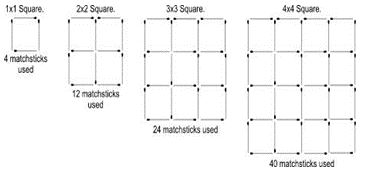
(a) 100
(b) 200
(c) 220
(d) 500
Answer : C
Question. The pattern of numbers below forms a special sequence called the Fibonacci sequence. Study the first 7 numbers given below and understand the pattern 1,1,2,3,5,8,13 ...........
What could the next two numbers of the sequence be?
(a) 18 and 23
(b) 18 and 31
(c) 21 and 26
(d) 21 and 34
Answer : D
Question. Mr. Malkani owns a hotel with exactly 100 rooms. The first room is numbered as 1, the second one as 2 and so on. However, being a superstitious man, he has taken care that no room in his hotel bears the number 13 or any of its multiples.
What is the room number of the 100th room in the hotel?
(a) 87
(b) 100
(c) 107
(d) 108
Answer : D
Question. If x + 5 is a multiple of 3, which of the following MUST be a multiple of 9?
(a) x2 + 25
(b) 3x + 5
(c) (x + 5)(x + 5)
(d) (x + 5)(x + 9)
Answer : C
Question. A certain whole number is multiplied by 90 and then divided by 2. Which of the following could be the result?
(a) 33228
(b) 52320
(c) 61635
(d) 26550
Answer : D
Question. Adil's bathroom has two taps next to each other and a bucket is kept under them. Tap 1 alone (at full flow) can fill HALF the bucket in 2 minutes and Tap 2 alone (at full flow) can fill HALF the bucket in 3 minutes.
If both taps are turned on (to full flow), in how much time will the bucket get filled completely?
(a) 2 minutes 24 seconds
(b) 2 minutes 30 seconds
(c) 5 minutes
(d) 10 minutes
Answer : A
Question. 2. 31 × 10-3 can be written as
(a) -69. 3
(b) -2310
(c) 0. 00231
(d) 1/2.31 × 103
Answer : C
Question. 3 ×10³ / 6 ×10⁴ is
(a) 0. 5 × (10)3/4
(b) 0. 5 × 10
(c) (2 × 10)-1
(d) 2 × (10)-1
Answer : C
Question. A number N is increased by 100%. The resulting number is then decreased by 100%. The final result will be
(a) 50N
(b) N
(c) N2
(d) 0
Answer : D
Mathematics Assignment
NUMBER SYSTEM
Question 1. Define 1) Natural Numbers (denoted by \(N\)) 2) Whole Numbers (denoted by \(W\)) 3) Integers (denoted by \(Z\)) 4) Rational Numbers (denoted by \(Q\)) 5) Irrational Number (denoted by \(S\)) 6) Real Numbers (denoted by \(R\)). Give at least two examples of each
Answer: 1) Natural Numbers: Counting numbers starting from 1. Examples: \(N = \{1, 2, 3, \dots\}\)
2) Whole Numbers: Natural numbers including zero. Examples: \(W = \{0, 1, 2, 3, \dots\}\)
3) Integers: All whole numbers and their negative counterparts. Examples: \(Z = \{\dots, -3, -2, -1, 0, 1, 2, 3, \dots\}\)
4) Rational Numbers: Numbers that can be expressed in the form \(\frac{p}{q}\), where \(p\) and \(q\) are integers and \(q \neq 0\). Examples: \(Q = \{\dots, -\frac{1}{2}, -\frac{1}{3}, 0, \frac{5}{6}, \dots\}\)
5) Irrational Numbers: Real numbers that cannot be expressed as a simple fraction. Examples: \(S = \{\pm\sqrt{2}, \pm\sqrt{3}, \dots\}\)
6) Real Numbers: The set of all rational and irrational numbers. Examples: \(R = \{0, 1, \frac{1}{2}, \sqrt{2}, -\frac{1}{3}, \dots\}\)
In simple words: These definitions classify numbers based on whether they include fractions, negative values, zero, or roots.
Exam Tip: Memorize the standard letter notations (\(N, W, Z, Q, S, R\)) as they are frequently tested in objective questions.
Question 2. Between two rational numbers, how many rational numbers lie?
Answer: Infinite.
In simple words: You can always find a rational number right between any two given rational numbers, meaning there is no limit.
Exam Tip: Remember that rational numbers are dense on the number line.
Question 3. Find 5 rational numbers between \(\frac{2}{3}\) and \(\frac{1}{2}\).
Answer: First, make the denominators equal by finding the LCM of 3 and 2, which is 6.
\(\frac{2}{3} = \frac{2 \times 2}{3 \times 2} = \frac{4}{6}\)
\(\frac{1}{2} = \frac{1 \times 3}{2 \times 3} = \frac{3}{6}\)
To find 5 rational numbers, multiply the numerator and denominator of both fractions by \(5 + 1 = 6\):
\(\frac{4}{6} = \frac{4 \times 6}{6 \times 6} = \frac{24}{36}\)
\(\frac{3}{6} = \frac{3 \times 6}{6 \times 6} = \frac{18}{36}\)
Five rational numbers between them are: \(\frac{19}{36}, \frac{20}{36}, \frac{21}{36}, \frac{22}{36}, \frac{23}{36}\)
In simple words: Convert the fractions to have the same denominator, then expand them to create enough space between them to pick 5 numbers.
Exam Tip: Always make denominators equal first before comparing or inserting rational numbers.
Question 4. Write six rational numbers between 3 and 4.
Answer: To find 6 rational numbers between 3 and 4, multiply and divide both numbers by \(6 + 1 = 7\):
\(3 = \frac{3 \times 7}{7} = \frac{21}{7}\)
\(4 = \frac{4 \times 7}{7} = \frac{28}{7}\)
Six rational numbers between 3 and 4 are: \(\frac{22}{7}, \frac{23}{7}, \frac{24}{7}, \frac{25}{7}, \frac{26}{7}, \frac{27}{7}\)
In simple words: Write whole numbers as fractions with denominator 7, then pick the six fractions lying between them.
Exam Tip: For \(n\) numbers between \(a\) and \(b\), multiply by \(n+1\).
Question 5. Express \(\frac{3}{8}\) and \(\frac{87}{32}\) in decimal form.
Answer: For \(\frac{3}{8}\):
Divide 3 by 8 using long division: \(3 \div 8 = 0.375\)
For \(\frac{87}{32}\):
Divide 87 by 32 using long division: \(87 \div 32 = 2.71875\)
In simple words: Perform standard long division of numerator by denominator to get the decimal values.
Exam Tip: Fractions with denominators having prime factors only of 2 and 5 will always give terminating decimals.
Question 6. Prove zero is a rational number. Write it in three different ways.
Answer: A rational number is any number that can be written in the form \(\frac{p}{q}\) where \(p\) and \(q\) are integers and \(q \neq 0\). Since 0 can be written as \(\frac{0}{1}, \frac{0}{2}, \frac{0}{3}\), etc., where denominator is a non-zero integer, 0 is a rational number.
Three different ways: \(\frac{0}{1}, \frac{0}{2}, \frac{0}{3}\)
In simple words: Zero can be expressed as a fraction with zero numerator and any non-zero integer denominator.
Exam Tip: Remember that the denominator of a rational number can never be zero, but the numerator can be zero.
Question 7. Locate \(\sqrt{2}, \sqrt{3}\) on number line.
Answer: 1. Draw a number line and mark point 0 as origin \(O\) and point 1 as \(A\).
2. Construct a perpendicular \(AB\) of unit length (1 unit) at point \(A\).
3. Join \(OB\). By Pythagoras theorem, \(OB = \sqrt{1^2 + 1^2} = \sqrt{2}\).
4. Using compass with center \(O\) and radius \(OB\), draw an arc intersecting the number line at point \(P\). Point \(P\) represents \(\sqrt{2}\).
5. At point \(P\), draw a perpendicular line of unit length 1 unit, say \(PQ\).
6. Join \(OQ\). By Pythagoras theorem, \(OQ = \sqrt{(\sqrt{2})^2 + 1^2} = \sqrt{3}\).
7. Using compass with center \(O\) and radius \(OQ\), draw an arc intersecting the number line at point \(R\). Point \(R\) represents \(\sqrt{3}\).
In simple words: Use right triangles on the number line combined with Pythagoras theorem and a compass to plot square roots.
Exam Tip: Always show construction arcs clearly and write the application of Pythagoras theorem to score full marks.
Question 8. Convert the decimal number in the form \(\frac{p}{q}\): i) 0.35 ii) 0.875
Answer: i) \(0.35 = \frac{35}{100} = \frac{7}{20}\)
ii) \(0.875 = \frac{875}{1000} = \frac{7}{8}\)
In simple words: Remove the decimal point, place 1 followed by zeros in the denominator based on decimal places, and simplify the fraction.
Exam Tip: Always reduce the resulting fraction to its lowest terms.
Question 9. Show that \(0.555\) can be expressed in the form of \(\frac{p}{q}\).
Answer: Let \(x = 0.555\dots\) ---(1)
Multiply both sides by 10 (since 1 digit repeats):
\(10x = 5.555\dots\) ---(2)
Subtract equation (1) from equation (2):
\(10x - x = 5.555\dots - 0.555\dots\)
\(9x = 5\)
\(x = \frac{5}{9}\)
In simple words: Set the repeating decimal as \(x\), multiply by 10 for one repeating digit, and subtract the original equation to solve for \(x\).
Exam Tip: The number of zeros in the multiplier depends on the number of repeating digits.
Question 10. Find rational number equivalent to 5.5
Answer: \(5.5 = \frac{55}{10} = \frac{11}{2}\)
In simple words: Convert the terminating decimal into a fraction and simplify it. Note: If the question implies repeating 5.5 recurring, \(5.555\dots = \frac{50}{9}\). Based on the answer key provided: \(\frac{50}{9}\) corresponds to \(5.555\dots\).
Let \(x = 5.555\dots\)
\(10x = 55.555\dots\)
\(9x = 50 \implies x = \frac{50}{9}\)
Question 11. Is \(\pi\) a rational Number?
Answer: No, \(\pi\) is an irrational number. \(\pi\) is the ratio of the circumference of a circle to the length of its diameter. \(\frac{22}{7}\) is only an approximate rational value of \(\pi\) used for calculation convenience, but not its exact value. \(\pi \approx 3.142857\) is non-terminating and non-recurring. \(\pi = 3.14159\dots\) is an irrational number.
In simple words: \(\pi\) is irrational because its decimal representation never terminates and never repeats, even though \(\frac{22}{7}\) is used as a close fraction approximation.
Exam Tip: Never write that \(\pi\) equals \(\frac{22}{7}\); always state that \(\frac{22}{7}\) is an approximation of \(\pi\).
Free study material for Mathematics
Download Practice Assignments: Class 9 Mathematics Chapter 01 Number Systems
Download Assignment: Chapter 01 Number Systems (Class 9 Mathematics)
Review targeted chapter assignments for Class 9 Mathematics Chapter 01 Number Systems. Built according to official CBSE guidelines, these downloadable problem sets help students build accuracy and prepare effectively for school tests.
Key Advantages of Solving Chapter 01 Number Systems Assignments
- Syllabus Compliance: Sets reflect current CBSE evaluation criteria and official marking frameworks.
- Multi-Format Practice: Includes varied problem types designed to deepen comprehension across all sub-topics.
- Time Management: Routine practice optimizes pacing to finish school examinations comfortably within schedule.
Steps to Complete Chapter 01 Number Systems Assignments Successfully
- Concept Foundation: Review the NCERT book for Class 9 Mathematics thoroughly before diving into assignment tasks.
- Self-Evaluation: Solve exercises independently before inspecting professional answer guides.
- Progress Monitoring: Note down complex formulas or concepts, clearing them up using available online practice aids.
FAQs
You can download free PDF assignments for Class 9 Mathematics Chapter 01 Number Systems from StudiesToday.com. These practice sheets have been updated for the 2026-27 session covering all concepts from latest NCERT textbook.
Yes, our teachers have given solutions for all questions in the Class 9 Mathematics Chapter 01 Number Systems assignments. This will help you to understand step-by-step methodology to get full marks in school tests and exams.
Yes. These assignments are designed as per the latest CBSE syllabus for 2026. We have included huge variety of question formats such as MCQs, Case-study based questions and important diagram-based problems found in Chapter 01 Number Systems.
Practicing topicw wise assignments will help Class 9 students understand every sub-topic of Chapter 01 Number Systems. Daily practice will improve speed, accuracy and answering competency-based questions.
Yes, all printable assignments for Class 9 Mathematics Chapter 01 Number Systems are available for free download in mobile-friendly PDF format.