

School Assignments for Class 9 Mathematics: Chapter 03 Coordinate Geometry
Access comprehensive school assignments for Chapter 03 Coordinate Geometry using the CBSE Class 9 Maths Coordinate Geometry Assignment Set 01. Designed to align with the 2026-27 CBSE academic guidelines, these practice sets help Class 9 Mathematics students reinforce core concepts and improve their problem-solving accuracy.
Practice Class 9 Mathematics Assignments: Chapter 03 Coordinate Geometry
Navigate directly to the solved Mathematics assignments using the digital viewer below. Each practice set includes detailed step-by-step solutions, allowing students to instantly cross-check their work and identify areas requiring further revision.
Question. 7 stalls in an exhibition have to be connected with paths in a way that will allow a visitor to start at stall 1 finish at stall 7, visiting every stall exactly once.If the dots show the stalls and the lines the paths, which network of paths is likely to be preferred?
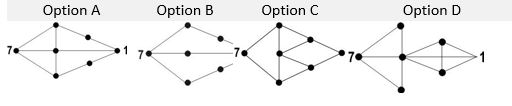
Answer : C
Question. A part of the real number line is shown. Which of the following points best represents the location of 5.5

(a) A
(b) B
(c) C
(d) D
Answer : C
Question. A lamp post has to be fixed right at the centre of the rectangular lawn shown in the figure.At what distance from a corner should the lamp post be fixed?
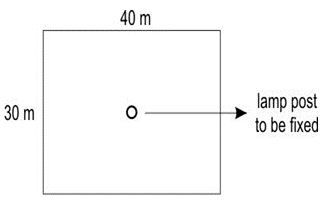
(a) 25m
(b) 35m
(c) 50m
(d) 70m
Answer : A
Question. A plane figure can be 'transformed' in different ways. Study the transformations described below and answer the question. A 'translation' slides all the points in a plane figure through the same distance in the same direction. Let horizontal translation be given by 'h' and vertical by 'v'. Consider Figure 1 as the original figure, with h = 0, v = 0.What are the h and v values for the following figure, taking Figure 1 as the reference?
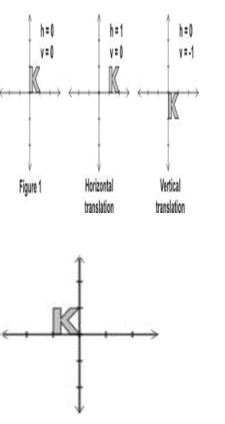
(a) h = -1, v = -1
(b) h = -1, v = 0
(c) h = 0, v = -1
(d) h = 2, v = -1
Answer : B
Question. A plane figure can be 'transformed' in different ways. Study the transformations described below and answer the question. A 'translation' slides all the points in a plane figure through the same distance in the same direction. Let horizontal translation be given by 'h' and vertical by 'v'. Consider Figure 1 as the original figure, with h = 0, v = 0.A 'reflection' flips all the points of a plane over a line, called the 'mirror'. If Figure 1 is reflected using the y-axis as the mirror, it will look like this: If Figure 1 were to be translated to the position h = 0, v = 1, and then reflected using the y-axis as the mirror, what would be the resultant position?
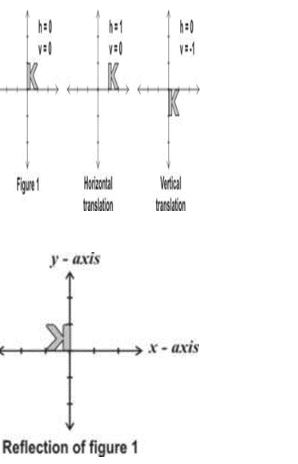

Answer : D
Question. Mrs. Singh and her son start from home in their car. She is on her way to the supermarket. On the way, she stops to drop her son at his drawing class. She drives on to the supermarket, spends some time shopping there and then drives back home. Which of the graphs below correctly describes Mrs. Singh's journey?
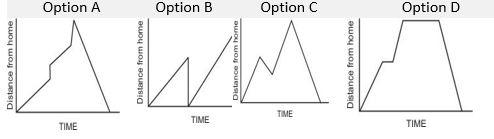
Answer : D
ASSERTION REASONING QUESTIONS
DIRECTION : In the following questions, a statement of assertion (A) is followed by a statement of reason (R) . Mark the correct choice as:
(a) Both assertion (A) and reason (R) are true and reason (R) is the correct explanation of assertion (A) .
(b) Both assertion (A) and reason (R) are true but reason (R) is not the correct explanation of assertion (A) .
(c) Assertion (A) is true but reason (R) is false.
(d) Assertion (A) is false but reason (R) is true.
Question. Assertion : The point (-2, 0) lies on y -axis and (0, 4) on x -axis.
Reason : Every point on the x -axis has zero distance from x -axis and every point on the y -axis has zero distance from y -axis.
(a) Both assertion (A) and reason (R) are true and reason
(R) is the correct explanation of assertion (A) .
(b) Both assertion (A) and reason (R) are true but reason
(R) is not the correct explanation of assertion (A) .
(c) Assertion (A) is true but reason (R) is false.
(d) Assertion (A) is false but reason (R) is true.
Answer : We know that Every point on the x -axis has zero distance from x -axis and every point on the y -axis has zero distance from y -axis.
So, Reason is correct.
Now, point (-2, 0) lies on x-axis and (0, 4) on y-axis
So, Assertion is not correct
Correct option is (d) Assertion (A) is false but reason (R) is true.
Question. Assertion: A point whose abscissa is 2 and ordinate is -3 lies in fourth quadrant
Reason: Points of the type (–, +) lie in the second quadrant.
(a) Both assertion (A) and reason (R) are true and reason (R) is the correct explanation of assertion (A) .
(b) Both assertion (A) and reason (R) are true but reason (R) is not the correct explanation of assertion (A) .
(c) Assertion (A) is true but reason (R) is false.
(d) Assertion (A) is false but reason (R) is true
Answer : We know that Points of the type (–, +) lie in the second quadrant.
So, Reason is correct.
Also, we know that Points of the type (+, –) lie in the fourth quadrant.
Hence, point whose abscissa is 2 and ordinate is -3 lies in fourth quadrant
So, Assertion is also correct but Reason is the not the correct explanation of Assertion.
Correct option is (b) Both assertion (A) and reason (R) are true but reason
(R) is not the correct explanation of assertion (A) .
Question. Assertion: The abscissa of a point (5, 2) is 5.
Reason: The perpendicular distance of a point from y-axis is called its abscissa.
(a) Both assertion (A) and reason (R) are true and reason (R) is the correct explanation of assertion (A) .
(b) Both assertion (A) and reason (R) are true but reason (R) is not the correct explanation of assertion (A) .
(c) Assertion (A) is true but reason (R) is false.
(d) Assertion (A) is false but reason (R) is true.
Answer : We know that the perpendicular distance of a
point from y-axis is called its x-coordinate or abscissa.
So, Reason is correct.
The x co-ordinate of the point (5, 2) is 5.
So, Assertion is also correct
Correct option is (a) Both assertion (A) and reason (R) are true and reason (R) is the correct explanation of assertion (A) .
Question. Assertion : If the ordinate of a point is equal to its abscissa, then the point lies either in the first quadrant or in the second quadrant.
Reason : A point both of whose coordinates are negative will lie in third quadrants.
(a) Both assertion (A) and reason (R) are true and reason (R) is the correct explanation of assertion (A) .
(b) Both assertion (A) and reason (R) are true but reason (R) is not the correct explanation of assertion (A) .
(c) Assertion (A) is true but reason (R) is false.
(d) Assertion (A) is false but reason (R) is true.
Answer : We know that A point both of whose coordinates are negative will lie in third quadrants.
So, Reason is correct.
Also we know that If the ordinate of a point is equal to its abscissa, then the point lies either in the first quadrant or in the third quadrant.
So, Assertion is not correct
Correct option is (d) Assertion (A) is false but reason (R) is true.
Question. Assertion: A point whose abscissa is -3 and ordinate is 2 lies in second quadrant
Reason: Points of the type (–, +) lie in the second quadrant.
(a) Both assertion (A) and reason (R) are true and reason (R) is the correct explanation of assertion (A) .
(b) Both assertion (A) and reason (R) are true but reason (R) is not the correct explanation of assertion (A) .
(c) Assertion (A) is true but reason (R) is false.
(d) Assertion (A) is false but reason (R) is true.
Answer : We know that Points of the type (–, +) lie in the second quadrant.
So, Reason is correct.
Hence, point whose abscissa is -3 and ordinate is 2 lies in second quadrant
So, Assertion is also correct and Reason explains Assertion
Correct option is (a) Both assertion (A) and reason (R) are true and reason
(R) is the correct explanation of assertion (A) .
Question. Assertion: Point (4, -2) lies in IV quadrant.
Reason: The perpendicular distance of a point from y-axis is called its abscissa.
(a) Both assertion (A) and reason (R) are true and reason (R) is the correct explanation of assertion (A) .
(b) Both assertion (A) and reason (R) are true but reason (R) is not the correct explanation of assertion (A) .
(c) Assertion (A) is true but reason (R) is false.
(d) Assertion (A) is false but reason (R) is true.
Answer : We know that the perpendicular distance of a point from y-axis is called its x-coordinate or abscissa.
So, Reason is correct.
Point (4, -2) lies in IV quadrant.
So, Assertion is also correct but Reason is not the correct explanation of Assertion.
Correct option is (b) Both assertion (A) and reason
(R) are true and reason (R) is not the correct explanation of assertion (A) .
Question. Assertion: The perpendicular distance of the point A(3, 4) from the y-axis is 4
Reason: The perpendicular distance of a point from y-axis is called its x-coordinate.
(a) Both assertion (A) and reason (R) are true and reason (R) is the correct explanation of assertion (A) .
(b) Both assertion (A) and reason (R) are true but reason (R) is not the correct explanation of assertion (A) .
(c) Assertion (A) is true but reason (R) is false.
(d) Assertion (A) is false but reason (R) is true.
Answer : We know that the perpendicular distance of a point from y-axis is called its x-coordinate or abscissa.
So, Reason is correct.
The x co-ordinate of the point (3, 4) is 3.
So, Assertion is not correct
Correct option is (d) Assertion (A) is false but reason (R) is true.
Question. Assertion : The point (0, 4) lies on y -axis.
Reason : The x co-ordinate on the point on y -axis is zero.
(a) Both assertion (A) and reason (R) are true and reason (R) is the correct explanation of assertion (A) .
(b) Both assertion (A) and reason (R) are true but reason (R) is not the correct explanation of assertion (A) .
(c) Assertion (A) is true but reason (R) is false.
(d) Assertion (A) is false but reason (R) is true.
Answer : We know that the if the point lies on y-axis, its x-coordinate is 0.
So, Reason is correct.
The x co-ordinate of the point (0, 4) is zero.
So, Point (0, 4) lies on y -axis.
So, Assertion is also correct
Correct option is (a) Both assertion (A) and reason (R) are true and
reason (R) is the correct explanation of assertion (A) .
Question. Assertion : The points (-1, 2) and (2,- 1) are at different positions in the coordinate plane.
Reason : Point (-1, 2) lies in II-quadrant and (2,- 1) lies in IV quadrant
(a) Both assertion (A) and reason (R) are true and reason (R) is the correct explanation of assertion (A) .
(b) Both assertion (A) and reason (R) are true but reason (R) is not the correct explanation of assertion (A) .
(c) Assertion (A) is true but reason (R) is false.
(d) Assertion (A) is false but reason (R) is true.
Answer : We know that Point (-1, 2) lies in II-quadrant and (2,- 1) lies in IV quadrant
So, Reason is correct.
Hence the points (-1, 2) and (2,- 1) are at different positions in the coordinate plane.
So, Assertion is also correct
Correct option is (a) Both assertion (A) and reason
(R) are true and reason (R) is the correct explanation of assertion (A) .
Question. Assertion: Point A(-2, -4) lies on III quadrant
Reason: A point both of whose coordinates are negative lies in III quadrant
(a) Both assertion (A) and reason (R) are true and reason (R) is the correct explanation of assertion (A) .
(b) Both assertion (A) and reason (R) are true but reason (R) is not the correct explanation of assertion (A) .
(c) Assertion (A) is true but reason (R) is false.
(d) Assertion (A) is false but reason (R) is true.
Answer : We know that a point both of whose coordinates are negative lies in III quadrant
So, Reason is correct.
Hence, Point A(-2, -4) lies on III quadrant
So, Assertion is also correct and Reason explains Assertion
Correct option is (a) Both assertion (A) and reason (R) are true and reason
(R) is the correct explanation of assertion (A) .
Short Answer Type questions
Question 1. In which quadrant, the point P(x, y) will lie?, where x is a positive and y is a negative number.
Answer: Since the x-coordinate is positive and the y-coordinate is negative, the point \( P(x, y) \) lies in the fourth quadrant.
In simple words: When the first number is positive and the second number is negative, the point is always located in the fourth quadrant - which is the bottom-right section.
Exam Tip: Remember the signs of coordinates in each quadrant: I (+, +), II (-, +), III (-, -), IV (+, -).
Question 2. Write the name of the point of intersection of coordinate axes.
Answer: The point where the horizontal x-axis and the vertical y-axis intersect is called the origin.
In simple words: The central point where the two grid lines cross each other is called the origin.
Exam Tip: The coordinates of the origin are always written as \( (0, 0) \).
Question 3. Define quadrant.
Answer: The coordinate axes divide the Cartesian plane into four equal regions. Each of these four regions is called a quadrant.
In simple words: A quadrant is one of the four quarters of a coordinate grid created by the intersecting axes.
Exam Tip: Quadrants are numbered from I to IV in a counter-clockwise direction starting from the top-right.
Question 4. Write the x-coordinate of a point which lies on y-axis.
Answer: The x-coordinate of any point that lies on the y-axis is always equal to 0.
In simple words: If a point is on the vertical line, its first coordinate is always zero.
Exam Tip: Remember that any point on the y-axis is represented in the form \( (0, y) \).
Question 5. What is the sign of the x-coordinate of a point in third quadrant.
Answer: In the third quadrant, the sign of the x-coordinate is negative.
In simple words: The horizontal coordinate of any point in the bottom-left quadrant is always minus.
Exam Tip: In the third quadrant, both the x and y coordinates are negative - meaning points look like \( (-, -) \).
Question 6. If a point P(2,3) lies in first quadrant then what will be the coordinate of point Q opposite to it in fourth quadrant having equal distant from both the axes ?
Answer: If the coordinates have the same distance from both axes, then the numerical values must be equal. Since \( Q \) lies opposite to \( P(2,3) \) in the fourth quadrant (where x is positive and y is negative), we can consider:
1. If the distance from both axes is the same as \( P \)'s coordinates, the point is \( Q(2, -3) \).
2. If \( Q \) must be strictly equidistant from both axes (meaning \( |x| = |y| \)), the coordinates would be of the form \( (a, -a) \) such as \( (2, -2) \) or \( (3, -3) \).
Standard coordinate systems typically define the fourth quadrant reflection of \( P(2,3) \) to be \( Q(2, -3) \).
In simple words: In the fourth quadrant, the x-value is positive and the y-value is negative, so the coordinates of the mirrored point are \( (2, -3) \).
Exam Tip: Always make sure to write the coordinates of a point inside parentheses with a comma separating them. The x-coordinate always comes first.
Question 7. In the fig. given below, name the point whose abscissa and ordinate both are positive and write the abscissa and ordinate of the point E :
Answer: Based on the coordinate plane diagram:
1. The point whose abscissa (x-coordinate) and ordinate (y-coordinate) are both positive lies in the first quadrant, which is point \( D \) with coordinates \( (6, 2) \).
2. For point \( E \), its position is 3 units to the left on the x-axis and 5 units down on the y-axis, meaning its coordinates are \( (-3, -5) \). Thus:
\( \implies \) Abscissa of \( E = -3 \)
\( \implies \) Ordinate of \( E = -5 \)
In simple words: Point D is the one where both numbers are positive. For point E, the horizontal number is -3 and the vertical number is -5.
Exam Tip: Abscissa refers strictly to the horizontal value (x), and ordinate refers strictly to the vertical value (y).
Question 8. Write the answer of each of the following questions:
(i) What is the name of horizontal and the vertical lines drawn to determine the position of any point in the Cartesian plane?
(ii) Write the coordinates of the point where these two lines (as described above) intersect.
Answer:
(i) The horizontal axis line is called the x-axis, and the vertical reference line is called the y-axis.
(ii) The coordinates of their point of intersection are \( (0, 0) \).
In simple words: The horizontal line is the x-axis, the vertical line is the y-axis, and they meet at the point \( (0, 0) \) which is the origin.
Exam Tip: Always state both axis names clearly and use the standard coordinate format \( (x, y) \) when writing intersection points.
Question 9. A point is at a distance of 4 units from x axis and 5 units from the y axis. Represent the position of the point in the Cartesian plane and also write its Cartesian coordinates.
Answer: The distance of a point from the x-axis represents the absolute value of its y-coordinate, so \( |y| = 4 \).
The distance of a point from the y-axis represents the absolute value of its x-coordinate, so \( |x| = 5 \).
Thus, the point could lie in any of the four quadrants, giving four possible coordinate sets:
1. \( (5, 4) \) in Quadrant I
2. \( (-5, 4) \) in Quadrant II
3. \( (-5, -4) \) in Quadrant III
4. \( (5, -4) \) in Quadrant IV
If we assume the point is in the first quadrant, its Cartesian coordinates are \( (5, 4) \).
In simple words: A point that is 5 units away from the vertical line and 4 units away from the horizontal line has coordinates like \( (5, 4) \).
Exam Tip: Pay close attention: distance from the x-axis is the y-coordinate, while distance from the y-axis is the x-coordinate. Do not swap them.
Question 10. Find the value of x and y if:
1) (x-3, 7) = (5,7)
2) (2,2y-3)=(2,7)
Answer: For ordered pairs to be equal, their corresponding coordinates must be identical.
1) Compare the first coordinates:
\( x - 3 = 5 \)
\( \implies x = 5 + 3 \)
\( \implies x = 8 \)
2) Compare the second coordinates:
\( 2y - 3 = 7 \)
\( \implies 2y = 7 + 3 \)
\( \implies 2y = 10 \)
\( \implies y = 5 \)
In simple words: Set the matching parts of the parentheses equal to each other to solve for the missing letters: \( x = 8 \) and \( y = 5 \).
Exam Tip: Solve each coordinate equation step-by-step and double-check your arithmetic by substituting the answers back into the original ordered pairs.
Question 11. From the graph below determine the coordinates of the points A, B, C and D.
Answer: Reading the positions of the plotted points from the given coordinate grid:
\( \implies \) Point \( A \) is at 1 unit right and 3 units up: \( A(1, 3) \)
\( \implies \) Point \( B \) is on the x-axis, 2 units to the left: \( B(-2, 0) \)
\( \implies \) Point \( C \) is at 1 unit left and 4 units down: \( C(-1, -4) \)
\( \implies \) Point \( D \) is at 1 unit right and 7 units down: \( D(1, -7) \)
In simple words: Look at where each dot is on the grid and write down its horizontal and vertical numbers: \( A(1, 3) \), \( B(-2, 0) \), \( C(-1, -4) \), and \( D(1, -7) \).
Exam Tip: If a point lies exactly on an axis, one of its coordinate numbers must be zero. Check this first to avoid simple mistakes.
Question 12. Plot the coordinates A (-4, 0) and B (3, 0) on the coordinate plane hence finds:
1) Distance of A from origin.
2) Distance of B from origin.
3) Distance between points.
Answer:
1) Point \( A(-4, 0) \) is located on the negative x-axis. Its distance from the origin \( (0,0) \) is \( |-4| = 4 \) units.
2) Point \( B(3, 0) \) is located on the positive x-axis. Its distance from the origin is \( |3| = 3 \) units.
3) Since both points lie on the horizontal x-axis, the straight-line distance between them is the absolute difference of their x-coordinates:
\( \implies \text{Distance} = 3 - (-4) = 7 \) units.
In simple words: Point A is 4 steps away from the center, Point B is 3 steps away from the center in the opposite direction, and the total gap between them is 7 steps.
Exam Tip: Distance is always positive. Never express any distance measurement as a negative number.
Question 13. In which quadrant does the following points lies?
1) A(-1, 2)
2) B(2, 2)
3) C(3,-2)
4) D(-2,-2)
Answer: We determine the quadrant based on the signs of the coordinates:
1) \( A(-1, 2) \) has a negative x and positive y, so it lies in the **Second Quadrant (II)**.
2) \( B(2, 2) \) has a positive x and positive y, so it lies in the **First Quadrant (I)**.
3) \( C(3, -2) \) has a positive x and negative y, so it lies in the **Fourth Quadrant (IV)**.
4) \( D(-2, -2) \) has both coordinates negative, so it lies in the **Third Quadrant (III)**.
In simple words: The signs of the two numbers tell us which corner of the grid the point is in: A is in the top-left, B is top-right, C is bottom-right, and D is bottom-left.
Exam Tip: Memorize the signs of each quadrant thoroughly to solve quadrant identification questions quickly.
Question 14. Is Coordinate points (0, 5) and (5, 0) be same? Discuss.
Answer: No, the coordinate points \( (0, 5) \) and \( (5, 0) \) are not the same.
In ordered pairs, the position of the numbers is highly significant. For the point \( (0, 5) \), the x-coordinate is 0 and the y-coordinate is 5, meaning it lies on the vertical y-axis.
Conversely, for the point \( (5, 0) \), the x-coordinate is 5 and the y-coordinate is 0, placing it on the horizontal x-axis.
Because they designate two entirely different positions on the Cartesian plane, they are distinct.
In simple words: No, they are different points. One is on the vertical wall line, and the other is on the flat floor line. Order matters.
Exam Tip: Always state that order matters in coordinates. An ordered pair \( (x, y) \) is equal to \( (y, x) \) only when \( x = y \).
Question 15. If we plot the coordinate points A(-1, 0) , B(0, 1) , C(0,-1) and D(1, 0) on Cartesian plane . Which figure comes out after joining the Points? Also find the side of figure.
Answer: When we plot these four points and connect them in order:
The vertices are \( A(-1, 0) \), \( B(0, 1) \), \( D(1, 0) \), and \( C(0, -1) \).
The diagonals of this quadrilateral lie along the axes:
\( \implies \text{Diagonal } AD \text{ is along the x-axis, with length } 1 - (-1) = 2 \text{ units.} \)
\( \implies \text{Diagonal } BC \text{ is along the y-axis, with length } 1 - (-1) = 2 \text{ units.} \)
Since the diagonals are equal in length, perpendicular, and bisect each other at the origin, the resulting shape is a **square**.
To find the side length, we use the distance formula for side \( AB \):
\( \implies \text{Side Length} = \sqrt{(0 - (-1))^2 + (1 - 0)^2} = \sqrt{1^2 + 1^2} = \sqrt{2} \approx 1.414 \text{ units.} \)
In simple words: Connecting these points on the axes creates a perfect square. Each outer side of this square has a length of \( \sqrt{2} \) units.
Exam Tip: To prove a quadrilateral is a square, always verify that all four sides are equal and the two diagonals are equal and perpendicular.
Question 16. What is the distance of a point (7, -6) from x-axis and y-axis?
Answer: The distance of any point \( (x, y) \) from the axes is determined as follows:
1. The distance from the x-axis is equal to the absolute value of its y-coordinate:
\( \implies \text{Distance from x-axis} = |-6| = 6 \text{ units.} \)
2. The distance from the y-axis is equal to the absolute value of its x-coordinate:
\( \implies \text{Distance from y-axis} = |7| = 7 \text{ units.} \)
In simple words: The point is 6 units away from the flat floor line (x-axis) and 7 units away from the vertical wall line (y-axis).
Exam Tip: Remember: distance is the perpendicular gap. It is always a positive number, so drop any negative signs when writing it down.
Question 17. Which of the following points:
B(1, 0), C(0,1 ), E (-1, 0), F ( 0, -1), G (4, 0), H (0, -7)
(i) lie on x -axis?
(ii) lie on y - axis?
Answer: We classify the points by identifying which coordinates are zero:
(i) Points lying on the x-axis must have a y-coordinate of 0. These are:
\( \implies B(1, 0), E(-1, 0), \text{ and } G(4, 0) \).
(ii) Points lying on the y-axis must have an x-coordinate of 0. These are:
\( \implies C(0, 1), F(0, -1), \text{ and } H(0, -7) \).
In simple words: Points with a second number of zero lie on the flat line (x-axis). Points with a first number of zero lie on the vertical line (y-axis).
Exam Tip: A point lying on the x-axis is of the form \( (x, 0) \), and a point lying on the y-axis is of the form \( (0, y) \).
Question 18. Locate the points (3, 0), (-2, 3), (2, -3), (-5, 4) and (-2, -4) in Cartesian plane. Also find the quadrant.
Answer: We analyze and position each given point based on its coordinate values:
\( \implies \) Point \( (3, 0) \) has its y-coordinate as zero, so it lies on the **positive x-axis** (it does not lie in any quadrant).
\( \implies \) Point \( (-2, 3) \) has a negative x and a positive y, placing it in the **Second Quadrant (II)**.
\( \implies \) Point \( (2, -3) \) has a positive x and a negative y, placing it in the **Fourth Quadrant (IV)**.
\( \implies \) Point \( (-5, 4) \) has a negative x and a positive y, placing it in the **Second Quadrant (II)**.
\( \implies \) Point \( (-2, -4) \) has both coordinates negative, placing it in the **Third Quadrant (III)**.
In simple words: Points with zeroes lie directly on the grid lines. The other points are located in the four open corners based on their positive and negative signs.
Exam Tip: Do not assign a quadrant to points that lie directly on the axes. They are on the boundary, not inside a quadrant.
Question 19. Find the value of x and y if:
(2x-3/2, 4y-7/2 )=(5/2,3/2)
Answer: Equating the corresponding elements of the ordered pairs:
1) Equate the first coordinates:
\( 2x - \frac{3}{2} = \frac{5}{2} \)
\( \implies 2x = \frac{5}{2} + \frac{3}{2} \)
\( \implies 2x = \frac{8}{2} \)
\( \implies 2x = 4 \)
\( \implies x = 2 \)
2) Equate the second coordinates:
\( 4y - \frac{7}{2} = \frac{3}{2} \)
\( \implies 4y = \frac{3}{2} + \frac{7}{2} \)
\( \implies 4y = \frac{10}{2} \)
\( \implies 4y = 5 \)
\( \implies y = \frac{5}{4} = 1.25 \)
In simple words: Solve the separate equations for the left and right positions to find the values: \( x = 2 \) and \( y = 1.25 \).
Exam Tip: Be precise when manipulating fractions. Always convert improper fractions to their simplest form or decimal equivalents.
Question 20. See figure, and write the following:
1) The points identified by the coordinates (1, 2) and (- 1, -2)
2) The coordinate of A, B, C and D.
3) Abscissa of point C.
Answer: By carefully analyzing the coordinate plane diagram on Page 3:
1. The point located at \( (1, 2) \) is **A**, and the point located at \( (-1, -2) \) is **C**.
2. The coordinates of the four points plotted are:
\( \implies A(1, 2) \)
\( \implies B(-4, 0) \)
\( \implies C(-1, -2) \)
\( \implies D(3, 0) \)
3. The abscissa (x-coordinate) of point \( C \) is **-1**.
In simple words: Point A is at \( (1, 2) \) and Point C is at \( (-1, -2) \). The flat x-coordinate of point C is -1.
Exam Tip: Be careful when identifying points on axes. Point B has y = 0, and Point D has y = 0. Do not swap their x and y coordinates.
Question 21. Plot the points (x, y) given in the following table on the plane, choosing suitable units of distance on the axes:
| X | -1 | 2 | 0 | 3 | 2 |
|---|---|---|---|---|---|
| y | 3 | -5 | -3 | -3 | 1 |
Answer: The coordinate pairs formed from the table are:
1. \( (-1, 3) \) - lies in Quadrant II.
2. \( (2, -5) \) - lies in Quadrant IV.
3. \( (0, -3) \) - lies on the negative y-axis.
4. \( (3, -3) \) - lies in Quadrant IV.
5. \( (2, 1) \) - lies in Quadrant I.
To plot these points, we draw perpendicular axes crossing at the origin \( (0,0) \) and mark off unit intervals on both axes. Then we locate each point by moving left/right according to the x-value and up/down according to the y-value.
In simple words: Take each column as a point like \( (x, y) \) and plot them on graph paper. For example, the first point is 1 step left and 3 steps up.
Exam Tip: Always label the scale you use on your graph. Mark the positive and negative directions of both axes clearly.
Question 22. What will be the position of point A(2, 1) if:
1) Abscissa is multiplied by -1?
2) Ordinate is multiplied by -2?
3) Point each coordinate is multiplied by -3?
Answer: Starting with the point \( A(2, 1) \):
1) If the abscissa (x-coordinate) is multiplied by -1, the new point is \( (-2, 1) \). This point lies in the **Second Quadrant (II)**.
2) If the ordinate (y-coordinate) is multiplied by -2, the new point is \( (2, -2) \). This point lies in the **Fourth Quadrant (IV)**.
3) If both coordinates are multiplied by -3, the new point is \( (-6, -3) \). This point lies in the **Third Quadrant (III)**.
In simple words: Multiplying the numbers changes their signs and values, moving the point to different sections of the grid: first to the top-left, then to the bottom-right, and finally to the bottom-left.
Exam Tip: Be careful with signs. Multiplying a positive coordinate by a negative number makes it negative, shifting its quadrant position.
Question 23. Plot the following points in a Cartesian plane:
(-2,4), (3,-1), (-1, 0), (1, 2) & (-3, -5)
Answer: The positions of the given points on the Cartesian plane are determined as follows:
\( \implies (-2, 4) \) lies in the **Second Quadrant (II)** (moving 2 units left, 4 units up).
\( \implies (3, -1) \) lies in the **Fourth Quadrant (IV)** (moving 3 units right, 1 unit down).
\( \implies (-1, 0) \) lies on the **negative x-axis** (moving 1 unit left, 0 units up/down).
\( \implies (1, 2) \) lies in the **First Quadrant (I)** (moving 1 unit right, 2 units up).
\( \implies (-3, -5) \) lies in the **Third Quadrant (III)** (moving 3 units left, 5 units down).
In simple words: Plot each point by starting at the center and taking the specified horizontal and vertical steps. Mark each location with a labeled dot.
Exam Tip: Draw clear dotted lines from each point perpendicular to the axes to show its distance values plainly to the examiner.
Question 24. Observe the fig. given below and answer the following:
(i) The coordinates of B.
(ii) The Coordinates of C.
(iii) The point identified by the coordinate (-3, -5).
(iv) The abscissa of the point D.
(v) The coordinates of H.
Answer: Based on the reference figure provided on Page 4:
(i) The coordinates of \( B \) are \( (-5, 2) \).
(ii) The coordinates of \( C \) are \( (5, -5) \).
(iii) The point at \( (-3, -5) \) is identified as **E**.
(iv) Point \( D \) is at \( (6, 2) \), so the abscissa (x-coordinate) of point \( D \) is **6**.
(v) The coordinates of \( H \) are \( (-5, -3) \).
In simple words: Read the grid positions for each letter: B is \( (-5, 2) \), C is \( (5, -5) \), the point at \( (-3, -5) \) is E, the horizontal value of D is 6, and H is \( (-5, -3) \).
Exam Tip: Abscissa refers strictly to the x-value. Always read the horizontal value first when determining any coordinates from a figure.
Question 25. Determine the quadrants in which the following points lie;
(i) A (1,1)
(ii) B (2,4)
(iii) C (-3, -10)
(iv) D (-1,2)
(v) E (1,-1)
(vi) F (-2,-4)
(vii) G (-3, 10)
(viii) H (1,-2)
Answer: We classify each point's quadrant based on the signs of its coordinates:
(i) \( A(1, 1) \) has both positive coordinates, so it lies in **Quadrant I**.
(ii) \( B(2, 4) \) has both positive coordinates, so it lies in **Quadrant I**.
(iii) \( C(-3, -10) \) has both negative coordinates, so it lies in **Quadrant III**.
(iv) \( D(-1, 2) \) has a negative x and positive y, so it lies in **Quadrant II**.
(v) \( E(1, -1) \) has a positive x and negative y, so it lies in **Quadrant IV**.
(vi) \( F(-2, -4) \) has both negative coordinates, so it lies in **Quadrant III**.
(vii) \( G(-3, 10) \) has a negative x and positive y, so it lies in **Quadrant II**.
(viii) \( H(1, -2) \) has a positive x and negative y, so it lies in **Quadrant IV**.
In simple words: Look at whether the coordinates are positive or negative to group them into the four quadrants: I (+, +), II (-, +), III (-, -), and IV (+, -).
Exam Tip: Grouping the signs systematically helps prevent careless errors during exams.
Question 26. A car starts from the center of city and in each consecutive hour it covers a distance of 15km (along north), 5 km (along east), 15 km (along south) and 10 km (along west) respectively. Assuming the centre of city to be the origin, north-south direction is along y axis and west-east direction is along x axis; show the various position of the car on the Cartesian plane. Also, find how far is the car from x and y axis respectively at its final position.
Answer: Let the starting point (center of the city) be the origin \( (0, 0) \). The horizontal x-axis represents East-West, and the vertical y-axis represents North-South.
We track the positions step-by-step:
1. **First hour (15 km North):** The car moves up along the positive y-axis.
\( \implies \text{Position } P_1 = (0, 15) \)
2. **Second hour (5 km East):** The car moves right parallel to the x-axis.
\( \implies \text{Position } P_2 = (5, 15) \)
3. **Third hour (15 km South):** The car moves down parallel to the y-axis.
\( \implies \text{Position } P_3 = (5, 15 - 15) = (5, 0) \)
4. **Fourth hour (10 km West):** The car moves left along the x-axis.
\( \implies \text{Final Position } P_4 = (5 - 10, 0) = (-5, 0) \)
At its final position \( P_4(-5, 0) \):
\( \implies \text{Distance from the x-axis} = |0| = 0 \text{ km (as it lies on the axis)} \)
\( \implies \text{Distance from the y-axis} = |-5| = 5 \text{ km.} \)
In simple words: After driving in a big loop, the car ends up 5 km to the west of where it started. So its distance is 5 km from the y-axis, and it lies right on the x-axis.
Exam Tip: Draw a simple arrow sketch on your coordinate axes representing each vector of motion. This visual aid makes calculations straightforward and accurate.
Question 27. See the figure, and write the following:
1) The coordinates of B.
2) The point identified by the point (-3, -5).
3) The abscissa of point D.
4) The ordinate of the point E.
5) The point identified by the coordinates (2, -4).
Answer: Based on the standard NCERT coordinate plane figure:
1) The coordinates of \( B \) are \( (-5, 2) \).
2) The point located at \( (-3, -5) \) is **E**.
3) Point \( D \) is at \( (6, 2) \), so the abscissa (x-coordinate) of point \( D \) is **6**.
4) Point \( E \) is at \( (-3, -5) \), so the ordinate (y-coordinate) of point \( E \) is **-5**.
5) The point located at \( (2, -4) \) is **G**.
In simple words: Reading the coordinates directly from the graph gives: B is \( (-5, 2) \), E is at \( (-3, -5) \), the x-value of D is 6, the y-value of E is -5, and G is at \( (2, -4) \).
Exam Tip: Pay close attention to whether a question asks for the whole "coordinates" \( (x, y) \), or just the "abscissa" (only x) or "ordinate" (only y).
Most Important Questions
Q 1 What is the name to the horizontal and vertical line in a coordinate system?
Answer: In a coordinate system, the horizontal axis line is called the x-axis, and the vertical reference line is called the y-axis.
In simple words: The flat line is the x-axis, and the straight up-and-down line is the y-axis.
Exam Tip: Always use the lowercase letters x and y when naming these axes in your answers.
Q 2 The origin is indicated by what coordinates?
Answer: The origin is represented by the coordinates \( (0, 0) \).
In simple words: The central point where the two main lines cross is marked by the coordinates \( (0, 0) \).
Exam Tip: Never forget to enclose the origin coordinates in parentheses, separated by a comma.
Q 3 How many Quadrants are there in the Cartesian Plane?
Answer: There are exactly four quadrants in the Cartesian Plane.
In simple words: The two main lines cut the flat grid surface into four separate quarter areas.
Exam Tip: Quadrants are numbered I, II, III, and IV. Always use Roman numerals to designate them.
Q 4 In which Quadrant will the coordinates (-2,3 ) lie?
Answer: Since the x-coordinate is negative and the y-coordinate is positive, the point \( (-2, 3) \) lies in the Second Quadrant.
In simple words: Because the first number is negative and the second is positive, this point is in the top-left section.
Exam Tip: Visually trace negative-x (left) and positive-y (up) to confirm that the point belongs in Quadrant II.
Q 5 in which Quadrant will the coordinates (-3, -4) lie?
Answer: Since both the x-coordinate and y-coordinate are negative, the point \( (-3, -4) \) lies in the Third Quadrant.
In simple words: Because both numbers have minus signs, the point is located in the bottom-left section.
Exam Tip: Points where both coordinates are negative \( (-, -) \) always lie in Quadrant III.
Q 6 What is the abscissa and the ordinate in the coordinates (3, -5)
Answer: In the coordinate pair \( (3, -5) \):
\( \implies \text{The abscissa (x-coordinate) is } 3 \).
\( \implies \text{The ordinate (y-coordinate) is } -5 \).
In simple words: The first number (3) is called the abscissa, and the second number (-5) is called the ordinate.
Exam Tip: Learn these definitions: Abscissa = x, Ordinate = y. They are frequently asked in short-answer questions.
Q 7 Write the abscissa and the ordinate of the coordinates of the points ( 0,3) (3,0) (0, 0).
Answer: Let us identify the abscissa (x) and ordinate (y) for each given point:
1. For \( (0, 3) \): Abscissa = 0, Ordinate = 3.
2. For \( (3, 0) \): Abscissa = 3, Ordinate = 0.
3. For \( (0, 0) \): Abscissa = 0, Ordinate = 0.
In simple words: For any point, the first number is the abscissa and the second is the ordinate.
Exam Tip: Even when a coordinate is zero, list it clearly as the abscissa or ordinate as required by the question.
Q 8 Plot the following point on the number line using a graph and join the points.
a) (3, -4) b) ( -3, 2)
Answer: To represent these points on a Cartesian coordinate plane:
1. Plot point \( (3, -4) \) by moving 3 units to the right along the x-axis and then 4 units down parallel to the y-axis (Quadrant IV).
2. Plot point \( (-3, 2) \) by moving 3 units to the left along the x-axis and then 2 units up parallel to the y-axis (Quadrant II).
Connect these two points with a straight line segment to complete the graphing task.
In simple words: Find the two locations on your graph grid and use a straight ruler to draw a line connecting them.
Exam Tip: Use a sharp pencil and a ruler to ensure your drawn line segment is perfectly straight and clean.
Q 9 Which coordinates do the following points indicate?
Answer: Counting the grid intervals from the origin in the diagram:
\( \implies \) Point \( A \) is 4 units right and 3 units up: \( A(4, 3) \)
\( \implies \) Point \( B \) is 1 unit left and 4 units up: \( B(-1, 4) \)
\( \implies \) Point \( C \) is 3 units left and 2 units up: \( C(-3, 2) \)
\( \implies \) Point \( D \) is 2 units left and 2 units down: \( D(-2, -2) \)
\( \implies \) Point \( E \) lies on the y-axis, 3 units down: \( E(0, -3) \)
In simple words: Find each letter on the chart and count how many steps it is from the center: \( A(4, 3) \), \( B(-1, 4) \), \( C(-3, 2) \), \( D(-2, -2) \), and \( E(0, -3) \).
Exam Tip: Be careful not to swap the x and y values. The horizontal value is always written first, followed by the vertical value.
Q 10 Plot the following coordinates on the Cartesian system :
(2, 0), (-3, -4), (2, -2), (-4, 0), (-2, 3) and (1, 1.5).
Answer: We classify and plot each point based on its quadrant or axis:
\( \implies (2, 0) \) is on the **positive x-axis** (2 units right).
\( \implies (-3, -4) \) lies in the **Third Quadrant** (3 units left, 4 units down).
\( \implies (2, -2) \) lies in the **Fourth Quadrant** (2 units right, 2 units down).
\( \implies (-4, 0) \) is on the **negative x-axis** (4 units left).
\( \implies (-2, 3) \) lies in the **Second Quadrant** (2 units left, 3 units up).
\( \implies (1, 1.5) \) lies in the **First Quadrant** (1 unit right, 1.5 units up).
In simple words: Find each spot on your graph paper and mark it with a neat dot. Label each dot with its coordinates.
Exam Tip: When plotting fractional coordinates like 1.5, place the point exactly midway between the grid lines for 1 and 2.
Q 11 Define the following:
a) The Cartesian plane
b) The coordinate axes
c) The Origin.
Answer: Here are the standard definitions for coordinate geometry:
a) **The Cartesian plane**: A two-dimensional flat plane surface defined by a coordinate system where each point is uniquely located by a pair of real number coordinates.
b) **The coordinate axes**: The horizontal line (x-axis) and the vertical line (y-axis) drawn perpendicular to each other in a plane to act as reference lines for measurements.
c) **The Origin**: The unique reference point in a Cartesian plane where the x-axis and y-axis intersect, designated by the coordinates \( (0, 0) \).
In simple words: The Cartesian plane is the flat grid sheet. The axes are the two crossing baseline lines. The origin is the center spot where they cross.
Exam Tip: Examiners look for key terms such as "perpendicular", "intersect", and "ordered pairs" in these geometric definitions. Include them to secure full marks.
Free study material for Mathematics
CBSE Class 9 Mathematics Assignments for Chapter 03 Coordinate Geometry
Revision Assignment: Chapter 03 Coordinate Geometry (CBSE)
Access structured practice assignments for Chapter 03 Coordinate Geometry designed in alignment with the latest CBSE curriculum for Class 9 Mathematics. These printable sets cover objective and descriptive problem types to support thorough revision.
Maximize Exam Scores with Chapter Practice Sets
- Exam Alignment: Questions strictly follow contemporary CBSE sample papers and grading schemes.
- Comprehensive Coverage: Features objective drills, case studies, and structured descriptive problems for Chapter 03 Coordinate Geometry.
- Pacing & Precision: Regular problem-solving builds critical calculation speed and test-taking accuracy.
Steps to Complete Chapter 03 Coordinate Geometry Assignments Successfully
- Initial Reading: Begin by reading the NCERT book for Class 9 Mathematics to build a baseline understanding.
- Independent Testing: Attempt assignment questions unassisted, then verify work using provided answer keys.
- Supplementary Aids: Leverage revision notes and worksheets whenever you encounter difficult topics.
FAQs
You can download free PDF assignments for Class 9 Mathematics Chapter 03 Coordinate Geometry from StudiesToday.com. These practice sheets have been updated for the 2026-27 session covering all concepts from latest NCERT textbook.
Yes, our teachers have given solutions for all questions in the Class 9 Mathematics Chapter 03 Coordinate Geometry assignments. This will help you to understand step-by-step methodology to get full marks in school tests and exams.
Yes. These assignments are designed as per the latest CBSE syllabus for 2026. We have included huge variety of question formats such as MCQs, Case-study based questions and important diagram-based problems found in Chapter 03 Coordinate Geometry.
Practicing topicw wise assignments will help Class 9 students understand every sub-topic of Chapter 03 Coordinate Geometry. Daily practice will improve speed, accuracy and answering competency-based questions.
Yes, all printable assignments for Class 9 Mathematics Chapter 03 Coordinate Geometry are available for free download in mobile-friendly PDF format.