

Class 9 Mathematics Practice Assignments: CBSE Class 9 Mathematics Probability Set 03
Explore structured practice materials through the CBSE Class 9 Mathematics Probability Set 03. Tailored for Class 9 learners, utilizing these Mathematics assignments ensures thorough preparation and strengthens foundational knowledge before final CBSE evaluations.
Download Chapter 15 Probability Assignment PDF with Solutions
Access the complete assignment PDF for Class 9 Mathematics below. Regular practice with these targeted academic tasks builds familiarity with standard question patterns and helps secure higher marks in final school evaluations.
Very Short Answer Type Questions
Question. The following data represents the number of girls in a family.
| No. of children who like cricket | 2 | 1 | 0 |
| Number of families | 475 | 514 | 11 |
A family is chosen at random. Find the probability of having exactly 2 girls in the chosen family.
Answer : Total number of families = 1000 = n(S)
Number of families having exactly 2 girls = 475 = n(E)
∴ P (E) = n(E)/n(S) = 475/1000 = 19/40
Question. The following table shows the birth months of 48 babies in a hospital:
| Jan | Feb | March | April | May | June |
| 2 | 4 | 3 | 4 | 5 | 1 |
| June | Aug | Sept | Oct | Nov | Dec |
| 6 | 6 | 4 | 3 | 4 | 6 |
Find the probability of months in which 6 babies were born.
Answer : Number of months = 12 ⇒ n(S) = 12
Let E be the event having months in which 6 babies were born i.e., July, Aug and Dec
⇒ n(E) = 3
∴ P (E) = n(E)/n(S) = 3/12 = 14/5.
Question. A coin is tossed 500 times with the following frequencies : Head : 255, Tail : 245.
Then find the sum of the probabilities of each event.
Answer : P(Head appears) = 255/500 = 51/100
P(Tail appears) = 245/500 = 49/100
Sum of the probabilities = 51/100 + 49/100 = 100/100 = 1
Question. A bag contains 6 green and 5 blue balls. If probability of choosing a green ball randomly is n/11, then find the value of n.
Answer : Number of balls = 6 + 5 = 11 = n(S)
Let E be the event of choosing a green ball randomly.
∴ P (E) = n(E)/n(S) = 6/11 = n/11 ⇒ n = 6
Question. In a single throw of two dice, find the probability that there will be a doublet.
Answer : Number of elements in sample space when two dice are thrown = 6 × 6 = 36
Doublets are {(1, 1), (2, 2), (3, 3), (4, 4), (5, 5), (6, 6)}
i.e., 6 in number
∴ P(getting doublet)
= Number of doublets/Number of elements in sample space = 6/36 = 1/6
Question. A survey of 100 children of a locality shows their favourite sport
| No. of children who like football | 48 |
| No. of children who like cricket | 52 |
Out of these children, one is chosen at random.
What is the probability that the chosen child likes football?
Answer : Total number of students, n(S) = 100
Let E be the event that child likes football.
i.e., n(E) = 48
∴ P (E) = 48/100 = 12/25
Question. In a game, a woman wins 16 times out of 20 balls she plays. Find the probability that she does not win the game.
Answer : P(woman wins the game) = 16/20 = 4/5
P(woman does not win the game) = 1 − 4/5 = 1/5
Question. Ram and Priya are playing a game. Ram’s winning probability is 1/3 . Find the Priya’s winning probability.
Answer : Ram’s winning probability = 1/3
⇒ Priya’s winning probability = 1 − 1/3 = 2/3
Question. Find the probability of choosing a vowel randomly from the letters of the word ‘EXAMINATION’.
Answer : Number of letters in the word ′EXAMINATION′ = 11
Number of vowels in the word = 6
Required probability = 6/11
Question. Based on the given information, find the probability of people with age 60, 61 & 64 who can drive.
| Age (in years) | Number of persons of different age who can drive the car |
| 60 | 16090 |
| 61 | 11490 |
| 62 | 8012 |
| 63 | 5448 |
| 64 | 3607 |
| 65 | 2320 |
Answer : Number of people with age 60, 61 and 64 who can drive = 16090 + 11490 + 3607 = 31187
Total number of people who can drive
= 16090 + 11490 + 8012 + 5448 + 3607 + 2320 = 46967
∴ Required probability = 31187/46967
Short Answer Type Questions
Question. In a locality of 5000 families a survey was conducted and the following data was collected.
| Number of members | 2 | 3 | 4 | 5 | 6 or more |
| Number of families | 1060 | 1000 | 1020 | 1070 | 850 |
Out of these families, a family is chosen at random. What is the probability that the chosen family has less than 5 members?
Answer : Total number of families, n(S) = 5000
Let E be the event that the chosen family has less than 5 members.
i.e., n(E) = 1060 + 1000 + 1020 = 3080
∴ P(E) = n(E)/n(S) = 3080/5000 = 77/125
Question. In 60 throws of a die, the outcomes were noted as below:
| Outcomes | 1 | 2 | 3 | 4 | 5 | 6 |
| Number of times | 8 | 10 | 15 | 10 | 7 | 10 |
If die is thrown at random, then what is the probability that upper face of a die shows an even prime number? Also find the probability that upper face shows an odd number.
Answer : Total number of throws, n(S) = 60
Let E be the event that upper face shows an even prime number, i.e.,
n(E) = 10 [∵ 2 is the only even prime number]
∴ P(E) = n(E)/n(S) = 10/60 = 1/6
Let F be the event that upper face shows an odd number
= 8 + 15 + 7 = 30
∴ P(F) = n(F)/n(s) = 30/60 = 1/2
Question. An integer is chosen at random from the first 200 positive integers. Find the probability that the integer is divisible by 11.
Answer : Total number of integers in the sample space
= 200 = n(S).
Among first 200 positive integers, we have 11, 22, 33, 44, 55, 66, 77, 88, 99, 110, 121, 132, 143, 154, 165, 176, 187, 198 are divisible by 11.
∴ Number of integers which are divisible by 11 = 18 P(integer is divisible by 11)
= Number of integers divisible by 11/Total number of integers in sample space
= 18/200 = 9/100
Question. A die is thrown 100 times and following observations were recorded:
| Number on die | 1 | 2 | 3 | 4 | 5 | 6 |
| Frequency | 12 | 18 | 14 | 26 | 14 | 16 |
Find the probability that the die shows
(i) a number less than 3.
(ii) a number greater than 4.
Answer : n(S) = 100
(i) Let E be the event that the die shows a number less than 3, i.e., n(E) = 12 + 18 = 30
∴ P(E) = n(E)/n(S) = 30/100 = 3/10
(ii) Let F be the event that the die shows a number greater than 4, i.e., n(F) = 14 + 16 = 30
∴ P (F) = n(F)/n(S) = 30/100 = 3/10
Question. A die was rolled 100 times and the number of times, 6 came up was noted. If the experimental probability calculated from this information is 2/5, then how many times 6 came up?
Answer : Here, total number of trials = 100
Let x be the number of times 6 came up.
We know, probability of an event
= Frequency of the event occuring/Total number of trials
⇒ x/100 = 2/5
⇒ x = 40
Question. The number of hours spent by Ashu, a school student, on various activities on a working day are given below:
| Activity | No. of Hours |
| Sleep | 7 |
| School | 7 |
| Home work | 2 |
| Tuition out of home | 3 |
| Playing Outdoor games | 3 |
| Other activity at home | 2 |
His friend Sonu came to his house to meet Ashu.
What is the probability that
(i) Ashu is available at home.
(ii) Ashu will play outdoor games
Answer : Total number of hours = 24
(i) Number of hours during which Ashu is at home
= 7 + 2 + 2 = 11
∴ Probability that Ashu is available at home = 11/24
(ii) Number of hours during which Ashu plays outdoor games = 3
∴ Probability that Ashu will play outdoor games
= 3/24 = 1/8
Question. The probability of guessing the correct answer to a certain question is x/5. If the probability of not guessing the correct answer is 2x/3. Then, find the value of 26x.
Answer : We have
P(guessing correct answer) = x/5 and P(not guessing correct answer) = 2x/3
Clearly, P(guessing correct answer) + P(not guessing
correct answer) = 1 [ ∵ P(E) + P (not E) = 1]
x/5 + 2x/3 = 1
⇒ 3x + 10x = 15 ⇒ x = 15/13
⇒ 26x = 26 x 15/13 = 30
Question. There are 35 students in class IX–A, 34 in IX-B and 33 in IX–C. Some of them are allotted project on Chapter 2 (Polynomials) and some on Chapter-1 (Number system) as shown in the table.
| Projects | Ch-1 | Ch-2 |
| No. of students | 74 | 28 |
Find the probability that the student chosen at random,
(i) prepares project on chapter 1
(ii) prepares project on chapter 2
Answer : Total number of students = 35 + 34 + 33 = 102
(i) Number of students prepare project on chapter-1 = 74
∴ Probability that the student prepares project on chapter-1 = 74/102 = 37/51
(ii) Number of students prepare project on chapter-2 = 28
∴ Probability that the student prepares project on chapter-2 = 28/102 = 14/51
Question. The percentage of attendance of different classes in a year in a school is given below:
| Class | X | IX | VIII | VII | VI | V |
| Attendance | 30 | 62 | 85 | 92 | 76 | 55 |
(i) What is the probability that the class attendance is more than 75%?
(ii) Find the probability that the class attendance is less than 50%.
Answer : Total number of classes = 6
(i) Number of classes in which attendance percentage is more than 75% = 3
∴ Required probability = 3/6 = 1/2
(ii) Number of classes in which attendance is less than 50% = 1
∴ Required probability = 1/6
Question. If the difference between the probability of success and failure (i.e., not success) of an event is 5/19 (assuming probability of failure is greater than that of success). Find the probability of success and failure of the event respectively.
Answer : Let the probability of success be x
Then, probability of failure = 1 – probability of success
⇒ Probability of failure = 1 – x
According to question, we have,
Probability of failure – Probability of success = 5/19
⇒ 1 - x - x = 5/19 ⇒ 1 - 2x = 5/19
⇒ 2x = 1 - 5/19 = 14/19 ⇒ x = 7/19
∴ Probability of success = 7/19 and probability of failure = 1 − 7/19 = 12/19


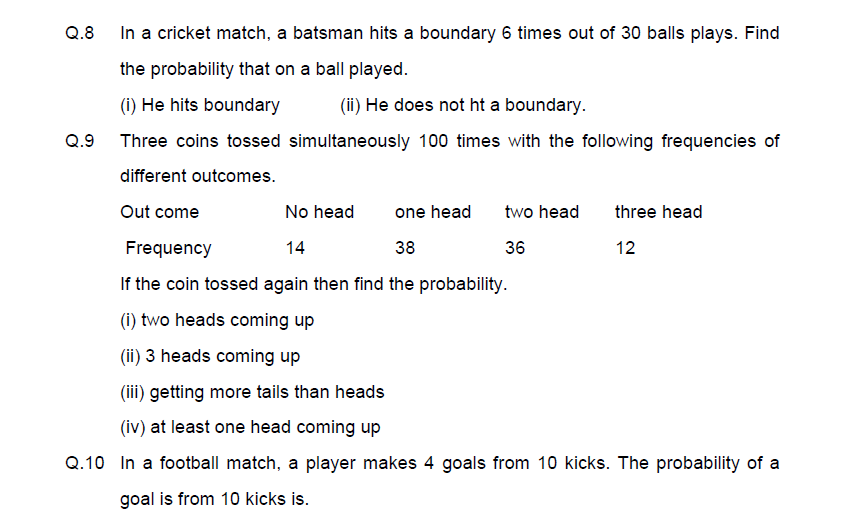
Click on link below to download CBSE Class 9 Mathematics Probability Set C
Free study material for Mathematics
CBSE Class 9 Mathematics Assignments for Chapter 15 Probability
Class 9 Mathematics Chapter 15 Probability Printable Assignments
Explore reliable practice questions for Chapter 15 Probability tailored for Class 9 learners. Use these structured worksheets to evaluate preparedness and strengthen core problem-solving skills.
Maximize Exam Scores with Chapter Practice Sets
- Curriculum Standards: Assignments match modern CBSE sample formats to ensure relevant preparation.
- Thorough Revision: Detailed problem sets reinforce core concepts and eliminate conceptual weak spots.
- Execution Speed: Timed practice with assignment sets sharpens overall response timing.
Effective Strategy for Class 9 Mathematics Assignments
- Initial Reading: Begin by reading the NCERT book for Class 9 Mathematics to build a baseline understanding.
- Independent Testing: Attempt assignment questions unassisted, then verify work using provided answer keys.
- Supplementary Aids: Leverage revision notes and worksheets whenever you encounter difficult topics.
FAQs
You can download free PDF assignments for Class 9 Mathematics Chapter 15 Probability from StudiesToday.com. These practice sheets have been updated for the 2026-27 session covering all concepts from latest NCERT textbook.
Yes, our teachers have given solutions for all questions in the Class 9 Mathematics Chapter 15 Probability assignments. This will help you to understand step-by-step methodology to get full marks in school tests and exams.
Yes. These assignments are designed as per the latest CBSE syllabus for 2026. We have included huge variety of question formats such as MCQs, Case-study based questions and important diagram-based problems found in Chapter 15 Probability.
Practicing topicw wise assignments will help Class 9 students understand every sub-topic of Chapter 15 Probability. Daily practice will improve speed, accuracy and answering competency-based questions.
Yes, all printable assignments for Class 9 Mathematics Chapter 15 Probability are available for free download in mobile-friendly PDF format.