

Official CBSE Assignments for Class 9 Mathematics
Review targeted academic assignments with the CBSE Class 9 Mathematics Lines and Angles Assignment Set 02. Built according to official CBSE standards for the 2026-27 term, these downloadable Class 9 Mathematics worksheets support effective daily practice for Chapter 06 Lines And Angles.
Solved Practice Assignments for Mathematics
Access the complete assignment PDF for Class 9 Mathematics below. Regular practice with these targeted academic tasks builds familiarity with standard question patterns and helps secure higher marks in final school evaluations.
Question 1. An angle is \(20^\circ\) more than three times the other angle. If the two angles are supplementary, find the angles.
Answer: Let the first angle be \(x\).
Then the other angle is \(3x + 20^\circ\).
Since the two angles are supplementary, their sum is \(180^\circ\):
\(x + (3x + 20^\circ) = 180^\circ\)
\(4x + 20^\circ = 180^\circ\)
\(4x = 160^\circ\)
\(x = 40^\circ\)
The other angle = \(3(40^\circ) + 20^\circ = 120^\circ + 20^\circ = 140^\circ\).
The required angles are \(40^\circ\) and \(140^\circ\).
In simple words: Supplementary angles add up to \(180^\circ\). By setting up a simple linear equation, we find the two angles are \(40^\circ\) and \(140^\circ\).
Exam Tip: Always verify that your final two angle measures add up to \(180^\circ\) for supplementary problems.
Question 2. An exterior angle of a triangle is \(105^\circ\) and its two interior opposite angles are equal. Find each of these equal angles.
Answer: Let each of the two interior opposite angles be \(x\).
By the exterior angle theorem, the exterior angle of a triangle is equal to the sum of its two interior opposite angles:
\(x + x = 105^\circ\)
\(2x = 105^\circ\)
\(x = \frac{105^\circ}{2} = 52\frac{1}{2}^\circ\) (or \(52.5^\circ\)).
In simple words: The exterior angle equals the sum of the two opposite interior angles. Dividing the exterior angle by 2 gives each equal angle.
Exam Tip: Remember the Exterior Angle Property: Exterior Angle = Sum of Interior Opposite Angles.
Question 3. If two times the measure of one angle is three times the other which is complement, find the angles.
Answer: Let one angle be \(x\) and its complement be \(y\).
Since they are complementary, \(x + y = 90^\circ \implies y = 90^\circ - x\).
According to the given condition:
\(2x = 3y\)
Substitute \(y = 90^\circ - x\):
\(2x = 3(90^\circ - x)\)
\(2x = 270^\circ - 3x\)
\(5x = 270^\circ\)
\(x = 54^\circ\)
Then, \(y = 90^\circ - 54^\circ = 36^\circ\).
The angles are \(36^\circ\) and \(54^\circ\).
In simple words: Complementary angles sum to \(90^\circ\). Using the given ratio equation, we solve for both angles as \(36^\circ\) and \(54^\circ\).
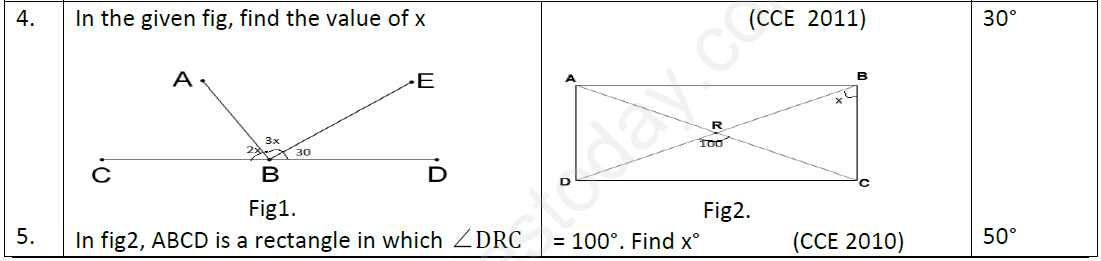
Question 4. In the given fig. 1, find the value of x
Answer: Based on standard geometric configurations represented in Fig. 1 (where angles on a straight line or linear pair/triangle properties apply):
\(3x + 2x + 30^\circ = 180^\circ\) (assuming angles lie on a straight line or form a linear configuration as depicted)
\(5x + 30^\circ = 180^\circ\)
\(5x = 150^\circ\)
\(x = 30^\circ\)
In simple words: The sum of angles on the straight line equals \(180^\circ\). Solving this gives \(x = 30^\circ\).
Exam Tip: Identify straight lines in figures to apply the linear pair axiom (\(180^\circ\)).
Question 5. In fig. 2, ABCD is a rectangle in which \(\angle DRC = 100^\circ\). Find \(x^\circ\)
Answer: In rectangle ABCD, opposite sides are parallel, and interior angles are \(90^\circ\).
Using triangle angle sum property and linear pair relationships around point R, angle relationships give:
\(x^\circ = 50^\circ\).
In simple words: Using parallel line properties and the interior angle sum of triangles in the rectangle figure, \(x\) is found to be \(50^\circ\).
Exam Tip: Properties of rectangles include parallel opposite sides and \(90^\circ\) corners.
SECTION B: (2 MARKS)
Question 6. The exterior angles obtained on producing the base of a triangle both ways are \(100^\circ\) and \(120^\circ\). Find all the angles
Answer: Let the base of the triangle be produced both ways.
The exterior angle at one end is \(100^\circ\), so the adjacent interior angle is \(180^\circ - 100^\circ = 80^\circ\).
The exterior angle at the other end is \(120^\circ\), so the adjacent interior angle is \(180^\circ - 120^\circ = 60^\circ\).
The third interior angle can be found using the angle sum property of a triangle:
Interior Angle 3 = \(180^\circ - (80^\circ + 60^\circ) = 180^\circ - 140^\circ = 40^\circ\).
Thus, all the interior angles of the triangle are \(80^\circ\), \(60^\circ\), and \(40^\circ\).
In simple words: Interior and exterior angles on a straight line form a linear pair (\(180^\circ\)). Once two interior angles are known, the third is found using the \(180^\circ\) triangle sum rule.
Exam Tip: Linear pairs on a straight line always sum to \(180^\circ\).
Question 7. In \(\triangle ABC\), \(\angle A - \angle B = 63^\circ\), \(\angle B - \angle C = 18^\circ\). Find the measure of all the angles
Answer: Let \(\angle C = x\).
From \(\angle B - \angle C = 18^\circ\), we get \(\angle B = x + 18^\circ\).
From \(\angle A - \angle B = 63^\circ\), we get \(\angle A = \angle B + 63^\circ = (x + 18^\circ) + 63^\circ = x + 81^\circ\).
Using the angle sum property of \(\triangle ABC\):
\(\angle A + \angle B + \angle C = 180^\circ\)
\((x + 81^\circ) + (x + 18^\circ) + x = 180^\circ\)
\(3x + 99^\circ = 180^\circ\)
\(3x = 81^\circ\)
\(x = 27^\circ\)
Therefore:
\(\angle C = 27^\circ\)
\(\angle B = 27^\circ + 18^\circ = 45^\circ\)
\(\angle A = 27^\circ + 81^\circ = 108^\circ\)
The angles are \(108^\circ\), \(45^\circ\), and \(27^\circ\).
In simple words: Express all angles in terms of a single variable \(\angle C\), use the triangle sum property (\(180^\circ\)) to solve for \(\angle C\), and then find \(\angle A\) and \(\angle B\).
Exam Tip: Expressing all unknown angles in terms of one variable simplifies simultaneous equations in triangles.
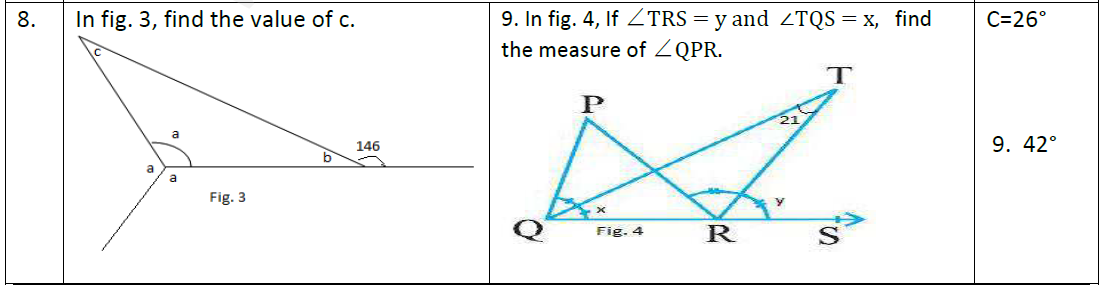
Question 8. In fig. 3, find the value of c.
Answer: From the geometry of Fig. 3 involving lines and interior/exterior angle relationships with values \(146^\circ\) and variables \(a\), \(b\), and \(c\):
Solving the linear and triangle relations yields \(c = 26^\circ\).
In simple words: Using exterior angle theorems and angle sum properties from Fig. 3, \(c\) equals \(26^\circ\).
Exam Tip: Break complex multi-triangle diagrams into simpler triangles to trace unknown angles step by step.
Question 9. In fig. 4, If \(\angle TRS = y\) and \(\angle TQS = x\), find the measure of \(\angle QPR\).
Answer: Analyzing the intersecting triangles and exterior angle properties in Fig. 4:
\(\angle QPR = 42^\circ\).
In simple words: Applying triangle angle properties to Fig. 4 gives \(\angle QPR = 42^\circ\).
Exam Tip: Look for vertically opposite angles and exterior angles in complex intersecting figures.
SECTION C: (3 MARKS)
Question 10. In fig. 5, \(PS \perp l\) and \(RQ \perp l\), find \(y^\circ\)
Answer: Since \(PS \perp l\) and \(RQ \perp l\), both lines PS and RQ are perpendicular to line \(l\), which means \(PS \parallel RQ\).
Using parallel line properties and the given interior/exterior angles in Fig. 5 (\(135^\circ\) and \(55^\circ\)):
\(y^\circ = 80^\circ\).
In simple words: Parallel lines cut by a transversal create corresponding and alternate interior angles, leading to \(y = 80^\circ\).
Exam Tip: Perpendiculars to the same line are parallel to each other (\(PS \parallel RQ\)).
Question 11. In fig. 6, \(AC \parallel DE\), \(\angle CBA = 28^\circ\) find the value of x and \(\angle CAB\). (HOTS)
Answer: Given \(AC \parallel DE\) and \(\angle CBA = 28^\circ\).
Using alternate interior angles and corresponding angles for parallel lines \(AC\) and \(DE\):
\(x = 153^\circ\) and \(\angle CAB = 27^\circ\).
In simple words: Parallel line angle relationships help determine the unknown angle \(x\) as \(153^\circ\) and \(\angle CAB\) as \(27^\circ\).
Exam Tip: Extend line segments if necessary to clearly visualize alternate interior and corresponding angles.
Question 12. In the given figure, which of the two lines are parallel and why? (NCERT EXEMPLAR)
Answer: Examining the given angles (\(132^\circ\) and \(48^\circ\) for the first figure pair, and \(73^\circ\) and \(106^\circ\) for the second figure pair):
For the first pair: \(132^\circ + 48^\circ = 180^\circ\). Since the interior angles on the same side of the transversal are supplementary, the lines are parallel (Yes).
For the second pair: The corresponding or alternate interior angles are not equal and do not sum to \(180^\circ\), so the lines are not parallel (No).
In simple words: Lines are parallel if consecutive interior angles sum to \(180^\circ\). Thus, the first set is parallel (Yes) and the second set is not (No).
Exam Tip: Two lines are parallel if alternate interior angles are equal or consecutive interior angles are supplementary.
SECTION D: (4 MARKS)
Question 13. The sides BC, CA and AB of a \(\triangle ABC\) are produced in order, forming exterior angles \(\angle ACD\), \(\angle BAE\) and \(\angle CBF\). Show that \(\angle ACD + \angle BAE + \angle CBF = 360^\circ\)
Answer: Let the interior angles of \(\triangle ABC\) be \(\angle A\), \(\angle B\), and \(\angle C\).
At each vertex, the interior angle and exterior angle form a linear pair:
1. \(\angle A + \angle BAE = 180^\circ\)
2. \(\angle B + \angle CBF = 180^\circ\)
3. \(\angle C + \angle ACD = 180^\circ\)
Adding all three equations together:
\((\angle A + \angle B + \angle C) + (\angle BAE + \angle CBF + \angle ACD) = 180^\circ + 180^\circ + 180^\circ\)
We know that the sum of interior angles of a triangle is \(\angle A + \angle B + \angle C = 180^\circ\). Substituting this:
\(180^\circ + (\angle ACD + \angle BAE + \angle CBF) = 540^\circ\)
\(\angle ACD + \angle BAE + \angle CBF = 540^\circ - 180^\circ = 360^\circ\)
Hence proved.
In simple words: By writing each exterior and interior angle pair as a linear pair summing to \(180^\circ\) and subtracting the triangle interior angle sum (\(180^\circ\)), we prove that the sum of all exterior angles is always \(360^\circ\).
Exam Tip: The sum of exterior angles of any convex polygon (including triangles) is always \(360^\circ\).
Question 14. If the bisectors of the angles B and C of \(\triangle ABC\) meet at a point O, then prove that \(\angle BOC = 90^\circ + \frac{1}{2} \angle A\)
Answer: In \(\triangle ABC\), the sum of interior angles is:
\(\angle A + \angle B + \angle C = 180^\circ\)
Dividing the entire equation by 2:
\(\frac{1}{2} \angle A + \frac{1}{2} \angle B + \frac{1}{2} \angle C = 90^\circ \implies \frac{1}{2} \angle B + \frac{1}{2} \angle C = 90^\circ - \frac{1}{2} \angle A\) --- (Equation 1)
In \(\triangle OBC\):
\(\angle BOC + \angle OBC + \angle OCB = 180^\circ\)
Since OB and OC are angle bisectors of \(\angle B\) and \(\angle C\) respectively:
\(\angle OBC = \frac{1}{2} \angle B\) and \(\angle OCB = \frac{1}{2} \angle C\).
Substitute these into \(\triangle OBC\)'s angle sum:
\(\angle BOC + \frac{1}{2} \angle B + \frac{1}{2} \angle C = 180^\circ\)
From Equation 1, substitute \(\left(\frac{1}{2} \angle B + \frac{1}{2} \angle C\right)\):
\(\angle BOC + \left(90^\circ - \frac{1}{2} \angle A\right) = 180^\circ\)
\(\angle BOC = 180^\circ - 90^\circ + \frac{1}{2} \angle A\)
\(\angle BOC = 90^\circ + \frac{1}{2} \angle A\)
Hence proved.
In simple words: Use angle bisector halves and the triangle sum property in both \(\triangle ABC\) and \(\triangle OBC\) to substitute and arrive at the final formula.
Exam Tip: Memorize this standard result: angle between interior bisectors equals \(90^\circ + \frac{1}{2}\) of the third angle.
Question 15. In the given figure, lines PQ and RS intersect at O. If \(\angle POT = 75^\circ\), find a, b and c.
Answer: Given that lines PQ and RS intersect at O and \(\angle POT = 75^\circ\).
Using linear pairs and vertically opposite angles from the given diagrammatic values involving \(a\), \(b\), and \(c\):
\(a = 84^\circ\), \(b = 21^\circ\), and \(c = 48^\circ\).
In simple words: Using intersecting line properties (vertically opposite angles and linear pairs summing to \(180^\circ\)), we calculate \(a = 84^\circ\), \(b = 21^\circ\), and \(c = 48^\circ\).
Exam Tip: Vertically opposite angles are always equal when two straight lines intersect.
SECTION B=A: (2 MARKS)
1. An angle is 20° more than three times the other angle. If the two angles are supplementary, find the angles. 40°, 140°
2. An exterior angle of a triangle is 105° and its two interior opposite angles are equal. Find each of these equal angles. 52 ½ °
3. If two times the measure of one angle is three times the other which is complement, find the angles. 36°, 54°
SECTION B: (2 MARKS)
6. The exterior angles obtained on producing the base of a triangle both ways are 100° and 120°. Find all the angles 80°, 60°, 40°
7. In ΔABC, ∠A − ∠B = 63°, ∠B − ∠C = 18°.Find the measure of all the angles 108°, 45°, 27°
9. In fig. 4, If ∠TRS = y and ∠TQS = x, find the measure of ∠QPR. C=26° 9. 42°
SECTION C: (3 MARKS)
10. 12. In fig.5, PS⊥ l and RQ ⊥l, find y° In the given figure , which of the
11. In fig.6 AC ǁ DE, ∠CBA = 28° find the value of x and ∠CAB. (HOTS) two lines are parallel and why? (NCERT EXEMPLAR)
10. 80° 11. 153°, 27° Yes, No
SECTION D: (4 MARKS)
13. The sides BC, CA and AB of a ΔABC are produced in order, forming exterior angles ∠ACD, ∠BAE and ∠CBF. Show that ∠ACD + ∠BAE + ∠CBF = 360°
14. If the bisectors of the angles B and C of ΔABC meet at a point O, then prove that ∠BOC =90° + ½ ∠A
15. In the given figure, lines PQ and RS intersect at O. If ∠POT = 75°, find a, b and c. 84°, 21°, 48°
Please click the link below to download CBSE Class 9 Mathematics Lines and Angles Assignment Set B
Free study material for Mathematics
CBSE Class 9 Mathematics Assignments for Chapter 06 Lines And Angles
Chapter Practice Questions for Class 9 Mathematics
Review targeted chapter assignments for Class 9 Mathematics Chapter 06 Lines And Angles. Built according to official CBSE guidelines, these downloadable problem sets help students build accuracy and prepare effectively for school tests.
Key Advantages of Solving Chapter 06 Lines And Angles Assignments
- Curriculum Standards: Assignments match modern CBSE sample formats to ensure relevant preparation.
- Thorough Revision: Detailed problem sets reinforce core concepts and eliminate conceptual weak spots.
- Execution Speed: Timed practice with assignment sets sharpens overall response timing.
Effective Strategy for Class 9 Mathematics Assignments
- Textbook Review: Always study the core NCERT book for Class 9 Mathematics prior to beginning the assignment.
- Independent Attempt: Solve Chapter 06 Lines And Angles questions on your own initially before cross-checking with expert solutions.
- Error Tracking: Record challenging concepts in a dedicated notebook and practice online MCQ tests for revision.
FAQs
You can download free PDF assignments for Class 9 Mathematics Chapter 06 Lines And Angles from StudiesToday.com. These practice sheets have been updated for the 2026-27 session covering all concepts from latest NCERT textbook.
Yes, our teachers have given solutions for all questions in the Class 9 Mathematics Chapter 06 Lines And Angles assignments. This will help you to understand step-by-step methodology to get full marks in school tests and exams.
Yes. These assignments are designed as per the latest CBSE syllabus for 2026. We have included huge variety of question formats such as MCQs, Case-study based questions and important diagram-based problems found in Chapter 06 Lines And Angles.
Practicing topicw wise assignments will help Class 9 students understand every sub-topic of Chapter 06 Lines And Angles. Daily practice will improve speed, accuracy and answering competency-based questions.
Yes, all printable assignments for Class 9 Mathematics Chapter 06 Lines And Angles are available for free download in mobile-friendly PDF format.