

School Assignments for Class 12 Physics: Chapter 09 Ray Optics And Optical Instruments
Access comprehensive school assignments for Chapter 09 Ray Optics And Optical Instruments using the CBSE Class 12 Physics Optics Assignment Set 02. Designed to align with the 2026-27 CBSE academic guidelines, these practice sets help Class 12 Physics students reinforce core concepts and improve their problem-solving accuracy.
Practice Class 12 Physics Assignments: Chapter 09 Ray Optics And Optical Instruments
View or download the dedicated CBSE Class 12 Physics Optics Assignment Set 02 resource below. Engaging with these assignments under focused study conditions ensures continuous academic progress and mastery of the 2026-27 curriculum.
Question. An object approaches a convergent lens from the left of the lens with a uniform speed 5 m/s and stops at the focus. The image
(a) moves away from the lens with an uniform speed 5 m/s
(b) moves away from the lens with an uniform acceleration
(c) moves away from the lens with a non-uniform acceleration
(d) moves towards the lens with a non-uniform acceleration
Answer: C
Question. A luminous object is placed at a distance of 30 cm from the convex lens of focal length 20 cm. On the other side of the lens, at what distance from the lens a convex mirror of radius of curvature 10 cm be placed in order to have an upright image of the object coincident with it?
(a) 12 cm
(b) 30 cm
(c) 50 cm
(d) 60 cm
Answer: C
Question. A passenger in an aeroplane shall
(a) never see a rainbow
(b) may see a primary and a secondary rainbow as concentric circles
(c) may see a primary and a secondary rainbow as concentric arcs
(d) shall never see a secondary rainbow
Answer: B
Question. There are certain material developed in laboratories which have a negative refractive index figure. A ray incident from air (Medium 1) into such a medium (Medium 2) shall follow a path given by 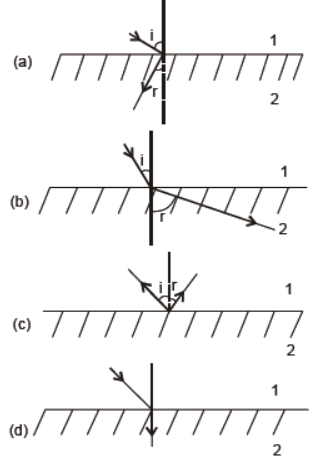
Answer: A
Question. An air bubble in glass slab (μ = 1.5) from one side is 6 cm and from other side is 4 cm. The thickness of glass slab is
(a) 10 cm
(b) 6.67 cm
(c) 15 cm
(d) None of these
Answer: C
Question. A concave mirror forms the image of an object on a screen. If the lower half of the mirror is covered with an opaque card, the effect would be to make the
(a) image less bright.
(b) lower half of the image disappear.
(c) upper half of the image disappear.
(d) image blurred.
Answer: A
Question. The direction of ray of light incident on a concave mirror is shown by PQ while directions in which the ray would travel after reflection is shown by four rays marked 1, 2, 3 and 4 (figure). Which of the four rays correctly shows the direction of reflected ray? 
(a) 1
(b) 2
(c) 3
(d) 4
Answer: B
Question. An air bubble in a glass slab (μ = 1.5) is 5 cm deep when viewed from one face and 2 cm deep when viewed from the opposite face. The thickness of the slab is
(a) 7.5 cm
(b) 10.5 cm
(c) 7 cm
(d) 10 cm
Answer: B
Question. A glass slab of thickness 4 cm contains the same number of waves as 5 cm of water when both are traversed by the same monochromatic light. If the refractive index of water is 4/3, what is that of glass?
(a) 5/3
(b) 5/4
(c) 16/15
(d) 1.5
Answer: A
Question. A light ray falls on a rectangular glass slab as shown. The index of refraction of the glass, if total internal reflection is to occur at the vertical face, is
(a) √3/ 2
(b) (√3 + 1)/2
(c) (√2 + 1)/2
(d) √5 / 2
Answer: A
Question. The reddish appearance of the sun at sunrise and sunset is due to
(a) the colour of the sky
(b) the scattering of light
(c) the polarisation of light
(d) the colour of the sun
Answer: B
Question. If the focal length of objective lens is increased then magnifying power of :
(a) microscope will increase but that of telescope decrease.
(b) microscope and telescope both will increase.
(c) microscope and telescope both will decrease
(d) microscope will decrease but that of telescope increase.
Answer: D
Question. The angle of a prism is ‘A’. One of its refracting surfaces is silvered. Light rays falling at an angle of incidence 2A on the first surface returns back through the same path after suffering reflection at the silvered surface. The refractive index μ, of the prism is :
(a) 2 sin A
(b) 2 cos A
(c) 1/2 cos A
(d) tan A
Answer: B
Question. The refracting angle of a prism is ‘A’, and refractive index of the material of the prism is cot(A/2). The angle of minimum deviation is :
(a) 180° – 2A
(b) 90° – A
(c) 180° + 2A
(d) 180° – 3A
Answer: A
Question. A plano convex lens fits exactly into a plano concave lens. Their plane surfaces are parallel to each other. If lenses are made of different materials of refractive indices μ1 and μ2 and R is the radius of curvature of the curved surface of the lenses, then the focal length of the combination is 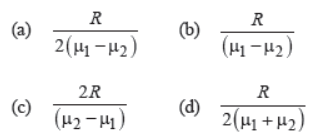
Answer: B
Question. Light enters at an angle of incidence in a transparent rod of refractive index n. For what value of the refractive index of the material of the rod the light once entered into it will not leave it through its lateral face whatsoever be the value of angle of incidence?
(a) n > √2
(b) n = 1
(c) n = 1.1
(d) n = 1.3
Answer: A
Question. The angle of incidence for a ray of light at a refracting surface of a prism is 45° . The angle of prism is 60°. If the ray suffers minimum deviation through the prism, the angle of minimum deviation and refractive index of the material of the prism respectively, are :
(a) 45° , 1/√2
(b) 30°, √2
(c) 45°, √2
(d) 30°, 1/√2
Answer: B
Question. A astronomical telescope has objective and eyepiece of focal lengths 40 cm and 4 cm respectively. To view an object 200 cm away from the objective, the lenses must be separated by a distance :
(a) 37.3 cm
(b) 46.0 cm
(c) 50.0 cm
(d) 54.0 cm
Answer: D
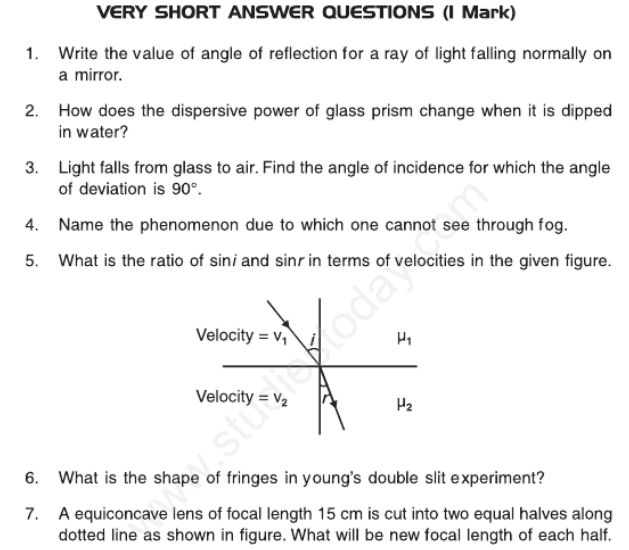
Question. An equiconvex lens is cut into two halves along (i) XOX' and (ii) YOY' as shown in the figure. Let f, f', f'' be the focal lengths of the complete lens, of each half in case (i), and of each half in case (ii), respectively 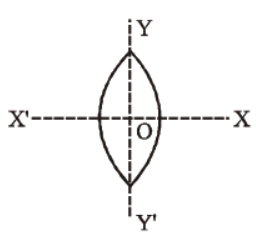
Choose the correct statement from the following
(a) f ' = 2f, f '' = 2f
(b) f ' = f, f '' = 2f
(c) f ' = 2f, f '' = f
(d) f ' = f, f '' = f
Answer: B
Question. The optical density of turpentine is higher than tnat of water while its mass density is lower. Figure shows a layer of turpentine floating over water in a container. For which one of the four rays incident on turpentine in figure, the path shown is correct?
(a) 1
(b) 2
(c) 3
(d) 4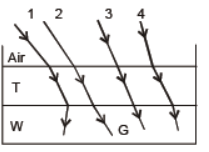
Answer: B
Question. Two plane mirrors are inclined at 70°. A ray incident on one mirror at angle q after reflection falls on second mirror and is reflected from there parallel to first mirror. The value of θ is
(a) 50°
(b) 45°
(c) 30°
(d) 55°
Answer: A
Question. Match the corresponding entries of column-1 with column-2 (Where m is the magnification produced by the mirror):
Column-1 Column-2
(A) m = –2 (a) Convex mirror
(B) m = -1/2 (b) Concave mirror
(C) m = +2 (c) Real image
(D) m = + 1/2 (d) Virtual image
(a) A → b and c, B → b and c, C → b and d, D → a and d.
(b) A → a and c, B → a and d, C → a and b, D → c and d
(c) A → a and d, B → b and c, C → b and d, D → b and c
(d) A → c and d, B → b and d, C → b and c, D → a and d
Answer: A
Directions for : Each question contains STATEMENT-1 and STATEMENT-2. Choose the correct answer (ONLY ONE option is correct ) from the following-
(a) Statement -1 is false, Statement-2 is true
(b) Statement -1 is true, Statement-2 is true; Statement -2 is a correct explanation for Statement-1
(c) Statement -1 is true, Statement-2 is true; Statement -2 is not a correct explanation for Statement-1
(d) Statement -1 is true, Statement-2 is false
Question. Statement 1: Optical fibres are used to transmit light without any appreciable loss in its intensity over distance of several kilometers.
Statement 2 : Optical fibres are very thick and all the light is passed through it without any loss.
Answer: D
Question. Statement 1: Two convex lenses joined together cannot produce an achromatic combination.
Statement 2 : The condition for achromatism is ω1/f1 + ω2/f2 = 0 where symbols have their usual meaning.
Answer: B
Question. Statement 1 : If P1 and P2 be the powers of two thin lenses located coaxially in a medium of refractive index μ at a distance d, then the power P of the combination is
P = P1 + P2 – P1P2d/μ
Statement 2 : Because for above given system equivalent focal length is given by F = f1f2/f1 + f2 - d/μ and P = 1/F .
Answer: B
Question. Statement 1: Critical angle is minimum for violet colour.
Statement 2 : Because critical angle θc = sin-1(1/μ) and μ∞ (1)/λ .
Answer: B
Free study material for Physics
Download Practice Assignments: Class 12 Physics Chapter 09 Ray Optics And Optical Instruments
Chapter Practice Questions for Class 12 Physics
Explore reliable practice questions for Chapter 09 Ray Optics And Optical Instruments tailored for Class 12 learners. Use these structured worksheets to evaluate preparedness and strengthen core problem-solving skills.
Maximize Exam Scores with Chapter Practice Sets
- Syllabus Compliance: Sets reflect current CBSE evaluation criteria and official marking frameworks.
- Multi-Format Practice: Includes varied problem types designed to deepen comprehension across all sub-topics.
- Time Management: Routine practice optimizes pacing to finish school examinations comfortably within schedule.
Steps to Complete Chapter 09 Ray Optics And Optical Instruments Assignments Successfully
- Textbook Review: Always study the core NCERT book for Class 12 Physics prior to beginning the assignment.
- Independent Attempt: Solve Chapter 09 Ray Optics And Optical Instruments questions on your own initially before cross-checking with expert solutions.
- Error Tracking: Record challenging concepts in a dedicated notebook and practice online MCQ tests for revision.
FAQs
You can download free PDF assignments for Class 12 Physics Chapter 09 Ray Optics And Optical Instruments from StudiesToday.com. These practice sheets have been updated for the 2026-27 session covering all concepts from latest NCERT textbook.
Yes, our teachers have given solutions for all questions in the Class 12 Physics Chapter 09 Ray Optics And Optical Instruments assignments. This will help you to understand step-by-step methodology to get full marks in school tests and exams.
Yes. These assignments are designed as per the latest CBSE syllabus for 2026. We have included huge variety of question formats such as MCQs, Case-study based questions and important diagram-based problems found in Chapter 09 Ray Optics And Optical Instruments.
Practicing topicw wise assignments will help Class 12 students understand every sub-topic of Chapter 09 Ray Optics And Optical Instruments. Daily practice will improve speed, accuracy and answering competency-based questions.
Yes, all printable assignments for Class 12 Physics Chapter 09 Ray Optics And Optical Instruments are available for free download in mobile-friendly PDF format.