

Class 12 Physics Practice Assignments: CBSE Class 12 Physics Dual Nature of Matter Assignment
Access comprehensive school assignments for Chapter 11 Dual Nature Of Radiation And Matter using the CBSE Class 12 Physics Dual Nature of Matter Assignment. Designed to align with the 2026-27 CBSE academic guidelines, these practice sets help Class 12 Physics students reinforce core concepts and improve their problem-solving accuracy.
Download Chapter 11 Dual Nature Of Radiation And Matter Assignment PDF with Solutions
View or download the dedicated CBSE Class 12 Physics Dual Nature of Matter Assignment resource below. Engaging with these assignments under focused study conditions ensures continuous academic progress and mastery of the 2026-27 curriculum.
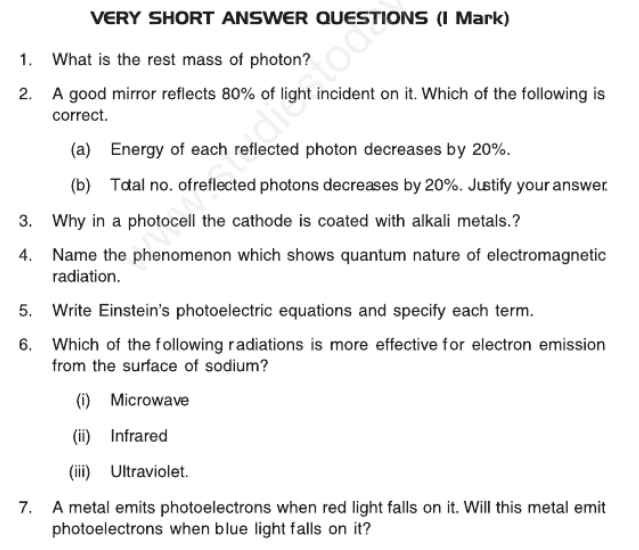
Important Questions for NCERT Class 12 Physics Dual Nature Of Matter And Radiation
Question. In a photoelectric effect experiment, for radiation with frequency υ0 with hυ0 = 8eV, electrons are emitted with energy 2 eV. What is the energy of the electrons emitted for incoming radiation of frequency 1.25 υ0 ?
(a) 1 eV
(b) 3.25 eV
(c) 4 eV
(d) 9.25 eV.
Answer: C
Question. Einstein’s photoelectric equation is Ek = hn - Φ . In this equation Ek refers to
(a) kinetic energy of all the emitted electrons
(b) mean kinetic energy of emitted electrons
(c) maximum kinetic energy of emitted electrons
(d) minimum kinetic energy of emitted electrons
Answer: C
Question. Photoelectric effect is the phenomenon in which
(a) photons come out of a metal when it is hit by a beam of electrons.
(b) photons come out of the nucleus of an atom under the action of an electric field.
(c) electrons come out of a metal with a constant velocity which depends on the frequency and intensity of incident light wave.
(d) electons come out of a metal with different velocities not greater than a certain value which depends only on the frequency of the incident light wave and not on its intensity.
Answer: D
Question. A photoelectric cell is a device which
(a) converts light into electricity
(b) converts electricity into light
(c) stores light
(d) stores electricity
Answer: A
Question. If E1, E2, E3 are the respective kinetic energies of an electron, an alpha-particle and a proton, each having the same de-Broglie wavelength, then
(a) E1 > E3 > E2
(b) E2 > E3 > E1
(c) E1 > E2 > E3
(d) E1 = E2 = E3
Answer: A
Question. When the speed of electrons increase, then the value of its specific charge
(a) increases
(b) decreases
(c) ramains unchanged
(d) increases upto some velocity and then begins to decrease
Answer: B
Question. In an electron gun the control grid is given a negative potential relative to cathode in order to
(a) decelerate electrons
(b) repel electrons and thus to control the number of electrons passing through it
(c) to select electrons of same velocity and to converge them along the axis.
(d) to decrease the kinetic energy of electrons
Answer: B
Question. X-rays are produced in X-ray tube operating at a given accelerating voltage. The wavelength of the continuous X-rays has values from
(a) 0 to ∞
(b) λmin to ∞, where λmin > 0
(c) 0 to λmax, where λmax < ∞
(d) λmin to λmax, where 0 < λmin <λmax < ∞
Answer: B
Question. As intensity of incident light increases
(a) photoelectric current increase
(b) K.E. of emitted photoelectron increases
(c) photoelectric current decreases
(d) K.E. of emitted photoelectrons decreases
Answer: A
Question. Which of the following shows par.ticle nature of light?
(a) Refraction
(b) Interference
(c) Polarization
(d) Photoelectric effect
Answer: D
Question. The ratio of de-Broglie wavelengths of proton and a -particle having same kinetic energy is
(a) √2 : 1
(b) 2 √2 : 1
(c) 2 : 1
(d) 4 : 1
Answer: C
Question. White X-rays are called white due to the fact that
(a) they are electromagnetic radiations having nature same as that of white light.
(b) they are produced most abundantly in X ray tubes.
(c) they have a continuous wavelength range.
(d) they can be converted to visible light using coated screens and photographic plates are affected by them just like light.
Answer: C
Question. In case of electrons and photons having the same wavelength. What is same for them?
(a) Energy
(b) Velocity
(c) Momentum
(d) Angular momentum
Answer: C
Question. The energy of a photon of wavelength λ is
(a) hc λ
(b) hc/λ
(c) λ/hc
(d) λh/c
Answer: B
Question. In the Davisson and Germer experiment, the velocity of electrons emitted from the electron gun can be increased by
(a) increasing the potential difference between the anode and filament
(b) increasing the filament current
(c) decreasing the filament current
(d) decreasing the potential difference between the anode and filament
Answer: A
Question. In a photoelectric experiment the stopping potential for the incident light of wavelength 4000Å is 2 volt. If the wavelength be changed to 3000 Å, the stopping potential will be
(a) 2 V
(b) zero
(c) less than 2 V
(d) more than 2 V
Answer: D
Question. A proton and a-particle are accelerated through the same potential difference. The ratio of their de-Broglie wavelength will be
(a) 1 : 1
(b) 1 : 2
(c) 2 : 1
(d) 2 √2 : 1
Answer: D
Question. The stopping potential (V0) versus frequency (v) plot of a substance is shown in figure, the threshold wavelength is 
(a) 5 × 10¹⁴m
(b) 6000 Å
(c) 5000 Å
(d) Cannot be estimated from given data
Answer: B
Question. The de-Broglie wavelength of a proton (mass = 1.6 × 10⁻²⁷ kg) accelerated through a potential difference of 1 kV is
(a) 600 A
(b) 0.9 × 10⁻¹²m
(c) 7 Å
(d) 0.9 nm.
Answer: B
Question. An electron is accelerated by a p.d. of 1000 V. Its velocity will be
(a) 3.78 × 10⁷ m/s
(b) 1.89 × 10⁷ m/s
(c) 5.67 × 10⁷ m/s
(d) 0.95 × 10⁷ m/s
Answer: B
Question. If a photon has velocity c and frequency u, then which of the following represents its wavelength?
(a) hν/c2
(b) hν
(c) hν/E
(d) hν/c
Answer : C
Question. Momentum of photon of wavelength l is
(a) hν/c
(b) zero
(c) hν/C2
(d) hν/c
Answer : A
Question. The wavelength of a 1 keV photon is 1.24 × 10⁻⁹ m.
What is the frequency of 1 MeV photon?
(a) 1.24 × 10¹⁵
(b) 2.4 × 10²⁰
(c) 1.24 × 10¹⁸
(d) 2.4 × 10²³
Answer : B
Question. A radio transmitter operates at a frequency 880 kHz and a power of 10 kW. The number of photons emitted per second is
(a) 1.72 × 1031
(b) 1.327 × 1025
(c) 1.327 × 1037
(d) 1.327 × 1045
Answer : A
Question. The momentum of a photon of an electromagnetic radiation is 3.3 ×10⁻²⁹ kg m s–1. What is the frequency of the associated waves? [h = 6.6 × 10⁻³⁴ J s ; c = 3 × 10⁸ m s–1]
(a) 1.5 × 10¹³ Hz
(b) 7.5 × 10¹² Hz
(c) 6 × 10³ Hz
(d) 3 × 10³ Hz
Answer : A
Question. The energy of a photon of wavelength l is
(a) hcλ (b) hc/λ
(c) λ/hc
(d) λh/c
Answer : B
Question. An electron is accelerated from rest through a potential difference of V volt. If the de Broglie wavelength of the electron is 1.227 × 10⁻² nm, the potential difference is
(a) 10 V
(b) 102 V
(c) 103 V
(d) 104 V
Answer : A
Question. An electron is accelerated through a potential difference of 10,000 V. Its de Broglie wavelength is, (nearly) (me = 9 × 10–31 kg)
(a) 12.2 nm
(b) 12.2 × 10⁻¹³ m
(c) 12.2 × 10⁻¹² m
(d) 12.2 × 10⁻¹⁴ m
Answer : C
Question. Light of wavelength 500 nm is incident on a metal with work function 2.28 eV. The de Broglie wavelength of the emitted electron is
(a) ≥ 2.8 × 10⁻⁹ m
(b) ≤ 2.8 × 10⁻¹² m
(c) < 2.8 × 10⁻¹⁰ m
(d) < 2.8 × 10⁻⁹ m
Answer : A
Question. If the kinetic energy of the particle is increased to 16 times its previous value, the percentage change in the de Broglie wavelength of the particle is
(a) 25
(b) 75
(c) 60
(d) 50
Answer : B
Question. An a-particle moves in a circular path of radius 0.83 cm in the presence of a magnetic field of 0.25 Wb/m2. The de Broglie wavelength associated with the particle will be
(a) 1 Å
(b) 0.1 Å
(c) 10 Å
(d) 0.01 Å
Answer : D
Please refer to attached file for CBSE Class 12 Physics Dual Nature of Matter Assignmen
Free study material for Physics
Chapter Assignment & Practice Material for Class 12 Physics Chapter 11 Dual Nature Of Radiation And Matter
Chapter Practice Questions for Class 12 Physics
Access structured practice assignments for Chapter 11 Dual Nature Of Radiation And Matter designed in alignment with the latest CBSE curriculum for Class 12 Physics. These printable sets cover objective and descriptive problem types to support thorough revision.
Key Advantages of Solving Chapter 11 Dual Nature Of Radiation And Matter Assignments
- Exam Alignment: Questions strictly follow contemporary CBSE sample papers and grading schemes.
- Comprehensive Coverage: Features objective drills, case studies, and structured descriptive problems for Chapter 11 Dual Nature Of Radiation And Matter.
- Pacing & Precision: Regular problem-solving builds critical calculation speed and test-taking accuracy.
How to Approach Physics Chapter 11 Dual Nature Of Radiation And Matter Assignments
- Initial Reading: Begin by reading the NCERT book for Class 12 Physics to build a baseline understanding.
- Independent Testing: Attempt assignment questions unassisted, then verify work using provided answer keys.
- Supplementary Aids: Leverage revision notes and worksheets whenever you encounter difficult topics.
FAQs
You can download free PDF assignments for Class 12 Physics Chapter 11 Dual Nature Of Radiation And Matter from StudiesToday.com. These practice sheets have been updated for the 2026-27 session covering all concepts from latest NCERT textbook.
Yes, our teachers have given solutions for all questions in the Class 12 Physics Chapter 11 Dual Nature Of Radiation And Matter assignments. This will help you to understand step-by-step methodology to get full marks in school tests and exams.
Yes. These assignments are designed as per the latest CBSE syllabus for 2026. We have included huge variety of question formats such as MCQs, Case-study based questions and important diagram-based problems found in Chapter 11 Dual Nature Of Radiation And Matter.
Practicing topicw wise assignments will help Class 12 students understand every sub-topic of Chapter 11 Dual Nature Of Radiation And Matter. Daily practice will improve speed, accuracy and answering competency-based questions.
Yes, all printable assignments for Class 12 Physics Chapter 11 Dual Nature Of Radiation And Matter are available for free download in mobile-friendly PDF format.