

Download CBSE Class 12 Physics Assignments
Review targeted academic assignments with the CBSE Class 12 Physics Electronic Devices Assignment Set 02. Built according to official CBSE standards for the 2026-27 term, these downloadable Class 12 Physics worksheets support effective daily practice for Chapter 14 Semiconductor Electronics Materials Devices And Simple Circuits.
Access CBSE School Assignments and Answers
Access the complete assignment PDF for Class 12 Physics below. Regular practice with these targeted academic tasks builds familiarity with standard question patterns and helps secure higher marks in final school evaluations.
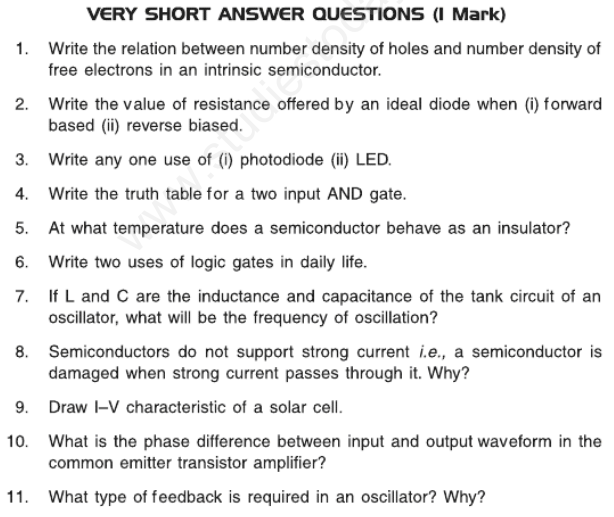
Important Questions for NCERT Class 12 Physics Electronic Devices
Question. Which one of the following is true about the p-type and n-type semi-conductor ?
(a) n-type semi-conductor have holes in majority.
(b) the concentration of electrons and holes are equal in both n-type and p -type semiconductors.
(c) n-type semi-conductors have free electrons in majority.
(d) p-type semi-conductor has excess negative charge.
Answer C
Question. When n-p-n transistor is used as an amplifier, then
(a) electrons move from base to collector
(b) holes move from emitter to base
(c) electrons move from collector to base
(d) holes move from base to emitter
Answer A
Question. When added an impurity into the silicon which one of the following produces n-type of semiconductors :
(a) iron
(b) magnesium
(c) aluminium
(d) phosphorous
Answer D
Question. When the two semiconductors p- and n-type are brought into contact they form a p-n junction, which acts like a/an :
(a) rectifier
(b) amplifier
(c) conductor
(d) oscillator
Answer A
Question. The transfer ratio b of a transistor is 50. The input resistance of the transistor when used in the common emitter configuration is 1kW. The peak value of the collector A.C. current for an A.C. input voltage of 0.01 V, is
(a) 500 μA
(b) 0.25 μA
(c) 0.01 μA
(d) 100 μA
Answer A
Question. Boolean algebra is essentially based on:
(a) Numbers
(b) Symbol
(c) Logic
(d) Truth
Answer C
Question. An amplifier has a voltage gain Av = 1000. The voltage gain in dB is:
(a) 30 dB
(b) 60 dB
(c) 3 dB
(d) 20 dB
Answer A
Question. A triode valve has an amplification factor of 20 and its plate is given a potential of 300 V. The grid voltage to reduce the plate current to zero, is
(a) 25 V
(b) 15 V
(c) 12 V
(d) 10 V
Answer B
Question. If collector current is 120 mA and base current is 2 mA and resistance gain is 3, what is power gain?
(a) 180
(b) 10800
(c) 1.8
(d) 18
Answer B
Question. Diode is used as a/an
(a) modulator
(b) rectifier
(c) oscillator
(d) amplifier
Answer B
Question. In the half wave rectifier circuit operating from 50 Hz mains frequency, the fundamental frequency in the ripple would be
(a) 25 Hz
(b) 50 Hz
(c) 70.7 Hz
(d) 100 Hz
Answer B
Question. In n-type semiconductor, majority charge carriers are
(a) electrons
(b) neutrons
(c) holes
(d) protons
Answer A
Question. The input resistance of a common emitter transistor amplifier, if the output resistance is 500 kW, the current gain a = 0.98 and power gain is 6.0625 × 10⁶, is
(a) 198 W
(b) 300 W
(c) 100 W
(d) 400 W
Answer A
Question. If the highest modulating frequency of the wave is 5 kHz, the number of stations that can be accomdated in a 150 kHz bandwidth are
(a) 15
(b) 10
(c) 5
(d) none of these
Answer A
Question. Zener diode acts as a/an
(a) oscillator
(b) regulator
(c) rectifier
(d) filter
Answer B
Question. Mobilities of electrons and holes in a sample of intrinsic Ge at room temperature are 0.35m2/V–s and 0.18m2/V–s respectively. If the electron and hole densities are each equal to 2.5×10¹⁹/m3, the Ge conductivity will be
(a) 3.12 S/m
(b) 2.12 S/m
(c) 1.12 S/m
(d) 4.12 S/m
Answer B
Question. In a full wave rectifier circuit operating from 50 Hz mains frequency, what is the fundamental frequency in the ripple?
(a) 50 Hz
(b) 100 Hz
(c) 70 Hz
(d) 25 Hz
Answer B
Question. At 0 K temperature, a p-type semiconductor
(a) has equal number of holes and free electrons
(b) has few holes but no free electrons
(c) has few holes and few free electrons
(d) does not have any charge carriers
Answer D
Question. In p-type semiconductor major current carriers are :
(a) negative ions
(b) holes
(c) electrons
(d) all of these
Answer B
Question. The cause of the potential barrier in a p-n junction diode is
(a) depletion of positive charges near the junction
(b) concentration of positive charges near the junction
(c) depletion of negative charges near the junction
(d) concentration of positive and negative charges near the junction
Answer D
Short Answer Type Questions
Question. State the order of the forbidden energy gap in conductors, semiconductors, and insulators.
Answer: For conductors, the band gap is completely absent. In semiconductors, this gap is approximately \( 1\text{ eV} \). For insulators, the energy separation is \( 6\text{ eV} \) or even higher.
In simple words: Conductors have no energy gap, so electricity flows easily. Semiconductors have a tiny gap of about 1 eV, and insulators have a very large gap of 6 eV or more, which blocks current.
Exam Tip: Remember to express the energy gap values in electron-volts (\(\text{eV}\)) and clearly distinguish between the three states of matter.
Question. Why does the electrical conductivity of a semiconductor increase when its temperature is raised?
Answer: As the temperature of a semiconductor rises, a greater number of electrons gain sufficient thermal energy. This enables them to cross the forbidden energy barrier, moving from the valence band into the conduction band. Once in the conduction band, these charge carriers are free to participate in electrical conduction, which enhances the material's overall conductivity.
In simple words: Heating a semiconductor gives its electrons the extra energy needed to break free and move. This increases the flow of electric current.
Exam Tip: Clearly mention the transition of electrons from the valence band to the conduction band upon receiving thermal energy to secure full marks.
Question. What is the relation between the number density of free electrons and holes in an intrinsic semiconductor?
Answer: In a pure or intrinsic semiconductor, the concentration of free electrons is exactly equal to the concentration of holes.
In simple words: In a pure semiconductor, every time an electron breaks free, it leaves behind a hole, so their numbers are always equal.
Exam Tip: Write the mathematical relation \( n_e = n_h = n_i \) along with the statement to make your answer more precise.
Question. Show the position of the donor energy level in the energy band diagram of an n-type semiconductor.
Answer: The diagram illustrates the energy levels of an n-type semiconductor, where the donor energy level lies extremely close to the conduction band, situated just beneath it within the forbidden energy gap.
In simple words: In n-type semiconductors, the extra donor energy level sits very close to the conduction band, making it easy for electrons to jump up and conduct electricity.
Exam Tip: Always draw the donor energy level dashed and position it very close to the lower edge of the conduction band.
Question. Show the position of the acceptor energy level in the energy band diagram of a p-type semiconductor.
Answer: In a p-type semiconductor, the acceptor energy level is located inside the forbidden energy gap, positioned very close to the upper edge of the valence band.
In simple words: In p-type semiconductors, the acceptor level lies just above the valence band, allowing valence electrons to easily jump into it and leave conducting holes behind.
Exam Tip: Place the acceptor energy level dashed and directly above the valence band to demonstrate the correct energy relation.
Question. State the typical values of barrier potential (or knee voltage) for germanium and silicon diodes.
Answer: The potential barrier is approximately \( 0.3\text{ V} \) for a germanium diode, whereas it is around \( 0.67\text{ V} \) (often rounded to \( 0.7\text{ V} \)) for a silicon diode.
In simple words: Germanium diodes need about 0.3 volts to start conducting properly, while silicon diodes need about 0.67 volts.
Exam Tip: These barrier potential values are crucial for solving numerical circuit problems - make sure to memorize them.
Question. Is a junction transistor a current-controlled or a voltage-controlled electronic device?
Answer: A junction transistor operates as a current-controlled device because its output current is determined and regulated by the input current.
In simple words: A transistor is controlled by current. Changing the small base current controls a much larger collector current.
Exam Tip: Contrast this with Field Effect Transistors (FETs), which are voltage-controlled devices, to show a deeper understanding.
Question. In a p-n junction diode circuit, if the p-side is connected to the negative terminal and the n-side is connected to the positive terminal of a battery, how is the diode biased?
Answer: Under these connection conditions, the p-n junction diode is configured in a reverse-biased state.
In simple words: When the positive side of the battery connects to the negative side of the diode (and vice versa), the diode is reverse biased and blocks current.
Exam Tip: Remember: Forward bias is positive-to-p and negative-to-n; reverse bias is positive-to-n and negative-to-p.
Question. Identify the universal logic gate whose output is low (0) only when all its inputs are high (1).
Answer: The logic gate characterized by this behavior is the NAND gate, which serves as a universal building block in digital electronics.
In simple words: The NAND gate outputs a 0 only when both inputs are 1. For any other inputs, its output is 1.
Exam Tip: Draw the symbol of the NAND gate (an AND gate with a bubble at the output) when asked to identify or explain it.
Question. The ratio of the number density of free electrons to holes (\( n_e / n_h \)) for two different materials A and B are 1 and less than 1, respectively. Identify the semiconductor type for both A and B.
Answer: For material A, since the ratio \( n_e / n_h = 1 \), the concentration of electrons equals that of holes, identifying it as an intrinsic semiconductor. For material B, the ratio is less than 1 (\( n_e / n_h < 1 \)), which means the hole concentration exceeds the electron concentration (\( n_e < n_h \)), designating it as a p-type semiconductor.
In simple words: Material A has equal electrons and holes, so it is pure (intrinsic). Material B has more holes than electrons, making it p-type.
Exam Tip: Write down the inequality clearly (\( n_e = n_h \) for intrinsic, \( n_h > n_e \) for p-type) to show your step-by-step logic.
Question. An alternating current of frequency 50 Hz is applied to both a half-wave rectifier and a full-wave rectifier. What will be the output ripple frequency in each case?
Answer: For a half-wave rectifier, the frequency of the output ripple remains identical to the input frequency, which is \( 50\text{ Hz} \). For a full-wave rectifier, because both halves of the input cycle are rectified, the output ripple frequency is doubled, resulting in \( 100\text{ Hz} \).
In simple words: A half-wave rectifier keeps the same 50 Hz frequency, but a full-wave rectifier doubles the pulses, making the output frequency 100 Hz.
Exam Tip: In full-wave rectification, the output ripple frequency is always \( 2 \times f_{\text{input}} \). Mention this formula to score full marks.
Question. Define the mobility of electrons and holes. Derive the expression for the total electrical conductivity of a semiconductor in terms of their respective mobilities.
Answer: Mobility (\( \mu \)) of a charge carrier is defined as the magnitude of its drift velocity per unit of applied electric field. The mobility of an electron is given by: \[ \mu_e = \frac{V_e}{E} \] Similarly, the mobility of a hole is given by: \[ \mu_h = \frac{V_h}{E} \] Since electrical conductivity (\( \sigma \)) is defined as the reciprocal of resistivity (\( \rho \)), the total current in a semiconductor is the sum of the electron and hole currents. Using the relationship between current density, drift velocity, and charge carrier densities, the conductivity can be written as: \[ \sigma = \frac{1}{\rho} = e(n_e \mu_e + n_h \mu_h ) \] where \( n_e \) and \( n_h \) represent the free electron and hole concentration densities, and \( e \) is the elementary charge.
In simple words: Mobility tells us how fast a charge carrier moves when pushed by an electric field. The total conductivity depends on the number and speed of both electrons and holes.
Exam Tip: Ensure that you define both \( \mu_e \) and \( \mu_h \) separately before combining them into the final conductivity equation.
Question. Draw the V-I characteristic curve of a p-n junction diode in both forward and reverse bias conditions. Clearly label the knee voltage and breakdown voltage.
Answer: The V-I characteristic curve of a p-n junction diode is divided into two regions. In the forward-bias region (first quadrant), current is negligible until the applied voltage reaches the knee voltage, after which it increases exponentially. In the reverse-bias region (third quadrant), a minute reverse saturation current flows until the voltage reaches the breakdown voltage, at which point the current increases sharply. In simple words: The graph shows that in forward bias, current flows easily after passing a small threshold (knee voltage). In reverse bias, almost no current flows until a very high voltage (breakdown voltage) is reached.
Exam Tip: Make sure to write the units for forward current (mA) and reverse current (\(\mu\text{A}\)) on your axes, as examiners check these details.
Question. Explain why semiconductors obey Ohm's law only at low electric fields and deviate from it at high electric fields.
Answer: At low electric field strengths, the drift velocity (\( v_d \)) of charge carriers is directly proportional to the applied electric field (\( E \)), governed by the expression: \[ v_d = \frac{e E \tau}{m} \implies v_d \propto E \] where \( \tau \) is the relaxation time. Under these conditions, the semiconductor behaves according to Ohm's law. However, as the electric field is increased significantly, the charge carriers gain high speeds, which greatly increases their collision frequency. Consequently, the relaxation time (\( \tau \)) starts to decrease. This prevents the drift velocity from rising indefinitely; instead, it saturates at the thermal velocity limit (approximately \( 10^5\text{ m/s} \)). For instance, an electric field around \( 10^6\text{ V/m} \) triggers this saturation. Above this critical field strength, the current becomes independent of the applied potential difference, causing a deviation from Ohm's law.
In simple words: At low electric fields, electrons speed up as the voltage increases, following Ohm's law. At very high fields, they collide so frequently that their speed hits a limit, and the current stops increasing.
Exam Tip: Mention the reduction in relaxation time \( \tau \) due to increased collision frequency at high electric fields to explain the physical cause of saturation.
Question. State the factors on which the transconductance of a transistor depends.
Answer: The transconductance of a junction transistor is primarily determined by three key factors:
(i) The physical dimensions and geometry of the transistor structure.
(ii) The doping concentrations of the emitter, base, and collector regions.
(iii) The operating bias voltages applied across the junctions.
In simple words: How well a transistor converts input voltage changes into output current changes depends on its size and shape, the amount of impurities added to the semiconductor, and the voltage connected to it.
Exam Tip: Listing these three points clearly in a numbered format is the best way to secure full marks.
Question. Why are NPN transistors preferred over PNP transistors for faster switching and high-frequency applications?
Answer: In NPN transistors, the primary charge carriers responsible for current conduction are free electrons. Conversely, in PNP transistors, current is mostly carried by holes. Because electrons have a significantly higher mobility than holes, NPN transistors can switch and respond much faster, while also supporting larger conduction currents. This makes them the preferred choice for high-speed electronic circuits.
In simple words: NPN transistors use electrons to carry current, while PNP transistors use holes. Electrons move much faster than holes, making NPN transistors quicker and more efficient.
Exam Tip: Focus your explanation on the difference in mobility between electrons and holes, as this is the core physical concept.
Question. Draw the typical input and output characteristic curves of an NPN transistor in common-emitter (CE) configuration.
Answer: The characteristic curves of a common-emitter transistor are shown below.
1. **Input Characteristics:** This plot displays the base current (\( I_B \)) against the base-emitter voltage (\( V_{BE} \)) for different constant values of collector-emitter voltage (\( V_{CE} \)). It resembles a forward-biased diode curve.
2. **Output Characteristics:** This plot shows the collector current (\( I_C \)) versus the collector-emitter voltage (\( V_{CE} \)) for various fixed values of base current (\( I_B \)). In simple words: The graphs show how the transistor responds: input curves show how base voltage controls base current, while output curves show how collector voltage affects collector current for different constant base currents.
Exam Tip: When drawing the output characteristics, make sure the curves start at the origin, rise steeply in the saturation region, and then become nearly horizontal in the active region.
Please refer to attached file for CBSE Class 12 Physics Electronic Devices Assignment Set B
Free study material for Physics
CBSE Class 12 Physics Assignments for Chapter 14 Semiconductor Electronics Materials Devices And Simple Circuits
Chapter Practice Questions for Class 12 Physics
Access structured practice assignments for Chapter 14 Semiconductor Electronics Materials Devices And Simple Circuits designed in alignment with the latest CBSE curriculum for Class 12 Physics. These printable sets cover objective and descriptive problem types to support thorough revision.
Key Advantages of Solving Chapter 14 Semiconductor Electronics Materials Devices And Simple Circuits Assignments
- Curriculum Standards: Assignments match modern CBSE sample formats to ensure relevant preparation.
- Thorough Revision: Detailed problem sets reinforce core concepts and eliminate conceptual weak spots.
- Execution Speed: Timed practice with assignment sets sharpens overall response timing.
How to Approach Physics Chapter 14 Semiconductor Electronics Materials Devices And Simple Circuits Assignments
- Textbook Review: Always study the core NCERT book for Class 12 Physics prior to beginning the assignment.
- Independent Attempt: Solve Chapter 14 Semiconductor Electronics Materials Devices And Simple Circuits questions on your own initially before cross-checking with expert solutions.
- Error Tracking: Record challenging concepts in a dedicated notebook and practice online MCQ tests for revision.
FAQs
You can download free PDF assignments for Class 12 Physics Chapter 14 Semiconductor Electronics Materials Devices And Simple Circuits from StudiesToday.com. These practice sheets have been updated for the 2026-27 session covering all concepts from latest NCERT textbook.
Yes, our teachers have given solutions for all questions in the Class 12 Physics Chapter 14 Semiconductor Electronics Materials Devices And Simple Circuits assignments. This will help you to understand step-by-step methodology to get full marks in school tests and exams.
Yes. These assignments are designed as per the latest CBSE syllabus for 2026. We have included huge variety of question formats such as MCQs, Case-study based questions and important diagram-based problems found in Chapter 14 Semiconductor Electronics Materials Devices And Simple Circuits.
Practicing topicw wise assignments will help Class 12 students understand every sub-topic of Chapter 14 Semiconductor Electronics Materials Devices And Simple Circuits. Daily practice will improve speed, accuracy and answering competency-based questions.
Yes, all printable assignments for Class 12 Physics Chapter 14 Semiconductor Electronics Materials Devices And Simple Circuits are available for free download in mobile-friendly PDF format.