

School Assignments for Class 12 Physics: Chapter 15 Communication Systems
Review targeted academic assignments with the CBSE Class 12 Physics Communication Systems Assignment Set 01. Built according to official CBSE standards for the 2026-27 term, these downloadable Class 12 Physics worksheets support effective daily practice for Chapter 15 Communication Systems.
Practice Class 12 Physics Assignments: Chapter 15 Communication Systems
Access the complete assignment PDF for Class 12 Physics below. Regular practice with these targeted academic tasks builds familiarity with standard question patterns and helps secure higher marks in final school evaluations.
Question- A transducer used at the transmitting end, serves the purpose of converting
(a) electrical signal to sound form
(b) sound signal to electrical form
(c) electrical signal to magnetic form
(d) sound signal to magnetic form
Answer-(b)
Question- The AM wave is equivalent to the summation of
(a) two sinusoidal waves
(b) three sinusoidal waves
(c) four sinusoidal waves
(d) None of these
Answer-(b)
Question- Reception of information involves
(a) decoding of signal
(b) storage of signal
(c) interpretation of signal
(d) All of the above
Answer-(d)
Question- If the output of the information source is a non-electrical signal like a voice signal, a ...A... converts it to ...B.. form before giving it as an input to the ...C... . Here, A, B and C refer to
(a) receiver, electrical, channel
(b) channel, magnetic, transducer
(c) transducer, electrical, channel
(d) transducer, electrical, transmitter
Answer-(d)
Question- Communication on ground is through electromagnetic waves of wavelength
(a) larger than 600 m
(b) between 200 and 600 m
(c) between 1 and 5 m
(d) between 10 – 3 and 0.1
Answer-(d)
Question- The term channel is used to indicate
(a) the amplitude range allocated to a given source
(b) the frequency range allocated to a given source
(c) the voltage-range allocated to a given source
(d) All of the above
Answer-(b)
Question- The purpose of ...A... is to convert the message signal produced by the source of information into a form suitable for transmission through the ...B... Here, A and B refer to
(a) channel, transmitter
(b) transmitter, channel
(c) receiver, transmitter
(d) receiver, channel
Answer-(b)
Question-Broadcasting antennas are generally
(a) omnidirectional type
(b) vertical type
(c) horizontal type
(d) None of these
Answer-(b)
Question- Modem is a short form of
(a) modulator-demodulator
(b) multiplexer-demultiplexer
(c) multivibrator-degenerator
(d) None of these
Answer-(a)
Question- In space communication, the sound waves can be sent from one place to another
(a) through space
(b) through wires
(c) by superimposing it on undamped electromagnetic waves
(d) by superimposing it on damped electromagnetic waves
Answer-(c)
Question- Optical fibre are used for long distance communication because
(a) it amplifies signals to be transmitted
(b) it transfer signals faster than electrical cables
(c) it pre-emphasise weak signals
(d) it provide little attenuation as compared to electrical cable for light propagation
Answer-(d)
Question- For transmission of speeches, talks, music, dramas etc-------- is used
(a) radio broadcast transmitter
(b) radio telegraph transmitter
(c) navigation transmitter
(d) None of these
Answer-(a)
Question- Ionosphere as a whole is
(a) +vely charges
(b) –vely charges
(c) electrically neutral
(d) can't say
Answer-(c)
Question- E.m.wave of audible frequency cannot be directly propagated over a long distance because
(a) they have vary small energy content
(b) the length of antenna required for transmission of these wave is too large
(c) both ( a) and (b)
(d) neither (a) nor (b)
Answer-(c)
Question- As the height of satellite orbit gets lower, the speed of the satellite
(a) increases
(b) decreases
(c) remain same
(d) both (a) and (b)
Answer-(b)
Question- In sky-wave propagation, skip-distance depends on
(a) frequency of e.m. waves transmitted
(b) critical frequency of the layer
(c) height of layer above earth’s surface
(d) all of the above
Answer-(d)
ONE MARK QUESTIONS:
Question. What are the three basic units of communication system.
Answer : (i)Transmitter (ii) Communication channel (iii) Receiver
Question. Name the types of communication systems according to the mode of transmission.
Answer : (i) Analog Communication (ii) Digital Communication
Question. Name an appropriate communication channel, needed to communicate a signal of bandwidth 100 kHz over a distance of 8 km.
Answer : Space wave communication
Question. How does the effective power radiated by an antenna vary with wavelength.
Answer : P is inversely proportional to λ2
Question. What is meaning of the term attenuation in communication system ?
Answer : Loss of strength of signal while propagating through a medium.
TWO MARKS QUESTIONS:
Question. A carrier wave of peak voltage 12 V is used to transmit a message signal. What should be the peak voltage of the modulating signal in order to have a modulation index of 75%?
Answer : modulation index = Am/Ac
Am = 75 x12/100 =9V
Question. What should be the length of the dipole antenna for carrier wave of frequency 6x10⁸ Hz?
Answer : Length of dipole antenna (Image)
Question. Define modulation and demodulation.
Answer : Modulation : process of superimposing message signal on a high frequency carrier wave.
Demodulation : process of retrieval of information from the carrier wave to the receiver. It is a reverse process of modulation.
Question. Name any two types of transmission media that are commonly used for transmission of signals also write their range of frequencies.
Answer : Coaxial Cable : Bandwidth of 750 MHz
Optical Fibre : Frequency range of 1 THz to 1000THz
Question. Identify the parts X and Y in the block diagram of communication system. (Image)
Answer : X - information source , Y- transmission channel
Question. The maximum amplitude of an amplitude modulated wave is found to be 15 V while its minimum amplitude is found to be 3 V. What is the modulation index?
Answer : modulation index, μ = Amax + Amin / Amax - Amin
= 18/12 = 9/6 = 3/2 = 1.5
THREE MARKS QUESTIONS
Question. Give reason, why high frequency carrier waves are needed for effective transmission of information signals.
Answer : (i) need for long antenna diminishes
(ii) power is inversely proportional to (wavelength)2
(iii) signals from different transmitters can be distinguished
Question. What is the range of frequencies used for T.V. transmission? State two factors by which the range of TV signals can be increased.
Answer : Range: 76-88 MHz and 420-890 MHz
Factors: by increasing height of transmitting antenna and using repeater stations
Question. What is ground wave communication? On what factors the maximum range of propagation in this mode depend.
Answer : The mode of propagation in which wave glides over the surface of the earth is called ground wave communication .The maximum range of propagation in this mode depends on (i) transmitted power(ii) frequency
Question. What is space wave communication ? Write the range of frequencies suitable for space wave communication. Give two examples of space wave mode of propagation is used.
Answer : When a wave propagates in a straight line , from the transmitting antenna to the receiving antenna ,its mode of propagation is called space wave propagation . Frequency range : above 40 MHz Use: Television broadcast, microwave link , satellite communication
Question. (i)Which mode of propagation is used by shortwave broadcast services having frequency range from a few MHz upto 30 MHz. Explain diagrammatically how long distance communication can be achieved by this mode.
Answer : Sky wave propagation, by ionospheric reflection (Image)
(ii) because frequencies higher than 40 MHz sky waves penetrates the ionosphere and are not reflected back.
(ii) Why is there an upper limit to frequency of waves used in this mode?
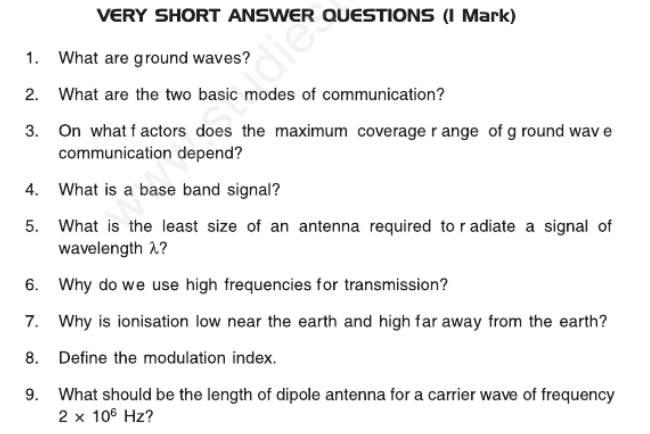
Short Answer Type Questions
Question. Why are microwaves used in radar systems?
Answer: Microwaves are utilized in radar because they have very short wavelengths, typically in the millimeter range. Having a small wavelength makes it possible to transmit a highly directional beam signal, which is essential for radar targeting and detection.
In simple words: Radar needs a sharp, directed beam, which is only possible with very short wavelengths. Since microwaves have tiny wavelengths of just a few millimeters, they are perfect for radar.
Exam Tip: Mention both the requirement of a directional beam and the millimeter-range wavelength of microwaves to score full marks.
Question. Why cannot sky waves be used for the transmission of television signals?
Answer: TV signals operate at high frequencies ranging from 100 to 200 MHz. The ionosphere is unable to reflect radio waves that exceed a frequency of approximately 40 MHz back to Earth. Consequently, sky wave propagation cannot be employed for transmitting television signals, as these waves pass right through the ionospheric layer.
In simple words: Television signals have very high frequencies (100 - 200 MHz). Since the ionosphere can only bounce back signals below 40 MHz, TV signals cannot travel as sky waves.
Exam Tip: Clearly state the frequency range of TV signals (100 - 200 MHz) and the critical limit of the ionosphere (around 40 MHz) to justify why sky waves fail.
Question. What characteristics should a diode detector possess for proper detection?
Answer: For efficient and accurate detection, a diode detector must satisfy the following requirements:
(a) It must exhibit high rectification efficiency.
(b) It should impose a negligible loading effect on the preceding stage of the circuit.
(c) It must introduce minimal distortion to the signal.
In simple words: A good diode detector needs to be highly efficient at converting AC to DC, must not overload the previous circuit, and should keep the signal clear without distorting it.
Exam Tip: List all three key traits - high efficiency, low loading effect, and minimal distortion - to obtain full credit in short-answer questions.
Question. What is the velocity factor of a cable, and how is it related to the dielectric constant of the medium?
Answer: The velocity factor (VF) of a cable represents the ratio of the speed of light within the cable's dielectric medium to its speed in a vacuum. As light or electromagnetic waves travel through a physical medium, their speed decreases. The velocity in a medium is calculated using the formula: \[ v = \frac{c}{\sqrt{k}} \] Here, \( c \) is the speed of light in vacuum (\( 3 \times 10^8 \text{ m/s} \)) and \( k \) is the dielectric constant of the medium. The velocity factor is given by: \[ \text{VF} = \frac{v}{c} = \frac{1}{\sqrt{k}} \] Typically, the velocity factor for transmission lines ranges from 0.6 to 0.9.
In simple words: The velocity factor is how fast a signal travels inside a cable compared to its speed in empty space. It gets slower because of the cable's material, and is usually between 60% and 90% of the speed of light.
Exam Tip: Remember the formula \( \text{VF} = \frac{1}{\sqrt{k}} \) and state that its value is always less than 1, typically between 0.6 and 0.9.
Question. Why is delta modulation considered convenient to use?
Answer: Delta modulation is highly convenient because it utilizes straightforward techniques for encoding and decoding pulses. In its simplest form, this method transmits only a single bit per sample (indicating either a positive or negative step, or a 'non-zero' change), making the overall system design simple and easy to implement.
In simple words: Delta modulation is easy to use because it sends only one bit of information for each sample to show if the signal went up or down.
Exam Tip: Highlight that delta modulation requires only one bit per sample, which significantly simplifies the transmitter and receiver design.
Question. Which transmission media are used for Audio Frequency (AF), Ultra High Frequency (UHF), and optical frequency ranges?
Answer: For transmitting signals in the audio frequency (AF) and ultra-high frequency (UHF) bands, parallel two-wire lines and coaxial cables are commonly used. On the other hand, optical fibers are used for transmitting signals at optical frequencies.
In simple words: Normal wires and coaxial cables are used for lower sound and radio frequencies, while glass optical fibers are used to carry light signals.
Exam Tip: Match the transmission medium correctly with its frequency range: two-wire/coaxial for AF/UHF, and optical fibers for light frequencies.
Question. How are two different frequencies mixed in communication systems?
Answer: The mixing of two different frequencies is achieved by passing the signals through a device that exhibits non-linear impedance, which generates new frequencies representing the sum and difference of the original signals.
In simple words: To mix two different frequencies together, we pass them through a special component whose resistance changes in a non-linear way.
Exam Tip: State that a non-linear device or impedance is essential to produce the sum and difference frequencies during mixing.
Question. What is population inversion in a laser medium, and why is it necessary?
Answer: Population inversion is a state where a greater number of atoms in the laser medium occupy a higher excited energy level compared to the lower ground state. Under normal conditions, more atoms reside in the ground state. This unnatural distribution is essential because it ensures that incident light stimulates emission rather than being absorbed, allowing for signal amplification.
In simple words: Normally, most atoms are at rest. For a laser to work, we must force more atoms into an excited, energetic state than the resting state. This active state is called population inversion.
Exam Tip: Define population inversion as \( N_2 > N_1 \) (more atoms in the excited state than ground state) and mention its role in achieving stimulated emission.
Question. What are the different types of lasers based on the state of the active medium?
Answer: Lasers can be classified into four primary categories depending on the nature of their medium:
(a) Solid-state lasers
(b) Semiconductor lasers
(c) Liquid lasers
(d) Gas lasers
In simple words: Lasers are grouped by what is inside them to make the light: solids, semiconductors, liquids, or gases.
Exam Tip: List all four types clearly when asked to classify lasers based on their medium.
Question. State some important applications of lasers.
Answer: Lasers are widely used in various fields, with key applications including:
(a) Precision medical procedures, such as laser surgery.
(b) High-speed printing technology, such as laser printing.
(c) Long-distance data transmission in optical communication systems.
In simple words: Lasers are used in medical operations, printing paper quickly, and sending data through optical fibers.
Exam Tip: Be ready with at least three diverse applications from medicine, daily technology, and communication.
Question. What are the three primary systems that constitute a telecommunication network?
Answer: A standard telecommunication network is comprised of three essential systems:
(1) Transmission Systems
(2) Switching Systems
(3) Signaling Systems
In simple words: A phone or data network needs three parts: one to carry the signal, one to connect the correct lines, and one to send control signals.
Exam Tip: Remember these three core systems - transmission, switching, and signaling - as they form the backbone of any communication network.
Free study material for Physics
Chapter 15 Communication Systems Printable Assignments & Solutions for Class 12 Physics
Revision Assignment: Chapter 15 Communication Systems (CBSE)
Access structured practice assignments for Chapter 15 Communication Systems designed in alignment with the latest CBSE curriculum for Class 12 Physics. These printable sets cover objective and descriptive problem types to support thorough revision.
Why Practice Class 12 Physics Assignments?
- Exam Alignment: Questions strictly follow contemporary CBSE sample papers and grading schemes.
- Comprehensive Coverage: Features objective drills, case studies, and structured descriptive problems for Chapter 15 Communication Systems.
- Pacing & Precision: Regular problem-solving builds critical calculation speed and test-taking accuracy.
Effective Strategy for Class 12 Physics Assignments
- Concept Foundation: Review the NCERT book for Class 12 Physics thoroughly before diving into assignment tasks.
- Self-Evaluation: Solve exercises independently before inspecting professional answer guides.
- Progress Monitoring: Note down complex formulas or concepts, clearing them up using available online practice aids.
FAQs
You can download free PDF assignments for Class 12 Physics Chapter 15 Communication Systems from StudiesToday.com. These practice sheets have been updated for the 2026-27 session covering all concepts from latest NCERT textbook.
Yes, our teachers have given solutions for all questions in the Class 12 Physics Chapter 15 Communication Systems assignments. This will help you to understand step-by-step methodology to get full marks in school tests and exams.
Yes. These assignments are designed as per the latest CBSE syllabus for 2026. We have included huge variety of question formats such as MCQs, Case-study based questions and important diagram-based problems found in Chapter 15 Communication Systems.
Practicing topicw wise assignments will help Class 12 students understand every sub-topic of Chapter 15 Communication Systems. Daily practice will improve speed, accuracy and answering competency-based questions.
Yes, all printable assignments for Class 12 Physics Chapter 15 Communication Systems are available for free download in mobile-friendly PDF format.