

Class 12 Physics Practice Assignments: CBSE Class 12 Physics Optics Assignment Set 01
Explore structured practice materials through the CBSE Class 12 Physics Optics Assignment Set 01. Tailored for Class 12 learners, utilizing these Physics assignments ensures thorough preparation and strengthens foundational knowledge before final CBSE evaluations.
Download Chapter 09 Ray Optics And Optical Instruments Assignment PDF with Solutions
Navigate directly to the solved Physics assignments using the digital viewer below. Each practice set includes detailed step-by-step solutions, allowing students to instantly cross-check their work and identify areas requiring further revision.
Question. Two identical thin plano-convex glass lenses (refractive index 1.5) each having radius of curvature of 20 cm are placed with their convex surfaces in contact at the centre. The intervening space is filled with oil of refractive index 1.7. The focal length of the combination is
(a) –25 cm
(b) –50 cm
(c) 50 cm
(d) –20 cm
Answer: B
Question. An object is placed upright on the axis of a thin convex lens at a distance of four focal lengths (4f) from the center of the lens. An inverted image appears at a distance of 4/3 f on the other side of the lens. What is the ratio of the height of he image of the height of the object?
(a) 1/3
(b) 3/4
(c) 4/3
(d) 3/1
Answer: A
Question. An achromatic convergent lens of focal length 20 cms is made of two lenses (in contact) of materials having dispersive powers in the ratio of 1 : 2 and having focal lengths f1 and f2. Which of the following is true ?
(a) f1 = 10 cms, f2 = –20 cms
(b) f1 = 20 cms, f2 = 10cms
(c) f1 = –10 cms, f2 = –20 cms
(d) f1 = 20 cms, f2 = –20 cms
Answer: A
Question. A beam of light consisting of red, green and blue colours is incident on a right angled prism. The refractive index of the material of the prism for the above red, green and blue wavelengths are 1.39, 1.44 and 1.47, respectively. 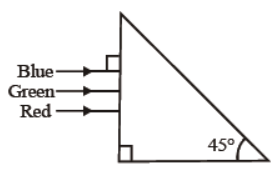
The prism will:
(a) separate all the three colours from one another
(b) not separate the three colours at all
(c) separate the red colour part from the green and blue colours
(d) separate the blue colour part from the red and green colours
Answer: C
Question. The phenomena involved in the reflection of radiowaves by ionosphere is similar to
(a) reflection of light by a plane mirror
(b) total internal reflection of light in air during a mirage
(c) dispersion of light by water molecules during the formation of a rainbow
(d) scattering of light by the particles of air
Answer: B
Question. You are given four sources of light each one providing a light of a single colour - red, blue, green and yellow. Suppose the angle of refraction for a beam of yellow light corresponding to a particular angle of incidence at the interface of two media is 90°. Which of the following statements is correct if the source of yellow light is replaced with that of other lights without changing the angle of incidence?
(a) The beam of red light would undergo total internal reflection
(b) The beam of red light would bend towards normal while it gets refracted through the second medium
(c) The beam of blue light would undergo total internal reflection
(d) The beam of green light would bend away from the normal as it gets refracted through the second medium
Answer: C
Question. A lens produces an image of an object on a screen. If a slab of refractive index n is placed in between lens and screen, the screen has to be moved by distance d behind. The thickness of slab is
(a) nd
(b) n-1/nd
(c) (n -1)d/n
(d) nd/n-1
Answer: D
Question. The intensity produced by a long cylindrical light source at a small distance r from the source is proportional to
(a) 1/r2
(b) 1/r3
(c) 1/r
(d) None of these
Answer: C
Question. A thin lens has focal length f, and its aperture has diameter D. It forms an image of intensity I. If the central part of the aperture, of diameter D/2 , is blocked by an opaque paper, the focal length of the lens and the intensity of image will become
(a) f/2 , I/2
(b) f , I/4
(c) 3f/4 , I/2
(d) f, 3I/4
Answer: D
Question. A paper, with two marks having separation d, is held normal to the line of sight of an observer at a distance of 50m. The diameter of the eye-lens of the observer is 2 mm. Which of the following is the least value of d, so that the marks can be seen as separate ? (The mean wavelength of visible light may be taken as 5000 Å)
(a) 1.25 m
(b) 12.5 cm
(c) 1.25 cm
(d) 2.5 mm
Answer: B
Question. A ray of light incident at an angle θ on a refracting face of a prism emerges from the other face normally. If the angle of the prism is 5° and the prism is made of a material of refractive index 1.5, the angle of incidence is
(a) 7.5°
(b) 5°
(c) 15°
(d) 2.5°
Answer: A
Question. A ray of light is travelling from glass to air. (Refractive index of glass = 1.5). The angle of incidence is 50°.
The deviation of the ray is
(a) 0°
(b) 80°
(c) 50° - sin-1[sin 50°/1.5]
(d) sin-[sin 50°/1.5]- 50°
Answer: B
Question. If fV and fR are the focal lengths of a convex lens for violet and red light respectively and FV and FR are the focal lengths of concave lens for violet and red light respectively, then we have
(a) fV < fR and FV > FR
(b) fV < fR and FV < FR
(c) fV > fR and FV > FR
(d) fV > fR and FV < FR
Answer: B
Question. A convex lens of focal length 80 cm and a concave lens of focal length 50 cm are combined together. What will be their resulting power?
(a) + 6.5 D
(b) –6.5 D
(c) + 7.5 D
(d) –0.75 D
Answer: D
Question. An object is moved along the principal axis of a converging lens from a position 5 focal lengths from the lens to a position that is 2 focal lengths from the lens. Which statement about the resulting image is most accurate?
(a) The image increases in size and decreases in distance from the lens
(b) The image increases in size and increases in distance from the lens
(c) The image decreases in size and decreases in distance from the lens
(d) The image decreases in size and increases in distance from the lens
Answer: B
Question. In the displacement method, a concave lens is placed in between an object and a screen. If the magnification in the two positions are m1 and m2 (m1 > m2), and the distance between the two positions of the lens is x, the focal length of the lens is
(a) x/m1 + m2
(b) x/m1 - m2
(c) (m1 + m2)2
(d) x/(m1 - m2)
Answer: B
Question. In a room containing smoke particles, the intensity due to a source of light will
(a) obey the inverse square law
(b) be constant at all distances
(c) increase with distance from the source than the inverse fourth power law
(d) fall faster with distance from the source than the inverse fourth power law
Answer: D
Question. A short pulse of white light is incident from air to a glass slab at normal incidence. After travelling through the slab, the first colour to emerge is
(a) blue
(b) green
(c) violet
(d) red
Answer: D
Question. One face of a rectangular glass plate 6 cm thick is silvered. An object held 8 cm in front of the first face, forms an image 12 cm behind the silvered face. The refractive index of the glass is
(a) 0.4
(b) 0.8
(c) 1.2
(d) 1.6
Answer: C
Question. The refractive index of the material of a prism is √2 and its refracting angle is 30º. One of the refracting surfaces of the prism is made a mirror inwards. A beam of monochromatic light enters the prism from the mirrored surface if its angle of incidence of the prism is
(a) 30º
(b) 45º
(c) 60º
(d) 0º
Answer: B
Question. The radius of curvature of the curved surface of a planoconvex lens is 20 cm. If the refractive index of the material of the lens be 1.5, it will
(a) act as a convex lens only for the objects that lie on its curved side
(b) act as a concave lens for the objects that lie on its curved side
(c) act as a convex lens irrespective of the side on which the object lies
(d) act as a concave lens irrespective of side on which the object lies
Answer: C
Question. The dispersive power of material of a lens of focal length 20 cm is 0.08. What is the longitudinal chromatic aberration of the lens ?
(a) 0.08 cm
(b) 0.08/20 cm
(c) 1.6 cm
(d) 0.16 cm
Answer: C
Question. A telescope has an objective lens of 10 cm diameter and is situated at a distance of one kilometer from two objects. The minimum distance between these two objects, which can be resolved by the telescope, when the mean wavelength of light is 5000 Å, is of the order of
(a) 5 cm
(b) 0.5 m
(c) 5 m
(d) 5 mm
Answer: D
Question. A ray is incident at an angle of incidence i on one surface of a prism of small angle A and emerges normally from the opposite surface. If the refractive index of the material of prism is μ, the angle of incidence i is nearly equal to
(a) A/μ
(b) A/2μ
(c) μ A
(d) μA/2
Answer: C
Question. A biconvex lens has a radius of curvature of magnitude 20 cm. Which one of the following options best describe the image formed of an object of height 2 cm placed 30 cm from the lens?
(a) Virtual, upright, height = 1 cm
(b) Virtual, upright, height = 0.5 cm
(c) Real, inverted, height = 4 cm
(d) Real, inverted, height = 1cm
Answer: C
Free study material for Physics
CBSE Class 12 Physics Assignments for Chapter 09 Ray Optics And Optical Instruments
Chapter Practice Questions for Class 12 Physics
Review targeted chapter assignments for Class 12 Physics Chapter 09 Ray Optics And Optical Instruments. Built according to official CBSE guidelines, these downloadable problem sets help students build accuracy and prepare effectively for school tests.
Maximize Exam Scores with Chapter Practice Sets
- Syllabus Compliance: Sets reflect current CBSE evaluation criteria and official marking frameworks.
- Multi-Format Practice: Includes varied problem types designed to deepen comprehension across all sub-topics.
- Time Management: Routine practice optimizes pacing to finish school examinations comfortably within schedule.
Effective Strategy for Class 12 Physics Assignments
- Textbook Review: Always study the core NCERT book for Class 12 Physics prior to beginning the assignment.
- Independent Attempt: Solve Chapter 09 Ray Optics And Optical Instruments questions on your own initially before cross-checking with expert solutions.
- Error Tracking: Record challenging concepts in a dedicated notebook and practice online MCQ tests for revision.
FAQs
You can download free PDF assignments for Class 12 Physics Chapter 09 Ray Optics And Optical Instruments from StudiesToday.com. These practice sheets have been updated for the 2026-27 session covering all concepts from latest NCERT textbook.
Yes, our teachers have given solutions for all questions in the Class 12 Physics Chapter 09 Ray Optics And Optical Instruments assignments. This will help you to understand step-by-step methodology to get full marks in school tests and exams.
Yes. These assignments are designed as per the latest CBSE syllabus for 2026. We have included huge variety of question formats such as MCQs, Case-study based questions and important diagram-based problems found in Chapter 09 Ray Optics And Optical Instruments.
Practicing topicw wise assignments will help Class 12 students understand every sub-topic of Chapter 09 Ray Optics And Optical Instruments. Daily practice will improve speed, accuracy and answering competency-based questions.
Yes, all printable assignments for Class 12 Physics Chapter 09 Ray Optics And Optical Instruments are available for free download in mobile-friendly PDF format.