

School Assignments for Class 12 Physics: Chapter 09 Ray Optics And Optical Instruments
Explore structured practice materials through the CBSE Class 12 Physics Optics Assignment. Tailored for Class 12 learners, utilizing these Physics assignments ensures thorough preparation and strengthens foundational knowledge before final CBSE evaluations.
Practice Class 12 Physics Assignments: Chapter 09 Ray Optics And Optical Instruments
Navigate directly to the solved Physics assignments using the digital viewer below. Each practice set includes detailed step-by-step solutions, allowing students to instantly cross-check their work and identify areas requiring further revision.
Question. A simple telescope, consisting of an objective of focal length 60 cm and a single eye lens of focal length 5 cm is focussed on a distant object in such a way that parallel rays emerge from the eye lens. If the object subtends an angle of 2º at the objective, the angular width of the image is
(a) 10º
(b) 24º
(c) 50º
(d) (1/6)º
Answer: B
Question. An astronomical telescope has an angular magnification of magnitude 5 for distant objects. The separation between the objective and the eye-piece is 36 cms and the final image is formed at infinity. The focal length f0 of the objective and fe of the eye piece are
(a) f0 = 45 cm and f2 = –9 cm
(b) f0 = 50 cm and fe = 10 cm
(c) f0 = 7.2 cm and fe = 5 cm
(d) f0 = 30 cm and fe = 6 cm
Answer: D
Question. An object is placed at a distance of 40 cm in front of a concave mirror of focal length 20 cm. The image produced is
(a) real, inverted and smaller in size
(b) real, inverted and of same size
(c) real and erect
(d) virtual and inverted
Answer: B
Question. Two lens of focal length f1 and f2 are kept in contact coaxially. The resultant power of combination will be
(a) f1 f2/f1 - f2
(b) f1 + f2/f1 f2
(c ) f1 + f2
(d) f1/f2 + f2/f1
Answer: B
Question. When white light enters a prism, its gets split into its constituent colours. This is due to
(a) high density of prism material
(b) because m is different for different wavelength
(c) diffraction of light
(d) velocity changes for different frequency
Answer: B
Question. A thin prism having refracting angle 10° is made of glass of refractive index 1.42. This prism is combined with another thin prism of glass of refractive index 1.7. This combination produces dispersion without deviation. The refracting angle of second prism should be
(a) 6°
(b) 8°
(c) 10°
(d) 4°
Answer: A
Question. A man’s near point is 0.5 m and far point is 3 m. Power of spectacle lenses required for (i) reading purposes, (ii) seeing distant objects, respectively, are
(a) –2 D and + 3 D
(b) +2 D and –3 D
(c) +2 D and –0.33 D
(d) –2 D and + 0.33 D
Answer: C
Question. A person is six feet tall. How tall must a vertical mirror be if he is able to see his entire length?
(a) 3 ft
(b) 4.5 ft
(c) 7.5 ft
(d) 6 ft
Answer: A
Question. A pencil of light rays falls on a plane mirror and form a real image, so the incident rays are
(a) parallel
(b) diverging
(c) converging
(d) statement is false
Answer: C
Question. Astronauts look down on earth surface from a space ship parked at an altitude of 500 km. They can resolve objects of the earth of the size (It can be assumed that the pupils diameter is 5mm and wavelength of light is 500 nm)
(a) 0.5 m
(b) 5 m
(c) 50 m
(d) 500 m
Answer: C
Question. A man wants to see two poles, separately, situated at 11 km.
The minimum distance (approximately) between these poles will be
(a) 5 m
(b) 0.5 m
(c) 1 m
(d) 3 m
Answer: D
Question. The refractive index of the material of the prism is √3 ; then the angle of minimum deviation of the prism is
(a) 30º
(b) 45º
(c) 60º
(d) 75º
Answer: C
Question. Which of the following is false ?
(a) Convex lens always forms image with m < 1
(b) A simple mirror produces virtual, erect and same-sized image
(c) A concave mirror produces virtual, erect and magnified image
(d) A convex lens can produce real and same-sized image
Answer: A
Question. Two light sources with equal luminous intensity are lying at a distance of 1.2 m from each other. Where should a screen be placed between them such that illuminance on one of its faces is four times that on another face ?
(a) 0.2 m
(b) 0.4 m
(c) 0.8 m
(d) 1.6 m
Answer: C
Question. Spherical aberration in a thin lens can be reduced by
(a) using a monochromatic light
(b) using a doublet combination
(c) using a circular annular mark over the lens
(d) increasing the size of the lens
Answer: C
Question. A beam of light from a source L is incident normally on a plane mirror fixed at a certain distance x from the source. The beam is reflected back as a spot on a scale placed just above the source I. When the mirror is rotated through a small angle q, the spot of the light is found to move through a distance y on the scale. The angle θ is given by
(a) y/x
(b) x/2y
(c) x/y
(d) y/2x
Answer: D
Question. Two lenses in contact form an achromatic lens. Their focal lengths are in the ratio 2 : 3. Their dispersive powers must be in the ratio of
(a) 1 : 3
(b) 2 : 3
(c) 3 : 2
(d) 3 : 1
Answer: B
Question. A car is moving with at a constant speed of 60 km h–1 on a straight road. Looking at the rear view mirror, the driver finds that the car following him is at a distance of 100 m and is approaching with a speed of 5 kmh–1. In order to keep track of the car in the rear, the driver begins to glance alternatively at the rear and side mirror of his car after every 2 s till the other car overtakes. If the two cars were maintaining their speeds, which of the following statement (s) is/are correct?
(a) The speed of the car in the rear is 65 km h–1
(b) In the side mirror, the car in the rear would appear to approach with a speed of 5 kmh–1 to the driver of the leading car
(c) In the rear view mirror, the speed of the approaching car would appear to decrease as the distance between the cars decreases
(d) In the side mirror, the speed of the approaching car would appear to increase as the distance between the cars decreases
Answer: D
Question. The refractive index of a piece of transparent quartz is the greatest for
(a) violet light
(b) red light
(c) green light
(d) yellow light
Answer: A
Question. A plano-convex lens is made of material of refractive index 1.6. The radius of curvature of the curved surface is 60 cm.
The focal length of the lens is
(a) 50 cm
(b) 100 cm
(c) 200 cm
(d) 400 cm
Answer: B
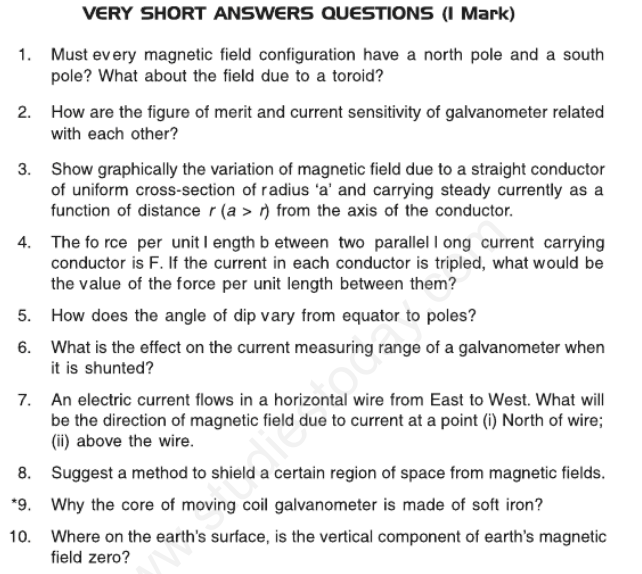
Please click the link below to download CBSE Class 12 Physics Optics Assignment
Free study material for Physics
Chapter 09 Ray Optics And Optical Instruments Printable Assignments & Solutions for Class 12 Physics
Download Assignment: Chapter 09 Ray Optics And Optical Instruments (Class 12 Physics)
Explore reliable practice questions for Chapter 09 Ray Optics And Optical Instruments tailored for Class 12 learners. Use these structured worksheets to evaluate preparedness and strengthen core problem-solving skills.
Why Practice Class 12 Physics Assignments?
- Syllabus Compliance: Sets reflect current CBSE evaluation criteria and official marking frameworks.
- Multi-Format Practice: Includes varied problem types designed to deepen comprehension across all sub-topics.
- Time Management: Routine practice optimizes pacing to finish school examinations comfortably within schedule.
How to Approach Physics Chapter 09 Ray Optics And Optical Instruments Assignments
- Concept Foundation: Review the NCERT book for Class 12 Physics thoroughly before diving into assignment tasks.
- Self-Evaluation: Solve exercises independently before inspecting professional answer guides.
- Progress Monitoring: Note down complex formulas or concepts, clearing them up using available online practice aids.
FAQs
You can download free PDF assignments for Class 12 Physics Chapter 09 Ray Optics And Optical Instruments from StudiesToday.com. These practice sheets have been updated for the 2026-27 session covering all concepts from latest NCERT textbook.
Yes, our teachers have given solutions for all questions in the Class 12 Physics Chapter 09 Ray Optics And Optical Instruments assignments. This will help you to understand step-by-step methodology to get full marks in school tests and exams.
Yes. These assignments are designed as per the latest CBSE syllabus for 2026. We have included huge variety of question formats such as MCQs, Case-study based questions and important diagram-based problems found in Chapter 09 Ray Optics And Optical Instruments.
Practicing topicw wise assignments will help Class 12 students understand every sub-topic of Chapter 09 Ray Optics And Optical Instruments. Daily practice will improve speed, accuracy and answering competency-based questions.
Yes, all printable assignments for Class 12 Physics Chapter 09 Ray Optics And Optical Instruments are available for free download in mobile-friendly PDF format.