

Download CBSE Class 12 Physics Assignments
Access comprehensive school assignments for Chapter 11 Dual Nature Of Radiation And Matter using the CBSE Class 12 Physics Dual Nature of Matter and Radiation Assignment. Designed to align with the 2026-27 CBSE academic guidelines, these practice sets help Class 12 Physics students reinforce core concepts and improve their problem-solving accuracy.
Access CBSE School Assignments and Answers
View or download the dedicated CBSE Class 12 Physics Dual Nature of Matter and Radiation Assignment resource below. Engaging with these assignments under focused study conditions ensures continuous academic progress and mastery of the 2026-27 curriculum.
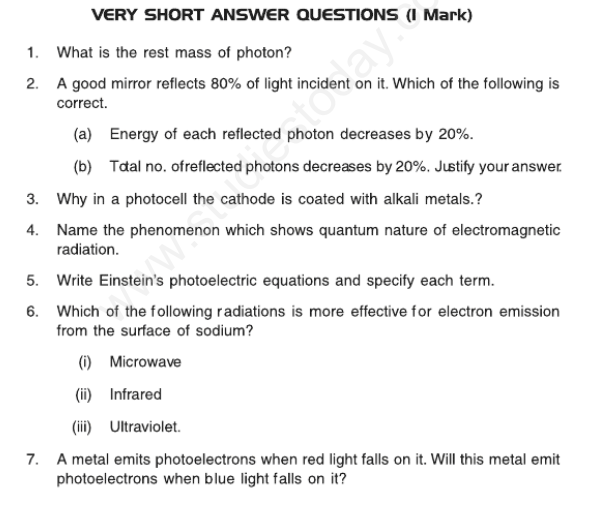
Question. The photoelectric work function for a metal surface is 4.125 eV. The cut-off wavelength for this surface is
(a) 3000 Å
(b) 2062.5 Å
(c) 4125 Å
(d) 6000 Å
Answer : A
Question. In a photo-emissive cell, with exciting wavelength λ, the fastest electron has speed v. If the exciting wavelength is changed to 3λ/4, the speed of the fastest emitted electron will be
(a) less than v(4/3)1/2
(b) v(4/3)1/2
(c) v(3/4)1/2
(d) greater than v(4/3)1/2
Answer : D
Question. When light of wavelength 300 nm (nanometer) falls on a photoelectric emitter, photoelectrons are liberated. For another emitter, however, light of 600 nm wavelength is sufficient for creating photoemission. What is the ratio of the work functions of the two emitters?
(a) 1 : 2
(b) 2 : 1
(c) 4 : 1
(d) 1 : 4
Answer : B
Question. In a photo-emissive cell with exciting wavelength λ, the fastest electron has speed V. If the exciting wavelength is changed to 3λ/4, the speed of the fastest emitted electron will be :
(a) n(3/4)1/2
(b) v(4/ 3)1/2
(c) less the v(4/ 3)1/2
(d) greater than v(4/ 3)1/2
Answer: D
Question. The anode voltage of a photocell is kept fixed. The wavelength λ of the light falling on the cathode is gradually changed. The plate current I of the photocell varies as follows 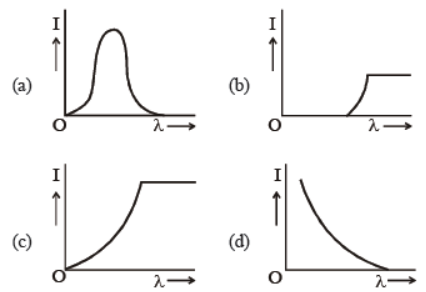
Answer: D
Question. A monochromatic source of light operating at 200 W emits 4 × 10²⁰ photons per second. Find the wavelength of light.
(a) 400 mm
(b) 200 nm
(c) 4 × 10⁻¹⁰ Å
(d) None of these
Answer: A
Question. The momentum of photon whose frequency f is
(a) hf/c
(b) hc/f
(c ) h/f
(d) c/hf
Answer: A
Question. 4eV is the energy of incident photon and the work function is 2eV. The stopping potential will be
(a) 2V
(b) 4V
(c) 6 V
(d) 2 √2V
Answer: A
Question. A small photocell is placed at a distance of 4 m from a photosensitive surface. When light falls on the surface the current is 5 mA. If the distance of cell is decreased to 1 m, the current will become
(a) 1.25 mA
(b) (5/16)mA
(c) 20 mA
(d) 80 mA
Answer: D
Question. If 5% of the energy supplied to a bulb is radiated as visible light, the number of visible quanta emitted per second by a 100 W bulb, assuming the wavelength of visible light to be 5.6 × 10⁻⁵ cm, is
(a) 1.4 × 10¹⁹
(b) 1.4 × 10²⁰
(c) 2 × 10¹⁹
(d) 2 × 10²⁰
Answer: A
Question. The maximum kinetic energy (Emax) of photoelectrons emitted in a photoelectric cell varies with frequency (n) as shown in the graph. The slope of the graph is equal to 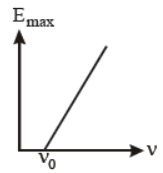
(a) charge of the electron
(b) e/m of the electron
(c) work function of the emitter
(d) Plank’s constant
Answer: D
Question. An X-ray tube with Cu target is operated at 25 kV. The glancing angle for a NaCl. Crystal for the Cu ka line is 15.8°. Find the wavelength of this line.
(d for NaCl = 2.82 Å, h = 6.62 × 10⁻²⁷ erg-sec)
(a) 3.06 Å
(b) 1.53 Å
(c) 0.75 Å
(d) None of these
Answer: B
Question. A photo sensitive metal is not emitting photo-electrons when irradiated. It will do so when threshold is crossed. To cross the threshold we need to increase
(a) intensity
(b) frequency
(c) wavelength
(d) None of these
Answer: B
Question. Two insulating plates are both uniformly charged in such a way that the potential difference between them is V2 – V1 = 20 V. (i.e., plate 2 is at a higher potential). The plates are separated by d = 0.1 m and can be treated as infinitely large. An electron is released from rest on the inner surface of plate 1. What is its speed when it hits plate 2?
(e = 1.6 × 10⁻¹⁹ C, me = 9.11 × 10⁻³¹ kg) 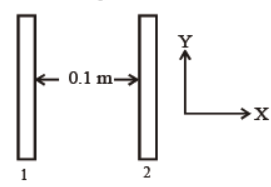
(a) 2.65 × 10⁶ m/s
(b) 7.02 × 10¹² m/s
(c) 1.87 × 10⁶ m/s
(d) 32 × 10–19 m/s
Answer: A
Question. A certain metallic surface is illuminated with monochromatic light of wavelength λ. The stopping potential for photoelectric current for this light is 3V0. If the same surface is illuminated with light of wavelength 2λ, the stopping potential is V0. The threshold wavelength for this surface for photo-electric effect is
(a) 4λ
(b) λ /4
(c) λ /6
(d) 6λ
Answer: A
Question. All electrons ejected from a surface by incident light of wavelength 200nm can be stopped before travelling 1m in the direction of uniform electric field of 4N/C. The work function of the surface is
(a) 4 eV
(b) 6.2 eV
(c) 2 eV
(d) 2.2 eV
Answer: D
Question. A steel ball of mass m is moving with a kinetic energy K. The de-Broglie wavelength associated with the ball is
(a) h/2mK
(b) √h/2mK
(c) h/√2mK
(d) meaningless
Answer: C
Question. Light of frequency v falls on a material of threshold frequency v0. Maximum kinetic energy of emitted electron is proportional to
(a) v–v0
(b) v
(c) √v - v0
(d) v0
Answer: A
Question. A particle with rest mass m0 is moving with speed of light c. The de-Broglie wavelength associated with it will be
(a) ∝
(b) zero
(c) m0 c/h
(d) hn/m0c
Answer: B
Question. In an electron gun, the potential difference between the filament and plate is 3000 V. What will be the velocity of electron emitting from the gun?
(a) 3 × 10⁸ m/s
(b) 3.18 × 10⁷ m/s
(c) 3.52 × 10⁷ m/s
(d) 3.26 × 10⁷ m/s
Answer: D
Question. In Davison-Germer experiment, an electron beam is incident on a crystal. The reflected beam consists of
(a) photons
(b) protons
(c) x-rays
(d) electrons
Answer: D
Question. What is the energy of kα X-ray photon of copper (Z = 29) ?
(a) 7.99 keV
(b) 8.29 keV
(c) 8.25 keV
(d) 7.19 keV
Answer: A
Question. The velocity of a body of rest mass mo is √3/2 c (where c is the velocity of light in vacuum). The mass of this body is:
(a) (√3/2)mo
(b) (1/2)mo
(c) 3mo
(d) 2m0
Answer: D
Question. Energy levels A, B, C of a certain atom correspond to increasing values of energy i.e., EA < EB < EC. If λ1, λ2, λ3 are the wavelengths of radiation corresponding to the transitions C to B, B to A and C to A respectively, which of the following relation is correct?
(a) λ3 = λ1 + λ
(b) λ3 = λ1λ2/λ1 + λ2
(c) λ1 + λ2 + λ3 = 0
(d) λ32 = λ12 + λ22
Answer: B
Question. Photoelectric work function of a metal is 1 eV. Light of wavelength λ =3000 Å falls on it. The photo electrons come out with a maximum velocity
(a) 10 metres/sec
(b) 102 metres/ sec
(c) 104 metres/sec
(d) 106 metres/sec
Answer : D
Question. Ultraviolet radiations of 6.2 eV falls on an aluminium surface. Kinetic energy of fastest electron emitted is (work function = 4.2 eV)
(a) 3.2 × 10⁻²¹ J
(b) 3.2 × 10⁻¹⁹ J
(c) 7 × 10–25 J
(d) 9 × 10–32 J
Answer : B
Question. The threshold frequency for photoelectric effect on sodium corresponds to a wavelength of 5000 Å. Its work function is
(a) 4 × 10–19 J
(b) 1 J
(c) 2 × 10–19 J
(d) 3 × 10–19 J
Answer : A
Question. A 200 W sodium street lamp emits yellow light of wavelength 0.6 mm. Assuming it to be 25% efficient in converting electrical energy to light, the number of photons of yellow light it emits per second is
(a) 1.5 × 10²⁰
(b) 6 × 10¹⁸
(c) 62 × 1020
(d) 3 × 10¹⁹
Answer : A
Question. A source S1 is producing, 1015 photons per second of wavelength 5000 Å. Another source S2 is producing 1.02 × 10¹⁵ photons per second of wavelength 5100 Å. Then, (power of S2)/(power of S1) is equal to
(a) 1.00
(b) 1.02
(c) 1.04
(d) 0.98
Answer : A
Question. Monochromatic light of wavelength 667 nm is produced by a helium neon laser. The power emitted is 9 mW. The number of photons arriving per second on the average at a target irradiated by this beam is
(a) 3 × 10¹⁶
(b) 9 × 10¹⁵
(c) 3 × 10¹⁹
(d) 9 × 10¹⁷
Answer : A
Question. Monochromatic light of frequency 6.0 × 10¹⁴ Hz is produced by a laser. The power emitted is 2 × 10⁻³ W.
The number of photons emitted, on the average, by the source per second is
(a) 5 × 10¹⁶
(b) 5 × 10¹⁷
(c) 5 × 10¹⁴
(d) 5 × 10¹⁵
Answer : D
Question. The momentum of a photon of energy 1 MeV in kg m/s will be
(a) 5 × 10–22
(b) 0.33 × 10⁶
(c) 7 × 10–24
(d) 10–22
Answer : A
Question. When a proton is accelerated through 1 V, then its kinetic energy will be
(a) 1 eV
(b) 13.6 eV
(c) 1840 eV
(d) 0.54 eV
Answer : A
Question. The kinetic energy of an electron, which is accelerated in the potential difference of 100 volts, is
(a) 416.6 cal
(b) 6.636 cal
(c) 1.602 × 10⁻¹⁷ J
(d) 1.6 × 10⁴ J
Answer : C
Free study material for Physics
Download Practice Assignments: Class 12 Physics Chapter 11 Dual Nature Of Radiation And Matter
Revision Assignment: Chapter 11 Dual Nature Of Radiation And Matter (CBSE)
Explore reliable practice questions for Chapter 11 Dual Nature Of Radiation And Matter tailored for Class 12 learners. Use these structured worksheets to evaluate preparedness and strengthen core problem-solving skills.
Why Practice Class 12 Physics Assignments?
- Exam Alignment: Questions strictly follow contemporary CBSE sample papers and grading schemes.
- Comprehensive Coverage: Features objective drills, case studies, and structured descriptive problems for Chapter 11 Dual Nature Of Radiation And Matter.
- Pacing & Precision: Regular problem-solving builds critical calculation speed and test-taking accuracy.
Steps to Complete Chapter 11 Dual Nature Of Radiation And Matter Assignments Successfully
- Textbook Review: Always study the core NCERT book for Class 12 Physics prior to beginning the assignment.
- Independent Attempt: Solve Chapter 11 Dual Nature Of Radiation And Matter questions on your own initially before cross-checking with expert solutions.
- Error Tracking: Record challenging concepts in a dedicated notebook and practice online MCQ tests for revision.
FAQs
You can download free PDF assignments for Class 12 Physics Chapter 11 Dual Nature Of Radiation And Matter from StudiesToday.com. These practice sheets have been updated for the 2026-27 session covering all concepts from latest NCERT textbook.
Yes, our teachers have given solutions for all questions in the Class 12 Physics Chapter 11 Dual Nature Of Radiation And Matter assignments. This will help you to understand step-by-step methodology to get full marks in school tests and exams.
Yes. These assignments are designed as per the latest CBSE syllabus for 2026. We have included huge variety of question formats such as MCQs, Case-study based questions and important diagram-based problems found in Chapter 11 Dual Nature Of Radiation And Matter.
Practicing topicw wise assignments will help Class 12 students understand every sub-topic of Chapter 11 Dual Nature Of Radiation And Matter. Daily practice will improve speed, accuracy and answering competency-based questions.
Yes, all printable assignments for Class 12 Physics Chapter 11 Dual Nature Of Radiation And Matter are available for free download in mobile-friendly PDF format.