

Class 12 Physics Practice Assignments: CBSE Class 12 Physics Dual Nature Nucleus and Atom Assignment
Review targeted academic assignments with the CBSE Class 12 Physics Dual Nature Nucleus and Atom Assignment. Built according to official CBSE standards for the 2026-27 term, these downloadable Class 12 Physics worksheets support effective daily practice for Chapter 11 Dual Nature Of Radiation And Matter.
Download Chapter 11 Dual Nature Of Radiation And Matter Assignment PDF with Solutions
Access the complete assignment PDF for Class 12 Physics below. Regular practice with these targeted academic tasks builds familiarity with standard question patterns and helps secure higher marks in final school evaluations.
TEST SERIES (PHYSICS)
DUAL NATURE,NUCLEUS AND ATOM
Question. An electron of mass m and charge e initially at rest gets accelerated by a constant electric field E. The rate of change of de-Broglie wavelength of this electron at time t ignoring relativistic effects is
(a) -h/eEt2
(b) -eht/E
(c) -mh/eEt2
(d) -h/eE
Answer: A
Question. Radiations of intensity 0.5 W/m2 are striking a metal plate.
The pressure on the plate is
(a) 0.166 × 10⁻⁸ N/m2
(b) 0.332 × 10⁻⁸ N/m2
(c) 0.111 × 10⁻⁸ N/m2
(d) 0.083 × 10⁻⁸ N/m2
Answer: A
Question. The magnitude of the de-Broglie wavelength (l) of electron (e), proton (p), neutron (n) and a-particle (a) all having the same energy of 1 MeV, in the increasing order will follow the sequence
(a) λe, λp, λn, λα
(b) λe, λn, λp, λα
(c) λα, λn, λp, λe
(d) λp, λe, λα, λn
Answer: C
Question. Light from a hydrogen discharge tube is incident on the cathode of a photoelectric cell, the work function of the cathode surface is 4.2 eV. In order to reduce the photocurrent to zero the voltage of the anode relative to the cathode must be made
(a) – 4.2 V
(b) – 9.4 V
(c) – 17.8 V
(d) + 9.4 V
Answer: B
Question. Einstein’s work on photoelectric effect provided support for the equation
(a) E = hn
(b) E = mc2
(c) E = -Rhc/n2
(d) K.E. = 1/2 mv2
Answer: A
Question. The glancing angle in a X-ray diffraction is 30º and the wavelength of X-rays used is 20 nm. The interplanar spacing of the crystal dffracting these X-rays will be
(a) 40 nm
(b) 20 nm
(c) 15 nm
(d) 10 nm
Answer: B
Question. The maximum velocity of an electron emitted by light of wavelength λ incident on the surface of a metal of work function Φ is 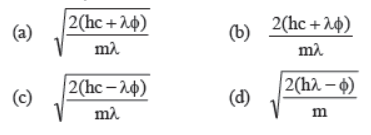
Answer: C
Question. The maximum distance between interatomic lattice planes is 15 Å. The maximum wavelength of X-rays which are diffracted by this crystal will be
(a) 15 Å
(b) 20 Å
(c) 30 Å
(d) 45 Å
Answer: C
Question. When a metallic surface is illuminated with radiation of wavelength λ, the stopping potential is V. If the same surface is illuminated with radiation of wavelength 2λ, the stopping potential is V/4 . The threshold wavelength for the metallic surface is :
(a) 4λ
(b) 5λ
(c) 5/2 λ
(d) 3λ
Answer: D
Question. If the X-ray tube is working at 20 kV then the minimum wavelength of X-rays will be
(a) 0.31 Å
(b) 0.62 Å
(c) 0.93 Å
(d) 0.47 Å
Answer: B
Question. A radio transmitter operates at a freqency 880 kHz and a power of 10 kW. The number of photons emitted per second is
(a) 1.72 × 1031
(b) 1.327 × 1025
(c) 1.327 × 1037
(d) 1.327 × 1045
Answer: A
Question. For photoelectric emission from certain metal the cut-off frequency is n. If radiation of frequency 2n impinges on the metal plate, the maximum possible velocity of the emitted electron will be (m is the electron mass)
(a) √hn / m
(b) √2hn / m
(c) √2 hn / m
(d) √hn / (2m)
Answer: B
Question. The momentum of a photon of an electromagnetic radiation is 3.3 × 10⁻²⁹ kgms–1. What is the frequency of the associated waves ?
[h = 6.6 × 10⁻³⁴ Js; c = 3 × 10⁸ ms–1)
(a) 1.5 × 10¹³ Hz
(b) 7.5 × 10¹² Hz
(c) 6.0 × 10³ Hz
(d) 3.0 × 10³ Hz
Answer: A
Question. An electron is moving with an initial velocity v = v0 î and is in a magnetic field B = B0 ĵ . Then, it's de-Broglie wavelength
(a) remains constant
(b) increases with time
(c) decreases with me
(d) increases and decreases periodically
Answer: A
Question. The wavelength of a 1 keV photon is 1.24 × 10⁻⁹ m. What is the frequency of 1 MeV photon ?
(a) 1.24 × 10¹⁵
(b) 2.4 × 10²⁰
(c) 1.24 × 10¹⁸
(d) 2 × 4 × 1023
Answer: B
Question. In photoelectric emission process from a metal of work function 1.8 eV, the kinetic energy of most energetic electrons is 0.5 eV. The corresponding stopping potential is
(a) 1.8 V
(b) 1.2 V
(c) 0.5 V
(d) 2.3 V
Answer: C
Question. A proton, a neutron, an electron and an a-particle have same energy. Then, their de-Broglie wavelengths compare as
(a) λp = λn > λe > λα
(b) λα < λp = λn > λe
(c) λe < λp = λn > λα
(d) λe = λp = λn = λα
Answer: B
Question. The frequency and work function of an incident photon are v and Φ0. If v0 is the threshold frequency then necessary condition for the emission of photoelectron is
(a) v < v0
(b) v = v0/2
(c) v ≥ v0
(d) None of these
Answer: C
Question. The wavelength le of an electron and lp of a photon are of same energy E are related by
(a) λp ∝ λe
(b) λp ∝ √λe
(c) λp ∝ 1/√λe
(d) λp ∝ λe2
Answer: D
Question. A source of light is placed at a distance of 50 cm from a photocell and the stopping potential is found to be V0. If the distance between the light source and photocell is made 25 cm, the new stopping potential will be
(a) 2V0
(b) V0/2
(c) V0
(d) 4V0
Answer: C
Question. The wavelength of a photon needed to remove a proton from a nucleus which is bound to the nuclear with 1 MeV energy is nearly
(a) 1.2 nm
(b) 1.2 × 10⁻³ nm
(c) 1.2 × 10⁻⁶ nm
(d) 1.2 × 10 nm
Answer: B
Question. The quantity e2/2hε0c has a value
(a) 1/137 ms-1
(b) 2/137 ms-1
(c) 1/137
(d) 2/137
Answer: C
Question. The threshold frequency for a photosensitive metal is 3.3 × 10¹⁴ Hz. If light of frequency 8.2 × 10¹⁴ Hz is incident on this metal, the cut-off voltage for the photoelectric emission is nearly
(a) 2 V
(b) 3 V
(c) 5 V
(d) 1 V
Answer: A
Question. The de-Broglie wavelength of neutron in thermal equilibrium at temperature T is
(a) 30.8/√T Å
(b) 3.08/√T Å
(c) 0.308/√T Å
(d) 0.0308/√T Å
Answer: A
Question. When the energy of the incident radiation is incredased by 20%, the kinetic energy of the photoelectrons emitted from a metal surface increased from 0.5 eV to 0.8 eV. The work function of the metal is :
(a) 0.65 eV
(b) 1.0 eV
(c) 1.3 eV
(d) 1.5 eV
Answer: B
Question. If the kinetic energy of the particle is increased to 16 times its previous value, the percentage change in the de-Broglie wavelength of the particle is :
(a) 25
(b) 75
(c) 60
(d) 50
Answer: B
Question. Light of wavelength 500 nm is incident on a metal with work function 2.28 eV. The de Broglie wavelength of the emitted electron is:
(a) < 2.8 × 10⁻⁹ m
(b) ≥. 2.8 × 10⁻⁹ m
(c) ≤ 2.8 × 10⁻¹² m
(d) < 2.8 × 10⁻¹⁰ m
Answer: B
Question. Consider a beam of electrons (each electron with energy E0) incident on a metal surface kept in an evacuated chamber. Then,
(a) no electrons will be emitted as only photons can emit electrons
(b) electrons can be emitted but all with an energy, E0
(c) electrons can be emitted with any energy, with a maximum of E0 – Φ (Φ is the work function)
(d) electrons can be emitted with any energy, with a maximum of E0
Answer: D
Question. Monochromatic radiation emitted when electron on hydrogen atom jumps from first excited to the ground state irradiates a photosensitive material. The stopping potential is measured to be 3.57 V. The threshold frequency of the materials is
(a) 4 × 10¹⁵ Hz
(b) 5 × 10¹⁵ Hz
(c) 1.6 × 10¹⁵ Hz
(d) 2.5 × 10¹⁵ Hz
Answer: C
Question. Consider figure given below. Suppose the voltage applied to A is increased. The diffracted beam will have the maximum at value of θ that 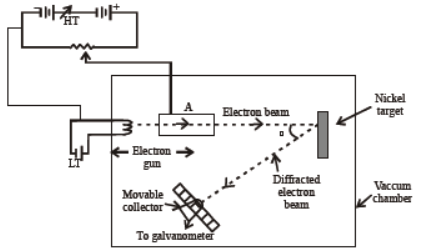
(a) will be larger than the earlier value
(b) will be the same as the earlier value
(c) will be less than the earlier value
(d) will depend on the target
Answer: C
Q1.A proton and an alpha particle both initially at rest are accelerated so as to have the same kinetic energy. What is the ratio of their De Broglie wave length.
Q2.Maximum velocity of electron emitted from a metal of negligible work function is v when a radiation of frequency f falls on it. what would be the velocity of electrons when a radiation of frequency 4f falls on same metal surface.
Q3.Find the ratio of densities of two nuclii of which mass number are 27 and 64.
Q4.Calculate the half life of a radioactive substance of which the activity drops to 1/16th of its initial value in 30 years.
Q5.For which transition shortest wavelength of Balmer series belongs?
Q6. Write the points which indicates that photo electric effect proves to particle nature of light.
Q7.A radiation of wavelength λ falls on a metal surface of negligible work function. Find the deBroglie wavelength associated with emitted electrons.
Q8. Draw a graph showing the variation of potential energy between a pair of nucleons as a function of their separation. Indicate the regions in which the nuclear force is (i) attractive(ii) repulsive
Q9.Why is the mass of a nucleus always less than the sum of masses of its constituents, neutrons and protons. If the total number of neutrons and protons in a nuclear reaction is conserved, how then the energy absorbed or evolved in the reaction?
Q10.By using the concept of deBroglie wavelength prove the Bohrs condition of quantization condition of angular momentum of an electron in an orbit.
Please refer to the link below for CBSE Class 12 Physics Dual Nature Nucleus and Atom Assignment
Free study material for Physics
Download Practice Assignments: Class 12 Physics Chapter 11 Dual Nature Of Radiation And Matter
Class 12 Physics Chapter 11 Dual Nature Of Radiation And Matter Printable Assignments
Review targeted chapter assignments for Class 12 Physics Chapter 11 Dual Nature Of Radiation And Matter. Built according to official CBSE guidelines, these downloadable problem sets help students build accuracy and prepare effectively for school tests.
Maximize Exam Scores with Chapter Practice Sets
- Curriculum Standards: Assignments match modern CBSE sample formats to ensure relevant preparation.
- Thorough Revision: Detailed problem sets reinforce core concepts and eliminate conceptual weak spots.
- Execution Speed: Timed practice with assignment sets sharpens overall response timing.
How to Approach Physics Chapter 11 Dual Nature Of Radiation And Matter Assignments
- Initial Reading: Begin by reading the NCERT book for Class 12 Physics to build a baseline understanding.
- Independent Testing: Attempt assignment questions unassisted, then verify work using provided answer keys.
- Supplementary Aids: Leverage revision notes and worksheets whenever you encounter difficult topics.
FAQs
You can download free PDF assignments for Class 12 Physics Chapter 11 Dual Nature Of Radiation And Matter from StudiesToday.com. These practice sheets have been updated for the 2026-27 session covering all concepts from latest NCERT textbook.
Yes, our teachers have given solutions for all questions in the Class 12 Physics Chapter 11 Dual Nature Of Radiation And Matter assignments. This will help you to understand step-by-step methodology to get full marks in school tests and exams.
Yes. These assignments are designed as per the latest CBSE syllabus for 2026. We have included huge variety of question formats such as MCQs, Case-study based questions and important diagram-based problems found in Chapter 11 Dual Nature Of Radiation And Matter.
Practicing topicw wise assignments will help Class 12 students understand every sub-topic of Chapter 11 Dual Nature Of Radiation And Matter. Daily practice will improve speed, accuracy and answering competency-based questions.
Yes, all printable assignments for Class 12 Physics Chapter 11 Dual Nature Of Radiation And Matter are available for free download in mobile-friendly PDF format.