

School Assignments for Class 12 Physics: Chapter 01 Electric Charges And Fields
Review targeted academic assignments with the CBSE Class 12 Physics Electric Charges And Field Assignment Set 01. Built according to official CBSE standards for the 2026-27 term, these downloadable Class 12 Physics worksheets support effective daily practice for Chapter 01 Electric Charges And Fields.
Practice Class 12 Physics Assignments: Chapter 01 Electric Charges And Fields
View or download the dedicated CBSE Class 12 Physics Electric Charges And Field Assignment Set 01 resource below. Engaging with these assignments under focused study conditions ensures continuous academic progress and mastery of the 2026-27 curriculum.
1 MARK QUESTIONS
Question. Ordinary rubber is an insulator. But the special rubber tyres of aircrafts are made slightly conducting. Why is this necessary?
Answer. During landing the tyres of aircrafts may get highly charged due to friction between tyres and the air strip. If the tyres are made slightly conducting they will lose the charge to the earth otherwise too much of static electricity accumulated may produce spark and result in fire.
Question. Two charges q1 and q2 separated by a small distance satisfy the equation q1+q2 = 0. What does it tell about the charges?
Answer. The equation signifies that the electric charges are algebraically addictive and here q1 and q2 are equal and opposite.
Question. Name the experiment which established the quantum nature of electric charges?
Answer. Millikan’s oil drop experiment for determining electronic charge.
Question. Can a body have a charge of 0.8x10⁻¹⁹ C? Justify your answer by comment.
Answer. The charge on anybody is always an integral multiple of e here ,
N = q/e=(0.8x10-19 C)/1.6x10-19 C
This is not an integer .so a body cannot have a charge of 0.8x10⁻¹⁹ C
Question. Two equal balls having equal positive charge ‘q’ coulombs are suspended by two insulating strings of equal length. What would be the effect on the force when a plastic sheet is inserted between the two?
Answer. The force between the two balls decrease because K( plastic ) > 1 and F =1/K
2 MARK QUESTIONS
Question. Explain the meaning of the statement ‘electric charge of a body is ‘quantized’.
Answer. Electric charge of a body is quantized. This means that only integral (1, 2, ...., n) number of electrons can be transferred from one body to the other. Charges are not transferred in fraction.
Hence, a body possesses total charge only in integral multiples of electric charge
Question. Why can one ignore quantization of electric charge when dealing with macroscopic i.e., large scale charges?
Answer. In macroscopic or large-scale charges, the charges used are huge as compared to the magnitude of electric charge. Hence, quantization of electric charge is of no use on macroscopic scale. Therefore,it is ignored and it is considered that electric charge is continuous.
Question. When a glass rod is rubbed with a silk cloth, charges appear on both. A similar phenomenon is observed with many other pairs of bodies. Explain how this observation is consistent with the law of conservation of charge.
Answer. When two bodies are rubbed with each other transfer of charge takes place. One body receives charge and other loses, becoming negatively and positively charged respectively. In the whole process no new charge is created or destroyed. This implies that in an isolated system the total charge is always conserved.
Question. Four-point charges qA = 2 μC, qB = –5 μC, qC = 2 μC, and qD = –5 μC are located at the corners of a square ABCD of side 10 cm. What is the force on a charge of 1 μC placed at the center of the square?
Answer. The charges of equal magnitude and same sign are at the corners of same diagonal. So they will exhibit equal and opposite forces at the charge situated at center, cancelling out each other. So, the force is zero Newton.
LONG ANSWER QUESTIONS
Question. Define electric flux and write its SI unit. The electric field components in the figure shown are :
Ex = αx, Ey = 0, Ez = 0 where α = 100N/cm. Calculate the charge within the cube, assuming a = 0.1m.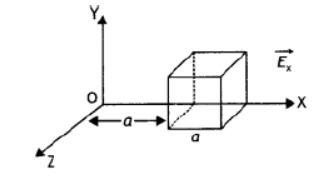
Answer. Electric Flux is the dot product of the electric field and area vector.
Φ = ∮𝐸⃗ds→ SI
Unit: Nm2/C or Vm
For a given case
Φ = Φ1 – Φ2 = [Ex(atx= 2a) – Ex (atx = a)]a2
= [α(2a)-α(a)]a2 = αa3
= 104 × (0.1 )3 = 10 Nm2/C
But
Φ = qε0
∴ q = ε0Φ
= 8.854 × 10-12 × 10 C = 8.54 pC
Question. Three-point charges Q1, Q2and Q3 are placed equally spaced in order along a straight line. Q2 and Q3 are equal in magnitude but opposite in sign . If the net force on Q3 is zero, the value of Q1 is
(a) Q1 = 4Q3
(b) Q1 = 2(Q3)
(c) Q1= √2 Q3
(d) Q1 = | Q3|
Answer. A
Question. Two-point charges are placed at a distance d apart. If a copper plate is placed between the charges the effective force will be
(a) F
(b) 2F
(c) √F
(d) zero
Answer. D
Question. The charges on two spheres are +7μC and -5 μC respectively. They experience a force F. If an additional charge of-2 μC is given to each of them the force between them is
(a) F
(b) F/2
(c) F/√3
(d) 2F
Answer. A
Question. What is the flux through a cube if q is at one corner of the cube?
(a) q/Є0
(b)2q/ Є0
(c) q/8 Є0
(d) q/4 Є0
Answer. C
Question. Two positive ions each carrying a charge q are separated by a distance d. If F is the force of repulsion between the ions , the number of electrons missing from each ion will be
(a) 4𝜋Є0𝐹𝑑2/𝑒2
(b)√4𝜋Є0𝐹𝑒2/𝑑2
(c) √4𝜋Є0𝐹𝑑2/𝑒2
(d) 4𝜋Є0𝐹𝑒2/𝑑2
Answer. C
Question. A plane square sheet of charge of side 0.5m has uniform surface charge density. An electron at 1cm from the center of the sheet experiences a force of 1.6x10⁻¹⁹ N directed away from the sheet. The total charge on the plane square sheet is
(a) 16.25 μC
(b) -22.15 μC
(C) -44.27 μC
(d) 144.27 μC
Answer. C
Question. Seven charges of equal magnitude q are placed at the corners of a cube of side b. The force experienced by another charge Q placed at the center of the cube is
(a) Zero
(b ) KQq/ 3b
( c) 7KQq/3b
(d) 2KQq/3b
Answer. D
Question. Electric charge is uniformly distributed along a long straight wire of radius 1mm. The charge per cm of the wire is Q coulomb. Another cylindrical surface of length L meter encloses the wire symmetrically, The total flux through the surface is
(a) Q/𝞮0
(b) LQ/ 𝞮0
(c) QL/ 10-3𝞮0
(d) Q/L 10-3𝞮0
Answer. B
Question. The total electric flux emanating from an alpha particle is
(a) 2e/𝞮0
(b)e/ 𝞮0
(c) 4e/ 𝞮0
(d) e2/ 𝞮0
Answer. A
Question. A positive charge Q is placed at the center of a neutral conducting metal sphere and an electric field E is applied outside the sphere. Then
(a) force on Q is due to E is zero
(b) Net force on Q is zero
(c) Net force on Q and conducting shell as a single system is zero
(d) Net force on the shell due to E is zero
Answer. A
CASE STUDY QUESTIONS
1. Electric Charge: When a glass rod is rubbed with silk, the rod acquires one kind of charge and the silk acquires the second kind of charge. This is true for any pair of objects that are rubbed to be electrified. Now if the electrified glass rod is brought in contact with silk, with which it was rubbed, they no longer attract each other. They also do not attract or repel other light objects as they did on being electrified. Thus, the charges acquired after rubbing are lost when the charged bodies are brought in contact. What can you conclude from these observations? It just tells us that unlike charges acquired by the objects neutralise or nullify each other’s effect. Therefore, the charges were named as positive and negative by the American scientist Benjamin Franklin. We know that when we add a positive number to a negative number of the same magnitude, the sum is zero. This might have been the philosophy in naming the charges as positive and negative. By convention, the charge on glass rod or cat’s fur is called positive and that on plastic rod or silk is termed negative. If an object possesses an electric charge, it is said to be electrified or charged. When it has no charge it is said to be electrically neutral
Question. When you charge a balloon by rubbing it on your hair this is an example of what method of charging?
(a) Friction
(b) Conduction
(c) Grounding
(d) Induction
Answer. A
Question. Neutral atoms contain equal numbers of positive __ and negative __.
(a) Electrons and Protons
(b) Protons and Electrons
(c) Neutrons and Electrons
(d) Protons and Neutrons
Answer. B
Question. During charging by rubbing which of the following is not true?
(a) Mass is conserved
(b) charge is conserved
(c) mass of each object is conserved
(d) Net charge before and after rubbing is zero
Answer. C
Question. If a negatively charged rod touches a conductor, the conductor will be charged by what method?
(a) Friction
(b) Conduction
(c) Induction
(d) Convection
Answer. B
Question. If we bring charged plastic rod near-neutral aluminium rod, then rods will
(a) Repel each other
(b) Attract each other
(c) Remain their position
(d) Exchange charges
Answer. B
2. Electric Dipole: The electric field due to a charge configuration with total charge zero is not zero, but for distances large compared to the size of the configuration, its field falls off faster than 1/r2 , typical of the field due to a single charge. An electric dipole is the simplest example of this fact. An electric dipole is a pair of equal and opposite charges +q and -q separated by some distance 2a. Its dipole moment vector p has magnitude 2qa and is in the direction of the dipole axis from -q to +q. The electric field of the pair of charges can be found out from Coulomb’s law and the superposition principle. The magnitude and the direction of the dipole field depend not only on the distance r but also on the angle between the position vector r and the dipole moment p. In some molecules, like H2O, the centers of -ve charges and of +ve charges do not coincide. So they have permanent dipole moment. Such molecules are called polar molecules.
Question. What will be the value of electric field at the centre of the electric dipole?
(a) Zero
(b) Equal to the electric field due to one charge at Centre
(c) Twice the electric field due to one charge at Centre
(d) Half the value of electric field due to one charge at Centre
Answer. C
Question. If r is the distance of a point from the Centre of a short dipole, then the electric field intensity due to the short dipole remains proportional to
(a) r2
(b) r3
(c) r-2
(d) r-3
Answer. D
Question. An electric dipole coincides on Z-axis and its midpoint is on origin of the coordinate system. The electric field at an axial point at a distance z from origin is Ez and electric field at an equatorial point at a distance y from origin is Ey. Here z=y>>a, so |Ez|/|Ey| is equal to…
(a)1
(b)4
(c) 3
(d) 2
Answer. D
Question. An electric dipole of moment p is placed in a uniform electric field E. The maximum torque experienced by the dipole is…
(a) pE
(b) p/E
(c) E/p
(d) p . E
Answer. A
Question. An electric dipole is placed in a uniform electric field parallel to the field
(a) It experiences a force and moves parallel to the field
(b) It experiences a torque and moves in a circular path
(c) It experiences no force and no torque and remains at rest
(d) It experiences force as well as torque and has translatory and rotational motion
Answer. C
ELECTRIC CHARGES AND FIELD
1. Charges of magnitudes 2Q and –Q are located at points (a,0,0) and (4a,0,0). Find the ratio of the flux of electric field due to these charges through concentric sphere as of radii 2a and 8a centered at the origin.
2. An electric dipole free to move is placed in a uniform electric field. Explain along with diagram its motion when it is placed
(a) parallel to the field
(b) perpendicular to the field.
3. A charge having magnitude Q is divided into two parts q and (Q-q). If the two parts exert a maximum force of repulsion on each other, then find the ratio Q/q.
4. A charged spherical conductor has a surface density of 0.7C/m2.When its charge is increased by 0.44C, the charge density changes by 0.14C/m2.Find the radius of the sphere and intial charge on it.
5. The electric field in a region can be expressed as E = [ (3/5)i + (4/5)j] 2x 10³ N/C Determine the flux of this field through a rectangular surface of area 0.2 m2 situated parallel to the Y-Z plane.
6. Five point charges each of value +q coulomb are placed on five vertices of a regular hexagon of side L metres. Find the magnitude of force on a charge –q coulomb placed at the centre of the hexagon.
7. Two identical spheres having charges of opposite sign attract each other with a force of 0.108 N when separated by 0.5m. The spheres are connected by a connecting wire, which then removed and thereafter they repel each other with a force of 0.036 N. What were the intial charges on the spheres.
8. Sixty four drops of radius 0.02 m and each carrying a charge of 5μC are combined to form a bigger drop. Find how the surface density of electrification will change if no charge is lost.
9. A spherical conducting shell of inner radius r1 and outer radius r2 has a charge Q.
(a) A charge q is placed at the centre of the shell. What is the surface charge density at the inner and outer surface of the shell?
(b) Is the electric field inside cavity (with no charge) zero, even if the shell is not spherical, but has an irregular shape?
10. Plot a graph showing the variation of coulomb force (F) versus (1/r2) where r is the distance between two charges of each pair of charges ( 1μC,2μC) and (2μC,-3μC).Interpret the graph obtained.
Free study material for Physics
Download Practice Assignments: Class 12 Physics Chapter 01 Electric Charges And Fields
Revision Assignment: Chapter 01 Electric Charges And Fields (CBSE)
Review targeted chapter assignments for Class 12 Physics Chapter 01 Electric Charges And Fields. Built according to official CBSE guidelines, these downloadable problem sets help students build accuracy and prepare effectively for school tests.
Key Advantages of Solving Chapter 01 Electric Charges And Fields Assignments
- Syllabus Compliance: Sets reflect current CBSE evaluation criteria and official marking frameworks.
- Multi-Format Practice: Includes varied problem types designed to deepen comprehension across all sub-topics.
- Time Management: Routine practice optimizes pacing to finish school examinations comfortably within schedule.
How to Approach Physics Chapter 01 Electric Charges And Fields Assignments
- Concept Foundation: Review the NCERT book for Class 12 Physics thoroughly before diving into assignment tasks.
- Self-Evaluation: Solve exercises independently before inspecting professional answer guides.
- Progress Monitoring: Note down complex formulas or concepts, clearing them up using available online practice aids.
FAQs
You can download free PDF assignments for Class 12 Physics Chapter 01 Electric Charges And Fields from StudiesToday.com. These practice sheets have been updated for the 2026-27 session covering all concepts from latest NCERT textbook.
Yes, our teachers have given solutions for all questions in the Class 12 Physics Chapter 01 Electric Charges And Fields assignments. This will help you to understand step-by-step methodology to get full marks in school tests and exams.
Yes. These assignments are designed as per the latest CBSE syllabus for 2026. We have included huge variety of question formats such as MCQs, Case-study based questions and important diagram-based problems found in Chapter 01 Electric Charges And Fields.
Practicing topicw wise assignments will help Class 12 students understand every sub-topic of Chapter 01 Electric Charges And Fields. Daily practice will improve speed, accuracy and answering competency-based questions.
Yes, all printable assignments for Class 12 Physics Chapter 01 Electric Charges And Fields are available for free download in mobile-friendly PDF format.