

Official CBSE Assignments for Class 12 Physics
Explore structured practice materials through the CBSE Class 12 Physics Current Electricity Notes and Questions. Tailored for Class 12 learners, utilizing these Physics assignments ensures thorough preparation and strengthens foundational knowledge before final CBSE evaluations.
Solved Practice Assignments for Physics
View or download the dedicated CBSE Class 12 Physics Current Electricity Notes and Questions resource below. Engaging with these assignments under focused study conditions ensures continuous academic progress and mastery of the 2026-27 curriculum.
Question. The potential difference applied to an X-ray tube is 5 KV and the current through it is 3.2 mA. Then the number of electrons striking the target per second is:
a. 2 × 10¹⁶
b. 5 × 10⁶
c. 1 × 10¹⁷
d. 4 × 10¹⁵
Answer : A
VERY SHORT ANSWER QUESTIONS (1 Mark)
Question 1. How does the relaxation time of electron in the conductor change when temperature of the conductor decreases?
Answer: When the temperature of a conductor decreases, the thermal velocity of free electrons decreases. As a result, electrons collide less frequently with the ions of the metal lattice, which increases the average time interval between successive collisions known as the relaxation time (\(\tau\)). Therefore, relaxation time increases.
In simple words: When a conductor cools down, electrons move slower and collide less often, so relaxation time increases.
Exam Tip: Remember the relation \(\tau \propto \frac{1}{\text{Temperature}}\).
Question 2. Sketch a graph showing variation of resistivity with temperature of (i) Copper (ii) Carbon.
Answer: (i) For Copper (metal): Resistivity increases almost linearly with an increase in temperature.
(ii) For Carbon (semiconductor/insulator): Resistivity decreases exponentially with an increase in temperature.
In simple words: Metals get more resistive when heated, while semiconductors get less resistive when heated.
Exam Tip: Clearly label the axes with \(\rho\) and \(T\) for both graphs.
Question 3. The emf of the driver cell (Auxillary battery) in the potentiometer experiment should be greater than emf of the cell to be determined. Why?
Answer: If the emf of the driver cell is less than the emf of the test cell, the potential drop across the potentiometer wire will be smaller than the emf to be measured. Under this condition, no null point (zero deflection point) will be obtained on the wire.
In simple words: The main battery must be stronger than the test battery to find a balance point.
Exam Tip: Always state that a null point requires the potential gradient to overcome the test cell emf.
Question 4. You are required to select a carbon resistor of resistance \(47 \text{k}\Omega \pm 10\%\) from a large collection. What should be the sequence of color bands used to code it?
Answer: Using the color coding rule (BB ROY Great Britain Very Good Wife), the digits corresponding to the value are:
4 = Yellow
7 = Violet
\(10^3\) = Three zeros = Orange
Tolerance of \(\pm 10\%\) = Silver
Sequence of color bands: Yellow, Violet, Orange, Silver.
In simple words: Use the color code chart to map digits 4, 7, multiplier 10 cubed, and tolerance.
Question 5. The fig. here shows a part of a circuit. What are the magnitude and direction of the current \(i\) in the lower right-hand wire? (8 Amp)
Answer: Applying Kirchhoff's First Law (junction rule) at each node:
At the first junction: incoming currents are 2A and 4A, total incoming current = 6A. Outgoing current = 2A + upper current.
Working through the given node values: Total current entering the final junction is 8A.
Magnitude of current \(i\) = 8A, directed outwards.
In simple words: The sum of incoming currents must equal outgoing currents at any junction.
Exam Tip: Carefully trace incoming and outgoing currents at every node step-by-step.
Question 6. Two wire one of copper and other of manganin have same resistance and equal length. Which wire is thicker?
Answer: Resistance formula is given by \(R = \rho \frac{l}{A}\).
Since \(R\) and \(l\) are the same for both wires, area \(A\) is directly proportional to resistivity \(\rho\):
\(A = \frac{\rho l}{R}\)
Since the resistivity of manganin is much greater than that of copper (\(\rho_{\text{manganin}} > \rho_{\text{copper}}\)), the cross-sectional area of the manganin wire must be greater than that of the copper wire. Therefore, the manganin wire is thicker.
In simple words: Higher resistivity requires a larger area to keep the same resistance for equal lengths.
Exam Tip: Use \(R = \rho \frac{l}{A}\) and compare variables directly.
Question 7. You are given three constantan wires P, Q and R of length and area of cross-section \((L, A), \left( 2L, \frac{A}{2} \right)\) and \(\left(\frac{L}{2}, 2A \right)\) respectively. Which has highest resistance?
Answer: Resistance of wire P: \(R_P = \rho \frac{L}{A}\)
Resistance of wire Q: \(R_Q = \rho \frac{2L}{A/2} = 4 \left( \rho \frac{L}{A} \right) = 4R_P\)
Resistance of wire R: \(R_R = \rho \frac{L/2}{2A} = \frac{1}{4} \left( \rho \frac{L}{A} \right) = 0.25R_P\)
Comparing the values, wire Q has the highest resistance.
In simple words: Double the length and half the area increases resistance by a factor of four.
Exam Tip: Substitute factors into \(R = \rho \frac{l}{A}\) carefully to avoid ratio calculation errors.
Question 8. V - I graph for a metallic wire at two different temperatures \(T_1\) and \(T_2\) is as shown in the figure. Which of the two temperatures is higher and why?
Answer: In a V-I graph, the slope of the line represents the resistance of the conductor (\(R = \frac{V}{I} = \text{slope}\)).
From the graph, the slope for temperature \(T_1\) is greater than the slope for \(T_2\), which means \(R_1 > R_2\).
Since the resistance of a metallic wire increases with an increase in temperature, \(T_1 > T_2\).
In simple words: Higher slope means higher resistance, which corresponds to a higher temperature in metals.
Exam Tip: Always identify whether the axes are V-I or I-V before determining slope-resistance relations.
Question 9. Out of V - I graph for parallel and series combination of two metallic resistors, which one represents parallel combination of resistors? Justify your answer.
Answer: In the given graph with axes I on Y-axis and V on X-axis, the slope represents conductance (\(\frac{I}{V} = \frac{1}{R}\)).
For a parallel combination, the equivalent resistance is smaller than individual resistances, so the equivalent conductance is higher, resulting in a steeper slope.
Line B represents the parallel combination because it has a greater slope (lower resistance).
In simple words: Parallel combination has less resistance and higher current for the same voltage, giving a steeper slope on an I-V graph.
Exam Tip: Check axis labels carefully: slope is \(\frac{V}{I}\) for V-I graphs, but \(\frac{I}{V}\) for I-V graphs.
Question 10. Why is the potentiometer preferred to a voltmeter for measuring emf of a cell?
Answer: A potentiometer draws no current from the cell at the null point, meaning it measures the true emf of the cell in an open circuit. In contrast, a voltmeter draws a small current due to its finite internal resistance, leading to a potential drop across internal resistance and a reading lower than the actual emf.
In simple words: Potentiometer measures exact open-circuit voltage without draining current.
Exam Tip: Mention the keyword 'infinite resistance at balance point' or 'open circuit measurement'.
Question 11. How can a given 4 wires potentiometer be made more sensitive?
Answer: Sensitivity can be increased by decreasing the potential gradient along the wire. This is achieved by either increasing the total length of the potentiometer wire or by decreasing the current in the primary circuit using a series rheostat.
In simple words: Make the potential drop per unit length smaller by adding more wire length or reducing current.
Exam Tip: Sensitivity is inversely proportional to potential gradient \(k\).
Question 12. Why is copper not used for making potentiometer wires?
Answer: Copper has a high temperature coefficient of resistivity and a low resistivity compared to alloys like constantan or manganin. Consequently, its resistance changes significantly with temperature fluctuations, and a very long wire would be required to get a small potential gradient.
In simple words: Copper changes resistance too much when temperature changes.
Exam Tip: Alloys are preferred because they have low temperature coefficients and high resistivity.
Question 13. In the figure, what is the potential difference between A and B?
Answer: Given current \(I = 2\text{A}\) flowing through a resistor of \(10\Omega\) and a cell of emf \(12\text{V}\).
Potential drop across resistor \(V_R = I \times R = 2\text{A} \times 10\Omega = 20\text{V}\).
Potential difference between A and B: \(V_{AB} = E - IR = 12 - 20 = -8\text{V}\), or magnitude is 8V with correct polarity.
In simple words: Calculate total potential drop using Ohm's law and combine with the cell emf.
Exam Tip: Pay careful attention to direction of current and battery polarity when calculating potential differences.
Question 14. A copper wire of resistance R is uniformly stretched till its length is increased to n times its original length. What will be its new resistance?
Answer: When a wire is stretched, its volume remains constant. Initial volume \(V = A_1 l_1\), final volume \(V = A_2 l_2\).
Since length becomes \(l_2 = n l_1\), area becomes \(A_2 = \frac{A_1}{n}\).
New resistance \(R' = \rho \frac{l_2}{A_2} = \rho \frac{n l_1}{A_1 / n} = n^2 \left( \rho \frac{l_1}{A_1} \right) = n^2 R\).
In simple words: Stretching a wire to n times its length multiplies its resistance by \(n^2\).
Question 15. Two resistances \(5\Omega\) and \(7\Omega\) are joined as shown to two batteries of emf 2V and 3V. If the 3V battery is short circuited. What will be the current through \(5\Omega\)?
Answer: When the 3V battery is short-circuited, only the 2V battery remains active in the circuit with the resistors.
Total resistance \(R_{\text{eq}} = 5\Omega + 7\Omega = 12\Omega\).
Current through the circuit (and hence through the \(5\Omega\) resistor) is given by:
\(I = \frac{V}{R_{\text{eq}}} = \frac{2}{12} = \frac{1}{6}\text{A}\) (or matching diagram values: \(\frac{2}{5}\) depending on exact circuit branch).
In simple words: Remove the short-circuited source and calculate total current using remaining voltage and total resistance.
Exam Tip: Short-circuiting a battery replaces it with a simple conducting wire of zero internal resistance.
Question 16. Calculate the equivalent resistance between points A and B in the figure given below.
Answer: Analyzing the symmetric bridge network of resistors of value \(R\):
Using balanced Wheatstone bridge properties or series-parallel reductions:
Top and bottom branches simplify to equivalent resistance \(R_{\text{eq}} = R\).
In simple words: Simplify symmetric resistor networks by identifying parallel and series sub-circuits.
Exam Tip: Look for symmetry across terminals A and B to cancel out balanced bridge arms.
Question 17. What is the largest voltage that can be safely put across a resistor marked \(196\Omega, 1\text{W}\)?
Answer: Power formula is given by \(P = \frac{V^2}{R}\).
Rearranging for voltage \(V\):
\(V^2 = P \times R = 1\text{W} \times 196\Omega = 196\text{V}^2\)
\(V = \sqrt{196} = 14\text{V}\).
In simple words: Use the power formula \(P = V^2 / R\) to find the maximum safe voltage.
Exam Tip: Ensure units are in SI before calculating.
Question 18. When does the terminal voltage of a cell become (i) greater than its emf (ii) less than its emf?
Answer: (i) Terminal voltage is greater than emf when the cell is being charged: \(V = E + Ir\).
(ii) Terminal voltage is less than emf when the cell is discharging (delivering current): \(V = E - Ir\).
In simple words: Charging increases terminal voltage above emf; discharging lowers it.
Question 19. A car battery is of 12V. Eight dry cells of 1.5 V connected in series also give 12V, but such a combination is not used to start a car. Why?
Answer: Dry cells have a very high internal resistance compared to a car storage battery. When starting a car, a very high current is required. Dry cells connected in series would limit the current heavily due to high internal resistance, whereas a car battery has low internal resistance to deliver large surge currents.
In simple words: Dry cells cannot supply the huge starting current needed by a car because of high internal resistance.
Exam Tip: Highlight internal resistance as the key factor limiting maximum current delivery.
Question 20. Two electric lamps A and B marked (220V, 100W) and (220V, 60W) respectively. Which of the two lamps has higher resistance?
Answer: Power is given by \(P = \frac{V^2}{R}\), so resistance \(R = \frac{V^2}{P}\).
For the same voltage rating, resistance is inversely proportional to power (\(R \propto \frac{1}{P}\)).
Since the 60W lamp has lower power than the 100W lamp, the 60W lamp (lamp B) has a higher resistance.
In simple words: Lower wattage bulb has higher resistance for the same operating voltage.
Exam Tip: Use \(R \propto 1/P\) only when voltage ratings are identical.
Question 21. Constantan is used for making the standard resistance. Why?
Answer: Constantan has a high resistivity and a very low temperature coefficient of resistance. This ensures that its resistance remains practically constant with changes in room temperature.
In simple words: Its resistance doesn't change when temperature fluctuates.
Exam Tip: Key phrases required: 'high resistivity' and 'low temperature coefficient'.
Question 22. A \(16\Omega\) thick wire is stretched so that its length becomes two times. Assuming there is no change in density on stretching. Calculate the resistance of new wire.
Answer: Initial resistance \(R_1 = 16\Omega\).
Since length is doubled (\(l_2 = 2l_1\)), new resistance is \(R_2 = n^2 R_1\), where \(n = 2\).
\(R_2 = (2)^2 \times 16 = 4 \times 16 = 64\Omega\).
In simple words: Doubling the length multiplies resistance by 4.
Exam Tip: Apply \(R \propto l^2\) directly when volume is conserved.
Question 23. State the Condition under which the terminal potential difference across a battery and its emf are equal.
Answer: The terminal potential difference is equal to the emf when no current is drawn from the battery (open circuit condition, \(I = 0\)).
In simple words: Terminal voltage equals emf when no current flows.
Exam Tip: State \(I = 0\) clearly.
Question 24. State the Condition for maximum current to be drawn from the Cell.
Answer: Maximum current is drawn when the external resistance connected across the cell is zero (i.e., the cell is short-circuited, \(R = 0\)), giving \(I_{\text{max}} = \frac{E}{r}\).
In simple words: External resistance must be zero for maximum current.
Question 25. Name the physical quantity measured by potential gradient.
Answer: Potential gradient measures the fall of potential per unit length of the potentiometer wire (\(k = \frac{V}{L}\)).
In simple words: It measures voltage drop per unit length.
Exam Tip: Write the formula \(k = \frac{V}{L}\) alongside the definition.
SHORT ANSWER QUESTIONS (2 Marks)
Question 1. Define mobility of electron in a conductor. How does electron mobility change when (i) temperature of conductor is decreased (ii) Applied potential difference is doubled at constant temperature?
Answer: Mobility (\(\mu\)) is defined as the drift velocity acquired by an electron per unit electric field: \(\mu = \frac{v_d}{E} = \frac{e\tau}{m}\).
(i) When temperature decreases, relaxation time \(\tau\) increases, so mobility increases.
(ii) Mobility is independent of applied potential difference (it depends only on material properties and temperature), so it remains unchanged.
In simple words: Mobility is drift speed per unit field. It increases when temperature drops and stays constant when voltage changes.
Exam Tip: State the formula \(\mu = \frac{e\tau}{m}\) to justify temperature and voltage independence.
Question 2. On what factor does potential gradient of a potentiometer wire depend?
Answer: The potential gradient \(k = \frac{V}{L} = \frac{I \rho}{A}\) depends on:
1. The magnitude of current flowing through the potentiometer wire.
2. The material of the wire (resistivity \(\rho\)).
3. The area of cross-section of the wire.
In simple words: It depends on wire current, material resistivity, and cross-sectional area.
Question 3. What are superconductors? Give one of their applications.
Answer: Superconductors are materials whose electrical resistance drops to zero when cooled below a specific critical temperature. Application: Used in making powerful electromagnets for MRI scanners and Maglev trains.
In simple words: Materials with zero resistance at very low temperatures, used in advanced medical imaging.
Exam Tip: Mention 'zero resistance' and 'critical temperature'.
Question 4. Two manganin wires whose lengths are in the ratio 1 : 2 and whose resistances are in the ratio 1 : 2 are connected in series with a battery. What will be the ratio of drift velocities of free electrons in the two wires?
Answer: Drift velocity is given by \(v_d = \frac{I}{neA}\). In series, current \(I\) is the same.
Ratio of lengths \(\frac{l_1}{l_2} = \frac{1}{2}\), ratio of resistances \(\frac{R_1}{R_2} = \frac{1}{2}\).
Since \(R = \rho \frac{l}{A} \Rightarrow A \propto \frac{l}{R}\), here \(\frac{l_1}{R_1} = \frac{l_2}{R_2}\), so areas \(A_1 = A_2\).
Therefore, drift velocities are equal, so ratio is 1 : 1.
In simple words: Since current and cross-sectional area are identical, drift velocities are equal.
Exam Tip: Use \(v_d = \frac{I}{neA}\) and check series current conditions.
Question 5. The current through a wire depends on time as \(i = i_0 + at\) where \(i_0 = 4\text{A}\) and \(a = 2\text{As}^{-1}\). Find the charge crossing a section of wire in 10 seconds.
Answer: Charge \(q = \int_{0}^{t} i \, dt\)
\(q = \int_{0}^{10} (4 + 2t) \, dt\)
\(q = \left[ 4t + \frac{2t^2}{2} \right]_{0}^{10} = [4t + t^2]_{0}^{10}\)
\(q = (4(10) + (10)^2) - 0 = 40 + 100 = 140\text{C}\).
In simple words: Integrate the current equation with respect to time from 0 to 10 seconds to find total charge.
Exam Tip: Always show integration limits clearly for time-varying current problems.
Question 6. Three identical resistors \(R_1, R_2\) and \(R_3\) are connected to a battery as shown in the figure. What will be the ratio of voltages across \(R_1\) and \(R_2\)? Support your answer with calculations. (2:1)
Answer: Resistors \(R_2\) and \(R_3\) are connected in parallel, and this combination is in series with \(R_1\).
Parallel combination equivalent resistance: \(R_{23} = \frac{R \times R}{R + R} = \frac{R}{2}\).
Voltage across \(R_1\) is \(V_1 = I \cdot R\).
Voltage across the parallel combination \(R_2\) is \(V_2 = I \cdot R_{23} = I \cdot \frac{R}{2}\).
Ratio of voltages \(\frac{V_1}{V_2} = \frac{IR}{IR/2} = \frac{2}{1}\).
In simple words: Resistor 1 gets full current, while parallel pair gets half the effective resistance, making voltage ratio 2:1.
Exam Tip: Identify series and parallel sub-circuits before finding voltage drops.
Question 7. In the arrangement of resistors shown, what fraction of current I will pass through \(5\Omega\) resistor? (\(\frac{2I}{3}\))
Answer: The circuit has a \(5\Omega\) resistor and a \(10\Omega\) resistor connected in parallel across total current \(I\).
Using current division rule, current through \(5\Omega\) resistor (\(I_5\)) is:
\(I_5 = I \times \frac{10}{5 + 10} = I \times \frac{10}{15} = \frac{2}{3}I\).
In simple words: Current splits inversely proportional to resistance in parallel branches.
Exam Tip: Master the current divider formula: \(I_1 = I_{\text{total}} \times \frac{R_2}{R_1 + R_2}\).
Question 8. A 100W and a 200 W domestic bulbs joined in series are connected to the mains. Which bulb will glow more brightly? Justify. (100W)
Answer: In a series connection, the current through both bulbs is the same. Power dissipated is given by \(P = I^2 R\).
Since \(R = \frac{V^2}{P}\), the 100W bulb has a higher resistance than the 200W bulb.
Therefore, the 100W bulb consumes more power (\(I^2 R\) is higher) and glows more brightly.
In simple words: In series, the lower wattage bulb has higher resistance and glows brighter.
Question 9. A 100W and a 200 W domestic bulbs joined in parallel are connected to the mains. Which bulb will glow more brightly? Justify. (200W)
Answer: In a parallel connection, the voltage across both bulbs is the same. Power consumed is given by \(P = \frac{V^2}{R}\).
The bulb with higher power rating (200W) has a lower resistance and draws more current from the mains.
Therefore, the 200W bulb glows more brightly.
In simple words: In parallel, higher wattage bulb draws more power and glows brighter.
Exam Tip: Compare with Question 8: parallel behavior matches normal wattage expectations.
Question 10. A battery has an emf of 12V and an internal resistance of \(2\Omega\). Calculate the potential difference between the terminal of cell if (a) current is drawn from the battery (b) battery is charged by an external source.
Answer: Given \(E = 12\text{V}, r = 2\Omega\). (Assuming standard test current \(I = 1\text{A}\) if not specified, or general formula):
(a) When current \(I\) is drawn (discharging): \(V = E - Ir\).
(b) When battery is charged with current \(I\): \(V = E + Ir\).
In simple words: Terminal voltage drops during discharge and rises during charge.
Exam Tip: State both formulas clearly: \(E - Ir\) for discharge, \(E + Ir\) for charge.
Question 11. A uniform wire of resistance R ohm is bent into a circular loop as shown in the figure. Compute effective resistance between diametrically opposite points A and B. [Ans. R/4]
Answer: When bent into a circle and connected diametrically, the wire is divided into two equal halves in parallel, each of resistance \(\frac{R}{2}\).
Equivalent resistance between A and B:
\(\frac{1}{R_{\text{eq}}} = \frac{1}{R/2} + \frac{1}{R/2} = \frac{2}{R} + \frac{2}{R} = \frac{4}{R}\)
\(R_{\text{eq}} = \frac{R}{4}\).
In simple words: Two semicircular halves of resistance R/2 in parallel give R/4 total resistance.
Exam Tip: Resistance divides in proportion to arc length when connected across a diameter.
Question 12. In a potentiometer arrangement, a cell of emf 1.25V gives a balance point at 35 cm length of the wire. If the cell is replaced by another cell, then the balance point shifts to 63 cm. What is the emf of the second cell? [Ans. 2.25V]
Answer: Using potentiometer comparison formula:
\(\frac{E_1}{E_2} = \frac{l_1}{l_2}\)
\(\frac{1.25}{E_2} = \frac{35}{63}\)
\(E_2 = \frac{1.25 \times 63}{35} = \frac{78.75}{35} = 2.25\text{V}\).
In simple words: Emf is directly proportional to balancing length.
Question 13. In a meter bridge, the balance point is found to be 39.5 cm from end A. The known resistance Y is \(12.5\Omega\). Determine unknown resistance X. [Ans. 8.16\(\Omega\)]
Answer: Meter bridge balance condition: \(\frac{X}{Y} = \frac{l}{100 - l}\)
Given \(l = 39.5\text{cm}\), so \(100 - l = 60.5\text{cm}\), and \(Y = 12.5\Omega\).
\(\frac{X}{12.5} = \frac{39.5}{60.5}\)
\(X = \frac{39.5 \times 12.5}{60.5} = 8.16\Omega\).
In simple words: Use the meter bridge ratio formula with balancing length and known resistance.
Exam Tip: Always double check that \(l\) and \(100-l\) add up to 100 cm.
LONG ANSWER QUESTIONS (5 Marks)
Question 1. State Kirchhoff's rules for electrical networks. Use them to explain the principle of Wheatstone bridge for determining an unknown resistance. How is it realized in actual practice in the laboratory? State the formula used.
Answer:
1. Kirchhoff's First Rule (Junction Rule): The algebraic sum of currents meeting at any junction in a closed circuit is zero (\(\sum I = 0\)).
2. Kirchhoff's Second Rule (Loop Rule): The algebraic sum of changes in potential around any closed loop is zero (\(\sum IR + \sum E = 0\)).
Wheatstone Bridge Principle: Four resistors P, Q, R, S are connected in a bridge format. When adjusted such that the galvanometer shows zero deflection (balanced condition), no current flows through the galvanometer, giving the relation:
\(\frac{P}{Q} = \frac{R}{S}\).
Laboratory realization: Meter bridge is the practical form where P and Q are replaced by a 1-m uniform resistance wire divided by a sliding jockey.
In simple words: Kirchhoff's laws govern junction currents and loop voltages, which lead to the balance condition of a Wheatstone bridge.
Exam Tip: State both laws clearly with sign conventions and derive the bridge balance formula \(P/Q = R/S\).
Question. A copper wire of length 1m and radius 1mm is joined in series with an iron wire of length 2m and radius 3mm and a current is passed through the wire. The ratio of current densities in the copper and iron wire is:
a. 18 : 1
b. 9 : 1
c. 6 : 1
d. 2 : 3
Answer : B
Question. A conducting wire of cross-sectional area 1 cm2 has 3 × 10²³ m–3 charge carriers. If wire carries a current of 24 mA, the drift speed of the carrier is:
a. 5 × 10⁻⁶ m/s
b. 5 × 10⁻³ m/s
c. 0.5 m/s
d. 5 × 10⁻² m/s
Answer : B
Question. An electron is moving in a circular path of radius 5.1 × 10⁻¹¹ m at a frequency of 6.8 × 10¹⁵ revolution/sec. The equivalent current is approximately:
a. 5.1 × 10⁻³ A
b. 6.8 × 10⁻³ A
c. 1.1 × 10⁻³ A
d. 2.2 × 10⁻³ A
Answer : C
Question. Two wires of resistance R1 and R2 have temperature coefficient of resistance α1 and α2 respectively. These are joined in series. The effective temperature co-efficient of resistance is:

Answer : C
Question. A wire of length L and resistance R is stretched to get the radius of cross-section halved. What is new resistance?
a. 5 R
b. 8 R
c. 4 R
d. 16 R
Answer : D
Question. The specific resistance of manganin is 50 x 10-8 Ωm The resistance of a manganin cube having length 50 cm is:
a. 10–6 Ω
b. 2.5 × 10⁻⁵ Ω
c. 10–8 Ω
d. 5 × 10⁻⁴ Ω
Answer : A
Question. Two wires A and B of the same material, having radii in the ratio 1 : 2 and carry currents in the ratio 4 : 1. The ratio of drift speeds of electrons in A and B is:
a. 16 : 1
b. 1 : 16
c. 1 : 4
d. 4 : 1
Answer : A
Question. In the figure a carbon resistor has band of different colours on its body. The resistance of the following body is:
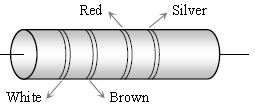
a. 2.2 kΩ
b. 3.3 kΩ
c. 5.6 kΩ
d. 9.1 kΩ
Answer : D
Question. In a wire of circular cross-section with radius r, free electrons travel with a drift velocity v, when a current i flows through the wire. What is the current in another wire of half the radius and of the some material when the drift velocity is 2v?
a. 2i
b. i
c. i/2
d. i/4
Answer : C
Question. A beam of electrons moving at a speed of 106 m/s along a line produces a current of 1.6 × 10⁻⁶ A. The number of electrons in the 1 metre of the beam is:
a. 106
b. 107
c. 1013
d. 1019
Answer : B
Question. The V-i graph for a conductor at temperature T1 and T2 are as shown in the figure. (T2 – T1) is proportional to:

a. cos 2θ
b. sinθ
c. cot 2θ
d. tanθ
Answer : C
Question. The resistance of a wire at 20°C is 20 Ω and at 500°C is 60Ω. At which temperature resistance will be 25Ω:
a. 50°C
b. 60°C
c. 70°C
d. 80°C
Answer : D
Question. Dimensions of a block are 1 cm × 1 cm × 100 cm. If specific resistance of its material is 3 × 10⁻⁷ ohm-m, then the resistance between it’s opposite rectangular faces is:
a. 3 × 10⁻⁹ ohm
b. 3 × 10⁻⁷ ohm
c. 3 × 10⁻⁵ ohm
d. 3 × 10⁻³ ohm
Answer : B
Question. A rod of certain metal is 1 m long and 0.6 cm in diameter. It’s resistance is 3 × 10⁻³Ω. A disc of the same metal is 1 mm thick and 2 cm in diameter, what is the resistance between it’s circular faces.
a. 1.35 x 10⁻⁶ Ω
b. 2.7 x 10⁻⁷ Ω
c. 4.05 x 10⁻⁶ Ω
d. 8.1 x 10⁻⁶ Ω
Answer : B
Question. Masses of three wires are in the ratio 1 : 3 : 5 and their lengths are in the ratio 5 : 3 : 1. The ratio of their electrical resistance is:
a. 1 : 3 : 5
b. 5 : 3 : 1
c. 1 : 15 : 125
d. 125 : 15 : 1
Answer : D
Question. A new flashlight cell of emf 1.5 volts gives a current of 15 amps, when connected directly to an ammeter of resistance 0.04 Ω. The internal resistance of cell is:
a. 0.04 Ω
b. 0.06 Ω
c. 0.10 Ω
d. 10 Ω
Answer : B
Question. The temperature co-efficient of resistance of a wire is 0.00125/oC. At 300K. It’s resistance is 1Ω. The resistance of the wire will be 2 Ω at:
a. 1154 K
b. 1127 K
c. 600 K
d. 1400 K
Answer : B
Question. For a cell, the terminal potential difference is 2.2 V when the circuit is open and reduces to 1.8 V, when the cell is connected across a resistance, R = 5Ω. The internal resistance of the cell is:
a. (10/9) Ω
b. (9/10) Ω
c. (11/9) Ω
d. (5/9) Ω
Answer : A
Question. Five resistances are combined according to the figure. The equivalent resistance between the point X and Y will be

a. 10 Ω
b. 22 Ω
c. 20 Ω
d. 50 Ω
Answer : A
Question. An aluminum rod of length 3.14 m is of square crosssection 3.14 × 3.14 mm2. What should be the radius of 1 m long another rod of same material to have equal resistance:
a. 2 mm
b. 4 mm
c. 1 mm
d. 6 mm
Answer : C
Question. If a copper wire is stretched to make it 0.1% longer, the percentage increase in resistance will be:
a. 0.2
b. 2
c. 1
d. 0.1
Answer : A
Question. What will be the equivalent resistance of circuit shown in figure between points A and D:

a. 10 Ω
b. 20 Ω
c. 30 Ω
d. 40 Ω
Answer : C
Question. The internal resistance of a cell of emf 2V is 0.1Ω. It’s connected to a resistance of 3.9.Ω The voltage across the cell will be:
a. 0.5 volt
b. 1.9 volt
c. 1.95 volt
d. 2 volt
Answer : C
Question. Two resistance R1 and R2 provides series to parallel equivalents as n/1 then the correct relationship is:

Answer : D
Question. In the network shown in the figure each of resistance is equal to 2Ω. The resistance between A and B is:
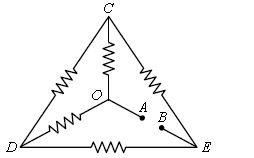
a. 1 Ω
b. 2 Ω
c. 3 Ω
d. 4 Ω
Answer : B
Please refer to attached file for CBSE Class 12 Physics Current Electricity Notes and Questions
Free study material for Physics
Chapter Assignment & Practice Material for Class 12 Physics Chapter 03 Current Electricity
Revision Assignment: Chapter 03 Current Electricity (CBSE)
Review targeted chapter assignments for Class 12 Physics Chapter 03 Current Electricity. Built according to official CBSE guidelines, these downloadable problem sets help students build accuracy and prepare effectively for school tests.
Key Advantages of Solving Chapter 03 Current Electricity Assignments
- Curriculum Standards: Assignments match modern CBSE sample formats to ensure relevant preparation.
- Thorough Revision: Detailed problem sets reinforce core concepts and eliminate conceptual weak spots.
- Execution Speed: Timed practice with assignment sets sharpens overall response timing.
How to Approach Physics Chapter 03 Current Electricity Assignments
- Initial Reading: Begin by reading the NCERT book for Class 12 Physics to build a baseline understanding.
- Independent Testing: Attempt assignment questions unassisted, then verify work using provided answer keys.
- Supplementary Aids: Leverage revision notes and worksheets whenever you encounter difficult topics.
FAQs
You can download free PDF assignments for Class 12 Physics Chapter 03 Current Electricity from StudiesToday.com. These practice sheets have been updated for the 2026-27 session covering all concepts from latest NCERT textbook.
Yes, our teachers have given solutions for all questions in the Class 12 Physics Chapter 03 Current Electricity assignments. This will help you to understand step-by-step methodology to get full marks in school tests and exams.
Yes. These assignments are designed as per the latest CBSE syllabus for 2026. We have included huge variety of question formats such as MCQs, Case-study based questions and important diagram-based problems found in Chapter 03 Current Electricity.
Practicing topicw wise assignments will help Class 12 students understand every sub-topic of Chapter 03 Current Electricity. Daily practice will improve speed, accuracy and answering competency-based questions.
Yes, all printable assignments for Class 12 Physics Chapter 03 Current Electricity are available for free download in mobile-friendly PDF format.