

Class 12 Physics Practice Assignments: CBSE Class 12 Physics Magnetic Effect of Current and Magnetism Assignment Set 01
Access comprehensive school assignments for Chapter 05 Magnetism And Matter using the CBSE Class 12 Physics Magnetic Effect of Current and Magnetism Assignment Set 01. Designed to align with the 2026-27 CBSE academic guidelines, these practice sets help Class 12 Physics students reinforce core concepts and improve their problem-solving accuracy.
Download Chapter 05 Magnetism And Matter Assignment PDF with Solutions
Access the complete assignment PDF for Class 12 Physics below. Regular practice with these targeted academic tasks builds familiarity with standard question patterns and helps secure higher marks in final school evaluations.
Question. Two points A and B are situated at a distance x and 2x respectively from the nearer pole of a magnet 2 cm long. The ratio of magnetic field at A and B is
(a) 4 : 1 exactly
(b) 4 : 1 approximately
(c) 8 : 1 approximately
(d) 1 : 1 approximately
Answer: C
Question. Needles N1, N2 and N3 are made of a ferromagnetic, a paramagnetic and a diamagnetic substance respectively. A magnet when brought close to them will
(a) attract N1 and N2 strongly but repel N3
(b) attract N1 strongly, N2 weakly and repel N3 weakly
(c) attract N1 strongly, but repel N2 and N3 weakly
(d) attract all three of them
Answer: B
Question. A bar magnet of magnetic moment M and length L is cut into two equal parts each of length L/2. The magnetic moment of each part will be
(a) M
(b) M/4
(c) √2M
(d) M/2
Answer: D
Question. A freely suspended magnet oscillates with period T in earth’s horizontal magnetic field. When a bar magnet is brought near it, such that the magnetic field created by bar magnet is in same direction as earth’s horizontal magnetic field, the period decreases to T/2 . The ratio of the field of the magnet F to the earth’s magnetic field (H) is
(a) 1 : 3
(b) 1 : 1
(c) 3 : 1
(d) 9 : 1
Answer: C
Question. If relative permeability of iron is 2000. Its absolute permeability in S.I. units is
(a) 8π × 10–4
(b) 8π × 10–3
(c) 800/π
(d) 8π × 109/π
Answer: A
Question. A steel wire of length l has a magnetic moment M. It is then bent into a semicircular arc. The new magnetic moment is
(a) M/π
(b) 2M/π
(c) 3M/π
(d) 4M/π
Answer: B
Question. Two identical magnetic dipoles of magnetic moments 1.0 A-m2 each, placed at a separation of 2 m with their axis perpendicular to each other. The resultant magnetic field at point midway between the dipole is
(a) 5 × 10⁻⁷ T
(b) 5 × 10⁻⁷ T
(c) 10–7 T
(d) 2 × 10⁻⁷ T
Answer: B
Question. Work done in turning a magnet of magnetic moment M by an angle of 90º from the mgnetic meridian is n times the corresponding work done to turn through an angle of 60º, where n is
(a) 1/2
(b) 2
(c) 1/4
(d) 1
Answer: B
Question. A toroid of n turns, mean radius R and cross-sectional radius a carries current I. It is placed on a horizontal table taken as xy-plane. Its magnetic moment m
(a) is non-zero and points in the z-direction by symmetry
(b) points along the axis of the toroid (m = mΦ)
(c) is zero, otherwise there would be a field falling as 1/r3 at large distances outside the toroid
(d) is pointing radially outwards
Answer: C
Question. If a magnet is suspended at angle 30º to the magnetic meridian, the dip needle makes an angle of 45º with the horizontal.
The real dip is
(a) tan-1(√3 / 2)
(b) tan -1(√3)
(c) tan-1(√3 / 2)
(d) tan-1(2 / √3)
Answer: D
Question. Current i is flowing in a coil of area A and number of turns N, then magnetic moment of the coil, M is
(a) NiA
(b) Ni/A
(c) Ni/√A
(d) N2Ai
Answer: A
Question. A thin rectangular magnet suspended freely has a period of oscillation of 4 s. If it is broken into two halves (each having half the original length) and one of the pieces is suspended similarly. The period of its oscillation will be
(a) 4 s
(b) 2 s
(c) 0.5 s
(d) 0.25 s
Answer: B
Question. If a toroid uses bismuth for its core, the field in the core compared to that in empty core will be slightly
(a) greater
(b) smaller
(c) equal
(d) None of these
Answer: B
Question. A paramagnetic sample shows a net magnetisation of 8 Am–1 when placed in an external magnetic field of 0.6 T at a temperature of 4 K. When the same sample is placed in an external magnetic field of 0.2 T at a temperature of 16 K, the magnetisation will be
(a) 32/3 Am-1
(b) 2/3 Am-1
(c) 6Am-1
(d) 2.4Am-1
Answer: B
Question. At a certain place, horizontal component is √3 times the vertical component. The angle of dip at this place is
(a) 0
(b) π/3
(c) π/6
(d) None of these
Answer: C
Question. The relative permeability of a medium is 0.075. What is its magnetic susceptibility?
(a) 0.925
(b) – 0.925
(c) 1.075
(d) –1.075
Answer: B
Question. The magnetic field of the earth can be modelled by that of a point dipole placed at the centre of the earth. The dipole axis makes an angle of 11.3° with the axis of the earth. At Mumbai, declination is nearly zero. Then,
(a) the declination varies between 11.3° W to 11.3° E
(b) the least declination is 0°
(c) the plane defined by dipole axis and the earth axis passes through Greenwich
(d) declination averaged over the earth must be always negative
Answer: A
Question. The magnetic moment of atomic neon is equal to
(a) zero
(b) 1/2μB
(c) μB
(d) 3/2μB
Answer: A
Question. A short bar magnet of magnetic moment 0.4J T–1 is placed in a uniform magnetic field of 0.16 T. The magnet is in stable equilibrium when the potential energy is
(a) – 0.064 J
(b) zero
(c) – 0.082 J
(d) 0.064 J
Answer: A
Question. The net magnetic moment of two identical magnets each of magnetic moment M0, inclined at 60° with each other is 
(a) M0
(b) √2 M0
(c) √3 M0
(d) 2M0
Answer: C
Question. The variation of magnetic susceptibility (x) with temperature for a diamagnetic substance is best represented by 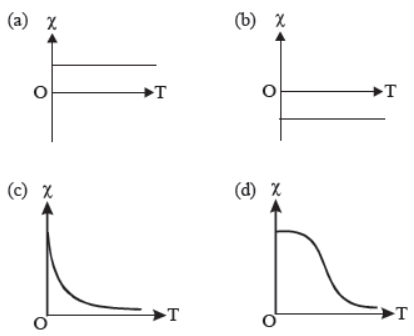
Answer: B
Question. A dip needle lies initially in the magnetic meridian when it shows an angle of dip θ at a place. The dip circle is rotated through an angle x in the horizontal plane and then it shows an angle of dip θ'. Then tan θ'/tan θ is
(a) 1/cos x
(b) 1/sin x
(c) 1/tan x
(d) cos x
Answer: A
Question. A coil in the shape of an equilateral triangle of side l is suspended between the pole pieces of a permanent magnet such that B̅ is in plane of the coil. If due to a current i in the triangle a torque t acts on it, the side l of the triangle is
(a) 2/√3(r/Bi)1/2
(b) 2(r/√3Bi)1/2
(c) 2/√3(r/Bi)
(d) 1/√3 r/Bi
Answer: B
Question. Torques t1 and t2 are required for a magnetic needle to remain perpendicular to the magnetic fields at two different places. The magnetic fields at those places are B1 and B2 respectively; then ratio B1/B2 is
(a) 𝜏2/𝜏1
(b) 𝜏1/𝜏2
(c) 𝜏1+ 𝜏2/𝜏1 - 𝜏2
(d) 𝜏1- 𝜏2/ 𝜏1 + 𝜏2
Answer: C
Question. Relative permittivity and permeability of a material er and mr , respectively. Which of the following values of these quantities are allowed for a diamagnetic material?
(a) εr = 0.5, μr = 1.5
(b) εr = 1.5, μr = 0.5
(c) εr = 0.5, μr = 0.5
(d) εr = 1.5, μr = 1.5
Answer: B
Question. Iron is ferromagnetic
(a) above 770°C
(b) below 770°C
(c) at all temperature
(d) above 1100°C
Answer: B
Question. The magnet of pole strength m and magnetic moment M is cut into two pieces along its axis. Its pole strength and magnetic moment now becomes
(a) m/2 , M/2
(b) m(M)/2
(c) m/2,M
(d) m, M
Answer: A
Question. The time period of oscillation of a magnet in a vibration magnetometer is 1.5 sec. The time period of oscillation of another magnet similar in size, shape and mass but having 1/4 magnetic moment than that of the 1st magnet oscillating at the same place will be
(a) 0.75 sec
(b) 1.5 sec
(c) 3.0 sec
(d) 6.0 sec
Answer: C
Question. Following figures show the arrangement of bar magnets in different configurations. Each magnet has magnet ic dipole moment m r . Which configuration has highest net magnetic dipole moment ? 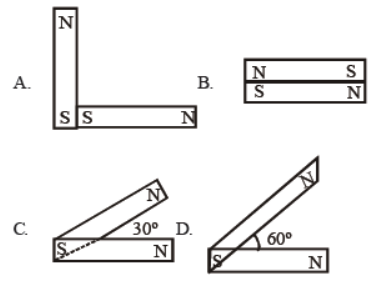
(a) A
(b) B
(c) C
(d) D
Answer: C
Question. Two short magnets have equal pole strengths but one is twice as long as the other. The shorter magnet is placed 20 cms in tan A position from the compass needle. The longer magnet must be placed on the other side of the magnetometer for no deflection at a distance equal to
(a) 20 cms
(b) 20 (2)1/3 cms
(c) 20 (2)2/3 cms
(d) 20 (2)3/3 cms
Answer: B
Question. At a certain place, the angle of dip is 30º and the horizontal component of earth’s magnetic field is 0.50 oerested. The earth’s total magnetic field (in oerested) is
(a) √3
(b) 1
(c) 1/√3
(d) 1/2
Answer: C
Question. In a permanent magnet at room temperature.
(a) magnetic moment of each molecule is zero
(b) the individual molecules have non-zero magnetic moment which are all perfectly aligned
(c) domains are partially aligned
(d) domains are all perfectly aligned
Answer: D
Question. At a temperatur of 30°C, the susceptibility of a ferromagnetic material is found to be c . Its susceptibility at 333°C is
(a) χ
(b) 0.5 χ
(c) 2χ
(d) 11.1χ
Answer: B
Question. A magnetic needle vibrates in a vertical plane parallel to the magnetic meridian about a horizontal axis passing through its centre. Its frequency is n. If the plane of oscillation is turned about a vertical axis by 90°C, the frequency of its oscillation in vertical plane will be
(a) n
(b) zero
(c) less than n
(d) more than n
Answer: C
Question. A bar magnet of length ‘l’ and magnetic dipole moment ‘M’ is bent in the form of an arc as shown in figure. The new magnetic dipole moment will be 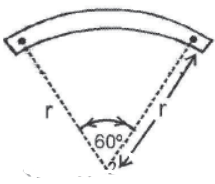
(a) 3/π M
(b) 2/π M
(c) M/2
(d) M
Answer: A
Question. Time periods of vibation of two bar magnets in sum and difference positions are 4 sec and 6 sec respectively. The ratio of their magnetic moments M1/ M2 is
(a) 6 : 4
(b) 30 : 16
(c) 2 . 6 : 1
(d) 1 . 5 : 1
Answer: C
Question. A dip circle is so set that its needle moves freely in the magnetic meridian. In this position, the angle of dip is 40º. Now the dip circle is rotated so that the plane in which the needle moves makes an angle of 30º with the magnetic meridian. In this position, the needle will dip by an angle
(a) 40º
(b) 30º
(c) more than 40º
(d) less than 40º
Answer: D
Question. A bar magnet of magnetic moment M is placed at right angles to a magnetic induction B. If a force F is experienced by each pole of the magnet, the length of the magnet will be
(a) F/MB
(b) MB/F
(c) BF/M
(d) MF/B
Answer: B
DIRECTIONS : Each question contains STATEMENT-1 and STATEMENT-2. Choose the correct answer from the following-
(a) Statement -1 is false, Statement-2 is true
(b) Statement -1 is true, Statement-2 is true; Statement -2 is a correct explanation for Statement-1
(c) Statement -1 is true, Statement-2 is true; Statement -2 is not a correct explanation for Statement-1
(d) Statement -1 is true, Statement-2 is false
Question. Statement-1 : A paramagnetic sample display greater magnetisation (for the same magnetic field) when cooled.
Statement-2 : The magnetisation does not depend on temperature.
Answer: D
Question. Statement-1 : Electromagnetic are made of soft iron.
Statement-2 : Coercivity of soft iron is small.
Answer: B
Question. Statement-1 : The ferromagnetic substance do not obey Curie’s law.
Statement-2 : At Curie point a ferromagnetic substance start behaving as a paramagnetic substance.
Answer: C
Question. Statement-1 : Magnetism is relativistic.
Statement-2 : When we move along with the charge so that there is no motion relative to us, we find no magnetic field associated with the charge.
Answer: B
Free study material for Physics
Download Practice Assignments: Class 12 Physics Chapter 05 Magnetism And Matter
Download Assignment: Chapter 05 Magnetism And Matter (Class 12 Physics)
Access structured practice assignments for Chapter 05 Magnetism And Matter designed in alignment with the latest CBSE curriculum for Class 12 Physics. These printable sets cover objective and descriptive problem types to support thorough revision.
Maximize Exam Scores with Chapter Practice Sets
- Syllabus Compliance: Sets reflect current CBSE evaluation criteria and official marking frameworks.
- Multi-Format Practice: Includes varied problem types designed to deepen comprehension across all sub-topics.
- Time Management: Routine practice optimizes pacing to finish school examinations comfortably within schedule.
Steps to Complete Chapter 05 Magnetism And Matter Assignments Successfully
- Initial Reading: Begin by reading the NCERT book for Class 12 Physics to build a baseline understanding.
- Independent Testing: Attempt assignment questions unassisted, then verify work using provided answer keys.
- Supplementary Aids: Leverage revision notes and worksheets whenever you encounter difficult topics.
FAQs
You can download free PDF assignments for Class 12 Physics Chapter 05 Magnetism And Matter from StudiesToday.com. These practice sheets have been updated for the 2026-27 session covering all concepts from latest NCERT textbook.
Yes, our teachers have given solutions for all questions in the Class 12 Physics Chapter 05 Magnetism And Matter assignments. This will help you to understand step-by-step methodology to get full marks in school tests and exams.
Yes. These assignments are designed as per the latest CBSE syllabus for 2026. We have included huge variety of question formats such as MCQs, Case-study based questions and important diagram-based problems found in Chapter 05 Magnetism And Matter.
Practicing topicw wise assignments will help Class 12 students understand every sub-topic of Chapter 05 Magnetism And Matter. Daily practice will improve speed, accuracy and answering competency-based questions.
Yes, all printable assignments for Class 12 Physics Chapter 05 Magnetism And Matter are available for free download in mobile-friendly PDF format.