

Class 12 Physics Practice Assignments: CBSE Class 12 Physics Atoms and Nuclei Assignment Set 01
Access comprehensive school assignments for Chapter 12 Atoms using the CBSE Class 12 Physics Atoms and Nuclei Assignment Set 01. Designed to align with the 2026-27 CBSE academic guidelines, these practice sets help Class 12 Physics students reinforce core concepts and improve their problem-solving accuracy.
Download Chapter 12 Atoms Assignment PDF with Solutions
Navigate directly to the solved Physics assignments using the digital viewer below. Each practice set includes detailed step-by-step solutions, allowing students to instantly cross-check their work and identify areas requiring further revision.
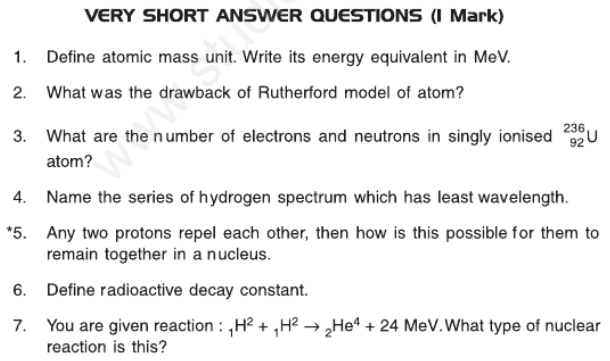
Question. The angular momentum of an electron in the 2nd excited state of a Helium ion (He+) is
(a) h/2Π
(b) 2h/2Π
(c) 3h/2Π
(d) 4h/2Π
Answer : C
Question.When an a-particle of mass m moving with velocity v bombards on a heavy nucleus of charge Ze, its distance of closest approach from the nucleus depends on m as
(a) 1/m2
(b) m
(c) 1/m
(d) 1/√m
Answer : C
Question. An alpha nucleus of energy 1/2 mv2 bombards a heavy nuclear target of charge Ze. Then the distance of closest approach for the alpha nucleus will be proportional to
(a) 1/Ze
(b) v2
(c) 1/m
(d) 1/v4
Answer : C
Question. In a Rutherford scattering experiment when a projectile of charge z1 and mass M1 approaches a target nucleus of charge z2 and mass M2, the distance of closest approach is r0. The energy of the projectile is
(a) directly proportional to z1z2
(b) inversely proportional to z1
(c) directly proportional to mass M1
(d) directly proportional to M1 × M2
Answer : A
Question. The ratio of wavelengths of the last line of Balmer series and the last line of Lyman series is
(a) 1
(b) 4
(c) 0.5
(d) 2
Answer : B
Question. Given the value of Rydberg constant is 107 m–1, the wave number of the last line of the Balmer series in hydrogen spectrum will be
(a) 0.25 × 10⁷ m–1
(b) 2.5 × 10⁷ m–1
(c) 0.025 × 10⁴ m–1
(d) 0.5 × 10⁷ m–1
Answer : A
Question. Ratio of longest wavelengths corresponding to Lyman and Balmer series in hydrogen spectrum is
(a) 7/29
(b) 9/31
(c) 5/27
(d) 5/23
Answer : C
Question. The wavelength of the first line of Lyman series for hydrogen atom is equal to that of the second line of Balmer series for a hydrogen like ion. The atomic number Z of hydrogen like ion is
(a) 3
(b) 4
(c) 1
(d) 2
Answer : D
Question. Which source is associated with a line emission spectrum?
(a) Electric fire
(b) Neon street sign
(c) Red traffic light
(d) Sun
Answer : B
Question. What is the wavelength of the least energetic photon emitted in the Lyman series of the hydrogen atom spectrum ?
(a) 150 nm
(b) 122 nm
(c) 102 nm
(d) 82 nm
Question. In Bohr’s theory, relation between principal quantum number n and radius of orbit r is:
(a) r ∝ 1/n2
(b) r ∝ n
(c) r ∝ 1/n
(d) r ∝ n2
Answer : D
Question. We wish to seen inside an atom. Assuming the atom to have a diameter of 100 pm, this means that one must be able to resolve a width of say 10 pm. If an electron microscope is used, the minimum electron energy required is about
(a) 1.5 keV
(b) 15 keV
(c) 150 keV
(d) 1.5 MeV
Answer : B
Question The ground state energy of hydrogen atom is – 13.6 eV. What is the potential energy of the electron in this state ?
(a) 0 eV
(b) – 27.2 eV
(c) 1 eV
(d) 2 eV
Answer : B
Important Questions for NCERT Class 12 Physics Nuclei
Question. In the nuclear reaction, there is a conservation of:
(a) momentum
(b) mass
(c) energy
(d) all of these
Answer : A
Question. If the radioactive decay constant of radium is 1.07 × 10⁻⁴ per year. Then its half life period approximately is equal to :
(a) 5000 years
(b) 6500 years
(c) 7000 years
(d) 8900 years
Answer : B
Question. In 88Ra226 nucleus there are :
(a) 226 protons and 88 electrons
(b) 138 protons and 88 neutrons
(c) 226 neutrons and 138 electrons
(d) 138 neutrons and 88 protons
Answer : D
Question. The activity of radioactive sample is measured as 9750 counts per minute at t = 0 and as 975 counts per minute at t = 5 minutes, the decay constant is approximately :
(a) 0.922 per minute
(b) 0.270 per minute
(c) 0.461 per minute
(d) 0.39 per minute
Answer : C
Question. The activity of a radioactive sample is 1.6 curie and its half life is 2.5 days. Then activity after 10 days will be :
(a) 0.16 curie
(b) 0.8 curie
(c) 0.1 curie
(d) 0.4 curie
Answer : C
Question. Which one of the following is used as a moderator in nuclear reaction ?
(a) Uranium
(b) Heavy water
(c) Cadmium
(d) Plutonium
Answer : B
Question. The reaction responsible for the production of light energy from the sun will be:
(a) fission
(b) fusion
(c) nuclear
(d) none of these
Answer : B
Question. Half life of a substance is 20 minutes, then the time between 33 % decay and 67 % decay will be
(a) 20 minute
(b) 40 minute
(c) 50 minute
(d) 10 minute
Answer : A
Question. Consider the following nuclear reaction X200 → A110 + B90 + Energy
If the binding energy per nucleon for X, A and B are 7.4 MeV, and 8.2 MeV and 8.2 MeV respectively, the energy released will be :
(a) 90 MeV
(b) 110 MeV
(c) 200 MeV
(d) 160 MeV
Answer : D
Question. In each fission of 92U235 releases 200 MeV, how many fissions must occur per second to produce power of 1 kW ?
(a) 1.25 × 10¹⁸
(b) 3.125 × 10¹³
(c) 3.2 × 10¹⁸
(d) 1.25 × 10¹³
Answer : B
Question. The function of heavy water in a nuclear reactor to
(a) slow down the neutrons
(b) increase the neutrons
(c) stop the electrons
(d) none of these
Answer : A
Question. Which one of the following has the highest neutrons ratio ?
(a) 92U235
(b) 8O16
(c) 2He4
(d) 26Fe56
Answer : A
Question. When radioactive substance emits an a-particle, then its position in the periodic table is lowered by
(a) two places
(b) three places
(c) five places
(c) one place
Answer : A
Question. In an atom bomb, the energy is released because of the :
(a) chain reaction of neutrons and 92U238
(b) chain reaction of neutrons and 92U235
(c) chain reaction of neutrons and 92U236
(d) chain reaction of neutrons and 92U240
Answer : B
Question. A radioactive substance decays to 1/16th of its initial activity in 40 days. The half-life of the radioactive substance expressed in days is
(a) 2.5
(b) 5
(c) 10
(d) 20
Answer : C
Question. Nuclear fusion is possible
(a) only between light nuclei
(b) only between heavy nuclei
(c) between both light and heavy nuclei
(d) only between nuclei which are stable against b-decay
Answer : A
Question. Radioactive nuclei that are injected into a potient collected at certain sites within its body, undergoing radioactive decay and emitting electromagnetic radiation. These radiations can then be recorded by a detector. This procedure provides an important diagnostic tools called
(a) Gamma camera
(b) CAT can
(c) Radiotracer technique
(d) Gamma ray spectroscopy
Answer : C
Question. In a material medium, when a positron meets an electron both the particles annihilate leading to the emission of two gamma ray photons. This process forms the basis of an important diagnostic procedure called
(a) MRI
(b) PET
(c) CAT
(d) SPECT
Answer : B
Question. Carbon dating is best suited for determining the age of fossils if their age in years is of the order of
(a) 103
(b) 104
(c) 105
(d) 106
Answer : B
Question. When an electron-positron pair annihilates, the energy released is about
(a) 0.8 × 10⁻¹³ J
(b) 1.6 × 10⁻¹³ J
(c) 3.2 × 10⁻¹³ J
(d) 4.8 × 10⁻¹³ J
Answer : B
Question. The half life of radium is about 1600 years. If 100 g of radium existing now, 25 g will remain unchanged after
(a) 4800 years
(b) 6400 years
(c) 2400 years
(d) 3200 years
Answer : D
Question. A sample of radioactive element has a mass of 10 g at an instant t = 0. The approximate mass of this element in the sample after two mean lives is
(a) 1.35 g
(b) 2.50 g
(c) 3.70 g
(d) 6.30 g
Answer : A
Question. A nuclear reaction given by ZXA → + Z+1YA + −1e0 V- represents
(a) b-decay
(b) g-decay
(c) fusion
(d) fission
Answer : A
Question. In the nuclear reaction, there is a conservation of:
(a) momentum
(b) mass
(c) energy
(d) all of these
Answer A
Question. When radioactive substance emits an a-particle, then its position in the periodic table is lowered by
(a) two places
(b) three places
(c) five places
(c) one place
Answer A
Question. In an atom bomb, the energy is released because of the :
(a) chain reaction of neutrons and 92U238
(b) chain reaction of neutrons and 92U235
(c) chain reaction of neutrons and 92U236
(d) chain reaction of neutrons and 92U240
Answer B
Question. If the radioactive decay constant of radium is 1.07 × 10⁻⁴ per year. Then its half life period approximately is equal to :
(a) 5000 years
(b) 6500 years
(c) 7000 years
(d) 8900 years
Answer B
Question. In 88Ra226 nucleus there are :
(a) 226 protons and 88 electrons
(b) 138 protons and 88 neutrons
(c) 226 neutrons and 138 electrons
(d) 138 neutrons and 88 protons
Answer D
Question. The activity of radioactive sample is measured as 9750 counts per minute at t = 0 and as 975 counts per minute at t = 5 minutes, the decay constant is approximately :
(a) 0.922 per minute
(b) 0.270 per minute
(c) 0.461 per minute
(d) 0.39 per minute
Answer C
Question. The activity of a radioactive sample is 1.6 curie and its half life is 2.5 days. Then activity after 10 days will be :
(a) 0.16 curie
(b) 0.8 curie
(c) 0.1 curie
(d) 0.4 curie
Answer C
Question. Half life of a substance is 20 minutes, then the time between 33 % decay and 67 % decay will be
(a) 20 minute
(b) 40 minute
(c) 50 minute
(d) 10 minute
Answer A
Question. Consider the following nuclear reaction X200 ® A110 + B90 + Energy
If the binding energy per nucleon for X, A and B are 7.4 MeV, and 8.2 MeV and 8.2 MeV respectively, the energy released will be :
(a) 90 MeV
(b) 110 MeV
(c) 200 MeV
(d) 160 MeV
Answer D
Question. The half life of a radioactive substance against a -decay is 1.2 × 10⁷ s. What is the decay rate for 4.0 × 10¹⁵ atoms of the substance
(a) 4.6 × 10 12 atoms/s
(b) 2.3 × 10 11 atoms/s
(c) 4.6 × 10 10 atoms/s
(d) 2.3 × 10 8 atoms/s
Answer D
Question. Actinium 231, 231Ac89, emit in succession two b-particles, four alphas, one b and one alpha plus several g rays. What is the resultant isotope:
(a) 221 Au79
(b) 211 Au 79
(c) 221 Pb 82
(d) 211 Pb 82
Answer D
Free study material for Physics
Download Practice Assignments: Class 12 Physics Chapter 12 Atoms
Revision Assignment: Chapter 12 Atoms (CBSE)
Access structured practice assignments for Chapter 12 Atoms designed in alignment with the latest CBSE curriculum for Class 12 Physics. These printable sets cover objective and descriptive problem types to support thorough revision.
Why Practice Class 12 Physics Assignments?
- Syllabus Compliance: Sets reflect current CBSE evaluation criteria and official marking frameworks.
- Multi-Format Practice: Includes varied problem types designed to deepen comprehension across all sub-topics.
- Time Management: Routine practice optimizes pacing to finish school examinations comfortably within schedule.
How to Approach Physics Chapter 12 Atoms Assignments
- Textbook Review: Always study the core NCERT book for Class 12 Physics prior to beginning the assignment.
- Independent Attempt: Solve Chapter 12 Atoms questions on your own initially before cross-checking with expert solutions.
- Error Tracking: Record challenging concepts in a dedicated notebook and practice online MCQ tests for revision.
FAQs
You can download free PDF assignments for Class 12 Physics Chapter 12 Atoms from StudiesToday.com. These practice sheets have been updated for the 2026-27 session covering all concepts from latest NCERT textbook.
Yes, our teachers have given solutions for all questions in the Class 12 Physics Chapter 12 Atoms assignments. This will help you to understand step-by-step methodology to get full marks in school tests and exams.
Yes. These assignments are designed as per the latest CBSE syllabus for 2026. We have included huge variety of question formats such as MCQs, Case-study based questions and important diagram-based problems found in Chapter 12 Atoms.
Practicing topicw wise assignments will help Class 12 students understand every sub-topic of Chapter 12 Atoms. Daily practice will improve speed, accuracy and answering competency-based questions.
Yes, all printable assignments for Class 12 Physics Chapter 12 Atoms are available for free download in mobile-friendly PDF format.