

Official CBSE Assignments for Class 12 Physics
Review targeted academic assignments with the CBSE Class 12 Physics Nuclei Assignment. Built according to official CBSE standards for the 2026-27 term, these downloadable Class 12 Physics worksheets support effective daily practice for Chapter 13 Nuclei.
Solved Practice Assignments for Physics
Navigate directly to the solved Physics assignments using the digital viewer below. Each practice set includes detailed step-by-step solutions, allowing students to instantly cross-check their work and identify areas requiring further revision.
Important Questions for NCERT Class 12 Physics Nuclei
Question. Nucleus of an atom whose atomic mass is 24 consists of
(a) 11 electrons, 11 protons and 13 neutrons
(b) 11 electrons, 13 protons and 11 neutrons
(c) 11 protons and 13 neutrons
(d) 11 protons and 13 electrons
Answer: C
Question. Which of the following nuclear reactions is not possible? 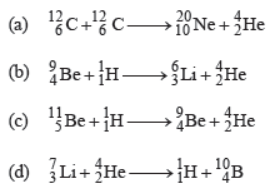
Answer: C
Question. In the uranium radioactive series, the initial nucleus is 92U238 and that the final nucleus is 82Pb206. When uranium nucleus decays to lead, the number of α particles and β particles emitted are
(a) 8α, 6 β
(b) 6α, 7β
(c) 6α, 8β
(d) 4α, 3β
Answer: A
Question. Activity of a radioactive sample decreases to (1/3) rd of its original value in 3 days. Then, in 9 days its activity will become
(a) (1/27) of the orginal value
(b) (1/9) of the original value
(c) (1/18) of the original value
(d) (1/3) of the orignal value
Answer: A
Question. Radioactive substance emits
(a) α-rays
(b) β-rays
(c) γ-rays
(d) All of the above
Answer: D
Question. At any instant, the ratio of the amount of radioactive substances is 2 : 1. If their half lives be respectively 12 and 16 hours, then after two days, what will be the ratio of the substances ?
(a) 1 : 1
(b) 2 : 1
(c) 1 : 2
(d) 1 : 4
Answer: A
Question. Consider a radioactive material of half-life 1.0 minute. If one of the nuclei decays now, the next one will decay
(a) after 1 minute
(b) after 1/loge2 minute
(c) after 1/N minute, where N is the number of nuclei present at that moment
(d) after any time
Answer: D
Question. If 200 MeV energy is released in the fission of a single U235 nucleus, the number of fissions required per second to produce 1 kilowatt power shall be (Given 1eV = 1.6 × 10⁻¹⁹ J)
(a) 3.125 × 10¹³
(b) 3.125 × 10¹⁴
(c) 3.125 × 10¹⁵
(d) 3.125 × 10¹⁶
Answer: A
Question. A nucleus of uranium decays at rest into nuclei of thorium and helium. Then :
(a) the helium nucleus has less momentum than the thorium nucleus.
(b) the helium nucleus has more momentum than the thorium nucleus.
(c) the helium nucleus has less kinetic energy than the thorium nucleus.
(d) the helium nucleus has more kinetic energy than the thorium nucleus.
Answer: D
Question. The fossil bone has a 14C : 12C ratio, which is [1/16] of that in a living animal bone. If the half-life of 14C is 5730 years, then the age of the fossil bone is
(a) 11460 years
(b) 17190 years
(c) 22920 years
(d) 45840 years
Answer: C
Question. Which one is correct about fission?
(a) Approx. 0.1% mass converts into energy
(b) Most of energy of fission is in the form of heat
(c) In a fission of U235 about 200 eV energy is released
(d) On an average, one neutron is released per fission of U235
Answer: A
Question. If Avogadro number is 6 × 10²³, then number of protons, neutrons and electrons in 14 gms of 6C14 are respecitvely
(a) 36 × 1023, 48 × 1023, 36 × 1023
(b) 36 × 1023, 36 × 1023, 36 × 1023
(c) 48 × 1023, 36 × 1023, 48 × 1023
(d) 48 × 1023, 48 × 1023, 36 × 1023
Answer: A
Question. A nuclear reaction is given by
ZXA → Z+1YA + -1e0 + v̅ , represents
(a) fission
(b) β-decay
(c) σ -decay
(d) fusion
Answer: B
Question. A radioactive nucleus undergoes a series of decay according to the scheme If the mass number and atomic number of ‘A’ are 180 and 72 respectively, then what are these numbers for A4
(a) 172 and 69
(b) 174 and 70
(c) 176 and 69
(d) 176 and 70
Answer: A
Question. Atomic number of a nucleus is Z and atomic mass is M. The number of neutron is
(a) M – Z
(b) M
(c) Z
(d) M + Z
Answer: A
Question. For a nuclear fusion process, suitable nuclei are
(a) any Nuclei
(b) heavy Nuclei
(c) light Nuclei
(d) nuclei lying in the middle of periodic table
Answer: C
Question. An element A decays into an element C by a two step process A → B+ 2He4 and B→ C + 2e- . Then,
(a) A and C are isotopes
(b) A and C are isobars
(c) B and C are isotopes
(d) A and B are isobars
Answer: A
Question. The masses of neutron and proton are 1.0087 a.m.u. and 1.0073 a.m.u. respectively. If the neutrons and protons combine to form a helium nucleus (alpha particles) of mass 4.0015 a.m.u the binding energy fo the helium nucleus will be (1 a.m.u. = 931 MeV)
(a) 28.4 MeV
(b) 20.8 MeV
(c) 27.3 MeV
(d) 14.2 MeV
Answer: A
Question. If the total binding energies of 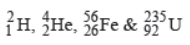
nuclei are 2.22, 28.3, 492 and 1786 MeV respectively, identify the most stable nucleus of the following. 
Answer: A
Question. A radio isotope ‘X’ with a half life 1.4 × 10⁹ years decays to ‘Y’ which is stable. A sample of the rock from a cave was found to contain ‘X’ and ‘Y’ in the ratio 1 : 7. The age of the rock is :
(a) 1.96 × 10⁹ years
(b) 3.92 × 10⁹ years
(c) 4.20 × 10⁹ years
(d) 8.40 × 10⁹ years
Answer: C
Question. A radioactive sample with a half life of 1 month has the label : ‘Activity = 2 micro curies on 1–8–1991. What would be its activity two months earlier ?
(a) 1.0 micro curie
(b) 0.5 micro curie
(c) 4 micro curie
(d) 8 micro curie
Answer: D
Question. A neutron travelling with a velocity v and kinetic energy E has a perfectly elastic head-on collision with a nucleus of an atom of mass number A at rest. The fraction of total energy retained by the neutron is approximately
(a) [(A – 1)/(A + 1)]2
(b) [(A + 1)/(A – 1)]2
(c) [(A – 1)/A]2
(d) [(A + 1)/A]2
Answer: A
Question. In gamma ray emission from a nucleus
(a) only the proton number changes
(b) both the neutron number and the proton number change
(c) there is no change in the proton number and the neutron number
(d) only the neutron number changes
Answer: C
Question. In an a-decay the kinetic energy of a-particle is 48 MeV and Q-value of the reaction is 50 MeV. The mass number of the mother nucleus is X. Find value of X/25. (Assume that daughter nucleus is in ground state)
(a) 2
(b) 4
(c) 6
(d) 8
Answer: B
Question. One milligram of matter convert into energy will give
(a) 90 joule
(b) 9 × 10³ joule
(c) 9 × 10⁵ joule
(d) 9 × 10¹⁰ joule
Answer: D
Question. Energy released in nuclear fission is due to
(a) some mass is converted into energy
(b) total binding energy of fragments is more than the binding energy of parental element
(c) total binding energy of fragments is less than the binding energy of parental element
(d) total binding energy of fragments is equal to the binding energy of parental element.
Answer: A
Question. The binding energy per nucleon is maximum in case of
(a) 24He
(b) 2656Fe
(c) 56141Ba
(d) 92235U
Answer: B
Question. A radioactive element has half life period 800 years.
After 6400 years what amount will remain?
(a) 1/2
(b) 1/16
(c) 1/8
(d) 1/256
Answer: D
Question. A radioisotope X with a half life 1.4 × 10⁹ years decays to Y which is stable. A sample of the rock from a cave was found to contain X and Y in the ratio 1 : 7. The age of the rock is
(a) 1.96 × 10⁹ years
(b) 3.92 × 10⁹ years
(c) 4.20 × 10⁹ years
(d) 8.40 × 10⁹ years
Answer: C
Question. The half life of a radioactive isotope ‘X’ is 20 years. It decays to another element ‘Y’ which is stable. The two elements ‘X’ and ‘Y’ were found to be in the ratio 1 : 7 in a sample of a given rock. The age of the rock is estimated to be
(a) 80 years
(b) 100 years
(c) 40 years
(d) 60 years
Answer: D
Question. a-particles, b-particles and g-rays are all having same energy. Their penetrating power in a given medium in increasing order will be
(a) g, a, b
(b) a, b, g
(c) b, a, g
(d) b, g, a
Answer: B
Question. A mixture consists of two radioactive materials A1 and A2 with half lives of 20 s and 10 s respectively.
Initially the mixture has 40 g of A1 and 160 g of A2.
The amount of the two in the mixture will become equal after
(a) 60 s
(b) 80 s
(c) 20 s
(d) 40 s
Answer: D
Question. The half life of a radioactive nucleus is 50 days. The time interval (t2 – t1) between the time t2 when 2/3 of it has decayed and the time t1 when 1/3 of it had decayed is
(a) 30 days
(b) 50 days
(c) 60 days
(d) 15 days
Answer: B
Question. The half life of a radioactive isotope X is 50 years. It decays to another element Y which is stable. The two elements X and Y were found to be in the ratio of 1 : 15 in a sample of a given rock. The age of the rock was estimated to be
(a) 150 years
(b) 200 years
(c) 250 years
(d) 100 years
Answer: B
Question. The activity of a radioactive sample is measured as N0 counts per minute at t = 0 and N0/e counts per minute at t = 5 minutes. The time (in minutes) at which the activity reduces to half its value is
(a) loge 2/5
(b) 5/ loge 2
(c) 5log10 2
Answer: D
Question. The decay constant of a radio isotope is l. If A1 and A2 are its activities at times t1 and t2 respectively, the number of nuclei which have decayed during the time (t1 – t2)
(a) A1t1 – A2t2
(b) A1 – A2
(c) (A1 – A2)/l
(d) l(A1 – A2)
Answer: C
Question. The number of beta particles emitted by a radioactive substance is twice the number of alpha particles emitted by it. The resulting daughter is an
(a) isomer of parent
(b) isotone of parent
(c) isotope of parent
(d) isobar of parent
Answer: C
Question. An element A decays into element C by a two step processes
A → B + 2He4 ; B → C + 2e–, Then
(a) A and C are isotopes
(b) A and C are isobars
(c) A and B are isotopes
(d) A and B are isobars.
Answer: A
Question. Curie is a unit of
(a) energy of gamma rays
(b) half-life
(c) radioactivity
(d) intensity of gamma rays
Answer: C
Question. Two radioactive materials X1 and X2 have decay constants 5l and l respectively. If initially they have the same number of nuclei, then the ratio of the number of nuclei of X1 to that X2 will be 1/e after a time
(a) 1/4λ
(b) e/λ
(c) l
(d) 1/2λ
Answer: A
Question. Two radioactive substances A and B have decay constants 5l and l respectively. At t = 0 they have the same number of nuclei. The ratio of number of nuclei of A to those of B will be (1/e)2 after a time interval
(a) 4λ
(b) 2λ
(c) 1/2λ
(d) 1/4λ
Answer: C
Question. Alpha particles are
(a) neutrally charged
(b) positron
(c) protons
(d) ionized helium atoms
Answer: D
Question. Half-lives of two radioactive substances A and B are respectively 20 minutes and 40 minutes. Initially the samples of A and B have equal number of nuclei. After 80 minutes the ratio of remaining numbers of A and B nuclei is
(a) 1 : 4
(b) 4 : 1
(c) 1 : 16
(d) 1 : 1
Answer: A
Question. In a radioactive decay process, the negatively charged emitted b-particles are
(a) the electrons produced as a result of the decay of neutrons inside the nucleus
(b) the electrons produced as a result of collisions between atoms
(c) the electrons orbiting around the nucleus
(d) the electrons present inside the nucleus.
Answer: A
Question. A sample of radioactive element containing 4 × 10¹⁶ active nuclei. Half life of element is 10 days, then number of decayed nuclei after 30 days
(a) 0.5 × 10¹⁶
(b) 2 × 10¹⁶
(c) 3.5 × 10¹⁶
(d) 1 × 10¹⁶
Answer: C
Question. a-particle consists of
(a) 2 protons only
(b) 2 protons and 2 neutrons only
(c) 2 electrons, 2 protons and 2 neutrons
(d) 2 electrons and 4 protons only
Answer: B
Question. A nucleus of uranium decays at rest into nuclei of thorium and helium. Then
(a) The helium nucleus has more momentum than the thorium nucleus.
(b) The helium nucleus has less kinetic energy than the thorium nucleus.
(c) The helium nucleus has more kinetic energy than the thorium nucleus.
(d) The helium nucleus has less momentum than the thorium nucleus.
Answer: C
Question. A deutron is bombarded on 8O16 nucleus then a-particle is emitted. The product nucleus is
(a) 7N13
(b) 5B10
(c) 4Be9
(d) 7N14
Answer: D
Question. The most penetrating radiation out of the following are
(a) b-rays
(b) g-rays
(c) X-rays
(d) a-rays.
Answer: B
Question. A radioactive substance has a half life of four months. Three fourth of the substance will decay in
(a) three months
(b) four months
(c) eight months
(d) twelve months
Answer: C
Question. In the process of fission, the binding energy per nucleon
(a) increases
(b) decreases
(c) remains unchanged
(d) increases for mass number A < 56 nuclei but decreases for mass number A > 56 nuclei
Answer: A
Question. The curve of binding energy per nucleon as a function of atomic mass number has a sharp peak for helium nucleus.
This implies that helium
(a) can easily be broken up
(b) is very stable
(c) can be used as fissionable meterial
(d) is radioactive
Answer: B
Question. Half lives of two radio active substance A & B are respectively 20 minutes & 40 minutes. Initially the samples of A & B have equal numbers of nulcei. After 80 minutes the ratio of remaining numbers of A & B nuclei is
(a) 1 : 16
(b) 4 : 1
(c) 1 : 4
(d) 1 : 1
Answer: C
Question. An archaeologist analyses the wood in a prehistoric structure and finds that C14 (Half life = 5700 years) to C12 is only one-fourth of that found in the cells of buried plants. The age of the wood is about
(a) 5700 years
(b) 2850 years
(c) 11,400 years
(d) 22,800 years
Answer: C
Question. If the end A of a wire is irradiated with a -rays and the other end B is irradiated with β-rays. Then
(a) a current will flow from A to B
(b) a current will flow from B to A
(c) there will be no current in the wire
(d) a current will flow from each end to the mid-point of the wire
Answer: A
Question. The electrons cannot exist inside the nucleus because
(a) de-Broglie wavelength associated with electron in β -decay is much less than the size of nucleus
(b) de-Broglie wavelength associated with electron in β -decay is much greater than the size of nucleus
(c) de-Broglie wavelength associated with electron in β -decay is equal to the size of nucleus
(d) negative charge cannot exist in the nucleus
Answer: B
Question. Actinium 231, 231 AC89, emit in succession two β particles,four α-particles, one β and one α plus several γ rays. What is the resultant isotope?
(a) 221Au79
(b) 211Au 79
(c) 221 Pb 82
(d) 211 Pb 82
Answer: D
Question. A nucleus m/nX emits one α-particle and two β-particles.
The resulting nucleus is 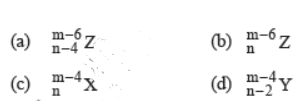
Answer: C
Question. Which of the following is best nuclear fuel
(a) thorium 236
(b) plutonium 239
(c) uranium 236
(d) neptunium 239
Answer: B
Question. The mass defect per nucleon is called
(a) binding energy
(b) packing fraction
(c) ionisation energy
(d) excitation energy
Answer: B
Question. Half life of radioactive element depends upon
(a) amount of element present
(b) temperature
(c) pressure
(d) nature of element
Answer: D
Question. Fusion reaction takes place at high temperature because
(a) nuclei break up at high temperature
(b) atoms get ionised at high temperature
(c) kinetic energy is high enough to overcome the coulomb repulsion between nuclei
(d) molecules break up at high temperature
Answer: C
Question. A gamma ray photon creates an electron-positron pair. If the rest mass energy of an electron is 0.5 MeV and the total kinetic energy of the electron-positron pair is 0.78 MeV, then the energy of the gamma ray photon must be
(a) 0.78 MeV
(b) 1.78 MeV
(c) 1.28 MeV
(d) 0.28 MeV
Answer: B
Question. The mass of a 73 Li nucleus is 0.042 u less than the sum of the masses of all its nucleons. The binding energy per nucleon of 73 Li nucleus is nearly
(a) 46 MeV
(b) 5.6 MeV
(c) 3.9 MeV
(d) 23 MeV
Answer: B
Question. If an electron and positron annihilate, then the energy released is
(a) 3.2 x 10⁻¹³ J
(b) 1.6 x 10⁻¹³ J
(c) 4.8 x 10⁻¹³ J
(d) 6.4 x 10⁻¹³ J
Answer: B
Question. The average binding energy per nucleon is maximum for the nucleus
(a) 2He4
(b) 8O16
(c) 26Fe56
(d) 92U238
Answer: C
Question. The ratio of half-life times of two elements A and B is TA/TB .
The ratio of respective decay constant λA/λB , is
(a) TB / TA
(b) TA / TB
(c) TA + TB/TA
(d) TA - TB/TA
Answer: A
Question. A radioactive substance contains 10000 nuclei and its halflife period is 20 days. The number of nuclei present at the end of 10 days is
(a) 7070
(b) 9000
(c) 8000
(d) 7500
Answer: A
Question. 
energy Q released is :
(a) 19.6 MeV
(b) – 2.4 MeV
(c) 8.4 MeV
(d) 17.3 MeV
Answer: D
Q1. Define mass defect and binding energy.
Q2. Draw the graph of binding energy per nucleon vs. atomic number. Why do atoms with atomic no less than 30 undergo fusion reaction.
Q3. State properties of nuclear forces.
Q4. A nucleus X of mass no. 187 and atomic no. 75 emits an α particle followed by a β particle and then an α particle to give nuclei X1, X2and X3 in succession. Write reactions for these processes.
Q5. Define radioactive constant and half life.
Q6. The activity of a radioactive material drops to 1/16 of its original value in 20 years. What is its half life?
Q7. A radioactive material has 4x 1060 nuclei. 30 seconds later 1x1060 are remaining. What is its half life?
Q8. What is the role of graphite and Cadmium rods in a nuclear reactor?
Q9. What is reactor constant and ‘a reactor goes critical’ means?
Q10. Fission of a Uranium atom produces about 200Mev energy while fusion of four Hydrogen atoms produces 24.7 Mev energy. Then why are fusion reactions considered more dangerous than fission reactions?
Submit by 1.8.14
Free study material for Physics
Download Practice Assignments: Class 12 Physics Chapter 13 Nuclei
Revision Assignment: Chapter 13 Nuclei (CBSE)
Access structured practice assignments for Chapter 13 Nuclei designed in alignment with the latest CBSE curriculum for Class 12 Physics. These printable sets cover objective and descriptive problem types to support thorough revision.
Key Advantages of Solving Chapter 13 Nuclei Assignments
- Curriculum Standards: Assignments match modern CBSE sample formats to ensure relevant preparation.
- Thorough Revision: Detailed problem sets reinforce core concepts and eliminate conceptual weak spots.
- Execution Speed: Timed practice with assignment sets sharpens overall response timing.
Steps to Complete Chapter 13 Nuclei Assignments Successfully
- Textbook Review: Always study the core NCERT book for Class 12 Physics prior to beginning the assignment.
- Independent Attempt: Solve Chapter 13 Nuclei questions on your own initially before cross-checking with expert solutions.
- Error Tracking: Record challenging concepts in a dedicated notebook and practice online MCQ tests for revision.
FAQs
You can download free PDF assignments for Class 12 Physics Chapter 13 Nuclei from StudiesToday.com. These practice sheets have been updated for the 2026-27 session covering all concepts from latest NCERT textbook.
Yes, our teachers have given solutions for all questions in the Class 12 Physics Chapter 13 Nuclei assignments. This will help you to understand step-by-step methodology to get full marks in school tests and exams.
Yes. These assignments are designed as per the latest CBSE syllabus for 2026. We have included huge variety of question formats such as MCQs, Case-study based questions and important diagram-based problems found in Chapter 13 Nuclei.
Practicing topicw wise assignments will help Class 12 students understand every sub-topic of Chapter 13 Nuclei. Daily practice will improve speed, accuracy and answering competency-based questions.
Yes, all printable assignments for Class 12 Physics Chapter 13 Nuclei are available for free download in mobile-friendly PDF format.