

Download CBSE Class 12 Physics Assignments
Review targeted academic assignments with the CBSE Class 12 Physics Electromagnetic Induction Alternating Currents Assignment Set 01. Built according to official CBSE standards for the 2026-27 term, these downloadable Class 12 Physics worksheets support effective daily practice for Chapter 06 Electromagnetic Induction.
Access CBSE School Assignments and Answers
Access the complete assignment PDF for Class 12 Physics below. Regular practice with these targeted academic tasks builds familiarity with standard question patterns and helps secure higher marks in final school evaluations.
Electromagnetic Induction Alternating Currents MCQ Questions with Answers Class 12 Physics
Question- The self inductance associated with a coil is independent of
(a) current
(b) time
(c) induced voltage
(d) resistance of coil
Answer-(d)
Question-A conducting loop is placed in a uniform magnetic field with its plane perpendicular to the field. An e.m.f. is induced in the loop, if
(a) it is translated.
(b) it is rotated about its axis.
(c) both (a) and (b).
(d) it is rotated about its diameter.
Answer-(d)
Question-An induced e.m.f. is produced when a magnet is plunged into a coil. The strength of the induced e.m.f. is independent of
(a) the strength of the magnet
(b) number of turns of coil
(c) the resistivity of the wire of the coil
(d) speed with which the magnet is moved
Answer-(c)
Question-According to Faraday’s law of electromagnetic induction
(a) electric field is produced by time varying magnetic flux.
(b) magnetic field is produced by time varying electric flux.
(c) magnetic field is associated with a moving charge.
(d) None of these
Answer-(a)
Question-Mutual induction is the production of induced e.m.f. in a coil due to the changes of current in the
(a) same coil
(b) neighbouring coil
(c) both (a) and (b)
(d) neither (a) nor (b)
Answer-(b)
Question-A moving conductor coil produces an induced e.m.f. This is in accordance with
(a) Lenz’s law
(b) Faraday’s law
(c) Coulomb’s law
(d) Ampere’s law
Answer-(b)
Question-Direction of current induced in a wire moving in a magnetic field is found using
(a) Fleming’s left found rule
(b) Fleming’s right hand rule
(c) Ampere’s rule
(d) Right hand clasp rule
Answer-(b)
Question-A coil of insulated wire is connected to a battery. If it is taken to galvanometer, its pointer is deflected, because
(a) the induced current is produced
(b) the coil acts like a magnet
(c) the number of turns in the coil of the galvanometer are changed
(d) None of these
Answer-(a)
Question-Magnetic flux is
(a) total charge per unit area.
(b) total current through a surface.
(c) total number of magnetic field lines passing normally through given area.
(d) total e.m.f. in closed circuit.
Answer-(a)
Question-In electromagnetic induction, the induced charge is independent of
(a) change of flux
(b) time.
(c) resistance of the coil
(d) None of these
Answer-(b)
Question-The mutual inductance between two coils depends on
(a) medium between the coils
(b) separation between the two coils
(c) orientation of the two coils
(d) All of the above
Answer-(d)
Question- Len’z law provides a relation between
(a) current and magnetic field.
(b) induced e.m.f. and the magnetic flux.
(c) force on a conductor in magnetic field.
(d) current and induced e.m.f.
Answer-(b)
Question-A coil of insulated wire is connected to a battery. If it is connected to galvanometer, its pointer is deflected, because
(a) induced current is set up
(b) no induced current is set up
(c) the coil behaves as a magnet
(d) the number of turns is changed
Answer-(a)
Question-Whenever the magnetic flux linked with an electric circuit changes, an emf is induced in the circuit. This is called
(a) electromagnetic induction
(b) lenz’s law
(c) hysteresis loss
(d) kirchhoff’s laws
Answer-(a)
Question-A cylindrical bar magnet is kept along the axis of a circular coil. On rotating the magnet about its axis, the coil will have induced in it
(a) a current
(b) no current
(c) only an e.m.f.
(d) both an e.m.f. and a current
Answer-(b)
Question-A circular coil expands radially in a region of magnetic field and no electromotive force is produced in the coil This is because
(a) the magnetic field is constant
(b) the magnetic field is in the same plane as the circular coil and it may or may not vary.
(c) the magnetic field has a perpendicular (to the plane of the coil) component whose magnitude is decreasing suitably.
(d) both (b) and (c).
Answer-(d)
Question-Whenever, current is changed in a coil, an induced e.m.f. is produced in the same coil. This property of the coil is due to
(a) mutual induction
(b) self induction
(c) eddy currents
(d) hysteresis
Answer-(b)
Question-An inductor may store energy in
(a) its electric field
(b) its coils
(c) its magnetic field
(d) both in electric and magnetic fields
Answer-(c)
Question-Which of the following does not use the application of eddy current ?
(a) Electric power meters
(b) Induction furnace
(c) LED lights
(d) Magnetic brakes in trains
Answer-(c)
Question-Induction furnace make use of
(a) self induction
(b) mutual induction
(c) eddy current
(d) None of these
Answer-(c)
Question-The emf is induced in a single, isolated coil due to ...A... of flux through the coil by means of varying the current through the same coil. This phenomenon is called ...B... Here, A and B refer to
(a) constancy, mutual induction
(b) change, self induction
(c) constancy, self induction
(d) changes, mutual induction
Answer-(b)
Question-The self inductance of a coil is a measure of
(a) electrical inertia
(b) electrical friction
(c) induced e.m.f.
(d) induced current
Answer-(a)
Question-Lenz’s law is a consequence of the law of conservation of
(a) charge
(b) mass
(c) energy
(d) momentum
Answer- (c)
Question- The coils in resistance boxes are made from doubled insulated wire to nullify the effect of
(a) heating
(b) magnetism
(c) pressure
(d) self induced e.m.f.
Answer-(d)
Question-Two pure inductors each of self inductance L are connected in series, the net inductance is
(a) L
(b) 2 L
(c) L/2
(d) L/4
Answer-(b)
Question-The self inductance associated with a coil is independent of
(a) current
(b) induced voltage
(c) time
(d) resistance of a coil
Answer-(d)
Question- Induction coil is an instrument based on the principle of
(a) electromagnetic induction
(b) mutual induction
(c) self induction
(d) induction furnace.
Answer-(b)
Question-Production of induced e.m.f. in a coil due to the changes of current in the same coil is
(a) self induction
(b) mutual induction
(c) dynamo
(d) none of these
Answer-(a)
Question- Henry is the S.I. unit of
(a) resistance
(b) capacity
(c) inductance
(d) current
Answer-(c)
Question- Eddy currents are produced when
(a) A metal is kept in varying magnetic field
(b) A metal is kept in the steady magnetic field
(c) A circular coil is placed in a magnetic field
(d) Through a circular coil, current is passed
Answer-(a)
Question-A magnet is moved towards a coil (i) quickly (ii) slowly, then the induced e.m.f. is
(a) larger in case (i)
(b) smaller in case (i)
(c) equal to both the cases
(d) larger or smaller depending upon the radius of the coil
Answer-(a)
Question- When current i passes through an inductor of self inductance L, energy stored in it is 1/2. L i2. This is stored in the
(a) current
(b) voltage
(c) magnetic field
(d) electric field
Answer-(c)
Question-The polarity of induced emf is given by
(a) Ampere's circuital law
(b) Biot-Savart law
(c) Lenz’s law
(d) Fleming's right hand rule
Answer-(c)
Question. An electron and proton are moving on straight parallel paths with same velocity. They enter a semi-infinite region of uniform magnetic field perpendicular to the velocity. Which of the following statement (s) is/are true?
a. They will never come out of the magnetic field region
b. They will come out travelling along parallel paths
c. They will come out at the same time
d. They will come out at different times
Answer : B, D
Question. A particle of mass M and positive charge Q, moving with a constant velocity υ1 = 4iˆms−1 , enters a region of uniform static magnetic field normal to the x-y plane. The region of the magnetic field extends from x = 0 to x = L for all values of y. after passing through this region, the particle emerges on the other side after 10 milliseconds with a velocity υ2 = 2(√3iˆ + ˆj )ms−1 .The correct statements (s) is (are)
a. the direction of the magnetic field is –z direction.
b. the direction of the magnetic field is +z direction.
c. the magnitude of the magnetic field is 50πM / 3Q units
d. the magnitude of the magnetic field is 100πM / 3Q units
Answer : A, C
Question. Consider the motion of a positive point charge in a region where there are simultaneous uniform electric and magnetic fields E = E0 ˆj and B = B0 ˆj. At time t = 0, this charge has velocity v in the x-y plane, making an angle θ with the x-axis. Which of the following options (s) is (are) correct for time t > 0?
a. If θ = 0°, the charge moves in a circular path in the x-z plane
b. If θ = 0°, the charge undergoes helical motion with constant pith along the y-axis
c. If θ =10°, the charge undergoes helical motion with its pith increasing with time, along the y-axis
d. If θ = 90°, the charge undergoes linear but accelerated motion along the y-axis.
Answer : A
Question. The radius of curvature of the path of a charged particle moving in a static uniform magnetic field is
a. Directly proportional to the magnitude of the charge on the particle
b. Directly proportional to the magnitude of the linear momentum of the particle
c. Directly proportional to the kinetic energy of the particle
d. Inversely proportional to the magnitude of the magnetic field
Answer : A, B, C
Question. The current sensitivity of a moving coil galvanometer can be increased by
a. Increasing the magnetic field of the permanent magnet
b. Increasing the area of the deflecting coil
c. Increasing the number of turns in the coil
d. Increasing the restoring couple of the coil
Answer : B, D
Assertion and Reason
Note: Read the Assertion (A) and Reason (R) carefully to mark the correct option out of the options given below:
a. If both assertion and reason are true and the reason is the correct explanation of the assertion.
b. If both assertion and reason are true but reason is not the correct explanation of the assertion.
c. If assertion is true but reason is false.
d. If the assertion and reason both are false.
e. If assertion is false but reason is true.
Question. Assertion: A compass needle when placed on the magnetic north pole of the earth rotates in vertical direction.
Reason: The earth has only horizontal component of its magnetic field at the north poles.
Answer : D
Question. Assertion: The susceptibility of diamagnetic materials does not depend upon temperature.
Reason: Every atom of a diamagnetic material is not a complete magnet in itself.
Answer : C
Question. Assertion: The properties of paramagnetic and ferromagnetic substance are not effected by heating.
Reason: As temperature rises, the alignment of molecular magnets gradually decreases.
Answer : E
Question. Assertion: If an electron is not deflected while passing through a certain region of space, then only possibility is that there is no magnetic region.
Reason: Force is directly proportional to the magnetic field applied.
Answer : E
Question. Assertion: The tangent galvanometer can be made more sensitive by increasing the number of turns of its coil.
Reason: Current through galvanometer is proportional to the number of turns of coil.
Answer : B
Question. Assertion: The ferromagnetic substance do not obey Curie’s law.
Reason: At Curie point a ferromagnetic substance start behaving as a paramagnetic substance.
Answer : B
Question. Assertion: The coil is bound over the metallic frame in moving coil galvanometer.
Reason: The metallic frame help in making steady deflection without any oscillation.
Answer : A
Question. Assertion: Reduction factor (K) of a tangent galvanometer helps in reducing deflection to current.
Reason: Reduction factor increases with increase of current.
Answer : C
Question. Assertion: Free electron always keep on moving in a conductor even then no magnetic force act on them in magnetic field unless a current is passed through it.
Reason: The average velocity of free electron is zero.
Answer : A
Question. Assertion: If an electron, while coming vertically from outer space, enter the earth's magnetic field, it is deflected towards west.
Reason: Electron has negative charge.
Answer : B
Question. Assertion: If a charged particle is moving on a circular path in a perpendicular magnetic field, the momentum of the particle is not changing,.
Reason: Velocity of the particle in not changing in the magnetic field.
Answer : D
Question. Assertion: The energy of charged particle moving in a uniform magnetic field does not change.
Reason: Work done by magnetic field on the charge is zero.
Answer : A
Question. Assertion: A circular loop carrying current lies in XY plane with its center at origin having a magnetic flux in negative Z-axis.
Reason: Magnetic flux direction is independent of the direction of current in the conductor.
Answer : C
Question. Assertion: The ion cannot move with a speed beyond a certain limit in a cyclotron.
Reason: As velocity increases time taken by ion increases.
Answer : C
Question. Assertion: A direct current flows through a metallic rod, produced magnetic field only outside the rod.
Reason: There is no flow of charge carriers inside the rod.
Answer : D
Question. Assertion: If a proton and an α-particle enter a uniform magnetic field perpendicularly, with the same speed, then the time period of revolution of the α-particle is double than that of proton.
Reason: In a magnetic field, the time period of revolution of a charged particle is directly proportional to mass.
Answer : B
Comprehension Based
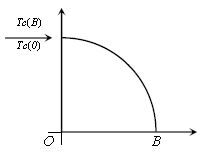
Electrical resistance of certain materials, know as superconductors, changes abruptly from a non-zero value to zero as their temperature is lowered below a critical temperature TC (0).An interesting property of superconductors is that their critical temperature becomes smaller than TC (0).if they are placed in a magnetic field i.e., the critical temperature TC (B) is a function of the magnetic field strength B. the dependence of TC (B) on B is shown in the figure.
Question. In the graphs below, the resistance R of a superconductor is shown as a function of its temperature T for two different magnetic fields B1 (solid line) and B2 (dashed line). If B2 is larger than B1 , which of the following graphs shows the correct variation of R with T in these fields?
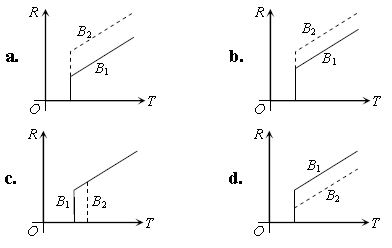
Answer : A
Question. A superconductor has When a magnetic field of 7.5 Tesla is applied, its decreases to 75 K. for this material one can definitely say that when: (Note T = Tesla)
a. B = 5T, TC(B) = 80 K
b. B = 10T, TC(B) = 70 K
c. B = 10T, 75K < TC(B) < 100 K
d. B = 10T, TC(B) = 70 K
Answer : B
Free study material for Physics
Chapter Assignment & Practice Material for Class 12 Physics Chapter 06 Electromagnetic Induction
Class 12 Physics Chapter 06 Electromagnetic Induction Printable Assignments
Review targeted chapter assignments for Class 12 Physics Chapter 06 Electromagnetic Induction. Built according to official CBSE guidelines, these downloadable problem sets help students build accuracy and prepare effectively for school tests.
Why Practice Class 12 Physics Assignments?
- Syllabus Compliance: Sets reflect current CBSE evaluation criteria and official marking frameworks.
- Multi-Format Practice: Includes varied problem types designed to deepen comprehension across all sub-topics.
- Time Management: Routine practice optimizes pacing to finish school examinations comfortably within schedule.
How to Approach Physics Chapter 06 Electromagnetic Induction Assignments
- Textbook Review: Always study the core NCERT book for Class 12 Physics prior to beginning the assignment.
- Independent Attempt: Solve Chapter 06 Electromagnetic Induction questions on your own initially before cross-checking with expert solutions.
- Error Tracking: Record challenging concepts in a dedicated notebook and practice online MCQ tests for revision.
FAQs
You can download free PDF assignments for Class 12 Physics Chapter 06 Electromagnetic Induction from StudiesToday.com. These practice sheets have been updated for the 2026-27 session covering all concepts from latest NCERT textbook.
Yes, our teachers have given solutions for all questions in the Class 12 Physics Chapter 06 Electromagnetic Induction assignments. This will help you to understand step-by-step methodology to get full marks in school tests and exams.
Yes. These assignments are designed as per the latest CBSE syllabus for 2026. We have included huge variety of question formats such as MCQs, Case-study based questions and important diagram-based problems found in Chapter 06 Electromagnetic Induction.
Practicing topicw wise assignments will help Class 12 students understand every sub-topic of Chapter 06 Electromagnetic Induction. Daily practice will improve speed, accuracy and answering competency-based questions.
Yes, all printable assignments for Class 12 Physics Chapter 06 Electromagnetic Induction are available for free download in mobile-friendly PDF format.