

Class 12 Physics Practice Assignments: CBSE Class 12 Physics Electrostatics Assignment
Explore structured practice materials through the CBSE Class 12 Physics Electrostatics Assignment. Tailored for Class 12 learners, utilizing these Physics assignments ensures thorough preparation and strengthens foundational knowledge before final CBSE evaluations.
Download Chapter 02 Electrostatic Potential And Capacitance Assignment PDF with Solutions
Navigate directly to the solved Physics assignments using the digital viewer below. Each practice set includes detailed step-by-step solutions, allowing students to instantly cross-check their work and identify areas requiring further revision.
Question. An isolated metal sphere of radius R is electrically charged. It is connected by means of a thin connecting wire to a very distant uncharged metal sphere Y of radius r (r < R). Then:
a. the total charge is uniformly and equally distributed over the two sphere
b. the total charge is uniformly and unequally distributed over the two spheres
c. the final potential energy of the system is less than the initial potential energy
d. no amount of energy is lost in the process
Answer : B, C,D
Question. A point charge is brought in an electric field. The electric field at a nearby point:
a. will increase if the charge is positive
b. will decrease if the charge is negative
c. may increase if the charge is positive
d. may decrease if the charge is negative
Answer : C, D
Question. Let E1 (r), E2 (r) and E3 (r) be the respective electric fields at a distance r from a point charge Q, an infinitely long wire with constant linear charge density ,λ and an infinite plane with uniform surface chare densityσ . If E1 (r0) = E2 (r0) = E3 (r0) at a given distance r0 then:
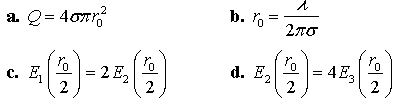
Answer : C
Question. A non-conducting solid sphere of radius R is uniformly charged. The magnitude of the electric field due to the sphere at a distance r from its centre:
a. increases as r increases, for r < R
b. decreases as r increases, for 0 < r < ∞
c. decreases as r increases, for R < r < ∞
d. is discontinuous at r = R
Answer : A, C
Question. Under the influence of the coulomb field of charge = Q,a chare-q is moving around it in an elliptical orbit. Find out the correct statement (s):
a. The angular momentum of the charge is –q constant
b. The linear momentum of the charge is –q constant
c. The angular velocity of the charge –q constant
d. The linear speed of the charge is –q constant
Answer : A
Question. A spherical metal shell A of radius and a solid metal sphere B of radius RB (< RA ) are kept far apart and each is given charge +Q. Now they are connected by a thin metal wire. Then:
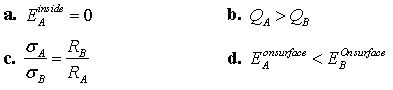
Answer : ALL
Question. There is a uniform electric field of strength 3 10 V/m along y-axis. A body of mass 1g and charge 10–6C is projected into the field from origin along the positive x- axis with a velocity 10m/s. Its speed in m/s after 10s is: (Neglect gravitation)
a. 10
b. 5√2
b. 10√2
d. 20
Answer : C
Question. An electric dipole is placed at the centre of a sphere. Select the correct alternative/(s)
a. The flux of electric field through the sphere is zero
b. The electric field is zero at every point of the sphere
c. The electric field is not zero anywhere on the sphere
d. The electric field is zero on a circle on the sphere
Answer : A, C
Question. R and S are two non identical metal spheres, placed near each other and insulated from each other. R is positively charged while S is negatively charged, with same quantity of charge. Then:
a. the charge on each sphere will be uniformly and equally distributed over its surface
b. the potential on that part of surface of R facing S is less than the potential on the other part
c. each sphere has the same potential through-out its volume but this potential is different from that on the other sphere
d. the electrostatic force on the bigger sphere is same as that on the smaller sphere
Answer : C, D
Question. Two non-conducting solid spheres of radii R and 2 R, having uniform volume charge densities ρ1 and ρ2 respectively, touch each other. The net electric field at a distance 2R from the centre of the smaller sphere, along the line joining the centre of the spheres, is zero. The ratio ρ1 / ρ2 can be:
a. −4
b. -32/25
c. 32/25
d. 4
Answer : B, D
Question. A positively charged thin metal ring of radius R is fixed in the xy– plane with its centre at the O. A negatively charged particle P is released from rest at the point (0,0, z0 ) , where z0 > 0 . Then the motion of P is:
a. Periodic for all values of 0 z satisfying 0 < z0 < ∞
b. Simple harmonic for all values of satisfying 0 < z0 < R
c. Approximately simple harmonic provided z0 << R
d. Such that P crosses O and continues to move along the negative z − axis towards z = −∞
Answer : A, C
Question. A dielectric slab of thickness d is inserted in a parallel plate capacitor whose negative plate is at x = 0 and positive plate is at x = 3d . The slab is equidistant from the plates. The capacitor is given some charge. As one goes from 0 to 3d :
a. The magnitude of the electric field remains the same
b. The direction of the electric field remains the same
c. The electric potential increases continuously
d. The electric potential increases at first, then decreases and again increases
Answer : B, C
Question. Which one statement is correct? A parallel plate air condenser is connected with a battery. Its charge, potential, electric field and energy are Qo , Vo , Eo and o Uo respectively. In order to fill the complete space between the plates a dielectric slab is inserted, the battery is still connected. Now the corresponding values Q, V, E and U are in relation with the initially stated as:
a. Q > Qo
b. V > Vo
c. E > Eo
d. U > Uo
Answer : A, D
Question. An ellipsoidal cavity is carved within a perfect conductor. A positive charge q is placed at the centre of the cavity. The points A and B are on the cavity surface as shown in the figure. Then:
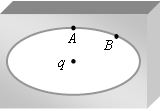
a. Electric field near A in the cavity = Electric field near B in the cavity
b. Charge density at A = Charge density at B
c. Potential at A = Potential at B
d. Total electric field flux through the surface of the cavity is q / ε0
Answer : C, D
Question. A parallel plate capacitor is charged to a potential difference of 50 V. It is discharged through a resistance. After 1 second, the potential difference between plates becomes 40 V. Then:
a. Fraction of stored energy after 1 second is 16/25
b. Potential difference between the plates after 2 seconds will be 32 V
c. Potential difference between the plates after 2 seconds will be 20 V
d. Fraction of stored energy after 1 second is 4/5
Answer : A, B
Assertion and Reason
Note: Read the Assertion (A) and Reason (R) carefully to mark the correct option out of the options given below:
a. If both assertion and reason are true and the reason is the correct explanation of the assertion.
b. If both assertion and reason are true but reason is not the correct explanation of the assertion.
c. If assertion is true but reason is false.
d. If the assertion and reason both are false.
e. If assertion is false but reason is true.
Question. Assertion: A positive charge +q is located at the centre of a circle W1 is the work done in taking a small positive charge +q0 from A to B and W2 is the work done in taking the same charge from A to C. Then W2 > W1
Reason: Work done = charge × potential difference.
Answer : D
Question. Assertion: If an electron is moved from P to Q, its potential energy increases (see Fig.)
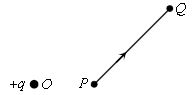
Reason: Potential at Q is less than that at P.
Answer : C
Question. Assertion: The electric field in the region around a point charge is uniform.
Reason: The equipotential surface of the electric field of a point charge is a sphere with the charge at its center.
Answer : D
Question. Assertion: Three equal charges are situated on a circle of radius r such that they form on equilateral triangle, then the electric field intensity at the centre is zero.
Reason: The force on unit positive charge at the centre, due to the three equal charges are represented by the three sides of a triangle taken in the same order. Therefore, electric field intensity at centre is zero.
Answer : A
Question. Assertion: Conductors having equal positive charge and volume, must also have same potential.
Reason: Potential depends only on charge and volume of conductor.
Answer : D
Question. Assertion: A point charge is brought in an electric field. The field at a nearby point will increase, whatever be the nature of the charge.
Reason: The electric field is independent of the nature of charge.
Answer : D
Question. Assertion: The work doen by the electric field of a nucleus in moving an electron around it in a complete orbit is greater if the orbit is elliptical than if the orbit is circular.
Reason: Electric field is conservative.
Answer : D
Question. Assertion: The electric field is always tangential to the surface of a conductor.
Reason: The potential at every point on the surface of a conductor is the same.
Answer : D
Question. Assertion: At a point in space, the electric field points towards north. In the region, surrounding this point the rate of change of potential will be zero along the east and west.
Reason: Electric field due to a charge is the space around the charge.
Answer : B
Question. Assertion: A parallel plate capacitor is charged by a d.c. source supplying a constant voltage V. If the plates are kept connected to the source and the space between the plates is filled with a dielectric, the charge on the plates will increase.
Reason: Additional charge will flow from the source to the plates.
Answer : A
Question. Assertion: A parallel plate capacitor is charged by a battery of voltage V. The battery is then disconnected. If the space between the plates is filled with a dielectric, the energy stored in the capacitor will decrease.
Reason: Work has to be done to increase the separation between the plates of a charged capacitor.
Answer : B
Question. Assertion: The force with which one plate of a parallel plate capacitor is attracted towards the other plate is equal to square of surface density per ε per unit area.
Reason: The electric field due to one charged plate of the capacitor at the location of the other is equal to surface density per ε.
Answer : D
Comprehension Based
Paragraph –I
Electrons (mass m and charge e) can be projected between two parallel plate electrodes separated by a distance d as shown in the diagram. The bottom plate is connected to mid-point C of a rheostat, while the upper plate is connected to the rheostate through a sliding jockey J. The end terminals A and B of the rheostate are connected with an ideal battery of electromotive force V. When the jockey is held at C, electrons entering the region between the plates take a certain time 0 T to reach P from O along the dotted line OP parallel to the plates, hit a phosphorescent screen and make a spot at P.
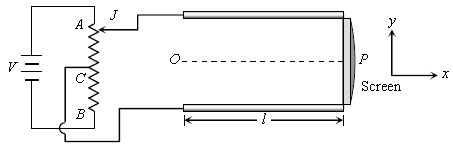
Distance d between the electrons is large enough so that none of the electrons strikes the electrodes. Ignore magnetic effects and electromagnetic radiations.
Question. In a trial, when an electron is projected at O the jockey J,is held at A. After a time interval, half of T0 , the jockey is,suddenly made to jump to the end B. Where on the screen does the electron beam make a spot?
a. Exactly at point P.
b.eVT02 / 8 md above the point P
c. eVT02 / 8 md below the point P
d. 0
Answer : B
Question. In second trial, the jockey J is made to slide from C to A and then back to C with the same speed both the way in the time interval T0 . which one of the following statements is correct?
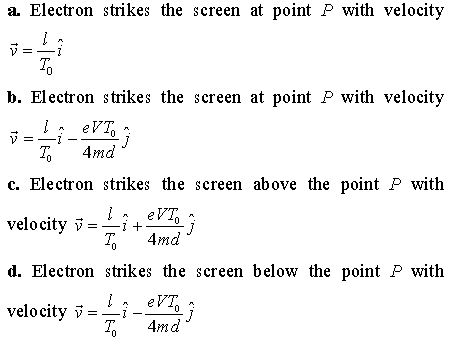
Answer : C
Paragraph –II
The nuclear charge (Ze) is non-uniformly distributed within a nucleus of radius R. The charge density ρ (r) (charge per unit volume) is dependent only on the radial distance r from the centre of the nucleus as shown in figure. The electric field is only along the radial direction.
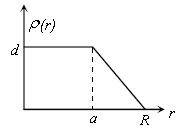
Question. The electric field at r = R is:
a. independent of a
b. directly proportional to a
c. directly proportional to a2
d. inversely proportional to a
Answer : A
Question. For a = 0, the value of d (maximum value of ρ as shown in the figure) is:
a. 3Ze/4πR3
b. 3Ze/πR3
c. 4Ze/3πR3
d. Ze/3πR3
Answer : B
Question. The electric field within the nucleus is generally observed to be linearly dependent on r. This implies:
a. a = 0
b. 2 = R/2
c. a = R
d. a = 2R/3
Answer : C
Integer
Question. A point charge q = 1 C and mass 1 kg if projected with speed 10m/s in the perpendicular direction of uniform electric field E = 100 V / m. The value of latus rectum of the path followed by charged particle (in metre) is
Answer : 2
Question. Two charges of values 2μC and −50μC are placed at a distance of 6 cm from each other. The distance of the point (in cm) from the bigger charge where the electric intensity will be zero is:
Answer : 5
Question. The electric lines of forces of two point charges are shown in Fig. What is the value of the ratio q1 / q2 ?
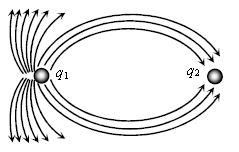
Answer : 3
Question. Eight drops of water each having a charge of 3 10−9 C having surface potential 2 V coalesce to form a single drop what is the surface potential of new drop?
Answer : 8
Question. The variation of potential V with distance r from fixed point is shown in Fig. The magnitude of electric field at r = 2 cm is
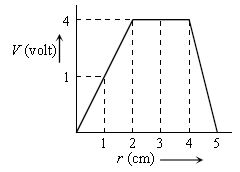
Answer : 2
Free study material for Physics
CBSE Class 12 Physics Assignments for Chapter 02 Electrostatic Potential And Capacitance
Download Assignment: Chapter 02 Electrostatic Potential And Capacitance (Class 12 Physics)
Review targeted chapter assignments for Class 12 Physics Chapter 02 Electrostatic Potential And Capacitance. Built according to official CBSE guidelines, these downloadable problem sets help students build accuracy and prepare effectively for school tests.
Maximize Exam Scores with Chapter Practice Sets
- Exam Alignment: Questions strictly follow contemporary CBSE sample papers and grading schemes.
- Comprehensive Coverage: Features objective drills, case studies, and structured descriptive problems for Chapter 02 Electrostatic Potential And Capacitance.
- Pacing & Precision: Regular problem-solving builds critical calculation speed and test-taking accuracy.
Effective Strategy for Class 12 Physics Assignments
- Initial Reading: Begin by reading the NCERT book for Class 12 Physics to build a baseline understanding.
- Independent Testing: Attempt assignment questions unassisted, then verify work using provided answer keys.
- Supplementary Aids: Leverage revision notes and worksheets whenever you encounter difficult topics.
FAQs
You can download free PDF assignments for Class 12 Physics Chapter 02 Electrostatic Potential And Capacitance from StudiesToday.com. These practice sheets have been updated for the 2026-27 session covering all concepts from latest NCERT textbook.
Yes, our teachers have given solutions for all questions in the Class 12 Physics Chapter 02 Electrostatic Potential And Capacitance assignments. This will help you to understand step-by-step methodology to get full marks in school tests and exams.
Yes. These assignments are designed as per the latest CBSE syllabus for 2026. We have included huge variety of question formats such as MCQs, Case-study based questions and important diagram-based problems found in Chapter 02 Electrostatic Potential And Capacitance.
Practicing topicw wise assignments will help Class 12 students understand every sub-topic of Chapter 02 Electrostatic Potential And Capacitance. Daily practice will improve speed, accuracy and answering competency-based questions.
Yes, all printable assignments for Class 12 Physics Chapter 02 Electrostatic Potential And Capacitance are available for free download in mobile-friendly PDF format.