

School Assignments for Class 12 Physics: All topics
Explore structured practice materials through the CBSE Class 12 Physics Revision Assignment Set 08. Tailored for Class 12 learners, utilizing these Physics assignments ensures thorough preparation and strengthens foundational knowledge before final CBSE evaluations.
Practice Class 12 Physics Assignments: All topics
Access the complete assignment PDF for Class 12 Physics below. Regular practice with these targeted academic tasks builds familiarity with standard question patterns and helps secure higher marks in final school evaluations.
Question 1. Define resistivity. State its unit.
Answer: Electrical resistivity of a material is defined as the resistance offered by a conductor of unit length and unit cross-sectional area to the flow of electric current through it.
Alternatively, it can be defined from the relation \(\rho = \frac{RA}{l}\), where \(R\) is resistance, \(A\) is area of cross-section, and \(l\) is the length of the conductor.
The SI unit of resistivity is ohm-meter (\(\Omega \cdot \text{m}\)).
In simple words: Resistivity is a material property that measures how strongly a substance opposes the flow of electric current.
Exam Tip: Always remember to include the formula \(\rho = \frac{RA}{l}\) and the correct SI unit (\(\Omega \cdot \text{m}\)) to secure full marks.
Question 2. A wire is not connected to a battery. Does it possess charge? Do electrons in it have velocity? This wire is now connected to a battery, do electrons have velocity? What is the direction of their velocity? What is the direction of current?
Answer: 1. Yes, the wire possesses net neutral charge (equal number of protons and electrons).
2. Yes, free electrons in the disconnected wire have thermal velocity, moving randomly in all directions such that the net thermal velocity and net current are zero.
3. Yes, when connected to a battery, electrons acquire a net directional drift velocity superimposed on their random thermal motion.
4. The direction of electron drift velocity is from the negative terminal to the positive terminal of the battery.
5. The direction of conventional electric current is from the positive terminal to the negative terminal of the battery (opposite to the direction of electron flow).
In simple words: Free electrons are always moving randomly inside a wire. When a battery is attached, they drift towards the positive terminal, creating an electric current in the opposite direction.
Exam Tip: Distinguish clearly between thermal random motion (zero net current) and drift velocity under an electric field (non-zero net current).
Question 3. What are the factors that affect resistivity of a wire?
Answer: The resistivity of a wire depends on:
1. The nature or type of the material of the wire.
2. The temperature of the wire.
It is independent of the geometrical dimensions (length and cross-sectional area) of the wire.
In simple words: Resistivity depends only on what material the wire is made of and its temperature, not on how long or thick the wire is.
Exam Tip: A common misconception is that resistivity depends on length and area. Emphasize that resistance depends on dimensions, but resistivity does not.
Question 4. A wire of resistance 5 \(\Omega\) is drawn out so that its length is increased to twice its original length. Calculate its new resistance.
Answer: Initial resistance \(R_1 = 5 \, \Omega\)
Initial length = \(l_1\)
Final length \(l_2 = 2l_1\)
Since the wire is drawn out, its volume remains constant:
\(A_1 l_1 = A_2 l_2\)
\(A_1 l_1 = A_2 (2l_1) \Rightarrow A_2 = \frac{A_1}{2}\)
The new resistance \(R_2\) is given by:
\(R_2 = \rho \frac{l_2}{A_2} = \rho \frac{2l_1}{\left(\frac{A_1}{2}\right)} = 4 \left(\rho \frac{l_1}{A_1}\right) = 4R_1\)
\(R_2 = 4 \times 5 \, \Omega = 20 \, \Omega\)
In simple words: When a wire is stretched to double its length, its cross-sectional area halves, making the resistance four times greater.
Exam Tip: For stretching problems where volume is constant, resistance is directly proportional to the square of the length (\(R \propto l^2\)). Thus, doubling length multiplies resistance by \(2^2 = 4\).
Question 5. The voltage-current variation X and Y are shown in the given graph-
(a) If X and Y are for two wires of different material then find out which of them has higher resistivity.
(b) If X and Y are for same wire at two different temp. then which is at lower temp.?
(c) If X and Y are for two wires connected in series and then in parallel then which of them is for parallel combination?
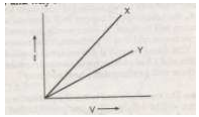
Answer: (a) In a V-I graph, the slope represents the resistance (\(R = \frac{V}{I}\)). Line X has a steeper slope than line Y, so \(R_X > R_Y\). Since \(R = \rho \frac{l}{A}\), for wires of same dimensions, higher resistance implies higher resistivity. Therefore, wire X has higher resistivity.
(b) Resistance of a metallic conductor increases with temperature. Since line X has higher resistance than line Y at the same voltage, line X corresponds to a higher temperature and line Y corresponds to a lower temperature. Therefore, Y is at the lower temperature.
(c) The equivalent resistance in parallel combination is smaller than the smallest individual resistance, whereas in series combination it is larger than the individual resistances. Since line Y has a smaller slope (lower resistance) compared to X, line Y represents the parallel combination.
In simple words: Steeper lines on a V-I graph mean higher resistance, which corresponds to higher resistivity, higher temperature, or series connection.
Exam Tip: Always check the axes of graphical questions. If the graph is I-V (current on y-axis, voltage on x-axis), slope is conductance (\(1/R\)), which is the reverse of V-I graphs.
Question 6. Find the effective resistance of the given circuit. Also find the current drawn from the cell of e.m.f. 1 V and internal resistance \(\frac{2}{3} \, \Omega\).
Answer: Analyzing the given bridge circuit (Wheatstone bridge network):
Let each resistor in the bridge arms have a resistance of 1 \(\Omega\) (as typically labeled in standard symmetric bridge diagrams of this format).
The bridge is balanced because the ratio of resistances in opposite arms is equal (\(\frac{1}{1} = \frac{1}{1}\)).
Therefore, no current flows through the central galvanometer/resistor branch, and it can be removed.
The upper two 1 \(\Omega\) resistors are in series: \(R_{s1} = 1 + 1 = 2 \, \Omega\)
The lower two 1 \(\Omega\) resistors are in series: \(R_{s2} = 1 + 1 = 2 \, \Omega\)
These two branches are in parallel with each other:
\(R_{\text{net}} = \frac{2 \times 2}{2 + 2} = 1 \, \Omega\)
Total resistance of the circuit including internal resistance \(r = \frac{2}{3} \, \Omega\):
\(R_{\text{total}} = R_{\text{net}} + r = 1 + \frac{2}{3} = \frac{5}{3} \, \Omega\)
Current drawn from the cell \(I = \frac{E}{R_{\text{total}}} = \frac{1}{\frac{5}{3}} = \frac{3}{5} = 0.6 \, \text{A}\)
In simple words: Recognize the balanced Wheatstone bridge, simplify the series and parallel branches to find total resistance, and apply Ohm's law with internal resistance to find the current.
Exam Tip: Always check for Wheatstone bridge symmetry before attempting complex nodal analysis.
Question 7. Draw a graph to show the variation of resistance of a wire as a function of its diameter, keeping length of the wire and temp. constant.
Answer: Resistance is given by \(R = \rho \frac{l}{A}\).
Since area \(A = \pi r^2 = \pi \left(\frac{d}{2}\right)^2 = \frac{\pi d^2}{4}\), where \(d\) is the diameter:
\(R = \frac{4\rho l}{\pi d^2}\)
Thus, resistance is inversely proportional to the square of the diameter (\(R \propto \frac{1}{d^2}\)).
The graph is a downward-sloping rectangular hyperbola curve showing a steep decrease in resistance as diameter increases.
In simple words: As a wire becomes thicker (larger diameter), its resistance decreases rapidly following an inverse-square curve.
Exam Tip: Clearly label axes and indicate the non-linear hyperbolic nature of the curve when plotting inverse-square relationships.
Free study material for Physics
Chapter Assignment & Practice Material for Class 12 Physics All topics
Class 12 Physics All topics Printable Assignments
Access structured practice assignments for All topics designed in alignment with the latest CBSE curriculum for Class 12 Physics. These printable sets cover objective and descriptive problem types to support thorough revision.
Maximize Exam Scores with Chapter Practice Sets
- Syllabus Compliance: Sets reflect current CBSE evaluation criteria and official marking frameworks.
- Multi-Format Practice: Includes varied problem types designed to deepen comprehension across all sub-topics.
- Time Management: Routine practice optimizes pacing to finish school examinations comfortably within schedule.
Effective Strategy for Class 12 Physics Assignments
- Textbook Review: Always study the core NCERT book for Class 12 Physics prior to beginning the assignment.
- Independent Attempt: Solve All topics questions on your own initially before cross-checking with expert solutions.
- Error Tracking: Record challenging concepts in a dedicated notebook and practice online MCQ tests for revision.
FAQs
You can download free PDF assignments for Class 12 Physics All topics from StudiesToday.com. These practice sheets have been updated for the 2026-27 session covering all concepts from latest NCERT textbook.
Yes, our teachers have given solutions for all questions in the Class 12 Physics All topics assignments. This will help you to understand step-by-step methodology to get full marks in school tests and exams.
Yes. These assignments are designed as per the latest CBSE syllabus for 2026. We have included huge variety of question formats such as MCQs, Case-study based questions and important diagram-based problems found in All topics.
Practicing topicw wise assignments will help Class 12 students understand every sub-topic of All topics. Daily practice will improve speed, accuracy and answering competency-based questions.
Yes, all printable assignments for Class 12 Physics All topics are available for free download in mobile-friendly PDF format.