

School Assignments for Class 12 Physics: Chapter 08 Electromagnetic Waves
Access comprehensive school assignments for Chapter 08 Electromagnetic Waves using the CBSE Class 12 Physics Electromagnetic Waves Assignment Set 01. Designed to align with the 2026-27 CBSE academic guidelines, these practice sets help Class 12 Physics students reinforce core concepts and improve their problem-solving accuracy.
Practice Class 12 Physics Assignments: Chapter 08 Electromagnetic Waves
Access the complete assignment PDF for Class 12 Physics below. Regular practice with these targeted academic tasks builds familiarity with standard question patterns and helps secure higher marks in final school evaluations.
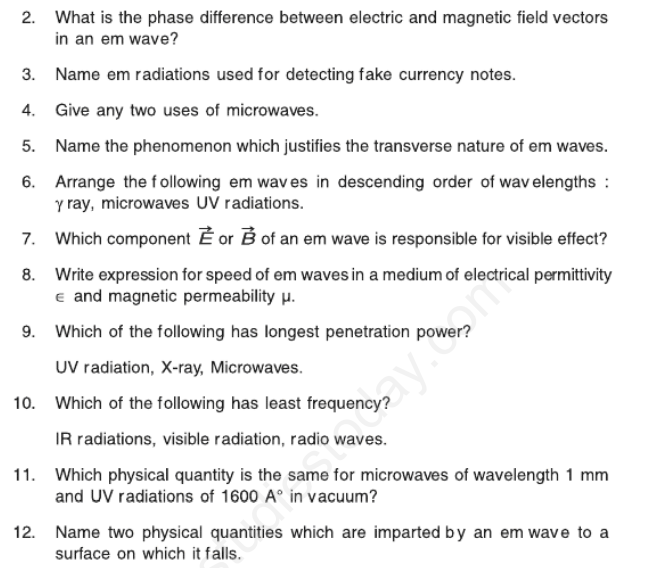
Question. Electromagnetic wave consists of periodically oscillating electric and magnetic vectors
(a) in mutually perpendicular planes but vibrating with a phase difference of Π
(b) in mutually perpendicular planes but vibrating with a phase difference of Π/2
(c) in randomly oriented planes but vibrating in phase
(d) in mutually perpendicular planes but vibrating in phase
Answer: D
Question. A parallel plate capacitor of capacitance 20 mF is being charged by a voltage source whose potential is changing at the rate of 3 V/s. The conduction current through the connecting wires, and the displacement current through the plates of the capacitor, would be, respectively
(a) zero, zero
(b) zero, 60 mA
(c) 60 mA, 60 mA
(d) 60 mA, zero
Answer: C
Question. A 100 W resistance and a capacitor of 100 W reactance are connected in series across a 220 V source. When the capacitor is 50% charged, the peak value of the displacement current is
(a) 2.2 A
(b) 11 A
(c) 4.4 A
(d) 11√2 A
Answer: A
Question. Light with an average flux of 20 W/cm2 falls on a non-reflecting surface at normal incidence having surface area 20 cm2. The energy received by the surface during time span of 1 minute is
(a) 10 × 103 J
(b) 12 × 103 J
(c) 24 × 103 J
(d) 48 × 103 J
Answer: C
Question. The ratio of contributions made by the electric field and magnetic field components to the intensity of an electromagnetic wave is (c = speed of electromagnetic waves)
(a) c : 1
(b) 1 : 1
(c) 1 : c
(d) 1 : c2
Answer: B
Question. According to Maxwell’s hypothesis, changing of electric field give rise to :
(a) magnetic field
(b) pressure gradient
(c) charge
(d) voltage
Answer: A
Question. For a transparent medium relative permeability and permittivity, μr and er are 1.0 and 1.44 respectively. The velocity of light in this medium would be
(a) 2.5 × 10⁸ m/s
(b) 3 × 10⁸ m/s
(c) 2.08 × 10⁸ m/s
(d) 4.32 × 10⁸ m/s
Answer: A
Question. If e0 and m0 are the electric permittivity and magnetic permeability in a free space, e and m are the corresponding quantities in medium, the index of refraction of the medium is
(a) √(ε0μ0 /εμ)
(b) √(εμ /ε0μ0)
(c) √(ε0μ /εμ0)
(d) √ε/ε0
Answer: B
Question. The velocity of electromagnetic radiation in a medium of permittivity e0 and permeability m0 is given by
(a) 1/√μ0ε0
(b) 1/√μ0/ε0
(c) ε0 /μ0
(d) √μ0/ε0
Answer: A
Question. What is the cause of Green house effect?
(a) Infra-red rays
(b) Ultra violet rays
(c) X-rays
(d) Radio waves
Answer: A
Question. Which of the following are not electromagnetic waves?
(a) cosmic rays
(b) γ-rays
(c) β-rays
(d) X-rays.
Answer: C
Question. The energy of electromagnetic wave in vacuum is given by the relation 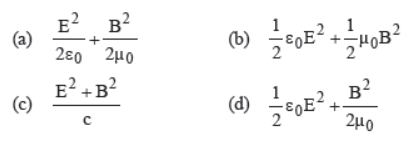
Answer: D
Question. The energy of the em waves is of the oder of 15 keV. To which part of the spectrum does it belong?
(a) Infra-red rays
(b) Ultraviolet rays
(c) γ-rays
(d) X-rays
Answer: D
Question. Which of the following radiations has the least wavelength ?
(a) γ -rays
(b) β -rays
(c) α -rays
(d) X -rays
Answer: A
Question. The frequency of electromagnetic wave, which is best suited to observe a particle of radius 3 × 10⁻⁴ cm is of the order of
(a) 1015
(b) 1014
(c) 1013
(d) 1012
Answer: B
Question. Radio waves diffract around building although light waves do not. The reason is that radio waves
(a) travel with speed larger than c
(b) have much larger wavelength than light
(c) are not electromagnetic waves
(d) None of these
Answer: B
Question. The frequency of electromagnetic wave, which best suited to observe a particle of radii 3 × 10⁻⁴ cm is of the order of
(a) 1015
(b) 1014
(c) 1013
(d) 1012
Answer: A
Question. Intensity of electromagnetic wave will be
(a) I = cμ0B02/2
(b) I = cε0B02/2
(c) I = B02/cμ0
(d) I = E02/2cε0
Answer: B
Question. An electromagnetic wave is propagating along Y-axis. Then
(a) oscillating electric field is along X-axis and oscillating magnetic field is along Y-axis
(b) oscillating electric field is along Z-axis and oscillating magnetic field is along X-axis
(c) both oscillating electric and magnetic fields are along Y-axis, but phase difference between them is 90°
(d) both oscillating electric and magnetic fields are mutually perpendicular in arbitrary direction
Answer: B
Question. The ratio of amplitude of magnetic field to the amplitude of electric field for an electromagnetic wave propagating in vacuum is equal to
(a) the speed of light in vacuum
(b) reciprocal of speed of light in vacuum
(c) the ratio of magnetic permeability to the electric susceptibility of vacuum
(d) unity
Answer: B
Question. An EM wave radiates outwards from a dipole antenna, with E0 as the amplitude of its electric field vector. The electric field E0 which transports significant energy from the source falls off as
(a) 1/r3
(b) 1/r2
(c) 1/r
(d) remains constant
Answer: C
Question. An electromagnetic wave travels in vacuum along z-direction E = (E1î + E2ĵ) cos (kz -ωt) . Choose the correct options from the following
(a) The associated magnetic field is given as B = 1/c (E1î + E2ĵ) cos (kz -ωt)
(b) The associated magnetic field is given as B = 1/c (E1î + E2ĵ) cos (kz -ωt)
(c) The given electromagnetic field is circularly polarised
(d) The given electromagnetic wave is plane polarised
Answer: D
Question. An electromagnetic wave of frequency n = 3.0 MHz passes from vacuum into a dielectric medium with relative permittivity e = 4.0. Then
(a) wavelength is doubled and frequency is unchanged
(b) wavelength is doubled and frequency becomes half
(c) wavelength is halved and frequency remains unchanged
(d) wavelength and frequency both remain unchanged
Answer: C
Question. Light with an energy flux of 25 × 104 Wm–2 falls on a perfectly reflecting surface at normal incidence. If the surface area is 15 cm2, the average force exerted on the surface is :
(a) 1.25 × 10⁻⁶ N
(b) 2.50 × 10⁻⁶ N
(c) 1.20 × 10⁻⁶ N
(d) 3.0 × 10⁻⁶ N
Answer: B
Question. Pick out the longest wavelength from the following types of radiation.
(a) blue light
(b) gamma rays
(c) X-rays
(d) red light
Answer: D
Question. One requires 11 eV of energy to dissociate a carbon monoxide molecule into carbon and oxygen atoms. The minimum frequency of the appropriate electromagnetic radiation to achieve the dissociation lies in
(a) visible region
(b) infrared region
(c) ultraviolet region
(d) microwave region
Answer: C
Question. The electric and the magnetic field associated with an E.M. wave, propagating along the +z-axis, can be represented by 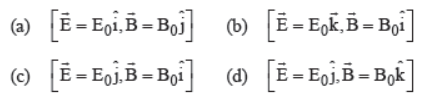
Answer: A
DIRECTIONS for Each question contains STATEMENT-1 and STATEMENT-2. Choose the correct answer from the following-
(a) Statement -1 is false, Statement-2 is true
(b) Statement -1 is true, Statement-2 is true; Statement -2 is a correct explanation for Statement-1
(c) Statement -1 is true, Statement-2 is true; Statement -2 is not a correct explanation for Statement-1
(d) Statement -1 is true, Statement-2 is false
Question. Statement 1 : Environmental damage has increased the amount of ozone in the atmosphere.
Statement 2 : Increase of ozone increases the amount of ultraviolet radiation on earth.
Answer: A
Question. Statement 1 : Radio waves can be polarised.
Statement 2 : Sound waves in air are longitudinal in nature.
Answer: C
Question. Statement 1 : The earth without atmosphere would be inhospitably cold.
Statement 2 : All heat would escape in the absence of atmosphere.
Answer: B
Question. Statement 1 : When variable frequency a.c. source is connected to a capacitor, displacement current increases with increase in frequency.
Statement 2 : As frequency increases conduction current also increases.
Answer: B
Question. Statement 1 : Television signals are received through skywave propagation.
Statement 2 : The ionosphere reflects electromagnetic waves of frequencies greater than a certain critical frequency.
Answer: A
Question. Statement 1 : Ultraviolet radiations of higher frequency waves are dangerous to human being.
Statement 2 : Ultraviolet radiation are absorbed by the atmosphere.
Answer: C
Question. Statement 1 : Short wave bands are used for transmission of radio waves to a large distance.
Statement 2 : Short waves re reflected by ionosphere.
Answer: A
Free study material for Physics
CBSE Class 12 Physics Assignments for Chapter 08 Electromagnetic Waves
Class 12 Physics Chapter 08 Electromagnetic Waves Printable Assignments
Review targeted chapter assignments for Class 12 Physics Chapter 08 Electromagnetic Waves. Built according to official CBSE guidelines, these downloadable problem sets help students build accuracy and prepare effectively for school tests.
Maximize Exam Scores with Chapter Practice Sets
- Curriculum Standards: Assignments match modern CBSE sample formats to ensure relevant preparation.
- Thorough Revision: Detailed problem sets reinforce core concepts and eliminate conceptual weak spots.
- Execution Speed: Timed practice with assignment sets sharpens overall response timing.
How to Approach Physics Chapter 08 Electromagnetic Waves Assignments
- Initial Reading: Begin by reading the NCERT book for Class 12 Physics to build a baseline understanding.
- Independent Testing: Attempt assignment questions unassisted, then verify work using provided answer keys.
- Supplementary Aids: Leverage revision notes and worksheets whenever you encounter difficult topics.
FAQs
You can download free PDF assignments for Class 12 Physics Chapter 08 Electromagnetic Waves from StudiesToday.com. These practice sheets have been updated for the 2026-27 session covering all concepts from latest NCERT textbook.
Yes, our teachers have given solutions for all questions in the Class 12 Physics Chapter 08 Electromagnetic Waves assignments. This will help you to understand step-by-step methodology to get full marks in school tests and exams.
Yes. These assignments are designed as per the latest CBSE syllabus for 2026. We have included huge variety of question formats such as MCQs, Case-study based questions and important diagram-based problems found in Chapter 08 Electromagnetic Waves.
Practicing topicw wise assignments will help Class 12 students understand every sub-topic of Chapter 08 Electromagnetic Waves. Daily practice will improve speed, accuracy and answering competency-based questions.
Yes, all printable assignments for Class 12 Physics Chapter 08 Electromagnetic Waves are available for free download in mobile-friendly PDF format.