

Class 12 Physics Practice Assignments: CBSE Class 12 Physics Current Electricity Assignment Set 01
Review targeted academic assignments with the CBSE Class 12 Physics Current Electricity Assignment Set 01. Built according to official CBSE standards for the 2026-27 term, these downloadable Class 12 Physics worksheets support effective daily practice for Chapter 03 Current Electricity.
Download Chapter 03 Current Electricity Assignment PDF with Solutions
Navigate directly to the solved Physics assignments using the digital viewer below. Each practice set includes detailed step-by-step solutions, allowing students to instantly cross-check their work and identify areas requiring further revision.
TEST SERIES (PHYSICS)
CURRENT -ELECTRICITY
Q1. A resistance R is connected across a cell of emf E,and internal resistance r. A potentiometer now measures the p.d., between the terminals of the cell as V. Write the expression for r in terms of E,V,and R
Q2.Two wires A and B of which lengths are in the ratio 1:2 and the area of crosssection are in the ratio 2:1 and of same resistivity are connected in parallel with the same source of emf.Find the ratio of drift velocities in the given two wires.
Q3. Resistance of a wire is 3.4 kΩ+_5 %.Write the order of coloured rings representing the given resistance.
Q4.Draw the resistivity ρ vs temperature t graph for a conductor.
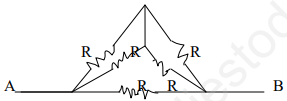
Q5.Find the equivelant resistance between A and B.
Q6.In the following the circuit if X is the position of the null point,write with reason what would be the change in position of null point due to following changes?
(a) if the resistance R is increased
(b) if the resistance S is increased by keeping R constant.
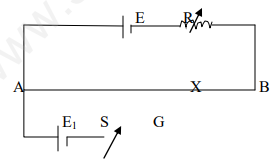
Q7.At the balancing condition of meterbridge if cell and galvanometer are interchanged,write with reason whether we will obtain zero deflection in galvanometer again?
Q8.P.d. V vs I graph for the series combination of two identical cell is given below.(a) find the emf of each cell.(b) find the internal resistance of each cell.
Important Questions for NCERT Class 12 Physics Current Electricity
Question. n equal resistors are first connected in series and then connected in parallel. What is the ratio of the maximum to the minimum resistance ?
(a) n
(b) 1/n2
(c) n2
(d) 1/n
Answer: C
Question. A set of n equal resistors, of value R each, are connected in series to a battery of emf E and internal resistance R. The current drawn is I. Now, the n resistors are connected in parallel to the same battery Then the current drawn from battery becomes 10I.
The value of n is
(a) 10
(b) 11
(c) 20
(d) 9
Answer: A
Question. A flow of 107 electrons per second in a conducting wire constitutes a current of A
(a) 1.6 × 10⁻¹² A
(b) 1.6 × 1026 A
(c) 1.6 × 10⁻²⁶ A
(d) 1.6 × 10¹² A
Answer: A
Question. The electric resistance of a certain wire of iron is R. If its length and radius are both doubled, then
(a) The resistance will be doubled and the specific resistance will be halved
(b) The resistance will be halved and the specific resistance will remain unchanged
(c) The resistance will be halved and the specific resistance will be doubled
(d) The resistance and the specific resistance, will both remain unchanged.
Answer: B
Question. A heating coil is labelled 100 W, 220 V. The coil is cut in half and the two pieces are joined in parallel to the same source. The energy now liberated per second is
(a) 200 W
(b) 400 W
(c) 25 W
(d) 50 W
Answer: B
Question. A 6 volt battery is connected to the terminals of a three metre long wire of uniform thickness and resistance of 100 ohm. The difference of potential between two points on the wire separated by a distance of 50 cm will be
(a) 2 volt
(b) 3 volt
(c) 1 volt
(d) 1.5 volt
Answer: C
Question. Three copper wires of lengths and cross-sectional areas are (l, A), (2l, A/2) and (l/2, 2A). Resistance is minimum in
(a) wire of cross-sectional area 2A
(b) wire of cross-sectional area A
(c) wire of cross-sectional area A
(d) same in all three cases.
Answer: A
Question. A charged particle having drift velocity of 7.5 × 10⁻⁴ m s–1 in an electric field of 3 × 10⁻¹⁰ V m–1, has a mobility in m2 V–1 s–1 of
(a) 2.25 × 10¹⁵
(b) 2.5 × 10⁶
(c) 2.5 × 10⁻⁶
(d) 2.25 × 10⁻¹⁵
Answer: B
Question. The mean free path of electrons in a metal is 4 × 10⁻⁸ m.
The electric field which can give on an average 2 eV energy to an electron in the metal will be in units V/m
(a) 5 × 10–11
(b) 8 × 10–11
(c) 5 × 10⁷
(d) 8 × 10⁷
Answer: C
Question. The velocity of charge carriers of current (about 1 ampere) in a metal under normal conditions is of the order of (a) a fraction of mm/sec
(b) velocity of light
(c) several thousand metres/second
(d) a few hundred metres per second
Answer: A
Question. The resistance of a discharge tube is
(a) non-ohmic
(b) ohmic
(c) zero
(d) both (b) and (c)
Answer: A
Question. In India electricity is supplied for domestic use at 220 V. It is supplied at 110 V in USA. If the resistance of a 60 W bulb for use in India is R, the resistance of a 60 W bulb for use in USA will be
(a) R
(b) 2R
(c) R/4
(d) R/2
Answer: C
Question. An electric kettle has two heating coils. When one of the coils is connected to an a.c. source, the water in the kettle boils in 10 minutes. When the other coil is used the water boils in 40 minutes. If both the coils are connected in parallel, the time taken by the same quantity of water to boil will be
(a) 8 minutes
(b) 4 minutes
(c) 25 minutes
(d) 15 minutes
Answer: A
Question. For a cell terminal potential difference is 2.2V when circuit is open and reduces to 1.8 V when cell is connected to a resistance of R = 5 W. Determine internal resistance of cell (r).
(a) 10 /9 Ω
(b) 9 /10 Ω
(c) 11/9 Ω
(d) 5 /9 Ω
Answer: A
Question. A car battery of emf 12 V and internal resistance 5 × 10⁻² W, receives a current of 60 amp from external source, then terminal potential difference of battery is
(a) 12 V
(b) 9 V
(c) 15 V
(d) 20 V
Answer: C
Question. An electrical cable of copper has just one wire of radius 9 mm. Its resistance is 5 ohm. This single copper wire of the cable is replaced by 6 different well insulated copper wires each of radius 3 mm. The total resistance of the cable will now be equal to
(a) 7.5 ohm
(b) 45 ohm
(c) 90 ohm
(d) 270 ohm
Answer: A
Question. A primary cell has an e.m.f. of 1.5 volt. When short-circuited it gives a current of 3 ampere. The internal resistance of the cell is
(a) 4.5 ohm
(b) 2 ohm
(c) 0.5 ohm
(d) (1/4.5) ohm
Answer: C
Question. If R1 and R2 are the filament resistances of 200 Ω and a 100 W bulb respectively both designed to run at the same voltage, then
(a) R2 is four times of R1
(b) R1 is four times of R2
(c) R2 is two times of R1
(d) R1 is two times of R2
Answer: C
Question. To get maximum current in a resistance of 3 ohms, one can use n rows of m cells (connected in series) connected in parallel. If the total number of cells is 24 and the internal resistance of a cell is 0.5 ohms then
(a) m = 12, n = 2
(b) m = 8, n = 3
(c) m = 2, n = 12
(d) m = 6, n = 4
Answer: A
Question. Each of the resistance in the network shown in fig. is equal to R. The resistance between the terminals A and B is 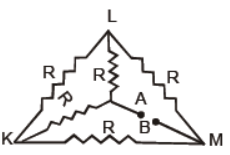
(a) R
(b) 5 R
(c) 3 R
(d) 6 R
Answer: A
Question. Is it possible that any battery has some constant value of e.m.f but the potential difference between the plates is zero?
(a) No
(b) Yes, if another identical battery is joined in series.
(c) Yes, if another identical battery is joined in opposition in series.
(d) Yes, if another similar battery is joined in parallel.
Answer: C
Question. A non-conducting ring of radius R has charge Q distributed unevenly over it. If it rotates with an angular velocity w, the equivalent current will be
(a) zero
(b) Qω
(c) Q(ω)/2π
(d) Q(ω)/2πR
Answer: C
Question. All the edges of a block with parallel faces are unequal. Its longest edge is twice its shortest edge. The ratio of the maximum to minimum resistance between parallel faces is
(a) 2
(b) 4
(c) 8
(d) indeterminate unless the length of the third edge is specified
Answer: B
Question. In the network shown below, the ring has zero resistance. The equivalent resistance between the point A and B is 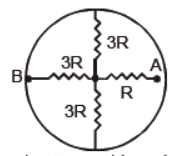
(a) 2R
(b) 4R
(c) 7R
(d) 10R
Answer: A
Question. The infinity resistance plug in a post-office box has
(a) an air gap only
(b) a resistance coil of infinite resistance
(c) largest resistance available in box
(d) resistance of the coil 5000 W
Answer: A
Question. A 4 m long wire of resistance 8 W is connected in series with a battery of e.m.f. 2 V and a resistor of 7 Ω. The internal resistance of the battery is 1 W. What is the potential gradient along the wire?
(a) 1.00 V m–1
(b) 0.75 V m–1
(c) 0.50 V m–1
(d) 0.25 V m–1
Answer: D
Question. A wire of radius r and another wire of radius 2r, both of same material and length are connected in series to each other. The combination is connected across a battery. The ratio of the heats produced in the two wires will be
(a) 4.00
(b) 2.00
(c) 0.50
(d) 0.25
Answer: A
Question. The electrochemical equivalent of a metal is 3.3 × 10⁻⁷ kg per coulomb. The mass of the metal liberated at the cathode when a 3 A current is passed for 2 seconds will be
(a) 19.8 × 10⁻⁷ kg
(b) 9.9 × 10⁻⁷ kg
(c) 6.6 × 10⁻⁷ kg
(d) 1.1 × 10⁻⁷ kg
Answer: A
Question. The length of a given cylindrical wire is increased by 100%.
Due to the consequent decrease in diameter the change in the resistance of the wire will be
(a) 100%
(b) 50%
(c) 300%
(d) 200%
Answer: C
Question. An electric heating element in vacuum is surrounded by a cavity at constant temperature of 227ºC; it consumes 60W of power to maintain a temperature of 727ºC. What is the power consumed by the element to maintain a temperature of 1227º C?
(a) 101 Ω
(b) 304 Ω
(c) 90 Ω
(d) 320 Ω
Answer: D
Question. Current I1 in the following circuit is
(a) 0.4A
(b) – 0.4 A
(c) 0.8 A
(d) – 0.8 A
Answer: B
Question. Null point with 1V cell comes out to be 55 cm and with R = 10 Ω it is 50 cm. What is the internal resistance of the cell ? (60)
(a) 0.5Ω
(b) 0.4Ω
(c) 1Ω
(d) 0.2Ω
Answer: C
Question. Three resistances are connected to form a T-shape as shown in the figure. Then the current in the 4K resistor is: 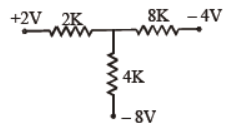
(a) 0.93mA
(b) 1.42mA
(c) 2.5mA
(d) 1.57mA
Answer: D
Question. Which of the following in electricity is analogous to momentum mv in dynamics ?
(a) IV
(b) I L
(c) Q L
(d) IQ
Answer: B
Question. Four resistors are connected as shown in fig. A 6 V battery of negligible resistance is connected across terminal AC.
The potential difference across terminals B, D will be 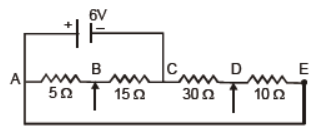
(a) 0 V
(b) 1.5 V
(c) 2 V
(d) 3 V
Answer: A
Please refer to the link below for CBSE Class 12 Physics Current Electricity Assignment Set A
Free study material for Physics
Chapter Assignment & Practice Material for Class 12 Physics Chapter 03 Current Electricity
Revision Assignment: Chapter 03 Current Electricity (CBSE)
Access structured practice assignments for Chapter 03 Current Electricity designed in alignment with the latest CBSE curriculum for Class 12 Physics. These printable sets cover objective and descriptive problem types to support thorough revision.
Maximize Exam Scores with Chapter Practice Sets
- Curriculum Standards: Assignments match modern CBSE sample formats to ensure relevant preparation.
- Thorough Revision: Detailed problem sets reinforce core concepts and eliminate conceptual weak spots.
- Execution Speed: Timed practice with assignment sets sharpens overall response timing.
How to Approach Physics Chapter 03 Current Electricity Assignments
- Textbook Review: Always study the core NCERT book for Class 12 Physics prior to beginning the assignment.
- Independent Attempt: Solve Chapter 03 Current Electricity questions on your own initially before cross-checking with expert solutions.
- Error Tracking: Record challenging concepts in a dedicated notebook and practice online MCQ tests for revision.
FAQs
You can download free PDF assignments for Class 12 Physics Chapter 03 Current Electricity from StudiesToday.com. These practice sheets have been updated for the 2026-27 session covering all concepts from latest NCERT textbook.
Yes, our teachers have given solutions for all questions in the Class 12 Physics Chapter 03 Current Electricity assignments. This will help you to understand step-by-step methodology to get full marks in school tests and exams.
Yes. These assignments are designed as per the latest CBSE syllabus for 2026. We have included huge variety of question formats such as MCQs, Case-study based questions and important diagram-based problems found in Chapter 03 Current Electricity.
Practicing topicw wise assignments will help Class 12 students understand every sub-topic of Chapter 03 Current Electricity. Daily practice will improve speed, accuracy and answering competency-based questions.
Yes, all printable assignments for Class 12 Physics Chapter 03 Current Electricity are available for free download in mobile-friendly PDF format.