

Download CBSE Class 12 Geography Assignments
Explore structured practice materials through the CBSE Class 12 Geography The world Population Assignment Set 02. Tailored for Class 12 learners, utilizing these Geography assignments ensures thorough preparation and strengthens foundational knowledge before final CBSE evaluations.
Access CBSE School Assignments and Answers
Access the complete assignment PDF for Class 12 Geography below. Regular practice with these targeted academic tasks builds familiarity with standard question patterns and helps secure higher marks in final school evaluations.
I. Read the case study given below and answer the questions that follow:
The people of a country are its real wealth. It is they who make use of the country’s resources and decide its policies. Ultimately a country is known by its people. It is important to know how many women and men a country has, how many children are born each year, how many people die and how?
Whether they live in cities or villages, can they read or write and what work do they do? The world at the beginning of 21st century recorded the presence of over 6 billion population.
The population of the world is unevenly distributed. The remark of George B. Gressey about the population of Asia that “Asia has many places where people are few and few places where people are very many” is true about the pattern of population distribution of the world also.
Question. What is the real wealth of a country?
(a) Government
(b) People
(c) Educational institutes
(d) Economy
Answer: B
Question. Why is it important to know how many women and men a country has, how many children are born each year, how many people die?
(a) For planning purpose
(b) For push factors
(c) For pull factors
(d) For preparing military strength
Answer: A
Question. The knowledge of how many women and men a country has, how many children are born each year, how many people die and how is known as:
(a) Density data
(b) Population data
(c) Sensex data
(d) None of the above
Answer: B
Question. The world at the beginning of 21st century recorded the presence of over __________population.
(a) 6 billion
(b) 8 billion
(c) 10 million
(d) 6 million
Answer: A
II. Read the case study given below and answer the questions that follow:
There are three components of population change – births, deaths and migration. Death rate plays an active role in population change. Population growth occurs not only by increasing births rate but also due to decreasing death rate. Crude Death Rate (CDR) is a simple method of measuring mortality of any area. CDR is expressed in terms of number of deaths in a particular year per thousand of population in a particular region. By and large mortality rates are affected by the region’s demographic structure, social advancement and levels of its economic development.
Question. Name the three components of population change.
(a) Migration, economy, education
(b) Migration, birth rate , death rate
(c) Migration, industries , agriculture
(d) None of the Above
Answer: B
Question. ___________ plays an active role in population change.
(a) Birth rate
(b) Death rate
(c) Accidents
(d) Immigration
Answer: B
Question. Which method is used for measuring the mortality of an area?
(a) Crude Birth Rate
(b) Crude Death Rate
(c) Population Index
(d) None of the above
Answer: B
Question. Name two factors that affect the mortality rate.
(a) Economic development, death rate
(b) Demographic structure, economic growth
(c) Social advancement , birth rate
(d) Social advancement , demographic structure
Answer: D
III. Read the case study given below and answer the questions that follow:
A small increase in population is desirable in a growing economy. However, population growth beyond a certain level leads to problems. Of these the depletion of resources is the most serious.Population decline is also a matter of concern.It indicates that resources that had supported a population earlier are now insufficient to maintain the population. The deadly HIV/ AIDS epidemics in Africa and some parts of the Commonwealth of Independent States (CIS) and Asia have pushed up death rates and reduced average life expectancy.This has slowed down population growth.
Question. What is the correlation between population economy?
(a) High population growth leads to high economic growth
(b) High population growth leads to limited economic growth
(c) Less population growth leads to exponential economic growth
(d) None of the Above
Answer: B
Question. Population decline is a matter of ________ .
(a) happiness
(b) concern
(C ) economic growth
(d) push factors
Answer: B
Question. ____________ is an estimate of the average number of additional years that a person of a given age can expect to live.
(a) Average life span
(b) Average death span
(c) Average life expectancy
(d) Average death expectancy
Answer: C
Question. The increase in the number of individuals in a population is known as:
(a) Population growth
(b) Population stability
(c) Population blast
(d) None of the Above
Answer: A
IV. Study the given graph carefully and answer the following questions :
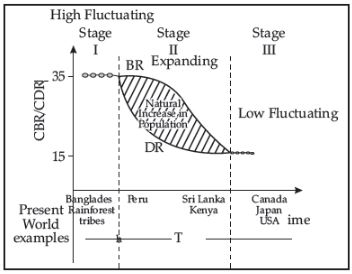
Question. How does the natural increase in population occur, as per the graph?
(a) Birth Rate – Death Rate
(b) Death Rate + Birth Rate
(c) Growth Rate – Birth Rate
(d) Birth Rate + Migration
Answer: B
Question. What does the transition from high fluctuating stage to low fluctuating stage indicate?
(a) Shift from Urban Industrial economy to Rural Agrarian economy
(b) Shift from Rural Agrarian economy to Urban Industrial economy
(c) Low Birth and Death Rate to High Birth and Death Rate
(d) Migration from Urban to Rural areas
Answer: B
Question. From the given graph, what condition can you infer about the developing countries?
(a) High Birth Rate and High Death Rate
(b) Low Birth rate and Low Death rate
(c) High Birth Rate and Low Birth Rate
(d) Low Birth Rate and High Death Rate
Answer: C
Question. In which stage of Demographic Transition,population explosion took place :
(a) Stage I
(b) Stage II
(c) Stage III
(d) Post Stage III
Answer: B
V. Study the given graph carefully and answer the following questions :
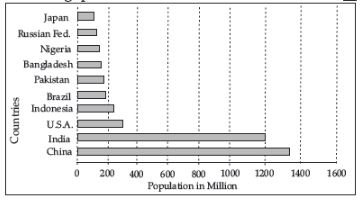
Question. Identify the Asian country with the maximum population.
(a) India
(b) China
(c) Pakistan
(d) USA
Answer: B
Question. Why is Japan’s population decreasing?
(a) No pull factors
(b) Terrorism
(c) Government policies
(d) Low fertility rate
Answer: D
Question. Why is Brazil sparsely populated?
(a) Due to climate
(b) Due to drug mafia
(c) Due to less land availability
(d) None of the Above
Answer: A
Question. Why is Asia the most populous continent?
(a) No contact with Western world
(b) Dictatorship
(c) No emigration allowed
(d) Rich in natural resources
Ans. Option (d) is correct.
Answer: B
VI. Study the given graph carefully and answer the following questions :
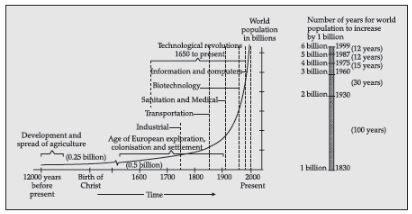
Question. Which of these periods closely represents the European explorations?
(a) 1 CE to 1600 CE
(b) 1500 CE to 1700 CE
(c) 1520 CE to 1900 CE
(d) 1650 CE to 1950 CE
Answer: C
Question. In how many years did world population increase from 4 billion to 5 billion?
(a) 12 years
(b) 15 years
(c) 30 years
(d) 100 years
Answer: A
Question. What is the speciality of the period 1650 CE to present?
(a) Development and spread of agriculture
(b) Colonialization
(c) Technological revolutions
(d) Transportation
Answer: C
Question. What was the approximate population of the world in 1600s?
(a) 0.25 billion
(b) 0.5 billion
(c) 0.75 billion
(d) 1 billion
Answer: B
Free study material for Geography
Download Practice Assignments: Class 12 Geography Fundamentals Of Human Geography Chapter 02 The World Population Distribution Density And Growth
Chapter Practice Questions for Class 12 Geography
Review targeted chapter assignments for Class 12 Geography Fundamentals Of Human Geography Chapter 02 The World Population Distribution Density And Growth. Built according to official CBSE guidelines, these downloadable problem sets help students build accuracy and prepare effectively for school tests.
Why Practice Class 12 Geography Assignments?
- Exam Alignment: Questions strictly follow contemporary CBSE sample papers and grading schemes.
- Comprehensive Coverage: Features objective drills, case studies, and structured descriptive problems for Fundamentals Of Human Geography Chapter 02 The World Population Distribution Density And Growth.
- Pacing & Precision: Regular problem-solving builds critical calculation speed and test-taking accuracy.
How to Approach Geography Fundamentals Of Human Geography Chapter 02 The World Population Distribution Density And Growth Assignments
- Concept Foundation: Review the NCERT book for Class 12 Geography thoroughly before diving into assignment tasks.
- Self-Evaluation: Solve exercises independently before inspecting professional answer guides.
- Progress Monitoring: Note down complex formulas or concepts, clearing them up using available online practice aids.
FAQs
You can download free PDF assignments for Class 12 Geography Fundamentals Of Human Geography Chapter 02 The World Population Distribution Density And Growth from StudiesToday.com. These practice sheets have been updated for the 2026-27 session covering all concepts from latest NCERT textbook.
Yes, our teachers have given solutions for all questions in the Class 12 Geography Fundamentals Of Human Geography Chapter 02 The World Population Distribution Density And Growth assignments. This will help you to understand step-by-step methodology to get full marks in school tests and exams.
Yes. These assignments are designed as per the latest CBSE syllabus for 2026. We have included huge variety of question formats such as MCQs, Case-study based questions and important diagram-based problems found in Fundamentals Of Human Geography Chapter 02 The World Population Distribution Density And Growth.
Practicing topicw wise assignments will help Class 12 students understand every sub-topic of Fundamentals Of Human Geography Chapter 02 The World Population Distribution Density And Growth. Daily practice will improve speed, accuracy and answering competency-based questions.
Yes, all printable assignments for Class 12 Geography Fundamentals Of Human Geography Chapter 02 The World Population Distribution Density And Growth are available for free download in mobile-friendly PDF format.