

Official CBSE Assignments for Class 12 Geography
Explore structured practice materials through the CBSE Class 12 Geography Human Development Assignment Set 01. Tailored for Class 12 learners, utilizing these Geography assignments ensures thorough preparation and strengthens foundational knowledge before final CBSE evaluations.
Solved Practice Assignments for Geography
View or download the dedicated CBSE Class 12 Geography Human Development Assignment Set 01 resource below. Engaging with these assignments under focused study conditions ensures continuous academic progress and mastery of the 2026-27 curriculum.
Growth and development
Growth and development both refer to changes over a period of time
Growth
- It is quantitative
- Value neutral
- May have positive or negative sign
- Change may be either positive[showing an increase] or negative[showing a decrease]
Development
- Qualitative change
- Always value positive
- Development occurs when there is positive change in quality
- Eg the population of a city grows from one lakh to two lakhs over a period of time then growth has taken place but if there is no improvement in facilities like housing and provision of basic services no development has taken place
Development
Earlier idea-
- measured in terms of economic growth.
- The bigger the economy of the country the more developed it was considered.
Present idea
Development aspects include
a. Quality of life people enjoy
b. The opportunities they have
c. Freedoms they enjoy
New idea of development given by
1.Dr. Mahbub- ul-Haq 2. Dr. Amartya Sen
The concept of human development was introduced by Dr Mahbub-ul-Haq
Human development =development that enlarges peoples choices and improves their lives and create conditions where people can live meaningful lives [life with some purpose]
Basic Goal of development
- To create conditions where people can live meaningful lives.
Important aspects of human development
1. Leading a long and healthy life
2. Being able to gain knowledge
3. Having enough means to be able to live a decent life
Key areas of human development
1. Access to resources
2. Health
3. Education
Pillars of human development
4 pillars
1. Equity
2. Sustainability
3. Productivity
4. Empowerment
Equity-
- refers to making equal access to opportunities available to everybody
- Opportunities available to people must be equal irrespective of gender, race income and caste
- Eg a large number of women and persons belonging to socially and economically backward groups drop out of school
Sustainability
- means continuity in the availability of opportunities
- To have sustainable human development each generation must have the same opportunities. So each generation must ensure the availability of choices and opportunities to its future generations
- Eg if a community does not stress the importance of sending its girl children to school many opportunities will be lost to these young women when they grow up
Productivity
- means human labour productivity or productivity in terms of human work
- Efforts to increase the knowledge of people or providing better health facilities to them ultimately leads to better work efficiency.
Empowerment
- means to have the power to make choices
- It comes from increasing freedom and capability
- Good governance and people oriented policies are required to empower people
APPROACHES TO HUMAN DEVELOPMENT
1. The income approach
- One of the oldest approaches to human development
- Human development is seen as being linked to income
- Level of income reflects the level of freedom an individual enjoys
- Higher the level of income the higher is the level of human development
2. The welfare approach
- This approach looks at human beings as beneficiaries or targets of all development activities
- Approach argues for higher government expenditure on education health social sector and amenities
- People are not participants in development but only passive recipients
- The government is responsible for increasing levels of human development by maximizing expenditure on welfare
3. Minimum[Basic] needs approach
- This approach was initially proposed by the international labour organisation
- Six basic needs- health, education, food, water supply, sanitation and housing
- The question of human choices is ignored
- Emphasis is on the provision of basic needs of defined sections
4. Capability approach
- This approach is associated with prof Amartya Sen
- Building human capabilities in the areas of health, education and access to resources is the key to increasing human development
Measuring human development
- The human development index ranks the countries based on their performance in the key areas of health, Education and access to resources
- Rankings are based on a score between 0 to 1
Health
- Indicator is life expectancy at birth
Education
- Adult literacy rate
- Gross enrolment ratio
Access to resources
- Measure in terms of purchasing power[US dollars]
- Each of these dimensions is given a 1/3 weightage
- The human development index is a sum total of the weights assigned to all these dimension
HDI
- Measures the attainments in human development
- Not a reliable measure as it does not say anything about distribution
HPI[human poverty index]
- Measures the shortfall in human development
- The probability of not surviving till the age of 40
- The adult illiteracy rate
- The no of people who do not have access to clean water
- The number of small children who are underweight
Both these measure together gives an accurate picture of the human development situation in a country
International comparisons
Based on HDI countries classified into four
- Very High
- High HDI
- medium HDI
- low HDI
HIGH HDI
- Lot of investment in social sector
- Good governance
- Former imperial powers
- Social diversity not high
MEDIUM HDI
- Adopting people oriented policies
- Reducing social discrimination
LOW HDI
- Political turmoil
- Civil war
- Famine
- High incidence of diseases
Question. Which is not the reason of low HDI?
a. Political Turmoil, Famine, Social Instability
b. Education, Good Governance, better healthcare
c. Civil war, social discrimination, political turmoil
d. None of these
Answer. b
Question. The shortfalls of human development include
a. underweight children
b. adult literacy
c. access to clean water
d. high life expectancy
Answer.b
Question. Arrange the countries from highest HDI to Lower HDI as per HDI report 2020
1. Norway
2. Ireland
3. Switzerland
4. Hongkong
a. 1-2-3-4
b. 2-3-1-4
c. 1-4-2-3
d. 1-3-4-2
Answer. a
Question. What is the range of measuring human development index?
a. 0 to 1
b. -1 to 1
c. 0 to -1
d. None of the above
Answer. a
Question. What is the weightage given to each indicator in the human development index?
a. 2/3
b. ½
c. 1/3
d. ¼
Answer. c
Question. The ……… is chosen as an indicator to assess health in Human development.
a. purchasing power
b. knowledge
c. vaccination level
d. life expectancy
Answer : D
Question. According to Dr Mahbub-ul-Haq which of the following means Human development?
a. Development which increase people’s incomes
b. Development which enlarges people’s choices
c. Development which makes people strong
d. Development which makes people smart
Answer : B
Question. Which of the following is sustainability in context of Human development?
a. Giving equal opportunities to all generations
b. Using natural resources widely
c. Continuity in the availability of resources
d. All of the above
Answer : D
Question. In the Human Development Report, 2018, how many countries are there in the very high category of Human Development?
a. 65
b. 59
c. 53
d. 35
Answer : B
Question. Which of the following is the earliest approach to human development?
a. Welfare approach
b. Income approach
c. Basic needs approach
d. Capabilities approach
Answer : B
Question. Which of the following pairs is not correctly matched?
a. Equity- It refers to making equal access to opportunities available to everybody.
b. Sustainability – It means continuity in the availability of opportunities.
c. Accessibility- It means human labour productivity or productivity in terms of human work.
d. Empowerment – It means to have the power to make choices.
Answer : C
Question. Which of the following steps can be taken to improve the level of human development?
a. Increasing literacy levels
b. Providing health facilities
c. Having more enrolment ratio
d. All of the above
Answer : D
Question. Who publishes the Human Development Report (HDR) annually?
a. United Nations Development Programme [UNDP]
b. Amnesty International
c. World Bank
d. International Monetary Fund
Answer : A
Question. What is the rank of India in the Human Development Report, 2018?
a. 135
b. 132
c. 130
d. 129
Answer : C
Question. Which of the following is not one of the four pillars of Human Development?
a. Equity
b. Sustainability
c. Accessibility
d. Productivity
Answer : C
Question. Countries having Lower Human development can be characterised by which of the following
a. Political Turmoil
b. More spending on defence
c. Social unrest
d. All of the above
Answer : D
Question. Which country officially uses “Gross Happiness Index” [GHI] as the measure of the country’s progress?
a. Nepal
b. Tibet
c. Bhutan
d. Singapore
Answer : C
Question. Development of a few regions by individuals brought about in a short span of time leads to
a. Malnutrition
b. Poverty
c. Ecological degradation
d. All of these
Answer : D
Question. Which of the following indicators is not used to measure Human Development in HDI?
a. Purchasing Power
b. Gross Enrolment
c. Vaccination
d. Life Expectancy
Answer : C
Question. Which pillar of Human Development stresses on opportunities for future generations?
a. Equity
b. Empowerment
c. Sustainability
d. Productivity
Answer : C
Question. Which of the following are the characteristics of the countries with high level of human development?
a. More investment in the social sectors
b. Freedom from Political turmoil and instability
c. Distribution of resources is equitable
d. a, b and c are correct
Answer : D
Question. The idea of Human development gives ……… a central position in the process of development.
a. income
b. health
c. people
d. education
Answer : C
Question. Which of the following is not a pillar of human development?
a. Equity
b. Equality
c. Sustainability
d. Empowerment
Answer : B
Question. What is the rank of India in the Human Development Report 2020?
a. 125
b. 135
c. 129
d. 131
Answer : D
Question. Which of the following is not a pillar of Human Development?
a. Equity
b. Productivity
c. Equality
d. Sustainability
Answer : C
Question. ‘Minimum Needs Approach’ was proposed by which organisation?
a. UNDP
b. World Bank
c. UNICEF
d. International Labour Organisation [ILO]
Answer : D
Question. The most important aspects of human lives are
a. Access to health
b. Access to education
c. Access to Resources
d. All of these
Answer : B
Question. Arrange the following according to their rank in HDR 2020 (Highest to lowest).
1. Norway
2. Australia
3. Germany
4. Iceland
Codes
a. 1, 4, 3, 2
b. 3, 4, 2, 1
c. 3, 2, 1, 4
d. 2, 4, 1, 3
Answer : A
Question. Match the following.
Column I Column II
(Countries) (Rank in HDI 2020)
A. Norway 1. 1st
B. Ireland 2. 2nd
C. Switzerland 3. 3rd
D. Hongkong, (China) SAR 4. 4th
E. Iceland 5. 5th
F. Germany 6. 6th
Codes
A B C D E
a. 1 2 3 4 5 6
b. 6 5 4 3 2 1
c. 3 4 5 2 1 6
d. 2 3 6 5 4 1
Answer : A
Question. Match the following.
Column I Column II
(Levels in HDI) (No. of countries in HDI 2020)
A. Very High Level 1. 66
B. High Level 2. 53
C. Medium 3. 37
D. Low Level 4. 33
Codes
A B C D
a. 1 2 3 4
b. 4 3 2 1
c. 3 4 2 1
d. 4 1 3 2
Answer : A
Question. Consider the following points, evaluate them and choose the correct option
I. If a community does not stress the importance of sending its girl children to school, many opportunities will be lost to these young women when they grow up. Their career choices will be severely curtailed and this would affect other aspects of their lives.
II. Each generation must ensure the availability of choices and opportunities to its future generations.
a. Both statements are true, statement 2 does not explain statement 1 correctly
b. Statements 1 is true but statement 2 is false and statement 2 does not explains the statement 1
c. Both statements 1 and 2 are wrong.
d. Both Statements are correct and related to each other
Answer.d
Question. Increasing freedom is also one of the most effective ways of bringing about development’, who put this idea of development?
Answer. Prof.Amartya Sen
Question. Name the scholar who introduced the concept of human development.
Answer. Dr. Mahbub-ul-Haq
Question. Examine the concept of ‘human development’ as introduced by Mahbub-ul-Haq.
Answer. Human development is described as development that enlarges people’s choices and improves their lives and create conditions where people can live meaningful lives [life with some purpose]
Question. What is human development? Explain with examples the four pillars of human development in the world.
Answer. Human development is described as development that enlarges people’s choices and improves their lives and create conditions where people can live meaningful lives [life with some purpose]
The four pillars of development are
Equity-
- refers to making equal access to opportunities available to everybody
- Opportunities available to people must be equal irrespective of gender, race income and caste
- Eg a large number of women and persons belonging to socially and economically backward groups drop out of school
Sustainability
- means continuity in the availability of opportunities
- To have sustainable human development each generation must have the same opportunities. So each generation must ensure the availability of choices and opportunities to its future generations
- Eg if a community does not stress the importance of sending its girl children to school man opportunities will be lost to these young women when they grow up
Productivity
- means human labour productivity or productivity in terms of human work
- Efforts to increase the knowledge of people or providing better health facilities to them ultimately leads to better work efficiency
Empowerment
- means to have the power to make choices
- It comes from increasing freedom and capability
- Good governance and people oriented policies are required to empower people
Question. Explain the basic needs approach to human development of the world.
Answer.
- This approach was initially proposed by the international labour organisation
- Six basic needs- health, education, food, water supply, sanitation and housing
- The question of human choices is ignored
- Emphasis is on the provision of basic needs of defined sections
Question. ‘‘The Gross National Happiness is the measure of the country’s progress.’’ Evaluate the statement
Answer.
- Bhutan is the only country in the world to officially proclaim the Gross National Happiness (GNH) as the measure of the country’s progress.
- Material progress and technological development are approached cautiously taking into consideration the possible harm to the environment, culture and spiritual life
- GNH encourages to think of spiritual, non-material and qualitative aspects of development
Question. How are countries classified on the basis of human development index?
Answer. Countries can be classified into four groups on the basis of the human development scores earned by them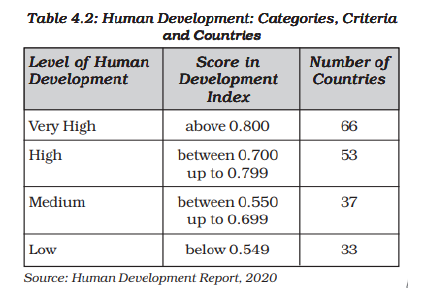
Question. Analyse any three features of countries with medium levels of human development.
Answer.
- Most of these countries have emerged in the period after the Second World War.
- Some countries from this group were former colonies.
- Many others have emerged after the breakup of the erstwhile Soviet Union in 1990.
- To improve their human development score many of these countries are adopting more people-oriented policies and reducing social discrimination.
- Most of these countries have a much higher social diversity
- Many in this group have faced political instability and social uprising.
Question 1. Who introduced the concept of Human development?
Answer: Dr. Mahboob ul Haque
In simple words: Dr. Mahboob ul Haque introduced the concept of human development, which focuses on expanding human choices rather than just economic growth.
Exam Tip: Remember key personalities and their contributions for 1-mark objective questions.
Question 2. Write four pillars of the human development.
Answer: The four pillars of human development are:
1. Equity
2. Sustainability
3. Productivity
4. Empowerment
In simple words: These four principles form the foundation for supporting and measuring human development globally.
Exam Tip: Memorize all four pillars accurately as they frequently appear in both short and long answer questions.
Question 3. Expand I.L.O.
Answer: International Labour Organisation.
In simple words: I.L.O. stands for the International Labour Organisation, a specialized agency of the United Nations.
Question 4. Expand U.N.D.P.
Answer: United Nations Development Programme.
In simple words: U.N.D.P. stands for United Nations Development Programme, which publishes the annual Human Development Report.
Exam Tip: Note the correct spelling of Programme (with 'me') as used in international organizations.
Question 5. Which countries has the highest human development index?
Answer: Norway
In simple words: Norway consistently ranks at the top of the Human Development Index (HDI) globally.
Exam Tip: Keep track of top-ranking countries in global indices as per current reports.
Question 6. What is the place of India in HDI of the world?
Answer: 127th
In simple words: India holds the 127th rank in the global Human Development Index according to the reference data.
Exam Tip: India's rank is an important data point for questions related to national and international comparisons.
Question 7. How many countries come under High HDI category?
Answer: 57
In simple words: As per the report classification, 57 countries fall under the high human development category.
Exam Tip: Memorize key statistical figures regarding country groupings in HDI.
Question 8. In which year was the first HD report published by UNDP?
Answer: 1990
In simple words: The United Nations Development Programme published its very first Human Development Report in the year 1990.
Exam Tip: Chronological dates like the inception of the HD report are vital for board exams.
Question 9. Write any two components of HD.
Answer: Education and Health
In simple words: Health and education are two fundamental components used to measure human development.
Exam Tip: The three core components are health, education, and access to resources; you can choose any two when asked.
Question 10. What is the basic goal of human development? Explain with examples the four pillars of human development.
Answer: The basic goal of development is to create conditions where people can live meaningful lives.
The four pillars of human development are:
- Equity: It refers to providing equal access to opportunities available to everybody irrespective of their gender, race, income, and caste.
- Sustainability: Sustainability means continuity in the availability of opportunities for sustainable human development.
- Productivity: It refers to human labour productivity in terms of human work. It must be constantly enriched by building capabilities in people.
- Empowerment: It means to have the power to make choices. Such power comes from increasing freedom and capabilities, good governance, and people-oriented policies, so as to empower people.
In simple words: Human development aims to give people fulfilling lives through equity, sustainability, productivity, and empowerment.
Exam Tip: For long-answer questions, define the core goal first and then list all four pillars with brief explanations.
Question 11. Define human development? Describe the various approaches to Human development.
Answer: Human development is a process of enlarging the range of people's choices, increasing their opportunities for education, health care, income, and empowerment and covering the full range of human choices from a sound physical environment to economic, social, and political freedom.
Approaches to Human Development:
(1) Income Approach - The level of income reflects the level of freedom an individual enjoys. Higher the level of income, the higher is the level of human development.
(2) Welfare Approach - This approach argues for higher government expenditure on education, health, social secondary, and amenities. The government is responsible for increasing levels of human development by maximising expenditure on welfare.
(3) Basic Needs Approach - The emphasis is on provision of basic needs of defined sections. Six basic needs were identified - health, education, food, water supply, sanitation, and housing.
(4) Capability Approach - Building human capabilities in the areas of health, education, and access to resources is the key to increasing human development.
In simple words: Human development expands choices, and different approaches focus on income, welfare, basic needs, or human capabilities to achieve it.
Question 12. Name four countries having high human development index. Discuss three reasons for high human development index.
Answer: Four countries with high human development index:
(1) Norway
(2) Iceland
(3) Australia
(4) Luxembourg
Reasons for high HDI:
- Investment more in the Social Sector (education, health care)
- Good governance
- Free from political turmoil and instability
In simple words: High HDI countries excel due to heavy social sector investments, stable governance, and peace.
Exam Tip: Pair examples of countries with their structural socio-economic factors for complete marks.
Question 13. Name any four countries having low human development index. Discuss three reasons for low human development index.
Answer: (1) Nigeria
(2) Sierra Leone
(3) Burkina Faso
(4) Mali
Reasons for low HDI:
- Political turmoil.
- Social instability (civil war).
- Famine.
- High incidence of diseases.
In simple words: Low HDI countries struggle due to political instability, conflicts, famine, and health crises.
Exam Tip: Highlight socio-political and economic challenges as the primary drivers of low human development.
Question 14. Discuss in detail about the alternative view of development given by Dr. Mahbub-ul haq and Prof. Amartya Sen.
Answer: For many decades, a country's level of development was measured only in terms of its economic growth.
The idea that the quality of life people enjoy in a country, the opportunities they have, and freedoms they enjoy are important aspects of development now and the works of Mahbub-ul-Haq and Amartya Sen are important in this regard.
- According to Haq - development is all about enlarging people's choices in order to lead long, healthy lives with dignity. The basic goal of development is to create conditions where people can live meaningful lives.
- Prof. Amartya Sen saw an increase in freedom or decrease in unfreedom as the main objective of development.
- The works of these economists are path breaking and have succeeded in bringing people to the centre of any discussion on development.
In simple words: Haq and Sen shifted the focus of development from pure economic growth to human choices and freedom.
Exam Tip: Mention both economists separately: Haq emphasized expanding choices, while Sen focused on building freedom.
Question 15. What are the three parameters of HDI.
Answer: (1) Health (2) Education (3) Access to resources.
In simple words: The Human Development Index is measured using health, education, and resource access.
Exam Tip: Keep this 3-point list ready as it is a core concept in geography and economics.
Question 16. Which country has given the recognition of Gross National Happiness country in the world?
Answer: Bhutan
In simple words: Bhutan pioneered Gross National Happiness as an alternative metric to measure national progress.
Exam Tip: Associate Bhutan instantly with Gross National Happiness (GNH).
Question 17. Why does the particular region of the world keep reporting low or High levels of human development? Explain by giving suitable examples?
Answer: Countries advanced in the three key areas i.e. health, education, and access to resource are having high level of human developed such as U.S.A, Japan etc. The countries lagging being in the above mentioned three key areas are having low level of human development such as Nigeria.
In simple words: Regional disparities exist because advanced countries successfully invest in health, education, and resources, while lagging regions face continuous barriers.
Exam Tip: Contrast developed regions with developing regions using the three parameters of HDI.
Free study material for Geography
CBSE Class 12 Geography Assignments for Fundamentals Of Human Geography Chapter 03 Human Development
Class 12 Geography Fundamentals Of Human Geography Chapter 03 Human Development Printable Assignments
Explore reliable practice questions for Fundamentals Of Human Geography Chapter 03 Human Development tailored for Class 12 learners. Use these structured worksheets to evaluate preparedness and strengthen core problem-solving skills.
Key Advantages of Solving Fundamentals Of Human Geography Chapter 03 Human Development Assignments
- Exam Alignment: Questions strictly follow contemporary CBSE sample papers and grading schemes.
- Comprehensive Coverage: Features objective drills, case studies, and structured descriptive problems for Fundamentals Of Human Geography Chapter 03 Human Development.
- Pacing & Precision: Regular problem-solving builds critical calculation speed and test-taking accuracy.
How to Approach Geography Fundamentals Of Human Geography Chapter 03 Human Development Assignments
- Initial Reading: Begin by reading the NCERT book for Class 12 Geography to build a baseline understanding.
- Independent Testing: Attempt assignment questions unassisted, then verify work using provided answer keys.
- Supplementary Aids: Leverage revision notes and worksheets whenever you encounter difficult topics.
FAQs
You can download free PDF assignments for Class 12 Geography Fundamentals Of Human Geography Chapter 03 Human Development from StudiesToday.com. These practice sheets have been updated for the 2026-27 session covering all concepts from latest NCERT textbook.
Yes, our teachers have given solutions for all questions in the Class 12 Geography Fundamentals Of Human Geography Chapter 03 Human Development assignments. This will help you to understand step-by-step methodology to get full marks in school tests and exams.
Yes. These assignments are designed as per the latest CBSE syllabus for 2026. We have included huge variety of question formats such as MCQs, Case-study based questions and important diagram-based problems found in Fundamentals Of Human Geography Chapter 03 Human Development.
Practicing topicw wise assignments will help Class 12 students understand every sub-topic of Fundamentals Of Human Geography Chapter 03 Human Development. Daily practice will improve speed, accuracy and answering competency-based questions.
Yes, all printable assignments for Class 12 Geography Fundamentals Of Human Geography Chapter 03 Human Development are available for free download in mobile-friendly PDF format.