

Class 12 Geography Practice Assignments: CBSE Class 12 Geography Migration Assignment Set 02
Access comprehensive school assignments for India People And Economy Chapter 02 Migration Types Causes And Consequences using the CBSE Class 12 Geography Migration Assignment Set 02. Designed to align with the 2026-27 CBSE academic guidelines, these practice sets help Class 12 Geography students reinforce core concepts and improve their problem-solving accuracy.
Download India People And Economy Chapter 02 Migration Types Causes And Consequences Assignment PDF with Solutions
Access the complete assignment PDF for Class 12 Geography below. Regular practice with these targeted academic tasks builds familiarity with standard question patterns and helps secure higher marks in final school evaluations.
I. Study the given graph showing causes of migration of male population in India carefully and answer the following questions:
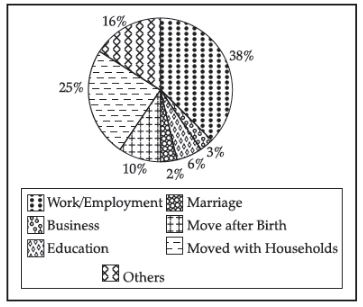
Question. What is the most common reason for male migration in India?
(a) Marriage
(b) Business
(c) Education
(d) Work/Employment
Answer: D
Question. What percentage of male population migrates with households?
(a) 2%
(b) 3%
(c) 25%
(d) 38%
Answer: C
Question. What ratio of male students migrate for educational purposes?
(a) 6:100
(b) 10:100
(c) 2:100
(d) 25:100
Answer: A
Question. Which of these can be one of the reasons for male migration covered under the category ‘Others’?
(a) Better employment opportunities
(b) Family reasons
(c) Environmental degradation
(d) In pursuit of higher studies
Answer: C
II. Read the case study given below and answer the questions that follow:
The major benefit for the source region is the remittance sent by migrants. Remittances from the international migrants are one of the major sources of foreign exchange. In 2002, India received US$ 11 billion as remittances from international migrants. Punjab, Kerala and Tamil Nadu receive very significant amount from their international migrants. The amount of remittances sent by the internal migrants is very meagre as compared to international migrants, but it plays an important role in the growth of economy of the source area.
Remittances are mainly used for food, repayment of debts, treatment, marriages, children’s education, agricultural inputs, construction of houses, etc. For thousands of the poor villages of Bihar, Uttar Pradesh, Odisha, Andhra Pradesh,Himachal Pradesh, etc. remittance works as life blood for their economy. Migration from rural areas of Eastern Uttar Pradesh, Bihar, Madhya Pradesh and Odisha to the rural areas of Punjab,Haryana, Western Uttar Pradesh accounted for the success of their green revolution strategy for agricultural development. Besides this, unregulated migration to the metropolitan cities of India has caused overcrowding. Development of slums in industrially developed states such as Maharashtra,Gujarat, Karnataka, Tamil Nadu and Delhi is a negative consequence of unregulated migration within the country.
Question. What is the major benefit that the source regions receive from the migrants?
(a) Medical aid
(b) Agricultural products
(c) Remittance
(d) Educational aid
Answer: C
Question. How much remittance did India receive in 2002 from international migrants?
(a) US$ 10 billion
(b) US$ 11 billion
(c) US$20 billion
(d) US$ 22 billion
Answer: B
Question. Give an example of uses of remittance.
(a) Repayment of debt
(b) Marriage
(c) Children’s education
(d) All of the Above
Answer: D
Question. Remittances appear to be responsive to income __________ .
(a) shortfalls
(b) boost
(c) outflow
(d) All of the Above
Answer: A
III. Read the case study given below and answer the questions that follow:
The internal migration (within the country) and international migration (out of the country and into the country from other countries)are presented under the internal migrants. The stream was dominated by female migrants. Most of these were migrants related to marriage part from these streams of internal migration. India also experiences immigration from and emigration to the neighbouring countries. Indian Census 2011 has recorded that more than 5 million persons have migrated to India from other countries.Out of these, about 88.9 percent came from the neighbouring countries: Bangladesh followed by Nepal and Pakistan.
Question. Internal migration refers to :
(a) Migration outside the country
(b) Migration outside the state
(c) Migration inside the country
(d) Migration inside the state
Answer: C
Question. Internal migration is also known as :
(a) Domestic migration
(b) International migration
(c) Rural migration
(d) Urban migration
Answer: A
Question. According to Indian Census 2011, more than _______million persons have migrated to India from other countries.
(a) 4
(b) 5
(c) 6
(d) 7
Answer: B
Question. Out of the total migration, people migrated to India from Nepal, Bangladesh and Pakistan.
(a) 67%
(b) 79.9%
(c) 88.9 %
(d) None of the Above
Answer: B
IV. Read the case study given below and answer the questions that follow:
During colonial period (British period) millions of the indentured labourers were sent to Mauritius, Caribbean islands (Trinidad, Tobago and Guyana),Fiji and South Africa by British from Uttar Pradesh and Bihar; to Reunion Island, Guadeloupe,Martinique and Surinam by French and Dutch and by Portuguese from Goa, Daman and Diu to Angola,Mozambique to work as plantation workers. All such migrations were covered under the timebound contract known as Girmit Act (Indian Emigration Act). However, the living conditions of these indentured labourers were not better than the slaves.
The second wave of migrants ventured out into the neighbouring countries in recent times as professionals, artisans, traders and factory workers, in search of economic opportunities to Thailand,Malaysia, Singapore, Indonesia, Brunei and African countries, etc. and the trend still continues. There was a steady outflow of India’s semi-skilled and skilled labour in the wake of the oil boom in West Asia in the 1970s. There was also some outflow of entrepreneurs, store owners, professionals, businessmen to Western countries.Third wave of migrants was comprised of professionals like doctors, engineers (1960s onwards), software engineers, management consultants, financial experts, media persons (1980s onwards), and others migrated to countries such as USA, Canada, UK, Australia, New Zealand and Germany. These professionals enjoy the distinction of being one of highly educated, the highest earning and prospering groups. After liberalisation, in the 90s education and knowledge–based Indian emigration has made Indian Diaspora one of the most powerful diasporas in the world. In all these countries, Indian diaspora has been playing an important role in the development of the respective countries.
Question. Under the provisions of which Act were the labourers emigrated from India to other European colonies?
(a) Girmit Act
(b) Girhit Act
(c) Indian Migration Act
(d) Indian Immigration Act
Answer: A
Question. Who sent the Indian labourers from Goa to Mozambique?
(a) British
(b) French
(c) Dutch
(d) Portuguese
Answer: D
Question. Which of these migrated from India during the second wave?
(a) Doctors
(b) Financial experts
(c) Artisans
(d) Software engineers
Answer: C
Question. When did the knowledge-based Indian migrate from India?
(a) 1960s
(b) 1970s
(c) 1980s
(d) 1990s
Answer: D
Question. Which of these is not a part of Caribbean Islands?
(a) Trinidad
(b) Tobago
(c) Guyana
(d) Fiji
Answer: D
Question. The living conditions of the indentured labourers resembled those of:
(a) Kings
(b) Tradesmen
(c) Slaves
(d) None of these
Answer: C
Question. Which of these events happened in West Asia in 1970s?
(a) Oil boom
(b) Work boom
(c) Brain drain
(d) Imperialism
Answer: A
Question. Which of these countries was a destination for migrants in the second wave?
(a) Australia
(b) Canada
(c) Singapore
(d) Germany
Answer: C
V. Study the given graph showing causes of migration of male population in India carefully and answer the following questions:
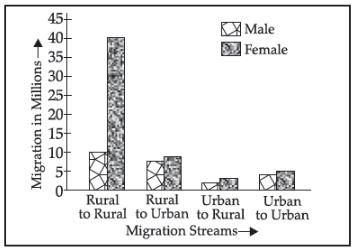
Intra state migration by place of last residence indicating migration steams (Duration 0-9 year)
Question. Which migration stream shows the highest number of migration both male and female categories?
(a) Rural to Urban
(b) Urban to Rural
(c) Rural to Rural
(d) Urban to Urban
Answer: C
Question. Why does female category show the highest migration in both the categories?
(a) Education
(b) Marriage
(c) Medical aids
(d) Employment
Answer: B
Question. Female migrants dominates which stream of migration?
(a) Move with household
(b) Better opportunities
(c) Marriage
(d) All of the Above
Answer: D
Question. Intra state migration means:
(a) Migration to another state
(b) Migration within the state
(c) Migration to another district
(d) None of the Above
Answer: B
Question. How many types of migration takes place in India?
(a) Rural to Rural
(b) Rural to Urban
(c) Urban to Urban
(d) All of the Above
Answer: D
Question. What is the common feature shown among all the migration streams?
(a) Dominance of rural migration
(b) Dominance of female migration
(c) Dominance of male migration
(d) Dominance of male and female migration
Answer: B
Question. In which stream is the number of female migrants the highest?
(a) Rural to urban
(b) Urban to rural
(c) Urban to urban
(d) Rural to rural
Answer: D
Question. Give the main reason for Q. 3.
(a) Marriage
(b) Job transfer
(c) Medical facilities
(d) None of the Above
Answer: A
Free study material for Geography
Chapter Assignment & Practice Material for Class 12 Geography India People And Economy Chapter 02 Migration Types Causes And Consequences
Download Assignment: India People And Economy Chapter 02 Migration Types Causes And Consequences (Class 12 Geography)
Access structured practice assignments for India People And Economy Chapter 02 Migration Types Causes And Consequences designed in alignment with the latest CBSE curriculum for Class 12 Geography. These printable sets cover objective and descriptive problem types to support thorough revision.
Maximize Exam Scores with Chapter Practice Sets
- Curriculum Standards: Assignments match modern CBSE sample formats to ensure relevant preparation.
- Thorough Revision: Detailed problem sets reinforce core concepts and eliminate conceptual weak spots.
- Execution Speed: Timed practice with assignment sets sharpens overall response timing.
Steps to Complete India People And Economy Chapter 02 Migration Types Causes And Consequences Assignments Successfully
- Textbook Review: Always study the core NCERT book for Class 12 Geography prior to beginning the assignment.
- Independent Attempt: Solve India People And Economy Chapter 02 Migration Types Causes And Consequences questions on your own initially before cross-checking with expert solutions.
- Error Tracking: Record challenging concepts in a dedicated notebook and practice online MCQ tests for revision.
FAQs
You can download free PDF assignments for Class 12 Geography India People And Economy Chapter 02 Migration Types Causes And Consequences from StudiesToday.com. These practice sheets have been updated for the 2026-27 session covering all concepts from latest NCERT textbook.
Yes, our teachers have given solutions for all questions in the Class 12 Geography India People And Economy Chapter 02 Migration Types Causes And Consequences assignments. This will help you to understand step-by-step methodology to get full marks in school tests and exams.
Yes. These assignments are designed as per the latest CBSE syllabus for 2026. We have included huge variety of question formats such as MCQs, Case-study based questions and important diagram-based problems found in India People And Economy Chapter 02 Migration Types Causes And Consequences.
Practicing topicw wise assignments will help Class 12 students understand every sub-topic of India People And Economy Chapter 02 Migration Types Causes And Consequences. Daily practice will improve speed, accuracy and answering competency-based questions.
Yes, all printable assignments for Class 12 Geography India People And Economy Chapter 02 Migration Types Causes And Consequences are available for free download in mobile-friendly PDF format.