

Official Class 10 Science Worksheets: Chapter 06 Control and Coordination
Explore reliable practice materials for Chapter 06 Control and Coordination tailored for Class 10 learners. Utilizing these Science worksheets ensures thorough preparation and strengthens problem-solving speed for upcoming school assessments.
Chapter-wise Practice Material: Chapter 06 Control and Coordination
Access the complete worksheet PDF for Chapter 06 Control and Coordination below. Regular practice with these targeted questions builds familiarity with standard exam patterns and helps secure higher marks in final Science evaluations.
Question. Which of the following acts as both endocrine and exocrine gland?
(a) Pancreas
(b) Thyroid
(c) Adrenal
(d) Liver
Answer : A
Question. Which of the following is not associated with growth of plant?
(a) Auxin
(b) Gibberellins
(c) Cytokinins
(d) Abscisic acid
Answer : D
Question. A student accidentally places her hand on a flame of candle and quickly pulls her hand away. The flame represents
(a) a response
(b) a stimulus
(c) an impulse
(d) an effector
Answer : B
Question. How many pairs of cranial nerves are present in man?
(a) 12
(b) 21
(c) 31
(d) 41
Answer : A
Question. Main function of cerebrum is
(a) thinking
(b) hearing
(c) memory
(d) balancing
Answer : A
Question. Which endocrine gland is also known as ‘master gland’?
(a) Pancreas
(b) Adrenal
(c) Pituitary
(d) Hypothalamus
Answer : C
Question. The main function of abscisic acid in plants is
(a) to promote cell division.
(b) to inhibit growth.
(c) to promote growth of stem.
(d) to increase the length of cells.
Answer : B
Question. Fall of mature leaves and fruits from plants is triggered by which of the following substance?
(a) Auxin
(b) Cytokinin
(c) Gibberellin
(d) Abscisic acid
Answer : D
Question. Any change in the environment to which an organism responds is called
(a) stimulus
(b) coordination
(c) response
(d) hormone
Answer : A
Question. Which nerves transmit impulses from the cen¬tral nervous system towards muscle cells?
(a) Sensory nerves
(b) Motor nerves
(c) Relay nerves
(d) Cranial nerves
Answer : B
Question. A microscopic gap between a pair of adjacent neurons over which nerve impulses pass is called
(a) neurotransmitter
(b) dendrites
(c) axon
(d) synapse
Answer : D
Question. Movement of sunflower in accordance with the path of Sun is due to
(a) Chemotropism
(b) Geotropism
(c) Phototropism
(d) Hydrotropism
Answer : C
Question. The highest coordinating centre in the human body is
(a) spinal cord
(b) heart
(c) brain
(d) kidney
Answer : C
Question. Which of the following statements is correct about receptors?
(a) Gustatory receptors detect taste while olfactory receptors detect smell
(b) Both gustatory and olfactory receptors detect smell
(c) Auditory receptors detect smell and olfactory receptors detect taste
(d) Olfactory receptors detect taste and gustatory receptors smell
Answer : A
(a) Both the Assertion and the Reason are correct and the Reason is the correct explanation of the Assertion.
(b) The Assertion and the Reason are correct but the Reason is not the correct explanation of the Assertion.
(c) Assertion is true but the Reason is false.
(d) The statement of the Assertion is false but the Reason is true.
Question. Assertion: Brain is a delicate organ which is protected from injury.
Reason: The bony box protects the brain from any shock.
Answer : C
Question. Assertion: Plants do have a nervous system for control and coordination.
Reason: Plants use electro chemical means to convey information from cell to cell.
Answer : D
Question. Assertion: Reflex Arc works faster than thinking process of brain.
Reason: Reflex Arc works in case of those animals who donot have thinking process.
Answer: C
Question. Assertion: Impulse travels from dendrite to cell body and then along the axon to its end.
Reason: Information acquired at the end of the dendrite tip of a nerve cell sets of an electric impulse.
Answer : A
Question. Assertion: On attaining puberty, breast size increases and reproductive organs develop in females.
Reason: Ovaries release hormone proges-terone in female.
Answer : B
True and False :
Question. Plants coordinate their behaviour against environmental changes by using plant hormones.
Answer: True
Question. The reaction to stimuli is a characteristic property of animals only.
Answer: False
Question. Iodine is essential for the synthesis of thyroxine.
Answer: True
Question. The hormone which is associated with female puberty is called testosterone.
Answer: False
Question. The job of the central nervous system is to collect all the information from all the receptors in our body
Answer: True
Fill in the Blanks :
Question. Control and coordination are the functions of the nervous system and ……… in our body.
Answer: hormones
Question. The nervous system uses ……… impulses to transmit messages.
Answer: electrical
Question. The cells in our body that can be over a foot long are ____________ .
Answer: nerve cells
Question. The box enclosing the brain is called the ____________ .
Answer: cranium
Question. The lobes — parietal, temporal, frontal and occipital belong to ____________ .
Answer: cerebrum
Question. In a neuron, conversion of electrical signal to a chemical signal occurs at/in ____________ .
Answer: axonal end
AR TYPE QUESTIONS
Following questions consist of two statements – Assertion (A) and Reason (R). Answer these questions selecting the appropriate option given below:
(a) Both A and R are true and R is the correct explanation of A.
(b) Both A and R are true but R is not the correct explanation of A.
(c) A is true but R is false.
(d) A is false but R is true.
Question. Assertion(A): A growing plant appears to bend towards the direction of light
Reason (R) : The plant hormone auxin diffuses towards the shady side of the root.
Answer : A
Question. Assertion(A) : The brain is also known as the central nervous system.
Reason (R) : Central nervous system controls and regulates the voluntary actions.
Answer : D
Question. Assertion(A): The effect of auxin hormone on the growth of root is exactly opposite to that on a stem.
Reason (R) : Auxin hormone increases the rate of growth in root and decreases the rate of growth in stem
Answer : C
Question. Assertion(A) : Plants lack a nervous system, but they do coordinate.
Reason (R) : It is so because of hormones
Answer : A
Question. Assertion(A): A receptor is a specialized group of cells in a sense organ that perceive a particular type of stimulus.
Reason (R) : Different sense organs have different receptors for detecting stimuli.
Answer : B
Question. Name the place of the human body where largest number of neurons are found.
Answer: Human brain.
Question. Which is the main coordinating centre of the body?
Answer: Brain.
Question. Why is pituitary called the master gland?
Answer: The pituitary gland controls the activity of other endocrine glands; so, it is called the master gland.
Question. Name the plant hormones which help/ promote
(a) cell division
(b) growth of the stem.
Answer: The plant hormones which help or promote:
(a) Cell division — Cytokinins
(b) Growth of the stem — Gibberellins
Question. What are the different parts of the human brain?
Answer: Three major parts namely fore-brain, mid-brain and hind-brain.
Question. A young green plant receives sunlight from one direction only. What will happen to its shoots and roots?
Answer: Shoots will bend towards the light and roots away from the light.
Question. Do you know which part of the brain you use to think?
Answer: Fore-brain.
Question. What are tropic movements?
Answer: The movement which a plant makes in response to an external stimulus is called tropic.
Question. Name one gland in human body which secretes digestive enzymes as well as hormones.
Answer: Pancreas
Question. If we step on something sharp accidently, we move our foot away at once. What type of response is it?
Answer: Reflex action.
Question. Mention one function for each of these hormones.
i) Thyroxine
ii) Insulin
iii) Estrogen
iv) Growth hormone
v) Testosterone.
Answer : (i) Thyroxin – Control overall metabolic rate of the body (carbohydrate, protein and fat metabolism)
(ii) Insulin – Conversion of glucose to glycogen in liver and muscles, thus decreases blood glucose level.
(iii) Estrogen – Development of female sex organ and secondary sexual characteristics like development of breast, pimples, shrill and a higher pitch voice
(iv) Growth hormone – Body growth and development of bones.
(v) Testosterone – Development of male sex organ and secondary sexual characteristics like moustache, beard & voice.
Question.
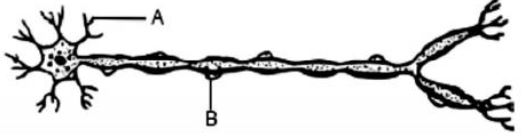
(i) Name the parts labelled A and B in the neuron drawn above.
(ii) Which part acquires the information in the neuron?
(iii) Through which part does the information travel?
(iv) In what form does this information travel?
(v) Where is the impulse converted into a chemical signal for onward transmission?
(b) How does nervous tissues cause action?
Answer : (a) (i) A – Dendrite, B – Axon
(ii) The information in the neuron is acquired at the end of the dendrite tip.
(iii) The information travels from the dendrite to the cell body and then along the axon to its end.
(iv) The information travels in the form of an impulse.
(v) The impulse is converted into a chemical signal at the end of the axon.
(b) Refer flow chart given in study material
Question. Smita’s father was complaining about frequent urination, pain in legs and a frequent
weight loss to Smita’s mother and she discussed the things with her daughter when Smita
returned from school. Listening to this Smita told her mother that her father should go
and visit a doctor immediately. The doctor diagnosed that Smita’s father was having an elevated level of blood glucose. He should take care of his diet and should exercise regularly to maintain his normal glucose level.
On the basis of the text, answer the following questions:
(i) Name the disease he is suffering from and name the hormone whose deficiency causes it.
(ii) Identify the gland that secretes it and mention the function of this hormone.
(iii) Explain how the time and amount of secretion of this hormone is regulated in human system.
Answer : (i) Disease-Diabetes, Hormone: Insulin
(ii) Gland-Pancreas: The blood glucose level is regulated by insulin hormone secreted by the pancreas.
(iii) Feedback Mechanism - Cells of pancreas secrete insulin hormone when level of blood glucose level increases in the blood. Insulin regulates the blood glucose level and
its secretion gets reduced when blood glucose level falls down.
Question. a) Name chemical messenger of endocrine glands responsible for changes taking place in the body
b) Mention the gland which produces adrenalin and write its function
c) Name two phytohormones
Answer : a) Hormone
b) Adrenal gland
During the situation of fight or flight, secretion of this hormone causes -
i. increases the blood pressure.
ii. increases heart beat rate.
iii. increases breathing rate.
iv. diverts blood to essential organs including the heart, brain and skeletal muscles by dilating their blood vessels and constricting those of less essential organs, such as the skin and digestive system.
c) auxin & gibberrellin
Free study material for Science
Practice Worksheet and Study Resources for Class 10 Science Chapter 06 Control and Coordination
Chapter 06 Control and Coordination Printable Worksheet for Class 10 Science
Review targeted practice exercises for Class 10 Science Chapter 06 Control and Coordination. Curated to match official CBSE guidelines, these downloadable PDF sheets support daily revision and core concept reinforcement.
How to Use These Practice Sheets
Each worksheet is structured around standard CBSE textbooks, allowing students to check their working steps and correct mistakes early in their revision.
Enhance Speed with Online Practice
Explore our broader library of printable assignments, chapter notes, and mock tests designed to support continuous revision and secure higher marks in CBSE assessments.
FAQs
You can download the teacher-verified PDF for CBSE Class 10 Biology Control and Coordination Worksheet Set 01 from StudiesToday.com. These practice sheets for Class 10 Science are designed as per the latest CBSE academic session.
Yes, our CBSE Class 10 Biology Control and Coordination Worksheet Set 01 includes a variety of questions like Case-based studies, Assertion-Reasoning, and MCQs as per the 50% competency-based weightage in the latest curriculum for Class 10.
Yes, we have provided detailed solutions for CBSE Class 10 Biology Control and Coordination Worksheet Set 01 to help Class 10 and follow the official CBSE marking scheme.
Daily practice with these Science worksheets helps in identifying understanding gaps. It also improves question solving speed and ensures that Class 10 students get more marks in CBSE exams.
All our Class 10 Science practice test papers and worksheets are available for free download in mobile-friendly PDF format. You can access CBSE Class 10 Biology Control and Coordination Worksheet Set 01 without any registration.